REVIEW 3 major objections 5 minor 39 references
RATE-Nav: Region-Aware Termination Enhancement for Zero-shot Object Navigation with Vision-Language Models
T0 review · 3 major / 5 minor · reviewed 2026-08-07 · deepseek-v4-flash
Pith's one-line read Terminating a region's search when a vision-language model judges the target very unlikely lifts zero-shot object navigation to 67.8% success on HM3D and 50.3% on MP3D.
desk verdict A genuinely new termination mechanism and strong benchmark numbers, but the empirical hygiene (no code, no seeds, no VLM false-negative rate) keeps this at 'needs revision' rather than 'accept as is'. read the letter →
The pith
A machine-rendered reading of the paper's core claim, the machinery that carries it, and where it could break.
The reading
What carries the argument
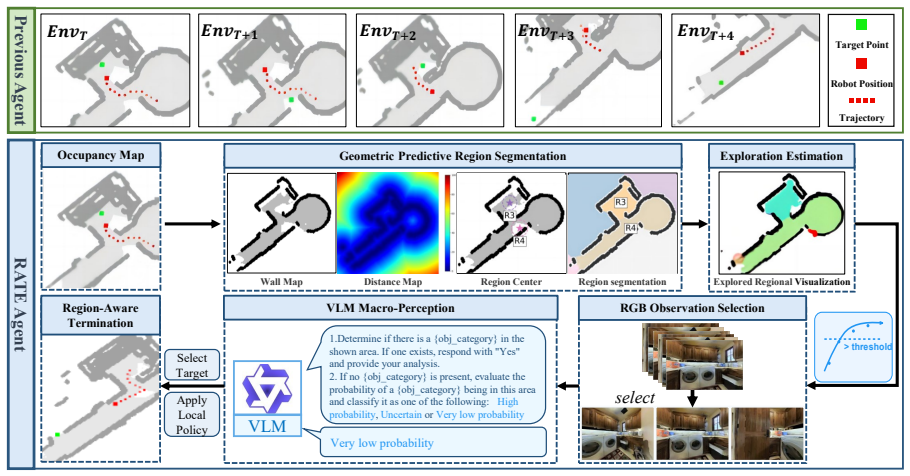
The load-bearing mechanism is the termination decision, built from three interacting pieces: Geometric Predictive Region Segmentation, a watershed algorithm seeded at local maxima of a distance transform of the wall map, which splits the environment into regions; Region-Based Exploration Estimation, which computes each region's exploration rate $r = |E \cap R_i| / |R_i|$ from the union of line-of-sight visible areas and traversable areas; and VLM Macro-Perception, which receives a filtered set of key frames once $r$ exceeds a threshold and returns one of High probability, Uncertain, or Very low probability. Only the 'Very low probability' verdict stops exploration of that region. The argument is carried by the threshold-and-verdict rule: the exploration rate tells the system when to consult the vision-language model, and the vision-language model tells the system when to quit.
What would settle it
Run the termination decision on episodes whose target region is known in advance, record the fraction of times the vision-language model returns 'Very low probability' for a region that actually contains the target at the triggering exploration rate of 0.7, and check whether that false-negative rate is substantial enough to undermine the reported success rates.
Extended reading notes
Core claim
The paper establishes that the marginal value of exploring a region falls as its exploration rate rises, so a rational agent should stop exploring a region when new information is unlikely to change the verdict on where the target is. RATE-Nav operationalizes this by segmenting the map into regions from wall geometry, computing an exploration rate per region as the fraction of its points that have been observed or traversed, and, when that rate exceeds a threshold of 0.7, asking a vision-language model to judge whether the target category could be in the region based on selected key frames. A 'very low probability' answer permanently deprioritizes the region, and a re-perception step double-checks apparent target detections. The paper reports that this pipeline reaches 67.8% success rate and 31.3% SPL on HM3D, and 50.3% success rate and 20.6% SPL on MP3D, outperforming the zero-shot baselines it compares against.
Load-bearing premise
The method stands on the vision-language model's 'Very low probability' verdict being accurate and appropriately calibrated; if the model says a region is hopeless when the target is actually there, the agent abandons the search and the episode fails.
Editorial extensions
If this is right
- Future object navigation systems can trade exhaustive search for a cheap perceptual check, improving both success and path efficiency.
- The region-level abstraction gives a natural interface for commonsense priors such as 'beds are not in living rooms', which the vision-language model exploits.
- The exploration-rate threshold becomes a tunable cost-benefit knob: lower thresholds save steps but risk abandoning target regions, while higher thresholds explore more but waste time.
- The method extends to open-set target categories because termination uses vision-language judgment rather than trained object classifiers.
- Re-perception of detected targets reduces false-positive goal detections, which matters for any vision-language-based navigator.
Reading between the lines
- One testable extension the authors leave implicit is collecting the false-negative rate of the 'Very low probability' verdict and using it to calibrate the termination threshold per object category.
- The diminishing-returns curve suggests a general principle: any search policy, not just object navigation, could use a stop rule based on marginal information gain, transferring the cost-benefit framing to other embodied tasks.
- Region segmentation currently depends on wall geometry; semantically defined regions could make vision-language judgments more reliable, but the paper does not test that variant.
- The reported gains on MP3D are large enough that a direct comparison of per-episode exploration steps would be a useful check on whether termination, rather than better perception, drives the improvement.
Editorial analysis
A structured set of objections, weighed in public.
Referee Report
Summary. RATE-Nav proposes a zero-shot object navigation method that terminates exploration of a region when a region-aware exploration rate exceeds a threshold and a VLM (Qwen-vl-max) judges the target object's presence as 'Very low probability'. The system is built on a Geometric Predictive Region Segmentation module (watershed on wall-distance maps), a Region-Based Exploration Estimation module, and VLM macro-perception with re-perception of detected targets. On HM3D the method reports SR 67.8% and SPL 31.3%; on MP3D, SR 50.3% and SPL 20.6%, outperforming prior zero-shot baselines. The paper motivates the approach through a marginal-utility analysis of exploration steps vs. exploration rate, and presents component ablations and a VLM case study.
Significance. If the reported numbers are reproducible, the paper makes a useful contribution: it introduces a concrete region-level termination mechanism that is fully zero-shot and demonstrates large gains over existing methods on HM3D and MP3D. The marginal-utility analysis in Section 3.1 is a valuable empirical observation, and the method is architecturally coherent. The ablations are directionally consistent, and the authors are candid about the simulator-only scope. However, three load-bearing issues—evaluation-set threshold selection, an unmeasured VLM false-negative rate for irreversible termination, and a confounded ablation of the termination module—mean that the central causal claim is not yet established at the level of the headline numbers. The paper would be a solid contribution after these points are addressed with additional experiments and analysis.
major comments (3)
- [Section 5.3, Table 3] The exploration-rate trigger threshold is tuned on the same HM3D evaluation set used for the headline comparison in Table 1. With rate 0.5, 0.7, 0.9 giving SR 59.4, 67.8, 68.1, the choice of 0.7 matters, and no error bars or multiple-seed results are reported; as it stands, the 67.8% number could reflect selection on the evaluation set rather than a general property of the termination rule. Please report seed-level results (or standard errors), and either a nested validation scheme or a sensitivity analysis showing the claim holds across a range of thresholds.
- [Section 4.5, Algorithm 1 Phase 4, Figure 5] The termination decision is irreversible: once the VLM outputs 'Very low probability', region.priority is set to low and is not revisited. If the VLM is wrong about a region that actually contains the target, the episode cannot succeed unless the region is re-entered accidentally. The only evidence for VLM calibration is one qualitative case study (Figure 5), and the Limitations section (Section 7) does not discuss this failure mode. The manuscript should report a false-negative rate for the termination decision over the HM3D/MP3D episodes (e.g., how often the terminated region actually contained the target), or compare against an oracle that never terminates a target-containing region. This is needed to support the causal claim that VLM-judged early termination is the source of the gains.
- [Section 5.3, Tables 2 and 3] The VP module in Table 2 bundles the region-termination mechanism together with a re-perception / goal-verification mechanism. Table 3 shows that removing re-perception alone costs 7.5 SR (60.3 vs 67.8) with Qwen-vl-max, so part of the gain attributed to the proposed termination policy could come from the separate re-verification step. Please add an ablation that removes only the region-termination decision while keeping re-perception (and vice versa), so that the contribution of the headline mechanism is isolated.
minor comments (5)
- [Abstract] The abstract contains a missing space in 'termination.RATE-Nav' and an inconsistent capitalization in 'region-Based'.
- [Section 1] The citation '(Li et al., 2023; Liu et al.))' in the third paragraph is malformed and incomplete.
- [Figure 2] The numeric labels in the bar chart are not defined in the caption; please state explicitly that they are marginal values in percent per step and describe how they are computed.
- [Section 5.1] The experimental setup does not mention the number of random seeds or evaluation repeats, so the absence of variance information in Tables 1-3 cannot be interpreted; please state whether the reported numbers are single-run or averaged.
- [Algorithm 1] The helper predicates IsLowRelevance and ContinueSearch appear in the pseudocode but are not formally defined in the text; please align the pseudocode with the prose in Sections 4.4 and 4.5.
Circularity Check
No circularity found: RATE-Nav's headline SR/SPL figures come from measured episodes against external baselines; exploration rate is geometric, the VLM verdict is an external model output, and the tunable threshold is a hyperparameter-selection issue, not a fitted prediction.
full rationale
The load-bearing quantities are all externally grounded. The exploration rate r = |E∩Ri|/|Ri| (Eq. 5) is computed from geometric visibility (Eq. 3) and traversable area (Eq. 4), not from the success metric; the termination decision (Algorithm 1, Phase 4) depends on the VLM's three-level verdict over selected key frames, which is an external model output (Qwen-vl-max), and the reported SR/SPL values in Table 1 are measured on HM3D and MP3D against independent published baselines (ESC, OpenFMNav, SG-Nav, VLFM, etc.) rather than derived from the method's own assumptions. No load-bearing step is defined in terms of the target result, and the reference list contains no works by the present authors, so no self-citation chain carries the argument. The closest concerns are non-circular: (i) the exploration-rate trigger (0.7 in Table 3) is selected by sweeping on the HM3D evaluation episodes used for the headline number, which is a hyperparameter-selection/overfitting risk rather than a derivation-from-inputs; (ii) the VP ablation bundles the termination mechanism with the re-perception/verification step (Table 3: Qwen w/o re-perception = 60.3 SR vs 67.8 SR), which is a mechanism-attribution confound, not circularity; and (iii) the unmeasured VLM false-negative rate for 'Very low probability' verdicts (Section 4.5, supported only by the qualitative case study in Figure 5) is a calibration/validity risk on the load-bearing premise, not a circular step. Under the rubric these are correctness risks, so the circularity score stays at 0.
Assumptions & free parameters
free parameters (7)
- Exploration rate trigger threshold =
0.7 (selected from ablation on HM3D)
- Wall proximity threshold delta =
1.5 units
- Region center distance threshold tau =
not reported
- Small region merge threshold alpha =
not reported
- Maximum visible distance d_max =
not reported
- Keyframe count K =
not reported
- Wall height threshold h =
not reported
assumptions (4)
- domain assumption Walls and tall obstacles, extracted with height threshold h, define semantically meaningful region boundaries for navigation planning.
- domain assumption The VLM's three-level probability verdict, especially "Very low probability", is accurate and calibrated enough to permanently deprioritize exploration of a region.
- domain assumption Habitat simulator episodes on HM3D and MP3D are representative of real-world indoor ObjectNav, and simulator measurements transfer to physical robots.
- domain assumption ConceptGraphs semantic map is accurate enough to provide reliable object priors for VLM region assessment.
Cite this review
Pith. "Pith review of RATE-Nav: Region-Aware Termination Enhancement for Zero-shot Object Navigation with Vision-Language Models." pith.science (2026). https://pith.science/paper/FZOTJJ2E
@misc{pith2026250602354,
  author       = {Pith},
  title        = {Pith review of: RATE-Nav: Region-Aware Termination Enhancement for Zero-shot Object Navigation with Vision-Language Models},
  year         = {2026},
  howpublished = {\url{https://pith.science/paper/FZOTJJ2E}},
  note         = {Machine review of arXiv:2506.02354}
}
read the original abstract
Object Navigation (ObjectNav) is a fundamental task in embodied artificial intelligence. Although significant progress has been made in semantic map construction and target direction prediction in current research, redundant exploration and exploration failures remain inevitable. A critical but underexplored direction is the timely termination of exploration to overcome these challenges. We observe a diminishing marginal effect between exploration steps and exploration rates and analyze the cost-benefit relationship of exploration. Inspired by this, we propose RATE-Nav, a Region-Aware Termination-Enhanced method. It includes a geometric predictive region segmentation algorithm and region-Based exploration estimation algorithm for exploration rate calculation. By leveraging the visual question answering capabilities of visual language models (VLMs) and exploration rates enables efficient termination.RATE-Nav achieves a success rate of 67.8% and an SPL of 31.3% on the HM3D dataset. And on the more challenging MP3D dataset, RATE-Nav shows approximately 10% improvement over previous zero-shot methods.
Figures


Figures from the paper (2 more)


Reference graph
Works this paper leans on
-
[1]
Josh Achiam, Steven Adler, Sandhini Agarwal, Lama Ahmad, Ilge Akkaya, Florencia Leoni Aleman, Diogo Almeida, Janko Altenschmidt, Sam Altman, Shyamal Anadkat, et al. 2023. Gpt-4 technical report. arXiv preprint arXiv:2303.08774
arXiv 2023
-
[2]
Jinze Bai, Shuai Bai, Shusheng Yang, Shijie Wang, Sinan Tan, Peng Wang, Junyang Lin, Chang Zhou, and Jingren Zhou. 2023. Qwen-vl: A versatile vision-language model for understanding, localization, text reading, and beyond. arXiv preprint arXiv:2308.12966
arXiv 2023
-
[3]
Dhruv Batra, Aaron Gokaslan, Aniruddha Kembhavi, Oleksandr Maksymets, Roozbeh Mottaghi, Manolis Savva, Alexander Toshev, and Erik Wijmans. 2020. Objectnav revisited: On evaluation of embodied agents navigating to objects. arXiv preprint arXiv:2006.13171
arXiv 2020
-
[4]
Wenzhe Cai, Siyuan Huang, Guangran Cheng, Yuxing Long, Peng Gao, Changyin Sun, and Hao Dong. 2024. Bridging zero-shot object navigation and foundation models through pixel-guided navigation skill. In 2024 IEEE International Conference on Robotics and Automation (ICRA), pages 5228--5234. IEEE
work page 2024
-
[5]
Tommaso Campari, Paolo Eccher, Luciano Serafini, and Lamberto Ballan. 2020. Exploiting scene-specific features for object goal navigation. In European Conference on Computer Vision, pages 406--421. Springer
work page 2020
-
[6]
Angel Chang, Angela Dai, Thomas Funkhouser, Maciej Halber, Matthias Niebner, Manolis Savva, Shuran Song, Andy Zeng, and Yinda Zhang. 2017. Matterport3d: Learning from rgb-d data in indoor environments. In International Conference on 3D Vision (3DV)
work page 2017
-
[7]
Devendra Singh Chaplot, Dhiraj Prakashchand Gandhi, Abhinav Gupta, and Russ R Salakhutdinov. 2020 a . Object goal navigation using goal-oriented semantic exploration. In Advances in Neural Information Processing Systems, volume 33, pages 4247--4258. Curran Associates, Inc
work page 2020
-
[8]
Devendra Singh Chaplot, Dhiraj Prakashchand Gandhi, Abhinav Gupta, and Russ R Salakhutdinov. 2020 b . Object goal navigation using goal-oriented semantic exploration. Advances in Neural Information Processing Systems, 33:4247--4258
work page 2020
Show all 39 references
-
[9]
Junting Chen, Guohao Li, Suryansh Kumar, Bernard Ghanem, and Fisher Yu. 2023. How to not train your dragon: Training-free embodied object goal navigation with semantic frontiers. Proceedings of Robotics: Science and System XIX, page 075
2023
-
[10]
Ronghao Dang, Liuyi Wang, Zongtao He, Shuai Su, Jiagui Tang, Chengju Liu, and Qijun Chen. 2023 a . Search for or navigate to? dual adaptive thinking for object navigation. In Proceedings of the IEEE/CVF International Conference on Computer Vision, pages 8250--8259
2023
-
[11]
Ronghao Dang, Liuyi Wang, Zongtao He, Shuai Su, Jiagui Tang, Chengju Liu, and Qijun Chen. 2023 b . Search for or navigate to? dual adaptive thinking for object navigation. In Proceedings of the IEEE/CVF International Conference on Computer Vision (ICCV), pages 8250--8259
2023
-
[12]
Samir Yitzhak Gadre, Mitchell Wortsman, Gabriel Ilharco, Ludwig Schmidt, and Shuran Song. 2023. Cows on pasture: Baselines and benchmarks for language-driven zero-shot object navigation. In Proceedings of the IEEE/CVF Conference on Computer Vision and Pattern Recognition, page...
2023
-
[13]
Qiao Gu, Ali Kuwajerwala, Sacha Morin, Krishna Murthy Jatavallabhula, Bipasha Sen, Aditya Agarwal, Corban Rivera, William Paul, Kirsty Ellis, Rama Chellappa, et al. 2024. Conceptgraphs: Open-vocabulary 3d scene graphs for perception and planning. In 2024 IEEE International Con...
2024
-
[14]
Apoorv Khandelwal, Luca Weihs, Roozbeh Mottaghi, and Aniruddha Kembhavi. 2022. Simple but effective: Clip embeddings for embodied ai. In Proceedings of the IEEE/CVF Conference on Computer Vision and Pattern Recognition, pages 14829--14838
2022
-
[15]
Yuxuan Kuang, Hai Lin, and Meng Jiang. 2024. Openfmnav: Towards open-set zero-shot object navigation via vision-language foundation models. In Findings of the Association for Computational Linguistics: NAACL 2024, pages 338--351
2024
-
[16]
Baosheng Li, Jishui Han, Yuan Cheng, Chong Tan, Peng Qi, Jianping Zhang, and Xiaolei Li. 2022. Object goal navigation in eobodied ai: A survey. In Proceedings of the 2022 4th International Conference on Video, Signal and Image Processing, pages 87--92
2022
-
[17]
Junnan Li, Dongxu Li, Silvio Savarese, and Steven Hoi. 2023. Blip-2: Bootstrapping language-image pre-training with frozen image encoders and large language models. In International conference on machine learning, pages 19730--19742. PMLR
2023
-
[18]
Llava-next: Improved reasoning, ocr, and world knowledge (january 2024)
Haotian Liu, Chunyuan Li, Yuheng Li, Bo Li, Yuanhan Zhang, Sheng Shen, and Yong Jae Lee. Llava-next: Improved reasoning, ocr, and world knowledge (january 2024). URL https://llava-vl. github. io/blog/2024-01-30-llava-next, 2(5):8
2024
-
[19]
Yuxing Long, Wenzhe Cai, Hongcheng Wang, Guanqi Zhan, and Hao Dong. 2024. Instructnav: Zero-shot system for generic instruction navigation in unexplored environment. In 8th Annual Conference on Robot Learning
2024
-
[20]
Arjun Majumdar, Gunjan Aggarwal, Bhavika Devnani, Judy Hoffman, and Dhruv Batra. 2022. Zson: Zero-shot object-goal navigation using multimodal goal embeddings. Advances in Neural Information Processing Systems, 35:32340--32352
2022
-
[21]
Humza Naveed, Asad Ullah Khan, Shi Qiu, Muhammad Saqib, Saeed Anwar, Muhammad Usman, Naveed Akhtar, Nick Barnes, and Ajmal Mian. 2023. A comprehensive overview of large language models. arXiv preprint arXiv:2307.06435
2023 arXiv
-
[22]
Alec Radford, Jong Wook Kim, Chris Hallacy, Aditya Ramesh, Gabriel Goh, Sandhini Agarwal, Girish Sastry, Amanda Askell, Pamela Mishkin, Jack Clark, et al. 2021. Learning transferable visual models from natural language supervision. In International conference on machine learni...
2021
-
[23]
Santhosh Kumar Ramakrishnan, Devendra Singh Chaplot, Ziad Al-Halah, Jitendra Malik, and Kristen Grauman. 2022. Poni: Potential functions for objectgoal navigation with interaction-free learning. In Proceedings of the IEEE/CVF Conference on Computer Vision and Pattern Recogniti...
2022
-
[24]
Habitat-matterport 3d dataset (hm3d): 1000 large-scale 3d environments for embodied ai
Santhosh Kumar Ramakrishnan, Aaron Gokaslan, Erik Wijmans, Oleksandr Maksymets, Alexander Clegg, John M Turner, Eric Undersander, Wojciech Galuba, Andrew Westbury, Angel X Chang, et al. Habitat-matterport 3d dataset (hm3d): 1000 large-scale 3d environments for embodied ai. In ...
-
[25]
Ram Ramrakhya, Dhruv Batra, Erik Wijmans, and Abhishek Das. 2023. Pirlnav: Pretraining with imitation and rl finetuning for objectnav. In Proceedings of the IEEE/CVF Conference on Computer Vision and Pattern Recognition (CVPR), pages 17896--17906
2023
-
[26]
James A Sethian. 1999. Fast marching methods. SIAM review, 41(2):199--235
1999
-
[27]
Dhruv Shah, Michael Robert Equi, B a \.z ej Osi \'n ski, Fei Xia, Brian Ichter, and Sergey Levine. 2023. Navigation with large language models: Semantic guesswork as a heuristic for planning. In Conference on Robot Learning, pages 2683--2699. PMLR
2023
-
[28]
Jingwen Sun, Jing Wu, Ze Ji, and Yu-Kun Lai. 2024. A survey of object goal navigation. IEEE Transactions on Automation Science and Engineering
2024
-
[29]
Hugo Touvron, Thibaut Lavril, Gautier Izacard, Xavier Martinet, Marie-Anne Lachaux, Timoth \'e e Lacroix, Baptiste Rozi \`e re, Naman Goyal, Eric Hambro, Faisal Azhar, et al. 2023. Llama: Open and efficient foundation language models. arXiv preprint arXiv:2302.13971
2023 arXiv
-
[30]
Pengying Wu, Yao Mu, Bingxian Wu, Yi Hou, Ji Ma, Shanghang Zhang, and Chang Liu. 2024. Voronav: voronoi-based zero-shot object navigation with large language model. In Proceedings of the 41st International Conference on Machine Learning, pages 53737--53775
2024
-
[31]
Hang Yin, Xiuwei Xu, Zhenyu Wu, Jie Zhou, and Jiwen Lu. 2024. SG -nav: Online 3d scene graph prompting for LLM -based zero-shot object navigation. In The Thirty-eighth Annual Conference on Neural Information Processing Systems
2024
-
[32]
Naoki Yokoyama, Sehoon Ha, Dhruv Batra, Jiuguang Wang, and Bernadette Bucher. 2024. Vlfm: Vision-language frontier maps for zero-shot semantic navigation. In 2024 IEEE International Conference on Robotics and Automation (ICRA), pages 42--48. IEEE
2024
-
[33]
Bangguo Yu, Hamidreza Kasaei, and Ming Cao. 2023. L3mvn: Leveraging large language models for visual target navigation. In 2023 IEEE/RSJ International Conference on Intelligent Robots and Systems (IROS), pages 3554--3560. IEEE
2023
-
[34]
Jiazhao Zhang, Liu Dai, Fanpeng Meng, Qingnan Fan, Xuelin Chen, Kai Xu, and He Wang. 2023. 3d-aware object goal navigation via simultaneous exploration and identification. In Proceedings of the IEEE/CVF Conference on Computer Vision and Pattern Recognition (CVPR), pages 6672--6682
2023
-
[35]
Lingfeng Zhang, Qiang Zhang, Hao Wang, Erjia Xiao, Zixuan Jiang, Honglei Chen, and Renjing Xu. 2024. Trihelper: Zero-shot object navigation with dynamic assistance. In IEEE/RSJ International Conference on Intelligent Robots and Systems, IROS 2024, Abu Dhabi, United Arab Emirat...
2024
-
[36]
Xinxin Zhao, Wenzhe Cai, Likun Tang, and Teng Wang. 2024. Imaginenav: Prompting vision-language models as embodied navigator through scene imagination. arXiv preprint arXiv:2410.09874
2024 arXiv
-
[37]
Kaiwen Zhou, Kaizhi Zheng, Connor Pryor, Yilin Shen, Hongxia Jin, Lise Getoor, and Xin Eric Wang. 2023. Esc: Exploration with soft commonsense constraints for zero-shot object navigation. In International Conference on Machine Learning, pages 42829--42842. PMLR
2023
-
[38]
online" 'onlinestring :=
ENTRY address archivePrefix author booktitle chapter edition editor eid eprint eprinttype howpublished institution journal key month note number organization pages publisher school series title type volume year doi pubmed url lastchecked label extra.label sort.label short.list...
-
[39]
write newline
" write newline "" before.all 'output.state := FUNCTION n.dashify 't := "" t empty not t #1 #1 substring "-" = t #1 #2 substring "--" = not "--" * t #2 global.max substring 't := t #1 #1 substring "-" = "-" * t #2 global.max substring 't := while if t #1 #1 substring * t #2 gl...
Reviewed August 7, 2026 · model on record in the stance chip above.
Discussion (0). Sign in to comment.