REVIEW 3 major objections 6 minor 12 references
Online Performance Assessment of Multi-Source-Localization for Autonomous Driving Systems Using Subjective Logic
T0 review · 3 major / 6 minor · reviewed 2026-08-07 · deepseek-v4-flash
Pith's one-line read A subjective-logic framework that cross-checks an autonomous vehicle's localization systems against each other can detect jumps, persistent errors, and low-quality models online, without ground truth.
desk verdict Plausible cross-system localization monitor, but the evidence only supports the injected failure types, not the general 'can detect' claim. read the letter →
The pith
A machine-rendered reading of the paper's core claim, the machinery that carries it, and where it could break.
The reading
What carries the argument
The central object is the behavior opinion $\hat{\omega}^L_t$ of each localization system $L$ at time $t$, assembled from a short-term window (per-timestep measurement opinions fused cumulatively, with the oldest element removed by unfusion) and a long-term window (decaying old evidence through trust discount). A threshold on the degree of conflict between the two windows decides whether the windows are fused or the short-term window is used alone, so sudden changes are preserved rather than smoothed away. The detector itself is the pairwise degree of conflict $\delta^{LL'}_t = DC(\hat{\omega}^L_t, \hat{\omega}^{L'}_t)$, which compares the projected probabilities of two systems' opinions; the corresponding uncertainty of the opinion is reported alongside as a confidence level.
What would settle it
Inject the same position-hold defect into both SLAM and GNSS simultaneously during a tunnel drive, or add an identical growing drift to both systems, and check whether all pairwise degree-of-conflict values remain below the threshold for the whole interval; if they do, the claim that the framework detects short spikes, persistent errors, and low-quality models is shown to miss common-mode failures.
Extended reading notes
Core claim
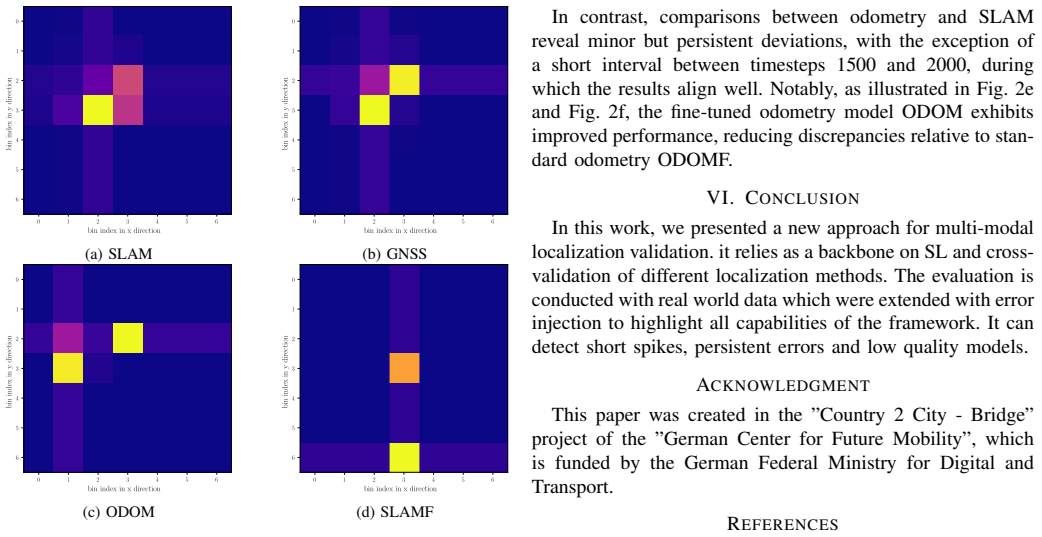
The central claim is that cross-checking localization systems against one another with subjective-logic opinions is enough to detect typical localization failures online, without any ground-truth input. Concretely, the paper shows that a GNSS reacquisition jump at the tunnel exit appears as a sharp conflict spike, an injected SLAM position-hold appears as a continuously elevated conflict for the duration of the error, and a deliberately worse odometry model triggers more frequent conflicts than its better-tuned counterpart. The advance over earlier self-assessment work is that the reference for judging any one system is no longer a prestored model or map cell, but simply the fused short- and long-term behavior of the other systems.
Load-bearing premise
The method assumes that a localization failure shows up as a disagreement between the relative-position updates of different systems; if two or more systems fail in the same way, or the failure only corrupts absolute position, no conflict appears and the failure goes undetected.
Editorial extensions
If this is right
- The framework can feed per-source trust scores into a localization fusion module, reweighting inputs automatically as pairwise conflicts rise and fall.
- It detects the GNSS reacquisition jump at the tunnel exit as a single spike, the injected SLAM freeze as a continuous high-conflict interval, and the worse odometry model by a higher rate of threshold crossings.
- Because systems are compared only to each other, the assessment works in GPS-denied environments and needs no per-location error model or ground truth.
- Detection latency is bounded by the short-term window length, so short spikes can be caught within one window while the long-term window keeps the overall assessment stable.
- Each additional localization source adds new pairwise references, so the sensitivity of the detection improves as the sensor suite grows.
Reading between the lines
- The pairwise cross-check is blind to common-mode failures—shared map errors, shared IMU bias, or synchronized freezes—so a single absolute-reference check or physical plausibility prior would still be required in a safety case; the paper does not address this.
- The same short-term/long-term opinion architecture and pairwise conflict comparison could be transferred to other redundant perception tasks, such as object tracking or lane detection, where multiple algorithms estimate the same state; the paper does not discuss such extensions.
- The histogram bin ranges and the conflict threshold $\theta^L$ are engineering parameters; an adaptive or learned threshold would likely tighten detection in changing environments, but no such tuning procedure is proposed.
- A natural next step, not taken here, is to form an $N \times N$ conflict matrix across all sources and derive a consensus-based ranking or a fused trust score, which would turn the pairwise triggers into a single online integrity estimate.
Editorial analysis
A structured set of objections, weighed in public.
Referee Report
Summary. The paper proposes an online, ground-truth-free performance assessment method for multiple localization systems in autonomous driving. Relative position updates from each localization source are converted into histograms and then into subjective-logic opinions. Short-term and long-term sliding windows are maintained by cumulative fusion/unfusion with trust discounting, and pairs of systems are compared using the degree of conflict (DC) to identify anomalies. The method is evaluated on data from the CoCar NextGen vehicle in a tunnel scenario, comparing GNSS, two odometry variants, SLAM, and an error-injected SLAM variant. The authors claim the approach can detect short spikes, persistent errors, and low-quality localization models.
Significance. If the claims were fully established, the work would offer a useful integrity-monitoring layer for multi-source localization without requiring ground truth, building on a principled subjective-logic framework. Strengths are the use of real vehicle data, a controlled error-injection experiment, and the release of a SUBJ library implementing the SL operators. The qualitative plots do show DC peaks at the tunnel-exit jump and during the injected SLAM freeze, which indicates the method is not vacuous. However, the evaluation is entirely qualitative, the central conclusion overstates robustness to common-cause failures, and key parameters are undisclosed, so the significance is conditional on a substantially strengthened evaluation.
major comments (3)
- [§IV-B, Eq. (20), §VI] The detection signal is δLL' = DC(ωL, ωL'), computed from opinions formed from relative position updates Δx and Δy. Any failure mode that affects all localization sources similarly—two systems freezing together, a shared HD-map error, a broadcast GNSS correction, or a pure constant absolute offset—leaves the relative updates mutually consistent and produces no conflict. Section IV-B itself acknowledges this with 'the assumption is that most failures can be recognized in this way,' but the conclusion drops the caveat and states 'It can detect short spikes, persistent errors and low quality models.' This is load-bearing: for exactly the common-cause cases where integrity monitoring is most needed, the method is blind by construction. The conclusion should be qualified, and the paper should either test common-cause scenarios or explicitly state them as out of scope.
- [§V-A] The evaluation provides no quantitative detection metrics. The six pairwise comparisons in Figure 2 are described by inspection ('a distinct spike is observed,' 'clearly visible as a continuous spike'), but there is no event-level comparison of detected anomalies against the known injection times, no false-positive analysis, no precision/recall or ROC evaluation, no repeated runs, and no baseline comparison against alternative monitoring methods such as innovation-based Kalman filtering or the probability-distribution approach of [9]. Since the central claim is online detection, this qualitative evidence is not sufficient to establish that the method 'can detect' failures; add quantitative event-based evaluation.
- [§IV-A and Eq. (19)] The conflict threshold θL is central to the detection logic in Eq. (19) and is drawn as a green line in Figure 2, yet its value and selection method are never reported. The other free parameters—histogram ranges [xmin,xmax] and [ymin,ymax], bin counts n and m, base-rate distributions a_X and a_Y, window lengths l_st and l_lt, and trust-discount probability p_td—are also unspecified. Without these values and a sensitivity analysis, the results are not reproducible and the risk that the apparent detections are an artifact of threshold tuning cannot be assessed.
minor comments (6)
- [§III-A] There is a formatting error in 'emphsubjective opinions'; it should read 'subjective opinions.'
- [§III-C1, Eq. (11)] The DC formula is typeset ambiguously; the denominator should be written clearly as 2 − (1 − uA)(1 − uB), with parentheses making the fraction explicit.
- [§III-B, Eq. (7)] The line 'with rX = x∀x ∈ X' appears to be a typographical artifact; the evidence-vector definition should be stated explicitly, for example r_X(x) with the intended interpretation.
- [Abstract and §IV-A] The sentence 'Typical errors of the localization systems, which are long term drifts, jumps and false localization, that must be detected to enhance safety' is grammatically incomplete; it should be rewritten. Additionally, the boundary definition in §IV-A uses inconsistent indices (x0 = −∞ and xn = ∞) that should be aligned with the bin-index convention.
- [Fig. 2 and §V-A] The term 'cross-validation' is used to mean pairwise comparison between localization systems, which is not the standard machine-learning meaning; consider using 'pairwise comparison' to avoid confusion. The orange uncertainty curves are shown but never interpreted in the text; either discuss them or remove them.
- [§II] There is a typo 'behahvior' for 'behavior'; the paper would also benefit from a careful proofread of other similar typographical errors.
Circularity Check
No significant circularity; the SL opinion construction and DC comparison are self-contained, with the main caveat being an observability assumption rather than a circular step.
full rationale
The paper's derivation chain is self-contained: relative position updates Δx and Δy are histogrammed into evidence vectors; Eq. (9) converts these to SL opinions; sliding-window fusion (Eqs. 17-18) forms short- and long-term behavior models; Eq. (20) defines the difference measure as the SL Degree of Conflict; detection is thresholding this measure (θL in Eq. 19 and the evaluation). The evaluation injects known faults (SLAMF freeze, ODOMF bad model) and shows that these cause DC to rise. No fitted quantity is renamed as a prediction, and no load-bearing claim is justified by the authors' own prior work: the SL formalism is from Jøsang [6], the sliding-window idea is from Griebel et al. [4], and the authors' self-citations (SUBJ library, CoCar NextGen, Chefs-KISS SLAM) are implementation or data sources, not evidence for the method's correctness. The conclusion 'It can detect short spikes, persistent errors and low quality models' is conditional on the paper's explicit assumption in Sec. IV-B that failures manifest as measurable inter-system disagreement; common-cause failures affecting all sources equally are not observable by this design. That is a correctness and robustness limitation, not a circular derivation, so the circularity score is 0.
Assumptions & free parameters
free parameters (5)
- Histogram ranges and bin counts [xmin,xmax],[ymin,ymax], n, m
- Base rate distributions a_X, a_Y
- Sliding-window lengths l_st, l_lt
- Trust discount probability p_td
- Conflict threshold theta_L
assumptions (5)
- standard math SL operators (fusion, unfusion, trust discount, normal multiplication, degree of conflict) are correct as defined in [6].
- domain assumption X and Y components of relative position are independent for the normal multiplication in Section IV-A.
- domain assumption A correct initial position estimate is available.
- domain assumption Localization failures cause observable disagreements between the relative position updates of different localizers.
- standard math The non-informative prior weight W is set to the domain cardinality |X| (and |Z|), as in [6].
Cite this review
Pith. "Pith review of Online Performance Assessment of Multi-Source-Localization for Autonomous Driving Systems Using Subjective Logic." pith.science (2026). https://pith.science/paper/VQBMIJGC
@misc{pith2026250602932,
  author       = {Pith},
  title        = {Pith review of: Online Performance Assessment of Multi-Source-Localization for Autonomous Driving Systems Using Subjective Logic},
  year         = {2026},
  howpublished = {\url{https://pith.science/paper/VQBMIJGC}},
  note         = {Machine review of arXiv:2506.02932}
}
read the original abstract
Autonomous driving (AD) relies heavily on high precision localization as a crucial part of all driving related software components. The precise positioning is necessary for the utilization of high-definition maps, prediction of other road participants and the controlling of the vehicle itself. Due to this reason, the localization is absolutely safety relevant. Typical errors of the localization systems, which are long term drifts, jumps and false localization, that must be detected to enhance safety. An online assessment and evaluation of the current localization performance is a challenging task, which is usually done by Kalman filtering for single localization systems. Current autonomous vehicles cope with these challenges by fusing multiple individual localization methods into an overall state estimation. Such approaches need expert knowledge for a competitive performance in challenging environments. This expert knowledge is based on the trust and the prioritization of distinct localization methods in respect to the current situation and environment. This work presents a novel online performance assessment technique of multiple localization systems by using subjective logic (SL). In our research vehicles, three different systems for localization are available, namely odometry-, Simultaneous Localization And Mapping (SLAM)- and Global Navigation Satellite System (GNSS)-based. Our performance assessment models the behavior of these three localization systems individually and puts them into reference of each other. The experiments were carried out using the CoCar NextGen, which is based on an Audi A6. The vehicle's localization system was evaluated under challenging conditions, specifically within a tunnel environment. The overall evaluation shows the feasibility of our approach.
Figures


Reference graph
Works this paper leans on
-
[9]
Orf, S.: SUBJ - Subjective Logic Library (2025), https://github.com/fzi-forschungszentrum-informatik/SUBJ/
work page 2025
-
[1]
11em plus .33em minus .07em 4000 4000 100 4000 4000 500 `\.=1000 = #1 \@IEEEnotcompsoconly \@IEEEcompsoconly #1 * [1] 0pt [0pt][0pt] #1 * [1] 0pt [0pt][0pt] #1 * \| ** #1 \@IEEEauthorblockNstyle \@IEEEcompsocnotconfonly \@IEEEauthorblockAstyle \@IEEEcompsocnotconfonly \@IEEEcompsocconfonly \@IEEEauthordefaulttextstyle \@IEEEcompsocnotconfonly \@IEEEauthor...
-
[2]
Delmotte, F., Gacquer, G.: Detection of defective sources with belief functions. In: Proceedings of 12th International Conference on Information Processing and Management of Uncertainty in Knowledge - Based Systems , Malaga , Spain . vol. 2227, p. 337344 (2008)
work page 2008
-
[3]
In: Proceedings of the 1st Annual Conference on Robot Learning
Dosovitskiy, A., Ros, G., Codevilla, F., Lopez, A., Koltun, V.: CARLA : An Open Urban Driving Simulator . In: Proceedings of the 1st Annual Conference on Robot Learning . pp. 1--16 (2017)
work page 2017
-
[4]
In: 2020 IEEE 23rd International Conference on Information Fusion ( FUSION )
Griebel, T., Müller, J., Buchholz, M., Dietmayer, K.: Kalman Filter Meets Subjective Logic : A Self - Assessing Kalman Filter Using Subjective Logic . In: 2020 IEEE 23rd International Conference on Information Fusion ( FUSION ). pp. 1--8 (Jul 2020)
work page 2020
-
[5]
In: 2022 25th International Conference on Information Fusion ( FUSION )
Griebel, T., Müller, J., Geisler, P., Hermann, C., Herrmann, M., Buchholz, M., Dietmayer, K.: Self- Assessment for Single - Object Tracking in Clutter Using Subjective Logic . In: 2022 25th International Conference on Information Fusion ( FUSION ). pp. 1--8 (Jul 2022)
work page 2022
-
[6]
Heinrich, M., Zipfl, M., Uecker, M., Ochs, S., Gontscharow, M., Fleck, T., Doll, J., Schörner, P., Hubschneider, C., Zofka, M.R., Viehl, A., Zöllner, J.M.: CoCar NextGen : a Multi - Purpose Platform for Connected Autonomous Driving Research
-
[7]
Jøsang, A.: Subjective logic, vol. 3. Springer (2016)
2016
Show all 12 references
-
[8]
Ochs, S., Heinrich, M., Schörner, P., Zofka, M.R., Zöllner, J.M.: A Chefs KISS -- Utilizing semantic information in both ICP and SLAM framework, arXiv:2504.02086
-
[10]
In: 2022 IEEE 18th International Conference on Intelligent Computer Communication and Processing ( ICCP )
Orf, S., Lambing, N., Ochs, S., Zofka, M.R., Zöllner, J.M.: Modeling Localization Uncertainty for Enhanced Robustness of Automated Vehicles . In: 2022 IEEE 18th International Conference on Intelligent Computer Communication and Processing ( ICCP ). pp. 175--182 (Sep 2022), iSS...
2022
-
[11]
In: 2023 IEEE Smart World Congress ( SWC )
Rodríguez-Arozamena, M., Aranguren-Mendieta, I., Pérez, J., Zubizarreta, A.: Fail- Safe Decision Architecture for Positioning Failures on Automated Vehicles . In: 2023 IEEE Smart World Congress ( SWC ). pp. 1--8 (Aug 2023)
2023
-
[12]
Sensors 22(7), 2595 (Jan 2022)
Viana, K., Zubizarreta, A., Diez, M.: A Reconfigurable Framework for Vehicle Localization in Urban Areas . Sensors 22(7), 2595 (Jan 2022)
2022
Reviewed August 7, 2026 · model on record in the stance chip above.
Discussion (0). Continue with ORCID to comment.