REVIEW 3 major objections 7 minor 50 references
FuseMamba-VD: Dual Branch VideoMamba with Gated Class Token Fusion for Violence Detection
T0 review · 3 major / 7 minor · reviewed 2026-08-07 · deepseek-v4-flash
Pith's one-line read A dual-branch state-space model with gated class-token fusion claims 95.85% test accuracy on violence detection while using less than half the compute of the previous best model.
desk verdict Solid applied-ML paper with a plausible architecture and a useful benchmark, but the headline SOTA needs a clearer statement of the ablation split and a fairer baseline before the numbers can be trusted. read the letter →
The pith
A machine-rendered reading of the paper's core claim, the machinery that carries it, and where it could break.
The reading
What carries the argument
The central object is the Dual Branch VideoMamba with Gated Class Token Fusion (GCTF): two parallel VideoMamba encoders—one scanning patch tokens spatial-first, the other temporal-first—each with its own learnable class token and initialized from Kinetics-400 pretrained weights. At every block, a learnable sigmoid gate combines the spatial branch's class token with the temporal branch's class token according to $\sigma'_l \odot \mathrm{CLS}^2_l + (1-\sigma'_l) \odot \mathrm{CLS}^1_l$, and the fused CLS token is passed into the temporal branch. A cropping module (YOLOv8-based) extracts the maximum bounding box around all detected people, and a final block concatenates the two branches' final CLS tokens before classification. The gating is what carries the argument: it performs cheap, layer-wise semantic fusion without the token-space misalignment that ablations show when full hidden states are concatenated.
What would settle it
Re-run the Section 4.5 ablations on a held-out validation split of the combined dataset, choose the configuration with the best validation accuracy, and then report its test accuracy; if that test accuracy is substantially below 95.85%, the headline result is an artifact of model selection on the test set.
Extended reading notes
Core claim
The paper's central claim is that continuous fusion of class tokens between two parallel scanning branches is what unlocks the performance: a spatial-first VideoMamba branch captures fine-grained spatial cues, a temporal-first branch captures motion dynamics, and a learnable sigmoid gate at every layer injects the spatial branch's CLS token into the temporal branch's CLS token, avoiding premature commitment to either stream. On top of this, a YOLOv8-based cropping module focuses the network on detected people, and a final concatenation of the two class tokens feeds a classification head. The authors report that this design achieves state-of-the-art accuracy on the combined benchmark and on DVD, and that the improvement over the comparable-size VideoMamba-Large is statistically significant under McNemar's test.
Load-bearing premise
The load-bearing premise is that the architectural choices picked in the ablation studies were selected on a held-out validation split; if the combined test set was reused for that selection, the reported 95.85% test accuracy is a selected maximum and not an unbiased estimate of generalization.
Editorial extensions
If this is right
- State-space models become a credible backbone for violence detection, offering a linear-complexity alternative to quadratic-attention transformers.
- The reported efficiency (154M parameters, 1830 GFLOPS versus CUE-Net's 354M and 5826) supports near real-time deployment of surveillance analytics on modest hardware.
- Gated class-token fusion from a spatial branch into a temporal branch may transfer to other video-understanding tasks that need long-range dependencies, such as anomaly detection.
- The leakage-checked amalgamated benchmark provides the field with a standardized testbed for cross-dataset generalization in violence detection.
- Per-dataset improvements over previously reported bests (94.50% on RWF-2000, 99.75% on RLVS, 96.67% on SURV) indicate the architecture captures complementary cues across surveillance conditions.
Reading between the lines
- Inference: The paper does not explicitly state that the ablation studies used a held-out validation split; if they used the combined test set for model selection, the 95.85% headline is a selected maximum and likely overestimates generalization. A validation-based re-run would settle this.
- Inference: The asymmetric benefit of spatial-to-temporal gating (95.85%) over temporal-to-spatial gating (93.22%) suggests spatial context acts as a prior that guides motion interpretation; this asymmetry could be tested in other SSM-based video models.
- Inference: The VideoMAE cosine-similarity leakage protocol is itself a reusable contribution; other benchmarks that merge datasets from overlapping sources could adopt it to avoid hidden duplicate videos.
- Inference: The larger gap on DVD (74.13%) relative to the combined benchmark hints that in-the-wild distribution shift, not architecture capacity, is the current bottleneck; multimodal signals or surveillance-specific pretraining might close it.
Editorial analysis
A structured set of objections, weighed in public.
Referee Report
Summary. The paper proposes FuseMamba-VD (also titled 'Dual Branch VideoMamba with Gated Class Token Fusion') for violence detection in surveillance video. The architecture uses two parallel VideoMamba branches, one with spatial-first scanning and one with temporal-first scanning, and continuously fuses their class tokens through a learnable gating mechanism. The authors also introduce a combined benchmark built from RWF-2000, RLVS, SURV, and VioPeru with a duplicate-removal step, and they evaluate on the recently introduced DVD dataset. They report state-of-the-art accuracy on both benchmarks (95.85% combined, 74.13% DVD) with substantially lower parameters and FLOPs than the strongest CNN+Transformer baseline CUE-Net.
Significance. If the reported results hold after proper validation, the paper would make a useful contribution: it demonstrates that a dual-branch SSM design with gated class-token fusion can match or beat heavier CNN/Transformer baselines for violence detection, with a large efficiency advantage. The ablation study is informative about the contribution of cropping, skip connections, lateral fusion direction, and continuous fusion. The authors also provide code and pretrained models, which supports reproducibility. However, the core 'state-of-the-art' claim currently rests on test-set selection details and an internal inconsistency in the fusion ablations, so the significance can only be assessed after those issues are resolved.
major comments (3)
- [§4.5 and §4.1] The ablations in §4.5 (Tabs 4–6) and Supplementary Tabs 12–13 report accuracies on the combined dataset but never state that these numbers come from a held-out validation split rather than the test set described in §4.1. Section 4.3 calls the reported numbers 'test accuracies,' and Supplementary §6 only says that the best validation model was saved. If the test set was used to choose among the many ablated configurations, the headline 95.85% is a selected maximum and the 0.88-point margin over CUE-Net (about 8 clips out of 915) could be due to selection bias. Please specify the validation protocol used for model selection, or re-report the ablations on a held-out validation split.
- [§4.5.2 vs. Supplementary §7.1.2] Table 5 reports 'Gated LCs (Branch-1→Branch-2)' as 95.85%, while Supplementary Table 13 reports the same named configuration as 95.30%. The paper does not explain whether these rows refer to different components (lateral fusion vs. final fusion) or whether one of the numbers is an error. Because the headline accuracy is 95.85%, this inconsistency must be resolved before the state-of-the-art claim can be evaluated.
- [§4.3, Table 1] All numbers in Table 1 appear to be single-run accuracies with no variance, confidence intervals, or repeated-seed information. The central comparisons against CUE-Net (95.85 vs. 94.97 on the combined test set; 74.13 vs. 73.68 on the DVD test set) are not accompanied by any statistical test, and the only significance test reported (McNemar) is against VideoMamba-Large, not against the main competitor. To support the claim of state-of-the-art performance, report mean±std over multiple runs or an appropriate significance test for the CUE-Net comparison.
minor comments (7)
- [Equation (2)] In Eq. (2), the notation \bar{B} = (\Delta A)^{-1}(\exp(\Delta A)-I)\cdot\Delta B is confusing because \Delta appears both as a timescale parameter and as a multiplier on B. Please clarify the discretization formula, for example by writing \bar{B} = (\Delta A)^{-1}(e^{\Delta A}-I)\Delta B with an explicit definition of \Delta B.
- [Table 4] The header of Table 4 ('Cropping -× Cropping -✓') is difficult to parse. Please use explicit column labels such as 'Cropping: off/on' and 'Skip: off/on' so the four configurations are clear.
- [§4.5.2] The text says 'we compare four fusion mechanisms for lateral connections,' but Table 5 lists six configurations (full-hidden-state concatenation, CLS-token concatenation, additive, cross-attention, and gated in both directions). Please correct the count or restructure the table.
- [Title/arXiv metadata] The arXiv metadata title is 'FuseMamba-VD: Dual Branch VideoMamba with Gated Class Token Fusion for Violence Detection,' while the manuscript title is 'Dual Branch VideoMamba with Gated Class Token Fusion for Violence Detection.' Please align these titles.
- [§1, Contribution 1] The claim of being 'the first state-space-based design for violence detection' needs stronger support. The related work mentions STNMamba for video anomaly detection; since anomaly detection and violence detection are closely related, the paper should explicitly discuss why prior SSM-based anomaly-detection work does not count, or soften the 'first' claim.
- [§4.1.1] The duplicate-removal procedure is not fully specified: after manually inspecting pairs with 75% or higher cosine similarity, what criterion led to removing exactly one RLVS test video? Please state the threshold or decision rule used for removal so the benchmark construction is reproducible.
- [Throughout] The abbreviation 'FLOPS' should be 'FLOPs' throughout the manuscript.
Circularity Check
Headline 95.85% appears to be the maximum over ablation configurations reported on the same combined dataset that Section 4.3 calls test accuracy, making the SOTA claim a selected maximum.
-
fitted input called prediction
[Section 4.5 (Tables 4–6) and Section 4.3 / Table 1]
"We perform a series of ablation studies to assess the efficacy of the components of our architecture on the combined dataset ... Gated LCs (Branch-1→Branch-2) 95.85 ... Continuous LCs 95.85 ... our Dual Branch VideoMamba model attains the highest scores for the combined dataset, with a test accuracy of 95.85%."
The final architecture is selected by comparing accuracy numbers reported 'on the combined dataset' in the ablation tables (Sec. 4.5, Tabs. 4–6 and Supp. Tabs. 12–13). Section 4.3 explicitly calls the combined-dataset numbers 'test accuracies,' and Supplement §6 only says the best validation model was saved, never that the ablation tables were computed on a held-out validation split. Therefore the headline 95.85% is the maximum over roughly 38 explored configurations on the same test set later reported as the SOTA result; the claim is a selected maximum, not an independent evaluation. The ambiguity is compounded by an internal inconsistency: Tab. 5 lists Gated LCs (Branch-1→Branch-2) as 95.85%, while Supp. Tab.
full rationale
The core architecture is not circular: the SSM equations and the GCTF fusion mechanism are standard, self-contained constructions, and the method is not defined in terms of the target accuracy. The comparison against CUE-Net and VideoMamba is empirical on external data, and the fact that CUE-Net and the DVD benchmark share authors with this paper is a self-citation but not load-bearing, because the benchmark is a dataset and the cropping module is ablated rather than assumed. The combined-dataset curation includes a cosine-similarity leakage check, so the benchmark construction itself is not circular. The one genuine circular step is the ablation-driven architecture selection reported on the combined dataset, which Section 4.3 labels as test accuracy; since no validation split is stated for the ablations, the headline SOTA reduces to a selected maximum over the explored configurations. That warrants a partial-circularity score of 6.
Assumptions & free parameters
free parameters (4)
- per-layer gating vector sigma_l =
learned, d-dimensional per layer
- cosine similarity threshold for duplicate removal =
0.75
- number of frames per branch =
64
- VideoMamba-M depth and hidden dimension =
32 layers, d=576 per branch
assumptions (5)
- domain assumption Binary clip-level classification of strongly labeled violence datasets is a valid task decomposition for surveillance violence detection.
- domain assumption YOLO v8 person detections reliably localize the relevant humans, and cropping to the maximum bounding box retains the violent interaction.
- domain assumption The CLS token is a sufficient summary of each branch for cross-branch fusion.
- domain assumption VideoMAE cosine similarity at a 75% threshold is sufficient to detect cross-split duplicates in the combined dataset.
- domain assumption Kinetics-400 pretrained VideoMamba weights transfer to surveillance violence clips.
Cite this review
Pith. "Pith review of FuseMamba-VD: Dual Branch VideoMamba with Gated Class Token Fusion for Violence Detection." pith.science (2026). https://pith.science/paper/REHXDFSR
@misc{pith2026250603162,
  author       = {Pith},
  title        = {Pith review of: FuseMamba-VD: Dual Branch VideoMamba with Gated Class Token Fusion for Violence Detection},
  year         = {2026},
  howpublished = {\url{https://pith.science/paper/REHXDFSR}},
  note         = {Machine review of arXiv:2506.03162}
}
read the original abstract
The rapid proliferation of surveillance cameras has increased the demand for automated violence detection. While CNNs and Transformers have shown success in extracting spatio-temporal features, they struggle with long-term dependencies and computational efficiency. We propose FuseMamba-VD: Dual Branch VideoMamba with Gated Class Token Fusion (GCTF), an efficient architecture combining a dual-branch design and a state-space model (SSM) backbone where one branch captures spatial features, while the other focuses on temporal dynamics. The model performs continuous fusion via a gating mechanism from the spatial branch into the temporal branch to enhance detection of violent activities even in challenging surveillance scenarios. We also present a new benchmark by merging RWF-2000, RLVS, SURV and VioPeru datasets in video violence detection, ensuring strict separation between training and testing sets. Experimental results demonstrate that our model achieves state-of-the-art performance on this benchmark and also on DVD dataset which is a recently introduced dataset on video violence detection, offering an optimal balance between accuracy and computational efficiency, demonstrating the promise of SSMs for scalable, resource efficient video violence detection. The code and pre-trained models are available at https://github.com/damith92/FuseMamba-VD.
Figures


Figures from the paper (2 more)
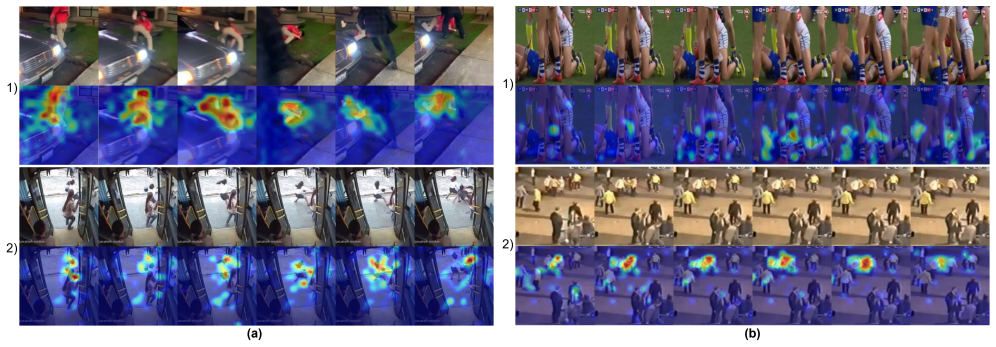

Reference graph
Works this paper leans on
-
[1]
Data efficient video transformer for violence detection
Almamon Rasool Abdali. Data efficient video transformer for violence detection. In2021 IEEE international confer- ence on communication, networks and satellite (COMNET- SAT), pages 195–199. IEEE, 2021. 2
work page 2021
-
[2]
Vision-based fight detection from surveillance cam- eras
S ¸eymanur Aktı, G¨ozde Ays ¸e Tataro˘glu, and Hazım Kemal Ekenel. Vision-based fight detection from surveillance cam- eras. In2019 Ninth International Conference on Image Pro- cessing Theory, Tools and Applications (IPTA), pages 1–6. IEEE, 2019. 2, 5, 1
work page 2019
-
[3]
Vivit: A video vision transformer
Anurag Arnab, Mostafa Dehghani, Georg Heigold, Chen Sun, Mario Lu ˇci´c, and Cordelia Schmid. Vivit: A video vision transformer. InProceedings of the IEEE/CVF inter- national conference on computer vision, pages 6836–6846,
-
[4]
Mujtaba Asad, He Jiang, Jie Yang, Enmei Tu, and Aftab A Malik. Multi-level two-stream fusion-based spatio-temporal attention model for violence detection and localization.In- ternational Journal of Pattern Recognition and Artificial In- telligence, 36(01):2255002, 2022. 2
work page 2022
-
[5]
Violence detection in video using computer vision techniques
Enrique Bermejo Nievas, Oscar Deniz Suarez, Gloria Bueno Garc´ıa, and Rahul Sukthankar. Violence detection in video using computer vision techniques. InComputer Anal- ysis of Images and Patterns: 14th International Conference, CAIP 2011, Seville, Spain, August 29-31, 2011, Proceedings, Part II 14, pages 332–339. Springer, 2011. 2, 5
work page 2011
-
[6]
A dataset for automatic violence de- tection in videos.Data in brief, 33:106587, 2020
Miriana Bianculli, Nicola Falcionelli, Paolo Sernani, Se- lene Tomassini, Paolo Contardo, Mara Lombardi, and Aldo Franco Dragoni. A dataset for automatic violence de- tection in videos.Data in brief, 33:106587, 2020. 5
work page 2020
-
[7]
Implementa- tion and application of violence detection system based on multi-head attention and lstm
Fengping Cao, Yi Miao, and Wangyi Zhang. Implementa- tion and application of violence detection system based on multi-head attention and lstm. InInternational Conference on Intelligent Computing, pages 77–88. Springer, 2024. 2, 3
work page 2024
-
[8]
Mgfn: Magnitude- contrastive glance-and-focus network for weakly-supervised video anomaly detection
Yingxian Chen, Zhengzhe Liu, Baoheng Zhang, Wilton Fok, Xiaojuan Qi, and Yik-Chung Wu. Mgfn: Magnitude- contrastive glance-and-focus network for weakly-supervised video anomaly detection. InProceedings of the AAAI Con- ference on Artificial Intelligence, pages 387–395, 2023. 2
work page 2023
Show all 50 references
-
[9]
Rwf-2000: an open large scale video database for violence detection
Ming Cheng, Kunjing Cai, and Ming Li. Rwf-2000: an open large scale video database for violence detection. In 2020 25th International Conference on Pattern Recognition (ICPR), pages 4183–4190. IEEE, 2021. 2, 5, 6, 1, 3
2000
-
[10]
A temporal fusion approach for video classifi- cation with convolutional and lstm neural networks applied to violence detection.Inteligencia Artificial, 24(67):40–50,
Jean Phelipe de Oliveira Lima and Carlos Maur ´ıcio Ser´odio Figueiredo. A temporal fusion approach for video classifi- cation with convolutional and lstm neural networks applied to violence detection.Inteligencia Artificial, 24(67):40–50,
-
[11]
Slowfast networks for video recognition
Christoph Feichtenhofer, Haoqi Fan, Jitendra Malik, and Kaiming He. Slowfast networks for video recognition. In Proceedings of the IEEE/CVF international conference on computer vision, pages 6202–6211, 2019. 2, 6, 7
2019
-
[12]
Two- stream transformer architecture for long video understand- ing.arXiv preprint arXiv:2208.01753, 2022
Edward Fish, Jon Weinbren, and Andrew Gilbert. Two- stream transformer architecture for long video understand- ing.arXiv preprint arXiv:2208.01753, 2022. 7
2022 arXiv
-
[13]
Human skeletons and change detection for efficient violence detec- tion in surveillance videos.Computer Vision and Image Un- derstanding, 233:103739, 2023
Guillermo Garcia-Cobo and Juan C SanMiguel. Human skeletons and change detection for efficient violence detec- tion in surveillance videos.Computer Vision and Image Un- derstanding, 233:103739, 2023. 2
2023
-
[14]
Mamba: Linear-time sequence modeling with selective state spaces.arXiv preprint arXiv:2312.00752, 2023
Albert Gu and Tri Dao. Mamba: Linear-time sequence modeling with selective state spaces.arXiv preprint arXiv:2312.00752, 2023. 2, 3
2023 arXiv
-
[15]
Unified keypoint-based action recognition framework via structured keypoint pooling
Ryo Hachiuma, Fumiaki Sato, and Taiki Sekii. Unified keypoint-based action recognition framework via structured keypoint pooling. InProceedings of the IEEE/CVF Con- ference on Computer Vision and Pattern Recognition, pages 22962–22971, 2023. 3
2023
-
[16]
Efficient human violence recognition for surveillance in real time.Sensors, 24(2):668, 2024
Herwin Alayn Huillcen Baca, Flor de Luz Palomino Val- divia, and Juan Carlos Gutierrez Caceres. Efficient human violence recognition for surveillance in real time.Sensors, 24(2):668, 2024. 2, 5, 6, 1, 3
2024
-
[17]
Efficient two-stream network for violence detection using separable convolutional lstm
Zahidul Islam, Mohammad Rukonuzzaman, Raiyan Ahmed, Md Hasanul Kabir, and Moshiur Farazi. Efficient two-stream network for violence detection using separable convolutional lstm. In2021 International Joint Conference on Neural Net- works (IJCNN), pages 1–8. IEEE, 2021. 2
2021
-
[18]
3d convolu- tional neural networks for human action recognition.IEEE transactions on pattern analysis and machine intelligence, 35(1):221–231, 2012
Shuiwang Ji, Wei Xu, Ming Yang, and Kai Yu. 3d convolu- tional neural networks for human action recognition.IEEE transactions on pattern analysis and machine intelligence, 35(1):221–231, 2012. 1
2012
-
[19]
Glenn Jocher, Ayush Chaurasia, and Jing Qiu. Yolo v8. In Ultralytics, 2023. 1
2023
-
[20]
The kinetics hu- man action video dataset.arXiv preprint arXiv:1705.06950,
Will Kay, Joao Carreira, Karen Simonyan, Brian Zhang, Chloe Hillier, Sudheendra Vijayanarasimhan, Fabio Viola, Tim Green, Trevor Back, Paul Natsev, et al. The kinetics hu- man action video dataset.arXiv preprint arXiv:1705.06950,
-
[21]
Thomas King, Simon Butcher, and Lukasz Zalewski.Apoc- rita - High Performance Computing Cluster for Queen Mary University of London, 2017. 9
2017
-
[22]
Dvd: A comprehensive dataset for advanc- ing violence detection in real-world scenarios.arXiv preprint arXiv:2506.05372, 2025
Dimitrios Kollias, Damith C Senadeera, Jianian Zheng, Kaushal KK Yadav, Greg Slabaugh, Muhammad Awais, and Xiaoyun Yang. Dvd: A comprehensive dataset for advanc- ing violence detection in real-world scenarios.arXiv preprint arXiv:2506.05372, 2025. 2, 5, 6
2025 arXiv
-
[23]
Keyframe- guided video swin transformer with multi-path excitation for violence detection.The Computer Journal, page bxad103,
Chenghao Li, Xinyan Yang, and Gang Liang. Keyframe- guided video swin transformer with multi-path excitation for violence detection.The Computer Journal, page bxad103,
-
[24]
Uniformer: Unified transformer for efficient spatiotemporal representation learning.arXiv preprint arXiv:2201.04676, 2022
Kunchang Li, Yali Wang, Peng Gao, Guanglu Song, Yu Liu, Hongsheng Li, and Yu Qiao. Uniformer: Unified transformer for efficient spatiotemporal representation learning.arXiv preprint arXiv:2201.04676, 2022. 2, 4 9
2022 arXiv
-
[25]
Uniformerv2: Spatiotemporal learning by arming image vits with video uniformer.arXiv preprint arXiv:2211.09552, 2022
Kunchang Li, Yali Wang, Yinan He, Yizhuo Li, Yi Wang, Limin Wang, and Yu Qiao. Uniformerv2: Spatiotemporal learning by arming image vits with video uniformer.arXiv preprint arXiv:2211.09552, 2022. 2, 6, 7
2022 arXiv
-
[26]
Videomamba: State space model for efficient video understanding
Kunchang Li, Xinhao Li, Yi Wang, Yinan He, Yali Wang, Limin Wang, and Yu Qiao. Videomamba: State space model for efficient video understanding. InEuropean Conference on Computer Vision, pages 237–255. Springer, 2024. 2, 3, 6, 7, 9
2024
-
[27]
Stnmamba: Mamba-based spatial-temporal nor- mality learning for video anomaly detection.arXiv preprint arXiv:2412.20084, 2024
Zhangxun Li, Mengyang Zhao, Xuan Yang, Yang Liu, Ji- amu Sheng, Xinhua Zeng, Tian Wang, Kewei Wu, and Yu- Gang Jiang. Stnmamba: Mamba-based spatial-temporal nor- mality learning for video anomaly detection.arXiv preprint arXiv:2412.20084, 2024. 2
2024 arXiv
-
[28]
Video swin transformer
Ze Liu, Jia Ning, Yue Cao, Yixuan Wei, Zheng Zhang, Stephen Lin, and Han Hu. Video swin transformer. InPro- ceedings of the IEEE/CVF conference on computer vision and pattern recognition, pages 3202–3211, 2022. 6, 7, 3
2022
-
[29]
Decoupled weight decay regularization.arXiv preprint arXiv:1711.05101, 2017
Ilya Loshchilov and Frank Hutter. Decoupled weight decay regularization.arXiv preprint arXiv:1711.05101, 2017. 2
2017 arXiv
-
[30]
State-of-the-art violence detection techniques in video surveillance security systems: a systematic review.PeerJ Computer Science, 8: e920, 2022
Batyrkhan Omarov, Sergazi Narynov, Zhandos Zhumanov, Aidana Gumar, and Mariyam Khassanova. State-of-the-art violence detection techniques in video surveillance security systems: a systematic review.PeerJ Computer Science, 8: e920, 2022. 1
2022
-
[31]
Effec- tive use of the mcnemar test.Behavioral Ecology and Socio- biology, 74(11):133, 2020
Matilda QR Pembury Smith and Graeme D Ruxton. Effec- tive use of the mcnemar test.Behavioral Ecology and Socio- biology, 74(11):133, 2020. 7
2020
-
[32]
Multimodal information fusion and tem- poral integration for violence detection in movies
C ´edric Penet, Claire-H ´el`ene Demarty, Guillaume Gravier, and Patrick Gros. Multimodal information fusion and tem- poral integration for violence detection in movies. In2012 IEEE International Conference on Acoustics, Speech and Signal Processing (ICASSP), pages 2393–2396. ...
2012
-
[33]
Learn- ing prompt-enhanced context features for weakly-supervised video anomaly detection.arXiv preprint arXiv:2306.14451,
Yujiang Pu, Xiaoyu Wu, and Shengjin Wang. Learn- ing prompt-enhanced context features for weakly-supervised video anomaly detection.arXiv preprint arXiv:2306.14451,
-
[34]
Grad-cam: Visual explanations from deep networks via gradient-based localization
Ramprasaath R Selvaraju, Michael Cogswell, Abhishek Das, Ramakrishna Vedantam, Devi Parikh, and Dhruv Batra. Grad-cam: Visual explanations from deep networks via gradient-based localization. InProceedings of the IEEE in- ternational conference on computer vision, pages 618–626,
-
[35]
Cue-net: Violence detection video analytics with spatial cropping, enhanced uniformerv2 and modified efficient additive attention
Damith Chamalke Senadeera, Xiaoyun Yang, Dimitrios Kol- lias, and Gregory Slabaugh. Cue-net: Violence detection video analytics with spatial cropping, enhanced uniformerv2 and modified efficient additive attention. In2024 IEEE/CVF Conference on Computer Vision and Pattern Reco...
2024
-
[36]
Violence recog- nition from videos using deep learning techniques
Mohamed Mostafa Soliman, Mohamed Hussein Kamal, Mina Abd El-Massih Nashed, Youssef Mohamed Mostafa, Bassel Safwat Chawky, and Dina Khattab. Violence recog- nition from videos using deep learning techniques. In 2019 Ninth International Conference on Intelligent Comput- ing and ...
2019
-
[37]
Violence detection using 3d con- volutional neural networks
Jiayi Su, Paris Her, Erik Clemens, Edwin Yaz, Susan Schnei- der, and Henry Medeiros. Violence detection using 3d con- volutional neural networks. In2022 18th IEEE International Conference on Advanced Video and Signal Based Surveil- lance (AVSS), pages 1–8, 2022. 2
2022
-
[38]
Human interaction learning on 3d skeleton point clouds for video violence recognition
Yukun Su, Guosheng Lin, Jinhui Zhu, and Qingyao Wu. Human interaction learning on 3d skeleton point clouds for video violence recognition. InComputer Vision–ECCV 2020: 16th European Conference, Glasgow, UK, August 23– 28, 2020, Proceedings, Part IV 16, pages 74–90. Springer,
2020
-
[39]
Real-world anomaly detection in surveillance videos
Waqas Sultani, Chen Chen, and Mubarak Shah. Real-world anomaly detection in surveillance videos. InProceedings of the IEEE conference on computer vision and pattern recog- nition, pages 6479–6488, 2018. 2, 5
2018
-
[40]
Detection of fights in videos: A comparison study of anomaly detection and action recog- nition
Weijun Tan and Jingfeng Liu. Detection of fights in videos: A comparison study of anomaly detection and action recog- nition. InEuropean Conference on Computer Vision, pages 676–688. Springer, 2022. 2, 3
2022
-
[41]
Weakly-supervised video anomaly detection with robust temporal feature magni- tude learning
Yu Tian, Guansong Pang, Yuanhong Chen, Rajvinder Singh, Johan W Verjans, and Gustavo Carneiro. Weakly-supervised video anomaly detection with robust temporal feature magni- tude learning. InProceedings of the IEEE/CVF international conference on computer vision, pages 4975–498...
2021
-
[42]
Videomae: Masked autoencoders are data-efficient learners for self-supervised video pre-training.Advances in neural information processing systems, 35:10078–10093, 2022
Zhan Tong, Yibing Song, Jue Wang, and Limin Wang. Videomae: Masked autoencoders are data-efficient learners for self-supervised video pre-training.Advances in neural information processing systems, 35:10078–10093, 2022. 5
2022
-
[43]
Violence detection using spa- tiotemporal features with 3d convolutional neural network
Fath U Min Ullah, Amin Ullah, Khan Muhammad, Ijaz Ul Haq, and Sung Wook Baik. Violence detection using spa- tiotemporal features with 3d convolutional neural network. Sensors, 19(11):2472, 2019. 2
2019
-
[44]
A comprehensive review on vision-based violence detection in surveillance videos.ACM Computing Surveys, 55(10):1–44,
Fath U Min Ullah, Mohammad S Obaidat, Amin Ullah, Khan Muhammad, Mohammad Hijji, and Sung Wook Baik. A comprehensive review on vision-based violence detection in surveillance videos.ACM Computing Surveys, 55(10):1–44,
-
[45]
A temporal–spatial deep learning framework leveraging dynamic 3d attention maps for violence detection
Elizabeth B Varghese, Almiqdad Elzein, Yin Yang, and Marwa Qaraqe. A temporal–spatial deep learning framework leveraging dynamic 3d attention maps for violence detection. Neural Computing and Applications, pages 1–21, 2025. 3
2025
-
[46]
Real-time violence detection and localization through subgroup analysis.Multimedia Tools and Applications, 84 (7):3793–3807, 2025
Emmeke Veltmeijer, Morris Franken, and Charlotte Gerrit- sen. Real-time violence detection and localization through subgroup analysis.Multimedia Tools and Applications, 84 (7):3793–3807, 2025. 2
2025
-
[47]
Not only look, but also listen: Learning multimodal violence detection under weak supervision
Peng Wu, Jing Liu, Yujia Shi, Yujia Sun, Fangtao Shao, Zhaoyang Wu, and Zhiwei Yang. Not only look, but also listen: Learning multimodal violence detection under weak supervision. InComputer Vision–ECCV 2020: 16th Euro- pean Conference, Glasgow, UK, August 23–28, 2020, Pro- ce...
2020
-
[48]
Vision mamba: efficient visual representation learning with bidirectional state space model
Lianghui Zhu, Bencheng Liao, Qian Zhang, Xinlong Wang, Wenyu Liu, and Xinggang Wang. Vision mamba: efficient visual representation learning with bidirectional state space model. InProceedings of the 41st International Conference on Machine Learning. JMLR.org, 2024. 2, 3, 4 10 ...
2024
-
[49]
All models were trained for 55 epochs with 5 warm-up epochs where the best validation model was saved
Implementation Details - Supplement Our Dual Branch VideoMamba architecture was imple- mented in PyTorch using the AdamW optimizer [29] with a cosine learning rate schedule starting with a learning rate of 1e-4 and Cross-Entropy Loss, taking insights from train- ing recipes of...
-
[50]
For the VioPeru dataset, our Dual Branch architecture is able to reach the already reported state-of-the-art accuracy of 89.23%
Dual Branch Video Mamba Performance on separate datasets of RWF-2000, RLVS and VioPeru When trained and tested separately, our architecture out- performs the reported state-of-the-art results in literature in classification accuracy for RWF-2000, RLVS and SURV datasets, by ach...
2000
Reviewed August 7, 2026 · model on record in the stance chip above.
Discussion (0). Sign in to comment.