REVIEW 3 major objections 4 minor 18 references
Orbital angular momentum can take non-integer values in a closed universe
T0 review · 3 major / 4 minor · reviewed 2026-08-07 · deepseek-v4-flash
Pith's one-line read On a flat torus universe, orbital angular momentum admits every real value with magnitude at least ℏ, alongside the usual integers.
desk verdict Plausible new result on OAM on a torus, but the proof has a gap in the direct-integral step that a referee should push on. read the letter →
The pith
A machine-rendered reading of the paper's core claim, the machinery that carries it, and where it could break.
The reading
What carries the argument
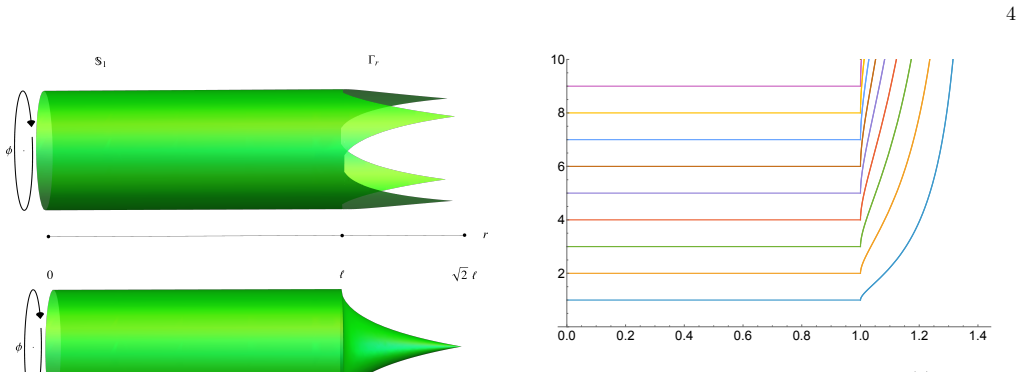
The machinery is the factorization of the torus Hilbert space into radial fibers, $H\simeq\int^{\oplus}_{[0,\sqrt{2}\ell]}H_r\,r\,dr$ with fiber $H_r\simeq L^2(\Gamma_r)$, and the identification $L^2(\Gamma_r)\simeq L^2(S_{\mu(r)})$ that turns angular momentum into a direct integral of one-dimensional momentum operators, $L_z\simeq\int^{\oplus}p_\varphi(r)\,r\,dr$. Each fiber operator $p_\varphi(r)$ is the derivative on a circle of effective radius $\mu(r)$ and has pure point spectrum $\hbar/\mu(r)\,\mathbb{Z}$. As $r$ runs from $\ell$ to $\sqrt{2}\ell$, the curves $\lambda_m(r)=\hbar m/\mu(r)$ sweep out the continuous bands, and the standard direct-integral spectral theorem cited in the paper as [18] converts the measure of the $r$-preimage of each $\lambda$ into pure point versus absolutely continuous spectrum. Because $L_z$ is scale invariant as a product of multiplication and derivative operators, the final spectrum does not depend on the torus size $\ell$.
What would settle it
Compute the spectral measure of $L_z$ on a finely discretized square torus for a small interval inside $(\hbar,2\hbar)$, for example $(1.1\hbar,1.2\hbar)$: the paper predicts nonzero support there, and a result of exactly zero would contradict the claimed continuous band without relying on the direct-integral decomposition.
Extended reading notes
Core claim
The central claim is that on the flat torus $\mathbb{T}^2_\ell$, the orbital angular momentum operator $L_z=xp_y-yp_x$ has spectrum $\sigma(L_z)=\hbar\mathbb{Z}\cup((-\infty,-\hbar]\cup[\hbar,\infty))$, with pure point part $\hbar\mathbb{Z}$ and absolutely continuous part $\mathbb{R}\setminus(-\hbar,\hbar)$, independent of the torus size $\ell$. The continuous part comes from the tension between rotational symmetry and the square boundary conditions: polar coordinates on a torus do not give a globally defined angle. For radii $r$ between $\ell$ and $\sqrt{2}\,\ell$, the allowed angular range $\Gamma_r$ consists of four intervals rather than a full circle, equivalent by periodicity to a circle of effective circumference $2\pi\mu(r)$, with $\mu(r)=1-\frac{4}{\pi}\arccos(\ell/r)$. The fiber momentum then has eigenvalues $\hbar m/\mu(r)$, which sweep out the continuous bands as $r$ varies. A band gap $(-\hbar,\hbar)$ remains, and the normalizable eigenstates belonging to $\hbar\mathbb{Z}$ are supported inside the disk of radius $\ell$, which is why the continuous part escapes local detection.
Load-bearing premise
The load-bearing premise is the asserted direct-integral decomposition of $L_z$ into fiber momentum operators on circles, with matching operator domains on $H^1(S_{\mu(r)})$; if that decomposition fails, the computed spectrum does not follow, and the paper in any case proves it only for square tori rather than a general periodic universe.
Editorial extensions
If this is right
- Every real number $\lambda$ with $|\lambda|\ge\hbar$ is a spectral value of $L_z$, so half-integer and irrational multiples of $\hbar$ occur, contrary to the textbook restriction to integers.
- The ordinary eigenvalues $\hbar\mathbb{Z}$ remain, infinitely degenerate, with eigenstates supported inside the disk $B_\ell$; only these are detectable in the laboratory.
- The spectrum is independent of the torus diameter, so the effect does not disappear in a large closed universe and also appears in small compactified dimensions.
- The continuous-spectrum states rotate by generally irrational angles to return to themselves, which the authors identify with anyonic behaviour.
- The authors suggest that these edge states could leave observable traces in cosmological data, for instance through photon orbital angular momentum in the cosmic microwave background, and that the same analysis applies to compactified-dimension theories.
Reading between the lines
- The proof is given for square tori only, but the same fibration idea can plausibly be extended to rectangular tori and other aspect ratios; the paper notes that non-square aspect ratios lead to chaotic classical orbits, so whether the continuous band persists there is an open, testable question.
- A concrete consequence the paper does not develop is that the edge states have chirality opposite to ordinary rotation, so they would imprint a handedness on cosmic microwave background maps; a search for a handedness in current data would test the cosmological relevance.
- Size independence suggests that compact extra dimensions could host continuous angular-momentum channels, which would modify the mass spectrum and selection rules of particle models built on compactified spaces.
- The distinction between locally preparable integer states and globally extended continuous states could be formalized as a superselection-like rule for angular momentum on compact spaces, with potential consequences for anyon models in such geometries.
Editorial analysis
A structured set of objections, weighed in public.
Referee Report
Summary. The paper studies the operator L_z = x p_y - y p_x on L^2 of a flat square torus T^2_ell with periodic boundary conditions. It claims that the spectrum consists of the usual pure point part hbar Z plus an absolutely continuous part (-infinity,-hbar] union [hbar,infinity), and that this spectrum is independent of the torus size ell. The argument combines a Bohr-Sommerfeld semiclassical picture with a direct-integral decomposition in polar coordinates, in which the fibers over r are identified with circles of effective radius mu(r), and then applies Theorem XIII.85 of Reed and Simon to obtain the spectrum. The authors argue that the exotic continuous part is supported near the corners of the fundamental domain and discuss possible cosmological implications for the CMB.
Significance. If the central fibration step is made rigorous, this is a surprising and potentially important result: it shows that the textbook integer quantization of orbital angular momentum depends on the spatial topology, and that on a torus all real values with |lambda| >= hbar occur in the spectrum, including half-integer and even irrational values, without the use of multi-valued wavefunctions. The claimed independence of the torus size is striking and would make the effect robust in the large-universe limit. The derivation is self-contained and parameter-free, with explicit point eigenfunctions for the pure point part and an explicit spectral picture, and the semiclassical and operator arguments agree. The manuscript is honest about the restriction to square tori in the body, though the abstract overstates the generality. The main weakness is that the unitary equivalence underlying the whole spectral computation is asserted rather than proved.
major comments (3)
- [Full quantum proof, Eqs. (10)-(16)] The direct-integral decomposition is the load-bearing step and is not proved. The paper states H ≃ ∫^⊕ H_r r dr and L_z ≃ ∫^⊕ p_phi(r) r dr, with L^2(Gamma_r) ≃ L^2(S_{mu(r)}), but no explicit intertwiner is given, and the matching of the domain D(p_phi(r)) = H^1(S_{mu(r)}) to the periodic boundary conditions on T^2_ell is not demonstrated. Since Theorem XIII.85 is applied to this direct integral, the claimed pure point part (21) and absolutely continuous part (23) stand or fall on this equivalence. Please provide a complete proof of the unitary equivalence, including the identification of the closure of L_z on C^infinity(T^2_ell) with the direct integral operator and its domain. The sentence "By the analytic vector theorem, it is easy to see..." is insufficient, particularly because x and y are not smooth functions on the torus.
- [Abstract, Conclusion, and Intuition] The proof is explicitly restricted to square tori of side 2ell x 2ell: the Intuition section states "We will consider a flat finite universe... dimension 2ell x 2ell" and adds that other aspect ratios lead to chaotic trajectories which will be discussed elsewhere. The abstract, title, and conclusion nevertheless claim the result for "a closed universe" without qualification. This is an overgeneralization as written; the main theorem should be stated for square tori, or the proof should be extended to general aspect ratios.
- [Introduction] The sentence "Remarkably, neither the spectrum of angular momentum nor its square, as a measure of energy, depends on the size of the closed universe" is unsupported and is contradicted later in the Intuition section, where the authors state that |L|^2 is "considerably harder and where we only have partial results till date." Since no result on L^2 is proved, this claim should be removed or explicitly marked as conjectural.
minor comments (4)
- [Introduction and Abstract] There are small typos: "soley" should be "solely", and "torodial" should be "toroidal".
- [Full quantum proof, Eq. (19)] The formula for lambda_m(r) is given for r in [ell, sqrt(2)ell), omitting the endpoint r = sqrt(2)ell where mu(r)=0 and the formula diverges; since the endpoint has measure zero this is harmless, but it should be stated explicitly.
- [Full quantum proof, Eq. (25)] The phrase "absolutely continuous wavefunctions psi in H_ac(L_z), psi in L^2" is imprecise: the absolutely continuous spectral subspace does not consist of normalizable eigenfunctions. It should be described as a spectral subspace, not as individual wavefunctions.
- [Full quantum proof, Eq. (22)] For negative m, the displayed eigenfunctions v_m(r,phi) = w(r) u_m(phi) are not smooth at r=0 for arbitrary w in L^2; if continuity at the origin is required, w must vanish appropriately. This is a minor regularity point, but worth a short note.
Circularity Check
No circularity: the spectral result is derived from canonical operators and an external direct-integral theorem, with no fitted parameters or load-bearing self-citations.
full rationale
The derivation chain is self-contained. The orbital angular momentum operator L_z is defined from canonical position and momentum operators on the flat torus, and its spectrum is obtained by a direct integral decomposition over the radial coordinate r. The fiber operators p_phi(r) have spectra computed explicitly from the standard Fourier basis, and the union over r of the fiber eigenvalues lambda_m(r) = hbar m / mu(r) yields the claimed continuous bands outside (-hbar, hbar) and the pure point part hbar Z. No parameter is fitted to the target spectrum, and no 'prediction' is a renamed input: the continuous band is a direct consequence of the geometry of the arcs Gamma_r and the explicitly stated mu(r). The cited Theorem XIII.85 of Reed and Simon is an external, standard result used to pass from fiber spectra to the spectrum of the direct integral; it is not a self-citation. The identification L^2(Gamma_r) ~ L^2(S_{mu(r)}) in Eq. (12) is asserted with reference to Fig. 4 rather than fully proved, and the domain of L_z is sketched rather than exhibited as a core; however, this is a rigor or completeness gap, not circularity. The Bohr-Sommerfeld discussion is explicitly labeled as intuition and is not needed for the quantum proof. There are no load-bearing self-citations, no ansatz smuggled in via prior work by the same authors, and no renaming of a known empirical pattern. The central result has independent mathematical content.
Assumptions & free parameters
assumptions (4)
- standard math The Hilbert space is L^2(T^2_ℓ) and q,p are defined as multiplication and derivative operators on periodic functions (Eqs. (1)-(5)).
- domain assumption The operator L_z=q⊗p−p⊗q is essentially self-adjoint on C∞(T^2_ℓ); the paper asserts this via the analytic vector theorem without giving the proof.
- ad hoc to paper The fibration H≃∫^⊕ H_r r dr with L_z≃∫^⊕ p_φ(r) r dr, including L^2(Γ_r)≃L^2(S_{μ(r)}), is a valid unitary equivalence (Eqs. (10)-(15)).
- domain assumption The torus is square, with equal side lengths 2ℓ×2ℓ; other aspect ratios are excluded.
Cite this review
Pith. "Pith review of Orbital angular momentum can take non-integer values in a closed universe." pith.science (2026). https://pith.science/paper/HHHBO4HZ
@misc{pith2026250603254,
  author       = {Pith},
  title        = {Pith review of: Orbital angular momentum can take non-integer values in a closed universe},
  year         = {2026},
  howpublished = {\url{https://pith.science/paper/HHHBO4HZ}},
  note         = {Machine review of arXiv:2506.03254}
}
read the original abstract
We show that the spectrum of orbital angular momentum in quantum mechanics consists of two parts when the underlying space has periodic boundaries. While the first part consists of the usual textbook integer quantized values, the second is a continuous band arising from regions at the `edge' of space with respect to the center of rotation. The spectrum thus contains not only half-integer values, previously thought impossible for orbital angular momentum, but even irrational ones. Remarkably, this effect is independent of the size of space. While these spectral components remain undetectable in laboratory experiments, they could still produce observable effects on cosmological scales, for instance in the Cosmic Microwave Background Radiation.
Figures


Figures from the paper (1 more)
Reference graph
Works this paper leans on
-
[1]
W. Heisenberg, ¨Uber quantentheoretische Umdeu- tung kinematischer und mechanischer Beziehungen., Zeitschrift f¨ ur Physik33, 879 (1925)
work page 1925
-
[2]
L. Mensing, Die Rotations-Schwingungsbanden nach der Quantenmechanik, Zeitschrift f¨ ur Physik36, 814 (1926)
work page 1926
-
[3]
L. C. Biedenharn and J. D. Louck,Angular momentum in quantum physics: theory and application(Cambridge University Press, Cambridge, 1984)
work page 1984
-
[4]
J. J. Sakurai and J. Napolitano,Modern Quantum Me- chanics(Cambridge University Press, Cambridge, 2020)
2020
-
[5]
Pauli, inQuantentheorie, edited by H
W. Pauli, inQuantentheorie, edited by H. Bethe, F. Hund, N. F. Mott, W. Pauli, A. Rubinowicz, G. Wentzel, and A. Smekal (Springer, Berlin, Heidelberg, 1933)
work page 1933
-
[6]
W. Pauli, ¨Uber ein Kriterium f¨ ur Ein- oder Zweiwer- tigkeit der Eigenfunktionen in der Wellenmechanik, Hel- vetica Physica Acta12, 147 (1939)
work page 1939
-
[7]
Pauli, inPrinciples of Quantum Theory 1, edited by S
W. Pauli, inPrinciples of Quantum Theory 1, edited by S. Fl¨ ugge (Springer, Berlin, 1958)
work page 1958
-
[8]
Merzbacher, Single Valuedness of Wave Functions, American Journal of Physics30, 237 (1962)
E. Merzbacher, Single Valuedness of Wave Functions, American Journal of Physics30, 237 (1962)
work page 1962
Show all 18 references
-
[9]
H. A. Buchdahl, Remark Concerning the Eigenvalues of Orbital Angular Momentum, American Journal of Physics30, 829 (2005)
2005
-
[10]
L. E. Ballentine,Quantum mechanics: a modern devel- opment(World Scientific, New Jersey, 2014)
2014
-
[11]
Lerda,Anyons: quantum mechanics of particles with fractional statistics(Springer, Berlin, 1992)
A. Lerda,Anyons: quantum mechanics of particles with fractional statistics(Springer, Berlin, 1992)
1992
-
[12]
E. A. Paraskevas and L. Perivolaropoulos, Probing the Universe’s Topology through a Quantum System?, 2025, arXiv:2505.08603 [quant-ph]
2025 arXiv
-
[13]
Back- ground geometry and topology of the Universe, A&A 594, A18 (2016)
Planck Collaboration, Planck 2015 results XVIII. Back- ground geometry and topology of the Universe, A&A 594, A18 (2016)
2016
-
[14]
Harwit, Photon orbital angular momentum in astro- physics, Astrophys
M. Harwit, Photon orbital angular momentum in astro- physics, Astrophys. J.597, 1266 (2003)
2003
-
[15]
Schm¨ udgen,An Invitation to Unbounded Represen- tations of *-Algebras on Hilbert Space(Springer, Berlin, 2020)
K. Schm¨ udgen,An Invitation to Unbounded Represen- tations of *-Algebras on Hilbert Space(Springer, Berlin, 2020)
2020
-
[16]
M. V. Berry and K. E. Mount, Semiclassical approxima- tions in wave mechanics, Reports on Progress in Physics 35, 315 (1972)
1972
-
[17]
B. C. Hall,Quantum Theory for Mathematicians (Springer, New York, 2013)
2013
-
[18]
Reed and B
M. Reed and B. Simon,Methods of modern mathemati- cal physics IV: Analysis of operators(Acad. Press, New York, 1972)
1972
Reviewed August 7, 2026 · model on record in the stance chip above.
Discussion (0). Sign in to comment.