REVIEW 4 major objections 6 minor 71 references
POLARIS: A High-contrast Polarimetric Imaging Benchmark Dataset for Exoplanetary Disk Representation Learning
T0 review · 4 major / 6 minor · reviewed 2026-08-07 · deepseek-v4-flash
Pith's one-line read POLARIS builds the first machine-learning benchmark for exoplanet direct imaging by turning a decade of public VLT/SPHERE polarized-light observations into a reference-star classifier that reaches 93% accuracy with under 10% manual…
desk verdict The POLARIS dataset is a real, useful contribution, but the Diff-SimCLR state-of-the-art claim is inflated by test-set hyperparameter selection and missing error bars. read the letter →
The pith
A machine-rendered reading of the paper's core claim, the machinery that carries it, and where it could break.
The reading
What carries the argument
The load-bearing object is the $Q_\phi$ image, the polarimetric differential imaging product of SPHERE/IRDIS that isolates light scattered by circumstellar dust and thereby reveals disks with minimal artifacts. On these images POLARIS defines target versus reference by a detection criterion: a $Q_\phi$ image showing a circumstellar structure is a target, and a non-detection marks its exposures as reference material. The carry mechanism for the learning results is Diff-SimCLR, which takes SimCLR's two augmented views, appends the last $\Delta t=8$ latent states of a conditional denoising diffusion probabilistic model as a prior trajectory, concatenates the features, and trains with InfoNCE loss; the appended diffusion states are what sharpen inter-class separation. A variational autoencoder, trained only on exposure sequences assigned to the reference cluster, then performs the downstream reconstruction task of imputing the masked stellar background.
What would settle it
Cross-match the images clustered as references against published resolved debris-disk catalogs; if any known disk systems appear in the reference cluster, the non-detection assumption has failed. Then re-run the pipeline with those systems moved to the target class and check whether the reported 93.00% SVC accuracy drops.
Extended reading notes
Core claim
The paper's central claim is that a decade of high-contrast polarimetric imaging can be repurposed as a machine-learning benchmark: the POLARIS dataset organizes 921 uniformly reduced $Q_\phi$ images, 96 of them with manual target/reference labels, so that a model can learn to separate circumstellar-disk images from reference-star images. The paper states that on this benchmark Diff-SimCLR achieves state-of-the-art accuracy in both supervised and unsupervised settings, with 93.00% SVC accuracy at 32-dimensional features, outperforming SimCLR, a masked autoencoder, DeepCluster, and seven large vision-language models. It further demonstrates that the learned representations can label unlabeled images; spectral clustering assigns 206 exposures as references, and a VAE trained on those exposures imputes the stellar PSF so that a target disk appears after background subtraction. In the authors' framing this fills a missing piece: no previous dataset provided a uniformly reduced, publicly available reference catalog at this scale for exoplanet direct imaging.
Load-bearing premise
A star whose polarized-light image shows no resolved circumstellar structure is treated as a clean reference, even though the same system could host a faint debris disk or an unseen exoplanet in total intensity.
Editorial extensions
If this is right
- If POLARIS works as claimed, observatories can stop scheduling dedicated reference-star observations for many RDI programs, cutting direct-imaging overhead by as much as about 50%.
- A classifier trained on SPHERE/IRDIS $Q_\phi$ images should transfer to other high-contrast instruments and to future space coronagraphs, because disk morphology in polarized light is largely instrument-independent.
- The 813 unlabeled images become usable training material: spectral clustering of learned features assigns them target/reference labels, and the 206 reference exposures train a VAE that reconstructs the stellar background and reveals disks in target images.
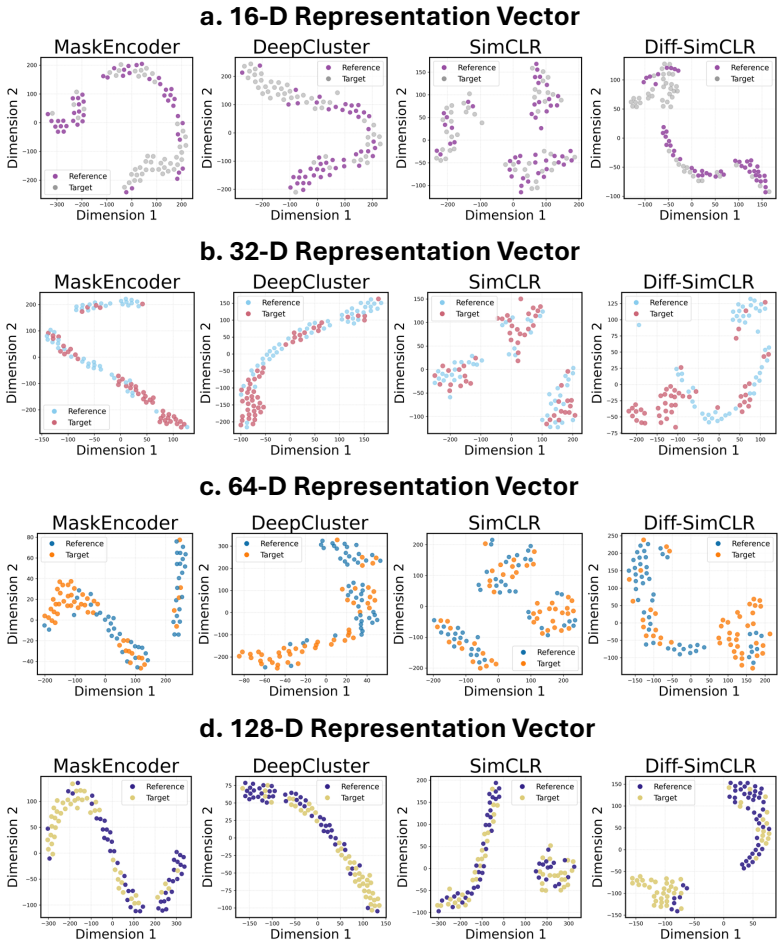
- The 32-dimensional Diff-SimCLR features give the best supervised accuracy (93.00% with a linear SVC) and the cleanest t-SNE and PCA cluster separation among the tested baselines.
- POLARIS will keep growing with ongoing SPHERE operations, so the benchmark can be extended to future versions rather than frozen.
Reading between the lines
- The paper's own limitation section implies a testable contamination risk: faint debris disks may already sit in the reference class, so the reported 93% could overstate performance on exactly the faint-disk regime; moving known debris-disk systems into the target class and re-running the pipeline would quantify this.
- Because the VAE learns background from reference exposures alone, the same pipeline could replace ADI's self-subtraction with a learned stellar PSF, which would change how extended disk morphology is measured; this is an extension the paper only begins to explore.
- Diff-SimCLR's diffusion priors carry no explicit astrophysical constraints; injecting rotation angle or parallactic-angle structure into the latent trajectory is a natural next experiment to test whether physical invariants further sharpen the representations.
Editorial analysis
A structured set of objections, weighed in public.
Referee Report
Summary. The paper introduces POLARIS, a publicly released benchmark dataset of polarized-light images from VLT/SPHERE IRDIS, comprising 96 manually labeled and 813 unlabeled Qϕ images together with corresponding preprocessed exposure sequences. The authors evaluate a range of unsupervised representation learning baselines (Masked Autoencoder, DeepCluster, SimCLR), large vision-language models in a zero-shot setting, and propose Diff-SimCLR, which augments SimCLR with latent states from a DDPM. The learned representations are assessed via supervised and unsupervised downstream classifiers, with Diff-SimCLR reported to achieve 93.00% SVC accuracy on the 96 labeled images. A preliminary VAE-based background reconstruction experiment is included as a proof of concept for automated reference-star subtraction.
Significance. If the dataset is validated, POLARIS addresses a real need in high-contrast imaging: automated reference-star selection for reference differential imaging, which could substantially reduce manual labeling effort and enable scalable archival analysis. The paper's strengths are the public data release, the uniform IRDAP-based reduction of a decade of SPHERE/IRDIS observations, the breadth of benchmarked models including LVLMs, and an explicit limitations section that candidly acknowledges the key labeling assumption. However, the headline Diff-SimCLR claim is undermined by the evaluation protocol, the accuracy tables are internally inconsistent, and the pseudo-labeling strategy carries unquantified contamination risk. The dataset contribution is promising, but the empirical claims as presented are not yet supported.
major comments (4)
- [Section 4.2 and Appendix A.2, Tables 4 and 5] The structural hyperparameters of Diff-SimCLR are selected using the same 96 labeled images on which the final accuracy is reported, with no error bars or confidence intervals. Appendix A.2 states that Δt is searched over [2,4,8,16], and Table 5 shows SVC accuracy varying from 80.44% to 93.00%; choosing the best of four values after seeing test performance inflates the estimate, as does selecting dimension 32 because the model 'begins to outperform other models from a dimension of 32 onward' in Table 4. The 10-fold cross-validation described in Section 4.2 only tunes downstream classifier hyperparameters within folds and does not protect the representation-learning hyperparameters. With n=96, the 6.54-point gap over SimCLR (86.46%) could plausibly arise from selection bias, so the state-of-the-art claim is not established. Please report confidence intervals and use an outer validation loop or a held-out test set for structural hyperparameter selection.
- [Section 7 vs Tables 2 and 4] The conclusion claims that Diff-SimCLR achieves state-of-the-art accuracy in both supervised and unsupervised settings, but Table 2 shows SimCLR's spectral clustering accuracy (77.78%) exceeding Diff-SimCLR's (77.33%), and Table 4 shows similar patterns at other dimensions. This is an internal contradiction. The claim should either be restricted to supervised settings, or the unsupervised comparison needs a statistical test (e.g., paired resampling over folds) to support it.
- [Section 6 and Section 4.2 (Figure 11)] The benchmark's pseudo-labels for the 813 unlabeled images rest on the assumption, stated in Section 6, that 'a non-detection of circumstellar objects in polarized light is equivalent to their non-existence in total intensity.' The paper concedes that this holds for disks but not for exoplanets and notes that faint debris disks may be mislabeled as references. Because the spectral clustering pseudo-labels are used to select reference exposures for the VAE and to evaluate clustering (Figure 11), label contamination would propagate into both the benchmark ground truth and the reconstruction experiment. Please quantify the contamination risk, for example by checking known debris disk systems, or clearly state the validity conditions in the dataset documentation.
- [Sections 3.1 and 3.2] The dataset description contains a serious documentation error: the 813 unlabeled images are said to be 'annotated with vegetation indices and land-use metadata,' which is nonsensical for astronomical images and likely a copy-paste artifact. In addition, the abstract claims 'over 1,000,000 images from more than 10,000 exposures,' while Section 3.1 reports 75,910 preprocessed files and 921 Qϕ files. These inconsistencies must be corrected, and the dataset documentation should be checked for any other erroneous metadata, before the benchmark can be considered trustworthy.
minor comments (6)
- [Section 3.2 heading] The heading 'Data Preprataion' should be 'Data Preparation'.
- [Section 3.2] The sentence 'To support research on our POLARIS representation learning, we create Single-frame polarimetric images (...)' is grammatically incomplete; it should be revised for clarity.
- [Tables 2 and 3] Tables 2 and 3 report different accuracy values for the same models (e.g., Maskencoder 80.33 vs 85.00; SimCLR 84.78 vs 86.46); the relationship between these tables should be clarified in the text.
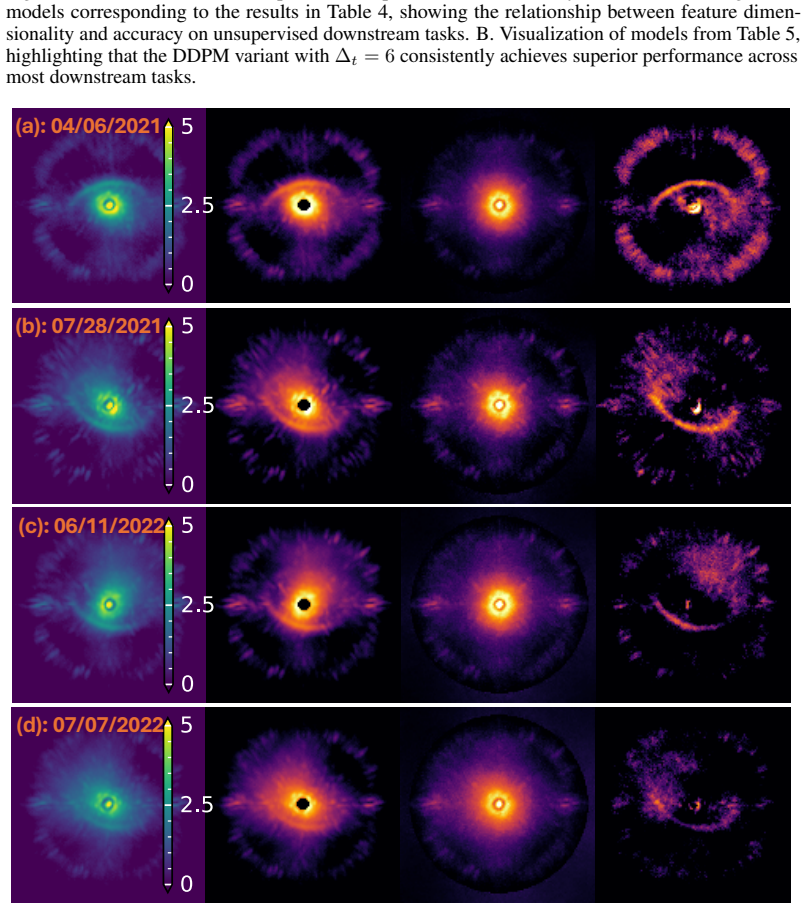
- [Figure 13B] Figure 13B caption states that the DDPM variant with Δt=6 achieves superior performance, but Table 5 uses Δt=8 and does not include Δt=6; this inconsistency should be fixed.
- [Throughout] There are several typographical errors, including 'Telesceope' in Section 1, 'upcompoing' in Section 5, and 'detections' in the Figure 1 caption; a careful proofread is needed.
- [References] Reference [70] duplicates reference [69]; the bibliography should be deduplicated.
Circularity Check
Diff-SimCLR's 93.00% SOTA accuracy is the maximum over Δt and dimensionality searched on the same 96 labeled images, so the headline performance claim is a fitted quantity rather than an independent prediction.
-
fitted input called prediction
[Section 4.2 (Tables 2–3) and Appendix A.2 (Table 5)]
"The number of latent states from DDPM Δt in Section 4.1.2, is evaluated over a searching region of [2, 4, 8, 16]. ... This trade-off is illustrated in Figure 13, where Δt = 8 achieves the best balance. ... achieving the highest accuracy of 93.00% with the SVC."
Δt is selected by maximizing downstream classification accuracy on the same 96 labeled images (Table 5: SVC accuracy ranges from 80.44% at Δt=16 to 93.00% at Δt=8), and the same selected-model accuracy is then reported in Tables 2–3 as Diff-SimCLR's state-of-the-art performance. The reported 93.00% is therefore the argmax of the search over Δt on the evaluation labels, not a held-out estimate; presenting it as the method's accuracy is equivalent to reporting the selection criterion itself. The 10-fold CV in Section 4.2 tunes only downstream classifier hyperparameters within folds, so it does not correct for selection of the representation-level hyperparameter Δt.
-
fitted input called prediction
[Section 4.1.1 and Appendix A.2 (Table 4)]
"As the models are designed to learn informative representations for subsequent classification tasks, a 32-dimensional feature vector is selected as the output representation. ... Diff-SimCLR begins to outperform other models from a dimension of 32 onward."
The representation dimensionality is chosen because Table 4, computed on the same 96 labeled images, shows Diff-SimCLR 'begins to outperform other models from a dimension of 32 onward.' All headline tables then use the 32-D representation. Selecting the dimension by the same labels and accuracy metric that define the final comparison turns the reported advantage into a post hoc selection, not an independent finding. This is the same selection-loop structure as the Δt choice and reinforces that the central SOTA claim reduces to a fitted maximum.
full rationale
The dataset itself is not circular: the 96 seed labels come from the externally published manual catalog [52] (despite author overlap, they are human inspection labels, not outputs of this paper's model), representation models are trained on unlabeled data, and only downstream classifiers/clustering see the 96 labels. The reference-labeling assumption (non-detection in polarized light equals absence in total intensity) is explicitly stated as a limitation in Section 6, not used to derive a prediction. The VAE reconstruction is qualitative and does not feed back into the accuracy claims. The genuine circularity is confined to the headline performance claim: the structural hyperparameters Δt and feature dimensionality are selected by optimizing the same 96-image evaluation metric that is later reported as Diff-SimCLR's 93.00% SOTA accuracy. Because the selection criterion is the reported quantity, the number is a fitted maximum over a small grid with no nested cross-validation or separate test set. This makes the 'state-of-the-art' claim statistically forced, but it does not invalidate the benchmark's data contribution.
Assumptions & free parameters
free parameters (4)
- Δt (number of DDPM latent states in Diff-SimCLR) =
8
- Spectral Clustering neighbor count n =
7
- MAE masking ratio =
20%
- Feature representation dimension =
32
assumptions (4)
- domain assumption Non-detection of circumstellar structure in polarized-light Qphi images implies the star is a clean reference in total intensity.
- domain assumption The 96 manually labeled systems from Ren et al. (2023) are a correct ground truth for target and reference classification.
- domain assumption IRDAP reduction of the public SPHERE/IRDIS archive produces uniformly calibrated Qphi and preprocessed products suitable for ML.
- domain assumption Standard deep learning training assumptions (i.i.d. images, meaningful augmentations) apply to astronomical imaging data.
Cite this review
Pith. "Pith review of POLARIS: A High-contrast Polarimetric Imaging Benchmark Dataset for Exoplanetary Disk Representation Learning." pith.science (2026). https://pith.science/paper/NG6OMRVI
@misc{pith2026250603511,
  author       = {Pith},
  title        = {Pith review of: POLARIS: A High-contrast Polarimetric Imaging Benchmark Dataset for Exoplanetary Disk Representation Learning},
  year         = {2026},
  howpublished = {\url{https://pith.science/paper/NG6OMRVI}},
  note         = {Machine review of arXiv:2506.03511}
}
read the original abstract
With over 1,000,000 images from more than 10,000 exposures using state-of-the-art high-contrast imagers (e.g., Gemini Planet Imager, VLT/SPHERE) in the search for exoplanets, can artificial intelligence (AI) serve as a transformative tool in imaging Earth-like exoplanets in the coming decade? In this paper, we introduce a benchmark and explore this question from a polarimetric image representation learning perspective. Despite extensive investments over the past decade, only a few new exoplanets have been directly imaged. Existing imaging approaches rely heavily on labor-intensive labeling of reference stars, which serve as background to extract circumstellar objects (disks or exoplanets) around target stars. With our POLARIS (POlarized Light dAta for total intensity Representation learning of direct Imaging of exoplanetary Systems) dataset, we classify reference star and circumstellar disk images using the full public SPHERE/IRDIS polarized-light archive since 2014, requiring less than 10 percent manual labeling. We evaluate a range of models including statistical, generative, and large vision-language models and provide baseline performance. We also propose an unsupervised generative representation learning framework that integrates these models, achieving superior performance and enhanced representational power. To our knowledge, this is the first uniformly reduced, high-quality exoplanet imaging dataset, rare in astrophysics and machine learning. By releasing this dataset and baselines, we aim to equip astrophysicists with new tools and engage data scientists in advancing direct exoplanet imaging, catalyzing major interdisciplinary breakthroughs.
Figures


Figures from the paper (11 more)




Reference graph
Works this paper leans on
-
[1]
C. Adam, J. Olofsson, R. G. van Holstein, A. Bayo, J. Milli, A. Boccaletti, Q. Kral, C. Ginski, Th. Henning, M. Montesinos, N. Pawellek, A. Zurlo, M. Langlois, A. Delboulbé, A. Pavlov, J. Ramos, L. Weber, F. Wildi, F. Rigal, and J. F. Sauvage. Characterizing the morphology of the debris disk around the low-mass star GSC 07396-00759.Astronomy and Astrophys...
work page 2021
-
[2]
Quanz, Antonio Garufi, Sebastian Perez, Simon Casassus, Christophe Pinte, Gesa H
Henning Avenhaus, Sascha P. Quanz, Antonio Garufi, Sebastian Perez, Simon Casassus, Christophe Pinte, Gesa H. M. Bertrang, Claudio Caceres, Myriam Benisty, and Carsten Do- minik. Disks around T Tauri Stars with SPHERE (DARTTS-S). I. SPHERE/IRDIS Polarimetric Imaging of Eight Prominent T Tauri Disks.The Astrophysical Journal, 863(1):44, August 2018
work page 2018
-
[3]
Dullemond, Stefano Facchini, Andrea Isella, Miriam Keppler, Laura M
Jaehan Bae, Zhaohuan Zhu, Clément Baruteau, Myriam Benisty, Cornelis P. Dullemond, Stefano Facchini, Andrea Isella, Miriam Keppler, Laura M. Pérez, and Richard Teague. An Ideal Testbed for Planet-Disk Interaction: Two Giant Protoplanets in Resonance Shaping the PDS 70 Protoplanetary Disk.The Astrophysical Journal Letters, 884(2):L41, October 2019
work page 2019
-
[4]
Jaehan Bae, Zhaohuan Zhu, and Lee Hartmann. Planetary Signatures in the SAO 206462 (HD 135344B) Disk: A Spiral Arm Passing through V ortex?The Astrophysical Journal, 819(2):134, March 2016
work page 2016
-
[5]
Bailey, Eduardo Bendek, Brian Monacelli, Caleb Baker, Gasia Bedrosian, Eric Cady, Ewan S
Vanessa P. Bailey, Eduardo Bendek, Brian Monacelli, Caleb Baker, Gasia Bedrosian, Eric Cady, Ewan S. Douglas, Tyler Groff, Sergi R. Hildebrandt, N. Jeremy Kasdin, John Krist, Bruce Macintosh, Bertrand Mennesson, Patrick Morrissey, Ilya Poberezhskiy, Hari B. Subedi, Jason Rhodes, Aki Roberge, Marie Ygouf, Robert T. Zellem, Feng Zhao, and Neil T. Zimmerman....
work page 2023
-
[6]
M. Benisty, C. Dominik, K. Follette, A. Garufi, C. Ginski, J. Hashimoto, M. Keppler, W. Kley, and J. Monnier. Optical and Near-infrared View of Planet-forming Disks and Protoplanets. In S. Inutsuka, Y . Aikawa, T. Muto, K. Tomida, and M. Tamura, editors,Protostars and Planets VII, volume 534 ofAstronomical Society of the Pacific Conference Series, page 60...
work page 2023
-
[7]
M. Benisty, A. Juhasz, A. Boccaletti, H. Avenhaus, J. Milli, C. Thalmann, C. Dominik, P. Pinilla, E. Buenzli, A. Pohl, J. L. Beuzit, T. Birnstiel, J. de Boer, M. Bonnefoy, G. Chauvin, V . Chris- tiaens, A. Garufi, C. Grady, T. Henning, N. Huelamo, A. Isella, M. Langlois, F. Ménard, D. Mouillet, J. Olofsson, E. Pantin, C. Pinte, and L. Pueyo. Asymmetric fe...
work page 2015
-
[8]
SPHERE: a ’Planet Finder’ instrument for the VLT
Jean-Luc Beuzit, Markus Feldt, Kjetil Dohlen, David Mouillet, Pascal Puget, Francois Wildi, Lyu Abe, Jacopo Antichi, Andrea Baruffolo, Pierre Baudoz, Anthony Boccaletti, Marcel Carbil- let, Julien Charton, Riccardo Claudi, Mark Downing, Christophe Fabron, Philippe Feautrier, Enrico Fedrigo, Thierry Fusco, Jean-Luc Gach, Raffaele Gratton, Thomas Henning, N...
work page 2008
Show all 71 references
-
[9]
Bonse, Timothy D
Markus J. Bonse, Timothy D. Gebhard, Felix A. Dannert, Olivier Absil, Faustine Cantalloube, Valentin Christiaens, Gabriele Cugno, Emily O. Garvin, Jean Hayoz, Markus Kasper, Elisabeth Matthews, Bernhard Schölkopf, and Sascha P. Quanz. Use the 4S (Signal-Safe Speckle Subtrac- t...
2011
-
[10]
Deep clustering for unsupervised learning of visual features, 2019
Mathilde Caron, Piotr Bojanowski, Armand Joulin, and Matthijs Douze. Deep clustering for unsupervised learning of visual features, 2019. 10
2019
-
[11]
Direct imaging of exoplanets: Legacy and prospects.Comptes Rendus Physique, 24(S2):139, January 2024
Gael Chauvin. Direct imaging of exoplanets: Legacy and prospects.Comptes Rendus Physique, 24(S2):139, January 2024
2024
-
[12]
A simple framework for contrastive learning of visual representations
Ting Chen, Simon Kornblith, Mohammad Norouzi, and Geoffrey Hinton. A simple framework for contrastive learning of visual representations. InProceedings of the International Conference on Machine Learning, pages 1597–1607. PmLR, 2020
2020
-
[13]
R. U. Claudi, M. Turatto, R. G. Gratton, J. Antichi, M. Bonavita, P. Bruno, E. Cascone, V . De Caprio, S. Desidera, E. Giro, D. Mesa, S. Scuderi, K. Dohlen, J. L. Beuzit, and P. Puget. SPHERE IFS: the spectro differential imager of the VLT for exoplanets search. In Ian S. McLe...
2008
-
[14]
Wagner, Camryn Mullin, Ruobing Dong, Thomas Greene, Doug Johnstone, Michael R
Gabriele Cugno, Jarron Leisenring, Kevin R. Wagner, Camryn Mullin, Ruobing Dong, Thomas Greene, Doug Johnstone, Michael R. Meyer, Schuyler G. Wolff, Charles Beichman, Martha Boyer, Scott Horner, Klaus Hodapp, Doug Kelly, Don McCarthy, Thomas Roellig, George Rieke, Marcia Rieke...
2024
-
[15]
Currie, B
T. Currie, B. Biller, A. Lagrange, C. Marois, O. Guyon, E. L. Nielsen, M. Bonnefoy, and R. J. De Rosa. Direct Imaging and Spectroscopy of Extrasolar Planets. In S. Inutsuka, Y . Aikawa, T. Muto, K. Tomida, and M. Tamura, editors,Protostars and Planets VII, volume 534 ofASPC, p...
2023
-
[16]
Desidera, G
S. Desidera, G. Chauvin, M. Bonavita, S. Messina, H. LeCoroller, T. Schmidt, R. Gratton, C. Lazzoni, M. Meyer, J. Schlieder, A. Cheetham, J. Hagelberg, M. Bonnefoy, M. Feldt, A. M. Lagrange, M. Langlois, A. Vigan, T. G. Tan, F. J. Hambsch, M. Millward, J. Alcalá, S. Benatti, W...
2021
-
[17]
The infra-red dual imaging and spectrograph for SPHERE: design and performance
Kjetil Dohlen, Maud Langlois, Michel Saisse, Lucien Hill, Alain Origne, Marc Jacquet, Christophe Fabron, Jean-Claude Blanc, Marc Llored, Michael Carle, Claire Moutou, Arthur Vi- gan, Anthony Boccaletti, Marcel Carbillet, David Mouillet, and Jean-Luc Beuzit. The infra-red dual ...
2008
-
[18]
An M Dwarf Companion and Its Induced Spiral Arms in the HD 100453 Protoplanetary Disk.The Astrophysical Journal Letters, 816(1):L12, January 2016
Ruobing Dong, Zhaohuan Zhu, Jeffrey Fung, Roman Rafikov, Eugene Chiang, and Kevin Wagner. An M Dwarf Companion and Its Induced Spiral Arms in the HD 100453 Protoplanetary Disk.The Astrophysical Journal Letters, 816(1):L12, January 2016
2016
-
[19]
Rafikov, and James M
Ruobing Dong, Zhaohuan Zhu, Roman R. Rafikov, and James M. Stone. Observational Signatures of Planets in Protoplanetary Disks: Spiral Arms Observed in Scattered Light Imaging Can be Induced by Planets.The Astrophysical Journal Letters, 809(1):L5, August 2015
2015
-
[20]
An image is worth 16x16 words: Transformers for image recognition at scale.CoRR, abs/2010.11929, 2020
Alexey Dosovitskiy, Lucas Beyer, Alexander Kolesnikov, Dirk Weissenborn, Xiaohua Zhai, Thomas Unterthiner, Mostafa Dehghani, Matthias Minderer, Georg Heigold, Sylvain Gelly, Jakob Uszkoreit, and Neil Houlsby. An image is worth 16x16 words: Transformers for image recognition at...
2010 arXiv
-
[21]
Esposito, Gaspard Duchêne, Paul Kalas, Malena Rice, Élodie Choquet, Bin Ren, Marshall D
Thomas M. Esposito, Gaspard Duchêne, Paul Kalas, Malena Rice, Élodie Choquet, Bin Ren, Marshall D. Perrin, Christine H. Chen, Pauline Arriaga, Eugene Chiang, Eric L. Nielsen, James R. Graham, Jason J. Wang, Robert J. De Rosa, Katherine B. Follette, S. Mark Am- mons, Megan Ansd...
2018
-
[22]
REXPACO: An algorithm for high contrast reconstruction of the circumstellar environment by angular differential imaging.Astronomy and Astrophysics, 651:A62, July 2021
Olivier Flasseur, Samuel Thé, Loïc Denis, Éric Thiébaut, and Maud Langlois. REXPACO: An algorithm for high contrast reconstruction of the circumstellar environment by angular differential imaging.Astronomy and Astrophysics, 651:A62, July 2021
2021
-
[23]
Fulton, Lee J
Benjamin J. Fulton, Lee J. Rosenthal, Lea A. Hirsch, Howard Isaacson, Andrew W. Howard, Cayla M. Dedrick, Ilya A. Sherstyuk, Sarah C. Blunt, Erik A. Petigura, Heather A. Knutson, Aida Behmard, Ashley Chontos, Justin R. Crepp, Ian J. M. Crossfield, Paul A. Dalba, Debra A. Fisch...
2021
-
[24]
Masked autoencoders are scalable vision learners, 2021
Kaiming He, Xinlei Chen, Saining Xie, Yanghao Li, Piotr Dollár, and Ross Girshick. Masked autoencoders are scalable vision learners, 2021
2021
-
[25]
Denoising diffusion probabilistic models, 2020
Jonathan Ho, Ajay Jain, and Pieter Abbeel. Denoising diffusion probabilistic models, 2020
2020
-
[26]
Formation of Giant Planets.arXiv e-prints, page arXiv:2504.04090, April 2025
Masahiro Ikoma and Hiroshi Kobayashi. Formation of Giant Planets.arXiv e-prints, page arXiv:2504.04090, April 2025
2025 arXiv
-
[27]
Juillard, V
S. Juillard, V . Christiaens, O. Absil, S. Stasevic, and J. Milli. Combining reference-star and angular differential imaging for high-contrast imaging of extended sources.Astronomy and Astrophysics, 688:A185, August 2024
2024
-
[28]
Supervised contrastive learning, 2021
Prannay Khosla, Piotr Teterwak, Chen Wang, Aaron Sarna, Yonglong Tian, Phillip Isola, Aaron Maschinot, Ce Liu, and Dilip Krishnan. Supervised contrastive learning, 2021
2021
-
[29]
Quentin Kral, Cathie Clarke, and Mark C. Wyatt. Circumstellar Discs: What Will Be Next? In Hans J. Deeg and Juan Antonio Belmonte, editors,Handbook of Exoplanets, page 165. 2018
2018
-
[30]
Langlois, R
M. Langlois, R. Gratton, A. M. Lagrange, P. Delorme, A. Boccaletti, M. Bonnefoy, A. L. Maire, D. Mesa, G. Chauvin, S. Desidera, A. Vigan, A. Cheetham, J. Hagelberg, M. Feldt, M. Meyer, P. Rubini, H. Le Coroller, F. Cantalloube, B. Biller, M. Bonavita, T. Bhowmik, W. Brandner, ...
2021
-
[31]
D. N. C. Lin, P. Bodenheimer, and D. C. Richardson. Orbital migration of the planetary companion of 51 Pegasi to its present location.Nature, 380(6575):606–607, April 1996
1996
-
[32]
Diffusion models meet remote sensing: Principles, methods, and perspectives.IEEE Transactions on Geoscience and Remote Sensing, 62:1–22, 2024
Yidan Liu, Jun Yue, Shaobo Xia, Pedram Ghamisi, Weiying Xie, and Leyuan Fang. Diffusion models meet remote sensing: Principles, methods, and perspectives.IEEE Transactions on Geoscience and Remote Sensing, 62:1–22, 2024
2024
-
[33]
Macintosh, James R
Bruce A. Macintosh, James R. Graham, David W. Palmer, René Doyon, Jennifer Dunn, Donald T. Gavel, James Larkin, Ben Oppenheimer, Les Saddlemyer, Anand Sivaramakrishnan, J. Kent Wallace, Brian Bauman, Darren A. Erickson, Christian Marois, Lisa A. Poyneer, and Remi Soummer. The ...
2008
-
[34]
Chauvin, Silvano Desidera, Julien H
Anne-Lise Maire, Maud Langlois, Kjetil Dohlen, Anne-Marie Lagrange, Raffaele Gratton, Gaël. Chauvin, Silvano Desidera, Julien H. Girard, Julien Milli, Arthur Vigan, Gerard Zins, Philippe Delorme, Jean-Luc Beuzit, Riccardo U. Claudi, Markus Feldt, David Mouillet, Pascal Puget, ...
2016
-
[35]
An- gular Differential Imaging: A Powerful High-Contrast Imaging Technique.The Astrophysical Journal, 641(1):556–564, April 2006
Christian Marois, David Lafrenière, René Doyon, Bruce Macintosh, and Daniel Nadeau. An- gular Differential Imaging: A Powerful High-Contrast Imaging Technique.The Astrophysical Journal, 641(1):556–564, April 2006
2006
-
[36]
A Jupiter-mass companion to a solar-type star.Nature, 378(6555):355–359, November 1995
Michel Mayor and Didier Queloz. A Jupiter-mass companion to a solar-type star.Nature, 378(6555):355–359, November 1995
1995
-
[37]
Johan Mazoyer, Charles Goulas, Fabrice Vidal, Isaac Bernardino Dinis, Julien Milli, Michel Tallon, Raphaël. Galicher, Olivier Absil, Clémentine Bechet, Anthony Boccaletti, Florian Ferreira, Maud Langlois, Patrice Martinez, Laurent Mugnier, Mamadou N’diaye, Gilles Orban de Xivr...
2024
-
[38]
Milli, D
J. Milli, D. Mouillet, A. M. Lagrange, A. Boccaletti, D. Mawet, G. Chauvin, and M. Bon- nefoy. Impact of angular differential imaging on circumstellar disk images.Astronomy and Astrophysics, 545:A111, September 2012
2012
-
[39]
Monnier, Tim J
John D. Monnier, Tim J. Harries, Jaehan Bae, Benjamin R. Setterholm, Anna Laws, Alicia Aarnio, Fred C. Adams, Sean Andrews, Nuria Calvet, Catherine Espaillat, Lee Hartmann, Stefan Kraus, Melissa McClure, Chris Miller, Rebecca Oppenheimer, David Wilner, and Zhaohuan Zhu. Multip...
2019
-
[40]
Nielsen, Robert J
Eric L. Nielsen, Robert J. De Rosa, Bruce Macintosh, Jason J. Wang, Jean-Baptiste Ruffio, Eu- gene Chiang, Mark S. Marley, Didier Saumon, Dmitry Savransky, S. Mark Ammons, Vanessa P. Bailey, Travis Barman, Célia Blain, Joanna Bulger, Adam Burrows, Jeffrey Chilcote, Tara Cotten...
2019
-
[41]
Olofsson, P
J. Olofsson, P. Thébault, A. Bayo, Th. Henning, and J. Milli. The near-infrared degree of polar- ization in debris disks. Toward a self-consistent approach to model scattered light observations. Astronomy and Astrophysics, 688:A42, August 2024
2024
-
[42]
Owen and Yanqin Wu
James E. Owen and Yanqin Wu. The Evaporation Valley in the Kepler Planets.The Astrophysical Journal, 847(1):29, September 2017
2017
-
[43]
MAYONNAISE: a morphological components analysis pipeline for circumstellar discs and exoplanets imaging in the near-infrared
Benoît Pairet, Faustine Cantalloube, and Laurent Jacques. MAYONNAISE: a morphological components analysis pipeline for circumstellar discs and exoplanets imaging in the near-infrared. Monthly Notices of the Royal Astronomical Society, 503(3):3724–3742, May 2021
2021
-
[44]
W. D. Pence, L. Chiappetti, C. G. Page, R. A. Shaw, and E. Stobie. Definition of the Flexible Image Transport System (FITS), version 3.0.Astronomy and Astrophysics, 524:A42, December 2010
2010
-
[45]
Perrin, Gaspard Duchene, Max Millar-Blanchaer, Michael P
Marshall D. Perrin, Gaspard Duchene, Max Millar-Blanchaer, Michael P. Fitzgerald, James R. Graham, Sloane J. Wiktorowicz, Paul G. Kalas, Bruce Macintosh, Brian Bauman, Andrew Cardwell, Jeffrey Chilcote, Robert J. De Rosa, Daren Dillon, René Doyon, Jennifer Dunn, Darren Erikson...
2015
-
[46]
Peters-Limbach, Tyler Groff, N
Mary A. Peters-Limbach, Tyler Groff, N. Jeremy Kasdin, Michael W. McElwain, Michael Galvin, Michael A. Carr, Robert Lupton, James E. Gunn, Gillian Knapp, Qian Gong, Alexis Carlotti, Timothy Brandt, Markus Janson, Olivier Guyon, Frantz Martinache, Masahiko Hayashi, and Naruhisa...
2012
-
[47]
Detection and Characterization of Exoplanets using Projections on Karhunen Loeve Eigenimages: Forward Modeling.The Astrophysical Journal, 824(2):117, June 2016
Laurent Pueyo. Detection and Characterization of Exoplanets using Projections on Karhunen Loeve Eigenimages: Forward Modeling.The Astrophysical Journal, 824(2):117, June 2016
2016
-
[48]
Direct Imaging as a Detection Technique for Exoplanets
Laurent Pueyo. Direct Imaging as a Detection Technique for Exoplanets. In Hans J. Deeg and Juan Antonio Belmonte, editors,Handbook of Exoplanets, page 10. 2018
2018
-
[49]
Quanz, Ian Crossfield, Michael R
Sascha P. Quanz, Ian Crossfield, Michael R. Meyer, Eva Schmalzl, and Jenny Held. Direct detection of exoplanets in the 3-10 µm range with E-ELT/METIS.International Journal of Astrobiology, 14(2):279–289, April 2015
2015
-
[50]
Debes, Gaspard Duchêne, François Ménard, and Marshall D
Bin Ren, Laurent Pueyo, Christine Chen, Élodie Choquet, John H. Debes, Gaspard Duchêne, François Ménard, and Marshall D. Perrin. Using Data Imputation for Signal Separation in High-contrast Imaging.The Astrophysical Journal, 892(2):74, April 2020
2020
-
[51]
Non-negative Matrix Factorization: Robust Extraction of Extended Structures.The Astrophysical Journal, 852(2):104, January 2018
Bin Ren, Laurent Pueyo, Guangtun Ben Zhu, John Debes, and Gaspard Duchêne. Non-negative Matrix Factorization: Robust Extraction of Extended Structures.The Astrophysical Journal, 852(2):104, January 2018
2018
-
[52]
Ren, Myriam Benisty, Christian Ginski, Ryo Tazaki, Nicole L
Bin B. Ren, Myriam Benisty, Christian Ginski, Ryo Tazaki, Nicole L. Wallack, Julien Milli, Antonio Garufi, Jaehan Bae, Stefano Facchini, François Ménard, Paola Pinilla, C. Swastik, Richard Teague, and Zahed Wahhaj. Protoplanetary disks in K s-band total intensity and polarized...
2023
-
[53]
Yu, and Lifang He
Yazhou Ren, Jingyu Pu, Zhimeng Yang, Jie Xu, Guofeng Li, Xiaorong Pu, Philip S. Yu, and Lifang He. Deep clustering: A comprehensive survey, 2022. 14
2022
-
[54]
Rich, John D
Evan A. Rich, John D. Monnier, Alicia Aarnio, Anna S. E. Laws, Benjamin R. Setterholm, David J. Wilner, Nuria Calvet, Tim Harries, Chris Miller, Claire L. Davies, Fred C. Adams, Sean M. Andrews, Jaehan Bae, Catherine Espaillat, Alexandra Z. Greenbaum, Sasha Hinkley, Stefan Kra...
2022
-
[55]
H. M. Schmid, A. Bazzon, R. Roelfsema, D. Mouillet, J. Milli, F. Menard, D. Gisler, S. Hunziker, J. Pragt, C. Dominik, A. Boccaletti, C. Ginski, L. Abe, S. Antoniucci, H. Avenhaus, A. Baruffolo, P. Baudoz, J. L. Beuzit, M. Carbillet, G. Chauvin, R. Claudi, A. Costille, J. B. D...
2018
-
[56]
B. A. Smith and R. J. Terrile. A Circumstellar Disk aroundβ Pictoris.Science, 226(4681):1421– 1424, December 1984
1984
-
[57]
Brendan Hagan, Laurent Pueyo, Adrien Thormann, Abhijith Rajan, and Christian Marois
Rémi Soummer, J. Brendan Hagan, Laurent Pueyo, Adrien Thormann, Abhijith Rajan, and Christian Marois. Orbital Motion of HR 8799 b, c, d Using Hubble Space Telescope Data from 1998: Constraints on Inclination, Eccentricity, and Stability.The Astrophysical Journal, 741(1):55, No...
1998
-
[58]
Perrin, Laurent Pueyo, Élodie Choquet, Christine Chen, David A
Rémi Soummer, Marshall D. Perrin, Laurent Pueyo, Élodie Choquet, Christine Chen, David A. Golimowski, J. Brendan Hagan, Tushar Mittal, Margaret Moerchen, Mamadou N’Diaye, Ab- hijith Rajan, Schuyler Wolff, John Debes, Dean C. Hines, and Glenn Schneider. Five Debris Disks Newly ...
2014
-
[59]
Detection and Characterization of Exoplan- ets and Disks Using Projections on Karhunen-Loève Eigenimages.The Astrophysical Journal Letters, 755(2):L28, August 2012
Rémi Soummer, Laurent Pueyo, and James Larkin. Detection and Characterization of Exoplan- ets and Disks Using Projections on Karhunen-Loève Eigenimages.The Astrophysical Journal Letters, 755(2):L28, August 2012
2012
-
[60]
Stark, Bertrand Mennesson, Steve Bryson, Eric B
Christopher C. Stark, Bertrand Mennesson, Steve Bryson, Eric B. Ford, Tyler D. Robinson, Ruslan Belikov, Matthew R. Bolcar, Lee D. Feinberg, Olivier Guyon, Natasha Latouf, Avi M. Mandell, Bernard J. Rauscher, Dan Sirbu, and Noah W. Tuchow. Paths to robust exoplanet science yie...
2024
-
[61]
Stepp, Larry G
Larry M. Stepp, Larry G. Daggert, and Paul E. Gillett. Estimating the costs of extremely large telescopes. In J. Roger P. Angel and Roberto Gilmozzi, editors,Future Giant Telescopes, volume 4840, pages 309 – 321. International Society for Optics and Photonics, SPIE, 2003
2003
-
[62]
SEEDS - Strategic explorations of exoplanets and disks with the Subaru Telescope -.Proceedings of the Japan Academy, Series B, 92:45–55, February 2016
Motohide Tamura. SEEDS - Strategic explorations of exoplanets and disks with the Subaru Telescope -.Proceedings of the Japan Academy, Series B, 92:45–55, February 2016
2016
-
[63]
R. G. van Holstein, J. H. Girard, J. de Boer, F. Snik, J. Milli, D. M. Stam, C. Ginski, D. Mouillet, Z. Wahhaj, H. M. Schmid, C. U. Keller, M. Langlois, K. Dohlen, A. Vigan, A. Pohl, M. Carbillet, D. Fantinel, D. Maurel, A. Origné, C. Petit, J. Ramos, F. Rigal, A. Sevin, A. Bo...
2020
-
[64]
van Holstein, Frans Snik, Julien H
Rob G. van Holstein, Frans Snik, Julien H. Girard, Jozua de Boer, C. Ginski, Christoph U. Keller, Daphne M. Stam, Jean-Luc Beuzit, David Mouillet, Markus Kasper, Maud Langlois, Alice Zurlo, Remco J. de Kok, and Arthur Vigan. Combining angular differential imaging and accurate ...
2017
-
[65]
Maarten van Smeden, Joris A. H. de Groot, Karel G. M. Moons, Gary S. Collins, Douglas G. Altman, Marinus J. C. Eijkemans, and Johannes B. Reitsma. No rationale for 1 variable per 10 events criterion for binary logistic regression analysis.BMC Medical Research Methodology, 16(1...
2016
-
[66]
Wahhaj, J
Z. Wahhaj, J. Milli, C. Romero, L. Cieza, A. Zurlo, A. Vigan, E. Peña, G. Valdes, F. Cantalloube, J. Girard, and B. Pantoja. A search for a fifth planet around HR 8799 using the star-hopping RDI technique at VLT/SPHERE.Astronomy and Astrophysics, 648:A26, April 2021
2021
-
[67]
Diffusion based zero-shot medical image-to-image translation for cross modality segmentation, 2024
Zihao Wang, Yingyu Yang, Yuzhou Chen, Tingting Yuan, Maxime Sermesant, Herve Delingette, and Ona Wu. Diffusion based zero-shot medical image-to-image translation for cross modality segmentation, 2024
2024
-
[68]
Mutual information guided diffusion for zero-shot cross-modality medical image translation.IEEE Transactions on Medical Imaging, 43(8):2825–2838, 2024
Zihao Wang, Yingyu Yang, Yuzhou Chen, Tingting Yuan, Maxime Sermesant, Hervé Delingette, and Ona Wu. Mutual information guided diffusion for zero-shot cross-modality medical image translation.IEEE Transactions on Medical Imaging, 43(8):2825–2838, 2024
2024
-
[70]
Reference-star differential imaging on SPHERE/IRDIS.Astronomy and Astrophysics, 666:A32, October 2022
Chen Xie, Elodie Choquet, Arthur Vigan, Faustine Cantalloube, Myriam Benisty, Anthony Boccaletti, Mickael Bonnefoy, Celia Desgrange, Antonio Garufi, Julien Girard, Janis Hagelberg, Markus Janson, Matthew Kenworthy, Anne-Marie Lagrange, Maud Langlois, François Menard, and Alice...
2022
-
[71]
Rethinking the augmentation module in contrastive learning: Learning hierarchical augmentation invariance with expanded views
Junbo Zhang and Kaisheng Ma. Rethinking the augmentation module in contrastive learning: Learning hierarchical augmentation invariance with expanded views. InProceedings of the IEEE/CVF Conference on Computer Vision and Pattern Recognition, pages 16650–16659, 2022
2022
-
[72]
Direct imaging of exoplanets.arXiv e-prints, page arXiv:2404.05797, April 2024
Alice Zurlo. Direct imaging of exoplanets.arXiv e-prints, page arXiv:2404.05797, April 2024. 16 A Technical Appendices and Supplementary Material A.1 Supplementary Details on POLARIS Note thatthe latest release of the POLARIS dataset (version v2) is available on Zenodo and is ...
2024 arXiv
Reviewed August 7, 2026 · model on record in the stance chip above.
Discussion (0). Sign in to comment.