REVIEW 4 major objections 5 minor 46 references
Path Generation and Evaluation in Video Games: A Nonparametric Statistical Approach
T0 review · 4 major / 5 minor · reviewed 2026-08-07 · deepseek-v4-flash
Pith's one-line read The paper claims that a model-free-copula pipeline with user-set bandwidth, correlation, and variance parameters generates synthetic game navigation paths spanning the full fidelity-diversity spectrum, and that an adapted nonparametric…
desk verdict A useful, interpretable path generator with a genuinely new copula-plus-model-free combination, but the validation skips the residual diagnostics that the temporal-preservation claim hinges on. read the letter →
The pith
A machine-rendered reading of the paper's core claim, the machinery that carries it, and where it could break.
The reading
What carries the argument
The machinery is the model-free transformation $H_n := C_n^{-1} \circ \Phi^{-1} \circ D_t$, which maps a path dimension into IID standard normal residuals by estimating a time-varying CDF $D_t$, applying the normal quantile function, and decorrelating with the Cholesky factor of the covariance matrix $\Gamma_n$. These residuals are coupled across dimensions by a Gaussian copula whose correlation matrix can be retargeted to $\Gamma_{\text{target}}$ and whose samples can be rescaled by $\lambda$ before the inverse transform is applied. The evaluation machinery is an adapted three-sample test: subsequences of length $L \sim O(\sqrt{T})$ are stacked into $pL$-dimensional points, and the binned statistic $C_T$ decides whether generated points are closer to the training data than held-out test points (overfit, $C_T \ll 0$) or farther away (underfit, $C_T \gg 0$).
What would settle it
Apply the MF transform to a path with known regime shifts and run a serial-correlation test (for example, Ljung-Box) and a normality test (for example, Shapiro-Wilk) on the residuals; significant dependence or non-normality would directly falsify the IID-residual premise that the copula-based reconstruction relies on.
Extended reading notes
Core claim
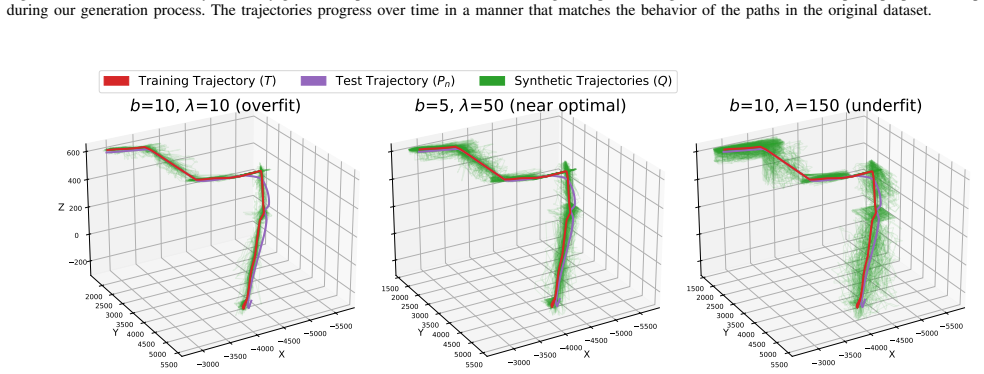
On its own terms, the paper claims that the MF-copula framework is a novel path-generation method that combines nonparametric model-free transformations with copulas to preserve both temporal and spatial dependence. The central discovery is that the combination of a per-dimension MF transform, a Gaussian copula on the residuals, and the inverse transform produces synthetic paths that preserve the local temporal dynamics of the original traces while allowing the cross-dimensional correlation and variance to be re-specified. The adapted three-sample statistic $C_T$, computed on subsequence-embedded point clouds, then places any generated set on the overfit-to-underfit continuum. Empirically, low bandwidth and scaling overfit, larger values reach near-optimal $C_T$, and still larger values underfit, on both the Tag and Navigation Turing Test datasets, and the same procedure generates synthetic human paths that the test can separate from neural-agent paths.
Load-bearing premise
The load-bearing premise is that after the model-free transformation, the residuals are truly independent standard normal draws; if the correlated variables $Z_t$ are not jointly normal, or the estimated time-varying CDFs $D_t$ are inaccurate, the Gaussian copula and inverse transform will not preserve the original temporal dependence structure.
Editorial extensions
If this is right
- Lower values of the bandwidth $b$ and scaling $\lambda$ make the generator intentionally reproduce training paths, while higher values shift the outputs through near-optimal fit to underfitting, with $C_T$ tracking the shift.
- Because the estimator is nonparametric and operates on a single path, the generator can produce many synthetic trajectories from one trace, filling the data-scarcity gap where deep generative models tend to underfit.
- Partitioning a path into locally stationary segments and fitting a separate copula to each segment lets the method generate long synthetic paths while respecting time-varying cross-correlation.
- The three-sample $C_T$ statistic acts as an interpretable diagnostic for generation quality, signaling excessive copying when strongly negative and excessive divergence when strongly positive, without requiring trained classifiers or human judges.
Reading between the lines
- The same pipeline should transfer to other low-dimensional multivariate traces such as eye tracking, handwriting, or telemetry, since the paper's core ingredients (nonstationary marginals plus cross-dimension dependence) are not specific to game navigation; the paper demonstrates only game data.
- Because $C_T$ appears monotone in $b$ and $\lambda$ in the reported experiments, one could invert the mapping and automatically choose parameters to hit a target $C_T \approx 0$, turning the method into a self-tuning generator; the paper does not implement this calibration loop.
- A direct residual-diagnostic check (serial dependence and normality tests on the MF residuals from real game paths) would tell practitioners when the IID assumption is trustworthy and therefore when the generated paths can be relied upon; the paper inherits the assumption from the locally stationary model rather than testing it.
Editorial analysis
A structured set of objections, weighed in public.
Referee Report
Summary. The paper proposes a nonparametric statistical framework for generating and evaluating synthetic navigation paths in video games. The generation method combines a model-free (MF) transformation, which maps each univariate component of a locally stationary path time series to independently distributed standard normal residuals via kernel estimates of the time-varying marginal CDFs and an estimated covariance matrix, with a Gaussian copula that models spatial dependence across coordinates. The generator has user-controllable parameters b (kernel bandwidth), λ (variance scaling), and Γ_target (target correlation), which the authors claim allow continuous interpolation between paths that closely mimic the training data and paths that are highly diverse. For evaluation, the paper adapts a three-sample hypothesis test from Meehan et al. to detect whether generated paths overfit or underfit the training data, using subsequence embeddings to capture local temporal dependencies. The method is demonstrated on two gaming datasets: the AMD Schola Tag example and the Navigation Turing Test (NTT) dataset. The reported results show that increasing b or λ moves the test statistic C_T from negative (overfitting) to positive (underfitting), and that synthetic human paths can be made to resemble or diverge from human trajectories relative to the NTT artificial agents.
Significance. If the method performs as claimed, it provides an interpretable, low-cost alternative to deep generative models for path augmentation and evaluation in game development, requiring only a small amount of training data and offering explicit control over the diversity of generated paths. The combination of model-free transformation with copulas for this application is novel and the paper includes a reproducible code repository, which is a notable strength. The proposed three-sample-test-based evaluation is a principled approach to diagnosing overfitting versus underfitting, and the application to two distinct gaming benchmarks gives the results practical grounding. However, the central statistical claim depends on an untested IID-Normal residual assumption and on several underspecified estimation steps, so the current evidence does not fully establish that temporal dependencies are preserved.
major comments (4)
- [Section III, Eq. (3) and footnote 2] The IID-Normal residual assumption is load-bearing and is not validated. The claim that ε_t = C_n^{-1}Z_t are IID standard normal requires joint normality of Z_t, which is deferred to reference [38] and not verified for the Schola or NTT paths. The paper reports no diagnostics such as autocorrelation functions, Ljung-Box tests, normality tests on the residuals, or uniformity tests on U_t. If this assumption fails, the inverse MF transform Y'_t = D_t^{-1}(Φ((C_n ε')_t)) will not preserve the temporal dependence of the original paths, and the C_T statistic in Tables I-III cannot distinguish faithful generation from artifacts. Please add residual diagnostics on the actual data and discuss how violations of the assumption would affect the generated paths.
- [Section III, Step 1 (Eq. (1))] The estimator D_t of the time-varying marginal CDF is not specified. The paper only states that D_t is obtained via kernel density estimation with bandwidth b, but does not define the local weighting scheme, the kernel, or the bandwidth selection procedure for a single path. Without this, the method is not reproducible from the text and the nonparametric claim is hard to assess. Please provide the exact estimator (e.g., as in Das and Politis [38]) and state how b is chosen in the experiments. Similarly, the covariance matrix estimator Γ_n from [42] is designed for stationary processes; please clarify how it is applied to locally stationary path data, particularly after the series is partitioned into locally stationary segments.
- [Section V, Eqs. (7)-(8)] The adaptation of the three-sample test is underspecified. In Eq. (7), d(x_i, T) and d(z_j, T) are not defined as distances to a set; please specify whether these are nearest-neighbor distances, average distances, or something else. The binning mechanism and the number of bins used to compute Z_π^U in Eq. (8) are not described. The subsequence length L is chosen only by the heuristic O(√T); please report the specific L used for each dataset and provide a sensitivity analysis or a justification. Additionally, Tables I-III report only the mean of C_T over 50 realizations; please include standard deviations or confidence intervals so the reader can assess whether the overfit/near-optimal/underfit classification is statistically stable.
- [Section VII, Fig. 8 and Tables I-III] The claim that temporal properties are preserved is supported only by a qualitative figure (three frames from one episode) and by the C_T statistic, which is an indirect measure based on subsequence distances. A direct quantitative comparison of temporal dependence, such as autocorrelation functions, spectral densities, or a test on the residuals' whiteness, is needed to substantiate the central claim. Furthermore, the text states that positive C_T values 'indicate close to optimal fit or underfitting,' which conflates two different regimes: C_T near 0 indicates good fit, while large positive C_T indicates underfitting. Please revise the interpretation and provide quantitative evidence of temporal preservation.
minor comments (5)
- [Section VII, Table I row 2] The sentence 'we obtain positive values of C_T for all agents which indicate close to optimal fit or underfitting' is ambiguous; values such as 1.65 for Chaser 1 likely indicate underfitting rather than near-optimal fit, and the discussion would benefit from a clearer threshold interpretation.
- [Section IV, Eq. (6)] The description of Γ_target as 'a set of uniformly distributed correlations within ±0.2 of the original correlation matrix' is vague; please state whether each entry is sampled independently and how the resulting matrix is made positive definite.
- [Section VII, Human-Like Navigation] The interpretation of Table III is confusing: 'overfit to the original human paths, i.e., they are farther from the RL agent paths' is not an accurate definition of overfitting; overfitting means being too close to the training data, not being farther from a comparison group. Please rephrase.
- [Section III, Step 2] The notation Φ^{-1}(U_t) is used without explicitly stating that Φ is the standard normal CDF in the main text; it is defined only in a parenthetical. Please define it at first use.
- [References] Reference [44] is listed as 'Package npcp' which is an R package name rather than a citable paper; please provide the appropriate citation for the hypothesis test used to detect non-stationary cross-correlations.
Circularity Check
No significant circularity: the derivation and evaluation loop is open, with user-chosen parameters and external tests.
full rationale
Walking the derivation: the MF transform (Eqs. 1-3) is a fixed invertible transformation; the claim that epsilon is IID follows from an explicit joint-normality premise footnoted to Das and Politis [38], an external published result with stated LSTS assumptions. Although [38] shares an author, the premise is an assumption about the data-generating process, not a conclusion derived from this paper's own outputs, so it is a correctness and robustness risk rather than a circular step. The generator's diversity controls (b, lambda, Gamma_target) are user-chosen and are characterized against C_T; the paper does not fit these parameters to minimize C_T or to force a particular score, so no fitted-input-called-prediction loop exists. The evaluation uses Meehan et al.'s three-sample test [35] with held-out test paths P_n, and the subsequence embedding is a stated heuristic; this is external benchmarking. The self-citations ([34], [38], [46]) supply prior methodology and a dataset and are not used to prove the paper's central claim by appeal to themselves. The temporal-preservation property is a designed consequence of the inverse transform (C_n imposes the estimated covariance), not an empirical prediction made to match the same covariance that defines the transform. Overall, no equation or fitted parameter reduces to its own conclusion; the IID-residual concern is a validity caveat, not evidence of circularity.
Assumptions & free parameters
free parameters (4)
- b (bandwidth of kernel density estimator) =
2, 5, 10, 20
- lambda (variance scaling factor) =
10, 50, 100, 150
- Gamma_target (target correlation matrix) =
sampled uniformly within +/- 0.2 of original correlations
- L (subsequence length in three-sample test) =
O(sqrt(T))
assumptions (5)
- domain assumption Z_t = Phi^{-1}(U_t) are jointly normal
- domain assumption Path traces are locally stationary time series
- standard math Sklar's theorem for copulas
- domain assumption Covariance matrix Gamma_n is invertible
- standard math The Z_U statistic is approximately standard normal under the null
Cite this review
Pith. "Pith review of Path Generation and Evaluation in Video Games: A Nonparametric Statistical Approach." pith.science (2026). https://pith.science/paper/UXROE6WP
@misc{pith2026250603522,
  author       = {Pith},
  title        = {Pith review of: Path Generation and Evaluation in Video Games: A Nonparametric Statistical Approach},
  year         = {2026},
  howpublished = {\url{https://pith.science/paper/UXROE6WP}},
  note         = {Machine review of arXiv:2506.03522}
}
read the original abstract
Navigation path traces play a crucial role in video game design, serving as a vital resource for both enhancing player engagement and fine-tuning non-playable character behavior. Generating such paths with human-like realism can enrich the overall gaming experience, and evaluating path traces can provide game designers insights into player interactions. Despite the impressive recent advancements in deep learning-based generative modeling, the video game industry hesitates to adopt such models for path generation, often citing their complex training requirements and interpretability challenges. To address these problems, we propose a novel path generation and evaluation approach that is grounded in principled nonparametric statistics and provides precise control while offering interpretable insights. Our path generation method fuses two statistical techniques: (1) nonparametric model-free transformations that capture statistical characteristics of path traces through time; and (2) copula models that capture statistical dependencies in space. For path evaluation, we adapt a nonparametric three-sample hypothesis test designed to determine if the generated paths are overfit (mimicking the original data too closely) or underfit (diverging too far from it). We demonstrate the precision and reliability of our proposed methods with empirical analysis on two existing gaming benchmarks to showcase controlled generation of diverse navigation paths. Notably, our novel path generator can be fine-tuned with user controllable parameters to create navigation paths that exhibit varying levels of human-likeness in contrast to those produced by neural network-based agents. The code is available at https://github.com/daniel-campa/mf-copula.
Figures


Figures from the paper (4 more)


Reference graph
Works this paper leans on
-
[38]
Predictive inference for locally stationary time series with an application to climate data,
S. Das and D. N. Politis, “Predictive inference for locally stationary time series with an application to climate data,”Journal of the American Statistical Association, vol. 116, no. 534, pp. 919–934, 2021
work page 2021
-
[42]
Banded and tapered estimates for autocovariance matrices and the linear process bootstrap,
T. L. McMurry and D. N. Politis, “Banded and tapered estimates for autocovariance matrices and the linear process bootstrap,”Journal of Time Series Analysis, vol. 31, no. 6, pp. 471–482, 2010
work page 2010
-
[1]
Believable bot navigation via playback of human traces,
I. V . Karpov, J. Schrum, and R. Miikkulainen, “Believable bot navigation via playback of human traces,” inBelievable Bots: Can Computers Play Like People?Springer, 2012, pp. 151–170
work page 2012
-
[2]
J. Campbell, J. Tremblay, and C. Verbrugge, “Clustering player paths.” inFDG, 2015
work page 2015
-
[3]
Bots trained to play like a human are more fun,
B. Soni and P. Hingston, “Bots trained to play like a human are more fun,” in2008 IEEE International Joint Conference on Neural Networks. IEEE, 2008, pp. 363–369
work page 2008
-
[4]
Counter-strike deathmatch with large-scale behavioural cloning,
T. Pearce and J. Zhu, “Counter-strike deathmatch with large-scale behavioural cloning,” in2022 IEEE Conference on Games (CoG). IEEE, 2022, pp. 104–111
work page 2022
-
[5]
Navigates like me: Understanding how people evaluate human-like ai in video games,
S. Milaniet al., “Navigates like me: Understanding how people evaluate human-like ai in video games,” inProceedings of the 2023 CHI Conference on Human Factors in Computing Systems, 2023, pp. 1–18
work page 2023
-
[6]
Deep reinforcement learning for navigation in AAA video games,
E. Alonso, M. Peter, D. Goumard, and J. Romoff, “Deep reinforcement learning for navigation in AAA video games,”Proceedings of the Thirtieth International Joint Conference on Artificial Intelligence, pp. 2133–2139, 2021
work page 2021
Show all 46 references
-
[7]
Open-ended learning leads to generally capable agents,
O. E. L. Teamet al., “Open-ended learning leads to generally capable agents,”arXiv preprint arXiv:2107.12808, 2021
2021 arXiv
-
[8]
Navigation turing test (NTT): Learning to evaluate human-like navigation,
S. Devlin, R. Georgescu, I. Momennejad, J. Rzepecki, E. Zuniga, G. Costello, G. Leroy, A. Shaw, and K. Hofmann, “Navigation turing test (NTT): Learning to evaluate human-like navigation,” inProceedings of the 38 th International Conference on Machine Learning, 2021
2021
-
[9]
“it’s unwieldy and it takes a lot of time
M. Jacob, S. Devlin, and K. Hofmann, ““it’s unwieldy and it takes a lot of time”—challenges and opportunities for creating agents in commercial games,” inProceedings of the AAAI Conference on Artificial Intelligence and Interactive Digital Entertainment, vol. 16, no. 1, 2020, ...
2020
-
[10]
Acting with style: Towards designer-centred reinforcement learning for the video games industry,
B. Aytemiz, M. Jacob, and S. Devlin, “Acting with style: Towards designer-centred reinforcement learning for the video games industry,” inWorkshop on RL for HCI, May 2021
2021
-
[11]
Navigational behavior of humans and deep reinforcement learning agents,
L. M. Rigoli, G. Patil, H. F. Stening, R. W. Kallen, and M. J. Richardson, “Navigational behavior of humans and deep reinforcement learning agents,”Frontiers in Psychology, vol. 12, 2021
2021
-
[12]
D. N. Politis and T. S. McElroy,Time series: A first course with bootstrap starter. Chapman and Hall/CRC, 2019
2019
-
[13]
Francq and J.-M
C. Francq and J.-M. Zakoian,GARCH models: structure, statistical inference and financial applications. John Wiley & Sons, 2019
2019
-
[14]
An introduction to copulas,
R. B. Nelsen, “An introduction to copulas,” 2006
2006
-
[15]
Yannakakis and J
G. Yannakakis and J. Togelius,Artificial Intelligence and Games. Springer International Publishing, 2018. [Online]. Available: https: //books.google.com/books?id=HK1MDwAAQBAJ
2018
-
[16]
The NPC AI of the last of us: A case study,
H. Panwar, “The NPC AI of the last of us: A case study,” 2022. [Online]. Available: https://arxiv.org/abs/2207.00682
2022 arXiv
-
[17]
El-Nasr, A
M. El-Nasr, A. Drachen, and A. Canossa,Game Analytics: Maximizing the Value of Player Data. Springer London, 2013. [Online]. Available: https://books.google.com/books?id=-guHadEPrFcC
2013
-
[18]
Auto-encoding variational bayes,
D. P. Kingma, “Auto-encoding variational bayes,”arXiv preprint arXiv:1312.6114, 2013
2013 arXiv
-
[19]
Generative adversarial nets,
I. Goodfellowet al., “Generative adversarial nets,”Advances in neural information processing systems, vol. 27, 2014
2014
-
[20]
Normalizing flows for probabilistic modeling and inference,
G. Papamakarioset al., “Normalizing flows for probabilistic modeling and inference,”JMLR, vol. 22, no. 57, pp. 1–64, 2021
2021
-
[21]
Denoising diffusion probabilistic models,
J. Ho, A. Jain, and P. Abbeel, “Denoising diffusion probabilistic models,” Advances in neural information processing systems, vol. 33, pp. 6840– 6851, 2020
2020
-
[22]
Data augmentation genera- tive adversarial networks,
A. Antoniou, A. Storkey, and H. Edwards, “Data augmentation genera- tive adversarial networks,”arXiv preprint arXiv:1711.04340, 2017
2017 arXiv
-
[23]
Text data augmentation using generative adversarial networks, back translation and eda,
P. Ghadekaret al., “Text data augmentation using generative adversarial networks, back translation and eda,” inICACDS. Springer, 2023, pp. 391–401
2023
-
[24]
Data augmentation and feature extraction using varia- tional autoencoder for acoustic modeling,
H. Nishizaki, “Data augmentation and feature extraction using varia- tional autoencoder for acoustic modeling,” in2017 Asia-Pacific Signal and Information Processing Association Annual Summit and Conference (APSIPA ASC). IEEE, 2017, pp. 1222–1227
2017
-
[25]
Synthetic data augmentation for deep reinforcement learning in financial trading,
C. Liu, C. Ventre, and M. Polukarov, “Synthetic data augmentation for deep reinforcement learning in financial trading,” inProceedings of the third ACM international conference on AI in finance, 2022, pp. 343–351
2022
-
[26]
Synthetic experience replay,
C. Lu, P. Ball, Y . W. Teh, and J. Parker-Holder, “Synthetic experience replay,”Advances in Neural Information Processing Systems, vol. 36, pp. 46 323–46 344, 2023
2023
-
[27]
Learning to reach goals via diffusion,
V . Jain and S. Ravanbakhsh, “Learning to reach goals via diffusion,” Proceedings of the 41st International Conference on Machine Learning, pp. 21 170 – 21 195, 2023
2023
-
[28]
Machine learning for synthetic data generation: a review,
Y . Luet al., “Machine learning for synthetic data generation: a review,” arXiv preprint arXiv:2302.04062, 2023
2023 arXiv
-
[29]
The copula-garch model of conditional dependencies: An international stock market application,
E. Jondeau and M. Rockinger, “The copula-garch model of conditional dependencies: An international stock market application,”Journal of international money and finance, vol. 25, no. 5, pp. 827–853, 2006
2006
-
[30]
Copula-arma model for multivariate wind speed and its applications in reliability assessment of generating sys- tems,
Y . Li, K. Xie, and B. Hu, “Copula-arma model for multivariate wind speed and its applications in reliability assessment of generating sys- tems,”Journal of Electrical Engineering and Technology, vol. 8, no. 3, pp. 421–427, 2013
2013
-
[31]
Using copulas to model price dependence in energy markets,
V . Gr´egoireet al., “Using copulas to model price dependence in energy markets,”Energy risk, vol. 5, no. 5, pp. 58–64, 2008
2008
-
[32]
Companion: A constraint- optimizing method for person-acceptable navigation,
R. Kirby, R. Simmons, and J. Forlizzi, “Companion: A constraint- optimizing method for person-acceptable navigation,” in18th IEEE ISRHIC. IEEE, 2009, pp. 607–612
2009
-
[33]
PT-MMD: A novel statistical framework for the evaluation of generative systems,
A. Potapov, I. Colbert, K. Kreutz-Delgado, A. Cloninger, and S. Das, “PT-MMD: A novel statistical framework for the evaluation of generative systems,” in2019 53rd Asilomar Conference on Signals, Systems, and Computers. IEEE, 2019, pp. 2219–2223
2019
-
[34]
Evaluating navigation behavior of agents in games using non-parametric statistics,
I. Colbert and M. Saeedi, “Evaluating navigation behavior of agents in games using non-parametric statistics,” in2022 IEEE Conference on Games (CoG). IEEE, 2022, pp. 544–547
2022
-
[35]
A non-parametric test to detect data-copying in generative models,
C. Meehan, K. Chaudhuri, and S. Dasgupta, “A non-parametric test to detect data-copying in generative models,” inInternational conference on artificial intelligence and statistics, 2020
2020
-
[36]
Model-free model-fitting and predictive distributions,
D. N. Politis, “Model-free model-fitting and predictive distributions,” Test, vol. 22, no. 2, pp. 183–221, 2013
2013
-
[37]
Springer, 2015
——,Model-free prediction in regression. Springer, 2015
2015
-
[39]
Model-based and model-free point prediction algorithms for locally stationary random fields,
S. Das, Y . Zhang, and D. N. Politis, “Model-based and model-free point prediction algorithms for locally stationary random fields,”Applied Sciences, vol. 13, no. 15, p. 8877, 2023
2023
-
[40]
Locally stationary processes,
R. Dahlhaus, “Locally stationary processes,” inHandbook of statistics, T. S. Raoet al., Eds. Elsevier, 2012, vol. 30, ch. 13, pp. 351–412
2012
-
[41]
M. P. Wand and M. C. Jones,Kernel smoothing. CRC Press, Boca Raton, 1994
1994
-
[43]
On the distributional transform, sklar’s theorem, and the empirical copula process,
L. R ¨uschendorf, “On the distributional transform, sklar’s theorem, and the empirical copula process,”Journal of statistical planning and inference, vol. 139, no. 11, pp. 3921–3927, 2009
2009
-
[44]
Package ‘npcp’,
I. Kojadinovic and M. I. Kojadinovic, “Package ‘npcp’,”Econometric Reviews, vol. 23, no. 1, pp. 53–70, 2024
2024
-
[45]
T-rep: Representa- tion learning for time series using time-embeddings,
A. Fraikin, A. Bennetot, and S. Allassonni `ere, “T-rep: Representa- tion learning for time series using time-embeddings,”arXiv preprint arXiv:2310.04486, 2023
2023 arXiv
-
[46]
A. Cann, T. Y . Liu, N. Hung, and M. Saeedi, “Schola,” Apr. 2025. [Online]. Available: https://github.com/GPUOpen-LibrariesAndSDKs/ Schola
2025
Reviewed August 7, 2026 · model on record in the stance chip above.
Discussion (0). Sign in to comment.