REVIEW 5 major objections 5 minor 42 references
SemiOccam: A Robust Semi-Supervised Image Recognition Network Using Sparse Labels
T0 review · 5 major / 5 minor · reviewed 2026-08-07 · deepseek-v4-flash
Pith's one-line read A frozen vision transformer plus a semi-supervised Gaussian mixture classifier achieves over 95% accuracy on two benchmarks with four labels per class, training in minutes.
desk verdict The STL-10 dedup finding is the real contribution; the SOTA claim is unsupported by an unmatched evaluation protocol. read the letter →
The pith
A machine-rendered reading of the paper's core claim, the machinery that carries it, and where it could break.
The reading
What carries the argument
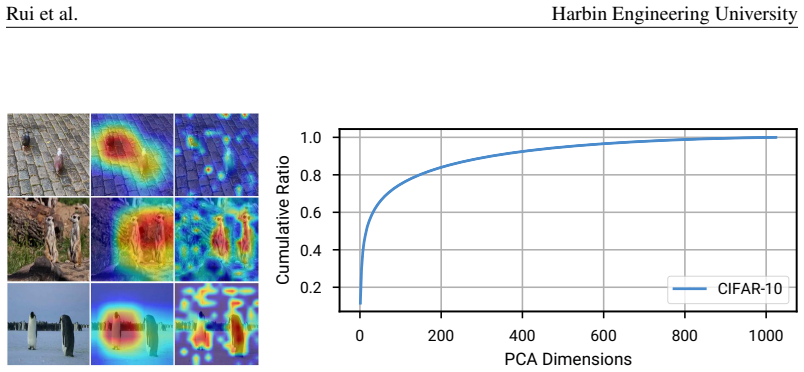
The central object is a Gaussian mixture model used as a mixture-of-experts classifier: each Gaussian component $l$ carries a class-conditional distribution $P(c|l)$, so the model can assign labels through components rather than through a single decision boundary. The EM updates in Eqs. (6)-(11) alternate responsibilities $\gamma_{il}$ for unlabeled features and $\gamma_{il|c_i}$ for labeled features, updating means, covariances, mixing weights, and class-conditional probabilities; Eq. (12) then converts component responsibilities into per-class pseudo-label probabilities $p_i(k) = \sum_l P(k|l)\,\gamma_{il}$. Confidence thresholding $\tau$ and proportional sampling $\alpha$ build a balanced pseudo-labeled set that is folded into a second EM pass. On the feature side, a frozen DINO-pretrained ViT-Large encoder (a self-supervised vision transformer) followed by PCA supplies representations that, the paper argues, are close to one Gaussian per class, which is what makes the GMM classifier effective with very few labels.
What would settle it
Run SemiOccam's SGMM on features from a randomly initialized vision transformer with no pretraining: if accuracy collapses, the result depends on the pretrained encoder rather than the classifier. Conversely, give published baselines the same frozen pretrained features and the same 40-label protocol on CleanSTL-10; if any matches or beats SemiOccam's error without the SGMM machinery, the claimed advantage lies in the features, not in the method.
Extended reading notes
Core claim
The paper's central claim is that a semi-supervised Gaussian mixture model (SGMM), operating on features from a frozen DINO-pretrained ViT-Large and reduced by PCA, forms a highly accurate and unusually fast image recognizer in the extreme low-label regime. The model maximizes a joint likelihood in which labeled features contribute supervised terms through component-conditional class probabilities $P(c|l)$ and unlabeled features contribute unsupervised mixture terms, all fit by an EM algorithm initialized with K-means++. After convergence, one round of confidence-thresholded, class-balanced pseudo-labeling augments the labeled set, and a second EM pass refines the parameters. The paper reports 3.51% error on CIFAR-10 with 40 labels, 26.59% error on CIFAR-100 with 400 labels, and 4.57% error on CleanSTL-10 with 40 labels, all in minutes of training on a single Tesla T4, and contends these results beat published semi-supervised baselines. It further claims that STL-10 contains at least 7,545 training images that are exact duplicates of test images, and that removing them is necessary for trustworthy evaluation.
Load-bearing premise
The central claim assumes that comparing a classifier built on frozen, already-trained image features with published semi-supervised methods that train from scratch is a fair test; if that assumption fails, the accuracy gains could come entirely from the pretrained features rather than from the proposed classifier.
Editorial extensions
If this is right
- The paper reports test errors of 3.51% on CIFAR-10 and 4.57% on CleanSTL-10 with only 4 labeled samples per class, i.e., accuracy above 95%.
- Across all label counts tested, the reported CIFAR-10 and CleanSTL-10 errors are lower than those of published baselines such as SequenceMatch and EPASS; on CIFAR-100, it leads at 400 and 2,500 labels and is comparable at 10,000.
- Ablations attribute part of the gain to the SGMM itself: replacing it with a softmax classification head raises CIFAR-10 40-label error from 3.51% to 51.05%, and disabling pseudo-labeling raises it to 3.73%.
- The reported STL-10 contamination (7,545 duplicate train-test images) means previously published STL-10 semi-supervised numbers are inflated, and future evaluations should use CleanSTL-10.
- The minute-level training cost contrasts with the hundreds of GPU hours reported for existing semi-supervised protocols, making the approach practical for rapid iteration and edge deployment.
Reading between the lines
- A testable extension the paper does not run: feed the same SGMM classifier features from other pretrained self-supervised encoders (for example contrastive or masked-image-modeling models) to see whether the minute-level training and low-label accuracy transfer beyond DINO ViT-Large.
- If the gains come mostly from the frozen pretrained encoder rather than the SGMM, then the practical recipe implied by the paper is 'freeze a strong self-supervised backbone and fit a simple generative head,' which would also make the reported GPU-hour savings partly a matter of shifted cost rather than eliminated cost.
- The CleanSTL-10 release has a consequence the paper states but does not quantify: every earlier STL-10 benchmark number, including the baselines in Tables 2-4, was produced on the leaked split; re-running those baselines on the cleaned split would settle how much of the reported margin is due to deduplication alone.
- Because the classifier is generative and per-component, it could be pointed at novel-class discovery without retraining the backbone, connecting SemiOccam to the generalized category discovery problem the paper cites as its closest prior work.
Editorial analysis
A structured set of objections, weighed in public.
Referee Report
Summary. The paper presents SemiOccam, a semi-supervised image recognition pipeline that combines a frozen DINO ViT-Large feature extractor with PCA dimensionality reduction and a Gaussian mixture model (MoE) classifier trained via EM with a one-shot pseudo-labeling step. The authors claim state-of-the-art results on CIFAR-10, CIFAR-100, and a newly released CleanSTL-10 dataset with as few as 4 labeled samples per class and minute-level classifier training time. They also report and attempt to fix a train/test leakage in STL-10 by publishing a deduplicated version (CleanSTL-10). The method's core is a standard semi-supervised mixture-of-experts likelihood (Eq. 5) with EM updates (Eqs. 6–11) and a proportional-sampling pseudo-labeling mechanism (Eqs. 12–15).
Significance. If the evaluation were fair, the idea of fitting a classical GMM/MoE classifier on strong self-supervised features would be a practically useful lightweight alternative to complex deep SSL pipelines in extremely low-label regimes. The paper also contributes a cleaned benchmark and releases code, which are positive steps. However, the central empirical claims are not currently supported because the comparisons are not matched: SemiOccam uses a frozen ImageNet-pretrained DINO ViT-Large encoder while baselines are trained from scratch, and the CleanSTL-10 results are compared with numbers from the original leaked STL-10. The count of the released dataset is inconsistent. The methodological novelty of the SGMM itself is limited (EM for GMM is classical); the paper's value would rest on a properly controlled empirical study, which is missing.
major comments (5)
- [§4.5, Tables 2–4] The state-of-the-art comparison is not valid as a method comparison because SemiOccam uses a frozen DINO ViT-Large pretrained on ImageNet, whereas all listed baselines (Dash, FlexMatch, SequenceMatch, EPASS, etc.) are trained from scratch under the TorchSSL or USB protocols. Since CIFAR-10 classes overlap with ImageNet, the pretrained encoder may supply nearly all class-discriminative information, so the reported error reductions could be entirely an encoder effect rather than a property of the proposed SGMM classifier. The authors should add same-feature baselines (e.g., linear probe, k-NN, or an SSL method retrained on DINO features) and revise the SOTA claim accordingly.
- [§4.5, Table 3] The CleanSTL-10 results are compared with published numbers obtained on the original STL-10, which the paper itself argues contains 7,545 duplicate train/test samples. Removing those duplicates changes the training distribution and the task, so the comparison in Table 3 is not apples-to-apples. To support the claim that SemiOccam outperforms other methods on CleanSTL-10, the baselines must be retrained and evaluated on CleanSTL-10, or the table must be clearly labeled as a cross-dataset comparison that does not establish a direct improvement.
- [§4.3] The dataset accounting is internally inconsistent. Original STL-10 has 105,000 training images (5,000 labeled + 100,000 unlabeled). Removing 7,545 duplicates should leave 97,455 total (5,000 labeled + 92,455 unlabeled), but the paper reports 5,000 labeled + 90,455 unlabeled = 95,455 training images. The discrepancy of about 2,000 images needs to be resolved; otherwise the released CleanSTL-10 dataset cannot be trusted for reproducibility. Additionally, the deduplication relies on exact image hashing (Algorithm 2), which catches only exact duplicates and may miss near-duplicates (e.g., resized CIFAR-10 images in STL-10); the procedure should be documented precisely and the duplicate count verified.
- [Abstract and §3.2] The abstract states that the method operates 'by optimizing mutual information between feature representations and target classes,' but the actual objective in Eq. (5) is a maximum-likelihood objective for a mixture model with labeled and unlabeled data. No derivation is provided that connects this likelihood to mutual information maximization. The authors should either supply a mathematical link (e.g., via the identity I(X;C) = H(C) - H(C|X) and its variational lower bound) or remove the mutual-information claim from the abstract and introduction.
- [§4.7] The 'minute-level training' claim refers only to the SGMM classifier training after features have been extracted (Figure 9), not to the full pipeline, which includes running a ViT-Large DINO model over the entire training set. This is a non-trivial computational cost and should be reported as part of the total training time. The abstract's claim that 'training time is at the minute level' is misleading without this qualification.
minor comments (5)
- [§4.1 / headings] There are several typos and capitalization inconsistencies, e.g., 'StandardsGMM' in the Section 4.1 heading, 'Guassian 1' in Figure 7, 'Cifar-10' versus 'CIFAR-10', and 'Dino' versus 'DINO'.
- [§4.5, Table 3 caption] The phrase '+10.88%, +8.35%, and +1.41%' should be phrased as percentage points, since it is the difference in error rates, not a relative improvement.
- [§4.3, Algorithm 2] The pseudo-code formatting is inconsistent: line numbers appear both left-aligned and inside the code, and the final 'Save duplicate details' block is not consistently indented.
- [Figure 2] The caption contains the redundant phrase 'Figure Illustration' immediately before the description; it should be removed.
- [References] Reference [34] contains an author formatting error ('Yue Fan, , Zhen Wu') with a double comma.
Circularity Check
No significant circularity: the SGMM classifier is a standard EM fit on frozen external features, and the benchmark claims are empirical rather than derived from the method's own outputs.
full rationale
The paper's derivation chain (Eqs. 3-15) is a standard semi-supervised Gaussian mixture EM objective: supervised and unsupervised log-likelihood terms, E-step responsibilities, M-step updates, followed by one-shot confidence-thresholded pseudo-label selection and a final EM pass. No fitted parameter is relabeled as a prediction: the labeled and pseudo-labeled data are used to fit the model, and accuracy is reported on held-out test sets. The DINO ViT-Large features are external and frozen; whatever transfer advantage they provide is a benchmark-protocol issue, not a circularity. The only self-citation in the reference list ([35], by the corresponding author) is not invoked in the text as a load-bearing premise. The abstract's 'optimizing mutual information' wording is not backed by an MI derivation, and the CleanSTL-10 count (90,455) is inconsistent with removing 7,545 from 100,000 unlabeled images, but both are correctness/novelty concerns rather than circular reasoning. Accordingly, no circular step is exhibited.
Assumptions & free parameters
free parameters (5)
- Number of Gaussian components L =
10 (CIFAR-10), 100 (CIFAR-100), 15 (CleanSTL-10)
- PCA dimension d =
60 (CIFAR-10/100), 45 (CleanSTL-10)
- Confidence threshold tau =
not reported
- Sampling ratio alpha =
not reported
- Loss weight lambda =
1
assumptions (4)
- domain assumption DINO ViT-Large features are sufficiently discriminative and roughly Gaussian per class after PCA.
- domain assumption Exact image hash equality is a sufficient detector of train/test leakage in STL-10.
- standard math Standard EM converges to a useful local optimum for the mixture likelihood.
- ad hoc to paper Pretrained ImageNet features are an acceptable input that need not be compared against from-scratch baselines.
Cite this review
Pith. "Pith review of SemiOccam: A Robust Semi-Supervised Image Recognition Network Using Sparse Labels." pith.science (2026). https://pith.science/paper/CNCDY7KV
@misc{pith2026250603582,
  author       = {Pith},
  title        = {Pith review of: SemiOccam: A Robust Semi-Supervised Image Recognition Network Using Sparse Labels},
  year         = {2026},
  howpublished = {\url{https://pith.science/paper/CNCDY7KV}},
  note         = {Machine review of arXiv:2506.03582}
}
read the original abstract
We present SemiOccam, an image recognition network that leverages semi-supervised learning in a highly efficient manner. Existing works often rely on complex training techniques and architectures, requiring hundreds of GPU hours for training, while their generalization ability with extremely limited labeled data remains to be improved. To address these limitations, we construct a hierarchical mixture density classification mechanism by optimizing mutual information between feature representations and target classes, compressing redundant information while retaining crucial discriminative components. Experimental results demonstrate that our method achieves state-of-the-art performance on three commonly used datasets, with accuracy exceeding 95% on two of them using only 4 labeled samples per class, and its simple architecture keeps training time at the minute level. Notably, this paper reveals a long-overlooked data leakage issue in the STL-10 dataset for semi-supervised learning and removes duplicates to ensure reliable experimental results. We release the deduplicated CleanSTL-10 dataset to facilitate fair and reproducible research. Code available at https://github.com/Shu1L0n9/SemiOccam.
Figures


Figures from the paper (6 more)



Reference graph
Works this paper leans on
-
[1]
Emerging properties in self-supervised vision transformers
Mathilde Caron, Hugo Touvron, Ishan Misra, Herv ´e J´egou, Julien Mairal, Piotr Bojanowski, and Armand Joulin. Emerging properties in self-supervised vision transformers. InProceed- ings of the IEEE/CVF international conference on computer vision, pp. 9650–9660, 2021
work page 2021
-
[2]
Softmatch: Addressing the quantity-quality trade-off in semi- supervised learning
Hao Chen, Ran Tao, Yue Fan, Yidong Wang, Jindong Wang, Bernt Schiele, Xing Xie, Bhik- sha Raj, and Marios Savvides. Softmatch: Addressing the quantity-quality trade-off in semi- supervised learning. InInternational Conference on Learning Representations (paper), 2023
work page 2023
-
[3]
T Chen, S Kornblith, M Norouzi, and G Hinton. Simclr: A simple framework for contrastive learning of visual representations [c].International Con-ference on Learning Representations, 2020
work page 2020
-
[4]
Performance of gaussian mixture model classifiers on embedded feature spaces, 2024
Jeremy Chopin and Rozenn Dahyot. Performance of gaussian mixture model classifiers on embedded feature spaces, 2024
work page 2024
-
[5]
An image is worth 16x16 words: Transformers for image recognition at scale, 2021
Alexey Dosovitskiy, Lucas Beyer, Alexander Kolesnikov, Dirk Weissenborn, Xiaohua Zhai, Thomas Unterthiner, Mostafa Dehghani, Matthias Minderer, Georg Heigold, Sylvain Gelly, Jakob Uszkoreit, and Neil Houlsby. An image is worth 16x16 words: Transformers for image recognition at scale, 2021
2021
-
[6]
Intrinsic self-supervision for data quality audits
Fabian Gr ¨oger, Simone Lionetti, Philippe Gottfrois, Alvaro Gonzalez-Jimenez, Ludovic Am- ruthalingam, Matthew Groh, Alexander A Navarini, and Marc Pouly. Intrinsic self-supervision for data quality audits. InThe Thirty-eight Conference on Neural Information Processing Sys- tems Datasets and Benchmarks Track, 2024. 15 Rui et al. Harbin Engineering University
work page 2024
-
[7]
Deep residual learning for image recognition
Kaiming He, Xiangyu Zhang, Shaoqing Ren, and Jian Sun. Deep residual learning for image recognition. InProceedings of the IEEE conference on computer vision and pattern recogni- tion, pp. 770–778, 2016
2016
-
[8]
Momentum contrast for unsupervised visual representation learning
Kaiming He, Haoqi Fan, Yuxin Wu, Saining Xie, and Ross Girshick. Momentum contrast for unsupervised visual representation learning. InProceedings of the IEEE/CVF Conference on Computer Vision and Pattern Recognition (CVPR), June 2020
2020
Show all 42 references
-
[9]
Batch normalization: accelerating deep network training by reducing internal covariate shift
Sergey Ioffe and Christian Szegedy. Batch normalization: accelerating deep network training by reducing internal covariate shift. InProceedings of the 32nd International Conference on International Conference on Machine Learning, pp. 448–456, 2015
2015
-
[10]
Understanding dimensional col- lapse in contrastive self-supervised learning
Li Jing, Pascal Vincent, Yann LeCun, and Yuandong Tian. Understanding dimensional col- lapse in contrastive self-supervised learning. In10th International Conference on Learning Representations, paper 2022, 2022
2022
-
[11]
Imagenet classification with deep convolutional neural networks.Advances in neural information processing systems, 25, 2012
Alex Krizhevsky, Ilya Sutskever, and Geoffrey E Hinton. Imagenet classification with deep convolutional neural networks.Advances in neural information processing systems, 25, 2012
2012
-
[12]
Pseudo-label: The simple and efficient semi-supervised learning method for deep neural networks
Dong-Hyun Lee et al. Pseudo-label: The simple and efficient semi-supervised learning method for deep neural networks. InWorkshop on challenges in representation learning, ICML, vol- ume 3, pp. 896. Atlanta, 2013
2013
-
[13]
Comatch: Semi-supervised learning with contrastive graph regularization
Junnan Li, Caiming Xiong, and Steven CH Hoi. Comatch: Semi-supervised learning with contrastive graph regularization. InProceedings of the IEEE/CVF international conference on computer vision, pp. 9475–9484, 2021
2021
-
[14]
A method of moments embedding constraint and its application to semi-supervised learning, 2024
Michael Majurski, Sumeet Menon, Parniyan Farvardin, and David Chapman. A method of moments embedding constraint and its application to semi-supervised learning, 2024
2024
-
[15]
A Mixture of Experts Classifier with Learn- ing Based on Both Labelled and Unlabelled Data
David J Miller and Hasan Uyar. A Mixture of Experts Classifier with Learn- ing Based on Both Labelled and Unlabelled Data. InAdvances in Neu- ral Information Processing Systems, volume 9. MIT Press, 1996. URL https://proceedings.neurips.cc/paper_files/paper/1996/hash/ a58149d3...
1996
-
[16]
Do not trust what you trust: Miscalibration in semi-supervised learning, 2024
Shambhavi Mishra, Balamurali Murugesan, Ismail Ben Ayed, Marco Pedersoli, and Jose Dolz. Do not trust what you trust: Miscalibration in semi-supervised learning, 2024
2024
-
[17]
Takeru Miyato, Shin-ichi Maeda, Masanori Koyama, and Shin Ishii. Virtual adversarial train- ing: a regularization method for supervised and semi-supervised learning.IEEE transactions on pattern analysis and machine intelligence, 41(8):1979–1993, 2018
1979
-
[18]
S-clip: Semi-supervised vision- language learning using few specialist captions, 2023
Sangwoo Mo, Minkyu Kim, Kyungmin Lee, and Jinwoo Shin. S-clip: Semi-supervised vision- language learning using few specialist captions, 2023
2023
-
[19]
Sequencematch: Revisiting the design of weak-strong augmentations for semi-supervised learning
Khanh-Binh Nguyen. Sequencematch: Revisiting the design of weak-strong augmentations for semi-supervised learning. InProceedings of the IEEE/CVF Winter Conference on Applications of Computer Vision (WACV), pp. 96–106, January 2024
2024
-
[20]
Debiasing, calibrating, and improving semi-supervised learning perfor- mance via simple ensemble projector
Khanh-Binh Nguyen. Debiasing, calibrating, and improving semi-supervised learning perfor- mance via simple ensemble projector. InProceedings of the IEEE/CVF Winter Conference on Applications of Computer Vision (WACV), pp. 2441–2451, January 2024
2024
-
[21]
Meta pseudo labels
Hieu Pham, Zihang Dai, Qizhe Xie, and Quoc V Le. Meta pseudo labels. InProceedings of the IEEE/CVF conference on computer vision and pattern recognition, pp. 11557–11568, 2021
2021
-
[22]
Better (pseudo-)labels for semi-supervised instance segmentation, 2024
Francois Porcher, camille couprie, Marc Szafraniec, and Jakob Verbeek. Better (pseudo-)labels for semi-supervised instance segmentation, 2024
2024
-
[23]
Learning transferable visual models from natural language supervision
Alec Radford, Jong Wook Kim, Chris Hallacy, Aditya Ramesh, Gabriel Goh, Sandhini Agar- wal, Girish Sastry, Amanda Askell, Pamela Mishkin, Jack Clark, et al. Learning transferable visual models from natural language supervision. InInternational conference on machine learning, p...
2021
-
[24]
Adamatch: A unified approach to semi-supervised learning and domain adaptation
Becca Roelofs, David Berthelot, Kihyuk Sohn, Nicholas Carlini, and Alex Kurakin. Adamatch: A unified approach to semi-supervised learning and domain adaptation. InInternational Con- ference on Learning Representations (paper), 2022
2022
-
[25]
Simpoolformer: A two-stream vision transformer for hyperspectral image classification.Remote Sensing Applications: Society and Environment, pp
Swalpa Kumar Roy, Ali Jamali, Jocelyn Chanussot, Pedram Ghamisi, Ebrahim Ghaderpour, and Himan Shahabi. Simpoolformer: A two-stream vision transformer for hyperspectral image classification.Remote Sensing Applications: Society and Environment, pp. 101478, 2025
2025
-
[26]
Amir Hossein Saberi, Amir Najafi, Alireza Heidari, Mohammad Hosein Movasaghinia, Abol- fazl Motahari, and Babak H. Khalaj. Out-of-domain unlabeled data improves generalization, 2024
2024
-
[27]
Fixmatch: Simplifying semi- supervised learning with consistency and confidence.Advances in neural information process- ing systems, 33:596–608, 2020
Kihyuk Sohn, David Berthelot, Nicholas Carlini, Zizhao Zhang, Han Zhang, Colin A Raf- fel, Ekin Dogus Cubuk, Alexey Kurakin, and Chun-Liang Li. Fixmatch: Simplifying semi- supervised learning with consistency and confidence.Advances in neural information process- ing systems, ...
2020
-
[28]
Dropout: a simple way to prevent neural networks from overfitting.The journal of machine learning research, 15(1):1929–1958, 2014
Nitish Srivastava, Geoffrey Hinton, Alex Krizhevsky, Ilya Sutskever, and Ruslan Salakhut- dinov. Dropout: a simple way to prevent neural networks from overfitting.The journal of machine learning research, 15(1):1929–1958, 2014. Publisher: JMLR. org
1929
-
[29]
The role of pseudo-labels in self-training linear classifiers on high- dimensional gaussian mixture data, 2024
Takashi Takahashi. The role of pseudo-labels in self-training linear classifiers on high- dimensional gaussian mixture data, 2024
2024
-
[30]
Antti Tarvainen and Harri Valpola. Mean teachers are better role models: Weight-averaged consistency targets improve semi-supervised deep learning results.Advances in neural infor- mation processing systems, 30, 2017
2017
-
[31]
Generalized category discov- ery
Sagar Vaze, Kai Han, Andrea Vedaldi, and Andrew Zisserman. Generalized category discov- ery. InProceedings of the IEEE/CVF Conference on Computer Vision and Pattern Recognition, pp. 7492–7501, 2022
2022
-
[32]
P 2FEViT: Plug-and-play cnn feature embedded hybrid vision trans- former for remote sensing image classification.Remote Sensing, 15(7):1773, 2023
Guanqun Wang, He Chen, Liang Chen, Yin Zhuang, Shanghang Zhang, Tong Zhang, Hao Dong, and Peng Gao. P 2FEViT: Plug-and-play cnn feature embedded hybrid vision trans- former for remote sensing image classification.Remote Sensing, 15(7):1773, 2023
2023
-
[33]
Usb: A unified semi-supervised learning benchmark for classification
Yidong Wang, Hao Chen, Yue Fan, SUN Wang, Ran Tao, Wenxin Hou, Renjie Wang, Linyi Yang, Zhi Zhou, Lan-Zhe Guo, et al. Usb: A unified semi-supervised learning benchmark for classification. InThirty-sixth Conference on Neural Information Processing Systems Datasets and Benchmark...
2022
-
[34]
Freematch: Self- adaptive thresholding for semi-supervised learning
Yidong Wang, Hao Chen, Qiang Heng, Wenxin Hou, Yue Fan, , Zhen Wu, Jindong Wang, Mar- ios Savvides, Takahiro Shinozaki, Bhiksha Raj, Bernt Schiele, and Xing Xie. Freematch: Self- adaptive thresholding for semi-supervised learning. InInternational Conference on Learning Represe...
2023
-
[35]
A multi-manifold semi-supervised Gaussian mixture model for pattern classification.Pattern Recognition Letters, 34(16):2118–2125, 2013
Xianglei Xing, Yao Yu, Hua Jiang, and Sidan Du. A multi-manifold semi-supervised Gaussian mixture model for pattern classification.Pattern Recognition Letters, 34(16):2118–2125, 2013. ISSN 0167-8655. doi: https://doi.org/10.1016/j.patrec.2013.08.005. URLhttps://www. sciencedir...
2013 doi
-
[36]
Dash: Semi-supervised learning with dynamic thresholding
Yi Xu, Lei Shang, Jinxing Ye, Qi Qian, Yu-Feng Li, Baigui Sun, Hao Li, and Rong Jin. Dash: Semi-supervised learning with dynamic thresholding. InInternational conference on machine learning, pp. 11525–11536. PMLR, 2021
2021
-
[37]
Unsupervised word sense disambiguation rivaling supervised methods
David Yarowsky. Unsupervised word sense disambiguation rivaling supervised methods. In 33rd annual meeting of the association for computational linguistics, pp. 189–196, 1995
1995
-
[38]
Deep layer aggregation
Fisher Yu, Dequan Wang, Evan Shelhamer, and Trevor Darrell. Deep layer aggregation. In Proceedings of the IEEE conference on computer vision and pattern recognition, pp. 2403– 2412, 2018. 17 Rui et al. Harbin Engineering University
2018
-
[39]
Flexmatch: Boosting semi-supervised learning with curriculum pseudo labeling.Advances in Neural Information Processing Systems, 34:18408–18419, 2021
Bowen Zhang, Yidong Wang, Wenxin Hou, Hao Wu, Jindong Wang, Manabu Okumura, and Takahiro Shinozaki. Flexmatch: Boosting semi-supervised learning with curriculum pseudo labeling.Advances in Neural Information Processing Systems, 34:18408–18419, 2021
2021
-
[40]
Learning semi-supervised gaussian mixture models for generalized category discovery
Bingchen Zhao, Xin Wen, and Kai Han. Learning semi-supervised gaussian mixture models for generalized category discovery. InProceedings of the IEEE/CVF International Conference on Computer Vision, pp. 16623–16633, 2023
2023
-
[41]
Simmatch: Semi-supervised learning with similarity matching
Mingkai Zheng, Shan You, Lang Huang, Fei Wang, Chen Qian, and Chang Xu. Simmatch: Semi-supervised learning with similarity matching. InProceedings of the IEEE/CVF confer- ence on computer vision and pattern recognition, pp. 14471–14481, 2022
2022
-
[42]
Deep Autoencoding Gaussian Mixture Model for Unsupervised Anomaly De- tection
Bo Zong, Qi Song, Martin Renqiang Min, Wei Cheng, Cristian Lumezanu, Daeki Cho, and Haifeng Chen. Deep Autoencoding Gaussian Mixture Model for Unsupervised Anomaly De- tection. InInternational Conference on Learning Representations, 2018. 18
2018
Reviewed August 7, 2026 · model on record in the stance chip above.
Discussion (0). Sign in to comment.