REVIEW 4 major objections 5 minor 33 references
MMRefine: Unveiling the Obstacles to Robust Refinement in Multimodal Large Language Models
T0 review · 4 major / 5 minor · reviewed 2026-08-07 · deepseek-v4-flash
Pith's one-line read MMRefine measures whether multimodal large language models can find and fix their own math errors by splitting every refinement attempt into six scenarios instead of comparing final accuracy alone.
desk verdict Useful benchmark with an honest limitations section, but the headline error-correction gaps inherit uncertainty from a 72%-agreement judge and a closed-model-filtered gold standard. read the letter →
The pith
A machine-rendered reading of the paper's core claim, the machinery that carries it, and where it could break.
The reading
What carries the argument
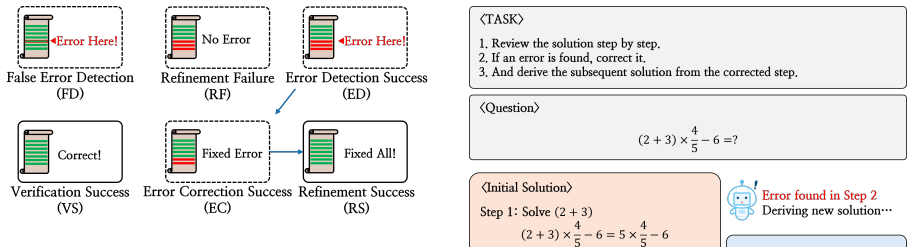
The central object is the six-scenario taxonomy of refinement outcomes. For initially correct solutions, the model either verifies the solution (VS) or wrongly flags an error (FD); for incorrect solutions, it either misses the error (RF), detects it (ED), corrects it (EC), or produces a flawless revised solution (RS). The evaluation protocol asks the model to review a solution step-by-step, stop at the first error, correct it, and regenerate from that point, and uses GPT-4O as a judge to classify the result against reference feedback generated by OpenAI O1. The metrics RefScore $= RS - FD$ and mRecall $= (ED + VS)/2$ compress the taxonomy into two numbers, while the raw scenario proportions reveal where in the chain each model loses the most.
What would settle it
Re-annotate the 200 MMRefine items with expert human judges, replace GPT-4O's scenario labels with the human labels, and recompute RefScore for all 17 models; if the closed-source advantage shrinks or reverses (for instance, if GPT-4O's RefScore falls below the best open-source model), the benchmark's central gap would not be robust.
Extended reading notes
Core claim
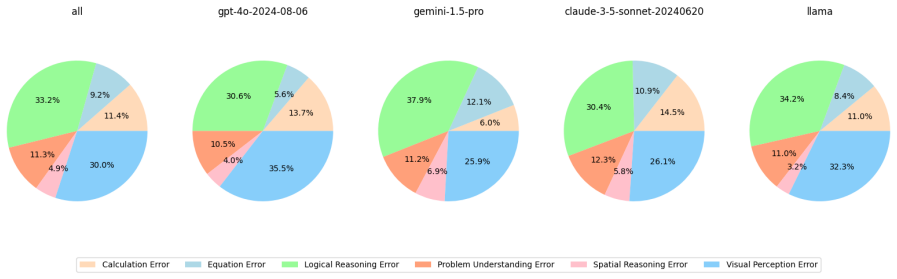
The central claim is that refinement is not a single skill but a chain of distinct stages—detecting an error, correcting it, and then continuing to a flawless solution—and that each stage can be measured separately. The paper defines two scalar metrics, RefScore $= RS - FD$ and mRecall $= (ED + VS)/2$, where RS and FD are the shares of fully repaired and falsely 'corrected' solutions and ED and VS are the shares of successful error detection and correct-solution verification. On its 200-problem set, the benchmark reports that closed-source models repair more than 32% of flawed solutions while most open-source models repair less than 20%, and that RefScore correlates at 0.82 with the actual score change from self-reflection on MATH-500 and MathVista. The paper further claims that error-type analysis reveals a qualitative split: larger models handle text-related errors better, while smaller models often handle image-related errors better, and spatial-reasoning errors behave almost independently of other error types.
Load-bearing premise
The load-bearing premise is that GPT-4O's automatic classification of open-ended math reasoning into the six scenarios is accurate enough to trust the reported RefScores, even though it agrees with human experts only 72% of the time.
Editorial extensions
If this is right
- If RefScore is predictive, model developers can use MMRefine to forecast whether a self-correction step will improve or degrade a model's math performance on unseen problems.
- The 0.82 correlation with MATH-500 and MathVista self-reflection deltas suggests that benchmark scores can stand in for expensive full self-correction evaluations in some settings.
- Because open-source models fail mostly at error detection (high RF), the paper points to detection, not correction, as the priority bottleneck for most small models.
- The low correlation of spatial-reasoning RefScore with other error types implies that scaling alone may not fix spatial reasoning; specialised training or prompting may be needed.
- The PRM experiments suggest that best-of-N selection with a process reward model raises verification but lowers error detection, so reward models must be tuned with refinement, not just answer accuracy, in mind.
Reading between the lines
- The 72% judge agreement means roughly a quarter of scenario labels may be wrong; a natural check is to recompute RefScore with full human annotation, which could either confirm or erode the reported closed-versus-open gap.
- The benchmark's single-reference-solution design may penalise valid alternative solution paths; an extension allowing multiple correct references would test whether the six-scenario taxonomy changes when diverse proofs are accepted.
- The scenario taxonomy should transfer to non-mathematical multimodal reasoning such as diagram comprehension or chart reading, where 'first error' is equally well defined; that would reveal which findings are math-specific.
- One testable extension the paper does not run: fine-tune a small open-source model on MMRefine-style detection feedback and measure whether its RefScore and downstream self-reflection gain both improve.
Editorial analysis
A structured set of objections, weighed in public.
Referee Report
Summary. The paper introduces MMRefine, a benchmark that evaluates how well multimodal large language models (MLLMs) detect and correct errors in mathematical solutions, including both text-only and visual problems. The benchmark assigns each refinement attempt to one of six scenarios (e.g., Refinement Failure, Error Detection Success, Refinement Success) and categorizes the first error in the initial solution into one of six error types. The authors evaluate 17 open- and closed-source MLLMs, propose two aggregated metrics (RefScore and mRecall), analyze bottlenecks by scenario and error type, and provide a correlation study with self-reflection performance on MATH-500 and MathVista. The dataset and code are released publicly.
Significance. If the benchmark's measurements are reliable, MMRefine would be a useful fine-grained instrument for studying refinement capabilities, going beyond before/after accuracy comparisons and providing a reusable taxonomy of failure modes. The paper has notable strengths: it ships public code and data, includes human verification of the annotation process, and explicitly discusses limitations such as the single-reference-solution bias. However, the central claims of a closed-source versus open-source gap and of specific bottleneck scenarios rest on (i) an aggregated metric whose definition mixes proportions over different subpopulations, and (ii) an automated judge with 72% human agreement and no reported per-category reliability breakdown. These issues are load-bearing for the paper's main conclusions, so the benchmark requires additional validation before its rankings and headline numbers can be taken as definitive.
major comments (4)
- [§2.2, Eq. (1)] The definition RefScore = RS − FD subtracts two proportions that are computed over different populations: RS is the proportion of incorrect initial solutions that are refined successfully, while FD is the proportion of correct initial solutions that are falsely flagged as erroneous. Consequently, RefScore is not an aggregated accuracy over a fixed population, and its scale and ranking behavior depend on the ratio of correct to incorrect initial solutions in the benchmark. A model with high RS but also high FD can be ranked below a model with low RS and low FD, purely because of the composition of the dataset. Since RefScore is used as the primary ranking metric in Tables 1, 4, 6, and 8, and for the efficiency analysis in Table 2, the metric's definition should be justified or replaced by a per-sample joint score (e.g., a weighted combination defined over all instances) with RS and FD reported separately.
- [§3.4] The GPT-4O judge is reported to agree with human judgments 72% of the time and with OpenAI O1 73% of the time, but the paper does not report the sample size, a confusion matrix, or a per-scenario/per-error-type breakdown. All six scenario rates, RefScore, mRecall, and the Section 3.1 claim that closed-source models outperform open-source models are computed from these labels. If the 28% of disagreements are systematic rather than random, per-model rankings and the closed-versus-open gap can change materially. The paper should provide agreement statistics per scenario, per error type, and per model, along with a chance-corrected agreement measure such as Cohen's kappa.
- [§2.3 and Figure 7] The evaluation protocol defines Refinement Success (RS) by whether the model's feedback 'reaches the same answer and logic as the reference feedback' (Figure 7 prompt). The reference feedback is generated by OpenAI O1 and retained only when GPT-4O, Gemini-1.5-Pro, and Claude-3.5-Sonnet all succeed in refining the initial solution using it. As a result, RS measures fidelity to a single reference repair path, not necessarily mathematical correctness. A model that corrects the error through a different but equally valid method can be scored as a failure, and the paper's own Limitations section concedes this single-reference bias. Because RS is one of the two components of RefScore and the basis for the headline 'correct errors in over 32%' claim, this conflation of correctness with reference-path agreement is a load-bearing issue that should be addressed by evaluating final-answer correctness independently of the reference feedback.
- [§3.2 and Table 3] The paper claims a correlation coefficient of 0.82 between MMRefine scores and self-reflection improvements on MATH-500 and MathVista, but this is computed on only four models (and on three after excluding Gemini as an exception). With n = 4, a single outlier can determine the correlation, and the text does not state whether a Pearson or Spearman coefficient is used, nor does it report the confidence interval. The claim that 'MMRefine scores are valuable indicators of refinement capability' would be stronger with more models in the correlation study or a clearly reported full-set coefficient with the outlier's influence quantified.
minor comments (5)
- [§3.1] The sentence 'closed-source models correct errors in over 32% of initial solutions' is ambiguous: if 'correct errors' refers to RS, Claude-3.5-Sonnet's RS is 18.95 in Table 1, contradicting the statement; if it refers to EC, the metric should be named explicitly to avoid confusion.
- [Table 2] The header 'RefinementCoT Refinement Efficiency' is malformed; it should likely read 'Refinement CoT' or 'Refinement Chain-of-Thought'.
- [§3.2] The correlation coefficient is reported without stating whether it is Pearson or Spearman; please specify the measure and the number of data points.
- [§2.3] The notation 'OPENAI O1' is inconsistent with the rest of the paper; use 'OpenAI O1' for consistency.
- [Table 4] The caption says 'Maximum and minimum values are highlighted', but no highlighting is visible in the text; please ensure the final version includes the color or boldface cues.
Circularity Check
No significant circularity: MMRefine measures models against an external reference and validates against independent benchmarks; its headline gaps are computed from those measurements, not from fitted inputs.
full rationale
MMRefine's claims are benchmark measurements rather than derived predictions. The six scenario labels are assigned by an external GPT-4O judge with human and O1 verification (Section 3.4), and RefScore and mRecall are arithmetic aggregates (RS−FD and (ED+VS)/2) of those labels. The reference feedback is generated by O1 and filtered through three closed-source MLLMs, but this is dataset construction, not a fitted parameter that forces the measured outcomes: open-source models are evaluated on the same items and can, and do, fail to reproduce the reference repair. Section 3.2 validates the benchmark against independent MATH-500 and MathVista self-reflection deltas (correlation 0.82), so the central claim has external content. The reported 72% human/GPT-4O agreement and the single-reference bias, which the Limitations section explicitly acknowledges, are validity limitations rather than circular derivation: they affect measurement accuracy but do not make the benchmark's conclusions equivalent to its inputs by construction.
Assumptions & free parameters
free parameters (2)
- Dataset sample size per source =
100 problems from MathOdyssey, 100 from MathVision
- VisualPRM error detection threshold =
0.6
assumptions (4)
- domain assumption GPT-4O judge categorizations are accurate enough (72% human agreement) to label refinement scenarios.
- domain assumption O1-generated reference feedback, after validation by three MLLMs, is a valid ground truth for successful correction.
- domain assumption Initial solutions from four MLLMs are representative of realistic refinement inputs.
- domain assumption The sampled 200 problems from MathOdyssey and MathVision are diverse enough to support general conclusions about MLLM refinement.
Cite this review
Pith. "Pith review of MMRefine: Unveiling the Obstacles to Robust Refinement in Multimodal Large Language Models." pith.science (2026). https://pith.science/paper/ORVL3UB4
@misc{pith2026250604688,
  author       = {Pith},
  title        = {Pith review of: MMRefine: Unveiling the Obstacles to Robust Refinement in Multimodal Large Language Models},
  year         = {2026},
  howpublished = {\url{https://pith.science/paper/ORVL3UB4}},
  note         = {Machine review of arXiv:2506.04688}
}
read the original abstract
This paper introduces MMRefine, a MultiModal Refinement benchmark designed to evaluate the error refinement capabilities of Multimodal Large Language Models (MLLMs). As the emphasis shifts toward enhancing reasoning during inference, MMRefine provides a framework that evaluates MLLMs' abilities to detect and correct errors across six distinct scenarios beyond just comparing final accuracy before and after refinement. Furthermore, the benchmark analyzes the refinement performance by categorizing errors into six error types. Experiments with various open and closed MLLMs reveal bottlenecks and factors impeding refinement performance, highlighting areas for improvement in effective reasoning enhancement. Our code and dataset are publicly available at https://github.com/naver-ai/MMRefine.
Figures


Figures from the paper (9 more)




Reference graph
Works this paper leans on
-
[1]
Anthropic . 2024. https://www-cdn.anthropic.com/fed9cc193a14b84131812372d8d5857f8f304c52/Model_Card_Claude_3_Addendum.pdf Claude 3.5 sonnet model card addendum
work page 2024
-
[2]
Justin Chih-Yao Chen, Archiki Prasad, Swarnadeep Saha, Elias Stengel-Eskin, and Mohit Bansal. 2024. https://arxiv.org/abs/2409.12147 Magicore: Multi-agent, iterative, coarse-to-fine refinement for reasoning . Preprint, arXiv:2409.12147
arXiv 2024
-
[3]
Zhe Chen, Weiyun Wang, Yue Cao, Yangzhou Liu, Zhangwei Gao, Erfei Cui, Jinguo Zhu, Shenglong Ye, Hao Tian, Zhaoyang Liu, Lixin Gu, Xuehui Wang, Qingyun Li, Yimin Ren, Zixuan Chen, Jiapeng Luo, Jiahao Wang, Tan Jiang, Bo Wang, Conghui He, Botian Shi, Xingcheng Zhang, Han Lv, Yi Wang, Wenqi Shao, Pei Chu, Zhongying Tu, Tong He, Zhiyong Wu, Huipeng Deng, Jia...
arXiv 2025
-
[4]
Meng Fang, Xiangpeng Wan, Fei Lu, Fei Xing, and Kai Zou. 2024. https://arxiv.org/abs/2406.18321 Mathodyssey: Benchmarking mathematical problem-solving skills in large language models using odyssey math data . Preprint, arXiv:2406.18321
arXiv 2024
-
[5]
Google . 2024. https://deepmind.google/technologies/gemini/pro Gemini 1.5 pro
work page 2024
-
[6]
Aaron Grattafiori, Abhimanyu Dubey, Abhinav Jauhri, Abhinav Pandey, Abhishek Kadian, Ahmad Al-Dahle, Aiesha Letman, Akhil Mathur, Alan Schelten, Alex Vaughan, Amy Yang, Angela Fan, Anirudh Goyal, Anthony Hartshorn, Aobo Yang, Archi Mitra, Archie Sravankumar, Artem Korenev, Arthur Hinsvark, Arun Rao, Aston Zhang, Aurelien Rodriguez, Austen Gregerson, Ava S...
arXiv 2024
-
[7]
Dan Hendrycks, Collin Burns, Saurav Kadavath, Akul Arora, Steven Basart, Eric Tang, Dawn Song, and Jacob Steinhardt. 2021. https://datasets-benchmarks-proceedings.neurips.cc/paper/2021/hash/be83ab3ecd0db773eb2dc1b0a17836a1-Abstract-round2.html Measuring mathematical problem solving with the MATH dataset . In The Thirty-fifth Conference on Neural Informati...
work page 2021
-
[8]
Jie Huang, Xinyun Chen, Swaroop Mishra, Huaixiu Steven Zheng, Adams Wei Yu, Xinying Song, and Denny Zhou. 2024 a . https://openreview.net/forum?id=IkmD3fKBPQ Large language models cannot self-correct reasoning yet . In The Twelfth International Conference on Learning Representations
work page 2024
Show all 33 references
-
[9]
Xiang Huang, Sitao Cheng, Shanshan Huang, Jiayu Shen, Yong Xu, Chaoyun Zhang, and Yuzhong Qu. 2024 b . https://doi.org/10.18653/v1/2024.acl-long.274 Q uery A gent: A reliable and efficient reasoning framework with environmental feedback based self-correction . In Proceedings o...
2024 doi
-
[10]
Aviral Kumar, Vincent Zhuang, Rishabh Agarwal, Yi Su, John D Co-Reyes, Avi Singh, Kate Baumli, Shariq Iqbal, Colton Bishop, Rebecca Roelofs, Lei M Zhang, Kay McKinney, Disha Shrivastava, Cosmin Paduraru, George Tucker, Doina Precup, Feryal Behbahani, and Aleksandra Faust. 2025...
2025
-
[11]
Bo Li, Yuanhan Zhang, Dong Guo, Renrui Zhang, Feng Li, Hao Zhang, Kaichen Zhang, Peiyuan Zhang, Yanwei Li, Ziwei Liu, and Chunyuan Li. 2025. https://openreview.net/forum?id=zKv8qULV6n Llava-onevision: Easy visual task transfer . Transactions on Machine Learning Research
2025
-
[12]
Loka Li, Zhenhao Chen, Guangyi Chen, Yixuan Zhang, Yusheng Su, Eric Xing, and Kun Zhang. 2024 a . https://arxiv.org/abs/2402.12563 Confidence matters: Revisiting intrinsic self-correction capabilities of large language models . Preprint, arXiv:2402.12563
2024 arXiv
-
[13]
Xiaoyuan Li, Wenjie Wang, Moxin Li, Junrong Guo, Yang Zhang, and Fuli Feng. 2024 b . https://doi.org/10.18653/v1/2024.findings-acl.673 Evaluating mathematical reasoning of large language models: A focus on error identification and correction . In Findings of the Association fo...
2024 doi
-
[14]
Tian Liang, Zhiwei He, Wenxiang Jiao, Xing Wang, Yan Wang, Rui Wang, Yujiu Yang, Shuming Shi, and Zhaopeng Tu. 2024. https://doi.org/10.18653/v1/2024.emnlp-main.992 Encouraging divergent thinking in large language models through multi-agent debate . In Proceedings of the 2024 ...
2024 doi
-
[15]
Hunter Lightman, Vineet Kosaraju, Yuri Burda, Harrison Edwards, Bowen Baker, Teddy Lee, Jan Leike, John Schulman, Ilya Sutskever, and Karl Cobbe. 2024. https://openreview.net/forum?id=v8L0pN6EOi Let's verify step by step . In The Twelfth International Conference on Learning Re...
2024
-
[16]
Haotian Liu, Chunyuan Li, Yuheng Li, Bo Li, Yuanhan Zhang, Sheng Shen, and Yong Jae Lee. 2024. https://llava-vl.github.io/blog/2024-01-30-llava-next/ Llava-next: Improved reasoning, ocr, and world knowledge
2024
-
[17]
Pan Lu, Hritik Bansal, Tony Xia, Jiacheng Liu, Chunyuan Li, Hannaneh Hajishirzi, Hao Cheng, Kai-Wei Chang, Michel Galley, and Jianfeng Gao. 2024. https://openreview.net/forum?id=KUNzEQMWU7 Mathvista: Evaluating mathematical reasoning of foundation models in visual contexts . I...
2024
-
[18]
Aman Madaan, Niket Tandon, Prakhar Gupta, Skyler Hallinan, Luyu Gao, Sarah Wiegreffe, Uri Alon, Nouha Dziri, Shrimai Prabhumoye, Yiming Yang, Shashank Gupta, Bodhisattwa Prasad Majumder, Katherine Hermann, Sean Welleck, Amir Yazdanbakhsh, and Peter Clark. 2023. https://proceed...
2023
-
[19]
Oikantik Nath, Hanani Bathina, Mohammed Safi Ur Rahman Khan, and Mitesh M. Khapra. 2025. https://arxiv.org/abs/2501.07244 Can vision-language models evaluate handwritten math? Preprint, arXiv:2501.07244
2025 arXiv
-
[20]
OpenAI, :, Aaron Hurst, Adam Lerer, Adam P. Goucher, Adam Perelman, Aditya Ramesh, Aidan Clark, AJ Ostrow, Akila Welihinda, Alan Hayes, Alec Radford, Aleksander Mądry, Alex Baker-Whitcomb, Alex Beutel, Alex Borzunov, Alex Carney, Alex Chow, Alex Kirillov, Alex Nichol, Alex Pai...
2024 arXiv
-
[21]
OpenAI, :, Aaron Jaech, Adam Kalai, Adam Lerer, Adam Richardson, Ahmed El-Kishky, Aiden Low, Alec Helyar, Aleksander Madry, Alex Beutel, Alex Carney, Alex Iftimie, Alex Karpenko, Alex Tachard Passos, Alexander Neitz, Alexander Prokofiev, Alexander Wei, Allison Tam, Ally Bennet...
2024 arXiv
-
[22]
Yashar Talebirad and Amirhossein Nadiri. 2023. https://arxiv.org/abs/2306.03314 Multi-agent collaboration: Harnessing the power of intelligent llm agents . Preprint, arXiv:2306.03314
2023 arXiv
-
[23]
Gemini Team, Petko Georgiev, Ving Ian Lei, Ryan Burnell, Libin Bai, Anmol Gulati, Garrett Tanzer, Damien Vincent, Zhufeng Pan, Shibo Wang, Soroosh Mariooryad, Yifan Ding, Xinyang Geng, Fred Alcober, Roy Frostig, Mark Omernick, Lexi Walker, Cosmin Paduraru, Christina Sorokin, A...
2024 arXiv
-
[24]
Ke Wang, Junting Pan, Weikang Shi, Zimu Lu, Houxing Ren, Aojun Zhou, Mingjie Zhan, and Hongsheng Li. 2024 a . https://openreview.net/forum?id=QWTCcxMpPA Measuring multimodal mathematical reasoning with MATH -vision dataset . In The Thirty-eight Conference on Neural Information...
2024
-
[25]
Peng Wang, Shuai Bai, Sinan Tan, Shijie Wang, Zhihao Fan, Jinze Bai, Keqin Chen, Xuejing Liu, Jialin Wang, Wenbin Ge, Yang Fan, Kai Dang, Mengfei Du, Xuancheng Ren, Rui Men, Dayiheng Liu, Chang Zhou, Jingren Zhou, and Junyang Lin. 2024 b . https://arxiv.org/abs/2409.12191 Qwen...
2024 arXiv
-
[26]
Weiyun Wang, Zhangwei Gao, Lianjie Chen, Zhe Chen, Jinguo Zhu, Xiangyu Zhao, Yangzhou Liu, Yue Cao, Shenglong Ye, Xizhou Zhu, et al. 2025. https://arxiv.org/abs/2503.10291 Visualprm: An effective process reward model for multimodal reasoning . Preprint, arXiv:2503.10291
2025 arXiv
-
[27]
Jason Wei, Xuezhi Wang, Dale Schuurmans, Maarten Bosma, brian ichter, Fei Xia, Ed Chi, Quoc V Le, and Denny Zhou. 2022. https://proceedings.neurips.cc/paper_files/paper/2022/file/9d5609613524ecf4f15af0f7b31abca4-Paper-Conference.pdf Chain-of-thought prompting elicits reasoning...
2022
-
[28]
Xueqing Wu, Yuheng Ding, Bingxuan Li, Pan Lu, Da Yin, Kai-Wei Chang, and Nanyun Peng. 2024. https://arxiv.org/abs/2412.02172 Visco: Benchmarking fine-grained critique and correction towards self-improvement in visual reasoning . Preprint, arXiv:2412.02172
2024 arXiv
-
[29]
Yu, Xuming Hu, and Qingsong Wen
Yibo Yan, Shen Wang, Jiahao Huo, Hang Li, Boyan Li, Jiamin Su, Xiong Gao, Yi-Fan Zhang, Tianlong Xu, Zhendong Chu, Aoxiao Zhong, Kun Wang, Hui Xiong, Philip S. Yu, Xuming Hu, and Qingsong Wen. 2024. https://arxiv.org/abs/2410.04509 Errorradar: Benchmarking complex mathematical...
2024 arXiv
-
[30]
Yunxiang Zhang, Muhammad Khalifa, Lajanugen Logeswaran, Jaekyeom Kim, Moontae Lee, Honglak Lee, and Lu Wang. 2024. https://doi.org/10.18653/v1/2024.findings-acl.924 Small language models need strong verifiers to self-correct reasoning . In Findings of the Association for Compu...
2024 doi
-
[31]
Lianmin Zheng, Wei-Lin Chiang, Ying Sheng, Siyuan Zhuang, Zhanghao Wu, Yonghao Zhuang, Zi Lin, Zhuohan Li, Dacheng Li, Eric Xing, et al. 2023. Judging llm-as-a-judge with mt-bench and chatbot arena. Advances in Neural Information Processing Systems, 36:46595--46623
2023
-
[32]
online" 'onlinestring :=
ENTRY address archivePrefix author booktitle chapter edition editor eid eprint eprinttype howpublished institution journal key month note number organization pages publisher school series title type volume year doi pubmed url lastchecked label extra.label sort.label short.list...
-
[33]
write newline
" write newline "" before.all 'output.state := FUNCTION n.dashify 't := "" t empty not t #1 #1 substring "-" = t #1 #2 substring "--" = not "--" * t #2 global.max substring 't := t #1 #1 substring "-" = "-" * t #2 global.max substring 't := while if t #1 #1 substring * t #2 gl...
Reviewed August 7, 2026 · model on record in the stance chip above.
Discussion (0). Sign in to comment.