REVIEW 4 major objections 7 minor 40 references
Context Is Not Comprehension
T0 review · 4 major / 7 minor · reviewed 2026-08-07 · deepseek-v4-flash
Pith's one-line read State-of-the-art LLMs solve bare ListOps near perfectly but lose roughly half their accuracy when the same computations are embedded in 10k-token narratives, because they fail to track intermediate values that appear only as named anchors.
desk verdict VLO is a worthwhile benchmark and the bare-to-narrative accuracy drop is probably real, but the paper has not yet demonstrated that its 1,000 final samples are faithful enough to make the gap interpretable as hidden-state-tracking failure. read the letter →
The pith
A machine-rendered reading of the paper's core claim, the machinery that carries it, and where it could break.
The reading
What carries the argument
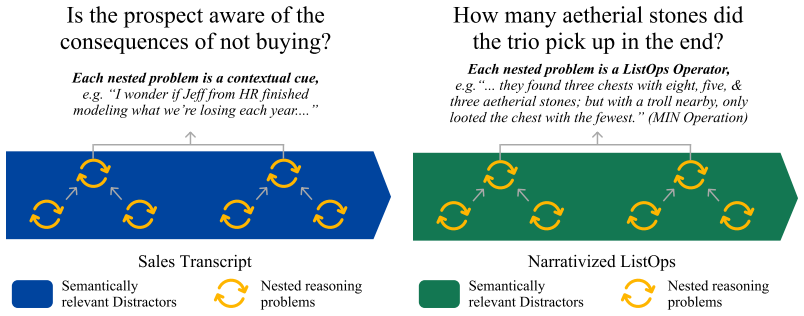
The central object is the Verbose ListOps benchmark and its five-stage agentic generation pipeline. A deterministically evaluated ListOps abstract syntax tree is sampled with tunable depth and branching; an Author LLM writes a narrative beat for each operator, a Critic LLM checks the beat against ultra-strict rules, a programmatic validator scans for numeric leakage, and a larger Validator LLM checks the whole sample against the original tree before it is kept. The load-bearing constraint is that intermediate results are never stated numerically and may only be referenced through narrative anchors, which forces the evaluated model to compute, cache, and reuse state internally rather than retrieve it.
What would settle it
Have human annotators who do not know the ground truth reconstruct the underlying ListOps tree from a random sample of the 1,000 final VLO instances; if more than a small fraction of narratives are ambiguous, misstate an operation, or reveal an intermediate value, part of the measured accuracy gap is a benchmark-fidelity artefact rather than a pure reasoning failure. A complementary check is to regenerate a subset with a different generation model family and see whether the collapse persists.
Extended reading notes
Core claim
The paper's central claim is that LLMs fail to maintain and reuse intermediate state when the state is hidden behind narrative camouflage, even at context lengths where pure recall remains strong. In VLO, each ListOps tree is traversed post-order, each operator becomes a story beat, and every intermediate value appears only as a 'narrative anchor' such as 'Daily Cell Intake' while semantically relevant distractors pad the story to about 10,000 tokens. On 1,000 final samples, Gemini 2.5 Pro falls from 100.0 percent on bare ListOps to 55.3 percent on VLO, DeepSeek R1 from 98.4 to 41.2 percent, and DeepSeek V3 from 93.7 to 25.1 percent, a pattern the paper attributes to an under-tested weakness in coherent multi-step computation rather than to context length.
Load-bearing premise
The VLO narratives genuinely encode the intended ListOps trees: every story beat must state its operator and atomic inputs correctly, never leak an intermediate value, and never introduce a number that changes the computation.
Editorial extensions
If this is right
- Near-perfect accuracy on bare ListOps or on retrieval-style long-context benchmarks should no longer be read as evidence of multi-step reasoning ability.
- Because the collapse occurs at only about 10k tokens, where recall is strong, the binding constraint is distraction-resistant state tracking rather than context window size.
- VLO's step-level labels let users locate the first point where a model's reasoning chain diverges, turning the benchmark into a diagnostic tool rather than a single accuracy number.
- The generation pipeline is task-agnostic and can embed any deterministically verifiable reasoning schema, so the same methodology can produce narrative benchmarks for symbolic, abductive, inductive, and defeasible reasoning.
Reading between the lines
- A testable extension the paper leaves implicit: varying context length (for example 2k, 10k, and 50k tokens) while holding tree depth fixed would separate a pure length effect from the narrative-distraction effect the paper attributes the gap to.
- Because the dataset was generated by one model family, the authors acknowledge generator bias; my inference is that re-running the pipeline with a different generator and re-evaluating the same models would quantify how much of the gap is stylistic alignment.
- If allowing external chain-of-thought or tree-of-thought search restored near-baseline VLO accuracy, the deficit would look like a policy-level or learned brittleness rather than an architectural ceiling; the paper explicitly leaves this as future work, so this inference is mine.
- VLO's step labels are a plausible training signal for process reward models; the paper mentions this possibility, and a concrete next step would be to train a process reward model on VLO steps and test whether it improves final-answer accuracy on unseen VLO samples.
Editorial analysis
A structured set of objections, weighed in public.
Referee Report
Summary. Verbose ListOps (VLO) is a 1,000-sample benchmark that wraps deterministic ListOps computations into roughly 10k-token narratives in which intermediate values are never stated, being referenced only by 'narrative anchors,' while semantically related distractors occupy the remaining token budget (Sections 3.1-3.6). The paper reports that ten LLMs solve the corresponding bare ListOps expressions with high accuracy (Gemini 2.5 Pro 100.0%, DeepSeek R1 98.4%) but drop dramatically on VLO-10k (55.3% and 41.2%, respectively; DeepSeek V3 falls from 93.7% to 25.1%; Table 2). The authors interpret this gap as evidence that models cannot maintain and reuse hidden intermediate state amid narrative distraction, argue that the result shows context length alone does not confer comprehension, and present the World-Author-Critic-Validator generation pipeline as a task-agnostic framework for embedding any deterministically verifiable reasoning schema in narrative form (Section 3.3, Appendix A).
Significance. The reported phenomenon is striking and, if dataset fidelity holds, VLO fills a genuine gap: existing long-context suites test retrieval (NIAH) or aggregation of explicitly presented clues (LongReason), whereas VLO withholds all intermediate results and ships per-step labels, enabling step-level diagnosis. The paper deserves credit for deterministic ground truth, the matched bare-ListOps control built from the same trees, Wilson-interval reporting, programmatic numeric-absence checks, and fully released code and data. However, the central measurement rests on LLM-only validation with unreported filtering rates, the causal mechanism (hidden-state tracking) is asserted rather than tested, and the architectural explanations in Section 3.8 are unsupported by any evidence in the manuscript. The contribution is therefore conditional on the fidelity audit and ablations being supplied.
major comments (4)
- [Section 3.3, Appendices D, F, G] The validation chain described in Section 3.3 (step 5) and Appendices D and G uses Gemini 2.5 Flash as the iterative critic and Gemini 2.5 Pro as the external validator (validator.py), the same model family that obtains the top VLO score in Table 2 (55.3%). Appendix F shows that the released [4_FINAL_EVAL_CLEANED] file is a filtered subset of [2_EVAL_READY], but the paper reports neither the number of samples discarded at each filtering stage nor the beat-retry and abort statistics specified in Appendix D, and it provides no human audit or second-validator agreement measure on the final 1,000 samples. Because the headline accuracy gap is only meaningful if each narrative beat encodes its operator faithfully, mentions every atomic input with the required frequency, and never leaks an intermediate value, the absence of these statistics leaves the central measurement unverified; a modest fraction of ambiguous or leaking samples could account for a meaningful part of the gap. Please report discard/pass rates at all stages, a human or independent audit on a stratified sample (e.g., 100-200 instances) with agreement figures, and a per-sample validation-error breakdown.
- [Section 3.8, Table 2] The paper attributes the VLO drop to the need to track hidden intermediate state, but no experiment varies the hypothesized mechanism. Tree depth is fixed at a maximum of 8 operations and never ablated; distraction density (up to 75% of the token budget per Appendix C.2) is not varied; context length is fixed at roughly 10k; and the only non-VLO condition is the bare ListOps expression at a few hundred tokens. The comparison therefore conflates narrative content with context length: a 10k-token control consisting of the bare ListOps expression padded with irrelevant tokens would be needed to support the title claim 'Context Is Not Comprehension.' Likewise, the step-level error-propagation curves and the diagnostic toolkit promised in Section 1 do not appear anywhere in the paper, so the claimed failure locus (divergence at the first hidden step) has not been demonstrated. Section 3.8's own admission that 'the current analysis remains primarily quantitative' confirms the gap; the hidden-state-tracking attribution should be reframed as a hypothesis pending these ablations and the step-level analysis.
- [Section 3.8] Section 3.8 makes strong architectural claims that are not supported by any evidence in the manuscript: that DeepSeek-V3's auxiliary-loss-free load balancing 'encourages over-specialisation' with routing to a 'narrative' expert, that its Multi-Token Prediction 'reinforces the very heuristic processing' that VLO penalizes, and that Gemini 2.5 performs 'dynamic context-aware routing' between semantic and logic experts. These claims are presented as explanations of the main result ('This architectural divergence explains the performance trends'), yet the paper reports no routing, gating, or ablation data. The related claim that 'models with explicit reasoning scaffolds' perform better is also not tested statistically and is undermined by overlap in Table 2, where Claude 3.7 Sonnet High (a thinking model) scores 40.0, below the non-thinking Qwen-3 235B at 41.5. Please either provide mechanistic evidence (e.g., error-locus, routing, or distillation ablations) or clearly relegate these passages to untested speculation.
- [Section 3.8, Table 2] The generator-bias limitation is acknowledged in Section 3.8 for the generation step, but the same model family also supplies the external validator (Gemini 2.5 Pro) and the best-performing evaluated model (Gemini 2.5 Pro, 55.3% in Table 2), which adds a confound to the comparative claims: samples that survive Gemini-based cleaning may be systematically easier for Gemini-family models. A concrete test would be to regenerate a subsample (e.g., 100 instances) with a different generator, since the paper notes GPT-4.5 is the only other reliable generator, and re-run the full model panel on that subsample. Short of that, the paper should report per-model accuracy split by whether the validator flagged a sample during cleaning (possible with the [2_EVAL_READY] and [4_FINAL_EVAL_CLEANED] files), to show that the Gemini advantage is not an artifact of cleaning bias.
minor comments (7)
- [Throughout] There are numerous typos and formatting artifacts: 'explicitely' (Section 3.1), 'preperation' (running example), 'a information processing burden' (Section 3.8), 'interal' and 'envrionment' (Broader Impacts), 'Numberic' (Appendix A heading), and reference-list artifacts such as '(duplicate removed)' in the DeepSeek-AI entry.
- [Sections 3.5-3.6] The evaluation protocol does not specify how non-integer, empty, or unparsable model outputs are handled by evaluator.py; please state the parsing and scoring rules for the exact-match metric.
- [Appendix C] MIN_ARITY=4 permits even-sized input lists for MEDIAN nodes, but the paper never specifies the MEDIAN convention for even cardinalities (e.g., lower middle vs. average), which matters because the required answer is a single integer; please clarify the convention and confirm that the released ground-truth files contain no non-integer values.
- [Table 2] Several neighboring VLO scores have overlapping Wilson intervals (e.g., DeepSeek R1: 38.2-44.3 vs. Qwen-3 235B: 38.4-44.6), yet the text draws pairwise ordering conclusions; paired tests on the same 1,000 samples would strengthen or qualify these comparisons.
- [Appendix B] The OpenRouter identifiers are described as 'illustrative examples ... may vary,' which is insufficient for reproducing Table 2; exact model versions with date stamps and sampling parameters should be pinned in the released evaluation script.
- [Section 3.8] The OAI MRCR-8k column is sourced from a third-party leaderboard (Uzar, 2025) rather than the primary MRCR paper, and MRCR-8k is a pure retrieval task, so the premise of 'robust recall at 10k' is supported only indirectly; the paper should either cite the underlying benchmark directly or add a context-length sweep on VLO itself.
- [Abstract, Section 1, Appendix A] The abstract and contribution 1 state that the pipeline 'can weave any deterministically verifiable reasoning schema' into narrative form, but Appendix A provides only design sketches; no symbolic, abductive, inductive, or defeasible variant was generated or tested, so the claim should be softened to a design property of the framework.
Circularity Check
No significant circularity: VLO's ground-truth labels come from deterministic AST evaluation, and the reported accuracy drops are direct measurements rather than fitted outputs.
full rationale
The paper's central empirical claim is that LLMs solve bare ListOps expressions accurately but collapse on the narrativized VLO-10k version. This claim rests on a direct comparison of exact-match accuracy against ground-truth integers that are computed programmatically from sampled ListOps abstract syntax trees, not derived from any model's predictions. No parameter is fitted to the accuracy data, and no equation in the paper makes the measured VLO performance equivalent to the generation process by construction. The paper contains no load-bearing self-citation chain, no imported uniqueness theorem, and no ansatz smuggled in from the authors' prior work; indeed, the authors have no prior-work citations of their own in the reference list. The limitations the paper itself flags, such as generator-model bias from using Gemini 2.5 Flash to create VLO-10k and the lack of granular failure-mode analysis, are threats to benchmark validity and interpretability, not circularity: they may affect whether the benchmark measures reasoning versus stylistic familiarity, but they do not make the reported accuracy numbers reduce to the benchmark's inputs. Therefore no circular step is exhibited, and the honest finding is no significant circularity.
Assumptions & free parameters
free parameters (3)
- VLO-10k context length =
10,000 tokens
- AST sampling parameters =
MAX_OPS=8, MAX_BRANCH=8, MIN_ARITY=4, atoms in [1,30]
- Generator bias prior =
Dataset generated exclusively with Gemini 2.5 Flash; validator Gemini 2.5 Pro
assumptions (3)
- domain assumption The VLO narratives correctly encode the underlying ListOps ASTs.
- domain assumption Exact-match integer accuracy on this benchmark measures internal computation rather than template pattern-matching.
- domain assumption Bare ListOps expressions of identical AST difficulty are a valid control for narrative effect.
Cite this review
Pith. "Pith review of Context Is Not Comprehension." pith.science (2026). https://pith.science/paper/YCTWFAE4
@misc{pith2026250604907,
  author       = {Pith},
  title        = {Pith review of: Context Is Not Comprehension},
  year         = {2026},
  howpublished = {\url{https://pith.science/paper/YCTWFAE4}},
  note         = {Machine review of arXiv:2506.04907}
}
read the original abstract
The dominant way of judging Large Language Models (LLMs) has been to ask how well they can recall explicit facts from very long inputs. While today's best models achieve near perfect recall, this masks a harder skill: performing multi-step reasoning and tracking intermediate state that never appears verbatim. We introduce Verbose ListOps (VLO), a benchmark that embeds deterministic ListOps computations inside narrative camouflage and, crucially, allows step-level evaluation of every intermediate result. Experiments show that models which solve raw ListOps with approximately 100% accuracy collapse on VLO after only 10,000 tokens. By exposing where a model's reasoning chain first diverges, VLO moves assessment beyond sheer context length and toward genuine comprehension. VLO's generation pipeline is task-agnostic: it can weave any deterministically verifiable reasoning schema -- arithmetic, symbolic, abductive, inductive or defeasible -- into narrative form. This makes VLO a reusable test-bed for the next wave of reasoning-centric model designs, not merely those with step-explicit scaffolds.
Figures

Reference graph
Works this paper leans on
-
[1]
build_random_ast: This function would be updated to construct these new symbolic and logical ASTs from a set of predefined templates to ensure the generated problems coherence
-
[2]
generate_narrative: • Prompts: The prompts would be modified. Instead of asking the LLM to narrate a scene about finding the MAX of a set of numbers, you would ask it to narrate a scene where characters reason about the most likely cause of an event. • Narrative Anchors: The concept of “narrative anchors” is even more powerful here. The result of an ABDUC...
-
[3]
Validation (make_number_validator and validator.py): This part requires the most significant rewrite, shifting from numerical validation to symbolic validation. • The Goal Remains: The core validation goals are the same: ensure all required inputs are mentioned, the (now symbolic) result is kept implicit, and no extraneous information or conclusions are l...
-
[4]
Replacing the numerical validation logic with a symbolic/factual validation system that enforces the same core principles of operand presence and result implicitness. The result would be a novel and powerful benchmark that pushes LLMs beyond numerical computa- tion into the realm of structured, verifiable, narrative-based logical reasoning. B Models Evalu...
work page 2025
-
[5]
Iterative Beat Generation and Validation: • The Abstract Syntax Tree is traversed in post-order. For each OpNode, a narrative "beat" is generated. • The Large Language Model generator is provided with a detailed prompt including the current operation, conceptual inputs (anchors from child nodes), new atomic inputs, and an extensive set of "ultra-strict nu...
-
[6]
Defining the symbolic operators and their deterministic evaluation logic
-
[7]
Creating templates for generating coherent, symbolic ASTs
-
[8]
Rewriting the prompt templates in _generate_narrative_recursive to guide the LLM in narrating these logical problems
Show all 40 references
-
[10]
The Abstract Syntax Tree is then evaluated to determine the ground truth answer
Abstract Syntax Tree Generation: A random ListOps Abstract Syntax Tree (AST) is constructed based on the core ListOps parameters (Appendix C). The Abstract Syntax Tree is then evaluated to determine the ground truth answer
-
[11]
World Generation: An Large Language Model (Gemini 2.5 Flash) generates fictional world metadata (characters, genre, setting, primary object) based on a structured prompt and schema (see Appendix E.1)
-
[12]
Narrative Anchor Generation: If USE_NARRATIVE_ANCHORS is true, conceptual names (anchors) for the results of each operation node in the Abstract Syntax Tree are generated, either by an Large Language Model or deterministically
-
[13]
This scene is validated for numerical compliance (strict zero numbers, with minor exceptions for phrasing)
Introduction Scene Generation: An introductory scene is generated by the Large Language Model, setting the stage without revealing numerical details. This scene is validated for numerical compliance (strict zero numbers, with minor exceptions for phrasing)
-
[15]
Padding is also Large Language Model-generated and validated for numerical compliance (strict zero numbers)
Padding Generation: Between valid beats (except after the root node’s beat), optional narrative padding can be inserted to increase context length. Padding is also Large Language Model-generated and validated for numerical compliance (strict zero numbers)
-
[16]
Final Question Assembly: A question asking for the final result of the ListOps sequence is appended to the narrative
-
[17]
The generation process utilizes a ThreadPoolExecutor for parallel generation of multiple samples, with up to DEFAULT_MAX_WORKERS (100 by default)
Output Formatting: Successfully generated samples are saved in JSONL format, including the full narrative, Abstract Syntax Tree, ground truth, and metadata. The generation process utilizes a ThreadPoolExecutor for parallel generation of multiple samples, with up to DEFAULT_MAX...
-
[18]
The entire output MUST be a single, valid JSON object
-
[19]
name": "value
All string keys and string values within the JSON must be enclosed in double quotes (e.g., "name": "value")
-
[20]
Nickname
**If a string value itself needs to contain a double quote character (e.g., a nickname within a name), that internal double quote MUST be escaped with a backslash (‘\\‘)**. For example, if a character’s name is ‘Dr. "Nickname" Who‘, it must be represented in the JSON string as...
-
[21]
Ensure all commas, colons, curly braces ‘{{}}‘, and square brackets ‘[]‘ are correctly placed according to standard JSON syntax
-
[22]
**Instructions for Content Generation:**
Do not include any text, explanations, or markdown (like ‘‘‘json) before or after the single JSON object. **Instructions for Content Generation:**
-
[23]
Kaelen Vane
**Characters:** Generate exactly {num_characters} distinct characters. Each... * ‘name‘: string (e.g., "Kaelen Vane", "Seraphina Moonwhisper") * ‘role‘: string (e.g., "The grizzled warrior," "The cunning sorceress,") * ‘quirk‘: string (e.g., "Collects antique spoons," "Only sp...
-
[24]
Steampunk Adventure
**Genre:** Define a ‘genre‘ as a string (e.g., "Steampunk Adventure")
-
[25]
A floating city
**Setting:** Define a ‘setting‘ as a string (e.g., "A floating city...")
-
[26]
etherium crystals
**Object:** Define an ‘object‘ as a string (plural noun, e.g., "etherium crystals"). **Guidance for Content:** Strive for thematic coherence... Output ONLY the single, valid JSON object. User: (Dynamically filled with num_characters) The full prompt includes detailed examples ...
-
[27]
**Thematic:** MUST fit Genre, Setting, Primary Object
-
[28]
**Concise:** 2 to {MAX_ANCHOR_WORDS} words (e.g., ’The Sunstone’s Core’)
-
[29]
**No Numbers:** Absolutely no numerical values
-
[30]
**No Direct Math Terms:** Avoid ’\texttt{SUM}’, ’\texttt{MIN}’, ’\texttt{MAX}’, etc
-
[31]
**Represent Outcome:** Conceptually represent the result
-
[32]
thing" or
**Focus on Noun:** Should feel like a "thing" or "state". 19
-
[33]
UNIQUE_FAILURE
**ABSOLUTE UNIQUENESS:** MUST NOT be in ’List of anchors ALREADY USED’. If unable, respond with "UNIQUE_FAILURE". User: Genre: {genre} Setting: {setting} Item: {primary_object} Concept/Operation Hint: {concept_keywords_for_prompt} **List of anchors ALREADY USED...:** {all_prev...
-
[34]
**ZERO NUMBERS IS THE PRIMARY GOAL:** Use NO numerical values (digits or words)
-
[35]
NO OTHER NUMBERS
**EXTREMELY LIMITED EXCEPTION:** MAY use ’one’, ’two’, or ’three’ for general, non-quantitative phrasing IF UNAVOIDABLE. NO OTHER NUMBERS
-
[36]
Safer to avoid names with digits for intro
**HANDLING CHARACTER NAMES WITH DIGITS:** Avoid stating numerical part as quantity. Safer to avoid names with digits for intro. Focus on atmosphere, intrigue... Output ONLY the narrative text. User: **World Context:** - Genre: {genre} - Setting: {setting} - Primary Object of I...
-
[37]
**Narrative Coherence:**
-
[38]
* **Rule 1.A (Exact Atomic Frequencies):** Mention EACH required *new atomic* number EXACTLY the specified number of times
**ULTRA-STRICT NUMERICAL AND OPERATIONAL PRECISION:** ... * **Rule 1.A (Exact Atomic Frequencies):** Mention EACH required *new atomic* number EXACTLY the specified number of times... AVOID summarizing. * **Rule 1.C (Conceptual Inputs):** Ensure prior results (conceptual input...
-
[39]
**Conceptual Inputs:** {conceptual_input_names_only_str_for_action}
-
[40]
{context_snippet}
**New Atomic Number Inputs:** {atomic_inputs_context_str_detailed_for_prompt}. Your narrative must clearly show ALL these inputs... being involved in an action that reflects the ’{op_label}’ operation. - **Action (Specific to Op, e.g., \texttt{SUM}):** Characters combine/tally...
-
[2022]
the ground is wet
Conference held in 2022; proceedings often list the subsequent year. Shunyu Yao, Dian Yu, Jeffrey Zhao, Izhak Shafran, Thomas L. Griffiths, Yuan Cao, and Karthik Narasimhan. Tree of Thoughts: Deliberate problem solving with large language models. In Pro- ceedings of the Thirty...
2022
-
[2023]
Meta LCM Team, Loïc Barrault, Paul-Ambroise Duquenne, Maha Elbayad, Artyom Kozhevnikov, Belen Alastruey, Pierre Andrews, Mariano Coria, Guillaume Couairon, Marta R
URL https://arxiv.org/abs/2310.04378. Meta LCM Team, Loïc Barrault, Paul-Ambroise Duquenne, Maha Elbayad, Artyom Kozhevnikov, Belen Alastruey, Pierre Andrews, Mariano Coria, Guillaume Couairon, Marta R. Costa-jussà, David Dale, Hady Elsahar, Kevin Heffernan, João Maria Janeiro...
Reviewed August 7, 2026 · model on record in the stance chip above.
Discussion (0). Sign in to comment.