REVIEW 4 major objections 4 minor 17 references
Peer-Ranked Precision: Creating a Foundational Dataset for Fine-Tuning Vision Models from DataSeeds' Annotated Imagery
T0 review · 4 major / 4 minor · reviewed 2026-08-07 · deepseek-v4-flash
Pith's one-line read Fine-tuning on a 10,610-image human-annotated, peer-ranked dataset shifts vision-language models toward human-style scene descriptions.
desk verdict Useful dataset resource, but the fine-tuning evaluation is in-domain only, so the 'known benchmarks' claim does not hold as stated. read the letter →
The pith
A machine-rendered reading of the paper's core claim, the machinery that carries it, and where it could break.
The reading
What carries the argument
The load-bearing object is the DSD annotation package: for each image, a short title, a 15+ word narrative description, a 20-30 word technical scene analysis, and a pixel-level semantic segmentation mask, all produced by human annotators and attached to photographs that carry an organic peer-ranking signal from a gamified photography community. The machinery is supervised fine-tuning: each image is paired with a prompt asking for a technical scene analysis, and the human annotation is the target output. LLaVA-NeXT is adapted with LoRA on top of a 0.5B Qwen2 language model with a SigLIP vision encoder, while BLIP2 is fine-tuned end-to-end with the Vision Transformer unfrozen; both are evaluated against the held-out human annotations using BLEU-4, ROUGE-L, BERTScore, and Long-CLIP CLIPScore.
What would settle it
Take the released fine-tuned checkpoints and run them on an independent image-captioning test set whose human references were not written by DataSeeds annotators, comparing BLEU-4, ROUGE-L, BERTScore, and CLIPScore against the base models. If the fine-tuned models do not beat the base models on that external set, the paper's central claim that DSD fine-tuning improves scene-description performance is falsified.
Extended reading notes
Core claim
The paper sets out to establish that a human peer-ranked, multi-tier-annotated image dataset is a sufficient lever for improving scene-description performance in vision-language models. Concretely, it reports that after LoRA fine-tuning of LLaVA-NeXT on 9,549 image-description pairs, BLEU-4 rose from 0.0199 to 0.0246, a 24.09% relative gain, while ROUGE-L, BERTScore, and CLIPScore also rose by smaller amounts. For BLIP2, BLEU-4 rose from 0.001 to 0.047 and ROUGE-L from 0.126 to 0.242, while BERTScore fell from 0.0545 to -0.0537 and CLIPScore from 0.2854 to 0.2583. The paper reads these contrasting results as evidence that data quality matters, but architecture determines how the data's value is realized.
Load-bearing premise
The entire quantitative case rests on the assumption that high scores on the DSD's own validation set, after choosing the checkpoint with lowest validation loss, measure a model's general ability to describe scenes well; if that assumption fails, the reported gains show only that the model learned to imitate the DSD annotation style.
Editorial extensions
If this is right
- A relatively small fine-tuning set of about 10,000 images can measurably change a vision-language model's descriptive output toward human technical style, at least on data drawn from the same distribution.
- Commercial label APIs should not be trusted as training-grade ground truth: Rekognition's 0.19 F1 and 18.96% label overlap with human annotations suggest uncritical use of such tags would inject noise.
- Lexical and semantic metrics can move in opposite directions after fine-tuning, so evaluations that rely on a single metric can misrepresent whether a model became better or worse.
- The DSD's EXIF metadata and peer-ranking scores make additional supervision channels available for future models, even though this paper only uses the captions for fine-tuning.
- If the pipeline scales to the larger licensed catalog, custom data-centric fine-tuning becomes feasible for commercial applications without relying on noisy public labels.
Reading between the lines
- The paper does not evaluate on an independently annotated benchmark; running the released checkpoints on one would settle whether the gains generalize beyond the DSD validation split.
- The peer-ranking scores could be repurposed as a reward signal for preference-based tuning of image-generation or captioning models; the paper flags this direction but does not train such a model.
- BLIP2's degraded BERTScore and CLIPScore after fine-tuning suggests that training only on technical scene descriptions may overfit annotation style; mixing generic captions into the fine-tuning set is a plausible fix the paper does not test.
- Because the dataset includes EXIF fields such as camera, lens, focal length, and GPS, a natural extension is camera-aware or geography-aware captioning and generation, which the paper leaves unexplored.
Editorial analysis
A structured set of objections, weighed in public.
Referee Report
Summary. The paper introduces the DataSeeds.AI Sample Dataset (DSD), approximately 10,610 human peer-ranked photographs with multi-tier human annotations, semantic segmentation masks, and EXIF metadata. The authors report an evaluation of AWS Rekognition label detection against human annotations, then fine-tune two vision-language models (LLaVA-NeXT and BLIP2) on DSD caption pairs and compare base versus fine-tuned models with BLEU-4, ROUGE-L, BERTScore, and CLIPScore. The abstract claims that the paper documents quantitative improvements 'against known benchmarks' and releases code and trained models.
Significance. If the quantitative claims were valid, a licensed, human-annotated, peer-ranked dataset with segmentation and metadata would be a useful contribution to data-centric vision-language research, and the public release of code and models is commendable. However, the evaluation as presented does not establish the paper's central claim: the fine-tuning metrics are computed on the same DSD validation split used for checkpoint selection, no external benchmark or independent test set is used, and the BLIP2 results show degradation on semantic metrics. The dataset may still have value, but the evidence for 'improvements against known benchmarks' is not supportable from the experiments reported.
major comments (4)
- [Sections 4.3.1, 4.3.2, 4.5.2, 4.5.3] The final metrics are computed on the DSD validation split that was also used to select checkpoints: Section 4.3.1 chooses the LLaVA-NeXT checkpoint with lowest validation loss, and Section 4.3.2 chooses the BLIP2 checkpoint with peak CIDEr+Bleu-4 on the validation set. Reporting improvements on the same split after model selection introduces selection bias and measures fit to the validation distribution, not generalization to unseen data. An independent test split or external benchmarks such as COCO Karpathy test, NoCaps, or Flickr30k are needed to support the abstract's claim of improvements 'against known benchmarks'.
- [Abstract and Section 4.1] The abstract and the experiment design state that the paper documents 'quantitative improvements generated by the DSD on specific models against known benchmarks,' but no known external benchmark is used anywhere in the evaluation. The only comparisons in Tables 3 and 4 are between base and fine-tuned models on the DSD validation split. This is a mismatch between the central claim and the evidence presented.
- [Table 4 and Section 4.5.3] The BLIP2 results show substantial degradation after fine-tuning: BERTScore drops from 0.0545 to -0.0537 (a -198.53% relative change) and CLIPScore drops from 0.2854 to 0.2583 (-9.49%). Section 4.5.5 nevertheless says the fine-tuned model achieved 'substantial improvements across all evaluation metrics,' and the conclusion claims 'compelling evidence' that the DSD 'significantly enhance[s] the performance and reliability of modern vision-language models.' These statements are directly contradicted by the paper's own Table 4.
- [Footnotes 1 and 2, Section 4.2] The experiments were run on 10,610 images, but the released dataset contains only 7,772 images after removal of sensitive content, and the training/validation split was created from the original 10,610 images. The exact experimental data is therefore not available to readers, and the released 7,772-image subset cannot reproduce the reported training and evaluation. The claim that code and trained models are publicly available does not address this reproducibility gap.
minor comments (4)
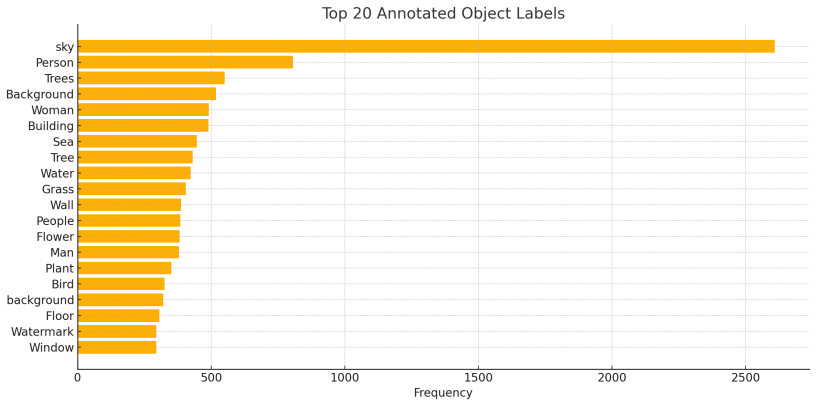
- [Sections 3.2.1 and 3.2.2] There are several typographical errors: 'followed byportraits' is missing a space, 'See' in the top-20 label list is likely a typo for 'Sea,' and the model name is rendered inconsistently as 'LLaVV A-NeXT,' 'LLaV A-NeXT,' and 'LLaVA-NeXT' across the text.
- [Section 3] The claim that the annotation framework was 'independently developed prior to the publication and our awareness of' NVIDIA's DAM framework is unverifiable and irrelevant to the technical content; it should be removed or substantiated with dated evidence.
- [Section 4.5] No confidence intervals, standard errors, or multiple-seed results are reported for any of the fine-tuning metrics, despite the validation set containing only 1,061 pairs; the differences in Tables 3 and 4 may not be statistically distinguishable.
- [Sections 4.4.1 and Table 2] The Rekognition comparison uses exact label matching at a fixed 50% confidence threshold without sensitivity analysis or a human-agreement baseline, so the reported precision/recall/F1 values are hard to interpret as a measure of 'semantic gap'; some discussion of threshold dependence would strengthen this section.
Circularity Check
No definitional circularity: the fine-tuning gains are measured on a held-out DSD validation split, so they are not identical to the training objective by construction; the 'known benchmarks' wording is an overstatement but not a circular reduction.
full rationale
The claimed derivation chain is: fine-tune LLaVA-NeXT and BLIP2 on the DSD training split (9,549 pairs), evaluate on the DSD validation split (1,061 pairs), and report BLEU-4/ROUGE-L/BERTScore/CLIPScore gains of the fine-tuned models over the base models. Because the validation pairs are disjoint from the training pairs, the reported numbers are a genuine held-out measurement rather than an identity with the training loss. The checkpoint choices are indeed made on the same validation split (lowest validation loss for LLaVA-NeXT, peak CIDEr+Bleu_4 for BLIP2), which introduces selection bias and weakens any claim of external generalization, but it does not make the metric equal to the input by construction. No equation in the paper reduces one claimed result to another, and no load-bearing self-citation or imported 'uniqueness' argument appears. The abstract's phrase 'against known benchmarks' is not supported by the experimental design: no public benchmark dataset such as COCO Karpathy test, NoCaps, or Flickr30k is used, and BLIP2 actually degrades on BERTScore and CLIPScore. These are serious validity and overclaim concerns, not instances of definitional circularity under the specified patterns.
Assumptions & free parameters
free parameters (1)
- AWS Rekognition confidence threshold =
0.50
assumptions (4)
- domain assumption Human peer rankings and multi-tier annotations are a reliable ground truth for image description quality.
- domain assumption Improvement on the DSD validation split transfers to external benchmarks.
- ad hoc to paper Exact label matching between Rekognition and human labels is a fair comparison.
- domain assumption BLEU, ROUGE, BERTScore, and CLIPScore adequately measure scene-description quality.
Cite this review
Pith. "Pith review of Peer-Ranked Precision: Creating a Foundational Dataset for Fine-Tuning Vision Models from DataSeeds' Annotated Imagery." pith.science (2026). https://pith.science/paper/42VBT6KR
@misc{pith2026250605673,
  author       = {Pith},
  title        = {Pith review of: Peer-Ranked Precision: Creating a Foundational Dataset for Fine-Tuning Vision Models from DataSeeds' Annotated Imagery},
  year         = {2026},
  howpublished = {\url{https://pith.science/paper/42VBT6KR}},
  note         = {Machine review of arXiv:2506.05673}
}
read the original abstract
The development of modern Artificial Intelligence (AI) models, particularly diffusion-based models employed in computer vision and image generation tasks, is undergoing a paradigmatic shift in development methodologies. Traditionally dominated by a "Model Centric" approach, in which performance gains were primarily pursued through increasingly complex model architectures and hyperparameter optimization, the field is now recognizing a more nuanced "Data-Centric" approach. This emergent framework foregrounds the quality, structure, and relevance of training data as the principal driver of model performance. To operationalize this paradigm shift, we introduce the DataSeeds.AI sample dataset (the "DSD"), initially comprised of approximately 10,610 high-quality human peer-ranked photography images accompanied by extensive multi-tier annotations. The DSD is a foundational computer vision dataset designed to usher in a new standard for commercial image datasets. Representing a small fraction of DataSeeds.AI's 100 million-plus image catalog, the DSD provides a scalable foundation necessary for robust commercial and multimodal AI development. Through this in-depth exploratory analysis, we document the quantitative improvements generated by the DSD on specific models against known benchmarks and make the code and the trained models used in our evaluation publicly available.
Figures


Figures from the paper (9 more)




Reference graph
Works this paper leans on
-
[1]
A data-centric approach to improve performance of deep learning models
Nikita Bhatt, Nirav Bhatt, Purvi Prajapati, Vishal Sorathiya, Samah Alshathri, and Walid El-Shafai. A data-centric approach to improve performance of deep learning models. Scientific Reports, 14 0 (1): 0 22329, 2024
work page 2024
-
[2]
A fast quartet tree heuristic for hierarchical clustering
Rudi L Cilibrasi and Paul MB Vit \'a nyi. A fast quartet tree heuristic for hierarchical clustering. Pattern recognition, 44 0 (3): 0 662--677, 2011
work page 2011
-
[3]
Imagenet: A large-scale hierarchical image database
Jia Deng, Wei Dong, Richard Socher, Li-Jia Li, Kai Li, and Li Fei-Fei. Imagenet: A large-scale hierarchical image database. In 2009 IEEE conference on computer vision and pattern recognition, pages 248--255. Ieee, 2009
2009
-
[4]
Lora: Low-rank adaptation of large language models
Edward J Hu, Yelong Shen, Phillip Wallis, Zeyuan Allen-Zhu, Yuanzhi Li, Shean Wang, Lu Wang, Weizhu Chen, et al. Lora: Low-rank adaptation of large language models. ICLR, 1 0 (2): 0 3, 2022
2022
-
[5]
The open images dataset v4: Unified image classification, object detection, and visual relationship detection at scale
Alina Kuznetsova, Hassan Rom, Neil Alldrin, Jasper Uijlings, Ivan Krasin, Jordi Pont-Tuset, Shahab Kamali, Stefan Popov, Matteo Malloci, Alexander Kolesnikov, et al. The open images dataset v4: Unified image classification, object detection, and visual relationship detection at scale. International journal of computer vision, 128 0 (7): 0 1956--1981, 2020
1956
-
[6]
Blip-2: Bootstrapping language-image pre-training with frozen image encoders and large language models
Junnan Li, Dongxu Li, Silvio Savarese, and Steven Hoi. Blip-2: Bootstrapping language-image pre-training with frozen image encoders and large language models. In International conference on machine learning, pages 19730--19742. PMLR, 2023
2023
-
[7]
Describe anything: Detailed localized image and video captioning
Long Lian, Yifan Ding, Yunhao Ge, Sifei Liu, Hanzi Mao, Boyi Li, Marco Pavone, Ming-Yu Liu, Trevor Darrell, Adam Yala, and Yin Cui. Describe anything: Detailed localized image and video captioning. arXiv preprint arXiv:2504.16072, 2025
arXiv 2025
-
[8]
Rouge: A package for automatic evaluation of summaries
Chin-Yew Lin. Rouge: A package for automatic evaluation of summaries. In Text summarization branches out, pages 74--81, 2004
2004
Show all 17 references
-
[9]
Llava-onevision-qwen2-0.5b-ov
LMMS Lab . Llava-onevision-qwen2-0.5b-ov. https://huggingface.co/lmms-lab/llava-onevision-qwen2-0.5b-ov, 2024. Accessed: March 20, 2025
2024
-
[10]
Peft: State-of-the-art parameter-efficient fine-tuning methods
Sourab Mangrulkar, Sylvain Gugger, Lysandre Debut, Younes Belkada, Sayak Paul, and Benjamin Bossan. Peft: State-of-the-art parameter-efficient fine-tuning methods. https://github.com/huggingface/peft, 2022
2022
-
[11]
Bleu: a method for automatic evaluation of machine translation
Kishore Papineni, Salim Roukos, Todd Ward, and Wei-Jing Zhu. Bleu: a method for automatic evaluation of machine translation. In Proceedings of the 40th annual meeting of the Association for Computational Linguistics, pages 311--318, 2002
2002
-
[12]
Introducing LLaVA - NeXT , 2024
Ping Sun, Maria Tsimpoukelli, Liang Zhang, et al. Introducing LLaVA - NeXT , 2024. URL https://llava-vl.github.io/blog/2024-01-30-llava-next/
2024
-
[13]
Normalized web distance and word similarity., 2010
Paul MB Vit \'a nyi, Rudi Cilibrasi, and PMB Vitanyi. Normalized web distance and word similarity., 2010
2010
-
[14]
Efficient human-in-loop deep learning model training with iterative refinement and statistical result validation
Manuel Zahn and Douglas P Perrin. Efficient human-in-loop deep learning model training with iterative refinement and statistical result validation. arXiv preprint arXiv:2304.00990, 2023
2023 arXiv
-
[15]
Sigmoid loss for language image pre-training, 2023
Xiaohua Zhai, Basil Mustafa, Alexander Kolesnikov, and Lucas Beyer. Sigmoid loss for language image pre-training, 2023
2023
-
[16]
Long-clip: Unlocking the long-text capability of clip
Beichen Zhang, Pan Zhang, Xiaoyi Dong, Yuhang Zang, and Jiaqi Wang. Long-clip: Unlocking the long-text capability of clip. In European Conference on Computer Vision, pages 310--325. Springer, 2024
2024
-
[17]
Bertscore: Evaluating text generation with bert
Tianyi Zhang, Varsha Kishore, Felix Wu, Kilian Q Weinberger, and Yoav Artzi. Bertscore: Evaluating text generation with bert. arXiv preprint arXiv:1904.09675, 2019
1904 arXiv
Reviewed August 7, 2026 · model on record in the stance chip above.
Discussion (0). Sign in to comment.