REVIEW 4 major objections 4 minor 29 references
Enhanced Trust Region Sequential Convex Optimization for Multi-Drone Thermal Screening Trajectory Planning in Urban Environments
T0 review · 4 major / 4 minor · reviewed 2026-08-07 · deepseek-v4-flash
Pith's one-line read The enhanced trust region sequential convex optimization algorithm plans multi-drone thermal screening trajectories that are shorter, less redundant, and faster to compute in urban simulations.
desk verdict A plausible engineering adaptation, but the algorithm as written is not convex because of the untreated inter-drone distance constraint, so the reported numbers belong to an underspecified method. read the letter →
The pith
A machine-rendered reading of the paper's core claim, the machinery that carries it, and where it could break.
The reading
What carries the argument
The central object is the trust-region sequential convex optimization (TR-SCO) loop: the non-convex trajectory problem is replaced at each iteration by a convex subproblem built around the current reference trajectory, with first-order Taylor linearizations of nonlinear constraints and a trust-region bound $\|x_k(t) - x_k^r(t)\|_2 \le \delta$ that keeps the linearizations valid. Two enhancements carry the reported gains: adaptive trust-region filtering, which drops collision-avoidance constraints that do not intersect the current trust region and shrinks each subproblem; and a higher-order soft trust-region penalty $w_\delta \delta^p$ with $p \ge 2$, which the paper argues enforces KKT optimality and suppresses oscillation. The obstacle-height constraint is linearized about the reference trajectory, while the inter-drone separation is enforced as $\|x_k(t)-x_m(t)\|_2 \ge d_{\mathrm{drone}}$ in the problem statement.
What would settle it
Run the released source code and inspect the constraint list of the first-iteration subproblem in the five-drone scenario: if the inter-drone collision constraint $\|x_k(t)-x_m(t)\|_2 \ge d_{\mathrm{drone}}$ appears without a convex reformulation, the subproblem is not convex and the claim that every iteration solves a convex program fails.
Extended reading notes
Core claim
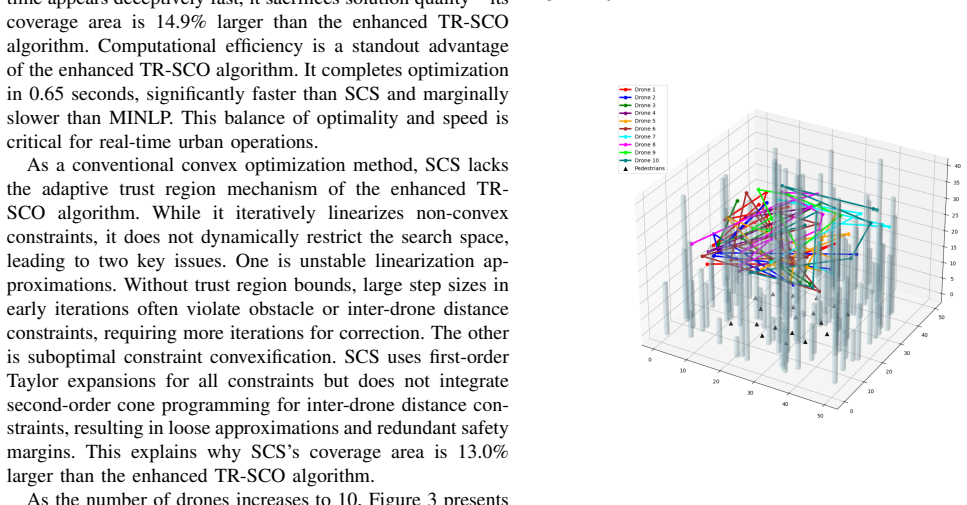
On the paper's own terms, the discovery is that TR-SCO, enhanced with adaptive trust-region filtering and a higher-order soft trust-region term, outperforms three established trajectory-planning approaches for multi-drone thermal screening. In the five-drone scenario, the enhanced algorithm reaches a total path length of 859.11 m, a coverage area of 2490.74 m², and a calculation time of 0.65 s; the paper states this is a 12.9% shorter path than MINLP and a 10.2% shorter path than SCS, with the smallest coverage area of the four methods. For ten drones it scales to 1684.91 m, 4934.46 m², and 1.58 s, which the paper reads as evidence that the approach remains computationally tractable as fleet size grows. The mechanism behind the gains is that linearized obstacle constraints stay valid inside an adaptive trust region, inactive collision constraints are dropped from each subproblem, and larger trust-region steps are penalized more strongly, producing smoother and shorter routes without sacrificing safety.
Load-bearing premise
The method's claim that each iteration solves a convex program assumes the inter-drone collision constraint 'stay at least $d_{\mathrm{drone}}$ apart' has been convexified, but the constraint as written is non-convex and the paper gives no relaxation.
Editorial extensions
If this is right
- A five-drone thermal screening mission could have its coordinated trajectories recomputed in about 0.65 s, making mid-mission re-planning realistic when pedestrian patterns or obstacle layouts change.
- Shorter total path length reduces per-mission energy consumption, which extends the limited battery endurance of small drones.
- The smaller coverage area implies less duplicated screening of the same ground, so the fleet spends more time over high-pedestrian-density zones.
- Scaling from five to ten drones raises computation time from 0.65 s to 1.58 s, suggesting the algorithm handles larger fleets without a combinatorial explosion.
Reading between the lines
- The paper leaves implicit that the adaptive trust-region filter could be run online during a mission, re-solving the subproblem when a new obstacle appears between waypoints; the 0.65 s solve time suggests this is plausible, but the paper only demonstrates offline planning.
- A natural test that goes beyond the written formulation is to replace the inter-drone constraint with an explicit second-order cone surrogate and re-run the simulations; the paper does not provide that reformulation, so the reported gains are tied to the unresolved constraint.
- Field validation would be stronger if the metric counted actual pedestrians screened per unit time, since the paper's convention that smaller coverage area means better screening is unusual and would need a direct public-health test.
Editorial analysis
A structured set of objections, weighed in public.
Referee Report
Summary. The paper proposes an enhanced Trust Region Sequential Convex Optimization (TR-SCO) algorithm for multi-drone trajectory planning in urban thermal screening. The claimed contributions are a convexification procedure for nonlinear constraints, an adaptive trust-region filtering mechanism, and a higher-order soft trust-region penalty. The manuscript reports simulations with five and ten drones, comparing the enhanced algorithm against Original TR-SCO, MINLP, and SCS on total path length, coverage area, and computation time. The central claim is that the enhanced TR-SCO algorithm produces shorter, smoother, and more computationally efficient trajectories while preserving safety constraints.
Significance. If the proposed algorithm were correctly specified and the reported results reproducible, the work would be a useful application of SCP/TR-SCO ideas to multi-drone thermal screening. The paper also releases source code, which is a positive step for reproducibility. However, the significance is currently undermined by the fact that the central subproblem is not actually a convex program as written: the inter-drone collision constraint is non-convex and unconvexified, and the trust-region constraints that define the method are absent from the final formulation. As a result, the reported numerical results are not tied to a well-defined algorithm, and the convergence and optimality claims are unsupported.
major comments (4)
- [§III.C, Eq. (24) and Algorithm 1, Eq. (26)] The inter-drone collision constraint ||x_k(t) - x_m(t)||_2 >= d_drone is non-convex because its feasible set is the complement of an open ball. The paper never provides a convexification or relaxation of this constraint. The passing remark in §IV.B about modeling inter-drone collision constraints as convex second-order cone problems is not accompanied by any formula, and a minimum-distance constraint cannot be represented as a convex SOCP in these variables without additional decision variables, separation hyperplanes, or a different formulation. As written, a DCP-based solver such as cvxpy would reject the program, so Algorithm 1 cannot be executed as specified. The paper must state the exact convexification used and revisit the convergence and optimality claims accordingly.
- [§III.A, Eq. (17) vs. §III.C, Eq. (24)] The trust-region constraints introduced in Eq. (17) are absent from the final subproblem formulations (24) and (26). The objective contains the term w_delta * delta^p, but delta is not defined as a decision variable or as a function of the iterate, and the scalar update rule (27) does not impose any bound on ||x(t) - x^r(t)||. Consequently the word "trust region" does not correspond to an actual constraint in the subproblem, and the claim that linearized constraints remain valid within a trust region is unsupported. Explicit trust-region constraints must be included, or an equivalence between the soft penalty and an explicit trust region must be derived.
- [§III.B.3, Higher-Order Soft Trust-Region Integration] The claim that a higher-order penalty term (e.g., p = 2) "guarantees KKT optimality" is not justified. In sequential convex programming, convergence to a KKT point of the original nonconvex problem requires conditions on the linearization scheme, constraint qualifications, and trust-region management; a higher-order penalty alone does not provide such a guarantee. The statement as written is technically unsupported and should be removed or replaced with a concrete convergence argument.
- [§IV.B, Tables I and II] Because the subproblem in Eq. (24)/(26) is not a valid convex program as written and the trust-region constraint is missing, the numerical results in Tables I and II cannot be attributed to the algorithm described in the paper. In addition, the experimental setup is not sufficiently specified for reproducibility: the initialization x0, the reference trajectory generation, the implementation details of Original TR-SCO, MINLP, and SCS, the solver settings, and the random seeds used to generate the urban scenarios are not reported. The paper must provide a complete, executable problem formulation and detailed experimental settings before the reported performance comparisons can be assessed.
minor comments (4)
- [§III.B.1, Eq. (19)] Replacing the Euclidean waypoint deviation constraint with component-wise absolute value constraints enlarges the feasible set: the square allows a diagonal deviation of up to sqrt(2)*d_dev. If this relaxation is intentional, it should be stated explicitly and its effect on the reported coverage and path metrics should be discussed.
- [§II.C, Eq. (9) and surrounding text] The sentence introducing Eq. (9) has an unmatched parenthesis in "preset waypoints (x(t), y(t), it is formulated that"; please fix the mathematical typesetting and the surrounding prose.
- [§III.B.1, Eq. (19) text] The phrase "value constraints to maintain convexity value constraints to maintain convexity" contains a duplicated fragment and should be corrected.
- [§IV.B, coverage-area discussion] The manuscript describes a lower total coverage area as meaning "more comprehensive screening" because it indicates less redundancy, but a lower area could also simply mean less total coverage. The metric should be defined more carefully, and the paper should clarify how redundancy is separated from total coverage in the reported numbers.
Circularity Check
No significant circularity: the algorithm's components come from external prior work and are benchmarked against external baselines; the reported results are not equivalent by construction to the method's inputs.
full rationale
The derivation chain is self-contained. The problem formulation in Section II defines the objective (smoothness plus path length, Eqs. 3-5) and the constraints (obstacle clearance, altitude, boundaries, waypoint deviation, inter-drone spacing, Eqs. 6-10). Section III.B provides a Taylor-based convexification for the obstacle-height constraint and component-wise absolute-value convexification for waypoint adherence, while the trust-region filtering and higher-order soft trust-region ideas are explicitly adopted from prior external works [25] and [27]. These borrowings are not circular because they are evaluated against external baselines (Original TR-SCO, MINLP, SCS), and the comparison metrics (path length, coverage area, computation time) are not fitted parameters renamed as predictions. No self-citation is load-bearing, no uniqueness theorem is imported from the authors' own prior work, and no ansatz is smuggled in through self-citation. The most serious concern in the paper is not circularity: the inter-drone collision constraint ||x_k(t) - x_m(t)||_2 >= d_drone, which appears in the 'convex' subproblems (24) and (26), is a reverse-norm constraint and is non-convex as written; the paper asserts that it is transformed into a convex second-order cone problem but gives no formula. That is a correctness/completeness gap, not a circular reduction. Therefore the appropriate circularity score is 0.
Assumptions & free parameters
free parameters (8)
- w_delta (trust region penalty weight) =
unspecified
- p (trust region penalty order) =
p >= 2, unspecified
- delta_0 (initial trust region radius) =
unspecified
- c1, c2 (trust region update factors) =
unspecified
- epsilon_rho (constraint violation threshold) =
unspecified
- d_dev (waypoint deviation bound) =
unspecified
- d_safe and d_drone (safety distances) =
d_safe=5 m stated, d_drone unspecified
- objective weights for J_smooth and J_length =
implicitly both 1
assumptions (6)
- domain assumption The obstacle height function h_obs is differentiable and linearizable within the trust region radius.
- ad hoc to paper The inter-drone collision constraint ||x_k(t) - x_m(t)||_2 >= d_drone is compatible with the convex subproblem as written.
- ad hoc to paper A higher-order soft trust region term in the objective guarantees KKT optimality of the original problem.
- domain assumption The random grid-based city model is a sufficient proxy for realistic urban environments.
- domain assumption The altitude range 20-50 m and waypoint deviation bound d_dev ensure accurate thermal screening.
- domain assumption The baselines (Original TR-SCO, MINLP, SCS) are implemented and tuned fairly.
Cite this review
Pith. "Pith review of Enhanced Trust Region Sequential Convex Optimization for Multi-Drone Thermal Screening Trajectory Planning in Urban Environments." pith.science (2026). https://pith.science/paper/H4OG6TNV
@misc{pith2026250606012,
  author       = {Pith},
  title        = {Pith review of: Enhanced Trust Region Sequential Convex Optimization for Multi-Drone Thermal Screening Trajectory Planning in Urban Environments},
  year         = {2026},
  howpublished = {\url{https://pith.science/paper/H4OG6TNV}},
  note         = {Machine review of arXiv:2506.06012}
}
read the original abstract
The rapid detection of abnormal body temperatures in urban populations is essential for managing public health risks, especially during outbreaks of infectious diseases. Multi-drone thermal screening systems offer promising solutions for fast, large-scale, and non-intrusive human temperature monitoring. However, trajectory planning for multiple drones in complex urban environments poses significant challenges, including collision avoidance, coverage efficiency, and constrained flight environments. In this study, we propose an enhanced trust region sequential convex optimization (TR-SCO) algorithm for optimal trajectory planning of multiple drones performing thermal screening tasks. Our improved algorithm integrates a refined convex optimization formulation within a trust region framework, effectively balancing trajectory smoothness, obstacle avoidance, altitude constraints, and maximum screening coverage. Simulation results demonstrate that our approach significantly improves trajectory optimality and computational efficiency compared to conventional convex optimization methods. This research provides critical insights and practical contributions toward deploying efficient multi-drone systems for real-time thermal screening in urban areas. For reader who are interested in our research, we release our source code at https://github.com/Cherry0302/Enhanced-TR-SCO.
Figures


Reference graph
Works this paper leans on
- [1]
-
[2]
S. W. Lee, W. T. Yuh, J. M. Yang, Y .-S. Cho, I. K. Yoo, H. Y . Koh, D. Marshall, D. Oh, E. K. Ha, M. Y . Han, et al., Nationwide results of covid-19 contact tracing in south korea: individual participant data from an epidemiological survey, JMIR medical informatics 8 (8) (2020) e20992
work page 2020
-
[3]
D. Perpetuini, C. Filippini, D. Cardone, A. Merla, An overview of thermal infrared imaging-based screenings during pandemic emergen- cies, International Journal of Environmental Research and Public Health 18 (6) (2021) 3286
work page 2021
-
[4]
K. Cardwell, K. Jordan, P. Byrne, S. M. Smith, P. Harrington, M. Ryan, M. O’Neill, The effectiveness of non-contact thermal screening as a means of identifying cases of covid-19: a rapid review of the evidence, Reviews in Medical Virology 31 (4) (2021) e2192
work page 2021
-
[5]
K. Khaksari, T. Nguyen, B. Hill, T. Quang, J. Perreault, V . Gorti, R. Malpani, E. Blick, T. Gonz ´alez Cano, B. Shadgan, et al., Review of the efficacy of infrared thermography for screening infectious diseases with applications to covid-19, Journal of Medical Imaging 8 (S1) (2021) 010901–010901
work page 2021
-
[6]
D. R ¨udisser, T. Weiss, L. Unger, Spatially resolved analysis of urban thermal environments based on a three-dimensional sampling algorithm and uav-based radiometric measurements, Sensors 21 (14) (2021) 4847
work page 2021
-
[7]
W. Hoshino, J. Seo, Y . Yamazaki, A study for detecting disaster victims using multi-copter drone with a thermographic camera and image object recognition by ssd, in: 2021 IEEE/ASME international conference on advanced intelligent mechatronics (AIM), IEEE, 2021, pp. 162–167
work page 2021
-
[8]
J. Xu, Application of multispectral and thermal imaging technologies in drone search and rescue missions, Traitement du Signal 41 (5) (2024) 2317
work page 2024
Show all 29 references
-
[9]
Xiang, Y
H. Xiang, Y . Han, N. Pan, M. Zhang, Z. Wang, Study on multi-uav cooperative path planning for complex patrol tasks in large cities, Drones 7 (6) (2023) 367
2023
-
[10]
Zhong, X
W. Zhong, X. Wang, X. Liu, Z. Lin, F. Ali, Joint optimization of uav communication connectivity and obstacle avoidance in urban environ- ments using a double-map approach, EURASIP Journal on Advances in Signal Processing 2024 (1) (2024) 35
2024
-
[11]
Qazavi, S
S. Qazavi, S. H. Semnani, Distributed swarm collision avoidance based on angular calculations, Autonomous Robots 47 (4) (2023) 425–434
2023
-
[12]
Z. Du, H. Zhang, Z. Wang, H. Yan, Model predictive formation tracking-containment control for multi-uavs with obstacle avoidance, IEEE Transactions on Systems, Man, and Cybernetics: Systems 54 (6) (2024) 3404–3414
2024
-
[13]
Y .-I. Cho, D. Yoon, M.-J. Lee, Comparative analysis of urban heat island cooling strategies according to spatial and temporal conditions using unmanned aerial vehicles (uav) observation, Applied Sciences 13 (18) (2023) 10052
2023
-
[14]
Al Maashri, A
A. Al Maashri, A. Saleem, H. Bourdoucen, O. Eldirdiry, A. Al Ghadani, A novel drone-based system for accurate human temperature mea- surement and disease symptoms detection using thermography and ai, Remote sensing applications: society and environment 27 (2022) 100787
2022
-
[15]
Y . V . Pant, M. Z. Li, A. Rodionova, R. A. Quaye, H. Abbas, M. S. Ryerson, R. Mangharam, Fads: A framework for autonomous drone safety using temporal logic-based trajectory planning, Transportation Research Part C: Emerging Technologies 130 (2021) 103275
2021
-
[16]
Tran, D.-D
T.-H. Tran, D.-D. Nguyen, Management and regulation of drone opera- tion in urban environment: A case study, Social Sciences 11 (10) (2022) 474
2022
-
[17]
Zhang, W
P. Zhang, W. Li, S. Gong, Ascent trajectory optimization for boost- glide vehicle using homotopy approximation function sequential convex programming, IEEE Transactions on Aerospace and Electronic Systems (2025) 1–22doi:10.1109/TAES.2025.3539639
2025
-
[18]
W. Li, W. Li, L. Cheng, S. Gong, Trajectory optimization with complex obstacle avoidance constraints via homotopy network sequential convex programming, Aerospace 9 (11) (2022) 720
2022
-
[19]
Zhang, H
T. Zhang, H. Su, C. Gong, Hp-adaptive rpd based sequential convex programming for reentry trajectory optimization, Aerospace Science and Technology 130 (2022) 107887
2022
-
[20]
Scheffe, T
P. Scheffe, T. M. Henneken, M. Kloock, B. Alrifaee, Sequential convex programming methods for real-time optimal trajectory planning in autonomous vehicle racing, IEEE Transactions on Intelligent Vehicles 8 (1) (2022) 661–672
2022
-
[21]
M. A. El-Meligy, A. M. El-Sherbeeny, Hybrid robust/stochastic trans- mission expansion planning considering uncertainties in generators’ offer prices: A second-order cone program approach, Electric Power Systems Research 203 (2022) 107631
2022
-
[22]
M. M.-U.-T. Chowdhury, S. Kamalasadan, S. Paudyal, A second-order cone programming (socp) based optimal power flow (opf) model with cyclic constraints for power transmission systems, IEEE Transactions on Power Systems 39 (1) (2023) 1032–1043
2023
-
[23]
H. Lu, J. Yang, A practical and optimal first-order method for large- scale convex quadratic programming, arXiv preprint arXiv:2311.07710 (2023)
2023 arXiv
-
[24]
Astudillo, J
A. Astudillo, J. Gillis, M. Diehl, W. Decr ´e, G. Pipeleers, J. Swevers, Po- sition and orientation tunnel-following nmpc of robot manipulators based on symbolic linearization in sequential convex quadratic programming, IEEE Robotics and Automation Letters 7 (2) (2022) 2867–2874
2022
-
[25]
G. Xu, T. Long, Z. Wang, J. Sun, Trust-region filtered sequential convex programming for multi-uav trajectory planning and collision avoidance, ISA transactions 128 (2022) 664–676. 10
2022
-
[26]
Xie, R.-Z
L. Xie, R.-Z. He, H.-B. Zhang, G.-J. Tang, Oscillation phenomenon in trust-region-based sequential convex programming for the nonlinear trajectory planning problem, IEEE Transactions on Aerospace and Electronic Systems 58 (4) (2022) 3337–3352
2022
-
[27]
L. Xie, X. Zhou, H.-B. Zhang, G.-J. Tang, Hybrid-order soft trust region- based sequential convex programming for reentry trajectory optimiza- tion, Advances in Space Research 73 (6) (2024) 3195–3208
2024
-
[28]
I. P. Androulakis, Minlp: Branch and bound global optimization algo- rithm, in: Encyclopedia of Optimization, Springer, 2024, pp. 1–7
2024
-
[29]
Chen, Efficient numerical algorithms for large-scale conic optimiza- tion, Ph.D
Y . Chen, Efficient numerical algorithms for large-scale conic optimiza- tion, Ph.D. thesis, University of Oxford (2024)
2024
Reviewed August 7, 2026 · model on record in the stance chip above.
Discussion (0). Sign in to comment.