REVIEW 3 major objections 6 minor 78 references
Towards Lifecycle Unlearning Commitment Management: Measuring Sample-level Unlearning Completeness
T0 review · 3 major / 6 minor · reviewed 2026-08-07 · deepseek-v4-flash
Pith's one-line read An interpolation-based score can measure, sample by sample, whether machine unlearning has actually removed a training point's influence.
desk verdict A useful, honest paper on unlearning verification via interpolated membership scoring; exact-unlearning results are strong, while the approximate-unlearning ground truth and one-shadow variance proxy need sharper treatment. read the letter →
The pith
A machine-rendered reading of the paper's core claim, the machinery that carries it, and where it could break.
The reading
What carries the argument
The mechanism is the model-behavior trajectory: for each query, IAM linearly interpolates between the shadow model's response $r(z;\tilde{\theta})$ and the original model's response $r(z;\theta)$ in $m$ steps, forming interpolated responses $r_i = \frac{m-i}{m-1}r(z;\tilde{\theta}) + \frac{i-1}{m-1}r(z;\theta)$. A Bounded GumbelMap transformation, $\tilde{r}(z;\theta) = -\log(\varepsilon_1 - \log(p + \varepsilon_2))$, maps confidences into bounded responses that remain Gumbel-fittable even when confidences concentrate near zero or one. At each interpolation level, the responses across shadow-original pairs are assumed to follow a Gumbel distribution, and the query's score is the weighted sum of probabilities $q_i = \Pr[r' > X]$ with $X \sim \Phi_i$, weighted linearly by level index. This construction is what lets IAM estimate full response distributions from a single shadow model, using cross-example variance as a proxy for cross-model variance.
What would settle it
Train a set of many shadow models (e.g., 128) on overlapping subsets of a dataset. For a fixed query example, compute the actual cross-model variance of Bounded GumbelMap responses and compare it to the cross-example variance estimated from a single shadow model over the full training set. If the two variances diverge systematically (say, by a factor of two or more), the CDF scores in Eq. (4) are miscalibrated and IAM's ranking would degrade; a direct check is whether IAM's predicted scores correlate with the true leave-one-out membership status on a held-out set of exactly retrained models.
Extended reading notes
Core claim
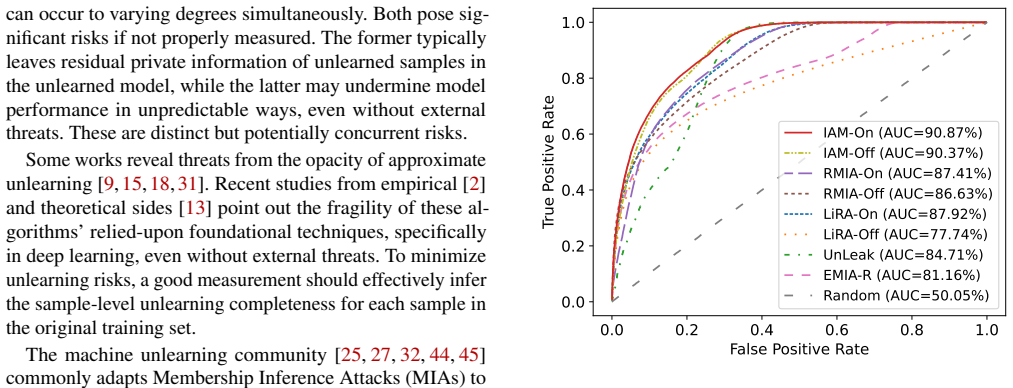
The paper's central claim is that sample-level unlearning completeness can be measured by locating the unlearned model's response on a generalization-to-fitting spectrum, rather than by testing binary membership. IAM builds this spectrum by interpolating between the response of a fitted original model and responses of pre-trained shadow models, modeling the distribution of interpolated responses at each level with a Gumbel distribution fitted by the method of moments, and then taking a weighted average of CDF values. The authors report that this score achieves AUC up to 90.87 percent on exact CIFAR-100 unlearning and Spearman correlation up to 0.713 on approximate unlearning, outperforming LiRA, RMIA, and UnLeak with a single shadow model. They further show that a double-flip adaptation extends the same mechanism to LLMs with a mismatched shadow model, and they use IAM to expose both under-unlearning and over-unlearning risks in seven approximate unlearning algorithms.
Load-bearing premise
The single-shadow-model efficiency rests on the unproved proxy that the spread of one shadow model's responses across many training examples approximates the spread of many shadow models on a single queried example; the paper's lemmas only bound the moments, not that these two variances match.
Editorial extensions
If this is right
- If IAM's scores are reliable, unlearning verification can be done at sample level with the same computational budget as a single shadow model, avoiding the retraining-scale cost of online membership inference attacks.
- For exact unlearning, IAM's binary inclusion scores could replace MIA-based checks as a more accurate full-ROC measure, since it ranks retained and unlearned samples rather than optimizing only worst-case privacy leakage.
- For approximate unlearning, IAM provides a continuous score that can flag under-unlearning (unlearned samples that still show fitted behavior) and over-unlearning (retained samples whose behavior is suppressed), enabling per-sample auditing of algorithms like SSD, Fisher Forgetting, and Forsaken.
- The score extrapolates to large language models: the paper demonstrates that a double-flip version of IAM, trained on a smaller mismatched shadow model, outperforms prior MIA and perplexity-based detectors on both exact and approximate unlearning of a LLaMA-2 7B model.
Reading between the lines
- A natural extension not pursued in the paper is to use IAM's per-sample scores as a continuous audit signal for data deletion regulations, where an auditor could set risk thresholds informed by the score distribution rather than by a single empirical constant.
- The interpolation trajectory view suggests that IAM could be adapted to estimate leave-one-out influence without retraining, connecting unlearning completeness measurement to influence-function style attribution, though the paper does not test this connection.
- The paper's empirical threshold choice for under-unlearning and over-unlearning is dataset-specific; a principled calibration procedure tying thresholds to the score's calibration error would make the risk flags more portable across models and domains.
- One could test whether IAM's scores remain meaningful when the shadow model is replaced by a synthetically generated population model, which would extend the method to settings where no matching shadow data is available at all.
Editorial analysis
A structured set of objections, weighed in public.
Referee Report
Summary. The paper proposes the Interpolated Approximate Measurement (IAM) framework for measuring sample-level unlearning completeness. IAM interpolates model responses between pre-trained shadow OUT models and the original IN model across m levels, applies a Bounded GumbelMap transformation, fits a Gumbel distribution at each level, and computes a weighted CDF score (Eqs. 3, 5, 8). The authors formalize binary unlearning inference (BinUI) and score-based unlearning inference (ScoreUI), benchmark IAM against LiRA, RMIA, EMIA, UnLeak, and other baselines on exact and approximate unlearning tasks, report SOTA AUC and Spearman correlations including a LLaMA-2 7B experiment, and apply IAM to seven approximate unlearning algorithms to flag under- and over-unlearning risks.
Significance. If the empirical results hold, IAM is a practical advance: it offers a low-cost, single-shadow-model measurement tool for unlearning inference, with a clean exact-unlearning evaluation against genuinely retrained models (Table 1), broad ablations over scoring functions, shadow data and architecture shifts, and a realistic LLM deployment (Table 6). The authors release code and use standard baseline implementations, which strengthens reproducibility. The main caveats are that the theoretical justification for the single-shadow proxy is much weaker than claimed, and the approximate-unlearning ground truth is an author-constructed checkpoint-index proxy; the ScoreUI comparisons should therefore be read as agreement with that operationalization rather than with an externally validated notion of unlearning completeness.
major comments (3)
- [4.3, Lemmas 1–3, Eq. (4)] The single-shadow scalability claim rests on the statement that cross-example variance of Bounded GumbelMap responses can stand in for cross-model variance. Lemmas 1–3 and the Popoviciu-inequality discussion establish only that both quantities are bounded by the same constant; boundedness does not imply that the two variances are close or proportional. With one OUT model, the distribution Φ_i in Eq. (4) is the empirical distribution of interpolated responses across training examples, so q_i measures the query's rank among examples rather than a probability over model draws for that query. The authors should either prove a quantitative relation between the two variances under stated assumptions or validate the proxy empirically, for example by comparing cross-example variance from a single shadow model with cross-model variance from many shadow models on the same queries and reporting the calibration of the resulting scores. Without this, the headline claim of reliable parametric estimates with only one shadow model is not supported by the theory.
- [5.2, Table 2] The ScoreUI ground truth is generated by assigning membership score i/20 to all training examples at the i-th checkpoint of 20 equally spaced checkpoints during continued training of shadow models. This operationalizes unlearning completeness as training progress and assumes a specific linear mapping that is not validated. Since IAM's score is itself built by interpolating between OUT and IN responses, high Spearman correlations in Table 2 may partly reflect the constructional similarity between IAM's score and the checkpoint proxy. The authors should validate ScoreUI against an independent ground truth, such as leave-one-out retraining on a subset, influence-function estimates, or memorization scores, or clearly reframe the results as measuring agreement with training-progress ordering and discuss the limitations of that proxy.
- [6, Definition 7, Table 8] The risk identifications in Section 6 rest on thresholds δ1=0.1 and δ2=1.5−test_acc, which are empirically chosen and for which the paper states theoretical grounding is left as future work. The color-coded conclusions about under- and over-unlearning risks therefore depend on constants that are not derived or calibrated with uncertainty. Reporting risk rates as a function of δ1 and δ2, or providing a calibration analysis on retrained models, would make the risk claims more robust; as written, the qualitative finding that five of seven approximate baselines present high under-unlearning risks could change under reasonable threshold choices.
minor comments (6)
- [Throughout] Typos should be fixed: 'unleraning' in Section 6, 'mdoel' in the Section 6 threshold paragraph, 'exhibite' in Appendix D.7, and 'This word is supported' in the Acknowledgments.
- [Tables 1 and 6] Table 1 contains formatting issues where numeric entries are concatenated, e.g., '54.79±0.3163.85±1.05' and '56.71±0.3361.78±0.61'; Table 6 contains '84.69±00.57' with an extra zero.
- [Title and Section 1] The title promises 'Lifecycle Unlearning Commitment Management', but the paper does not define or discuss lifecycle commitment management beyond the risk threshold discussion; consider aligning the title with the actual contribution or adding a short paragraph on the lifecycle framing.
- [4.1, Eq. (5)] The linearly increasing weights i in Eq. (5) are motivated by the misleading q1 example, but no justification is given for this particular weighting over other monotone weightings; a brief sensitivity discussion would be helpful.
- [Figure 8] The parameter labels in Figure 8 appear with spaces (e.g., '1 = 0.001' should be 'ε1 = 0.001'), and the caption lacks a clear separator between the ε1 and ε2 values.
- [5.2] The phrase 'post-trained 10 different shadow OUT models' is unusual; 'continued training' or 'fine-tuned' would be clearer.
Circularity Check
No equation-level circularity: IAM's score is a weighted CDF of interpolated responses, not a restatement of any input; the single-shadow-model proxy is an unproven approximation rather than a circular reduction.
full rationale
The paper's derivation chain is self-contained at the equation level. IAM's score (Eq. 5) is a weighted average of CDF values q_i (Eq. 4), where each q_i is computed from the unlearned model's response and a parametric Gumbel fit of interpolated responses (Eqs. 3, 6-8). None of these quantities is defined in terms of the ground-truth labels s or b used at evaluation time; the Gumbel parameters are estimated by method of moments from the responses themselves, not fitted to the target labels. Consequently, the high AUC and Spearman results in Tables 1, 2, and 6 are empirical outcomes rather than consequences of a fitted parameter being renamed as a prediction. The main theoretical support for the single-shadow-model claim (Section 4.3) is Lemmas 1-3, which establish boundedness of means and variances; the paper then states that this 'motivates using cross-example variance as a proxy for cross-model variance.' This is an unproven equivalence assumption, but it is not a circular one: boundedness of two quantities does not make them equal, and no equation in the paper defines the cross-model variance as the cross-example variance. Similarly, the ScoreUI ground truth (Section 5.2) is generated by assigning scores i/20 to training checkpoints; this operationalizes the generalization-to-fitting continuum that IAM also targets, so the two are correlated by construction only in the weak sense of sharing a monotone axis. The actual checkpoint responses are not the linear interpolations of Eq. (3), so the Spearman correlation is an empirical measurement, not an identity. Self-citations to prior work by the same authors appear in the references but are not load-bearing for the IAM derivation; the monotonicity premise is attributed to an external textbook (Goodfellow et al. [26]). No uniqueness theorem from the authors is invoked. Overall, the central claims have independent empirical content, so the circularity score is 0.
Assumptions & free parameters
free parameters (6)
- epsilon_1 (Bounded GumbelMap) =
1e-2 typical; grid-searched over {1e-1, 1e-2, 1e-3}
- epsilon_2 (Bounded GumbelMap) =
1e-5 typical; 1e-6 for offline Purchase; grid-searched over {1e-4, 1e-5, 1e-6}
- interpolation_steps m =
100 (set by authors)
- risk-threshold constant C =
1.5 (chosen from {1.0, 1.2, 1.4, 1.5, 1.6, 1.8, 2.0})
- under-unlearning threshold delta_1 =
0.1
- checkpoint membership mapping i/20 =
i=1..20 maps to s=i/20
assumptions (5)
- domain assumption Responses change monotonically from generalization to fitting during optimization.
- ad hoc to paper One shadow model's response variance across examples approximates the response variance across many shadow models for one example.
- domain assumption Level-i interpolated responses follow a Gumbel distribution estimable by method of moments.
- domain assumption Shadow OUT model responses on a training sample represent the response of a fully unlearned model to that sample.
- domain assumption For LLMs, training tokens concentrate in a moderate-confidence band while unseen tokens are lower-confidence, so flipping the signal is needed.
invented entities (2)
-
Interpolated Approximate Measurement (IAM) membership score
independent evidence
-
Bounded GumbelMap response transform
Cite this review
Pith. "Pith review of Towards Lifecycle Unlearning Commitment Management: Measuring Sample-level Unlearning Completeness." pith.science (2026). https://pith.science/paper/MSR764HL
@misc{pith2026250606112,
  author       = {Pith},
  title        = {Pith review of: Towards Lifecycle Unlearning Commitment Management: Measuring Sample-level Unlearning Completeness},
  year         = {2026},
  howpublished = {\url{https://pith.science/paper/MSR764HL}},
  note         = {Machine review of arXiv:2506.06112}
}
read the original abstract
Growing concerns over data privacy and security highlight the importance of machine unlearning--removing specific data influences from trained models without full retraining. Techniques like Membership Inference Attacks (MIAs) are widely used to externally assess successful unlearning. However, existing methods face two key limitations: (1) maximizing MIA effectiveness (e.g., via online attacks) requires prohibitive computational resources, often exceeding retraining costs; (2) MIAs, designed for binary inclusion tests, struggle to capture granular changes in approximate unlearning. To address these challenges, we propose the Interpolated Approximate Measurement (IAM), a framework natively designed for unlearning inference. IAM quantifies sample-level unlearning completeness by interpolating the model's generalization-fitting behavior gap on queried samples. IAM achieves strong performance in binary inclusion tests for exact unlearning and high correlation for approximate unlearning--scalable to LLMs using just one pre-trained shadow model. We theoretically analyze how IAM's scoring mechanism maintains performance efficiently. We then apply IAM to recent approximate unlearning algorithms, revealing general risks of both over-unlearning and under-unlearning, underscoring the need for stronger safeguards in approximate unlearning systems. The code is available at https://github.com/Happy2Git/Unlearning_Inference_IAM.
Figures


Figures from the paper (3 more)


Reference graph
Works this paper leans on
-
[1]
Kan- wal, Tegan Maharaj, Asja Fischer, Aaron C
Devansh Arpit, Stanislaw Jastrzebski, Nicolas Ballas, David Krueger, Emmanuel Bengio, Maxinder S. Kan- wal, Tegan Maharaj, Asja Fischer, Aaron C. Courville, Yoshua Bengio, and Simon Lacoste-Julien. A closer look at memorization in deep networks. In Doina Pre- cup and Yee Whye Teh, editors,Proceedings of the 34th International Conference on Machine Learnin...
work page 2017
-
[2]
In- fluence functions in deep learning are fragile
Samyadeep Basu, Phillip Pope, and Soheil Feizi. In- fluence functions in deep learning are fragile. In9th International Conference on Learning Representations, ICLR 2021, Virtual Event, Austria, May 3-7, 2021. Open- Review.net, 2021
work page 2021
-
[3]
Choquette-Choo, Hengrui Jia, Adelin Travers, Baiwu Zhang, David Lie, and Nicolas Papernot
Lucas Bourtoule, Varun Chandrasekaran, Christopher A. Choquette-Choo, Hengrui Jia, Adelin Travers, Baiwu Zhang, David Lie, and Nicolas Papernot. Machine un- learning. In42nd IEEE Symposium on Security and Privacy, SP 2021, San Francisco, CA, USA, 24-27 May 2021, pages 141–159. IEEE, 2021
work page 2021
-
[4]
Hannah Brown, Katherine Lee, Fatemehsadat Mireshghallah, Reza Shokri, and Florian Tramèr. What does it mean for a language model to preserve privacy? InFAccT ’22: 2022 ACM Conference on Fairness, Accountability, and Transparency, Seoul, Republic of Korea, June 21 - 24, 2022, pages 2280–2292. ACM, 2022
work page 2022
-
[5]
Towards making systems forget with machine unlearning
Yinzhi Cao and Junfeng Yang. Towards making systems forget with machine unlearning. In2015 IEEE Sympo- sium on Security and Privacy, SP 2015, San Jose, CA, USA, May 17-21, 2015, pages 463–480. IEEE Computer Society, 2015
work page 2015
-
[6]
Mem- bership inference attacks from first principles
Nicholas Carlini, Steve Chien, Milad Nasr, Shuang Song, Andreas Terzis, and Florian Tramèr. Mem- bership inference attacks from first principles. In 43rd IEEE Symposium on Security and Privacy, SP 2022, San Francisco, CA, USA, May 22-26, 2022, pages 1897–1914. IEEE, 2022. Code available at: https://github.com/tensorflow/privacy/tree/ master/research/mi_lira_2021
work page 2022
-
[7]
Quantifying memorization across neural language mod- els
Nicholas Carlini, Daphne Ippolito, Matthew Jagielski, Katherine Lee, Florian Tramèr, and Chiyuan Zhang. Quantifying memorization across neural language mod- els. InThe Eleventh International Conference on Learn- ing Representations, ICLR 2023, Kigali, Rwanda, May 1-5, 2023. OpenReview.net, 2023
work page 2023
-
[8]
Brown, Dawn Song, Úlfar Erlingsson, Alina Oprea, and Colin Raffel
Nicholas Carlini, Florian Tramèr, Eric Wallace, Matthew Jagielski, Ariel Herbert-V oss, Katherine Lee, Adam Roberts, Tom B. Brown, Dawn Song, Úlfar Erlingsson, Alina Oprea, and Colin Raffel. Extracting training data from large language models. In Michael D. Bailey and Rachel Greenstadt, editors,30th USENIX Security Sym- posium, USENIX Security 2021, Augus...
work page 2021
Show all 78 references
-
[9]
Fedmua: Exploring the vulner- abilities of federated learning to malicious unlearning attacks.IEEE Transactions on Information Forensics and Security, 2025
Jian Chen, Zehui Lin, Wanyu Lin, Wenlong Shi, Xi- aoyan Yin, and Di Wang. Fedmua: Exploring the vulner- abilities of federated learning to malicious unlearning attacks.IEEE Transactions on Information Forensics and Security, 2025. 15
2025
-
[10]
Boundary unlearning: Rapid forgetting of deep networks via shifting the decision boundary
Min Chen, Weizhuo Gao, Gaoyang Liu, Kai Peng, and Chen Wang. Boundary unlearning: Rapid forgetting of deep networks via shifting the decision boundary. In IEEE/CVF Conference on Computer Vision and Pattern Recognition, CVPR 2023, Vancouver, BC, Canada, June 17-24, 2023, pages ...
2023
-
[11]
When machine unlearning jeopardizes privacy
Min Chen, Zhikun Zhang, Tianhao Wang, Michael Backes, Mathias Humbert, and Yang Zhang. When machine unlearning jeopardizes privacy. In Yongdae Kim, Jong Kim, Giovanni Vigna, and Elaine Shi, editors, CCS ’21: 2021 ACM SIGSAC Conference on Computer and Communications Security, V...
2021
-
[12]
Tools for verifying neural models’ training data
Dami Choi, Yonadav Shavit, and David Kristjanson Du- venaud. Tools for verifying neural models’ training data. In Alice Oh, Tristan Naumann, Amir Globerson, Kate Saenko, Moritz Hardt, and Sergey Levine, editors,Ad- vances in Neural Information Processing Systems 36: Annual Con...
2023
-
[13]
Forget unlearning: Towards true data-deletion in machine learning
Rishav Chourasia and Neil Shah. Forget unlearning: Towards true data-deletion in machine learning. In An- dreas Krause, Emma Brunskill, Kyunghyun Cho, Bar- bara Engelhardt, Sivan Sabato, and Jonathan Scarlett, editors,International Conference on Machine Learn- ing, ICML 2023, ...
2023
-
[14]
Crowley, Antreas Anto- niou, and Amos J
Luke Nicholas Darlow, Elliot J. Crowley, Antreas Anto- niou, and Amos J. Storkey. CINIC-10 is not imagenet or CIFAR-10.CoRR, abs/1810.03505, 2018
2018 arXiv
-
[15]
Di, Jack Douglas, Jayadev Acharya, Gau- tam Kamath, and Ayush Sekhari
Jimmy Z. Di, Jack Douglas, Jayadev Acharya, Gau- tam Kamath, and Ayush Sekhari. Hidden poison: Ma- chine unlearning enables camouflaged poisoning attacks. In Alice Oh, Tristan Naumann, Amir Globerson, Kate Saenko, Moritz Hardt, and Sergey Levine, editors,Ad- vances in Neural I...
2023
-
[16]
A tale of tails: Model col- lapse as a change of scaling laws
Elvis Dohmatob, Yunzhen Feng, Pu Yang, François Charton, and Julia Kempe. A tale of tails: Model col- lapse as a change of scaling laws. InForty-first Interna- tional Conference on Machine Learning, ICML 2024, Vi- enna, Austria, July 21-27, 2024. OpenReview.net, 2024
2024
-
[17]
A mathematical framework for transformer circuits, 2021
Nelson Elhage, Neel Nanda, Catherine Olsson, Tom Henighan, Nicholas Joseph, Ben Mann, Amanda Askell, Yuntao Bai, Anna Chen, Tom Conerly, Nova DasSarma, Dawn Drain, Deep Ganguli, Zac Hatfield-Dodds, Danny Hernandez, Andy Jones, Jackson Kernion, Liane Lovitt, Kamal Ndousse, Dari...
2021
-
[18]
Hero III, and Sijia Liu
Chongyu Fan, Jiancheng Liu, Alfred O. Hero III, and Sijia Liu. Challenging forgets: Unveiling the worst-case forget sets in machine unlearning.CoRR, abs/2403.07362, 2024
2024 arXiv
-
[19]
Alves, Caio F
Manuel Faysse, Patrick Fernandes, Nuno Miguel Guer- reiro, António Loison, Duarte M. Alves, Caio F. Corro, Nicolas Boizard, João Alves, Ricardo Rei, Pedro Hen- rique Martins, Antoni Bigata Casademunt, François Yvon, André F. T. Martins, Gautier Viaud, Céline Hude- lot, and Pie...
2024 arXiv
-
[20]
Does learning require memorization? a short tale about a long tail
Vitaly Feldman. Does learning require memorization? a short tale about a long tail. In Konstantin Makarychev, Yury Makarychev, Madhur Tulsiani, Gautam Kamath, and Julia Chuzhoy, editors,Proceedings of the 52nd An- nual ACM SIGACT Symposium on Theory of Computing, STOC 2020, Ch...
2020
-
[21]
Fast machine unlearning without retraining through se- lective synaptic dampening
Jack Foster, Stefan Schoepf, and Alexandra Brintrup. Fast machine unlearning without retraining through se- lective synaptic dampening. In Michael J. Wooldridge, Jennifer G. Dy, and Sriraam Natarajan, editors,Thirty- Eighth AAAI Conference on Artificial Intelligence, AAAI 2024...
2024
-
[22]
short-length
Shaopeng Fu, Liang Ding, and Di Wang. "short-length" adversarial training helps llms defend "long-length" jailbreak attacks: Theoretical and empirical evidence. CoRR, abs/2502.04204, 2025
2025
-
[23]
Mixed-privacy forgetting in deep networks
Aditya Golatkar, Alessandro Achille, Avinash Ravichan- dran, Marzia Polito, and Stefano Soatto. Mixed-privacy forgetting in deep networks. InIEEE Conference on Computer Vision and Pattern Recognition, CVPR 2021, virtual, June 19-25, 2021, pages 792–801. Computer Vision Foundat...
2021
-
[24]
Eternal sunshine of the spotless net: Selective forgetting in deep networks
Aditya Golatkar, Alessandro Achille, and Stefano Soatto. Eternal sunshine of the spotless net: Selective forgetting in deep networks. In2020 IEEE/CVF Conference on Computer Vision and Pattern Recognition, CVPR 2020, 16 Seattle, WA, USA, June 13-19, 2020, pages 9301–9309. Compu...
2020
-
[25]
Forgetting outside the box: Scrubbing deep networks of information accessible from input-output observations
Aditya Golatkar, Alessandro Achille, and Stefano Soatto. Forgetting outside the box: Scrubbing deep networks of information accessible from input-output observations. InComputer Vision - ECCV 2020 - 16th European Con- ference, Glasgow, UK, August 23-28, 2020, Proceedings, Part...
2020
-
[26]
Goodfellow, Yoshua Bengio, and Aaron C
Ian J. Goodfellow, Yoshua Bengio, and Aaron C. Courville.Deep Learning. Adaptive computation and machine learning. MIT Press, 2016
2016
-
[27]
Am- nesiac machine learning
Laura Graves, Vineel Nagisetty, and Vijay Ganesh. Am- nesiac machine learning. InThirty-Fifth AAAI Confer- ence on Artificial Intelligence, AAAI 2021, Thirty-Third Conference on Innovative Applications of Artificial In- telligence, IAAI 2021, The Eleventh Symposium on Edu- cat...
2021
-
[28]
US Government Printing Office, 1954
Emil Julius Gumbel.Statistical theory of extreme values and some practical applications: a series of lectures, volume 33. US Government Printing Office, 1954
1954
-
[29]
Hannun, and Lau- rens van der Maaten
Chuan Guo, Tom Goldstein, Awni Y . Hannun, and Lau- rens van der Maaten. Certified data removal from ma- chine learning models. InProceedings of the 37th Inter- national Conference on Machine Learning, ICML 2020, 13-18 July 2020, Virtual Event, volume 119 ofProceed- ings of Ma...
2020
-
[30]
Adaptive machine unlearning.CoRR, abs/2106.04378, 2021
Varun Gupta, Christopher Jung, Seth Neel, Aaron Roth, Saeed Sharifi-Malvajerdi, and Chris Waites. Adaptive machine unlearning.CoRR, abs/2106.04378, 2021
2021 arXiv
-
[31]
A duty to forget, a right to be assured? exposing vulnerabilities in machine unlearning services.CoRR, abs/2309.08230, 2023
Hongsheng Hu, Shuo Wang, Jiamin Chang, Haonan Zhong, Ruoxi Sun, Shuang Hao, Haojin Zhu, and Min- hui Xue. A duty to forget, a right to be assured? exposing vulnerabilities in machine unlearning services.CoRR, abs/2309.08230, 2023
2023 arXiv
-
[32]
EMA: au- diting data removal from trained models
Yangsibo Huang, Xiaoxiao Li, and Kai Li. EMA: au- diting data removal from trained models. In Marleen de Bruijne, Philippe C. Cattin, Stéphane Cotin, Nicolas Padoy, Stefanie Speidel, Yefeng Zheng, and Caroline Es- sert, editors,Medical Image Computing and Computer Assisted Int...
2021
-
[33]
Pleak: Prompt leaking attacks against large language model applications
Bo Hui, Haolin Yuan, Neil Gong, Philippe Burlina, and Yinzhi Cao. Pleak: Prompt leaking attacks against large language model applications. In Bo Luo, Xiaojing Liao, Jun Xu, Engin Kirda, and David Lie, editors,Proceed- ings of the 2024 on ACM SIGSAC Conference on Com- puter and...
2024
-
[34]
Approximate data deletion from ma- chine learning models
Zachary Izzo, Mary Anne Smart, Kamalika Chaudhuri, and James Zou. Approximate data deletion from ma- chine learning models. In Arindam Banerjee and Kenji Fukumizu, editors,The 24th International Conference on Artificial Intelligence and Statistics, AISTATS 2021, April 13-15, 2...
2021
-
[35]
Ullman, and Roxana Geambasu
Matthew Jagielski, Stanley Wu, Alina Oprea, Jonathan R. Ullman, and Roxana Geambasu. How to combine membership-inference attacks on multiple updated ma- chine learning models.Proc. Priv. Enhancing Tech- nol., 2023(3):211–232, 2023. Code available at: https: //github.com/stanle...
2023
-
[36]
Jelinek, R
F. Jelinek, R. L. Mercer, L. R. Bahl, and J. K. Baker. Perplexity—a measure of the difficulty of speech recog- nition tasks.The Journal of the Acoustical Society of America, 62(S1):S63–S63, 1977
1977
-
[37]
Choquette-Choo, Natalie Dullerud, Anvith Thudi, Varun Chandrasekaran, and Nicolas Papernot
Hengrui Jia, Mohammad Yaghini, Christopher A. Choquette-Choo, Natalie Dullerud, Anvith Thudi, Varun Chandrasekaran, and Nicolas Papernot. Proof-of- learning: Definitions and practice. In42nd IEEE Sympo- sium on Security and Privacy, SP 2021, San Francisco, CA, USA, 24-27 May 2...
2021
-
[38]
Model sparsity can simplify machine unlearning
Jinghan Jia, Jiancheng Liu, Parikshit Ram, Yuguang Yao, Gaowen Liu, Yang Liu, Pranay Sharma, and Sijia Liu. Model sparsity can simplify machine unlearning. In Al- ice Oh, Tristan Naumann, Amir Globerson, Kate Saenko, Moritz Hardt, and Sergey Levine, editors,Advances in Neural ...
2023
-
[39]
Rusu, Kieran Milan, John Quan, Tiago Ramalho, Agnieszka Grabska-Barwinska, Demis Hassabis, Claudia Clopath, Dharshan Kumaran, and Raia Hadsell
James Kirkpatrick, Razvan Pascanu, Neil Rabinowitz, Joel Veness, Guillaume Desjardins, Andrei A. Rusu, Kieran Milan, John Quan, Tiago Ramalho, Agnieszka Grabska-Barwinska, Demis Hassabis, Claudia Clopath, Dharshan Kumaran, and Raia Hadsell. Overcoming catastrophic forgetting i...
2017
-
[40]
Rabinowitz, Joel Veness, Guillaume Desjardins, Andrei A
James Kirkpatrick, Razvan Pascanu, Neil C. Rabinowitz, Joel Veness, Guillaume Desjardins, Andrei A. Rusu, Kieran Milan, John Quan, Tiago Ramalho, Agnieszka Grabska-Barwinska, Demis Hassabis, Claudia Clopath, Dharshan Kumaran, and Raia Hadsell. Overcoming catastrophic forgettin...
2016 arXiv
-
[41]
Learning mul- tiple layers of features from tiny images
Alex Krizhevsky, Geoffrey Hinton, et al. Learning mul- tiple layers of features from tiny images. 2009
2009
-
[42]
Lateste- val: Addressing data contamination in language model evaluation through dynamic and time-sensitive test con- struction
Yucheng Li, Frank Guerin, and Chenghua Lin. Lateste- val: Addressing data contamination in language model evaluation through dynamic and time-sensitive test con- struction. In Michael J. Wooldridge, Jennifer G. Dy, and Sriraam Natarajan, editors,Thirty-Eighth AAAI Confer- ence...
2024
-
[43]
Varshney, Mohit Bansal, Sanmi Koyejo, and Yang Liu
Sijia Liu, Yuanshun Yao, Jinghan Jia, Stephen Casper, Nathalie Baracaldo, Peter Hase, Yuguang Yao, Chris Yuhao Liu, Xiaojun Xu, Hang Li, Kush R. Varshney, Mohit Bansal, Sanmi Koyejo, and Yang Liu. Rethinking machine unlearning for large language models.Nature Machine Intellige...
2025
-
[44]
Tsaftaris
Xiao Liu and Sotirios A. Tsaftaris. Have you forgotten? A method to assess if machine learning models have forgotten data. In Anne L. Martel, Purang Abolmae- sumi, Danail Stoyanov, Diana Mateus, Maria A. Zulu- aga, S. Kevin Zhou, Daniel Racoceanu, and Leo Joskow- icz, editors,...
2020
-
[45]
Learn to forget: Machine unlearning via neuron masking.IEEE Trans
Zhuo Ma, Yang Liu, Ximeng Liu, Jian Liu, Jianfeng Ma, and Kui Ren. Learn to forget: Machine unlearning via neuron masking.IEEE Trans. Dependable Secur. Comput., 20(4):3194–3207, 2023
2023
-
[46]
Smith, Kyle Richardson, and Jesse Dodge
Ian Magnusson, Akshita Bhagia, Valentin Hofmann, Luca Soldaini, Ananya Harsh Jha, Oyvind Tafjord, Dustin Schwenk, Evan Pete Walsh, Yanai Elazar, Kyle Lo, Dirk Groeneveld, Iz Beltagy, Hanna Hajishirzi, Noah A. Smith, Kyle Richardson, and Jesse Dodge. Paloma: A benchmark for eva...
2024
-
[47]
Sok: Membership inference attacks on llms are rushing nowhere (and how to fix it)
Matthieu Meeus, Igor Shilov, Shubham Jain, Manuel Faysse, Marek Rei, and Yves-Alexandre de Montjoye. Sok: Membership inference attacks on llms are rushing nowhere (and how to fix it). 2025
2025
-
[48]
Ronak Mehta, Sourav Pal, Vikas Singh, and Sathya N. Ravi. Deep unlearning via randomized conditionally independent hessians. InIEEE/CVF Conference on Computer Vision and Pattern Recognition, CVPR 2022, New Orleans, LA, USA, June 18-24, 2022, pages 10412– 10421. IEEE, 2022
2022
-
[49]
In-context unlearning: Language models as few-shot unlearners
Martin Pawelczyk, Seth Neel, and Himabindu Lakkaraju. In-context unlearning: Language models as few-shot unlearners. InForty-first International Conference on Machine Learning, ICML 2024, Vienna, Austria, July 21-27, 2024. OpenReview.net, 2024
2024
-
[50]
Sur les équations algébriques ayant toutes leurs racines réelles.Mathematica, 9(129- 145):20, 1935
Tiberiu Popoviciu. Sur les équations algébriques ayant toutes leurs racines réelles.Mathematica, 9(129- 145):20, 1935
1935
-
[51]
Safety alignment should be made more than just a few tokens deep
Xiangyu Qi, Ashwinee Panda, Kaifeng Lyu, Xiao Ma, Subhrajit Roy, Ahmad Beirami, Prateek Mittal, and Peter Henderson. Safety alignment should be made more than just a few tokens deep. InThe Thirteenth International Conference on Learning Representations, ICLR 2025, Singapore, A...
2025
-
[52]
Detecting pretraining data from large language models
Weijia Shi, Anirudh Ajith, Mengzhou Xia, Yangsibo Huang, Daogao Liu, Terra Blevins, Danqi Chen, and Luke Zettlemoyer. Detecting pretraining data from large language models. InThe Twelfth International Confer- ence on Learning Representations, ICLR 2024, Vienna, Austria, May 7-...
2024
-
[53]
Smith, and Chiyuan Zhang
Weijia Shi, Jaechan Lee, Yangsibo Huang, Sadhika Malladi, Jieyu Zhao, Ari Holtzman, Daogao Liu, Luke Zettlemoyer, Noah A. Smith, and Chiyuan Zhang. MUSE: machine unlearning six-way evaluation for lan- guage models. InThe Thirteenth International Confer- ence on Learning Repres...
2025
-
[54]
Membership inference attacks against machine learning models
Reza Shokri, Marco Stronati, Congzheng Song, and Vi- taly Shmatikov. Membership inference attacks against machine learning models. In2017 IEEE Symposium on Security and Privacy, SP 2017, San Jose, CA, USA, May 22-26, 2017, pages 3–18. IEEE Computer Society, 2017. 18
2017
-
[55]
Asynchronous federated unlearning
Ningxin Su and Baochun Li. Asynchronous federated unlearning. InIEEE INFOCOM 2023 - IEEE Confer- ence on Computer Communications, New York City, NY, USA, May 17-20, 2023, pages 1–10. IEEE, 2023
2023
-
[56]
Communication efficient and provable federated unlearning.Proceedings of the VLDB Endowment, 17(5):1119–1131, 2024
Youming Tao, Cheng-Long Wang, Miao Pan, Dongxiao Yu, Xiuzhen Cheng, and Di Wang. Communication efficient and provable federated unlearning.Proceedings of the VLDB Endowment, 17(5):1119–1131, 2024
2024
-
[57]
Tarun, Vikram S
Ayush K. Tarun, Vikram S. Chundawat, Murari Mandal, and Mohan S. Kankanhalli. Fast yet effective machine unlearning.CoRR, abs/2111.08947, 2021
2021 arXiv
-
[58]
Guardrail baselines for unlearning in llms.CoRR, abs/2403.03329, 2024
Pratiksha Thaker, Yash Maurya, and Virginia Smith. Guardrail baselines for unlearning in llms.CoRR, abs/2403.03329, 2024
2024 arXiv
-
[59]
Google fined eur250 million in france over dispute with news publishers, 2024
The Wall Street Journal. Google fined eur250 million in france over dispute with news publishers, 2024. Ac- cessed: 2024-03-26
2024
-
[60]
Unrolling SGD: understanding fac- tors influencing machine unlearning
Anvith Thudi, Gabriel Deza, Varun Chandrasekaran, and Nicolas Papernot. Unrolling SGD: understanding fac- tors influencing machine unlearning. In7th IEEE Eu- ropean Symposium on Security and Privacy, EuroS&P 2022, Genoa, Italy, June 6-10, 2022, pages 303–319. IEEE, 2022
2022
-
[61]
On the necessity of auditable algorithmic definitions for machine unlearning
Anvith Thudi, Hengrui Jia, Ilia Shumailov, and Nicolas Papernot. On the necessity of auditable algorithmic definitions for machine unlearning. In31st USENIX Security Symposium (USENIX Security 22), pages 4007– 4022, 2022
2022
-
[62]
Llama 2: Open foundation and fine-tuned chat models.CoRR, abs/2307.09288, 2023
Hugo Touvron, Louis Martin, Kevin Stone, Peter Al- bert, Amjad Almahairi, Yasmine Babaei, Nikolay Bash- lykov, Soumya Batra, Prajjwal Bhargava, Shruti Bhosale, Dan Bikel, Lukas Blecher, Cristian Canton-Ferrer, Moya Chen, Guillem Cucurull, David Esiobu, Jude Fernan- des, Jeremy...
2023 arXiv
-
[63]
Rossi, and Raman Arora
Enayat Ullah, Tung Mai, Anup Rao, Ryan A. Rossi, and Raman Arora. Machine unlearning via algorithmic stability. In Mikhail Belkin and Samory Kpotufe, editors, Conference on Learning Theory, COLT 2021, 15-19 August 2021, Boulder, Colorado, USA, volume 134 of Proceedings of Mach...
2021
-
[64]
In- ductive graph unlearning
Cheng-Long Wang, Mengdi Huai, and Di Wang. In- ductive graph unlearning. In32nd USENIX Security Symposium (USENIX Security 23), pages 3205–3222, 2023
2023
-
[65]
Machine unlearning of features and labels
Alexander Warnecke, Lukas Pirch, Christian Wressneg- ger, and Konrad Rieck. Machine unlearning of features and labels. In30th Annual Network and Distributed System Security Symposium, NDSS 2023, San Diego, California, USA, February 27 - March 3, 2023. The In- ternet Society, 2023
2023
-
[66]
Proof of unlearning: Def- initions and instantiation.IEEE Trans
Jia-Si Weng, Shenglong Yao, Yuefeng Du, Junjie Huang, Jian Weng, and Cong Wang. Proof of unlearning: Def- initions and instantiation.IEEE Trans. Inf. Forensics Secur., 19:3309–3323, 2024
2024
-
[67]
Revisiting differentially private hyper- parameter tuning.arXiv preprint arXiv:2402.13087, 2024
Zihang Xiang, Tianhao Wang, Cheng-Long Wang, and Di Wang. Revisiting differentially private hyper- parameter tuning.arXiv preprint arXiv:2402.13087, 2024
2024 arXiv
-
[68]
Preserving node-level privacy in graph neural networks
Zihang Xiang, Tianhao Wang, and Di Wang. Preserving node-level privacy in graph neural networks. In2024 IEEE Symposium on Security and Privacy (SP), pages 4714–4732. IEEE, 2024
2024
-
[69]
Privacy audit as bits transmission:(im) possibilities for audit by one run.arXiv preprint arXiv:2501.17750, 2025
Zihang Xiang, Tianhao Wang, and Di Wang. Privacy audit as bits transmission:(im) possibilities for audit by one run.arXiv preprint arXiv:2501.17750, 2025
2025 arXiv
-
[70]
A theory to instruct differentially-private learning via clipping bias reduction
Hanshen Xiao, Zihang Xiang, Di Wang, and Srinivas De- vadas. A theory to instruct differentially-private learning via clipping bias reduction. In2023 IEEE Symposium on Security and Privacy (SP), pages 2170–2189. IEEE, 2023
2023
-
[71]
Large lan- guage model unlearning
Yuanshun Yao, Xiaojun Xu, and Yang Liu. Large lan- guage model unlearning. InAdvances in Neural Infor- mation Processing Systems 38: Annual Conference on Neural Information Processing Systems 2024, NeurIPS 2024, Vancouver, BC, Canada, December 10 - 15, 2024, 2024
2024
-
[72]
Enhanced membership inference attacks against machine learn- ing models
Jiayuan Ye, Aadyaa Maddi, Sasi Kumar Murakonda, Vincent Bindschaedler, and Reza Shokri. Enhanced membership inference attacks against machine learn- ing models. In Heng Yin, Angelos Stavrou, Cas Cremers, and Elaine Shi, editors,Proceedings of the 19 2022 ACM SIGSAC Conference ...
2022
-
[73]
Low- cost high-power membership inference attacks
Sajjad Zarifzadeh, Philippe Liu, and Reza Shokri. Low- cost high-power membership inference attacks. InForty- first International Conference on Machine Learning, ICML 2024, Vienna, Austria, July 21-27, 2024. Open- Review.net, 2024. Code available at: https://github. com/privac...
2024
-
[74]
Adaptive pre-training data detection for large language models via surprising tokens.CoRR, abs/2407.21248, 2024
Anqi Zhang and Chaofeng Wu. Adaptive pre-training data detection for large language models via surprising tokens.CoRR, abs/2407.21248, 2024
2024 arXiv
-
[75]
Yeats, Yang Ouyang, Martin Kuo, Jianyi Zhang, Hao Frank Yang, and Hai Li
Jingyang Zhang, Jingwei Sun, Eric C. Yeats, Yang Ouyang, Martin Kuo, Jianyi Zhang, Hao Frank Yang, and Hai Li. Min-k%++: Improved baseline for pre- training data detection from large language models. In The Thirteenth International Conference on Learning Representations, ICLR ...
2025
-
[77]
Furthermore, B(p)>0 by construction
Therefore, A(p)≥A(p ∗)>0 . Furthermore, B(p)>0 by construction. Thus, we can conclude thatg ′(p)>0. Consequently, when p is bounded in [p1,p 2], g(p) is bounded in[g(p 1),g(p 2)], completing our proof. B.3 Proof of Lemma 3 Proof. By the Lemma 2, we know that for any bounded p,...
-
[78]
Purchase100: It contains 197,324 anonymized data about customer purchases across 100 different product categories
CINIC-10 is widely used for benchmarking in machine learning due to its scalability and diversity, offering a more challenging alternative to CIFAR-10 for model evaluation. Purchase100: It contains 197,324 anonymized data about customer purchases across 100 different product c...
2023
-
[2025]
A Notation Table Table 9: Key notations and definitions
OpenReview.net, 2025. A Notation Table Table 9: Key notations and definitions. Notation Description DData distribution ALearning algorithm A ′ Exact unlearning algorithm ˜AUnlearning algorithm (exact or approximate) D∼D n Training dataset (sizen) zi ∈Dquery example θOriginal t...
2025
Reviewed August 7, 2026 · model on record in the stance chip above.
Discussion (0). Sign in to comment.