REVIEW 4 major objections 5 minor 6 cited by
LHAASO protons versus LHAASO diffuse gamma-rays: a consistency check
T0 review · 4 major / 5 minor · reviewed 2026-08-07 · deepseek-v4-flash
Pith's one-line read LHAASO's newly measured proton spectrum, converted into a predicted diffuse gamma-ray flux, overshoots the same observatory's diffuse gamma-ray measurements in both the inner and lateral Galactic regions, in normalization and in spectral…
desk verdict Useful first direct LHAASO-vs-LHAASO consistency check, but the 'robust overshoot' claim is overstated once you use the Planck gas map and take the uniform-CR assumption seriously. read the letter →
The pith
A machine-rendered reading of the paper's core claim, the machinery that carries it, and where it could break.
The reading
What carries the argument
The load-bearing device is the factorization $\phi_\gamma(E_\gamma, \hat n) = N(E_\gamma, \hat n)\,Y(E_\gamma)$. The yield $Y(E_\gamma)$ is the gamma-ray emissivity of the local cosmic-ray nucleon flux $\phi_{\mathrm{CR},\odot}(E_n)$, namely protons plus helium and heavy elements shifted in energy by rigidity, convolved with the differential proton-proton production cross-section, for which the AAFRAG parameterization is used because among the tested models it gives the smallest and softest predictions. The factor $N(E_\gamma, \hat n)$ is the integral along the line of sight of the gas density $n_g$ times the cosmic-ray density profile $g(r)$; setting $g(r)=1$ makes the prediction a pure convolution of the locally measured proton spectrum with the target gas templates taken from GALPROP or from Planck dust opacity. The diagnostic that carries the argument is the inner-to-lateral gamma-ray flux ratio, which for a uniform cosmic-ray density and a position-independent cosmic-ray spectrum is an energy-independent constant set only by the gas column densities in the two sky regions. The observed deviation of that ratio from the predicted constant, together with energy-dependent data-to-model ratios, is the evidence that the spectral shape of the cosmic-ray population producing the gamma rays differs from the local one.
What would settle it
Measure the cosmic-ray helium flux in the 100 TeV-PeV band, where no direct data exist, and determine the LHAASO diffuse gamma-ray inner-to-lateral flux ratio with the mask systematics reduced. If helium proves far less abundant at the knee than the rigidity-scaled model assumes, the predicted diffuse flux drops toward the data and the claimed overshoot is refuted; if the nucleon flux is instead confirmed while the inner-region spectrum below about 30 TeV still falls below the prediction, the paper's central claim stands.
Extended reading notes
Core claim
The paper's central claim is that the diffuse gamma-ray flux predicted from the locally measured LHAASO proton spectrum robustly overshoots the diffuse gamma-ray flux that LHAASO actually observes, in both the inner region ($|b| < 5^\circ$, $15^\circ < l < 125^\circ$) and the lateral region ($|b| < 5^\circ$, $125^\circ < l < 235^\circ$). The prediction is built from a four-break fit to the proton flux from GeV to PeV energies, a helium flux with spectral breaks at twice the proton energies (the same rigidity), a conservative band for heavy nuclei, the AAFRAG hadronic cross-section, and gas templates taken from the GALPROP code or from Planck dust opacity. The data-to-model ratio is not a constant: the mismatch grows toward lower photon energies and is largest in the inner region below roughly 30 TeV. The authors argue that the discrepancy cannot be blamed on the hadronic interaction model, since AAFRAG gives the smallest and softest gamma-ray predictions and every alternative parameterization increases the flux and the tension, nor on gamma-ray absorption, estimated to be small below the PeV range. A cosmic-ray density that is higher toward the inner Galaxy and lower outward would reduce the predicted lateral flux by up to about 20 percent but would increase the inner flux, so it cannot remove the mismatch by itself. The paper concludes that either the cosmic-ray spectrum responsible for the observed gamma-ray emission differs from the local one, for example a Galactic knee near 300 TeV instead of the local value near 3 PeV, or the conventional picture connecting the local cosmic-ray sea to diffuse gamma-ray emission must be revised.
Load-bearing premise
The baseline prediction assumes the cosmic-ray density is uniform across the Galaxy ($g(r)=1$), so the locally measured LHAASO proton spectrum is used unmodified along every line of sight; a position-dependent density or spectrum would change the size of the overshoot and alter the spectral-shape mismatch, and the paper does not replace this simplification with a full propagation model.
Editorial extensions
If this is right
- Switching to any other hadronic interaction model (Geant4, Pythia8, SIBYLL, QGSJET) makes the predicted gamma-ray flux larger and slightly harder, so the overshoot cannot be cured by the cross-section choice.
- Allowing the cosmic-ray density to follow the source distribution (higher inward, lower outward) reduces the predicted lateral-region flux by up to about 20 percent in the most optimistic scenario but raises the inner-region prediction, deepening the mismatch there.
- The spectral-shape discrepancy is compatible with a Galactic cosmic-ray spectrum whose knee sits near 300 TeV rather than the local value around 3 PeV, a hypothesis the authors propose to test with gamma-ray observations of the break energy.
- A lower helium contribution at the knee, currently unconstrained by direct measurements between 100 TeV and a few PeV, would decrease the predicted diffuse flux and could relieve part of the tension.
- If the updated KASCADE proton reanalysis is confirmed, all charged cosmic-ray measurements become mutually compatible and the persistent gamma-ray tension becomes a purely astrophysical problem rather than an artifact of conflicting charged-particle data.
Reading between the lines
- Editorial inference: molecular clouds at different Galactocentric radii act as standard cosmic-ray barometers, and their TeV-PeV gamma-ray emission measured with the same LHAASO detector would map the density profile $g(r)$ and the local spectral shape directly, without the line-of-sight averaging that blurs the diffuse maps.
- Editorial inference: if the Galactic cosmic-ray spectrum truly has a knee near 300 TeV away from the Sun, the diffuse gamma-ray spectrum should show a break at $E_\gamma \simeq 30$ TeV that sharpens toward the inner Galaxy; the paper's inner-region data below about 30 TeV are already suggestive of such a break, and higher-statistics observations could confirm it.
- Editorial inference: the same convolution applied to neutrinos implies that the predicted Galactic neutrino flux inherits the same overshoot, so TeV-PeV neutrino observations offer an independent, cross-checkable lever on whether the problem lies in the cosmic-ray sea or in the gamma-ray production model.
Editorial analysis
A structured set of objections, weighed in public.
Referee Report
Summary. This paper performs a consistency check between the LHAASO measurement of the cosmic-ray proton spectrum at the knee and the LHAASO measurement of TeV-PeV Galactic diffuse gamma-ray emission. The authors fit the proton and helium spectra from GeV to PeV energies, add heavy nuclei through a rigidity-scaling assumption, and compute the hadronic gamma-ray flux using two gas templates (GALPROP and Planck) and the AAFRAG cross-section. Under the assumption of a uniform cosmic-ray density in the Galaxy, g(r)=1, they compare the predicted flux with LHAASO data in the inner and lateral regions and report a mismatch in both normalization and spectral shape. They also examine the inner-to-lateral flux ratio and discuss possible explanations, including spatial variation of the CR spectrum, additional gamma-ray absorption, and unresolved sources.
Significance. The paper is a transparent and useful cross-check between two recent LHAASO measurements. Its strengths are the forward nature of the calculation, the explicit comparison of gas templates and cross-section models, and the use of the region-ratio diagnostic. If the claimed tension survives a more complete treatment of CR propagation, it would pose an important challenge to conventional Galactic CR models. However, the current analysis is built on the simplifying assumption g(r)=1, and the paper's own text shows that the lateral overshoot disappears for the Planck gas model; these gaps currently limit the robustness of the central claim.
major comments (4)
- [Section 4 / Abstract] The abstract states that the predicted flux 'robustly overshoots the LHAASO data in both inner and lateral Galactic regions', but Section 4 reports that the Planck-based prediction avoids overshooting in the lateral region and the authors adopt the Planck model as the reference for the ratio analysis. For the lateral region, the overshoot therefore depends on the gas template and is not robust to that choice. The central claim needs to be restated with this caveat or supported by a quantitative significance that includes the gas-template systematic.
- [Section 3, Eq. (8)] The baseline calculation assumes a uniform CR density, g(r)=1, so the local LHAASO proton spectrum is used for every line of sight. Section 5 concedes that a source-like g(r) reduces the lateral flux by up to 20% in the most optimistic scenario. Since the Planck-based lateral prediction is already consistent with the data, this reduction is sufficient to remove or reverse the lateral tension. In addition, the spectral-shape mismatch, the second pillar of the abstract, could be absorbed by a spatially varying CR spectrum, which the paper lists as a possible explanation but does not model. The paper should either replace g(r)=1 with a self-consistent propagation model or quantify the full range of g(r) and spectral-shape variations that would erase the discrepancy before claiming a robust mismatch.
- [Figures 3 and 4] The paper does not provide any statistical measure of the disagreement, such as chi-square, p-value, or a likelihood, and the shaded bands in Fig. 3 appear to represent only the heavy-element composition uncertainty rather than the combined uncertainties from gas templates, cross-sections, and CR flux systematics. Without such quantification, the words 'robust', 'persistent', and 'significant mismatch' are not supported by the presented analysis. A simple goodness-of-fit comparison for the two regions and gas templates would strengthen or qualify the claim.
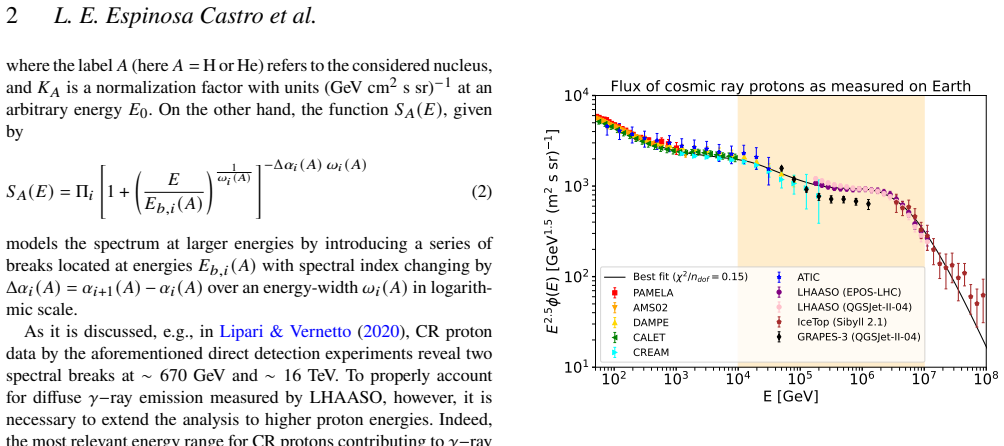
- [Section 2] The proton fit uses only the LHAASO EPOS-LHC data set, while the QGSJet-II-04 variant is shown in Fig. 1 but not used, and GRAPES-3 data are discarded because of disagreement. Because the predicted gamma-ray flux is most sensitive to the proton spectrum in the 10^4 to 10^7 GeV range, the choice among hadronic interaction models used to derive the LHAASO proton flux could shift the predicted normalization and shape. The paper should justify this choice quantitatively, for example by repeating the gamma-ray prediction using the QGSJet-based LHAASO proton spectrum and discussing the resulting change in the discrepancy.
minor comments (5)
- [Eq. (12)] The subscripts 'in' and 'lat' in Eq. (12) are not defined in the text; please define them at first use.
- [Eqs. (9)-(11)] The symbol N is used for the gas column integral in Eq. (11) while N_n is used earlier for the number of nucleons; this notational overlap is confusing and should be resolved.
- [Section 4] The text refers to an Appendix containing the comparison with other cross-section parametrizations, but no appendix appears in the provided manuscript text. If the appendix is missing from the arXiv version, it should be included or the citation should be made specific.
- [Section 2] The paper uses both 'AAFRAG' and 'AAFrag' for the same cross-section model; please choose one notation for consistency.
- [Data Availability] 'Data available upon reasonable request' is vague; for reproducibility, please consider releasing the fitting code and the derived gamma-ray prediction tables as supplementary material.
Circularity Check
No significant circularity: the gamma-ray prediction is a forward calculation whose inputs (CR nucleon flux, gas templates, cross-section) are independent of the LHAASO gamma-ray data being compared.
full rationale
The central derivation is Eq. (7): phi_gamma(E_gamma, n_hat) is obtained by convolving the CR nucleon flux phi_CR(E_n, r) with the gas density n_g and the hadronic cross-section dsigma/dE_gamma. The local CR nucleon flux phi_CR,sun is fitted to charged-particle data (PAMELA, AMS-02, DAMPE, CALET, CREAM, ATIC, IceTop, and LHAASO proton and all-particle measurements), not to the LHAASO diffuse gamma-ray data. The comparison in Section 4 is therefore a genuine consistency check between two independent LHAASO data sets, and the gamma-ray flux is not obtained by fitting the gamma-ray observations. The framework expressed in Eqs. (7)-(11) is standard formalism cited to the authors' earlier papers, but the claim does not reduce to those citations, and no uniqueness theorem or ansatz is imported from them. The assumption g(r)=1 in Eq. (8) is explicitly stated as an initial simplification and its consequences are discussed in Section 5; it is a physical modeling assumption, not a circular redefinition. The heavy-element normalization eta is derived from the LHAASO all-particle flux, which is a different observable from the diffuse gamma-ray emission. No fitted parameter is later renamed as a prediction, and no self-citation is load-bearing: the contextual references to Vecchiotti et al. (2024) and Cataldo et al. (2019) support the discussion but are not the basis of the central overshoot claim. The paper is self-contained as a consistency check, so no circularity is found.
Assumptions & free parameters
free parameters (3)
- Proton flux spectral parameters (K_H, alpha_i, E_b,i, omega_i)
- Helium flux spectral parameters
- Heavy-element normalization factor k =
estimated range (carbon-to-iron), based on eta ~ 1.7
assumptions (5)
- domain assumption The CR flux at any point factorizes as phi_CR(En,r) = g(r) phi_CR,odot(En), with g(r)=1 in the baseline.
- domain assumption Gas density traced by GALPROP maps or Planck dust opacity with X_D^-1 = 1.18e-26 cm^2.
- domain assumption Gamma-ray production cross-section from AAFRAG parameterization.
- domain assumption Heavy nuclei follow the helium rigidity spectrum with a fixed normalization eta ~ 1.7.
- ad hoc to paper GRAPES-3 proton data are excluded from the fit.
Cite this review
Pith. "Pith review of LHAASO protons versus LHAASO diffuse gamma-rays: a consistency check." pith.science (2026). https://pith.science/paper/MHKB5MBR
@misc{pith2026250606593,
  author       = {Pith},
  title        = {Pith review of: LHAASO protons versus LHAASO diffuse gamma-rays: a consistency check},
  year         = {2026},
  howpublished = {\url{https://pith.science/paper/MHKB5MBR}},
  note         = {Machine review of arXiv:2506.06593}
}
read the original abstract
We perform the first direct consistency check between the recently measured proton spectrum at the knee by Large High Altitude Air Shower Observatory (LHAASO) and the collaboration's own high-precision mapping of Galactic diffuse gamma-ray emission. By modeling the hadronic gamma-ray production using the updated cosmic-ray spectra, gas templates and cross-section models, we show that the predicted gamma-ray flux robustly overshoots the LHAASO data in both inner and lateral Galactic regions. This persistent mismatch in both normalization and spectral shape challenges conventional scenarios linking the local cosmic-ray sea to Galactic gamma-ray emission, and calls for a revision of current cosmic ray models in the TeV-PeV sky.
Figures


Figures from the paper (2 more)


Forward citations
Cited by 6 Pith papers
-
Dissecting the Diffuse Emission of the Galaxy with the HAWC Observatory
HAWC's Pass 5 analysis of 8 years of data yields new TeV diffuse galactic emission profiles with tails beyond 3 degrees latitude and a galactic-center excess relative to standard cosmic-ray propagation models.
-
Breaking Dark: Hunting Heavy Decaying Dark Matter with Tibet AS$_\gamma$ and LHAASO-KM2A
Tibet ASγ and LHAASO-KM2A diffuse gamma-ray data exclude decaying dark matter lifetimes below about 10^28 seconds for masses around 10^6-10^9 GeV, for many Standard Model final states.
-
Diffuse gamma-ray and neutrino emission from the Milky Way and the local knee in the cosmic ray spectrum
Diffuse gamma-ray predictions from locally measured cosmic rays exceed LHAASO observations above 100 TeV, suggesting the PeV cosmic-ray knee originates from a local bubble roughly 0.7 to 1.5 kpc across.
-
Leptonic and hadronic models of high-energy nebula around V4641 Sgr
Protons produce the >100 TeV gamma-ray halo of V4641 Sgr while freshly accelerated electrons produce its X-rays, a mixed leptohadronic model that matches the observed spectrum and morphology.
-
Testing the influence of anisotropic CR transport and the Galactic magnetic field structure on the all-sky gamma-ray emission
A Milky Way simulation with anisotropic cosmic-ray diffusion shows that magnetic field geometry controls where gamma-ray emission is enhanced or suppressed, producing templates that could help constrain the diffusion ...
-
The cosmic-ray sea explains the Galactic $\gamma$-ray and $\nu$ diffuse emissions from GeV to PeV
LHAASO's diffuse gamma-ray data from 1 TeV to 1 PeV are consistent with cosmic-ray sea models that use CALET, DAMPE, and KASCADE spectra, so no extra emission component is required.
Reference graph
Works this paper leans on
-
[1]
apsrev4-2.bst 2019-01-14 (MD) hand-edited version of apsrev4-1.bst
FUNCTION id.bst "apsrev4-2.bst 2019-01-14 (MD) hand-edited version of apsrev4-1.bst" ENTRY address archive archivePrefix author bookaddress booktitle chapter collaboration doi edition editor eid eprint howpublished institution isbn issn journal key language month note number organization pages primaryClass publisher school SLACcitation series title transl...
2019
-
[2]
author author Z. Cao et al. ( collaboration LHAASO Collaboration ),\ https://arxiv.org/abs/2505.14447 title First identification and precise spectral measurement of the proton component in the cosmic-ray `knee' ( year 2025 a ),\ https://arxiv.org/abs/2505.14447 arXiv:2505.14447 [astro-ph.HE] NoStop
arXiv 2025
-
[3]
author author Z. Cao et al. ( collaboration LHAASO Collaboration ),\ https://doi.org/10.1103/PhysRevLett.131.151001 journal journal Phys. Rev. Lett. \ volume 131 ,\ pages 151001 ( year 2023 ) NoStop
-
[4]
author author Z. Cao et al. ( collaboration LHAASO Collaboration ),\ https://doi.org/10.1103/PhysRevLett.134.081002 journal journal Phys. Rev. Lett. \ volume 134 ,\ pages 081002 ( year 2025 b ) NoStop
-
[5]
author author V. S. \ Ptuskin , author S. I. \ Rogovaya , author V. N. \ Zirakashvili , author L. G. \ Chuvilgin , author G. B. \ Khristiansen , author E. G. \ Klepach ,\ and\ author G. V. \ Kulikov ,\ @noop journal journal \ volume 268 ,\ pages 726 ( year 1993 ) NoStop
work page 1993
-
[6]
author author S. I. \ Syrovatskii ,\ @noop journal journal Comments on Astrophysics and Space Physics \ volume 3 ,\ pages 155 ( year 1971 ) NoStop
work page 1971
-
[7]
Modelling the Galactic very-high-energy $\gamma$-ray source population
author author C. Steppa \ and\ author K. Egberts ,\ https://doi.org/10.1051/0004-6361/202038172 journal journal \ volume 643 ,\ eid A137 ( year 2020 ) ,\ https://arxiv.org/abs/2010.03305 arXiv:2010.03305 [astro-ph.HE] NoStop
work page Pith review arXiv 2020
-
[8]
author author M. Cataldo , author G. Pagliaroli , author V. Vecchiotti ,\ and\ author F. L. \ Villante ,\ https://doi.org/10.3847/1538-4357/abc0ee journal journal Astrophys. J. \ volume 904 ,\ pages 85 ( year 2020 ) ,\ https://arxiv.org/abs/2006.04106 arXiv:2006.04106 [astro-ph.HE] NoStop
work page Pith review arXiv 2020
Show all 56 references
-
[9]
Vecchiotti , author F
author author V. Vecchiotti , author F. Zuccarini , author F. L. \ Villante ,\ and\ author G. Pagliaroli ,\ https://doi.org/10.3847/1538-4357/ac4df4 journal journal Astrophys. J. \ volume 928 ,\ pages 19 ( year 2022 ) ,\ https://arxiv.org/abs/2107.14584 arXiv:2107.14584 [astro...
2022 arXiv
-
[10]
Lipari \ and\ author S
author author P. Lipari \ and\ author S. Vernetto ,\ https://doi.org/10.1103/PhysRevD.111.063035 journal journal Phys. Rev. D \ volume 111 ,\ pages 063035 ( year 2025 ) ,\ https://arxiv.org/abs/2412.08861 arXiv:2412.08861 [astro-ph.HE] NoStop
2025 arXiv
-
[11]
He , author H
author author J. He , author H. Zeng , author Y. Zhang , author Q. Yuan , author R. Zhang ,\ and\ author J. Li ,\ https://doi.org/10.3847/1538-4357/ada6b2 journal journal \ volume 980 ,\ eid 17 ( year 2025 ) ,\ https://arxiv.org/abs/2501.02720 arXiv:2501.02720 [astro-ph.HE] NoStop
2025 arXiv
-
[12]
Lipari \ and\ author S
author author P. Lipari \ and\ author S. Vernetto ,\ journal journal Physical Review D \ volume 98 ,\ https://doi.org/10.1103/physrevd.98.043003 10.1103/physrevd.98.043003 ( year 2018 ) NoStop
2018 doi
-
[13]
Cataldo , author G
author author M. Cataldo , author G. Pagliaroli , author V. Vecchiotti ,\ and\ author F. L. \ Villante ,\ https://doi.org/10.1088/1475-7516/2019/12/050 journal journal JCAP \ volume 12 number number (1) ,\ pages 050 ,\ https://arxiv.org/abs/1904.03894 arXiv:1904.03894 [astro-p...
2019 arXiv
-
[14]
Schwefer , author P
author author G. Schwefer , author P. Mertsch ,\ and\ author C. Wiebusch ,\ https://doi.org/10.3847/1538-4357/acc1e2 journal journal Astrophys. J. \ volume 949 ,\ pages 16 ( year 2023 ) ,\ https://arxiv.org/abs/2211.15607 arXiv:2211.15607 [astro-ph.HE] NoStop
2023 arXiv
-
[15]
Vecchiotti , author G
author author V. Vecchiotti , author G. Peron , author E. Amato , author S. Menchiari , author G. Morlino , author G. Pagliaroli ,\ and\ author F. L. \ Villante ,\ @noop journal journal arXiv \ ( year 2024 ) ,\ https://arxiv.org/abs/2411.11439 arXiv:2411.11439 [astro-ph.HE] NoStop
2024
-
[16]
Gaggero , author A
author author D. Gaggero , author A. Urbano , author M. Valli ,\ and\ author P. Ullio ,\ journal journal Physical Review D \ volume 91 ,\ https://doi.org/10.1103/physrevd.91.083012 10.1103/physrevd.91.083012 ( year 2015 ) NoStop
2015 doi
-
[17]
author author P. D. L. T. \ Luque , author D. Gaggero , author D. Grasso , author A. Marinelli ,\ and\ author M. Rocamora ,\ https://arxiv.org/abs/2502.18268 title The cosmic-ray sea explains the diffuse galactic gamma-ray and neutrino emission from gev to pev ( year 2025 ),\ ...
2025 arXiv
-
[18]
Adriani et al
author author O. Adriani et al. ( collaboration PAMELA Collaboration ),\ https://doi.org/10.1126/science.1199172 journal journal Science \ volume 332 ,\ pages 69 ( year 2011 ) ,\ https://arxiv.org/abs/1103.4055 arXiv:1103.4055 [astro-ph.HE] NoStop
2011 arXiv
-
[19]
Aguilar et al
author author M. Aguilar et al. ( collaboration AMS Collaboration ),\ https://doi.org/10.1103/PhysRevLett.114.171103 journal journal Phys. Rev. Lett. \ volume 114 ,\ pages 171103 ( year 2015 a ) NoStop
2015 doi
-
[20]
Aguilar et al
author author M. Aguilar et al. ( collaboration AMS Collaboration ),\ https://doi.org/10.1103/PhysRevLett.115.211101 journal journal Phys. Rev. Lett. \ volume 115 ,\ pages 211101 ( year 2015 b ) NoStop
2015 doi
-
[21]
An et al
author author Q. An et al. ( collaboration DAMPE Collaboration ),\ https://doi.org/10.1126/sciadv.aax3793 journal journal Science Advances \ volume 5 ,\ pages eaax3793 ( year 2019 ) ,\ https://arxiv.org/abs/1909.12860 arXiv:1909.12860 [astro-ph.HE] NoStop
2019 arXiv
-
[22]
Alemanno et al
author author F. Alemanno et al. ( collaboration DAMPE Collaboration ),\ https://doi.org/10.1103/PhysRevLett.126.201102 journal journal Phys. Rev. Lett. \ volume 126 ,\ pages 201102 ( year 2021 ) NoStop
2021 doi
-
[23]
Adriani et al
author author O. Adriani et al. ( collaboration CALET Collaboration ),\ https://doi.org/10.1103/PhysRevLett.122.181102 journal journal Phys. Rev. Lett. \ volume 122 ,\ pages 181102 ( year 2019 ) NoStop
2019 doi
-
[24]
Adriani et al
author author O. Adriani et al. ( collaboration CALET Collaboration ),\ https://doi.org/10.1103/PhysRevLett.130.171002 journal journal Phys. Rev. Lett. \ volume 130 ,\ pages 171002 ( year 2023 ) NoStop
2023 doi
-
[25]
author author Y. S. \ Yoon et al. ,\ https://doi.org/10.3847/1538-4357/aa68e4 journal journal The Astrophysical Journal \ volume 839 ,\ pages 5 ( year 2017 ) NoStop
2017 doi
-
[26]
author author A. D. \ Panov et al. ,\ https://doi.org/10.3103/S1062873809050098 journal journal Bull. Russ. Acad. Sci. Phys. \ volume 73 ,\ pages 564 ( year 2009 ) ,\ https://arxiv.org/abs/1101.3246 arXiv:1101.3246 [astro-ph.HE] NoStop
2009 arXiv
-
[27]
author author S. V. \ Ter-Antonyan \ and\ author L. S. \ Haroyan ,\ https://arxiv.org/abs/hep-ex/0003006 title About eas size spectra and primary energy spectra in the knee region ( year 2000 ),\ https://arxiv.org/abs/hep-ex/0003006 arXiv:hep-ex/0003006 [hep-ex] NoStop
2000 arXiv
-
[28]
Lipari \ and\ author S
author author P. Lipari \ and\ author S. Vernetto ,\ https://doi.org/10.1016/j.astropartphys.2020.102441 journal journal Astroparticle Physics \ volume 120 ,\ pages 102441 ( year 2020 ) NoStop
2020
-
[29]
author author S. R. \ Kelner , author F. A. \ Aharonian ,\ and\ author V. V. \ Bugayov ,\ https://doi.org/10.1103/PhysRevD.74.034018 journal journal Phys. Rev. D \ volume 74 ,\ pages 034018 ( year 2006 ) ,\ note [Erratum: Phys.Rev.D 79, 039901 (2009)] ,\ https://arxiv.org/abs/...
2009 arXiv
-
[30]
Varsi et al
author author F. Varsi et al. ( collaboration GRAPES-3 Collaboration ),\ https://doi.org/10.1103/PhysRevLett.132.051002 journal journal Phys. Rev. Lett. \ volume 132 ,\ pages 051002 ( year 2024 ) NoStop
2024 doi
-
[31]
author author M. G. \ Aartsen et al. ,\ journal journal Physical Review D \ volume 100 ,\ https://doi.org/10.1103/physrevd.100.082002 10.1103/physrevd.100.082002 ( year 2019 ) NoStop
2019 doi
-
[32]
author author M. R. \ Finger ,\ title Reconstruction of energy spectra for different mass groups of high-energy cosmic rays ,\ @noop Ph.D. thesis ,\ school KIT, Karlsruhe ( year 2011 ) NoStop
2011
-
[33]
Cao et al
author author Z. Cao et al. ( collaboration LHAASO Collaboration ),\ https://doi.org/10.1103/PhysRevLett.132.131002 journal journal Phys. Rev. Lett. \ volume 132 ,\ pages 131002 ( year 2024 ) NoStop
2024 doi
-
[34]
author author J. A. \ Morales-Soto et al. ,\ https://doi.org/10.22323/1.395.0330 journal journal PoS \ volume ICRC2021 ,\ pages 330 ( year 2021 ) NoStop
2021 doi
-
[35]
author author V. V. \ Prosin et al. ,\ https://doi.org/10.1016/j.nima.2013.09.018 journal journal Nuclear Inst. and Methods in Physics Research, A \ volume 756 ,\ pages 94 ( year 2014 ) NoStop
2013 doi
-
[36]
Antoni et al
author author T. Antoni et al. ,\ https://doi.org/10.1016/j.astropartphys.2005.04.001 journal journal Astroparticle Physics \ volume 24 ,\ pages 1–25 ( year 2005 ) NoStop
2005 doi
-
[37]
Pagliaroli , author C
author author G. Pagliaroli , author C. Evoli ,\ and\ author F. L. \ Villante ,\ https://doi.org/10.1088/1475-7516/2016/11/004 journal journal JCAP \ volume 11 number number (1) ,\ pages 004 ,\ https://arxiv.org/abs/1606.04489 arXiv:1606.04489 [astro-ph.HE] NoStop
2016 arXiv
-
[38]
Koldobskiy , author M
author author S. Koldobskiy , author M. Kachelrie , author A. Lskavyan , author A. Neronov , author S. Ostapchenko ,\ and\ author D. V. \ Semikoz ,\ https://doi.org/10.1103/PhysRevD.104.123027 journal journal Phys. Rev. D \ volume 104 ,\ pages 123027 ( year 2021 ) NoStop
-
[39]
Kachelriess , author S
author author M. Kachelriess , author S. Ostapchenko ,\ and\ author J. Tjemsland ,\ https://doi.org/10.1016/j.cpc.2023.108698 journal journal Comput. Phys. Commun. \ volume 287 ,\ pages 108698 ( year 2023 ) ,\ https://arxiv.org/abs/2206.00998 arXiv:2206.00998 [hep-ph] NoStop
2023
-
[40]
Orusa , author M
author author L. Orusa , author M. Di Mauro , author F. Donato ,\ and\ author M. Korsmeier ,\ https://doi.org/10.22323/1.444.0264 journal journal PoS \ volume ICRC2023 ,\ pages 264 ( year 2023 ) NoStop
2023 doi
-
[41]
Ben Bekhti et al
author author N. Ben Bekhti et al. ( collaboration HI4PI Collaboration ),\ https://doi.org/10.1051/0004-6361/201629178 journal journal Astron. Astrophys. \ volume 594 ,\ eid A116 ( year 2016 ) ,\ https://arxiv.org/abs/1610.06175 arXiv:1610.06175 [astro-ph.GA] NoStop
2016 arXiv
-
[42]
author author T. M. \ Dame , author D. Hartmann ,\ and\ author P. Thaddeus ,\ https://doi.org/10.1086/318388 journal journal Astrophys. J. \ volume 547 ,\ pages 792 ( year 2001 ) ,\ https://arxiv.org/abs/astro-ph/0009217 arXiv:astro-ph/0009217 [astro-ph] NoStop
2001 arXiv
-
[43]
author author T. A. \ Porter , author G. Jóhannesson ,\ and\ author I. V. \ Moskalenko ,\ https://doi.org/10.3847/1538-4365/ac80f6 journal journal The Astrophysical Journal Supplement Series \ volume 262 ,\ pages 30 ( year 2022 ) NoStop
-
[44]
Aghanim et al
author author N. Aghanim et al. ( collaboration Planck ),\ https://doi.org/10.1051/0004-6361/201629022 journal journal Astron. Astrophys. \ volume 596 ,\ pages A109 ( year 2016 ) ,\ https://arxiv.org/abs/1605.09387 arXiv:1605.09387 [astro-ph.CO] NoStop
2016 arXiv
-
[45]
author author P. A. R. \ Ade et al. ( collaboration Planck Collaboration ),\ https://doi.org/10.1051/0004-6361/201116479 journal journal Astron. Astrophys. \ volume 536 ,\ eid A19 ( year 2011 ) ,\ https://arxiv.org/abs/1101.2029 arXiv:1101.2029 [astro-ph.GA] NoStop
2011 arXiv
-
[46]
author author K. M. \ Ferriere ,\ https://doi.org/10.1103/RevModPhys.73.1031 journal journal Rev. Mod. Phys. \ volume 73 ,\ pages 1031 ( year 2001 ) ,\ https://arxiv.org/abs/astro-ph/0106359 arXiv:astro-ph/0106359 NoStop
2001 arXiv
-
[47]
Kafexhiu , author F
author author E. Kafexhiu , author F. Aharonian , author A. M. \ Taylor ,\ and\ author G. S. \ Vila ,\ https://doi.org/10.1103/PhysRevD.90.123014 journal journal Phys. Rev. D \ volume 90 ,\ pages 123014 ( year 2014 ) NoStop
2014 doi
-
[48]
Acero et al
author author F. Acero et al. ( collaboration Fermi-LAT Collaboration ),\ https://doi.org/10.3847/0067-0049/223/2/26 journal journal The Astrophysical Journal Supplement Series \ volume 223 ,\ pages 26 ( year 2016 ) NoStop
2016 doi
-
[49]
Yang , author F
author author R. Yang , author F. Aharonian ,\ and\ author C. Evoli ,\ journal journal Physical Review D \ volume 93 ,\ https://doi.org/10.1103/physrevd.93.123007 10.1103/physrevd.93.123007 ( year 2016 ) NoStop
2016 doi
-
[50]
Pothast , author D
author author M. Pothast , author D. Gaggero , author E. Storm ,\ and\ author C. Weniger ,\ https://doi.org/10.1088/1475-7516/2018/10/045 journal journal Journal of Cosmology and Astroparticle Physics \ volume 2018 number (10) ,\ pages 045–045 NoStop
2018 doi
-
[51]
Recchia , author P
number author author S. Recchia , author P. Blasi ,\ and\ author G. Morlino ,\ https://doi.org/10.1093/mnrasl/slw136 journal journal Monthly Notices of the Royal Astronomical Society: Letters \ volume 462 ,\ pages L88–L92 ( year 2016 ) NoStop
-
[52]
author author S. S. \ Cerri , author D. Gaggero , author A. Vittino , author C. Evoli ,\ and\ author D. Grasso ,\ https://doi.org/10.1088/1475-7516/2017/10/019 journal journal Journal of Cosmology and Astroparticle Physics \ volume 2017 number (10) ,\ pages 019–019 NoStop
2017 doi
-
[53]
Vernetto \ and\ author P
number author author S. Vernetto \ and\ author P. Lipari ,\ https://doi.org/10.1103/PhysRevD.94.063009 journal journal Phys. Rev. D \ volume 94 ,\ pages 063009 ( year 2016 ) ,\ https://arxiv.org/abs/1608.01587 arXiv:1608.01587 [astro-ph.HE] NoStop
2016 arXiv
-
[54]
Pr\'evotat , author M
author author C. Pr\'evotat , author M. Kachelrie , author S. Koldobskiy , author A. Neronov ,\ and\ author D. Semikoz ,\ https://doi.org/10.1103/PhysRevD.110.103035 journal journal Phys. Rev. D \ volume 110 ,\ pages 103035 ( year 2024 ) NoStop
-
[55]
Kuznetsov , author N
author author M. Kuznetsov , author N. Petrov , author I. Plokhikh ,\ and\ author V. Sotnikov ,\ https://doi.org/10.1088/1475-7516/2024/05/125 journal journal Journal of Cosmology and Astroparticle Physics \ volume 2024 number (05) ,\ pages 125 NoStop
2024 doi
-
[56]
Wang , author L
number author author L. Wang , author L. Ma , author S. Zhang , author C. Feng ,\ and\ author Lhaaso Collaboration ,\ in\ @noop booktitle 38th International Cosmic Ray Conference \ ( year 2024 )\ p.\ pages 413 NoStop
2024
Reviewed August 7, 2026 · model on record in the stance chip above.
Discussion (0). Sign in to comment.