REVIEW 4 major objections 6 minor 9 references
Non-Intrusive Load Monitoring Based on Image Load Signatures and Continual Learning
T0 review · 4 major / 6 minor · reviewed 2026-08-07 · deepseek-v4-flash
Pith's one-line read The paper claims that converting current, voltage, and power-factor waveforms into two-dimensional image signatures lets a convolutional network recognize which household appliances are running simultaneously, and that self-supervised…
desk verdict The offline accuracy gain is plausible but the paper's central continual-learning contribution is never tested, so the full claim is unsupported as written. read the letter →
The pith
A machine-rendered reading of the paper's core claim, the machinery that carries it, and where it could break.
The reading
What carries the argument
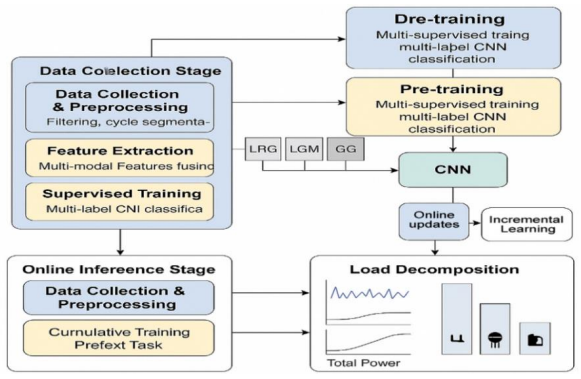
The load-bearing object is the 'image load signature': a set of three two-dimensional maps derived from the fused multimodal features. The learnable recurrent graph (LRG) builds an $N \times N$ matrix whose entries are learned from concatenated feature-column pairs, encoding correlation strength between different time points; the learnable Gram matrix (LGM) computes inner products between feature-channel rows, encoding which channels are correlated; and the generative feature map (GG) reshapes the flattened fused features into an $H \times W$ image through a fully connected layer. These maps give a CNN a fixed-size, texture-rich input that distinguishes different appliance combinations. Training is staged: self-supervised pre-training reconstructs the second half of each cycle (loss $\mathcal{L}_{ssl}$), supervised fine-tuning minimizes multi-label cross-entropy ($\mathcal{L}_{cls}$), and continual learning adds the EWC quadratic penalty with Fisher information (Eq. 9-10) so new data can update parameters without drifting too far from old-task-important values.
What would settle it
Run a task-continual experiment: train on a first set of appliance types, then introduce new types one at a time, measuring per-type F1 on the old types after each update. If old-type F1 drops markedly despite the EWC penalty, or if a model without EWC performs equally, the continual-learning claim is falsified. A simpler check is to compare the reported 92.5% offline accuracy against the same model with the EWC term removed, an ablation the paper does not report.
Extended reading notes
Core claim
The central claim is that a multimodal image representation of the raw electrical signals is what makes load identification accurate, and that self-supervised pre-training plus elastic weight consolidation make it adaptable. Current, voltage, and power-factor sequences from one 50-Hz cycle are denoised, normalized, and passed through TCN and CNN encoders; the resulting feature maps are concatenated and transformed into three different two-dimensional maps (LRG, LGM, GG) that serve as the input 'image' to a CNN classifier. Because each appliance combination produces a distinct texture structure in these maps, the classifier can label multiple devices that are running at once. Pre-training by predicting the second half of each cycle from the first half gives the feature encoder a general initialization without labels, and the EWC regularizer is meant to preserve old knowledge when new loads appear. In the paper's experiments, this pipeline achieves higher accuracy, precision, recall, and F1 than the three baselines, with per-category F1 above 90%.
Load-bearing premise
The claim that the model keeps learning new loads without forgetting depends on EWC actually preserving old-task performance when new appliance types appear, but the experiments only measure offline accuracy on a fixed train/test split and never test a sequence of new tasks.
Editorial extensions
If this is right
- Fusing current, voltage, and power factor into a two-dimensional image signature lets a CNN separate multiple simultaneously running appliances better than raw sequences or V-I trajectory images alone, reaching 92.5% accuracy on the test split.
- Self-supervised pre-training on unlabeled half-cycles provides an initialization that improves generalization across the three datasets used.
- The multi-label formulation directly outputs the on/off state of each appliance type, and with a variational autoencoder can also estimate per-appliance power and energy consumption.
- The continual-learning module is intended to let the model accept new appliance types after deployment without full retraining, addressing a scalability limit of fixed-load NILM systems.
- On each of the tested appliance categories the F1 score stays above 90%, suggesting the image signatures remain discriminative across different load types.
Reading between the lines
- The paper reports only offline test accuracy from an 8:2 split, so the continual-learning claim is not yet evidenced; a direct task-sequence experiment with newly appearing appliance types and a forgetting metric would test it.
- Because the LRG and LGM maps encode pairwise correlations between feature channels and time points, they may generalize across different sampling rates and grid frequencies, but the paper does not test this.
- The method's dependence on high-frequency (30-50 kHz) waveforms limits practical deployment; a downsampling study would show whether the image signatures retain their advantage at lower sampling rates.
- The combination of self-supervised pretraining plus EWC is generic, so the same image-signature pipeline could be evaluated on other multi-label time-series domains where simultaneous sources mix.
Editorial analysis
A structured set of objections, weighed in public.
Referee Report
Summary. The paper proposes a NILM method that converts multimodal power signals (current, voltage, power factor) into image-like load signatures via a pipeline of TCN feature extraction, feature fusion, and three constructed feature maps (LRG, LGM, GG), followed by a CNN classifier. It additionally describes self-supervised pre-training and an EWC-based continual online learning strategy, plus a VAE-based load decomposition for power estimation. The experiments report an offline multi-label classification accuracy of 92.5% on a combined dataset (PLAID, WHITED, self-collected), comparing favorably with SVM, V-I trajectory CNN, and sequence CNN baselines. The continual learning and decomposition components are described in the method but are not experimentally evaluated.
Significance. If the reported offline classification accuracy is reproducible, the multimodal image-signature representation combined with self-supervised pre-training could offer a practical improvement for NILM. However, the paper's distinct contributions of continual learning and load decomposition are never validated, so the full claims in the title and abstract are unsupported. The paper provides no code, no per-dataset breakdown, no error bars, no ablations, and no statistical analysis, which weakens the evidence for even the offline claim. The potential significance is moderate, contingent on additional experiments that substantiate the continual-learning advantage and the decomposition accuracy.
major comments (4)
- [§2.3.3 and §3] The continual-learning component, which is central to the paper's title and abstract, is never experimentally tested. Equations (9)-(10) define the EWC regularizer, but the experiments in Section 3 use only a static 8:2 train/test split. There is no sequence of tasks, no arrival of new appliance types over time, no forgetting metric, and no comparison with the cited continual baselines (PaRT [7], retrainable siamese network [6]). Consequently, the claim that the method 'overcome[s] model forgetting' and adapts to new loads is unsupported by any reported result.
- [§2.3.4 and §3.2] The VAE-based load decomposition introduced in Section 2.3.4 (Eq. 11) is never evaluated. Section 3.1.3 states that mean absolute error is used to measure decomposition accuracy, but no decomposition results appear in Section 3. The power/energy estimation claims are therefore entirely unverified.
- [Table 1 and §3.2.1] The reported offline accuracy gain lacks experimental substantiation. Only a single aggregated table is provided, with no per-dataset results for PLAID, WHITED, or the self-collected data listed in Section 3.1.1, no error bars or standard deviations, no number of runs, and no significance tests. Furthermore, the 'Proposed' row is described as including continual learning even though the evaluation does not involve continual learning, making it impossible to attribute the 4.6-point gain over Sequence CNN to the full proposed method. No ablation isolates the contributions of self-supervised pretraining, LRG/LGM, or GG.
- [§2.2.3 and §2.2.4] The novelty and utility of the LRG and LGM components are not established. Equation (5) is exactly the standard Gram matrix (with a subsequent ReLU), and Equation (4) is a fully connected layer on concatenated feature pairs. No ablation shows that these transformations improve classification over using the fused feature map F_fus directly; without such evidence, these components appear to be superficial additions rather than substantive contributions.
minor comments (6)
- [§3.1.1 and References] The dataset citations are incorrect: PLAID is cited to reference [4], which is a paper on VI trajectory fingerprint identification, not the PLAID dataset; WHITED is cited to reference [6], which is a paper on retrainable siamese networks. The correct dataset references should be provided.
- [§2.2.1] There is a typo 'Aas shown' in the text; also, the power factor is treated as a time series for feature extraction, but power factor is typically a scalar or slowly varying quantity. The paper should justify this representation and clarify how the power factor sequence is obtained.
- [§2.2.5, Eq. (6)] Equation (6) defines z' = W_g z + b_g without specifying an activation function, unlike other layers. Additionally, the constraint H*W = d_fus*N is stated but the text says 'appropriate H, W can be selected as needed,' which overstates the freedom in choosing these dimensions.
- [§3.2.1] The claim that the proposed method 'achieved an F1 value of more than 90% on each type of device' is not verifiable from the manuscript, as Figure 3 is not included and no per-class table is provided.
- [§2.3.1, Eq. (7)] The variable \hat{I}(t) is not formally defined before its use in the reconstruction loss. The text should explicitly define \hat{I}(t) as the decoder's prediction for the second half-cycle.
- [Throughout] The manuscript contains numerous grammatical errors and awkward phrasings (e.g., 'Recent years, with the development of AI...' in Section 1, 'Formulaic ally' in Section 2.3.4, 'the electrica l signals' in the abstract). A thorough language edit is needed.
Circularity Check
No circular derivation; the reported accuracy is an empirical result on a held-out split, not a fitted input or self-referential equation chain.
full rationale
The paper proposes an empirical machine-learning pipeline rather than a derivation whose conclusion is encoded in its assumptions. The image load signatures (LRG, LGM, GG) are input representations defined by Eqs. (4)-(6), including the standard Gram-matrix inner product in Eq. (5); the classifier is trained with the cross-entropy loss in Eq. (8). The accuracy, precision, recall, and F1 values in Table 1 come from a test split after an 8:2 data division, so no reported number is a fitted parameter renamed as a prediction. The EWC regularizer in Eqs. (9)-(10) is standard and is cited to external prior work [9]; although the paper does not report a task sequence or forgetting metric that would actually exercise Eq. (9), this is an evidence gap for the continual-learning claim, not circular reasoning. There are no self-citations by the present authors that carry a load-bearing premise, no imported uniqueness theorem, and no definition that presumes the target conclusion. The 'learnable Gramian Matrix' label partly renames the standard Gram matrix, but the central claim rests on held-out empirical comparison rather than on that naming, so any novelty dilution is not circularity.
Assumptions & free parameters
free parameters (4)
- EWC regularization coefficient lambda =
not reported
- Low-pass filter cutoff frequency =
1 kHz
- Sliding mean window length N =
not reported
- Image map dimensions H, W =
not reported
assumptions (4)
- domain assumption TCN captures long-range time-series patterns in current and voltage signals.
- domain assumption Pairwise correlation and Gram-matrix maps are discriminative for appliance identity.
- domain assumption EWC Fisher information approximates parameter importance and prevents catastrophic forgetting.
- domain assumption Dataset labels are correct and the 8:2 split is i.i.d. and representative of deployment.
Cite this review
Pith. "Pith review of Non-Intrusive Load Monitoring Based on Image Load Signatures and Continual Learning." pith.science (2026). https://pith.science/paper/DJ7K5OLM
@misc{pith2026250606637,
  author       = {Pith},
  title        = {Pith review of: Non-Intrusive Load Monitoring Based on Image Load Signatures and Continual Learning},
  year         = {2026},
  howpublished = {\url{https://pith.science/paper/DJ7K5OLM}},
  note         = {Machine review of arXiv:2506.06637}
}
read the original abstract
Non-Intrusive Load Monitoring (NILM) identifies the operating status and energy consumption of each electrical device in the circuit by analyzing the electrical signals at the bus, which is of great significance for smart power management. However, the complex and changeable load combinations and application environments lead to the challenges of poor feature robustness and insufficient model generalization of traditional NILM methods. To this end, this paper proposes a new non-intrusive load monitoring method that integrates "image load signature" and continual learning. This method converts multi-dimensional power signals such as current, voltage, and power factor into visual image load feature signatures, and combines deep convolutional neural networks to realize the identification and classification of multiple devices; at the same time, self-supervised pre-training is introduced to improve feature generalization, and continual online learning strategies are used to overcome model forgetting to adapt to the emergence of new loads. This paper conducts a large number of experiments on high-sampling rate load datasets, and compares a variety of existing methods and model variants. The results show that the proposed method has achieved significant improvements in recognition accuracy.
Figures
Reference graph
Works this paper leans on
-
[7]
Paknezhad, M., Rengarajan, H., Yuan, C., Suresh, S., Gupta, M., Ramasamy, S., & Lee, H. K. 2023. Improving transparency and representational generalizability through parallel continual learning. Neural Networks, 161, 449–465
work page 2023
-
[6]
Lu, L., Kang, J. S., Meng, F., & Yu, M. 2024. Non -intrusive load identification based on retrainable siamese network. Sensors, 24(8), 2562
work page 2024
-
[1]
Du, Z., Yin, B., Zhu, Y., Huang, X., & Xu, J. 2023. A NILM load identification method based on structured VI mapping. Scientific Reports, 13(1), 21276
work page 2023
-
[2]
Chen, S., Zhao, B., Zhong, M., Luan, W., & Yu, Y. 2023. Nonintrusive load monitoring based on self-supervised learning. IEEE Transactions on Instrumentation and Measurement, 72, 1-13
work page 2023
-
[3]
Shi, C., Gan, L., Yang, T., Zhang, P., Yu, K., & Mei, F. 2024, October. Non-Intrusive Load Monitoring Method Based on Color -Coded VI Trajectories and Multi-Feature Fusion. In 2024 IEEE PES 16th Asia -Pacific Power and Energy Engineering Conference (APPEEC) (pp. 1-5). IEEE
work page 2024
-
[4]
Lin, L., Zhang, J., Gao, X., Shi, J., Chen, C., & Huang, N. 2023. Power fingerprint identification based on the improved VI trajectory with color encoding and transferred CBAM-ResNet. PloS one, 18(2), e0281482
work page 2023
-
[5]
N., Himeur, Y., Varlamis, I., & Bensaali, F
Sayed, A. N., Himeur, Y., Varlamis, I., & Bensaali, F. 2025. Continual learning for energy management systems: A review of methods and applications, and a case study. Applied Energy, 384, 125458
work page 2025
-
[8]
Chen, T., Gao, J., Yuan, Y., Guo, S., & Yang, P. 2024. Non-intrusive load monitoring based on MoCo_v2, time series self-supervised learning. Energy and Buildings, 317, 114374
work page 2024
Show all 9 references
-
[9]
Kirkpatrick, J., Pascanu, R., Rabinowitz, N., Veness, J., Desjardins, G., Rusu, A. A., ... & Hadsell, R. 2017. Overcoming catastrophic forgetting in neural networks. Proceedings of the national academy of sc iences, 114(13), 3521-3526
2017
Reviewed August 7, 2026 · model on record in the stance chip above.
Discussion (0). Sign in to comment.