REVIEW 4 major objections 5 minor 20 references
MarginSel : Max-Margin Demonstration Selection for LLMs
T0 review · 4 major / 5 minor · reviewed 2026-08-07 · deepseek-v4-flash
Pith's one-line read MarginSel claims that few-shot in-context learning improves by 2-7% F1 when demonstration selection matches a test instance's zero-shot candidate-label set, because such hard examples act like support vectors.
desk verdict Plausible demo-selection heuristic with a nice empirical story, but the max-margin theory is asserted rather than derived, and the tables have an internal inconsistency. read the letter →
The pith
A machine-rendered reading of the paper's core claim, the machinery that carries it, and where it could break.
The reading
What carries the argument
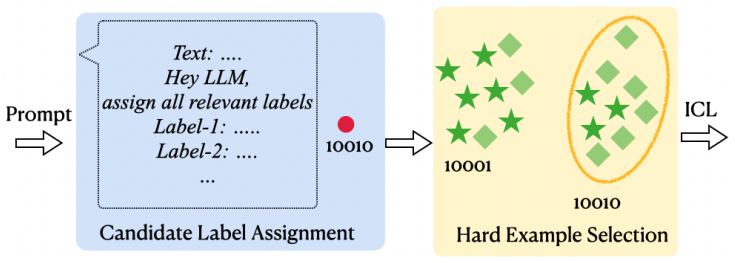
The load-bearing mechanism is the candidate-label set match: a zero-shot multilabel prompt returns all plausible labels for an input, and training examples with exactly the same candidate-label set as the test example are treated as hard, boundary-proximal examples. A linear-attention decomposition of the ICL prompt then represents the demonstrations' effect as an effective update to the zero-shot weight matrix, $\Delta W_{ICL} = \sum_{k} \beta_k y'_k (x'_k)^\top$, where only selected hard examples have non-zero $\beta_k$; this is the step that connects demonstration selection to SVM-style margin maximization. The hyperparameter $\alpha$ blends hard examples with kNN-selected semantically similar examples, with the paper reporting best performance near $\alpha = 0.9$.
What would settle it
The claim would be falsified if, in the prediction model's embedding space, candidate-label-matched demonstrations are not closer to the final decision boundary than randomly selected demonstrations, or if replacing Step-1 candidate labels with random label sets preserves the reported 2-7% F1 gains.
Extended reading notes
Core claim
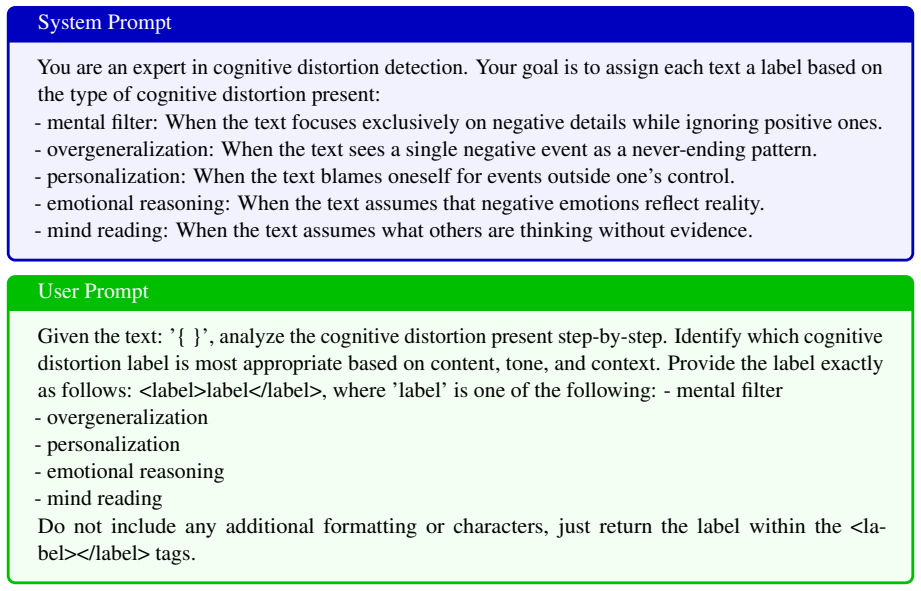
MarginSel selects demonstrations in two steps: first it prompts the LLM zero-shot to assign all relevant candidate labels to every training example and to the test example; then it selects training examples whose candidate-label set equals the test example's, using inverse-frequency weighted sampling to counter class imbalance, optionally mixing in kNN-selected examples with ratio $\alpha$. The paper's theoretical claim is that these selected examples are boundary-proximal and, in the linear-attention reformulation of ICL as a weight update $\Delta W_{ICL} = \sum_{k=1}^{|S|} \beta_k y'_k (x'_k)^\top$, they carry the non-zero coefficients $\beta_k$ analogous to support vectors. The paper asserts this induces max-margin behavior in the LLM, producing larger inter-class separation in the embedding space and improving few-shot F1 scores by 2-7% absolute over random selection.
Load-bearing premise
The method assumes that a training example sharing the test example's candidate-label set is genuinely near the decision boundary, so that selecting it shifts the boundary in a beneficial direction.
Editorial extensions
If this is right
- Few-shot classification prompts should be built per test instance by first identifying the test item's ambiguous label set and then pulling training examples with that same label set.
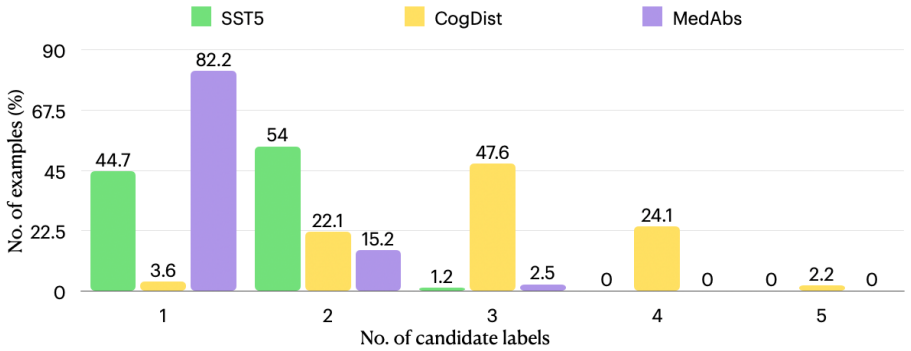
- The largest practical gains should appear on tasks with high label ambiguity, since the method's advantage is concentrated there.
- Because the selection step requires no retriever training, the method transfers to a new task or model by re-running the zero-shot candidate-label prompt rather than retraining a selector.
- The margin interpretation implies that adding easy, confidently classified demonstrations to a fixed prompt budget can dilute the benefit, so hard examples should dominate the prompt.
- The embedding-space analysis predicts that prompts assembled by MarginSel should show larger inter-class distances than random or zero-shot prompts, which the paper reports on SST-5.
Reading between the lines
- A direct test the paper does not run is to measure boundary proximity itself: if candidate-label-matched examples are not closer to a decision boundary in the prediction model's embedding space than random examples, then the support-vector story is not the active mechanism.
- The support-vector analogy suggests an ordering corollary: among the matched hard examples, those closest to the boundary should contribute the most, so ranking demonstrations by an estimated margin before placing them in the prompt could yield further gains.
- The candidate-label set could be viewed as a coarse uncertainty region rather than a geometric boundary; under that reading, similar uncertainty-region matching might extend MarginSel to regression, open-set, or generative tasks where the same label vocabulary is not available.
- The reported gain over kNN-ICL at $\alpha=0.9$ suggests that a small amount of semantic similarity compensates for Step-1 candidate-label errors; ablating Step-1 with random label sets would quantify how much of the gain is due to hardness versus mere relevance.
Editorial analysis
A structured set of objections, weighed in public.
Referee Report
Summary. The paper proposes MarginSel, a two-step, training-free method for selecting in-context demonstration examples for LLM classification. In Step 1, an LLM is prompted in a zero-shot, multilabel fashion to assign all plausible candidate labels to each training example and to the test example. In Step 2, training examples whose candidate-label set exactly matches the test example's candidate-label set are selected as 'hard' demonstrations; weighted sampling handles label imbalance, and a hyperparameter alpha blends these hard examples with kNN-ICL examples. The authors report absolute F1 improvements of 2-7% over random demonstration selection and kNN-ICL across three datasets (Cognitive Distortion, Medical Abstracts, SST-5) and several LLMs. They also claim a theoretical result: that MarginSel induces max-margin behavior in LLMs, analogous to support vectors in SVMs, based on the ICL-as-gradient-descent framework of Dai et al. (2023). The empirical method is simple and reproducible in principle, but the theoretical derivation in Section 4 is not mathematically supported as written.
Significance. If the empirical gains hold, MarginSel would be a useful contribution: it is retriever-free, adapts per test instance, and requires no task-specific training. The paper includes multi-model, multi-dataset evaluations, ablations of the candidate-label step, and an embedding-distance analysis, which are praiseworthy. However, the paper's central theoretical claim—that selected examples act as support vectors and induce a max-margin decision boundary—is asserted rather than derived. The connection between candidate-label-set overlap and geometric proximity to a decision boundary is never established. Since the paper's title, framing, and claimed novelty rest on this SVM analogy, the unsupported theory is a load-bearing flaw. The empirical results may still be valid as a heuristic, but they cannot currently be cited as evidence for the max-margin mechanism. The manuscript would need substantial revision to either provide a rigorous derivation or reframe the contribution as a purely empirical hard-example-selection heuristic.
major comments (4)
- The derivation of Eq. (5) from Eq. (3) is invalid. Eq. (3) expresses the linear-attention output as three separate terms: contributions from the test input X, the demonstration inputs X', and the demonstration labels Y'. Eq. (5) rewrites the same quantity as a sum over k of W_V [x'_k; y'_k] (W_K [x'_k; y'_k])^T q, which corresponds to concatenating each demonstration's input and label into a single token. This introduces cross terms of the form W_V x'_k (W_K y'_k)^T q and W_V y'_k (W_K x'_k)^T q that are absent from Eq. (3), and it also doubles the label-label term. Moreover, the definition of Delta W_ICL = sum_k y'_k (x'_k)^T silently drops the projection matrices W_V and W_K; absorbing them into a single outer product is not justified. Consequently, the claimed equivalence to a gradient-descent dual form is asserted rather than derived, and the subsequent argument that hard examples drive the update Delta W_ICL does not follow from the equations as written.
- Eq. (8) is the central step of the theoretical claim, but it is circular. The paper writes Lagrangian coefficients beta_k and states that they are non-zero only for support vectors, then decomposes the attention output as a sum over the selected hard examples with those beta_k. However, no margin optimization over Eqs. (6)-(7) is actually performed, and no argument is given that the candidate-label-set matching rule of Section 3 corresponds to the set of examples with beta_k > 0. The selection rule is effectively assumed to identify support vectors, and then the conclusion that these examples increase the margin is read back out of the assumption. A rigorous treatment would need to define an explicit optimization problem whose solution yields non-zero coefficients exactly for the examples selected by MarginSel, or at least prove a bound relating candidate-label-set overlap to distance from the decision boundary in the relevant embedding space. As it stands, Eq. (8) does not support the paper's claim that MarginSel induces max-margin behavior.
- The caption of Table 2 states that MarginSel(alpha = 0.9) corresponds to 90% hard examples and 10% kNN-ICL, exactly as in Table 1. However, the rows in Table 2 are labeled 'MarginSel(alpha = 0.1)' for Phi-4 and Llama8B. If alpha = 0.1 means only 10% hard examples and 90% kNN-ICL, then the reported improvements for these two models are mostly attributable to the kNN-ICL component, not to the proposed hard-example selection. This creates an inconsistency in the main experimental evidence: the favorable results for two of the four evaluated models may not actually demonstrate the benefit of MarginSel's core mechanism. The authors must clarify which alpha was used for each model and report results consistently; if the best alpha for Phi-4 and Llama8B was indeed 0.1, the interpretation of the results changes substantially.
- The claim that MarginSel 'increases the classifier margin' is based on pairwise distances between class centroids of embeddings of the full input prompts. This analysis does not establish a margin increase. The embeddings for MarginSel are computed from prompts that include the selected demonstrations, whereas the Random and Zero-Shot embeddings come from different prompts, so the comparison conflates prompt content with the method's effect. Furthermore, larger inter-class centroid distances in an arbitrary embedding space do not necessarily imply a larger classification margin at the output layer, and no formal relationship is provided between these distances and the margin quantities defined in Eqs. (6)-(7). The evidence in Figure 4 is suggestive but not conclusive, and the text overstates what it demonstrates.
minor comments (5)
- The abstract reports '2-7% absolute improvement', while the conclusion reports 'gains of up to 7.6%'. These numbers should be reconciled.
- The tables report F1 scores without standard deviations, confidence intervals, or p-values, despite the claim that improvements are 'statistically significant over 3 runs'. A significance test or at least variance reporting is needed to support this claim.
- The alpha hyperparameter appears to be tuned only on the Cognitive Distortion validation set (Appendix A.3), but it is then applied to other datasets. Please clarify whether alpha was tuned per dataset or fixed across datasets, and whether test-set performance influenced the choice of alpha for Tables 1-3.
- The sampling step is underspecified when |S_MarginSel| is smaller than alpha * n: the algorithm will attempt to sample more examples than are available, which requires either sampling with replacement or reducing the requested count. The pseudocode should state the behavior in this case.
- The citation for Llama-3.1-8B and Llama-3.1-70B points to Touvron et al. (2023), which is the original Llama paper, not the Llama-3.1 technical report. A correct reference should be provided.
Circularity Check
Score 6 — partial circularity: the central theoretical claim that MarginSel 'induces max-margin behavior' is built into Eq. 8 by construction (β_k > 0 is assigned to the selected set and then concluded), and the Eq. 5 rewrite that imports the gradient-descent dual form is algebraically invalid; the empirical F1 gains against external baselines remain independent and non-circular.
-
self definitional
[The step is in Section 4.2, at Eq. 8 and the paragraph introducing it.]
"As in SVMs, the prediction depends primarily on support vector examples; the Lagrangian coefficients βk are non-zero only for these critical samples. This insight allows us to decompose Equation 4 as an update to the zero-shot representation that emphasizes the influence of hard examples: ... where the term ∆WICL = P|S| k=1 βk y′ k (x′ k)T represents the cumulative update driven solely by the hard examples, chosen as the demonstration set S."
Eq. 8 writes the ICL update as a sum over exactly the set S that MarginSel constructs, and introduces β_k with the SVM property pre-attached ('non-zero only for these critical samples'). No margin optimization of Eqs. 6-7 is actually performed, and no argument shows that the selection rule 'same candidate-label set as the test example' is equivalent to β_k > 0. The decomposition therefore builds 'hard examples act as support vectors and drive the update' into the equation by construction, and the conclusion two sentences later—'only the examples near the decision boundary (with non-zero βk) significantly affect the final prediction'—restates the assumption used to write Eq. 8.
-
ansatz smuggled in via citation
[The step is in Section 4.1, at Eq. 5 and the sentence citing Dai et al. (2023).]
"We can rewrite Equation 4 as an update to WZSL from each demonstration example in X′: ... = (WZSL + ∆WICL)q where ... ∆WICL = PN k=1 y′ k (x′ k)T denotes the cumulative update from them. This formulation is analogous to a parameter update in an affine layer, and hence attention with ICL can be viewed as a dual form of an affine layer (Dai et al., 2023)."
Eq. 5 is presented as 'We can rewrite Equation 4...', but expanding W_V[x′_k;y′_k](W_K[x′_k;y′_k])^T yields x-x, x-y, y-x, and y-y outer-product terms. Eq. 3 contains only the x-x (demonstration input) and y-y (label) terms for demonstrations; the cross terms are newly introduced by the concatenation, and the W_V and W_K projections are then dropped to obtain ΔW_ICL = Σ y′_k(x′_k)^T. The gradient-descent dual form of Dai et al. (2023), cited to license the affine-update claim, requires conditions the paper does not verify, so the premise of the entire margin argument is imported by citation rather than derived. Conclusions about hard examples in Eq. 8 are inherited from this assumed form of ΔW_ICL.
1 more flagged steps
-
self definitional
[The step is in Section 3 (Step 2) and Section 4.1, where candidate-label matching is asserted to identify boundary-proximal examples.]
"MarginSel first identifies hard examples by prompting the LLM to assign all relevant candidate labels in a zero-shot manner ... and then selects training examples that have the same candidate labels. The underlying intuition is that if the LLM is uncertain about an input, it will output multiple candidate labels. In MarginSel, this is achieved during the hard example selection step (Step 2), where we ensure that only training examples whose candidate labels match those of the test example are selected."
The method's operational definition of 'hard examples' is: training examples whose candidate-label set equals the test example's (Algorithm 1, lines 12-13). Section 4.1 then asserts that such examples are 'misclassified (or hard) examples—those lying near the decision boundary,' and Eq. 8 identifies the selected set S with the support vectors (β_k > 0). The property to be established—geometric boundary proximity and max-margin relevance—is attributed by definition to whatever set the selection rule produces; no margin computation, gradient norm, or boundary-distance analysis connects candidate-label agreement to geometric proximity.
full rationale
The empirical core of the paper is not circular. MarginSel's F1 gains (2-7%, up to 7.6%) are measured against Random and kNN-ICL baselines on three external datasets across four or five LLMs, with α tuned on a held-out validation set (Section A.3); no fitted parameter is relabeled as a prediction, and the comparison is self-contained against external benchmarks. There is also no load-bearing self-citation: the citations used for the theory (Dai et al., 2023), hard mining (Shrivastava et al., 2016), and kNN-ICL (Liu et al., 2022) are all external work, so the self-citation and uniqueness-imported-from-authors patterns do not apply. The circularity is confined to the theoretical claim that MarginSel 'induces max-margin behavior' (Abstract; Section 4), which the paper lists as a key contribution. Three load-bearing steps exhibit it. First, the step from Eq. 3 to Eq. 5 is an invalid rewrite: expanding W_V[x′_k;y′_k](W_K[x′_k;y′_k])^T produces x-y and y-x cross terms absent from Eq. 3, and the reduction ΔW_ICL = Σ y′_k(x′_k)^T drops the W_V and W_K projections, so the 'dual form of an affine layer (Dai et al., 2023)' is asserted via an external citation rather than derived from the paper's own equations. Second, Eq. 8 postulates that β_k are nonzero only on the selected set S and then concludes that only boundary-near examples affect the prediction; since S is constructed by the selection rule and no margin optimization over Eqs. 6-7 is performed, the support-vector conclusion is assumed by construction. Third, the term 'hard example' is operationally defined as candidate-label agreement with the test example (Step 2), then asserted in Section 4.1 to mean 'misclassified ... lying near the decision boundary,' so the SVM interpretation is a relabeling of the selection heuristic. The Limitations section candidly admits the linear-attention simplification but does not flag the asserted β_k support or the invalid Eq. 5 rewrite; the Section 6.2 'margin' analysis measures inter-class centroid distances, not a geometric margin, and so cannot independently corroborate the support-vector claim. I also note as a reporting caveat, not a circularity, that Table 2 lists α=0.1 rows for Phi-4/Llama8B while the text and captions describe α=0.9. Overall: the empirical improvements stand, but the paper's central theoretical contribution—the SVM max-margin equivalence in the title—reduces by construction to the definition of the selected set, giving partial circularity.
Assumptions & free parameters
free parameters (2)
- alpha =
0.9 for Phi3-mini and Mistral-7B (Table 1); 0.1 for Phi-4 and Llama3.1-8B (Table 2)
- kNN neighbor count =
not reported
assumptions (5)
- domain assumption Transformer attention can be approximated by linear attention (softmax and scaling omitted) for the theoretical analysis.
- domain assumption The ICL representation update can be viewed as gradient descent on an affine layer, following Dai et al. 2023.
- ad hoc to paper Training examples with the same candidate label set as the test example are hard, boundary-proximal examples.
- ad hoc to paper The Lagrangian coefficients beta_k in Eq. 8 are non-zero only for the selected hard examples.
- domain assumption The output layer in embedding space is constant, so embedding movements indicate decision boundary shifts.
Cite this review
Pith. "Pith review of MarginSel : Max-Margin Demonstration Selection for LLMs." pith.science (2026). https://pith.science/paper/3CDZSCBK
@misc{pith2026250606699,
  author       = {Pith},
  title        = {Pith review of: MarginSel : Max-Margin Demonstration Selection for LLMs},
  year         = {2026},
  howpublished = {\url{https://pith.science/paper/3CDZSCBK}},
  note         = {Machine review of arXiv:2506.06699}
}
read the original abstract
Large Language Models (LLMs) excel at few-shot learning via in-context learning (ICL). However, the effectiveness of ICL is often sensitive to the selection and ordering of demonstration examples. To address this, we present MarginSel: Max-Margin Demonstration Selection for LLMs, a two-step method that selects hard demonstration examples for the ICL prompt, adapting to each test instance. Our approach achieves 2-7% absolute improvement in F1-score across classification tasks, compared to a random selection of examples. We also provide theoretical insights and empirical evidence showing that MarginSel induces max-margin behavior in LLMs by effectively increasing the margin for hard examples, analogous to support vectors, thereby shifting the decision boundary in a beneficial direction.
Figures


Figures from the paper (11 more)




Reference graph
Works this paper leans on
-
[1]
Marah Abdin, Jyoti Aneja, Hany Awadalla, Ahmed Awadallah, Ammar Ahmad Awan, Nguyen Bach, Amit Bahree, Arash Bakhtiari, Jianmin Bao, Harkirat Behl, Alon Benhaim, Misha Bilenko, Johan Bjorck, Sébastien Bubeck, Martin Cai, Qin Cai, Vishrav Chaudhary, Dong Chen, Dongdong Chen, Weizhu Chen, Yen-Chun Chen, Yi-Ling Chen, Hao Cheng, Parul Chopra, Xiyang Dai, Matt...
arXiv 2024
-
[2]
Hewett, Mojan Javaheripi, Piero Kauffmann, James R
Marah Abdin, Jyoti Aneja, Harkirat Behl, Sébastien Bubeck, Ronen Eldan, Suriya Gunasekar, Michael Harrison, Russell J. Hewett, Mojan Javaheripi, Piero Kauffmann, James R. Lee, Yin Tat Lee, Yuanzhi Li, Weishung Liu, Caio C. T. Mendes, Anh Nguyen, Eric Price, Gustavo de Rosa, Olli Saarikivi, Adil Salim, Shital Shah, Xin Wang, Rachel Ward, Yue Wu, Dingli Yu,...
arXiv 2024
-
[3]
Tom Brown, Benjamin Mann, Nick Ryder, Melanie Subbiah, Jared D Kaplan, Prafulla Dhariwal, Arvind Neelakantan, Pranav Shyam, Girish Sastry, Amanda Askell, Sandhini Agarwal, Ariel Herbert-Voss, Gretchen Krueger, Tom Henighan, Rewon Child, Aditya Ramesh, Daniel Ziegler, Jeffrey Wu, Clemens Winter, Chris Hesse, Mark Chen, Eric Sigler, Mateusz Litwin, Scott Gr...
2020
-
[4]
Damai Dai, Yutao Sun, Li Dong, Yaru Hao, Shuming Ma, Zhifang Sui, and Furu Wei. 2023. https://doi.org/10.18653/v1/2023.findings-acl.247 Why can GPT learn in-context? language models secretly perform gradient descent as meta-optimizers . In Findings of the Association for Computational Linguistics: ACL 2023, pages 4005--4019, Toronto, Canada. Association f...
-
[5]
Albert Q. Jiang, Alexandre Sablayrolles, Arthur Mensch, Chris Bamford, Devendra Singh Chaplot, Diego de las Casas, Florian Bressand, Gianna Lengyel, Guillaume Lample, Lucile Saulnier, Lélio Renard Lavaud, Marie-Anne Lachaux, Pierre Stock, Teven Le Scao, Thibaut Lavril, Thomas Wang, Timothée Lacroix, and William El Sayed. 2023. https://arxiv.org/abs/2310.0...
arXiv 2023
-
[6]
Itay Levy, Ben Bogin, and Jonathan Berant. 2023. https://arxiv.org/abs/2212.06800 Diverse demonstrations improve in-context compositional generalization . Preprint, arXiv:2212.06800
arXiv 2023
-
[7]
Jiachang Liu, Dinghan Shen, Yizhe Zhang, Bill Dolan, Lawrence Carin, and Weizhu Chen. 2022. https://doi.org/10.18653/v1/2022.deelio-1.10 What makes good in-context examples for GPT -3? In Proceedings of Deep Learning Inside Out (DeeLIO 2022): The 3rd Workshop on Knowledge Extraction and Integration for Deep Learning Architectures, pages 100--114, Dublin, ...
-
[8]
Yinhan Liu, Myle Ott, Naman Goyal, Jingfei Du, Mandar Joshi, Danqi Chen, Omer Levy, Mike Lewis, Luke Zettlemoyer, and Veselin Stoyanov. 2020. https://openreview.net/forum?id=SyxS0T4tvS Ro \ bert \ a: A robustly optimized \ bert \ pretraining approach
work page 2020
Show all 20 references
-
[9]
Pan Lu, Liang Qiu, Kai-Wei Chang, Ying Nian Wu, Song-Chun Zhu, Tanmay Rajpurohit, Peter Clark, and Ashwin Kalyan. 2023. https://arxiv.org/abs/2209.14610 Dynamic prompt learning via policy gradient for semi-structured mathematical reasoning . Preprint, arXiv:2209.14610
2023 arXiv
-
[10]
Yao Lu, Max Bartolo, Alastair Moore, Sebastian Riedel, and Pontus Stenetorp. 2022. https://doi.org/10.18653/v1/2022.acl-long.556 Fantastically ordered prompts and where to find them: Overcoming few-shot prompt order sensitivity . In Proceedings of the 60th Annual Meeting of th...
2022 doi
-
[11]
Ohad Rubin, Jonathan Herzig, and Jonathan Berant. 2022. https://doi.org/10.18653/v1/2022.naacl-main.191 Learning to retrieve prompts for in-context learning . In Proceedings of the 2022 Conference of the North American Chapter of the Association for Computational Linguistics: ...
2022 doi
-
[12]
Tim Schopf, Daniel Braun, and Florian Matthes. 2023. https://doi.org/10.1145/3582768.3582795 Evaluating unsupervised text classification: Zero-shot and similarity-based approaches . In Proceedings of the 2022 6th International Conference on Natural Language Processing and Info...
2023
-
[13]
Sagarika Shreevastava and Peter Foltz. 2021. https://doi.org/10.18653/v1/2021.clpsych-1.17 Detecting cognitive distortions from patient-therapist interactions . In Proceedings of the Seventh Workshop on Computational Linguistics and Clinical Psychology: Improving Access, pages...
2021 doi
-
[14]
Girshick
Abhinav Shrivastava, Abhinav Gupta, and Ross B. Girshick. 2016. https://arxiv.org/abs/1604.03540 Training region-based object detectors with online hard example mining . CoRR, abs/1604.03540
2016 arXiv
-
[15]
Manning, Andrew Ng, and Christopher Potts
Richard Socher, Alex Perelygin, Jean Wu, Jason Chuang, Christopher D. Manning, Andrew Ng, and Christopher Potts. 2013. https://aclanthology.org/D13-1170/ Recursive deep models for semantic compositionality over a sentiment treebank . In Proceedings of the 2013 Conference on Em...
2013
-
[16]
Hugo Touvron, Thibaut Lavril, Gautier Izacard, Xavier Martinet, Marie-Anne Lachaux, Timothée Lacroix, Baptiste Rozière, Naman Goyal, Eric Hambro, Faisal Azhar, Aurelien Rodriguez, Armand Joulin, Edouard Grave, and Guillaume Lample. 2023. https://arxiv.org/abs/2302.13971 Llama:...
2023 arXiv
-
[17]
Laurens van der Maaten and Geoffrey Hinton. 2008. http://jmlr.org/papers/v9/vandermaaten08a.html Visualizing data using t-sne . Journal of Machine Learning Research, 9(86):2579--2605
2008
-
[18]
Xubin Wang, Jianfei Wu, Yichen Yuan, Mingzhe Li, Deyu Cai, and Weijia Jia. 2024. https://arxiv.org/abs/2412.03966 Demonstration selection for in-context learning via reinforcement learning . Preprint, arXiv:2412.03966
2024 arXiv
-
[19]
online" 'onlinestring :=
ENTRY address archivePrefix author booktitle chapter edition editor eid eprint eprinttype howpublished institution journal key month note number organization pages publisher school series title type volume year doi pubmed url lastchecked label extra.label sort.label short.list...
-
[20]
write newline
" write newline "" before.all 'output.state := FUNCTION n.dashify 't := "" t empty not t #1 #1 substring "-" = t #1 #2 substring "--" = not "--" * t #2 global.max substring 't := t #1 #1 substring "-" = "-" * t #2 global.max substring 't := while if t #1 #1 substring * t #2 gl...
Reviewed August 7, 2026 · model on record in the stance chip above.
Discussion (0). Sign in to comment.