REVIEW 4 major objections 6 minor 53 references
Continuous-Time SO(3) Forecasting with Savitzky--Golay Neural Controlled Differential Equations
T0 review · 4 major / 6 minor · reviewed 2026-08-07 · deepseek-v4-flash
Pith's one-line read SG-neural CDE forecasts SO(3) rotations more accurately than existing baselines on real-world data.
desk verdict Useful idea, honest results, but the control path is not formally well-posed as written and the evaluation is too thin for the claims. read the letter →
The pith
A machine-rendered reading of the paper's core claim, the machinery that carries it, and where it could break.
The reading
What carries the argument
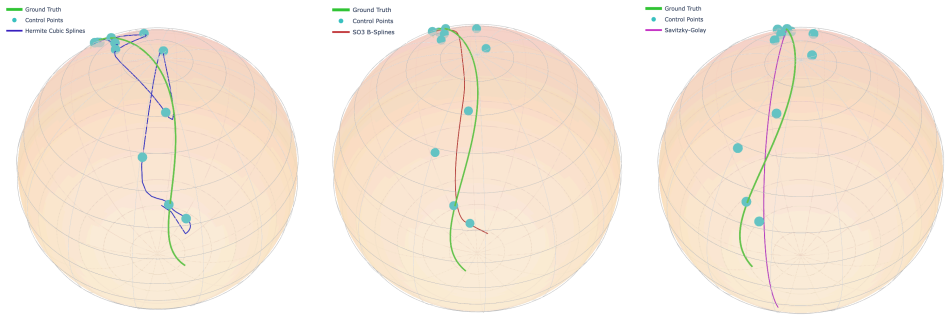
The load-bearing object is the weighted Savitzky-Golay control path on SO(3). A second-order polynomial $p(t; \rho) = \rho_0 + \rho_1 t + \frac{1}{2} \rho_2 t^2$ in the Lie algebra $\mathfrak{so}(3)$ is fit to noisy rotations inside a sliding window by minimizing $\sum_m \|\mathrm{Log}(\tilde{x}_{k+m} \tilde{x}_k^{-1}) - p(t_{k+m} - t_k; \rho)\|^2$, which reduces to the linear system $\rho_k = (A^\top W A)^{-1} A^\top W b$ with learnable weights $W$. Exponentiating this polynomial and applying it to the anchor rotation gives $\varphi(t) = \mathrm{Exp}(p(t - t_k; \rho_k)) \tilde{x}_k$, a smooth, manifold-respecting signal used as the control path in the neural CDE $z_t = z_{t_0} + \int_{t_0}^t f_\theta(z_s)\,dX_s$. The network $f_\theta$ and the weights $W$ are trained end-to-end by minimizing the Frobenius norm between predicted and ground-truth rotation matrices, with predictions recovered via the 6D representation and orthonormalization. This machinery replaces explicit motion priors (constant velocity, minimal torque) with a learned latent dynamical system, while staying cheap enough to differentiate through during training.
What would settle it
Train the same SG-nCDE architecture on real rotational trajectories (or on simulations whose torque and noise distributions deliberately diverge from the training set) and compare RGE to the reported numbers; if performance degrades to the level of the spline-CDE or GRU baselines when dynamics fall outside the simulated family, the claim that the learned model generalizes across real-world scenarios would be falsified. More directly, recording a real object under violent, non-smooth motion such as an impact and checking whether the method's forecasts remain below the baselines would test robustness under dynamics the simulator never covered.
Extended reading notes
Core claim
The paper's central claim is that a neural controlled differential equation can accurately forecast SO(3) trajectories from noisy pose observations if its control path is constructed by a (learned) Savitzky-Golay filter operating on the rotation manifold, rather than by cubic or Hermite splines that ignore the manifold and amplify noise. Concretely, the control path is $\varphi(t) = \mathrm{Exp}(p(t - t_k; \rho_k)) \tilde{x}_k$, where $p$ is a second-order polynomial in the Lie algebra and $\rho_k$ minimizes a weighted least-squares fit of log-differences inside a sliding window; the weights are learnable. Integrating the hidden state against this path yields a continuous-time latent dynamics that is then projected to a 6D rotation representation and orthonormalized back to SO(3). The authors validate the claim on two real-world datasets, reporting mean rotational geodesic errors of 2.32/2.30/2.18 degrees across three motion scenarios (versus 3.04/2.90/2.83 for the GRU baseline and 6.49/5.43/7.82 for the spline-based CDE) and 8.11 degrees on an irregularly sampled camera-IMU fusion scenario (versus 11.39 and 75.48).
Load-bearing premise
The method's learned filter weights and neural dynamics are trained only on simulated rigid-body trajectories (free rotation, linear control, configuration-dependent torque, damped motion) and then applied unchanged to real sensor data; the paper does not analyze how much the simulation-to-real distribution shift affects the reported gains.
Editorial extensions
If this is right
- On the motion-capture benchmark, SG-nCDE reports mean RGE of 2.32/2.30/2.18 degrees across unconstrained, multi-object, and static camera-motion scenarios, outperforming the SO(3)-GRU baseline (3.04/2.90/2.83) and the SO(3)-nCDE baseline (6.49/5.43/7.82).
- On the irregularly sampled camera-IMU sensor-fusion tablet, SG-nCDE reports 8.11 degrees mean RGE versus 11.39 for SO(3)-GRU and 75.48 for SO(3)-nCDE, indicating resilience to multi-rate noisy inputs.
- Because the control path is built from a closed-form weighted least-squares solution, the method can be differentiated through during training, unlike spline-based extrapolation that requires expensive manifold optimization.
- The learned latent dynamics avoid explicit motion assumptions such as constant angular velocity or conserved angular momentum, so the method is intended to cover more complex force-driven rotations than earlier approaches.
- The same 6D projection and orthonormalization used for SO(3) predictions means the model can be plugged into downstream 6D tracking pipelines that already use these rotation representations.
Reading between the lines
- We infer that the learned Savitzky-Golay weights could be interpreted as a data-driven noise-resistance profile: inspecting which window positions receive high weight might reveal whether the model learns to down-weight outliers or to emphasize recent motion, a testable hypothesis on synthetic noise.
- We infer that the continuous-time formulation naturally supports forecasting at arbitrary time horizons and asynchronous sensor rates, so an online variant in which the control path is updated incrementally as new frames arrive is a plausible extension.
- We infer that the same weighted SG control path could be applied to SE(3) by treating translations and rotations separately or working in the Lie algebra of twists, giving a direct route toward the full 6D pose forecasting the paper lists as future work.
- We infer that if the learned weights transfer across datasets, the method could serve as a drop-in preprocessor that turns noisy rotation streams into smooth CDE control paths, independent of the downstream dynamics model.
Editorial analysis
A structured set of objections, weighed in public.
Referee Report
Summary. The paper proposes SG-nCDE, a continuous-time model for forecasting rotations in SO(3). It constructs a control path by fitting a degree-two polynomial in the Lie algebra so(3) to a sliding window of noisy rotation measurements, with learnable Savitzky-Golay weights, and uses this path as the driving signal of a neural controlled differential equation. The model is trained on simulated rigid-body trajectories and evaluated without adaptation on the Oxford Motion Dataset and on a camera-IMU sensor-fusion tablet setup. The reported results show lower mean rotational geodesic error for SG-nCDE than SO(3)-GRU and SO(3)-nCDE in both settings.
Significance. The geometric construction is a reasonable and potentially useful contribution: it avoids Euclidean interpolation on rotation matrices, respects SO(3) structure, and the learnable weighting in Lemma 8 is a novel twist on Savitzky-Golay filtering. The idea of using a manifold-adapted, locally polynomial control path for neural CDEs is worth pursuing, and the two real-data experiments speak to practical applicability. The main weaknesses are formal and empirical: the control path is not defined as a continuous or causal global function, and the evaluation is too thin to establish the headline claim of consistent superiority.
major comments (4)
- [Sec. 4.2, Defs. 6-7, Eqs. (5)-(6)] Definition 6 defines phi(t) only as a local expression anchored at t_k, and Definition 7 computes rho_k from a window centered at t_k. The manuscript never states how these local polynomials are stitched into a global control path. Under the natural left-continuous interpretation on [t_k, t_{k+1}), phi jumps at every observation time because Exp(p(t_{k+1}-t_k; rho_k)) x_tilde_k is not generally equal to x_tilde_{k+1}. The neural CDE in Eq. (3) requires a continuous or at least bounded-variation control path, so the integral and the Dormand-Prince solver described in Sec. 5 are not well-defined for the path as written. Moreover, at the forecast boundary t_N, Eq. (6) requires observations t_{N+1},...,t_{N+n} that are not available at inference; no causal or one-sided variant is specified. Since Tables 1 and 2 report results for the method as implemented, the implementation must have used an undocumented interpolant or boundary handling. This gap must be closed before the empirical results can be attributed to the proposed SG-nCDE.
- [Sec. 4.3, paragraph 'Learning Rotational Kinematics'] The sentence 'we use the 9D rotational derivatives Rdot = R omega from Sec. 4.2 as integration paths for the latent state in Eq. (3)' is internally inconsistent. Equation (3) is integrated with respect to the control path X, not with respect to Rdot; Rdot = R omega is a 3x3 (skew-symmetric) object, not a 9D representation; and Sec. 4.2 does not define Rdot. The authors should state explicitly whether the control path X_t is the 9D coordinate vector of phi(t), or whether some other construction is intended. Without this, the exact input to the CDE integrator is ambiguous.
- [Sec. 5.1, Tables 1-2] The headline claim of consistent improvement rests on mean RGE differences of about 0.6-0.7 degrees on OMD and 3.3 degrees on the tablet sequence, with reported standard deviations of order 1 degree on OMD and 1.6 degrees for SG-nCDE on the tablet. The paper reports no ablations of the window size n, polynomial order p, or learnable weights W, no repeated-seed variance, and no significance tests. The tablet experiment appears to be a single sequence, so the comparison could be within run-to-run variability. Additional experiments or at least variance estimates are needed to support 'consistently outperforms.'
- [Appendix A.1 and Sec. 5.1] The models are trained exclusively on simulated rigid-body trajectories (free rotation, linear control, configuration-dependent torque, damped motion) and then applied unchanged to real Vicon and camera-IMU data. The manuscript does not analyze distribution shift in torque profiles, noise levels, sampling irregularity, or sensor errors between simulation and real data. Since the simulation is the only training signal, the real-world transfer claim is under-supported; a comparison of the simulation noise/torque ranges with the real recordings, or a sensitivity analysis over those ranges, would make the generalization claim more credible.
minor comments (6)
- [Abstract / Introduction] The name 'Savitzy' appears in the abstract and introduction; it should be 'Savitzky'.
- [Sec. 5.1] The heading 'Emperical Evaluation' should be 'Empirical Evaluation'.
- [Definition 5] In Eq. (4), p(t;rho) is written as an element of so(3) while rho is said to be in R^9; clarify that rho_0, rho_1, rho_2 are vectors that are mapped through the hat operator, or use the vee convention consistently.
- [Definition 7 / Lemma 8] The learnable weight matrix W is not specified. If W is unconstrained, the weighted least-squares solution (A^T W A)^{-1} in Eq. (8) may not be positive definite or invertible; state the parametrization and any constraints on W.
- [Appendix B] 'Hermit cubic' should be 'Hermite cubic' and 'Kroeneker' should be 'Kronecker'.
- [Sec. 5 / Appendix B] The numerical values of the SG window half-size n and polynomial order p used in the experiments are not reported; reporting them is important for reproducibility.
Circularity Check
No significant circularity: the empirical forecast comparison is evaluated on held-out real-world data, and no equation reduces the prediction to its input by construction.
full rationale
The paper's central claim is an empirical accuracy comparison on real-world datasets (Tables 1 and 2). The learnable parameters — the SG filter weights W in Lemma 8 and the neural vector field f_theta in Definition 4 — are optimized on simulated rigid-body trajectories via the supervised forecasting loss in Eq. (10), while the reported RGE numbers are measured on held-out real Vicon (OMD) and camera-IMU (tablet) data. No equation in the paper defines the forecast y_hat_k in terms of the ground-truth future rotations x_{k+1..k+m} at inference time, and no fitted parameter is renamed as a prediction. The SG control path in Definition 6/7 is a preprocessing function of the observed input rotations (and, when weighted, a learned but input-dependent filter), and the extrapolation is produced by integrating a trained vector field forward; the output is therefore not equivalent to the input by construction. The one substantive concern in the provided skeptical analysis — that the centered Savitzky-Golay window in Definition 7 includes future points at the forecast boundary t_N — is a potential causality and well-posedness gap in the method description, not a circular derivation: it would make the control path ill-defined as written or require an undocumented one-sided variant, but it does not exhibit an equation of the paper making the prediction equal to its own input. Self-citations in the related-work and background sections are present but not load-bearing; the cited SG filter [19] and Neural CDE [21] are external, parameter-free references with stated assumptions, and the claimed contribution is the new combination and its empirical evaluation. For these reasons the derivation chain is self-contained against external benchmarks and no circular step meets the evidentiary bar.
Assumptions & free parameters
free parameters (3)
- SG window half-size n =
not reported
- Learnable SG weights W =
learned end-to-end
- Polynomial order p =
2
assumptions (3)
- ad hoc to paper A second-order Lie algebra polynomial, mapped back via Exp, is an adequate control path for the latent dynamics over the forecast horizon.
- domain assumption The dynamics f_theta and filter weights W trained on simulated rigid-body motions generalize to real-world sensor data without adaptation.
- standard math The Frobenius norm in the learning objective is a suitable training proxy for the geodesic error used at evaluation.
Cite this review
Pith. "Pith review of Continuous-Time SO(3) Forecasting with Savitzky--Golay Neural Controlled Differential Equations." pith.science (2026). https://pith.science/paper/S46NDOPS
@misc{pith2026250606780,
  author       = {Pith},
  title        = {Pith review of: Continuous-Time SO(3) Forecasting with Savitzky--Golay Neural Controlled Differential Equations},
  year         = {2026},
  howpublished = {\url{https://pith.science/paper/S46NDOPS}},
  note         = {Machine review of arXiv:2506.06780}
}
abstract
Tracking and forecasting the rotation of objects is fundamental in computer vision and robotics, yet SO(3) extrapolation remains challenging as (1) sensor observations can be noisy and sparse, (2) motion patterns can be governed by complex dynamics, and (3) application settings can demand long-term forecasting. This work proposes modeling continuous-time rotational object dynamics on $SO(3)$ using Neural Controlled Differential Equations guided by Savitzky-Golay paths. Unlike existing methods that rely on simplified motion assumptions, our method learns a general latent dynamical system of the underlying object trajectory while respecting the geometric structure of rotations. Experimental results on real-world data demonstrate compelling forecasting capabilities compared to existing approaches.
Figures


Figures from the paper (1 more)
Reference graph
Works this paper leans on
-
[1]
Sameer Agarwal, Keir Mierle, and The Ceres Solver Team. Ceres Solver, 2023. 2
work page 2023
- [2]
-
[3]
Continuous 3d scan-matching with a spinning 2d laser
Michael Bosse and Robert Zlot. Continuous 3d scan-matching with a spinning 2d laser. InInt. Conf. Robot. Automation., pages 4312–4319. IEEE, 2009. 1
work page 2009
-
[4]
Deep regression on manifolds: a 3d rotation case study
Romain Br´egier. Deep regression on manifolds: a 3d rotation case study. InInt. Conf. 3D Vision, pages 166–174. IEEE,
-
[5]
Benjamin Busam, Tolga Birdal, and Nassir Navab. Cam- era pose filtering with local regression geodesics on the rie- mannian manifold of dual quaternions. InICCVW, pages 2436–2445, 2017. 2
work page 2017
-
[6]
Se3-nets: Learning rigid body motion using deep neural networks
Arunkumar Byravan and Dieter Fox. Se3-nets: Learning rigid body motion using deep neural networks. InInt. Conf. Robot. Automation., pages 173–180. IEEE, 2017. 2
work page 2017
-
[7]
Projective manifold gra- dient layer for deep rotation regression
Jiayi Chen, Yingda Yin, Tolga Birdal, Baoquan Chen, Leonidas J Guibas, and He Wang. Projective manifold gra- dient layer for deep rotation regression. InCVPR, pages 6646–6655, 2022. 2
work page 2022
-
[8]
Ricky T.Q. Chen. torchdiffeq, 2018. 3, 1
work page 2018
Show all 53 references
-
[9]
Chen, Yulia Rubanova, Jesse Bettencourt, and David K Duvenaud
Ricky T.Q. Chen, Yulia Rubanova, Jesse Bettencourt, and David K Duvenaud. Neural ordinary differential equations. 31, 2018. 2
2018
-
[10]
Gru-ode-bayes: Continuous modeling of sporadically-observed time series
Edward De Brouwer, Jaak Simm, Adam Arany, and Yves Moreau. Gru-ode-bayes: Continuous modeling of sporadically-observed time series. 32, 2019. 2
2019
-
[11]
Large scale interactive motion forecasting for autonomous driving: The waymo open motion dataset
Scott Ettinger, Shuyang Cheng, Benjamin Caine, Chenxi Liu, Hang Zhao, Sabeek Pradhan, Yuning Chai, Ben Sapp, Charles R Qi, Yin Zhou, et al. Large scale interactive motion forecasting for autonomous driving: The waymo open motion dataset. InCVPR, pages 9710–9719, 2021. 1
2021
-
[12]
Benchmarks and challenges in pose estimation for egocentric hand interactions with objects
Zicong Fan, Takehiko Ohkawa, Linlin Yang, Nie Lin, Zhishan Zhou, Shihao Zhou, Jiajun Liang, Zhong Gao, Xuanyang Zhang, Xue Zhang, et al. Benchmarks and challenges in pose estimation for egocentric hand interactions with objects. In ECCV, pages 428–448. Springer, 2025. 1, 2
2025
-
[13]
Auto- matic generation and detection of highly reliable fiducial markers under occlusion.Pattern Recognition, 47(6):2280– 2292, 2014
Sergio Garrido-Jurado, Rafael Mu˜noz-Salinas, Francisco Jos´e Madrid-Cuevas, and Manuel Jes ´us Mar´ın-Jim´enez. Auto- matic generation and detection of highly reliable fiducial markers under occlusion.Pattern Recognition, 47(6):2280– 2292, 2014. 4
2014
-
[14]
Learning with 3d rotations, a hitchhiker’s guide to so (3)
Andreas Ren´e Geist, Jonas Frey, Mikel Zhobro, Anna Levina, and Georg Martius. Learning with 3d rotations, a hitchhiker’s guide to so (3). InInt. Conf. Mach. Lear., 2024. 2, 3, 1
2024
-
[15]
Consistent parame- ter estimation for systems of ordinary differential equations: bypassing numerical integration via smoothing.Bernoulli, pages 1061–1098, 2012
Shota Gugushvili and Chris AJ Klaassen. Consistent parame- ter estimation for systems of ordinary differential equations: bypassing numerical integration via smoothing.Bernoulli, pages 1061–1098, 2012. 1
2012
-
[16]
Survey of higher order rigid body motion interpolation methods for keyframe animation and continuous-time trajectory estima- tion
Adrian Haarbach, Tolga Birdal, and Slobodan Ilic. Survey of higher order rigid body motion interpolation methods for keyframe animation and continuous-time trajectory estima- tion. InInt. Conf. 3D Vision. IEEE, 2018. 2, 4
2018
-
[17]
Metrics for 3d rotations: Comparison and analysis.Journal of Mathematical Imaging and Vision, 35: 155–164, 2009
Du Q Huynh. Metrics for 3d rotations: Comparison and analysis.Journal of Mathematical Imaging and Vision, 35: 155–164, 2009. 3
2009
-
[18]
Constrained 3d rotation smooth- ing via global manifold regression for video stabilization
Chao Jia and Brian L Evans. Constrained 3d rotation smooth- ing via global manifold regression for video stabilization. IEEE Trans. on Sig. Proc., 62(13):3293–3304, 2014. 2
2014
-
[19]
Geometric savitzky-golay filtering of noisy rotations on so (3) with si- multaneous angular velocity and acceleration estimation
Maarten Jongeneel and Alessandro Saccon. Geometric savitzky-golay filtering of noisy rotations on so (3) with si- multaneous angular velocity and acceleration estimation. In Int. Conf. Intell. Robot. and Syst., pages 2962–2968. IEEE,
-
[20]
The oxford multimotion dataset: Multiple se (3) motions with ground truth.Robo
Kevin Michael Judd and Jonathan D Gammell. The oxford multimotion dataset: Multiple se (3) motions with ground truth.Robo. Auto. Let., 4(2):800–807, 2019. 4
2019
-
[21]
Neural controlled differential equations for irregular time series
Patrick Kidger, James Morrill, James Foster, and Terry Lyons. Neural controlled differential equations for irregular time series. 33:6696–6707, 2020. 2, 3, 1
2020
-
[22]
A general construction scheme for unit quaternion curves with simple high order derivatives
Myoung-Jun Kim, Myung-Soo Kim, and Sung Yong Shin. A general construction scheme for unit quaternion curves with simple high order derivatives. InComputer graphics and interactive techniques, pages 369–376, 1995. 2
1995
-
[23]
Adam: A method for stochastic opti- mization.arXiv preprint arXiv:1412.6980, 2014
Diederik P Kingma. Adam: A method for stochastic opti- mization.arXiv preprint arXiv:1412.6980, 2014. 3
2014 arXiv
-
[24]
3d-rcnn: Instance- level 3d object reconstruction via render-and-compare
Abhijit Kundu, Yin Li, and James M Rehg. 3d-rcnn: Instance- level 3d object reconstruction via render-and-compare. In CVPR, 2018. 2
2018
-
[25]
Computationally efficient rigid-body gaussian process for motion dynamics.Robo
Muriel Lang and Sandra Hirche. Computationally efficient rigid-body gaussian process for motion dynamics.Robo. Auto. Let., 2, 2017. 2
2017
-
[26]
Gaussian process kernels for rotations and 6d rigid body motions
Muriel Lang, Oliver Dunkley, and Sandra Hirche. Gaussian process kernels for rotations and 6d rigid body motions. In Int. Conf. Robot. Automation., pages 5165–5170. IEEE, 2014. 2
2014
-
[27]
Global formulations of lagrangian and hamiltonian dynamics on manifolds.Springer, 13:31, 2017
Taeyoung Lee, Melvin Leok, and N Harris McClamroch. Global formulations of lagrangian and hamiltonian dynamics on manifolds.Springer, 13:31, 2017. 2
2017
-
[28]
An analysis of svd for deep rotation estimation
Jake Levinson, Carlos Esteves, Kefan Chen, Noah Snavely, Angjoo Kanazawa, Afshin Rostamizadeh, and Ameesh Maka- dia. An analysis of svd for deep rotation estimation. 33: 22554–22565, 2020. 2
2020
-
[29]
Incorporating con- trol inputs in the estimation of continuous mobile robot trajectories and continuum robot shapes.arXiv preprint arXiv:2408.01333, 2024
Sven Lilge and Timothy D Barfoot. Incorporating con- trol inputs in the estimation of continuous mobile robot trajectories and continuum robot shapes.arXiv preprint arXiv:2408.01333, 2024. 2
2024 arXiv
-
[30]
Spline fusion: A continuous-time representation for visual- inertial fusion with application to rolling shutter cameras
Steven Lovegrove, Alonso Patron-Perez, and Gabe Sibley. Spline fusion: A continuous-time representation for visual- inertial fusion with application to rolling shutter cameras. In BMVC, page 8, 2013. 2
2013
-
[31]
Dynamic grasp and trajectory planning for moving objects.Autonomous Robots, 43:1241–1256, 2019
Naresh Marturi, Marek Kopicki, Alireza Rastegarpanah, Vi- jaykumar Rajasekaran, Maxime Adjigble, Rustam Stolkin, Aleˇs Leonardis, and Yasemin Bekiroglu. Dynamic grasp and trajectory planning for moving objects.Autonomous Robots, 43:1241–1256, 2019. 1
2019
-
[32]
Learn- ing to predict 3d rotational dynamics from images of a rigid body with unknown mass distribution.Aerospace, 10(11): 921, 2023
Justice J Mason, Christine Allen-Blanchette, Nicholas Zol- man, Elizabeth Davison, and Naomi Ehrich Leonard. Learn- ing to predict 3d rotational dynamics from images of a rigid body with unknown mass distribution.Aerospace, 10(11): 921, 2023. 2, 1
2023
-
[33]
On the choice of interpolation scheme for neural cdes.Trans
James Morrill, Patrick Kidger, Lingyi Yang, and Terry Lyons. On the choice of interpolation scheme for neural cdes.Trans. Mach. Lear. Resea., 2022(9), 2022. 3, 1, 2
2022
-
[34]
Orb-slam: A versatile and accurate monocular slam system.IEEE transactions on robotics, 31(5):1147–1163,
Raul Mur-Artal, Jose Maria Martinez Montiel, and Juan D Tardos. Orb-slam: A versatile and accurate monocular slam system.IEEE transactions on robotics, 31(5):1147–1163,
-
[35]
Noise modeling and analysis of an imu-based attitude sensor: improvement of performance by filtering and sensor fusion
K Nirmal, AG Sreejith, Joice Mathew, Mayuresh Sarpotdar, Ambily Suresh, Ajin Prakash, Margarita Safonova, and Jayant Murthy. Noise modeling and analysis of an imu-based attitude sensor: improvement of performance by filtering and sensor fusion. InAdvances in optical and mechan...
-
[36]
Kinematic state estimation and motion planning for stochastic nonholonomic systems using the ex- ponential map.Robotica, 26(4):419–434, 2008
Wooram Park, Yan Liu, Yu Zhou, Matthew Moses, and Gre- gory S Chirikjian. Kinematic state estimation and motion planning for stochastic nonholonomic systems using the ex- ponential map.Robotica, 26(4):419–434, 2008. 1
2008
-
[37]
Pytorch: An imperative style, high-performance deep learning library
Adam Paszke, Sam Gross, Francisco Massa, Adam Lerer, James Bradbury, Gregory Chanan, Trevor Killeen, Zeming Lin, Natalia Gimelshein, Luca Antiga, et al. Pytorch: An imperative style, high-performance deep learning library. 32,
-
[38]
Nicholas Greene, David Rosen, Jonathan Kelly, and Nicholas Roy
Valentin Peretroukhin, Matthew Giamou, W. Nicholas Greene, David Rosen, Jonathan Kelly, and Nicholas Roy. A smooth representation of belief over so(3) for deep rotation learning with uncertainty.Robotics: Science and Systems, 2020. 2
2020
-
[39]
Practical pose trajectory splines with explicit reg- ularization
Mikael Persson, Gustav H¨ager, Hannes Ovr´en, and Per-Erik Forss´en. Practical pose trajectory splines with explicit reg- ularization. InInt. Conf. 3D Vision, pages 156–165. IEEE,
-
[40]
Latent ordinary differential equations for irregularly-sampled time series
Yulia Rubanova, Ricky TQ Chen, and David K Duvenaud. Latent ordinary differential equations for irregularly-sampled time series. 32, 2019. 2
2019
-
[41]
Why and how savitzky–golay filters should be replaced.ACS Measure- ment Science Au, 2(2):185–196, 2022
Michael Schmid, David Rath, and Ulrike Diebold. Why and how savitzky–golay filters should be replaced.ACS Measure- ment Science Au, 2(2):185–196, 2022. 3
2022
-
[42]
Uniform random rotations
Ken Shoemake. Uniform random rotations. InGraphics Gems III (IBM Version), pages 124–132. Elsevier, 1992. 1
1992
-
[43]
Efficient deriva- tive computation for cumulative b-splines on lie groups
Christiane Sommer, Vladyslav Usenko, David Schubert, Nikolaus Demmel, and Daniel Cremers. Efficient deriva- tive computation for cumulative b-splines on lie groups. In CVPR, 2020. 2, 4
2020
-
[44]
Sophus: C++ implementation of lie groups using eigen
Hauke Strasdat. Sophus: C++ implementation of lie groups using eigen. https : / / github . com / strasdat / Sophus, 2011. 2
2011
-
[45]
Continuous-time state estimation methods in robotics: A survey.arXiv preprint arXiv:2411.03951, 2024
William Talbot, Julian Nubert, Turcan Tuna, Cesar Cadena, Frederike D¨umbgen, Jesus Tordesillas, Timothy D Barfoot, and Marco Hutter. Continuous-time state estimation methods in robotics: A survey.arXiv preprint arXiv:2411.03951, 2024. 2
2024 arXiv
-
[46]
A white-noise-on-jerk motion prior for continuous-time trajectory estimation on se (3).Robo
Tim Yuqing Tang, David Juny Yoon, and Timothy D Bar- foot. A white-noise-on-jerk motion prior for continuous-time trajectory estimation on se (3).Robo. Auto. Let., 4, 2019. 2
2019
-
[47]
Tangent space backpropagation for 3d transformation groups
Zachary Teed and Jia Deng. Tangent space backpropagation for 3d transformation groups. InIEEE/CVF conference on computer vision and pattern recognition, pages 10338–10347,
-
[48]
The double sphere camera model
Vladyslav Usenko, Nikolaus Demmel, and Daniel Cremers. The double sphere camera model. In2018 International Conference on 3D Vision (3DV), pages 552–560. IEEE, 2018. 2
2018
-
[49]
A data-driven motion prior for continuous- time trajectory estimation on se(3).Robo
Jeremy N Wong, David J Yoon, Angela P Schoellig, and Tim- othy D Barfoot. A data-driven motion prior for continuous- time trajectory estimation on se(3).Robo. Auto. Let., 5, 2020. 2
2020
-
[50]
Grasparl: Dy- namic grasping via adversarial reinforcement learning.arXiv preprint arXiv:2203.02119, 2022
Tianhao Wu, Fangwei Zhong, Yiran Geng, Hongchen Wang, Yongjian Zhu, Yizhou Wang, and Hao Dong. Grasparl: Dy- namic grasping via adversarial reinforcement learning.arXiv preprint arXiv:2203.02119, 2022. 1
2022 arXiv
-
[51]
Quater- nion equivariant capsule networks for 3d point clouds
Yongheng Zhao, Tolga Birdal, Jan Eric Lenssen, Emanuele Menegatti, Leonidas Guibas, and Federico Tombari. Quater- nion equivariant capsule networks for 3d point clouds. In ECCV, pages 1–19. Springer, 2020. 2
2020
-
[52]
On the continuity of rotation representations in neural networks
Yi Zhou, Connelly Barnes, Jingwan Lu, Jimei Yang, and Hao Li. On the continuity of rotation representations in neural networks. InCVPR, pages 5745–5753, 2019. 2, 3, 1 Continuous-Time SO(3) Forecasting with Savitzky–Golay Neural Controlled Differential Equations Supplementary M...
2019
-
[53]
Following [21], the method encodes an initial value z0, which is then integrated forward in time usingtorchdiffeq[ 8] and Dormand-Prince 4/5 with respect to the constructed spline
via backward differences. Following [21], the method encodes an initial value z0, which is then integrated forward in time usingtorchdiffeq[ 8] and Dormand-Prince 4/5 with respect to the constructed spline. The latent representation is then decoded into the 6D rotation represe...
Reviewed August 7, 2026 · model on record in the stance chip above.
Discussion (0). Sign in to comment.