REVIEW 4 major objections 5 minor 47 references
Label-semantics Aware Generative Approach for Domain-Agnostic Multilabel Classification
T0 review · 4 major / 5 minor · reviewed 2026-08-07 · deepseek-v4-flash
Pith's one-line read By training a generative model to emit label descriptions rather than atomic labels, LAGAMC reports average gains of 13.94% in Micro-F1 and 24.85% in Macro-F1 over the closest baseline across five multi-label datasets with only 22.69…
desk verdict A genuinely assembled generative label-description pipeline with large reported gains, but the description-generation protocol leaves a test-leakage question that must be answered before the headline numbers can be trusted. read the letter →
The pith
A machine-rendered reading of the paper's core claim, the machinery that carries it, and where it could break.
The reading
What carries the argument
The load-bearing object is the generate-and-match loop built around FLAN-T5-Large. A prompt made of an instruction, a task description, and the input text is mapped to a target that concatenates the predefined descriptions of the true labels, separated by a stop. Training uses $L_{\mathrm{hybrid}} = \lambda L_{\mathrm{CE}} + (1-\lambda)L_{\mathrm{semantic}}$, with learnable $\lambda$, where $L_{\mathrm{CE}}$ is token-level cross-entropy and $L_{\mathrm{semantic}} = 1 - \cos(v_{\mathrm{gen}}, v_{\mathrm{target}})$ compares sentence-transformer embeddings of the generated and target description sequences. At inference, each generated description is embedded by the same trained sentence transformer and assigned the predefined label whose embedding has the highest cosine similarity. LoRA keeps the trainable count at 22.69M, about 0.08% of FLAN-T5-Large's parameters.
What would settle it
Re-run the pipeline with every label description generated from training-split gold labels only, and check whether any test sentence appears among the two prompt examples; if the 13.94% Micro-F1 and 24.85% Macro-F1 gains over the closest baseline shrink substantially, the source of the gain is description contamination rather than the generate-and-match mechanism.
Extended reading notes
Core claim
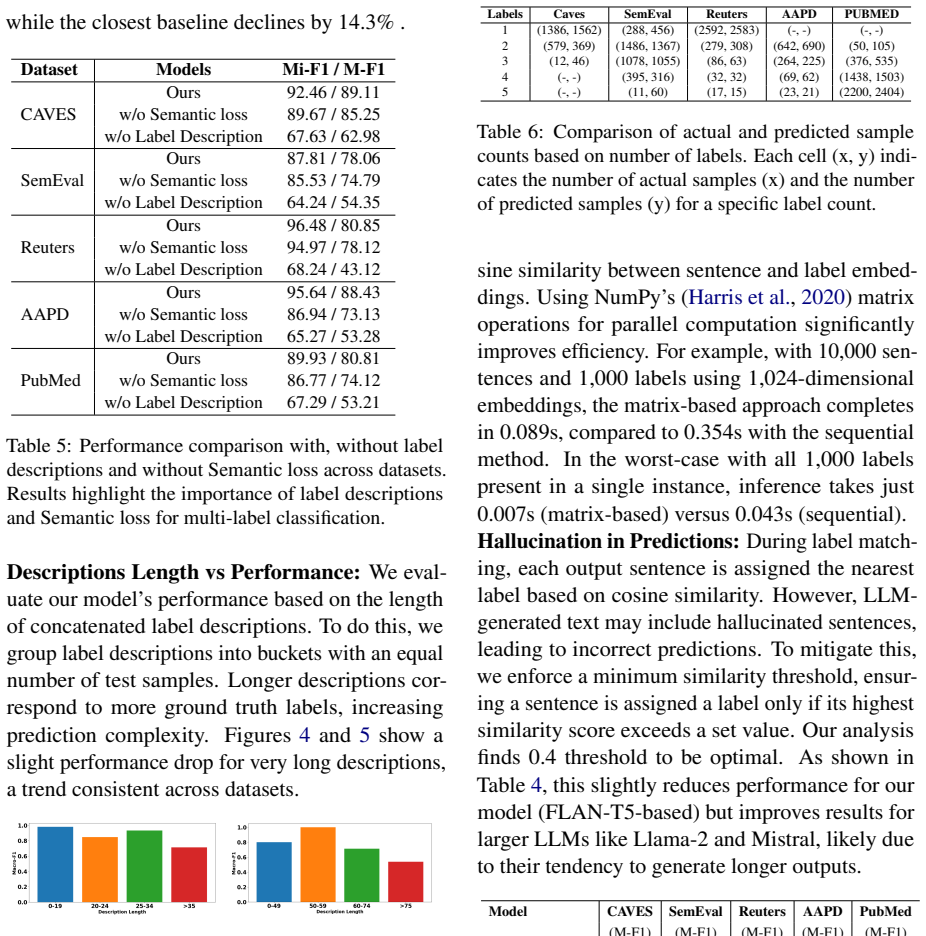
The central claim is that a parameter-efficient generative model can outperform specialized multi-label classifiers by emitting label descriptions instead of label identifiers, and then resolving those descriptions to labels by similarity. In the paper's experiments, LAGAMC reports the best Micro-F1 and Macro-F1 on CAVES, SemEval, Reuters, AAPD, and PubMed, with mean improvements of 13.94% in Micro-F1 and 24.85% in Macro-F1 over the strongest baseline per dataset. It reaches an average Macro-F1 of 70.61 in a zero-shot setting where 4–5 labels per dataset are held out during training, and it improves Macro-F1 by 22% on the least frequent 15% of labels compared to the closest baseline. The ablation results attribute drops of 36.04% in Macro-F1 to replacing descriptions with atomic labels and drops of 3.96% Micro-F1 and 7.33% Macro-F1 to removing the semantic loss term.
Load-bearing premise
The load-bearing premise is that the automatically generated label descriptions are neutral and contain no test information; the paper does not state whether the two dataset examples used to refine each description come from the training split, and if they come from the test set the reported gains could be inflated.
Editorial extensions
If this is right
- Label descriptions become a portable target representation, so a model trained on one dataset does not need a new classification head when moving to another domain.
- The semantic loss is doing real work: removing it costs 3.96% Micro-F1 and 7.33% Macro-F1 on average, so token-level generation alone is not the source of the gain.
- Rare labels gain disproportionately: on the least frequent 15% of labels the model beats the closest baseline by 22% Macro-F1 on average, which is the regime where real-world skewed datasets fail.
- Held-out labels can be added without retraining: with 4–5 unseen labels per dataset, the average Macro-F1 is 70.61, and the paper interprets this as zero-shot capability.
- The gain is not bought with scale: with 22.69M trainable parameters, LAGAMC beats baselines that train 110–161M parameters, including extreme-classification systems.
Reading between the lines
- A direct test of the mechanism would replace the description generator with an open-weight model and re-run the pipeline; if the F1 gains depend on the specific generator, the method's domain-agnostic claim needs qualification.
- The zero-shot experiment holds out labels but keeps their descriptions written in the same style as the training labels; a harder deployment test would give the model descriptions written later or by a different process.
- The description-to-label matcher could expose calibrated confidence by using the cosine-similarity threshold that the paper already tunes (0.4), but the paper leaves that calibration use implicit.
- If the descriptions are clean, the same generate-and-match recipe should transfer to single-label classification and to larger label sets, but neither setting is tested here.
Editorial analysis
A structured set of objections, weighed in public.
Referee Report
Summary. This paper proposes LAGAMC, a generative framework for multi-label text classification. It fine-tunes FLAN-T5-Large with LoRA to output the label descriptions corresponding to the true labels of a document, using a hybrid loss that combines token-level cross-entropy with cosine similarity between a sentence-transformer embedding of the generated text and that of the target description. At inference, the generated text is matched to the predefined label descriptions using a fine-tuned sentence transformer. The authors report state-of-the-art Micro-F1 and Macro-F1 results on CAVES, SemEval, Reuters, AAPD, and PubMed, with average gains of 13.94% and 24.85% over the closest baseline, and they attribute the gains to label descriptions and the semantic loss. They also report zero-shot and rare-label analyses, ablations, and comparisons with several LLMs.
Significance. The central idea is timely and practically attractive: replacing atomic labels with generated label descriptions is simple, parameter-efficient (22.69M trainable parameters), and, if the results hold, transferable across domains. The paper is unusually complete in shipping code and data, and its ablations (Table 5 and Table 7) isolate the contributions of label descriptions, semantic loss, and the fine-tuned matcher with large effect sizes. The main claims are empirical, however, and their validity depends on whether the description-generation pipeline is information-safe with respect to the test splits and on whether the reported margins survive repeated runs; these are exactly the points that require scrutiny before the SOTA claim can be accepted.
major comments (4)
- [§3.2, §5.2, §5.4] Section 3.2 states that each Wikipedia definition is refined by giving GPT-3.5 'two relevant examples from the dataset where the label appeared in the predictions,' but it never specifies the partition those examples come from or which model produced the predictions. These refined descriptions are not auxiliary: §5.2 uses them as the training target y_target, and §5.4 uses them as the reference embeddings for the label matcher. If any selected example is drawn from a test split, the model is trained to emit test-derived phrasings and the matcher is biased toward test-like text, so the headline Micro-F1 and Macro-F1 gains would not establish generalization. The authors must state the provenance of these examples, release the exact example IDs and prompts, and ideally regenerate descriptions from the training split only and rerun all experiments; the zero-shot analysis in §8.1 is especially exposed because it relies on labels that 'appear only in test instances.'
- [Table 3, §7] The central SOTA claim rests on a single run per model and dataset: Table 3 and Table 5 report no error bars, no random seeds, and no significance tests. Some margins are small (e.g., PubMed Micro-F1: LAGAMC 89.93 vs. Renee 89.74, and T5-Large 89.90 is within noise), while aggregate improvements are computed by averaging across heterogeneous datasets. Reporting standard deviations over at least three seeds and paired significance tests is necessary to support 'consistently outperforms state-of-the-art.'
- [Table 3, §2, §8.7] The comparison set omits closely related label-semantics and sequence-generation baselines that the paper itself discusses. SGM (Yang et al., 2018) is a sequence generation model for multi-label classification, and MatchXML (Ye et al., 2024) is a text-label matching framework; neither appears in Table 3, despite being more relevant to the claimed generative/matching paradigm than the extreme-classification baselines (DeepXML, Renee) that surround the best baseline. Without these comparisons, the incremental advantage of generating descriptions rather than treating labels atomically is not fully separated from the advantage of using an instruction-tuned FLAN-T5 backbone.
- [§5.3, §5.4] There is a granularity mismatch between training and inference that is not explained. In §5.3, L_semantic is computed between a single sentence-transformer embedding of the entire generated output and a single embedding of the entire target y_target, whereas in §5.4 the matcher embeds each generated description sentence separately and selects the nearest label per sentence. The paper does not state how a multi-sentence output is segmented into individual gendesc_i, nor how the whole-sequence training loss relates to the per-sentence matching objective. At minimum, the authors should specify the splitting rule (e.g., split on the separator period) and report whether description-internal punctuation was normalized; without this, the mechanism cannot be reproduced.
minor comments (5)
- [Abstract, §7] The abstract and §7 report gains of '13.94%' and '24.85%' without stating whether these are relative improvements or absolute percentage-point differences; please clarify the aggregation formula.
- [§6] Section 6 says 'inference time: 2 minutes/sample'; this seems inconsistent with the reported speed of the matcher in §8.5 and is likely a typo or missing unit.
- [§5.3] Section 5.3 describes λ as a learnable parameter but does not specify its initialization or any constraint; since Eq. (1) uses both λ and 1−λ, please state that λ is confined to [0,1] or explain the intended parameterization.
- [Table 7] Table 7 replaces the fine-tuned Sentence-BERT with Sentence-T5-xxl and S-BERT-L12, but these substitutes differ in more than the matcher component (e.g., embedding dimension, pretraining objective, whether they are fine-tuned); please clarify that only the matcher encoder is swapped while all other training details are unchanged.
- [§8.2] Section 8.2 does not define how 'test samples where the ground truth labels were part of this rare label set' is interpreted for multi-label instances; please specify whether a sample qualifies when any or all of its true labels are rare.
Circularity Check
No significant circularity: LAGAMC is an empirical pipeline evaluated against external baselines, and the use of label descriptions as both training targets and matching references is design consistency, not a fitted prediction.
full rationale
The paper makes no first-principles derivation that reduces to its own inputs. Its central claim is an empirical F1 comparison against external baselines (BERT, RoBERTa, GalaXC, DeepXML, Renee, etc.) on five public datasets. The pipeline trains FLAN-T5 to generate label descriptions and a sentence transformer to match those descriptions to predefined labels; the fact that the same descriptions appear as training targets and as matching references is the intended mechanism of the method, not a parameter fit that forces the reported result. The ablations (w/o label descriptions, w/o semantic loss) and zero-shot experiments provide additional empirical content that is not guaranteed by construction. The only self-citations (Khatuya et al., 2024; Poddar et al., 2022) are background references and are not load-bearing for the method's validity. The reviewer-identified concern that GPT-3.5-generated descriptions may be derived from test-set examples is a data-contamination/validity issue, not a circularity of the kind defined here: it does not make the reported predictions equivalent to the inputs by construction. Under the stated criteria, no circular step can be quoted and exhibited, so the appropriate finding is no significant circularity.
Assumptions & free parameters
free parameters (3)
- Hybrid loss weight lambda =
learned during training (value not reported)
- LoRA rank =
2
- Similarity threshold for label matcher =
0.4
assumptions (5)
- domain assumption HuggingFace pretrained FLAN-T5-Large checkpoints are available and behave as expected.
- domain assumption GPT-3.5-generated label descriptions are semantically faithful and contextually aligned with each dataset.
- domain assumption Sentence-transformer embeddings provide reliable similarity ordering for matching generated text to labels.
- domain assumption The baselines were tuned comparably and evaluated under the same protocol.
- domain assumption The two per-label examples given to GPT-3.5 for description refinement come from training data, not test data.
Cite this review
Pith. "Pith review of Label-semantics Aware Generative Approach for Domain-Agnostic Multilabel Classification." pith.science (2026). https://pith.science/paper/7N6SLVW5
@misc{pith2026250606806,
  author       = {Pith},
  title        = {Pith review of: Label-semantics Aware Generative Approach for Domain-Agnostic Multilabel Classification},
  year         = {2026},
  howpublished = {\url{https://pith.science/paper/7N6SLVW5}},
  note         = {Machine review of arXiv:2506.06806}
}
read the original abstract
The explosion of textual data has made manual document classification increasingly challenging. To address this, we introduce a robust, efficient domain-agnostic generative model framework for multi-label text classification. Instead of treating labels as mere atomic symbols, our approach utilizes predefined label descriptions and is trained to generate these descriptions based on the input text. During inference, the generated descriptions are matched to the pre-defined labels using a finetuned sentence transformer. We integrate this with a dual-objective loss function, combining cross-entropy loss and cosine similarity of the generated sentences with the predefined target descriptions, ensuring both semantic alignment and accuracy. Our proposed model LAGAMC stands out for its parameter efficiency and versatility across diverse datasets, making it well-suited for practical applications. We demonstrate the effectiveness of our proposed model by achieving new state-of-the-art performances across all evaluated datasets, surpassing several strong baselines. We achieve improvements of 13.94% in Micro-F1 and 24.85% in Macro-F1 compared to the closest baseline across all datasets.
Figures


Figures from the paper (1 more)
Reference graph
Works this paper leans on
-
[1]
URL: " 'urlintro :=
ENTRY address author booktitle chapter edition editor howpublished institution journal key month note number organization pages publisher school series title type volume year eprint doi pubmed url lastchecked label extra.label sort.label short.list INTEGERS output.state before.all mid.sentence after.sentence after.block STRINGS urlintro eprinturl eprintpr...
-
[2]
write newline
" write newline "" before.all 'output.state := FUNCTION n.dashify 't := "" t empty not t #1 #1 substring "-" = t #1 #2 substring "--" = not "--" * t #2 global.max substring 't := t #1 #1 substring "-" = "-" * t #2 global.max substring 't := while if t #1 #1 substring * t #2 global.max substring 't := if while FUNCTION word.in bbl.in capitalize " " * FUNCT...
-
[3]
Ashutosh Adhikari, Achyudh Ram, Raphael Tang, and Jimmy Lin. 2019. http://arxiv.org/abs/1904.08398 Docbert: Bert for document classification
work page Pith review arXiv 2019
-
[4]
Iqra Ameer, Necva Bölücü, Muhammad Hammad Fahim Siddiqui, Burcu Can, Grigori Sidorov, and Alexander Gelbukh. 2023. Multi-label emotion classification in texts using transfer learning. Expert Systems with Applications, 213:118534
work page 2023
-
[5]
Tom Brown, Benjamin Mann, Nick Ryder, Melanie Subbiah, Jared D Kaplan, Prafulla Dhariwal, Arvind Neelakantan, Pranav Shyam, Girish Sastry, Amanda Askell, et al. 2020. Language models are few-shot learners. Advances in neural information processing systems, 33:1877--1901
2020
-
[6]
Erik Cambria, Daniel Olsher, and Dheeraj Rajagopal. 2014. Senticnet 3: A common and common-sense knowledge base for cognition-driven sentiment analysis. volume 2
work page 2014
-
[7]
Ilias Chalkidis, Manos Fergadiotis, Prodromos Malakasiotis, Nikolaos Aletras, and Ion Androutsopoulos. 2020. https://doi.org/10.18653/v1/2020.findings-emnlp.261 LEGAL - BERT : The muppets straight out of law school . In Findings of the Association for Computational Linguistics: EMNLP 2020, pages 2898--2904, Online. Association for Computational Linguistics
-
[8]
Guibin Chen, Deheng Ye, Zhenchang Xing, Jieshan Chen, and Erik Cambria. 2017. Ensemble application of convolutional and recurrent neural networks for multi-label text categorization. In 2017 International Joint Conference on Neural Networks (IJCNN), pages 2377--2383
work page 2017
Show all 47 references
-
[9]
Xiaolong Chen, Jieren Cheng, Jingxin Liu, Wenghang Xu, Shuai Hua, Zhu Tang, and Victor S Sheng. 2022. A survey of multi-label text classification based on deep learning. In International Conference on Adaptive and Intelligent Systems, pages 443--456. Springer
2022
-
[10]
Hyung Won Chung et al. 2022. Scaling instruction-finetuned language models. arXiv preprint arXiv:2210.11416
2022 arXiv
-
[11]
Kunal Dahiya, Ananye Agarwal, Deepak Saini, K Gururaj, Jian Jiao, Amit Singh, Sumeet Agarwal, Purushottam Kar, and Manik Varma. 2021 a . Siamesexml: Siamese networks meet extreme classifiers with 100m labels. In International conference on machine learning, pages 2330--2340. PMLR
2021
-
[12]
Kunal Dahiya, Deepak Saini, Anshul Mittal, Ankush Shaw, Kushal Dave, Akshay Soni, Himanshu Jain, Sumeet Agarwal, and Manik Varma. 2021 b . Deepxml: A deep extreme multi-label learning framework applied to short text documents. In Proceedings of the 14th ACM international confe...
2021
-
[13]
Kunal Dahiya, Sachin Yadav, Sushant Sondhi, Deepak Saini, Sonu Mehta, Jian Jiao, Sumeet Agarwal, Purushottam Kar, and Manik Varma. 2023. Deep encoders with auxiliary parameters for extreme classification. In Proceedings of the 29th ACM SIGKDD Conference on Knowledge Discovery ...
2023
-
[14]
Jacob Devlin, Ming-Wei Chang, Kenton Lee, and Kristina Toutanova. 2019. http://arxiv.org/abs/1810.04805 Bert: Pre-training of deep bidirectional transformers for language understanding
2019 arXiv
-
[15]
Siddharth Gopal and Yiming Yang. 2010. Multilabel classification with meta-level features. Proceedings of the 33rd international ACM SIGIR conference on Research and development in information retrieval
2010
-
[16]
Aaron Grattafiori, Abhimanyu Dubey, Abhinav Jauhri, Abhinav Pandey, Abhishek Kadian, Ahmad Al-Dahle, Aiesha Letman, Akhil Mathur, Alan Schelten, Alex Vaughan, Amy Yang, Angela Fan, Anirudh Goyal, Anthony Hartshorn, Aobo Yang, Archi Mitra, Archie Sravankumar, Artem Korenev, Art...
2024 arXiv
-
[17]
Qipeng Guo, Xipeng Qiu, Pengfei Liu, Yunfan Shao, Xiangyang Xue, and Zheng Zhang. 2022. http://arxiv.org/abs/1902.09113 Star-transformer
2022 arXiv
-
[18]
Harris, K
Charles R. Harris, K. Jarrod Millman, St \' e fan J. van der Walt, Ralf Gommers, Pauli Virtanen, David Cournapeau, Eric Wieser, Julian Taylor, Sebastian Berg, Nathaniel J. Smith, Robert Kern, Matti Picus, Stephan Hoyer, Marten H. van Kerkwijk, Matthew Brett, Allan Haldane, Jai...
2020
-
[19]
Hayes and Steven P
Philip J. Hayes and Steven P. Weinstein. 1990. https://api.semanticscholar.org/CorpusID:18312939 Construe/tis: A system for content-based indexing of a database of news stories . In Conference on Innovative Applications of Artificial Intelligence
1990
-
[20]
Hu, Yelong Shen, Phillip Wallis, Zeyuan Allen-Zhu, Yuanzhi Li, Shean Wang, Lu Wang, and Weizhu Chen
Edward J. Hu, Yelong Shen, Phillip Wallis, Zeyuan Allen-Zhu, Yuanzhi Li, Shean Wang, Lu Wang, and Weizhu Chen. 2021. http://arxiv.org/abs/2106.09685 Lora: Low-rank adaptation of large language models
2021 arXiv
-
[21]
Yi Huang, Buse Giledereli, Abdullatif Köksal, Arzucan Özgür, and Elif Ozkirimli. 2021. http://arxiv.org/abs/2109.04712 Balancing methods for multi-label text classification with long-tailed class distribution
2021 arXiv
-
[22]
Vidit Jain, Jatin Prakash, Deepak Saini, Jian Jiao, Ramachandran Ramjee, and Manik Varma. 2023. Renee: End-to-end training of extreme classification models. Proceedings of Machine Learning and Systems, 5
2023
-
[23]
Albert Q. Jiang, Alexandre Sablayrolles, Arthur Mensch, Chris Bamford, Devendra Singh Chaplot, Diego de las Casas, Florian Bressand, Gianna Lengyel, Guillaume Lample, Lucile Saulnier, Lélio Renard Lavaud, Marie-Anne Lachaux, Pierre Stock, Teven Le Scao, Thibaut Lavril, Thomas ...
2023 arXiv
-
[24]
Siddhant Kharbanda, Atmadeep Banerjee, Devaansh Gupta, Akash Palrecha, and Rohit Babbar. 2024. http://arxiv.org/abs/2109.07319 Inceptionxml: A lightweight framework with synchronized negative sampling for short text extreme classification
2024 arXiv
-
[25]
Subhendu Khatuya, Rajdeep Mukherjee, Akash Ghosh, Manjunath Hegde, Koustuv Dasgupta, Niloy Ganguly, Saptarshi Ghosh, and Pawan Goyal. 2024. https://doi.org/10.18653/v1/2024.naacl-long.410 Parameter-efficient instruction tuning of large language models for extreme financial num...
2024 doi
-
[26]
Yoon Kim. 2014. http://arxiv.org/abs/1408.5882 Convolutional neural networks for sentence classification
2014 arXiv
-
[27]
Ankit Kumar, Ozan Irsoy, Peter Ondruska, Mohit Iyyer, James Bradbury, Ishaan Gulrajani, Victor Zhong, Romain Paulus, and Richard Socher. 2016. Ask me anything: Dynamic memory networks for natural language processing. In International conference on machine learning, pages 1378-...
2016
-
[28]
Jingzhou Liu, Wei-Cheng Chang, Yuexin Wu, and Yiming Yang. 2017. https://api.semanticscholar.org/CorpusID:1009397 Deep learning for extreme multi-label text classification . Proceedings of the 40th International ACM SIGIR Conference on Research and Development in Information Retrieval
2017
-
[29]
Pengfei Liu, Xipeng Qiu, and Xuanjing Huang. 2016. http://arxiv.org/abs/1605.05101 Recurrent neural network for text classification with multi-task learning
2016 arXiv
-
[30]
Yinhan Liu, Myle Ott, Naman Goyal, Jingfei Du, Mandar Joshi, Danqi Chen, Omer Levy, Mike Lewis, Luke Zettlemoyer, and Veselin Stoyanov. 2019. http://arxiv.org/abs/1907.11692 Roberta: A robustly optimized bert pretraining approach
2019 arXiv
-
[31]
Shayne Longpre et al. 2023. http://arxiv.org/abs/2301.13688 The flan collection: Designing data and methods for effective instruction tuning
2023 arXiv
-
[32]
Long Ma, Zeye Sun, Jiawei Jiang, and Xuan Li. 2023. https://aclanthology.org/2023.semeval-1.34 PAI at S em E val-2023 task 4: A general multi-label classification system with class-balanced loss function and ensemble module . In Proceedings of the 17th International Workshop o...
2023
-
[33]
Saif Mohammad, Felipe Bravo-Marquez, Mohammad Salameh, and Svetlana Kiritchenko. 2018. Semeval-2018 task 1: Affect in tweets. In Proceedings of the 12th international workshop on semantic evaluation, pages 1--17
2018
-
[34]
Humza Naveed, Asad Ullah Khan, Shi Qiu, Muhammad Saqib, Saeed Anwar, Muhammad Usman, Naveed Akhtar, Nick Barnes, and Ajmal Mian. 2024. http://arxiv.org/abs/2307.06435 A comprehensive overview of large language models
2024 arXiv
-
[35]
Soham Poddar, Azlaan Mustafa Samad, Rajdeep Mukherjee, Niloy Ganguly, and Saptarshi Ghosh. 2022. Caves: A dataset to facilitate explainable classification and summarization of concerns towards covid vaccines. In Proceedings of the 45th International ACM SIGIR Conference on Res...
2022
-
[36]
Colin Raffel et al. 2020. Exploring the limits of transfer learning with a unified text-to-text transformer. JMLR
2020
-
[37]
Nils Reimers and Iryna Gurevych. 2019. Sentence-bert: Sentence embeddings using siamese bert-networks. arXiv preprint arXiv:1908.10084
2019 arXiv
-
[38]
Deepak Saini, Arnav Kumar Jain, Kushal Dave, Jian Jiao, Amit Singh, Ruofei Zhang, and Manik Varma. 2021. Galaxc: Graph neural networks with labelwise attention for extreme classification. In Proceedings of the Web Conference 2021, pages 3733--3744
2021
-
[39]
Robert Schapire and Yoram Singer. 2000. Boostexter: A boosting-based system for text categorization. Machine Learning - ML, 39:135--168
2000
-
[40]
Hugo Touvron, Louis Martin, Kevin Stone, Peter Albert, Amjad Almahairi, Yasmine Babaei, Nikolay Bashlykov, Soumya Batra, Prajjwal Bhargava, Shruti Bhosale, Dan Bikel, Lukas Blecher, Cristian Canton Ferrer, Moya Chen, Guillem Cucurull, David Esiobu, Jude Fernandes, Jeremy Fu, W...
2023 arXiv
-
[41]
Lin Xiao, Xin Huang, Boli Chen, and Liping Jing. 2019. Label-specific document representation for multi-label text classification. In Proceedings of the 2019 conference in EMNLP-IJCNLP, pages 466--475
2019
-
[42]
Pengcheng Yang, Xu Sun, Wei Li, Shuming Ma, Wei Wu, and Houfeng Wang. 2018. http://arxiv.org/abs/1806.04822 Sgm: Sequence generation model for multi-label classification
2018 arXiv
-
[43]
Zhilin Yang, Zihang Dai, Yiming Yang, Jaime Carbonell, Ruslan Salakhutdinov, and Quoc V. Le. 2020. http://arxiv.org/abs/1906.08237 Xlnet: Generalized autoregressive pretraining for language understanding
2020 arXiv
-
[44]
Zichao Yang, Diyi Yang, Chris Dyer, Xiaodong He, Alex Smola, and Eduard Hovy. 2016. Hierarchical attention networks for document classification. In Proceedings of the 2016 conference of NAACL: human language technologies, pages 1480--1489
2016
-
[45]
Hui Ye, Rajshekhar Sunderraman, and Shihao Ji. 2024. http://arxiv.org/abs/2308.13139 Matchxml: An efficient text-label matching framework for extreme multi-label text classification
2024 arXiv
-
[46]
Wenpeng Yin and Hinrich Sch \"u tze. 2018. Attentive convolution: Equipping cnns with rnn-style attention mechanisms. Transactions of the Association for Computational Linguistics, 6:687--702
2018
-
[47]
Ronghui You, Zihan Zhang, Ziye Wang, Suyang Dai, Hiroshi Mamitsuka, and Shanfeng Zhu. 2019. Attentionxml: Label tree-based attention-aware deep model for high-performance extreme multi-label text classification. Advances in neural information processing systems, 32
2019
Reviewed August 7, 2026 · model on record in the stance chip above.
Discussion (0). Sign in to comment.