REVIEW 3 major objections 5 minor 112 references
Towards a Global Search for New Physics with Isotope Shifts
T0 review · 3 major / 5 minor · reviewed 2026-08-07 · deepseek-v4-flash
Pith's one-line read The paper presents kifit, a fit framework that for the first time combines King-plot isotope-shift data from several elements, with correlations, into global bounds on a new boson coupling to electrons and neutrons.
desk verdict kifit is a genuinely useful and honestly documented framework, but the paper overreaches when it presents the Ca-Yb combination in Fig. 14 as a global new-physics bound, because both datasets violate the paper's own data-sparsity criterion. read the letter →
The pith
A machine-rendered reading of the paper's core claim, the machinery that carries it, and where it could break.
The reading
What carries the argument
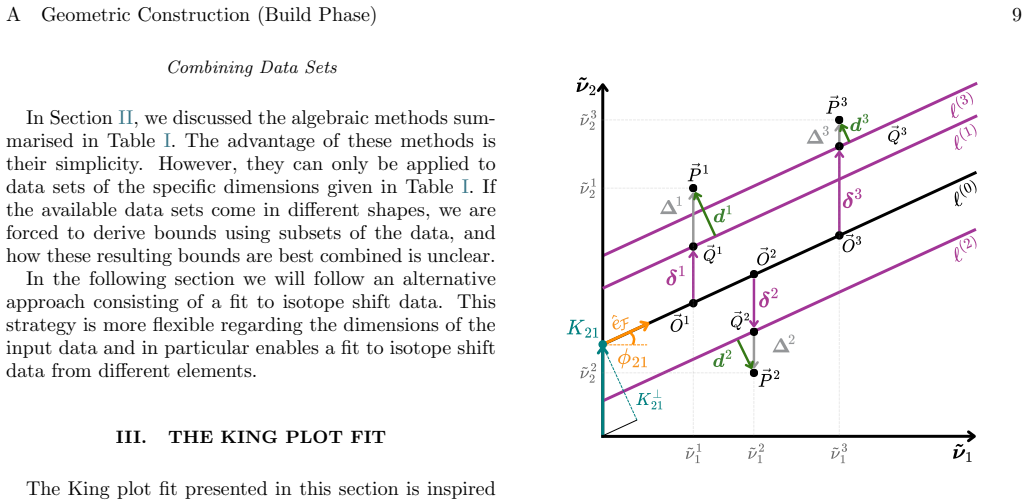
The engine is the geometric King-plot fit. For each element the isotope shifts of $m$ transitions over $n$ isotope pairs are vectors in transition space lying on parallel lines: one line per isotope pair, oriented along the electronic field-shift vector $\mathbf{F}$ and displaced by the new-physics shift $(\alpha_{\mathrm{NP}}/\alpha_{\mathrm{EM}})\tilde{\gamma}_a \mathbf{X}$, where $\tilde{\gamma}_a$ is the neutron-number difference of the isotope pair divided by the reduced mass and $\mathbf{X}$ holds electronic sensitivity coefficients from atomic-structure calculation. Numerical stability comes from parametrising the line direction by inclination angles and the intercepts by their projections orthogonal to the line, which avoids the near-collinear limit of the naive intercepts. The distances from the data points to the shifted lines define the log-likelihood, whose covariance is estimated by Monte Carlo, and the total log-likelihood is the sum over elements. Confidence intervals come from repeated 'experiments,' each a block of $\alpha_{\mathrm{NP}}$ samples, combined conservatively by a blocking average.
What would settle it
Generate mock isotope shifts for one element from a pure Standard Model second-order mass shift, with zero new physics but with precision high enough to resolve the curvature, and run kifit on it: if the 2-$\sigma$ window excludes $\alpha_{\mathrm{NP}} = 0$, the assumption that linear-plot residuals are entirely new physics is falsified. The same test can be run on the real Yb data by adding the known Standard Model nonlinearity as a fitted term and checking whether the global bound moves by more than its stated uncertainty.
Extended reading notes
Core claim
The central claim is that one framework now handles all linear King-plot data at once. kifit models the mass-normalised isotope shifts of $m$ transitions in $n$ isotope pairs as data points whose perpendicular distance to a King line, shifted by the predicted new-physics term $(\alpha_{\mathrm{NP}}/\alpha_{\mathrm{EM}})\,\tilde{\gamma}_a X$, is fed into a log-likelihood; because the new boson couples to electrons and neutrons with the same constants in every element, the element log-likelihoods can be added under the assumption of uncorrelated data sets. The fit therefore produces a single global bound on the product of the new couplings, with confidence intervals estimated by Monte Carlo sampling and a blocking-average method. Against the algebraic methods, which require data sets of fixed shape and force the analyst to pick the subset that gives the most stringent bound, the fit accepts any number of transitions and isotope pairs and pools all data. The price is the linearity premise: any resolvable nonlinearity is attributed to new physics, so the framework is a constraint engine, not a discovery tool, and the combined Yb result must be read with caution because that dataset is known to contain Standard Model nonlinearities.
Load-bearing premise
Every King plot fed to the fit must be linear within its experimental uncertainties, so that any resolvable residue is read as a new-physics signal and not as an ordinary Standard Model higher-order effect; the paper flags that the Yb data violate this premise.
Editorial extensions
If this is right
- Combined analysis becomes possible across elements, so for the first time one global bound on $\alpha_{\mathrm{NP}}/\alpha_{\mathrm{EM}}$ can be quoted for mediator masses spanning roughly eight orders of magnitude.
- The fit accepts any data shape ($n$ isotope pairs, $m$ transitions) and therefore avoids omitting data or cherry-picking the subset that gives the strongest algebraic bound.
- For well-populated datasets the fit and the algebraic methods agree, whereas for minimal datasets (2 transitions, 3 isotope pairs) the fit can be roughly an order of magnitude more stringent, which the paper attributes to overfitting sparse data.
- The framework is currently limited to King plots linear within uncertainties; extending it to subtract higher-order Standard Model terms, as the Nuclear Input King Plot formula does in a simpler setting, is left to future work.
- The paper recommends that future measurements add transitions and isotopes even at moderate precision, since extra points stabilise the new-physics bounds and sharpen nuclear-structure constraints.
Reading between the lines
- A consequence the authors do not spell out: because all elements share the single coupling $\alpha_{\mathrm{NP}}$, a spurious nonlinearity in one element, such as the known Yb Standard Model curvature, biases the global constraint for all elements, turning a local misattribution into a global one.
- Testable extension: the paper validates kifit against mock linear data and algebraic methods, but not against mock data with a known injected new-physics signal; recovering an injected $\alpha_{\mathrm{NP}}$ across the mediator-mass range would close that gap.
- The sensitivity projections suggest a concrete shopping list: the even-isotope arrays of Zn, Cd, Sn, and Ba, and the metastable isotopes of Ca and Yb, each added as new kifit elements, would let one map how the global bound sharpens with each additional isotope pair and transition.
Editorial analysis
A structured set of objections, weighed in public.
Referee Report
Summary. The manuscript presents kifit, a publicly available Python package for fitting linear King plots and for combining isotope-shift data from multiple elements to constrain the new-physics coupling αNP/αEM. The authors review algebraic methods (KP, NMKP, GKP, NMGKP, projection), describe the fit construction based on distances to King lines with a Monte-Carlo log-likelihood, and compare results on Ca and Yb datasets. They also provide appendices on AMBiT coefficients, uncertainty projections, code validation, and a sparsity study, and they give recommendations for future isotope-shift measurements.
Significance. The framework addresses a timely problem: combining heterogeneous isotope-shift datasets into a single global constraint on new boson couplings. Its main strengths are the public implementation with a substantial test suite (pytests, Mathematica cross-checks, mock-data studies), the explicit treatment of correlations, and the transparent comparison with algebraic methods. If the validity issues identified below are resolved, kifit would be a useful community tool and the global bounds would be a new physics result.
major comments (3)
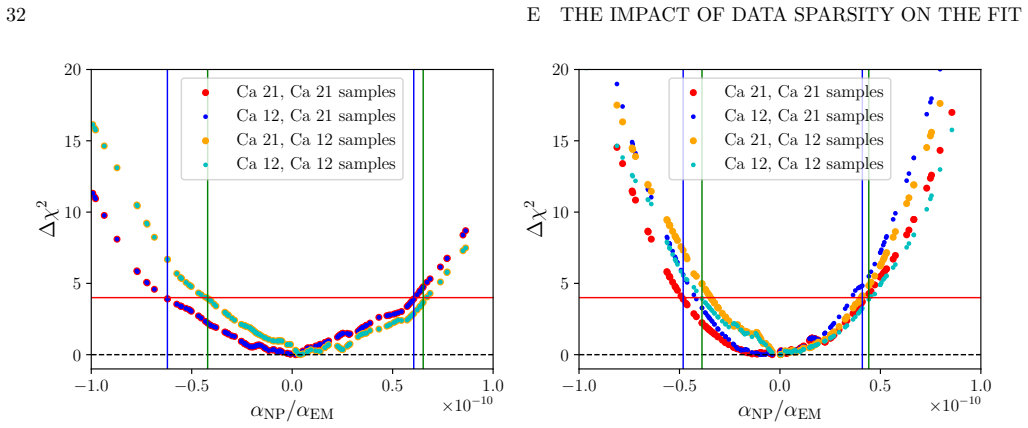
- [§IV.B, Fig. 14, Table V, Appendix E] The global combination in Fig. 14 is built from two data sets that violate the paper's own minimum-data requirement stated in §IV.B: 'in order to fit 2(m−1)+1 = 2m−1 degrees of freedom with n data points, ... n ≥ 2m−1 data points are required.' According to Table V, Ca WT Aarhus PTB 2024 has n=3 isotope pairs and m=4 transitions (2m−1 = 7), and Yb Kyoto MIT GSI PTB MPIK 2024 has n=4 isotope pairs and m=5 transitions (2m−1 = 9). Both therefore fall in the sparse-data regime in which Appendix E explicitly demonstrates that the fit 'will significantly underestimate the bounds on |αNP|.' Since the central novelty of the paper is the global constraint, the combined interval shown in Fig. 14 cannot be regarded as a validated physics result. I ask the authors to either restrict the headline combination to subsets satisfying n ≥ 2m−1, or provide a dedicated validation (e.g. mock-data studies at (n,m)=(3,4) and (4,5) with realistic uncertainties) that quantifies the bias and corrects the reported bounds.
- [§IV.B, Fig. 14, §V] The Yb dataset included in the combined fit is known to contain Standard Model King-plot nonlinearities, as the paper itself states: 'the fit result for Yb must be interpreted with caution, since it is known to contain SM nonlinearities, which are, however, not taken into account by the current version of kifit.' Because the kifit model is linear-plus-new-physics, a resolvable SM nonlinearity in Yb will be absorbed into αNP in the combined likelihood. This is not a minor caveat for Fig. 14: it directly biases the global bound. The paper should remove Yb from the headline combination, subtract the known SM nonlinearity using the methods of §II.B, or quantify the bias with a mock-data injection study before presenting the combined result.
- [§III.A, Eq. (52), §III.C/D] The log-likelihood treats the Euclidean norms ||d^a|| as multivariate normal. These quantities are non-negative and, for small numbers of isotope pairs, may be far from Gaussian; the confidence intervals and the blocking-average uncertainties in §III.C/D are derived from this assumption. The mock-data studies in Appendix E validate scaling behavior but do not test the full likelihood at the specific dimensions used in Fig. 14. I recommend a direct comparison of the kifit intervals with intervals obtained from a full Monte Carlo over the original isotope-shift observables for at least one representative dataset.
minor comments (5)
- [§III.A, Eq. (45)] In Eq. (45), the vector ⟨˜γ⟩ is written with n components, but K and K′ are m-dimensional vectors in transition space; the index structure should be corrected (the definition in Eq. (44) suggests a vector in transition space for j=2,...,m).
- [§III.D] The choice of the critical Δχ² 'associated to 2m+1 degrees of freedom' is not derived; under the approximate normal likelihood of Eq. (52) a profile-likelihood justification would be helpful.
- [Appendix A] The rescaling of X coefficients to the experimental field-shift ratio is a data-driven step; its effect on the quoted bounds, particularly in the high-mass region, should be quantified and discussed in the main text.
- [Abstract, §V] The statements 'provides for the first time a framework to combine all linear King plots across elements' and 'global bounds ... spanning eight orders of magnitude' should be qualified in the abstract and conclusions to reflect the sparse-data and nonlinearity limitations of the specific combination shown in Fig. 14.
- [Table III] The row for Ca WT Aarhus PTB 2024 gives a kifit 1σ interval of order 10^-9 while the algebraic standard deviation is 4.7×10^-10; the accompanying text says the discrepancy is lifted, which is confusing. Please clarify whether the comparison is meant at the same confidence level and explain the origin of the remaining difference.
Circularity Check
One declared calibration: the high-mass X coefficients are rescaled to the experimentally fitted field-shift ratio, so the high-mass insensitivity of the fit is partly self-imposed; the lower-mass global bound remains independent.
-
fitted input called prediction
[Appendix A, final paragraph (p. 24), with Eqs. (38) and (41) in Sec. III.A]
"Since even a small discrepancy between the experimental and theoretical values of the field shift ratio Fj/Fi can significantly impact the high-mass behavior of the bounds on new physics, the X coefficients are rescaled so that in the high-mass limit the ratio Xj/Xi approaches the experimental field shift ratio F exp j /F exp i, which is obtained from a linear fit to King plot measurements."
The new-physics displacement entering the fit is X_j1 = X_j - F_j1 X_1 (Eq. (41)), where F_j1 = tan(phi_j1) is fixed by an ODR fit to the same King-plot data (Sec. III.A). Appendix A then rescales the X coefficients so that X_j/X_i -> F_j^exp/F_i^exp in the high-mass limit. By construction this drives X_j1 -> 0, so the new-physics displacement delta^a vanishes and the high-mass loss of sensitivity shown in the exclusion plots is imposed by the calibration rather than computed from independent AMBiT input. The step is transparent and conservative—it weakens, not creates, a signal—and it does not feed the lower/intermediate-mass constraints, where the m_phi-dependent AMBiT coefficients carry the result.
full rationale
The central alpha_NP extraction in kifit is a likelihood scan over a free coupling, not a fit of the hypothesis to its own output: the King-line parameters are fitted to data, but the new-physics term uses external AMBiT electronic coefficients and the neutron-number vector gamma, so the main constraints are not equivalent to the inputs by construction. The paper validates the algorithm on mock data against algebraic formulas and Mathematica cross-checks, and the low-mass behavior is governed by the mass-dependent X coefficients from independent atomic-structure calculations. No load-bearing uniqueness theorem is imported from the authors' prior work, and the references to Refs. [36], [43], [49], [50] are used as ordinary prior methodology or data sources rather than as a forced self-citation chain. The Yb nonlinearity caution and the n >= 2m-1 data-sparsity criterion are internal model-validity concerns, not circularity. The one genuine, albeit mild, circular step is the Appendix A rescaling of the X coefficients to the experimentally fitted field-shift ratio, which makes the high-mass suppression partly self-imposed; because this only widens bounds and does not generate the global low-mass exclusion, the overall circularity score is low.
Assumptions & free parameters
free parameters (1)
- X coefficient high-mass rescaling to experimental field shift ratio =
F_j^exp / F_i^exp from linear King plot fit
assumptions (6)
- domain assumption Isotope shifts factorize into a mass shift term and a field shift term at leading order (Eq. 1).
- domain assumption New physics is described by a Yukawa potential with a boson coupling linearly to electrons and neutrons (Eq. 6).
- domain assumption King plots are linear in the absence of new physics; higher-order SM contributions are negligible for the datasets used (except where noted).
- domain assumption Electronic coefficients X_i, F_i, K_i from AMBiT are accurate within assigned uncertainties (10% for X_i).
- domain assumption The Euclidean distances of data points to the predicted lines are approximately multivariate normal (Eq. 52).
- domain assumption Measurements across different elements are uncorrelated (Eq. 57).
Cite this review
Pith. "Pith review of Towards a Global Search for New Physics with Isotope Shifts." pith.science (2026). https://pith.science/paper/4Z4VQ4FD
@misc{pith2026250607303,
  author       = {Pith},
  title        = {Pith review of: Towards a Global Search for New Physics with Isotope Shifts},
  year         = {2026},
  howpublished = {\url{https://pith.science/paper/4Z4VQ4FD}},
  note         = {Machine review of arXiv:2506.07303}
}
read the original abstract
Isotope shifts have emerged as a sensitive probe of new bosons that couple to electrons and neutrons, and of nuclear structure. The recent Hz- or even sub-Hz-level isotope shift measurements across different elements call for a global assessment of all available data. In this work, we present the fit framework kifit that for the first time enables a combined analysis of isotope shift data from several elements, taking into account correlations. We provide a thorough comparison of analytical methods and the fit to analyse linear and nonlinear King plots and quantify their uncertainties. Finally, we provide recommendations for future measurements that could enhance the sensitivity to new physics and offer new insights into nuclear structure.
Figures


Figures from the paper (19 more)




Reference graph
Works this paper leans on
-
[1]
Search for New Physics with Atoms and Molecules,
M. S. Safronova, D. Budker, D. DeMille, Derek F. Jack- son Kimball, A. Derevianko, and C. W. Clark, “Search for New Physics with Atoms and Molecules,” Rev. Mod. Phys. 90, 025008 (2018), arXiv:1710.01833 [physics.atom-ph]
arXiv 2018
-
[2]
Highly charged ions: optical clocks and applications in fundamental physics
M. G. Kozlov, M. S. Safronova, J. R. Crespo L´ opez- Urrutia, and P. O. Schmidt, “Highly charged ions: Op- tical clocks and applications in fundamental physics,” Rev. Mod. Phys. 90, 045005 (2018), arXiv:1803.06532 [physics.atom-ph]. 21
work page Pith review arXiv 2018
-
[3]
New Horizons: Scalar and Vector Ul- tralight Dark Matter,
D. Antypas et al., “New Horizons: Scalar and Vector Ul- tralight Dark Matter,” (2022), arXiv:2203.14915 [hep- ex]
arXiv 2022
-
[4]
Cooling of gases by laser radiation,
T.W. H¨ ansch and A.L. Schawlow, “Cooling of gases by laser radiation,” Optics Communications 13, 68–69 (1975)
1975
-
[5]
Proposed 10 14∆ν < ν Laser Fluorescence Spectroscopy on Tl + Mono-Ion Os- cillator,
D.J. Wineland and H. Dehmelt, “Proposed 10 14∆ν < ν Laser Fluorescence Spectroscopy on Tl + Mono-Ion Os- cillator,” Bulletin of the American Physical Society 20, 637 (1975)
1975
-
[6]
The semiclassical theory of laser cool- ing,
Stig Stenholm, “The semiclassical theory of laser cool- ing,” Rev. Mod. Phys. 58, 699–739 (1986)
1986
-
[7]
Cooling and trapping of neutral atoms,
Harold Metcalf and Peter van der Straten, “Cooling and trapping of neutral atoms,” Physics Reports 244, 203– 286 (1994)
1994
-
[8]
Nobel lecture: Passion for preci- sion,
Theodor W. H¨ ansch, “Nobel lecture: Passion for preci- sion,” Rev. Mod. Phys. 78, 1297–1309 (2006)
2006
Show all 112 references
-
[9]
Nobel lecture: Defining and measuring optical frequencies,
John L. Hall, “Nobel lecture: Defining and measuring optical frequencies,” Rev. Mod. Phys. 78, 1279–1295 (2006)
2006
-
[10]
Acceleration and trapping of particles by radiation pressure,
A. Ashkin, “Acceleration and trapping of particles by radiation pressure,” Phys. Rev. Lett. 24, 156–159 (1970)
1970
-
[11]
Observation of a single-beam gradient force op- tical trap for dielectric particles,
A. Ashkin, J. M. Dziedzic, J. E. Bjorkholm, and Steven Chu, “Observation of a single-beam gradient force op- tical trap for dielectric particles,” Opt. Lett. 11, 288 (1986)
1986
-
[12]
Experimental Observation of Optically Trapped Atoms,
Steven Chu, J. E. Bjorkholm, A. Ashkin, and A. Ca- ble, “Experimental Observation of Optically Trapped Atoms,” Phys. Rev. Lett. 57, 314–317 (1986)
1986
-
[13]
Narrowing of the Doppler Width in a Standing Wave,
V. S. Letokhov, “Narrowing of the Doppler Width in a Standing Wave,” Soviet Journal of Experimental and Theoretical Physics Letters 7, 272 (1968)
1968
-
[14]
Laser control of the motion of neutral atoms and optical atomic traps,
V I Balykin, V S Letokhov, and V G Minogin, “Laser control of the motion of neutral atoms and optical atomic traps,” Physica Scripta 1988, 119 (1988)
1988
-
[15]
Two dimension se- lective coherent population trapping controlled by a phase shift,
F. Mauri and E. Arimondo, “Two dimension se- lective coherent population trapping controlled by a phase shift,” Physical Review Letters 54 (1992), 10.1007/bf00325388
1992 doi
-
[16]
Optical dipole traps for neutral atoms,
Rudolf Grimm, Matthias Weidem¨ uller, and Yurii B. Ovchinnikov, “Optical dipole traps for neutral atoms,” (1999), arXiv:physics/9902072 [physics.atom-ph]
1999 arXiv
-
[17]
Spectroscopy using quantum logic,
P. O. Schmidt, T. Rosenband, C. Langer, W. M. Itano, J. C. Bergquist, and D. J. Wineland, “Spectroscopy using quantum logic,” Science 309, 749–752 (2005)
2005
-
[18]
Quantum-limited cooling and detection of radio-frequency oscillations by laser-cooled ions,
D. J. Heinzen and D. J. Wineland, “Quantum-limited cooling and detection of radio-frequency oscillations by laser-cooled ions,” Phys. Rev. A 42, 2977–2994 (1990)
1990
-
[19]
Quantum computations with cold trapped ions,
J. I. Cirac and P. Zoller, “Quantum computations with cold trapped ions,” Phys. Rev. Lett. 74, 4091–4094 (1995)
1995
-
[20]
Experimental issues in coherent quantum state manipulation of trapped atomic ions,
D. J. Wineland, C. Monroe, W. M. Itano, D. Leibfried, B. E. King, and D. M. Meekhof, “Experimental issues in coherent quantum state manipulation of trapped atomic ions,” J. Res. Natl. Inst. Stand. Tech. 103, 259 (1998), arXiv:quant-ph/9710025
1998 arXiv
-
[21]
Clock with 8 × 10⁻¹⁹ Systematic Uncertainty,
Alexander Aeppli, Kyungtae Kim, William Warfield, Marianna S. Safronova, and Jun Ye, “Clock with 8 × 10⁻¹⁹ Systematic Uncertainty,” Phys. Rev. Lett. 133, 023401 (2024)
2024
-
[22]
115In+−172Yb+ Coulomb Crystal Clock with 2 .5 × 10−18 Systematic Uncertainty,
H. N. Hausser, J. Keller, T. Nordmann, N. M. Bhatt, J. Kiethe, H. Liu, I. M. Richter, M. von Boehn, J. Rahm, S. Weyers, E. Benkler, B. Lipphardt, S. D¨ orscher, K. Stahl, J. Klose, C. Lisdat, M. Filzinger, N. Huntemann, E. Peik, and T. E. Mehlst¨ aubler, “115In+−172Yb+ Coulomb...
2025
-
[23]
Comments on the article “Peculiarities of the isotope shift in the samarium spectrum
W. H. King, “Comments on the article “Peculiarities of the isotope shift in the samarium spectrum”,” J. Opt. Soc. Am. 53, 638 (1963)
1963
-
[24]
W. H. King, Isotope shifts in atomic spectra (Springer Science & Business Media, 1984)
1984
-
[25]
Table of experimental nuclear ground state charge radii: An update,
I. Angeli and K.P. Marinova, “Table of experimental nuclear ground state charge radii: An update,” Atomic Data and Nuclear Data Tables 99, 69–95 (2013)
2013
-
[26]
Precision Isotope Shift Measurements in Cal- cium Ions Using Quantum Logic Detection Schemes,
Florian Gebert, Yong Wan, Fabian Wolf, Christo- pher N. Angstmann, Julian C. Berengut, and Piet O. Schmidt, “Precision Isotope Shift Measurements in Cal- cium Ions Using Quantum Logic Detection Schemes,” Phys. Rev. Lett. 115, 053003 (2015), arXiv:1504.03139 [physics.atom-ph]
2015 arXiv
-
[27]
Un- expectedly large difference of the electron density at the nucleus in the 4 p2P1/2,3/2 fine-structure dou- blet of Ca +,
C Shi, F Gebert, C Gorges, S Kaufmann, W N¨ ortersh¨ auser, BK Sahoo, A Surzhykov, V A Yerokhin, JC Berengut, F Wolf, et al. , “Un- expectedly large difference of the electron density at the nucleus in the 4 p2P1/2,3/2 fine-structure dou- blet of Ca +,” Applied Physics B , 1–1...
2018 arXiv
-
[28]
Probing Atomic Higgs-like Forces at the Pre- cision Frontier,
C´ edric Delaunay, Roee Ozeri, Gilad Perez, and Yotam Soreq, “Probing Atomic Higgs-like Forces at the Pre- cision Frontier,” Phys. Rev. D 96, 093001 (2017), arXiv:1601.05087 [hep-ph]
2017 arXiv
-
[29]
Probing New Long-Range Interactions by Isotope Shift Spectroscopy,
Julian C. Berengut et al. , “Probing New Long-Range Interactions by Isotope Shift Spectroscopy,” Phys. Rev. Lett. 120, 091801 (2018), arXiv:1704.05068 [hep-ph]
2018 arXiv
-
[30]
Michael Bordag, Galina Leonidovna Klimchitskaya, Umar Mohideen, and Vladimir Mikhaylovich Mostepa- nenko, Advances in the Casimir Effect (Oxford Univer- sity Press, 2009)
2009
-
[31]
Probing Dark Forces and Light Hidden Sectors at Low-Energy e+e− Colliders,
Rouven Essig, Philip Schuster, and Natalia Toro, “Probing Dark Forces and Light Hidden Sectors at Low-Energy e+e− Colliders,” Phys. Rev. D 80, 015003 (2009), arXiv:0903.3941 [hep-ph]
2009 arXiv
-
[32]
An Electron Fixed Target Exper- iment to Search for a New Vector Boson A’ Decaying to e+e-,
Rouven Essig, Philip Schuster, Natalia Toro, and Bog- dan Wojtsekhowski, “An Electron Fixed Target Exper- iment to Search for a New Vector Boson A’ Decaying to e+e-,” JHEP 02, 009 (2011), arXiv:1001.2557 [hep-ph]
2011 arXiv
-
[33]
Ex- ploring Portals to a Hidden Sector Through Fixed Tar- gets,
Brian Batell, Maxim Pospelov, and Adam Ritz, “Ex- ploring Portals to a Hidden Sector Through Fixed Tar- gets,” Phys. Rev. D 80, 095024 (2009), arXiv:0906.5614 [hep-ph]
2009 arXiv
-
[34]
Search for B → K (∗)νν and invisible quarkonium decays,
J. P. Lees et al. (BaBar), “Search for B → K (∗)νν and invisible quarkonium decays,” Phys. Rev. D 87, 112005 (2013), arXiv:1303.7465 [hep-ex]
2013 arXiv
-
[35]
New Measurement of the K + → π+ν ¯ν Branching Ratio,
A. V. Artamonov et al. (E949), “New Measurement of the K + → π+ν ¯ν Branching Ratio,” Phys. Rev. Lett. 101, 191802 (2008), arXiv:0808.2459 [hep-ex]
2008 arXiv
-
[36]
Constraining New Physics Mod- els with Isotope Shift Spectroscopy,
Claudia Frugiuele, Elina Fuchs, Gilad Perez, and Matthias Schlaffer, “Constraining New Physics Mod- els with Isotope Shift Spectroscopy,” Phys. Rev. D 96, 015011 (2017), arXiv:1602.04822 [hep-ph]
2017 arXiv
-
[37]
Light Dark Matter: Models and Constraints,
Simon Knapen, Tongyan Lin, and Kathryn M. Zurek, “Light Dark Matter: Models and Constraints,” Phys. Rev. D 96, 115021 (2017), arXiv:1709.07882 [hep-ph]
2017 arXiv
-
[38]
Isotope shifts in neutral and singly- 22 V CONCLUSIONS AND OUTLOOK ionized calcium,
A. Kramida, “Isotope shifts in neutral and singly- 22 V CONCLUSIONS AND OUTLOOK ionized calcium,” Atomic Data and Nuclear Data Tables 133-134, 101322 (2020)
2020
-
[39]
Isotope-shift measurement of the 423- nm transition in neutral Ca,
David R¨ oser, Lukas M¨ oller, Hans Keßler, and Si- mon Stellmer, “Isotope-shift measurement of the 423- nm transition in neutral Ca,” Phys. Rev. A 110, 032809 (2024), arXiv:2406.06806 [physics.atom-ph]
2024 arXiv
-
[40]
Part-per-billion measurement of the 4 2S1/2 → 32D5/2 electric quadrupole transition isotope shifts be- tween 42,44,48Ca+ and 40Ca+,
Felix W. Knollmann, Ashay N. Patel, and S. Charles Doret, “Part-per-billion measurement of the 4 2S1/2 → 32D5/2 electric quadrupole transition isotope shifts be- tween 42,44,48Ca+ and 40Ca+,” Phys. Rev. A 100, 022514 (2019), [Erratum: Phys.Rev.A 107, 069902 (2023)], arXiv:1906...
2019 arXiv
-
[41]
Im- proved isotope-shift-based bounds on bosons beyond the Standard Model through measurements of the 2D3/2−2D5/2 interval in Ca +,
Cyrille Solaro, Steffen Meyer, Karin Fisher, Julian C. Berengut, Elina Fuchs, and Michael Drewsen, “Im- proved isotope-shift-based bounds on bosons beyond the Standard Model through measurements of the 2D3/2−2D5/2 interval in Ca +,” Phys. Rev. Lett. 125, 123003 (2020), [Erratu...
2020 arXiv
-
[43]
Nonlinear calcium King plot constrains new bosons and nuclear properties,
Alexander Wilzewski et al. , “Nonlinear calcium King plot constrains new bosons and nuclear properties,” (2024), arXiv:2412.10277 [physics.atom-ph]
2024 arXiv
-
[44]
Optical isotopic shifts and hyperfine splittings for Yb,
D. L. Clark, M. E. Cage, D. A. Lewis, and G. W. Green- lees, “Optical isotopic shifts and hyperfine splittings for Yb,” Phys. Rev. A 20, 239–253 (1979)
1979
-
[45]
Experimental inves- tigation of the 6 s21 S0 → 5d6s3D1,2 forbidden transi- tions in atomic ytterbium,
C. J. Bowers, D. Budker, S. J. Freedman, G. Gwinner, J. E. Stalnaker, and D. DeMille, “Experimental inves- tigation of the 6 s21 S0 → 5d6s3D1,2 forbidden transi- tions in atomic ytterbium,” Phys. Rev. A59, 3513–3526 (1999)
1999
-
[46]
Measurement of the Yb I 1S0−1P1 transition fre- quency at 399 nm using an optical frequency comb,
Michaela Kleinert, M. E. Gold Dahl, and Scott Berge- son, “Measurement of the Yb I 1S0−1P1 transition fre- quency at 399 nm using an optical frequency comb,” Phys. Rev. A 94, 052511 (2016)
2016
-
[47]
Precision De- termination of Isotope Shifts in Ytterbium and Impli- cations for New Physics,
N. L. Figueroa, J. C. Berengut, V. A. Dzuba, V. V. Flambaum, D. Budker, and D. Antypas, “Precision De- termination of Isotope Shifts in Ytterbium and Impli- cations for New Physics,” Phys. Rev. Lett. 128, 073001 (2022)
2022
-
[48]
Evidence for Nonlinear Isotope Shift in Yb + Search for New Boson,
Ian Counts, Joonseok Hur, Diana P. L. Aude Craik, Honggi Jeon, Calvin Leung, Julian C. Berengut, Amy Geddes, Akio Kawasaki, Wonho Jhe, and Vladan Vuleti´ c, “Evidence for Nonlinear Isotope Shift in Yb + Search for New Boson,” Phys. Rev. Lett. 125, 123002 (2020), arXiv:2004.113...
2020 arXiv
-
[49]
Evidence of Two-Source King Plot Nonlinearity in Spectroscopic Search for New Boson,
Joonseok Hur et al., “Evidence of Two-Source King Plot Nonlinearity in Spectroscopic Search for New Boson,” Phys. Rev. Lett. 128, 163201 (2022), arXiv:2201.03578 [physics.atom-ph]
2022 arXiv
-
[50]
Probing New Bosons and Nu- clear Structure with Ytterbium Isotope Shifts,
Menno Door et al. , “Probing New Bosons and Nu- clear Structure with Ytterbium Isotope Shifts,” Phys. Rev. Lett. 134, 063002 (2025), arXiv:2403.07792 [physics.atom-ph]
2025 arXiv
-
[51]
Nuclear deformation as a source of the nonlinearity of the King plot in the Yb+ ion,
Saleh O. Allehabi, V. A. Dzuba, V. V. Flambaum, and A. V. Afanasjev, “Nuclear deformation as a source of the nonlinearity of the King plot in the Yb+ ion,” Phys. Rev. A 103, L030801 (2021)
2021
-
[52]
Calculation of isotope shifts and King- plot nonlinearities in Ca +,
Anna V. Viatkina, Vladimir A. Yerokhin, and An- drey Surzhykov, “Calculation of isotope shifts and King- plot nonlinearities in Ca +,” Phys. Rev. A 108, 022802 (2023), arXiv:2306.06990 [physics.atom-ph]
2023 arXiv
-
[53]
Generalized King linearity and new physics searches with isotope shifts,
Julian C. Berengut, C´ edric Delaunay, Amy Geddes, and Yotam Soreq, “Generalized King linearity and new physics searches with isotope shifts,” Phys. Rev. Res. 2, 043444 (2020), arXiv:2005.06144 [hep-ph]
2020 arXiv
-
[54]
Precision isotope-shift spectroscopy for new physics searches and nuclear insights,
Julian C. Berengut and C´ edric Delaunay, “Precision isotope-shift spectroscopy for new physics searches and nuclear insights,” Nature Rev. Phys. 7, 119–125 (2025)
2025
-
[55]
Theory of anomalous iso- tope shifts in samarium,
CWP Palmer and DN Stacey, “Theory of anomalous iso- tope shifts in samarium,” Journal of Physics B: Atomic and Molecular Physics 15, 997 (1982)
1982
-
[56]
Second- order hyperfine structure in strontium and impact on new physics searches using isotope shift spectroscopy,
Julian C. Berengut and Natalia S. Oreshkina, “Second- order hyperfine structure in strontium and impact on new physics searches using isotope shift spectroscopy,” (2024), arXiv:2409.01530 [physics.atom-ph]
2024 arXiv
-
[57]
High-resolution isotope-shift spectroscopy of Cd i,
Simon Hofs¨ ass, J. Eduardo Padilla-Castillo, Sid C. Wright, Sebastian Kray, Russell Thomas, Boris G. Sar- takov, Ben Ohayon, Gerard Meijer, and Stefan Truppe, “High-resolution isotope-shift spectroscopy of Cd i,” Phys. Rev. Res. 5, 013043 (2023), arXiv:2210.11425 [physics.atom-ph]
2023 arXiv
-
[58]
Hyperfine structure and isotope shifts of the (4 s2)1S0 → (4s4p)1P1 transition in atomic zinc,
David R¨ oser, J. Eduardo Padilla-Castillo, Ben Ohayon, Russell Thomas, Stefan Truppe, Gerard Meijer, Simon Stellmer, and Sid C. Wright, “Hyperfine structure and isotope shifts of the (4 s2)1S0 → (4s4p)1P1 transition in atomic zinc,” Phys. Rev. A 109, 012806 (2024)
2024
-
[59]
ambit: A programme for high-precision relativistic atomic structure calcula- tions,
E.V. Kahl and J.C. Berengut, “ambit: A programme for high-precision relativistic atomic structure calcula- tions,” Computer Physics Communications 238, 232– 243 (2019)
2019
-
[60]
Theory of Isotope Shift,
G. Breit, “Theory of Isotope Shift,” Rev. Mod. Phys. 30, 507–516 (1958)
1958
-
[61]
Comments on the Article “Peculiarities of the Isotope Shift in the Samarium Spectrum
W. H. King, “Comments on the Article “Peculiarities of the Isotope Shift in the Samarium Spectrum”,” J. Opt. Soc. Am. 53, 638–639 (1963)
1963
-
[62]
Isotope shifts and nuclear charge distribu- tions,
D N Stacey, “Isotope shifts and nuclear charge distribu- tions,” Reports on Progress in Physics 29, 171 (1966)
1966
-
[63]
Changes in mean-square nu- clear charge radii from optical isotope shifts,
K. Heilig and A. Steudel, “Changes in mean-square nu- clear charge radii from optical isotope shifts,” Atomic Data and Nuclear Data Tables 14, 613–638 (1974), nu- clear Charge and Moment Distributions
1974
-
[64]
Reformulation of the theory of the mass shift,
CWP Palmer, “Reformulation of the theory of the mass shift,” Journal of Physics B: Atomic and Molecular Physics 20, 5987 (1987)
1987
-
[65]
A reformulation of the theory of field isotope shift in atoms,
S A Blundell, P E G Baird, C W P Palmer, D N Stacey, and G K Woodgate, “A reformulation of the theory of field isotope shift in atoms,” Journal of Physics B: Atomic and Molecular Physics 20, 3663 (1987)
1987
-
[66]
The AME 2020 atomic mass evaluation (II). Tables, graphs and references,
Meng Wang, W. J. Huang, F. G. Kondev, G. Audi, and S. Naimi, “The AME 2020 atomic mass evaluation (II). Tables, graphs and references,” Chin. Phys. C 45, 030003 (2021)
2021
-
[67]
Isotopiever- schiebung der nat¨ urlichen geraden und ungeraden Sm- und Nd-Isotope,
A. Steudel J. E. Hansen and H. Walther, “Isotopiever- schiebung der nat¨ urlichen geraden und ungeraden Sm- und Nd-Isotope,” Z. Physik 203, 296–329 (1967)
1967
-
[68]
Laser spectroscopy of calcium isotopes,
C W P Palmer, P E G Baird, S A Blundell, J R Bran- denberger, C J Foot, D N Stacey, and G K Woodgate, “Laser spectroscopy of calcium isotopes,” Journal of Physics B: Atomic and Molecular Physics 17, 2197 (1984)
1984
-
[69]
The Fermion Mass Scale and Possible Effects of Higgs Bosons 23 on Experimental Observables,
H. E. Haber, Gordon L. Kane, and T. Sterling, “The Fermion Mass Scale and Possible Effects of Higgs Bosons 23 on Experimental Observables,” Nucl. Phys. B161, 493– 532 (1979)
1979
-
[70]
Pecu- liarities of the isotopic shift in the samarium spectrum,
A R Striganov, V A Katulin, and V V Eliseev, “Pecu- liarities of the isotopic shift in the samarium spectrum,” Optics and Spectroscopy (U.S.S.R.) (English Transla- tion) 2 (1962)
1962
-
[71]
A note on the interpretation of isotope shifts,
D.N. Stacey, “A note on the interpretation of isotope shifts,” Physics Letters 20, 644–645 (1966)
1966
-
[72]
Ob- servation of nonlinearity of generalized king plot in the search for new boson,
Koki Ono, Yugo Saito, Taiki Ishiyama, Toshiya Higo- moto, Tetsushi Takano, Yosuke Takasu, Yasuhiro Ya- mamoto, Minoru Tanaka, and Yoshiro Takahashi, “Ob- servation of nonlinearity of generalized king plot in the search for new boson,” Phys. Rev. X 12, 021033 (2022)
2022
-
[73]
Isotope shift analysis with the 4 f 146s2 1 S0 − 4f 135d6s2(J = 2) transition in ytterbium,
Akio Kawasaki, Takumi Kobayashi, Akiko Nishiyama, Takehiko Tanabe, and Masami Yasuda, “Isotope shift analysis with the 4 f 146s2 1 S0 − 4f 135d6s2(J = 2) transition in ytterbium,” (2024), arXiv:2402.13541 [physics.atom-ph]
2024 arXiv
-
[74]
Isotope shifts in cadmium as a sensitive probe for physics beyond the standard model,
B. Ohayon, S. Hofs¨ ass, J. E. Padilla-Castillo, S. C. Wright, G. Meijer, S. Truppe, K. Gibble, and B. K. Sahoo, “Isotope shifts in cadmium as a sensitive probe for physics beyond the standard model,” New J. Phys. 24, 123040 (2022), arXiv:2208.13599 [physics.atom-ph]
2022 arXiv
-
[75]
Probing new spin-independent inter- actions through precision spectroscopy in atoms with few electrons,
C´ edric Delaunay, Claudia Frugiuele, Elina Fuchs, and Yotam Soreq, “Probing new spin-independent inter- actions through precision spectroscopy in atoms with few electrons,” Phys. Rev. D 96, 115002 (2017), arXiv:1709.02817 [hep-ph]
2017 arXiv
-
[76]
Probing new physics using Ry- dberg states of atomic hydrogen,
Matthew P. A. Jones, Robert M. Potvliege, and Michael Spannowsky, “Probing new physics using Ry- dberg states of atomic hydrogen,” Phys. Rev. Res. 2, 013244 (2020), arXiv:1909.09194 [hep-ph]
2020 arXiv
-
[77]
Deuterium spec- troscopy for enhanced bounds on physics beyond the standard model,
Robert M. Potvliege, Adair Nicolson, Matthew P. A. Jones, and Michael Spannowsky, “Deuterium spec- troscopy for enhanced bounds on physics beyond the standard model,” Phys. Rev. A 108, 052825 (2023), arXiv:2309.03732 [hep-ph]
2023 arXiv
-
[78]
Spectroscopy of light atoms and bounds on physics beyond the standard model,
R. M. Potvliege, “Spectroscopy of light atoms and bounds on physics beyond the standard model,” (2024), arXiv:2412.16315 [physics.atom-ph]
2024 arXiv
-
[79]
P. T. Boggs and J. E. Rogers, “Orthogonal Distance Regression: Statistical analysis of measurement error models and applications: proceedings of the AMS-IMS- SIAM joint summer research conference held June 10- 16, 1989,” Contemporary Mathematics 112, 186 (1990)
1990
-
[80]
SciPy 1.0: Fundamental Al- gorithms for Scientific Computing in Python,
Pauli Virtanen, Ralf Gommers, Travis E. Oliphant, Matt Haberland, Tyler Reddy, David Cournapeau, Evgeni Burovski, Pearu Peterson, Warren Weckesser, Jonathan Bright, St´ efan J. van der Walt, Matthew Brett, Joshua Wilson, K. Jarrod Millman, Nikolay May- orov, Andrew R. J. Nelso...
2020
-
[81]
Cholesky Decomposi- tions and Estimation of A Covariance Ma- trix: Orthogonality of Variance–Correlation Pa- rameters,
Mohsen Pourahmadi, “Cholesky Decomposi- tions and Estimation of A Covariance Ma- trix: Orthogonality of Variance–Correlation Pa- rameters,” Biometrika 94, 1006–1013 (2007), https://academic.oup.com/biomet/article- pdf/94/4/1006/681653/asm073.pdf
2007
-
[82]
Error estimates on averages of correlated data,
Henrik Flyvbjerg and H.G. Petersen, “Error estimates on averages of correlated data,” The Journal of Chemi- cal Physics 91 (1989), 10.1063/1.457480
1989 doi
-
[83]
Isotope shifts in the atomic spectrum of tin: 112Sn, 114Sn and 115Sn,
A T Goble, J D Silver, and D N Stacey, “Isotope shifts in the atomic spectrum of tin: 112Sn, 114Sn and 115Sn,” Journal of Physics B: Atomic and Molecular Physics 7, 26 (1974)
1974
-
[84]
Direct measurement of isotope shifts in the barium 6s2 1S0–5d6p 3Do 1 transition,
Jungwoo Choi, Eunhwi Lee, Dahyun Yum, Kyungwon An, and Junki Kim, “Direct measurement of isotope shifts in the barium 6s2 1S0–5d6p 3Do 1 transition,” Phys. Rev. A 110, 032812 (2024)
2024
-
[85]
High-resolution isotope-shift spectroscopy of Cd I,
Simon Hofs¨ ass, J. Eduardo Padilla-Castillo, Sid C. Wright, Sebastian Kray, Russell Thomas, Boris G. Sartakov, Ben Ohayon, Gerard Meijer, and Stefan Truppe, “High-resolution isotope-shift spectroscopy of Cd I,” Phys. Rev. Res. 5, 013043 (2023)
2023
-
[86]
Orders-of-magnitude improved precision spectroscopy of an inner-shell orbital clock transition in neutral yt- terbium,
Taiki Ishiyama, Koki Ono, Hokuto Kawase, Tetsushi Takano, Reiji Asano, Ayaki Sunaga, Yasuhiro Ya- mamoto, Minoru Tanaka, and Yoshiro Takahashi, “Orders-of-magnitude improved precision spectroscopy of an inner-shell orbital clock transition in neutral yt- terbium,” (2025), arXi...
2025
-
[87]
En- hanced accuracy of isotope-shift measurements of Yb + 369- and 935-nm transitions via sympathetic cooling,
Jize Han, Ying Zheng, Yanmei Yu, Jiguang Li, Zhiguo Huang, Jingwei Wen, Ling Qian, and Lijun Wang, “En- hanced accuracy of isotope-shift measurements of Yb + 369- and 935-nm transitions via sympathetic cooling,” Phys. Rev. A 111, 033101 (2025)
2025
-
[88]
Single-ion spectroscopy of four metastable-state clear-out transi- tions in Yb +: Isotope shifts and hyperfine structure,
N. A. Diepeveen, C. Robalo Pereira, M. Mazzanti, Z. E. D. Ackerman, L. P. H. Gallagher, T. Timmer- man, R. Gerritsma, and R. X. Sch¨ ussler, “Single-ion spectroscopy of four metastable-state clear-out transi- tions in Yb +: Isotope shifts and hyperfine structure,” Phys. Rev. A...
2024
-
[89]
Isotope shift of fine structure of Kr+ and hyperfine structure of 83Kr+ by strong-field ultrahigh-resolution Fourier-transform spectroscopy,
Toshiaki Ando, Kana Yamada, Atsushi Iwasaki, and Kaoru Yamanouchi, “Isotope shift of fine structure of Kr+ and hyperfine structure of 83Kr+ by strong-field ultrahigh-resolution Fourier-transform spectroscopy,” Phys. Rev. Res. 7, L022025 (2025)
2025
-
[90]
Laser spectroscopy on the hyperfine struc- ture and isotope shift of sympathetically cooled 229Th3+ ions,
G. Zitzer, J. Tiedau, Ch. E. D¨ ullmann, M. V. Okhapkin, and E. Peik, “Laser spectroscopy on the hyperfine struc- ture and isotope shift of sympathetically cooled 229Th3+ ions,” Phys. Rev. A 111, L050802 (2025)
2025
-
[91]
Investigation of isotope shifts and Stark shifts in the strontium Rydberg state via 5 s2 1 S0 → 5s5p 1P 0 1 → 5p1/25p1/2 → 4d3/2nlj(n∗ = 39.4),
Chao Zhang, Ryohei Terabayashi, and Shuichi Hasegawa, “Investigation of isotope shifts and Stark shifts in the strontium Rydberg state via 5 s2 1 S0 → 5s5p 1P 0 1 → 5p1/25p1/2 → 4d3/2nlj(n∗ = 39.4),” Spec- trochimica Acta Part B: Atomic Spectroscopy 225, 107118 (2025)
2025
-
[92]
King- Plot Analysis of Isotope Shifts in Simple Diatomic Molecules,
Michail Athanasakis-Kaklamanakis, Shane G. Wilkins, Alexander A. Breier, and Gerda Neyens, “King- Plot Analysis of Isotope Shifts in Simple Diatomic Molecules,” Phys. Rev. X 13, 011015 (2023)
2023
-
[93]
Combination of the many-body perturbation theory with the configuration-interaction method,
V. A. Dzuba, V. V. Flambaum, and M. G. Kozlov, “Combination of the many-body perturbation theory with the configuration-interaction method,” Phys. Rev. A 54, 3948–3959 (1996)
1996
-
[94]
CI-MBPT: A package of programs for rela- tivistic atomic calculations based on a method combin- ing configuration interaction and many-body perturba- tion theory,
M.G. Kozlov, S.G. Porsev, M.S. Safronova, and I.I. Tupitsyn, “CI-MBPT: A package of programs for rela- tivistic atomic calculations based on a method combin- ing configuration interaction and many-body perturba- tion theory,” Computer Physics Communications 195, 199–213 (2015)
2015
-
[95]
Particle-hole configuration interaction 24 A CALCULATION OF ELECTRONIC COEFFICIENTS IN Ca + and many-body perturbation theory: Application to Hg+,
J. C. Berengut, “Particle-hole configuration interaction 24 A CALCULATION OF ELECTRONIC COEFFICIENTS IN Ca + and many-body perturbation theory: Application to Hg+,” Phys. Rev. A 94, 012502 (2016)
2016
-
[96]
Optical spectroscopy of complex open-4 d-shell ions Sn7+ − Sn10+,
F. Torretti, A. Windberger, A. Ryabtsev, S. Dobrodey, H. Bekker, W. Ubachs, R. Hoekstra, E. V. Kahl, J. C. Berengut, J. R. Crespo L´ opez-Urrutia, and O. O. Ver- solato, “Optical spectroscopy of complex open-4 d-shell ions Sn7+ − Sn10+,” Phys. Rev. A 95, 042503 (2017)
2017
-
[97]
Atomic energy levels of the iron-period elements: potassium through nickel,
Jack Sugar and Charles Corliss, “Atomic energy levels of the iron-period elements: potassium through nickel,” Journal of Physical and Chemical Reference Data 14, Supplement No. 2 (1985)
1985
-
[98]
Part-per-billion measurement of the 4 2S1/2 → 3 2D5/2 electric-quadrupole-transition isotope shifts be- tween 42,44,48Ca+ and 40Ca+,
Felix W. Knollmann, Ashay N. Patel, and S. Charles Doret, “Part-per-billion measurement of the 4 2S1/2 → 3 2D5/2 electric-quadrupole-transition isotope shifts be- tween 42,44,48Ca+ and 40Ca+,” Phys. Rev. A 100, 022514 (2019)
2019
-
[99]
Erratum: Part-per-billion measurement of the 4 2S1/2 → 3 2D5/2 electric-quadrupole-transition isotope shifts between 42,44,48Ca+ and 40Ca+ [Phys. Rev. A 100, 022514 (2019)],
Felix W. Knollmann, Ashay N. Patel, and S. Charles Doret, “Erratum: Part-per-billion measurement of the 4 2S1/2 → 3 2D5/2 electric-quadrupole-transition isotope shifts between 42,44,48Ca+ and 40Ca+ [Phys. Rev. A 100, 022514 (2019)],” Phys. Rev. A 107, 069902 (2023)
2019
-
[100]
Nist atomic spectra database (version 5.11), [online],
A. Kramida, Yu. Ralchenko, and J. et al. Reader, “Nist atomic spectra database (version 5.11), [online],” (2023), https://doi.org/10.18434/T4W30F
2023 doi
-
[101]
The AME2016 atomic mass evaluation (I). Evaluation of input data; and adjustment procedures,
FG Kondev and S Naimi, “The AME2016 atomic mass evaluation (I). Evaluation of input data; and adjustment procedures,” Chinese physics C 41, 030002 (2017)
2017
-
[102]
Systematic-free limit on new light scalar bosons via isotope shift spectroscopy in Ca +,
Timothy T. Chang, Bless Bah Awazi, Julian C. Berengut, Elina Fuchs, and S. Charles Doret, “Systematic-free limit on new light scalar bosons via isotope shift spectroscopy in Ca +,” (2024), arXiv:2311.17337 [physics.atom-ph]
2024 arXiv
-
[103]
The AME2016 atomic mass evaluation (II). Tables, graphs and refer- ences,
and, F. G. Kondev, , and S. and Naimi, “The AME2016 atomic mass evaluation (II). Tables, graphs and refer- ences,” Chinese Physics C 41, 030003 (2017)
2017
-
[104]
Collinear laser spectroscopy of Ca +: Solving the field-shift puzzle of the 4s2S1/2 → 4p2P1/2,3/2 transitions,
Patrick M¨ uller, Kristian K¨ onig, Phillip Imgram, J¨ org Kr¨ amer, and Wilfried N¨ ortersh¨ auser, “Collinear laser spectroscopy of Ca +: Solving the field-shift puzzle of the 4s2S1/2 → 4p2P1/2,3/2 transitions,” Phys. Rev. Res. 2, 043351 (2020)
2020
-
[105]
Shifts of the 3d - 4p transitions in different isotopes of positive calcium ions,
W Alt, M Block, V Schmidt, T Nakamura, P Seibert, X Chu, and G Werth, “Shifts of the 3d - 4p transitions in different isotopes of positive calcium ions,” Journal of Physics B: Atomic, Molecular and Optical Physics 30, L677 (1997)
1997
-
[106]
Unexpect- edly large charge radii of neutron-rich calcium isotopes,
Ronald Fernando Garcia Ruiz, ML Bissell, Klaus Blaum, A Ekstr¨ om, N Fr¨ ommgen, G Hagen, M Ham- men, K Hebeler, JD Holt, GR Jansen, et al., “Unexpect- edly large charge radii of neutron-rich calcium isotopes,” Nature Physics 12, 594–598 (2016), arXiv:1602.07906 [nucl-ex]
2016 arXiv
-
[107]
Observation of an inner-shell orbital clock transition in neutral ytterbium atoms,
Taiki Ishiyama, Koki Ono, Tetsushi Takano, Ayaki Sunaga, and Yoshiro Takahashi, “Observation of an inner-shell orbital clock transition in neutral ytterbium atoms,” Phys. Rev. Lett. 130, 153402 (2023)
2023
-
[108]
Isotope shifts and hyperfine struc- ture in the 369.4-nm 6s-6 p1/2 resonance line of singly ionized ytterbium,
Ann-Marie M ˚ artensson-Pendrill, David S. Gough, and Peter Hannaford, “Isotope shifts and hyperfine struc- ture in the 369.4-nm 6s-6 p1/2 resonance line of singly ionized ytterbium,” Phys. Rev. A 49, 3351–3365 (1994)
1994
-
[109]
Hyperfine structure and isotope shifts of transitions in neutral and singly ionized ytterbium,
R. W. Berends and L. Maleki, “Hyperfine structure and isotope shifts of transitions in neutral and singly ionized ytterbium,” J. Opt. Soc. Am. B 9, 332–338 (1992). Appendix A: Calculation of Electronic Coefficients in Ca + In this section we present some details of the calcula...
1992
-
[110]
· · ·Cov(˜νa 1 , ˜νb m) ... . . . ... Cov(˜νa 1 , ˜νb m) · · ·Cov(˜νa m, ˜νb m) , (C4) where Cov(˜νa i ,˜νb j ) = mX k=1 nX c=1 ∂ ˜νa i ∂ν c k σ[νc k]2 ∂ ˜νb j ∂ν c k + ∂ ˜νa i ∂mc σ[mc]2 ∂ ˜νb j ∂mc + ∂ ˜νa i ∂mc′ σ[mc′ ]2 ∂ ˜νb j ∂mc′ ! , (C5) assuming the isotope s...
-
[111]
Structure of the kifit Package The source code of kifit can be divided into three main modules: build, tools and run, which are repre- sented with yellow boxes in the diagram of Fig. 19. The operative module is run, where a Runner class makes use of build and tools to process ...
-
[112]
dimension
How to Use kifit Data Preparation First, the input data needs to be organised in subfold- ers of the kifit data subfolder and with names corre- sponding to the element identification (e.g. elem): 1 kifit / 2 | - - src / 3 | | - kifit / 4 | | | - ... 5 | | | - u s e r _ e l e m...
-
[113]
Ca ji, Ca lk samples
V alidation of the Algorithm We performed a series of validation simulations to highlight the robustness to the procedure sketched above, and to gain a better understanding of the optimal hyper- parameters required to run akifit experiment. Table VI lists the benchmark values,...
2000
Reviewed August 7, 2026 · model on record in the stance chip above.
Discussion (0). Sign in to comment.