REVIEW 4 major objections 4 minor 42 references
Multiple Object Stitching for Unsupervised Representation Learning
T0 review · 4 major / 4 minor · reviewed 2026-08-07 · deepseek-v4-flash
Pith's one-line read Stitching known single-object images into synthetic multi-object composites gives contrastive learning object-level correspondences without labels, and unsupervised representations that top single-object and multi-object benchmarks.
desk verdict A solid empirical SSL paper with a genuinely new stitching objective, but the multi-object SOTA claim is not yet backed up because the COCO comparison omits iBOT and there are no error bars. read the letter →
The pith
A machine-rendered reading of the paper's core claim, the machinery that carries it, and where it could break.
The reading
What carries the argument
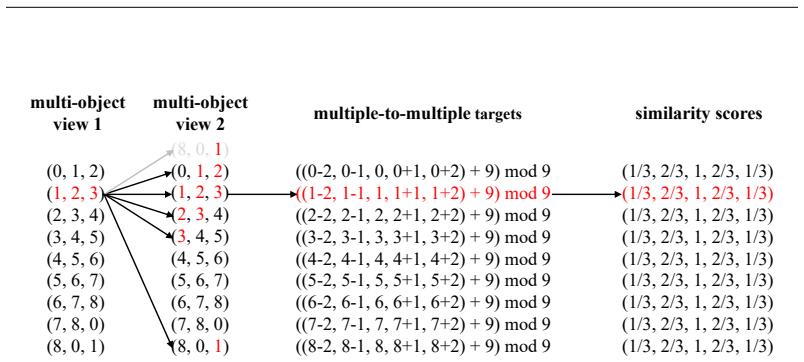
The carrier of the argument is the Multiple Object Stitching (MOS) operation: a deterministic rearrangement of small augmented views from a batch of single-object images into grid composites, together with the index bookkeeping that makes every object's source known. Each image $x_i$ is transformed into $r^2$ views, optionally at a smaller inner scale $s$, and the flattened view sequence is permuted by $q = (t + (t \bmod r^2)\cdot r^2) \bmod T$ with $T = N r^2$, which mixes views from different batch samples into a stitched image $I_i$ containing $r^2$ objects. The same rule generates the label maps $y_{\mathrm{m2s}}$ (which source image each tile came from) and $y_{\mathrm{m2m}}$ with overlap weights $\omega_{\mathrm{m2m}}$ (how many objects two stitched images share), so the contrastive targets are exact rather than inferred. Three losses run on this bookkeeping — multiple-to-single $\mathcal{L}_{\mathrm{m2s}}$, multiple-to-multiple $\mathcal{L}_{\mathrm{m2m}}$, and single-to-single $\mathcal{L}_{\mathrm{s2s}}$ applied to natural views to close the synthetic-to-natural gap. The second load-bearing piece is the premise that Vision Transformers, which read images as patch sequences, are insensitive enough to seam boundaries for stitched grids to stand in for natural multi-object scenes.
What would settle it
Run the identical three-loss pretraining on stitched images whose seams are made conspicuous, for example by drawing bright grid lines or leaving one- or two-pixel gaps between tiles. If ImageNet linear-probe accuracy and COCO transfer AP stay about the same, seam insensitivity is not what carries the result; if they drop sharply, it is. As a second check, permute the tile-to-source labels during pretraining so $y_{\mathrm{m2s}}$ no longer matches the tiles; if performance is unchanged, the exact object correspondence is not the active ingredient.
Extended reading notes
Core claim
The central claim is that synthetic multi-object images with predetermined object identities supply exact object-level correspondences for contrastive learning, eliminating the semantic inconsistency that image-level contrast suffers on natural multi-object images. The authors build each multi-object image by tiling small, scale-varied views drawn from a batch of single-object images; because the tile order follows a fixed cyclic index rule, the labels linking any stitched image to its source images are known exactly. Three contrastive objectives shape the representation: multiple-to-single (the stitched image against each source object view), multiple-to-multiple (two stitched images, weighted by how many objects they share), and single-to-single (natural views, kept to close the domain gap from stitching). On Vision Transformer backbones the paper reports 83.5% finetune, 77.9% linear, and 74.2% kNN accuracy on ImageNet-1K; 98.3%, 96.3%, and 95.1% on CIFAR10; 86.1%, 78.5%, and 73.5% on CIFAR100; and 45.6 box AP with 40.6 mask AP on COCO, taken to show that the model captures per-object detail without sacrificing single-object classification.
Load-bearing premise
The load-bearing premise is that Vision Transformers are insensitive enough to stitching seams that synthetic grid composites behave like natural multi-object photographs; if seam artifacts dominate the training signal, the learned representations would not transfer to real multi-object scenes.
Editorial extensions
If this is right
- The representation transfers to dense prediction: a MOS-pretrained ViT-S/16 under Mask R-CNN reaches 45.6 box AP and 40.6 mask AP on COCO, above prior contrastive methods aimed at single-object images and above earlier region- and patch-level multi-object methods.
- The multiple-to-single loss carries most of the benefit: ablations show that adding it to the single-to-single baseline raises CIFAR100 linear accuracy by 9.1 points and kNN accuracy by 7.8 points, with clear gains on ImageNet and COCO as well.
- The multiple-to-multiple loss alone fails to converge, and the full three-term objective beats every subset, so the single-to-single term anchors training against the synthetic-to-natural gap.
- Multi-scale stitching is what pays off on multi-object scenes: sampling tile counts and inner scales from $\{1,2\}$ adds 3.3 box AP on COCO over single-scale stitching, while extending the range to $\{1,2,3\}$ gives no further gain.
- Because object correspondences come free of annotation, the method needs no region proposals or saliency maps, removing the incorrect-proposal failure mode of earlier multi-object contrastive approaches.
Reading between the lines
- The exact-correspondence mechanism is testable against a simpler hypothesis: if the same three losses run with tiles assigned to random, incorrect source labels, the correspondence signal is destroyed, and if performance does not drop the paper's mechanism is not what drives the gains; the paper does not run this control.
- The same known-composition trick should transfer to any domain whose units can be deterministically assembled — the paper announces plans for audio and video — so the stitching objective could generalize beyond images without new machinery.
- The COCO evaluation uses only Mask R-CNN on a ViT-S/16 backbone, so whether the features are genuinely object-level in a backbone-agnostic sense remains open; a convolutional detector or a dense pixel head would give a sharper test of that claim.
Editorial analysis
A structured set of objections, weighed in public.
Referee Report
Summary. The manuscript proposes Multiple Object Stitching (MOS), an unsupervised representation-learning method that synthesizes multi-object images by stitching randomly cropped views from single-object-centric images. It introduces three contrastive objectives: multiple-to-single (Eq. 11), multiple-to-multiple (Eq. 12), and single-to-single (Eq. 13), trained with a MoCo-v3-style base/momentum encoder. Experiments report ViT-S/16 and ViT-B/16 results on ImageNet-1K, ViT-T/S/B on CIFAR-10/100, and transfer to COCO object detection and instance segmentation with Mask R-CNN, claiming state-of-the-art performance in both single-object and multi-object settings.
Significance. If the reported results are reproducible, MOS is an attractive and simple contribution: it requires no region proposals, no saliency maps, no additional annotations, and it provides known correspondences among synthetic multi-object views. The paper ships code, reports ablations isolating each loss component, and evaluates across three dataset families and two downstream task types; the proposed losses are easy to implement in existing MoCo/DINO-style frameworks. The main uncertainty is whether the empirical SOTA claim survives a complete baseline set (notably iBOT on COCO) and significance testing, and whether the ViT seam-insensitivity premise holds.
major comments (4)
- [Sec. 4.2.3, Table 3] Table 3 omits iBOT from the COCO object-detection and instance-segmentation comparison, even though Section 4.2.1 and Tables 1-2 treat iBOT as the strongest prior. The abstract's claim of 'significantly outperforming previous state-of-the-art methods on both single object centric images and multi-object ones' is therefore not supported for the multi-object half: MOS improves over the best included ViT-S/16 baseline (ADCLR) by only 1.3 APbb and 0.9 APmk, and it is unknown whether iBOT, under the same Mask R-CNN protocol, lies above or below those numbers. Please add iBOT to Table 3 or explicitly restrict the COCO claim to the baselines included.
- [Sec. 4.2.3, Tables 3-5] No repeated runs, error bars, or significance tests are reported. The COCO margins are small in absolute terms, and the ablations in Tables 4 and 5 show differences of comparable magnitude (e.g., adding Lm2m changes APbb from 44.3 to 45.6), so 'significantly outperforming' and 'the fusion ... significantly improves' are not statistically supported. Please report mean and standard deviation over at least three seeds for the main results and ablations, or soften the significance claims accordingly.
- [Sec. 1 and Sec. 5] The load-bearing premise that 'Vision Transformer architecture is less sensitive to artificiality produced by the boundary of image stitching' is asserted without a citation, a controlled experiment, or a quantitative check. If the model instead latches onto seam boundaries or grid layouts, the multiple-to-single and multiple-to-multiple losses could be minimized by layout artifacts rather than by object semantics, weakening the claimed mechanism behind the COCO gains. Please provide evidence, for example by comparing hard-boundary stitching with soft-blended boundaries, by probing attention at seam locations, or by benchmarking on natural multi-object crops.
- [Sec. 3.1, Eq. (11)] The method calls each stitched sub-view an 'object', but those sub-views are random crops of a single-object-centric image and may contain background, partial objects, or several object fragments. Thus the 'object correspondences' are really crop correspondences, and the loss in Eq. (11) treats every stitched crop as a positive object regardless of its content. Since the central motivation is object-level contrast, please quantify how often the stitched views actually correspond to foreground objects (e.g., with a detector or saliency oracle) or revise the terminology and motivation.
minor comments (4)
- [Sec. 4.2.1] The sentence 'our method outperforms state-of-the-art iBOT by 1.7% and 1.8% under linear and finetune protocol, respectively' names a finetune comparison for iBOT, but Table 1 lists no finetune accuracy for iBOT; the 1.8% difference matches the kNN column. Please correct the protocol name.
- [Sec. 4.3.1, Table 4] In addition to the missing error bars, the 'NA' entry for the configuration with only Lm2m (failure to converge) would benefit from a brief explanation in the appendix, since it is the only non-convergent configuration and the main text only gives a partial interpretation.
- [Appendix F/G] The t-SNE and self-attention visualizations are qualitative and depend on hand-picked examples; they should be framed as illustrations rather than as evidence supporting the main quantitative claims.
- [Sec. 3.1, Eqs. (1)-(10)] The notation around the stitching indices is dense and mixes r, s, and r^2; for example Eq. (7) is hard to parse without the appendix, and the relationship between the u(i,j) used near Eq. (5) and the 1-D indices in Eq. (7) should be spelled out in the main text.
Circularity Check
No significant circularity: the stitching-defined targets and held-out downstream evaluations make the derivation self-contained.
full rationale
The derivation chain is self-contained. The multi-object images and their labels are produced by a fixed stitching permutation (Eqs. 1-10): I_i = stitch({V_{u(i,j)j}}_j, r) with u(i,j) = (i+j) mod N, and the m2s/m2m targets are read off from this permutation, not from network predictions. The three losses (Eqs. 11-14) train the encoder to satisfy these stitched-image correspondences, and all reported claims are evaluated on held-out tasks (ImageNet and CIFAR classification, COCO detection and segmentation) with external labels. No circularity pattern applies: the paper does not define its input in terms of its output, does not fit a parameter to a subset and then call the same quantity a prediction, and does not invoke a self-authored uniqueness theorem. The only overlapping-author citations (PatchMix, MGC, APS) appear in Related Work as context, not as load-bearing justification; the stitching idea is not justified by these citations. The omission of iBOT from the COCO comparison in Table 3 is a benchmark-completeness and significance issue regarding the 'significantly outperforming' claim, not circular reasoning. The weaker premise that ViT is insensitive to stitching seams is an empirical assumption testable by the COCO transfer results, not a definitional equivalence.
Assumptions & free parameters
free parameters (3)
- temperature_tau =
0.2
- stitch_scale_factors_r_and_s =
{1,2} for both r and s
- loss_weights =
1.0 for each of L_m2s, L_m2m, L_s2s
assumptions (4)
- domain assumption Random crops from single-object-centric datasets serve as object-level views in stitched images.
- domain assumption Vision Transformers are sufficiently insensitive to stitching boundaries for stitched images to simulate natural multi-object scenes.
- domain assumption The momentum encoder and stop-gradient framework inherited from MoCo v3 prevents representation collapse.
- domain assumption The image-level semantics consistency assumption holds for the natural single-object views used in the single-to-single loss.
Cite this review
Pith. "Pith review of Multiple Object Stitching for Unsupervised Representation Learning." pith.science (2026). https://pith.science/paper/PEOFPZCD
@misc{pith2026250607364,
  author       = {Pith},
  title        = {Pith review of: Multiple Object Stitching for Unsupervised Representation Learning},
  year         = {2026},
  howpublished = {\url{https://pith.science/paper/PEOFPZCD}},
  note         = {Machine review of arXiv:2506.07364}
}
read the original abstract
Contrastive learning for single object centric images has achieved remarkable progress on unsupervised representation, but suffering inferior performance on the widespread images with multiple objects. In this paper, we propose a simple but effective method, Multiple Object Stitching (MOS), to refine the unsupervised representation for multi-object images. Specifically, we construct the multi-object images by stitching the single object centric ones, where the objects in the synthesized multi-object images are predetermined. Hence, compared to the existing contrastive methods, our method provides additional object correspondences between multi-object images without human annotations. In this manner, our method pays more attention to the representations of each object in multi-object image, thus providing more detailed representations for complicated downstream tasks, such as object detection and semantic segmentation. Experimental results on ImageNet, CIFAR and COCO datasets demonstrate that our proposed method achieves the leading unsupervised representation performance on both single object centric images and multi-object ones. The source code is available at https://github.com/visresearch/MultipleObjectStitching.
Figures


Figures from the paper (9 more)



Reference graph
Works this paper leans on
-
[1]
@esa (Ref
\@ifxundefined[1] #1\@undefined \@firstoftwo \@secondoftwo \@ifnum[1] #1 \@firstoftwo \@secondoftwo \@ifx[1] #1 \@firstoftwo \@secondoftwo [2] @ #1 \@temptokena #2 #1 @ \@temptokena \@ifclassloaded agu2001 natbib The agu2001 class already includes natbib coding, so you should not add it explicitly Type <Return> for now, but then later remove the command n...
-
[2]
\@lbibitem[] @bibitem@first@sw\@secondoftwo \@lbibitem[#1]#2 \@extra@b@citeb \@ifundefined br@#2\@extra@b@citeb \@namedef br@#2 \@nameuse br@#2\@extra@b@citeb \@ifundefined b@#2\@extra@b@citeb @num @parse #2 @tmp #1 NAT@b@open@#2 NAT@b@shut@#2 \@ifnum @merge>\@ne @bibitem@first@sw \@firstoftwo \@ifundefined NAT@b*@#2 \@firstoftwo @num @NAT@ctr \@secondoft...
-
[3]
@open @close @open @close and [1] URL: #1 \@ifundefined chapter * \@mkboth \@ifxundefined @sectionbib * \@mkboth * \@mkboth\@gobbletwo \@ifclassloaded amsart * \@ifclassloaded amsbook * \@ifxundefined @heading @heading NAT@ctr thebibliography [1] @ \@biblabel @NAT@ctr \@bibsetup #1 @NAT@ctr @ @openbib .11em \@plus.33em \@minus.07em 4000 4000 `\.\@m @bibit...
-
[4]
Unsupervised learning of visual features by contrasting cluster assignments
Mathilde Caron, Ishan Misra, Julien Mairal, Priya Goyal, Piotr Bojanowski, and Armand Joulin. Unsupervised learning of visual features by contrasting cluster assignments. Advances in Neural Information Processing Systems (NeurIPS), 33: 0 9912--9924, 2020
work page 2020
-
[5]
Emerging properties in self-supervised vision transformers
Mathilde Caron, Hugo Touvron, Ishan Misra, Herv \'e J \'e gou, Julien Mairal, Piotr Bojanowski, and Armand Joulin. Emerging properties in self-supervised vision transformers. In Proceedings of the IEEE International Conference on Computer Vision (ICCV), pp.\ 9650--9660, 2021
work page 2021
-
[6]
A simple framework for contrastive learning of visual representations
Ting Chen, Simon Kornblith, Mohammad Norouzi, and Geoffrey Hinton. A simple framework for contrastive learning of visual representations. In International Conference on Machine Learning (ICML), pp.\ 1597--1607. PMLR, 2020 a
work page 2020
-
[7]
Exploring simple siamese representation learning
Xinlei Chen and Kaiming He. Exploring simple siamese representation learning. In Proceedings of the IEEE Conference on Computer Vision and Pattern Recognition (CVPR), pp.\ 15750--15758, 2021
work page 2021
-
[8]
Improved baselines with momentum contrastive learning
Xinlei Chen, Haoqi Fan, Ross Girshick, and Kaiming He. Improved baselines with momentum contrastive learning. arXiv preprint arXiv:2003.04297, 2020 b
arXiv 2003
Show all 42 references
-
[9]
An empirical study of training self-supervised vision transformers
Xinlei Chen, Saining Xie, and Kaiming He. An empirical study of training self-supervised vision transformers. In Proceedings of the IEEE International Conference on Computer Vision (ICCV), pp.\ 9640--9649, 2021
2021
-
[10]
An image is worth 16x16 words: Transformers for image recognition at scale
Alexey Dosovitskiy, Lucas Beyer, Alexander Kolesnikov, Dirk Weissenborn, Xiaohua Zhai, Thomas Unterthiner, Mostafa Dehghani, Matthias Minderer, Georg Heigold, Sylvain Gelly, Jakob Uszkoreit, and Neil Houlsby. An image is worth 16x16 words: Transformers for image recognition at...
2021
-
[11]
Bootstrap your own latent-a new approach to self-supervised learning
Jean-Bastien Grill, Florian Strub, Florent Altch \'e , Corentin Tallec, Pierre Richemond, Elena Buchatskaya, Carl Doersch, Bernardo Avila Pires, Zhaohan Guo, Mohammad Gheshlaghi Azar, et al. Bootstrap your own latent-a new approach to self-supervised learning. In Advances in N...
2020
-
[12]
Mask r-cnn
Kaiming He, Georgia Gkioxari, Piotr Doll \'a r, and Ross Girshick. Mask r-cnn. In Proceedings of the IEEE Conference on Computer Vision and Pattern Recognition (CVPR), pp.\ 2961--2969, 2017
2017
-
[13]
Momentum contrast for unsupervised visual representation learning
Kaiming He, Haoqi Fan, Yuxin Wu, Saining Xie, and Ross Girshick. Momentum contrast for unsupervised visual representation learning. In Proceedings of the IEEE Conference on Computer Vision and Pattern Recognition (CVPR), pp.\ 9729--9738, 2020
2020
-
[14]
Sinha, Peter Morales, and Richard J
Ashraful Islam, Benjamin Lundell, Harpreet Sawhney, Sudipta N. Sinha, Peter Morales, and Richard J. Radke. Self-supervised learning with local contrastive loss for detection and semantic segmentation. In Proceedings of the IEEE Conference on Applications of Computer Vision (WA...
2023
-
[15]
Learning multiple layers of features from tiny images
Alex Krizhevsky, Geoffrey Hinton, et al. Learning multiple layers of features from tiny images. 2009
2009
-
[16]
Univip: A unified framework for self-supervised visual pre-training
Zhaowen Li, Yousong Zhu, Fan Yang, Wei Li, Chaoyang Zhao, Yingying Chen, Zhiyang Chen, Jiahao Xie, Liwei Wu, Rui Zhao, Ming Tang, and Jinqiao Wang. Univip: A unified framework for self-supervised visual pre-training. In Proceedings of the IEEE Conference on Computer Vision and...
2022
-
[17]
Microsoft coco: Common objects in context
Tsung-Yi Lin, Michael Maire, Serge Belongie, James Hays, Pietro Perona, Deva Ramanan, Piotr Doll \'a r, and C Lawrence Zitnick. Microsoft coco: Common objects in context. In European Conference on Computer Vision (ECCV), pp.\ 740--755. Springer, 2014
2014
-
[18]
Self-emd: Self-supervised object detection without imagenet
Songtao Liu, Zeming Li, and Jian Sun. Self-emd: Self-supervised object detection without imagenet. arXiv preprint arXiv:2011.13677, 2020
2011 arXiv
-
[19]
Object-aware cropping for self-supervised learning
Shlok Mishra, Anshul Shah, Ankan Bansal, Abhyuday Jagannatha, Abhishek Sharma, David Jacobs, and Dilip Krishnan. Object-aware cropping for self-supervised learning. Transactions on Machine Learning Research (TMLR), 2022
2022
-
[20]
Object-aware contrastive learning for debiased scene representation
Sangwoo Mo, Hyunwoo Kang, Kihyuk Sohn, Chun-Liang Li, and Jinwoo Shin. Object-aware contrastive learning for debiased scene representation. Advances in Neural Information Processing Systems (NeurIPS), 34: 0 12251--12264, 2021
2021
-
[21]
Pinheiro, Amjad Almahairi, Ryan Benmalek, Florian Golemo, and Aaron C Courville
Pedro O O. Pinheiro, Amjad Almahairi, Ryan Benmalek, Florian Golemo, and Aaron C Courville. Unsupervised learning of dense visual representations. In Advances in Neural Information Processing Systems (NeurIPS), volume 33, pp.\ 4489--4500, 2020
2020
-
[22]
Spatially consistent representation learning
Byungseok Roh, Wuhyun Shin, Ildoo Kim, and Sungwoong Kim. Spatially consistent representation learning. In Proceedings of the IEEE Conference on Computer Vision and Pattern Recognition (CVPR), pp.\ 1144--1153, June 2021
2021
-
[23]
Berg, and Li Fei-Fei
Olga Russakovsky, Jia Deng, Hao Su, Jonathan Krause, Sanjeev Satheesh, Sean Ma, Zhiheng Huang, Andrej Karpathy, Aditya Khosla, Michael Bernstein, Alexander C. Berg, and Li Fei-Fei. Imagenet large scale visual recognition challenge. International Journal of Computer Vision (IJC...
2015
-
[24]
Casting your model: Learning to localize improves self-supervised representations
Ramprasaath R Selvaraju, Karan Desai, Justin Johnson, and Nikhil Naik. Casting your model: Learning to localize improves self-supervised representations. In Proceedings of the IEEE Conference on Computer Vision and Pattern Recognition (CVPR), pp.\ 11058--11067, 2021
2021
-
[25]
Inter-instance similarity modeling for contrastive learning
Chengchao Shen, Dawei Liu, Hao Tang, Zhe Qu, and Jianxin Wang. Inter-instance similarity modeling for contrastive learning. arXiv preprint arXiv:2306.12243, 2023
2023 arXiv
-
[26]
Multi-grained contrast for data-efficient unsupervised representation learning
Chengchao Shen, Jianzhong Chen, and Jianxin Wang. Multi-grained contrast for data-efficient unsupervised representation learning. Pattern Recognition, pp.\ 111655, 2025 a
2025
-
[27]
Asymmetric patch sampling for contrastive learning
Chengchao Shen, Jianzhong Chen, Shu Wang, Hulin Kuang, Jin Liu, and Jianxin Wang. Asymmetric patch sampling for contrastive learning. Pattern Recognition, 158: 0 111012, 2025 b
2025
-
[28]
Selective search for object recognition
Jasper RR Uijlings, Koen EA Van De Sande, Theo Gevers, and Arnold WM Smeulders. Selective search for object recognition. International Journal of Computer Vision (IJCV), 104: 0 154--171, 2013
2013
-
[29]
Dense contrastive learning for self-supervised visual pre-training
Xinlong Wang, Rufeng Zhang, Chunhua Shen, Tao Kong, and Lei Li. Dense contrastive learning for self-supervised visual pre-training. In Proceedings of the IEEE Conference on Computer Vision and Pattern Recognition (CVPR), pp.\ 3024--3033, 2021
2021
-
[30]
Aligning pretraining for detection via object-level contrastive learning
Fangyun Wei, Yue Gao, Zhirong Wu, Han Hu, and Stephen Lin. Aligning pretraining for detection via object-level contrastive learning. In Advances in Neural Information Processing Systems (NeurIPS), volume 34, pp.\ 22682--22694, 2021
2021
-
[31]
Unsupervised feature learning via non-parametric instance discrimination
Zhirong Wu, Yuanjun Xiong, Stella X Yu, and Dahua Lin. Unsupervised feature learning via non-parametric instance discrimination. In Proceedings of the IEEE Conference on Computer Vision and Pattern Recognition (CVPR), pp.\ 3733--3742, 2018
2018
-
[32]
Region similarity representation learning
Tete Xiao, Colorado J Reed, Xiaolong Wang, Kurt Keutzer, and Trevor Darrell. Region similarity representation learning. In Proceedings of the IEEE Conference on Computer Vision and Pattern Recognition (CVPR), pp.\ 10539--10548, 2021
2021
-
[33]
Detco: Unsupervised contrastive learning for object detection
Enze Xie, Jian Ding, Wenhai Wang, Xiaohang Zhan, Hang Xu, Peize Sun, Zhenguo Li, and Ping Luo. Detco: Unsupervised contrastive learning for object detection. In Proceedings of the IEEE International Conference on Computer Vision (ICCV), pp.\ 8392--8401, October 2021 a
2021
-
[34]
Unsupervised object-level representation learning from scene images
Jiahao Xie, Xiaohang Zhan, Ziwei Liu, Yew Soon Ong, and Chen Change Loy. Unsupervised object-level representation learning from scene images. In Advances in Neural Information Processing Systems (NeurIPS), volume 34, pp.\ 28864--28876, 2021 b
2021
-
[35]
Propagate yourself: Exploring pixel-level consistency for unsupervised visual representation learning
Zhenda Xie, Yutong Lin, Zheng Zhang, Yue Cao, Stephen Lin, and Han Hu. Propagate yourself: Exploring pixel-level consistency for unsupervised visual representation learning. In Proceedings of the IEEE Conference on Computer Vision and Pattern Recognition (CVPR), pp.\ 16684--16...
2021
-
[36]
Instance localization for self-supervised detection pretraining
Ceyuan Yang, Zhirong Wu, Bolei Zhou, and Stephen Lin. Instance localization for self-supervised detection pretraining. In Proceedings of the IEEE Conference on Computer Vision and Pattern Recognition (CVPR), pp.\ 3987--3996, June 2021
2021
-
[37]
Unsupervised embedding learning via invariant and spreading instance feature
Mang Ye, Xu Zhang, Pong C Yuen, and Shih-Fu Chang. Unsupervised embedding learning via invariant and spreading instance feature. In Proceedings of the IEEE Conference on Computer Vision and Pattern Recognition (CVPR), pp.\ 6210--6219, 2019
2019
-
[38]
Patch-level representation learning for self-supervised vision transformers
Sukmin Yun, Hankook Lee, Jaehyung Kim, and Jinwoo Shin. Patch-level representation learning for self-supervised vision transformers. In Proceedings of the IEEE Conference on Computer Vision and Pattern Recognition (CVPR), pp.\ 8354--8363, 2022
2022
-
[39]
Barlow twins: Self-supervised learning via redundancy reduction
Jure Zbontar, Li Jing, Ishan Misra, Yann LeCun, and St \'e phane Deny. Barlow twins: Self-supervised learning via redundancy reduction. In International Conference on Machine Learning (ICML), pp.\ 12310--12320. PMLR, 2021
2021
-
[40]
Patch-level contrasting without patch correspondence for accurate and dense contrastive representation learning
Shaofeng Zhang, Feng Zhu, Rui Zhao, and Junchi Yan. Patch-level contrasting without patch correspondence for accurate and dense contrastive representation learning. In International Conference on Learning Representations (ICLR), 2023
2023
-
[41]
ibot: Image bert pre-training with online tokenizer
Jinghao Zhou, Chen Wei, Huiyu Wang, Wei Shen, Cihang Xie, Alan Yuille, and Tao Kong. ibot: Image bert pre-training with online tokenizer. In International Conference on Learning Representations (ICLR), 2022
2022
-
[42]
write newline
" write newline "" before.all 'output.state := FUNCTION n.dashify 't := "" t empty not t #1 #1 substring "-" = t #1 #2 substring "--" = not "--" * t #2 global.max substring 't := t #1 #1 substring "-" = "-" * t #2 global.max substring 't := while if t #1 #1 substring * t #2 gl...
Reviewed August 7, 2026 · model on record in the stance chip above.
Discussion (0). Sign in to comment.