REVIEW 4 major objections 6 minor 1 cited by
Tracing the Evolution of Nuclear Excitation at the Electron-Ion Collider
T0 review · 4 major / 6 minor · reviewed 2026-08-07 · deepseek-v4-flash
Pith's one-line read Event-by-event fluctuations in mean transverse momentum can separate intranuclear cascade from nuclear de-excitation in electron-nucleus collisions at the EIC.
desk verdict Plausible new use of kappa for EIC stage separation, but the cascade/de-excitation window mapping is unvalidated and the strong claims outrun the evidence. read the letter →
The pith
A machine-rendered reading of the paper's core claim, the machinery that carries it, and where it could break.
The reading
What carries the argument
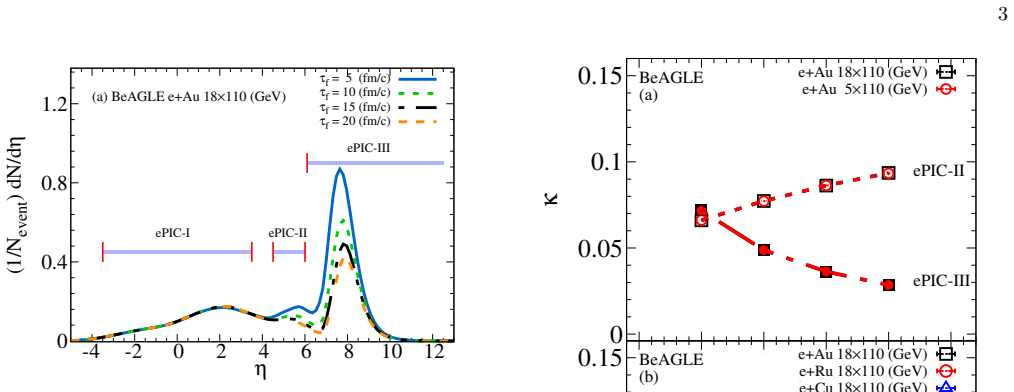
The load-bearing object is the observable $\kappa = C / M(p_T)^2$, where $C$ sums $(p_{Ti}-M(p_T))(p_{Tj}-M(p_T))$ over all particle pairs in each event. The stage separation is carried by the pseudorapidity acceptance of the EIC detector: the ePIC-I, ePIC-II, and ePIC-III regions are taken to be dominated by hard scattering, intranuclear cascade, and nuclear de-excitation, respectively. The formation time $\tau_f$ in the BeAGLE generator controls how much secondary hadrons re-interact inside the nucleus, and the opposing slopes of $\kappa$ versus $\tau_f$ and versus $A$ in the two forward windows supply the discriminating signal.
What would settle it
A measurement of $\kappa$ for gold, ruthenium, and copper targets at the EIC, in both the cascade-dominated and de-excitation-dominated forward regions, would settle the claim: the paper predicts opposite signs of $d\kappa/dA$ in the two regions, so observing the same sign in both would falsify the two-stage separation.
Extended reading notes
Core claim
The paper's own claim is that the hard scattering, intranuclear cascade, and nuclear de-excitation stages of an e+A collision become cleanly separated in pseudorapidity at EIC collider kinematics, and that the ratio $\kappa = C / M(p_T)^2$ (with $C$ the second-order momentum correlation and $M(p_T)$ the event mean transverse momentum) reads out that separation. In the cascade-dominated ePIC-II window, $\kappa$ increases with formation time; in the de-excitation-dominated ePIC-III window, $\kappa$ decreases with formation time. As a function of target mass number $A$, $\kappa$ decreases with $A$ in the cascade region and increases with $A$ in the de-excitation region. These opposing trends are proposed as the handle for disentangling the two stages, complementing the earlier finding that particle multiplicities alone cannot separate them.
Load-bearing premise
The key assumption is that the two forward detector regions each capture almost exclusively one of the two nuclear reaction stages, so that an observed change in the momentum-fluctuation signal in those regions can be attributed to a single mechanism.
Editorial extensions
If this is right
- EIC measurements of $\kappa$ in the forward and far-forward rapidity windows can constrain the intranuclear cascade formation time $\tau_f$, a parameter that is currently fixed inside event generators.
- The opposite $\kappa$ versus $A$ trends in the two windows give experiments a way to separate cascade-driven from de-excitation-driven particle production without relying on model labels.
- The near-independence of $\kappa$ from electron beam energy in the 5–18 GeV range allows results from different beam settings to be compared directly when mapping $\kappa$ versus $\tau_f$ or $A$.
- The predicted $A$-dependent benchmarks provide target values for tuning formation-time and nuclear-transport parameters in generators like BeAGLE.
Reading between the lines
- Inference: the same $\kappa$ observable could be applied to ultraperipheral photon–nucleus collisions, where a similar cascade-versus-de-excitation separation may appear in rapidity.
- Inference: if the stage-to-rapidity mapping survives real detector smearing, $\kappa$ could be promoted from a benchmark to a tuning observable, fitting generator formation-time parameters to EIC data rather than leaving them at defaults.
- Inference: a comparison of $\kappa$ in e+A collisions with an e+p reference would isolate the nuclear-medium contribution without depending on generator event labels.
Editorial analysis
A structured set of objections, weighed in public.
Referee Report
Summary. This manuscript uses the BeAGLE hybrid Monte Carlo generator to study event-by-event mean transverse momentum fluctuations, denoted kappa, in electron-nucleus collisions at EIC kinematics. The author computes kappa in two forward pseudorapidity regions, ePIC-II and ePIC-III, which are argued to be dominated by intranuclear cascade and nuclear de-excitation, respectively. The study covers e+Au at 18x110 and 5x110 GeV and e+Au, e+Ru, and e+Cu at 18x110 GeV, scanning the intranuclear cascade formation time tau_f from 5 to 20 fm/c with 50 million events per scenario. The central claims are that kappa increases with tau_f in ePIC-II and decreases with tau_f in ePIC-III, that kappa is nearly independent of electron beam energy, and that its system-size dependence contrasts between the two regions, making kappa a benchmark observable for disentangling cascade and de-excitation stages at the EIC.
Significance. If the claims hold, kappa would provide a practically accessible EIC observable sensitive to the intranuclear cascade formation time and to nuclear geometry, with a falsifiable prediction of opposite tau_f trends in forward rapidity windows. The paper's strengths are its use of a standard, publicly benchmarked generator (BeAGLE), the large statistics (50M events per scenario), the clear formulation of kappa via Eqs. (1)-(3), and the concrete mapping to ePIC detector acceptances. The main limitation is that the robustness and separation claims are currently supported by a single generator and by an unvalidated stage-to-rapidity mapping, so the quantitative conclusions are plausible but not yet fully established.
major comments (4)
- [Results, Figs. 4 and 5] No statistical uncertainties are reported for any kappa value, although 50 million events are generated per scenario. The electron-energy-independence claim in Fig. 4(a) is based on visual agreement between two curves (18x110 and 5x110 GeV) with no error bars, no confidence intervals, and no significance test; the same is true for the A-dependence trends in Fig. 5. Please provide statistical uncertainties, including any event-wise correlations, and state explicitly whether the observed differences in kappa across tau_f and A are significant relative to those uncertainties.
- [Figs. 2(b), 3 and 4] The central disentanglement claim assumes that the ePIC-II and ePIC-III pseudorapidity windows isolate the intranuclear cascade and de-excitation stages. This mapping is taken from BeAGLE's internal process decomposition shown in Fig. 2(b) and is not independently validated. Because kappa in Eq. (1) is an inclusive multiparticle correlator over all particles in each window, a tau_f-dependent migration of particles between the windows, or a change in the excitation energy passed from DPMJET to FLUKA, could produce the opposing trends in Fig. 4 without implying intrinsically opposite stage responses. Please report process-tagged kappa for cascade and de-excitation particles separately and test the stability of the ePIC-II/ePIC-III conclusions against plausible shifts of the window boundaries.
- [Abstract, Summary, and simulation-setup paragraph] The conclusion that kappa is a 'robust observable' and that the results provide 'critical benchmarks' is based entirely on one event generator, BeAGLE version 1.03, with a single formation-time parameter varied. No comparison is made with any alternative intranuclear-cascade or de-excitation model, and no sensitivity to other generator parameters (shadowing, Fermi motion, quenching) is reported. A single-generator study yields a prediction, not robustness; please add a second model or an analytic reference calculation, or soften the robustness claim accordingly.
- [Fig. 4(a)] The beam-energy dependence is tested at only two electron energies, 5 and 18 GeV, for a fixed 110 GeV hadron beam. Two points cannot establish a trend or a 'minimal sensitivity' region. An intermediate energy (e.g., 10 GeV) and, ideally, a different hadron-beam energy would be needed to support the claim that kappa is energy-independent over the EIC range.
minor comments (6)
- [Eqs. (1)-(3) and text near them] The particle sample entering Eqs. (1)-(3) is described only as 'a selected class of particles'; please specify whether charged hadrons, all hadrons, or specific species are used, and state the pT and eta cuts applied to define the ePIC-II and ePIC-III samples. Without this, the numerical values of kappa are not reproducible.
- [Eq. (2)] In Eq. (2), the quantities N_pairs^k and N_k are not defined before use, and the treatment of events with fewer than two particles in the selected class is not stated; please clarify the summation and the empty-event convention.
- [Abstract and body] The abstract uses the symbol 'k' for the mean transverse momentum fluctuation while the body uses kappa; please unify the notation.
- [Fig. 2 caption and text] There are minor typographical issues, including 'e+Aucollisions' in the caption of Fig. 2 and inconsistent spacing in expressions such as 'M(p T)' and 'eP IC'; a careful proofread would help.
- [Fig. 2 and Fig. 3] The eta axis extends to 12; please specify whether particles from the nuclear remnant are included in dN/deta and in kappa, since this affects the ePIC-III interpretation.
- [Ref. [16] and surrounding text] Reference [16] is a prior BeAGLE study by the author and collaborators; the sentence citing it for the separation of reaction stages in collider kinematics should also cite a detector-acceptance study if available, to avoid relying solely on a self-citation.
Circularity Check
No significant circularity: kappa is computed from final-state particles with tau_f scanned as an input, so the reported trends do not reduce to the inputs.
full rationale
The paper's central observable kappa is defined in Eqs. (1)-(3) directly from final-state particle transverse momenta. The formation time tau_f is a free parameter of the BeAGLE/DPMJET generator that is scanned over 5, 10, 15, and 20 fm/c, not fitted to kappa or to the ePIC-II/ePIC-III results. System-size and beam-energy dependences are likewise produced by running the generator for different targets and beam energies, not by adjusting kappa to match a target trend. No equation in the paper reduces a claimed prediction to an input by construction: kappa is not defined in terms of tau_f, and tau_f is not extracted from kappa. The only same-author citation is [16] (Magdy et al.), used as background for EIC kinematic separation; the actual stage decomposition is plotted in the current paper's Fig. 2(b) using BeAGLE's process labels, so the citation is not load-bearing. The ePIC-II/ePIC-III attribution to intranuclear cascade and nuclear de-excitation is an interpretive assumption inherited from generator bookkeeping and could be challenged as a physics-validity concern, but it is not circular: the quoted kappa values are computed without using those labels. No fitted-input-as-prediction, uniqueness-theorem, or ansatz-via-citation pattern is present. The analysis is self-contained against an external generator, so the appropriate circularity score is 0.
Assumptions & free parameters
free parameters (1)
- intranuclear cascade formation time tau_f =
scanned: 5, 10, 15, 20 fm/c
assumptions (4)
- domain assumption BeAGLE v1.03 reliably models e+A collisions
- domain assumption The three reaction stages are separable by pseudorapidity into ePIC-I/II/III regions
- domain assumption ePIC-II and ePIC-III acceptances correspond to the regions used in the analysis
- domain assumption tau_f variation in DPMJET produces physically meaningful cascade changes
Cite this review
Pith. "Pith review of Tracing the Evolution of Nuclear Excitation at the Electron-Ion Collider." pith.science (2026). https://pith.science/paper/YOZWEFFX
@misc{pith2026250607426,
  author       = {Pith},
  title        = {Pith review of: Tracing the Evolution of Nuclear Excitation at the Electron-Ion Collider},
  year         = {2026},
  howpublished = {\url{https://pith.science/paper/YOZWEFFX}},
  note         = {Machine review of arXiv:2506.07426}
}
read the original abstract
We investigate the evolution of nuclear excitation in electron-nucleus (e+A) collisions at the upcoming Electron-Ion Collider (EIC) using the BeAGLE event generator. Leveraging the EIC's unique collider kinematics, we demonstrate the remarkable capability to separate distinct nuclear reaction stages, hard scattering, intranuclear cascade, and nuclear de-excitation, in the laboratory frame. Our systematic analysis reveals that event-by-event fluctuations in the mean transverse momentum (k) are highly sensitive to the intranuclear cascade formation time and nuclear geometry, while minimally affected by variations in electron beam energy. These findings establish k as a robust observable for constraining nuclear excitation mechanisms, providing critical benchmarks for future EIC experiments and guiding theoretical advancements in nuclear transport modeling.
Figures


Figures from the paper (2 more)


Forward citations
Cited by 1 Pith paper
-
Producing and Studying Rare Isotopes in $e+A$ Collisions at the Electron-Ion Collider
Simulations indicate the EIC can produce diverse rare isotopes and measure their de-excitation gamma rays, enabling a collider-based nuclear spectroscopy program.
Reference graph
Works this paper leans on
-
[1]
Bertulani and Pawel Danielewicz,Introduction to Nuclear Reactions(IOP Publishing, 2004)
Carlos A. Bertulani and Pawel Danielewicz,Introduction to Nuclear Reactions(IOP Publishing, 2004)
work page 2004
-
[2]
A guide to micro- scopic models for intermediate energy heavy ion colli- sions,
G. F. Bertsch and S. Das Gupta, “A guide to micro- scopic models for intermediate energy heavy ion colli- sions,” Phys. Rept.160, 189–233 (1988)
work page 1988
-
[3]
Transport-theoretical De- scription of Nuclear Reactions,
O. Buss, T. Gaitanos, K. Gallmeister, H. van Hees, M. Kaskulov, O. Lalakulich, A. B. Larionov, T. Leit- ner, J. Weil, and U. Mosel, “Transport-theoretical De- scription of Nuclear Reactions,” Phys. Rept.512, 1–124 (2012), arXiv:1106.1344 [hep-ph]
arXiv 2012
-
[4]
Pawel Jucha, Mariola Klusek-Gawenda, Antoni Szczurek, Michal Ciemala, and Katarzyna Mazurek, “Neutron emission from the photon-induced reactions in ultrape- ripheral ultrarelativistic heavy-ion collisions,” Phys. Rev. C111, 034901 (2025), arXiv:2411.17865 [nucl-th]
work page Pith review arXiv 2025
-
[5]
Slow neutron pro- duction as a probe of hadron formation in high-energy γ∗Areactions,
A. B. Larionov and M. Strikman, “Slow neutron pro- duction as a probe of hadron formation in high-energy γ∗Areactions,” Phys. Rev. C101, 014617 (2020), arXiv:1812.08231 [hep-ph]
arXiv 2020
-
[6]
Review on the progress in nuclear fission
Karl-Heinz Schmidt and Beatriz Jurado, “Review on the progress in nuclear fission—experimental methods and theoretical descriptions,” Rept. Prog. Phys.81, 106301 (2018), arXiv:1804.10421 [nucl-th]
work page Pith review arXiv 2018
-
[7]
Microscopic Theory of Nuclear Fission: A Review
N. Schunck and L. M. Robledo, “Microscopic Theory of Nuclear Fission: A Review,” Rept. Prog. Phys.79, 116301 (2016), arXiv:1511.07517 [nucl-th]
work page Pith review arXiv 2016
-
[8]
Nuclear de-excitation: Statistical models and experimental signatures,
R. J. Charity, “Nuclear de-excitation: Statistical models and experimental signatures,” Phys. Rev. C82, 014610 (2010)
work page 2010
Show all 42 references
-
[9]
Statistical multifragmentation of nuclei,
J. P. Bondorf, A. S. Botvina, A. S. Iljinov, I. N. Mishus- tin, and K. Sneppen, “Statistical multifragmentation of nuclei,” Phys. Rept.257, 133–221 (1995)
1995
-
[10]
In- tranuclear cascade model for a comprehensive description of spallation reaction data,
A. Boudard, J. Cugnon, S. Leray, and C. Volant, “In- tranuclear cascade model for a comprehensive description of spallation reaction data,” Phys. Rev. C66, 044615 (2002). 5
2002
-
[11]
Phenomenology of nuclear shadowing in deep inelastic scattering,
G. Piller, W. Ratzka, and W. Weise, “Phenomenology of nuclear shadowing in deep inelastic scattering,” Z. Phys. A352, 427–439 (1995), arXiv:hep-ph/9504407
1995 arXiv
-
[12]
Nuclear effects in structure functions,
M. Arneodo, “Nuclear effects in structure functions,” Phys. Rept.240, 301–393 (1994)
1994
-
[13]
INTRANUCLEAR CASCADE MODEL. A REVIEW,
J. Cugnon, “INTRANUCLEAR CASCADE MODEL. A REVIEW,” Nucl. Phys. A387, 191C–203C (1982)
1982
-
[14]
Statistics and Nuclear Reactionsl,
V. Weisskopf, “Statistics and Nuclear Reactionsl,” Phys. Rev.52, 295–303 (1937)
1937
-
[15]
Inclusion of deuteron and alpha-particle collisions in intranuclear cascade calculations,
Grant J. Mathews, B. G. Glagola, R. A. Moyle, and V. E. Viola, “Inclusion of deuteron and alpha-particle collisions in intranuclear cascade calculations,” Phys. Rev. C25, 2181–2195 (1982)
1982
-
[16]
A study of nuclear structure of light nuclei at the electron–ion collider,
Niseem Magdy, Mariam Hegazy, Aliaa Rafaat, Wenliang Li, Abhay Deshpande, A. M. H. Abdelhady, A. Y. Ellithi, Roy A. Lacey, and Zhoudunming Tu, “A study of nuclear structure of light nuclei at the electron–ion collider,” Eur. Phys. J. A60, 212 (2024), arXiv:2405.07844 [nucl-th]
2024 arXiv
-
[17]
Intranuclear cascade model for a comprehensive description of spallation reactions,
A. Boudard et al., “Intranuclear cascade model for a comprehensive description of spallation reactions,” Phys. Rev. C66, 044615 (2002)
2002
-
[18]
Final-state interactions in inclusive pion photoproduction from nu- clei,
J. Lehr, M. Effenberger, and U. Mosel, “Final-state interactions in inclusive pion photoproduction from nu- clei,” Nucl. Phys. A671, 503 (2000)
2000
-
[19]
Sys- tematics of nuclear fragmentation in relativistic heavy ion collisions,
A. Sch¨ uttauf and others (ALADIN Collaboration), “Sys- tematics of nuclear fragmentation in relativistic heavy ion collisions,” Nucl. Phys. A701, 495–502 (2002)
2002
-
[20]
The hades spectrometer at gsi,
G. Agakishiev and others (HADES Collaboration), “The hades spectrometer at gsi,” Eur. Phys. J. A41, 243–277 (2009)
2009
-
[21]
First measurement of proton-induced fission cross section of 181ta at relativistic energies,
G. Cerizzaet al., “First measurement of proton-induced fission cross section of 181ta at relativistic energies,” Phys. Rev. C93, 034606 (2016)
2016
-
[23]
The epic collaboration,
“The epic collaboration,”https://www.epic-eic.org/
-
[24]
Microscopic models for ultrarelativistic heavy ion collisions,
S. A. Basset al., “Microscopic models for ultrarelativistic heavy ion collisions,” Prog. Part. Nucl. Phys.41, 255–369 (1998)
1998
-
[25]
Science requirements and de- tector concepts for the electron-ion collider: Eic yellow report,
R. Abdul Khalek et al., “Science requirements and de- tector concepts for the electron-ion collider: Eic yellow report,” arXiv:2103.05419 (2021)
2021 arXiv
-
[26]
Electron ion collider: The next qcd frontier,
A. Accardiet al., “Electron ion collider: The next qcd frontier,” Eur. Phys. J. A52, 268 (2016)
2016
-
[27]
Beagle: Benchmark ea generator for leptoproduction,
B. Changet al., “Beagle: Benchmark ea generator for leptoproduction,” Phys. Rev. C106, 044901 (2022)
2022
-
[28]
Multiplicity and pseudorapidity distributions of charged particles and photons at forward pseudorapidity in au+au collisions at√sN N= 62.4 gev,
J. Adams and et al. (STAR Collaboration), “Multiplicity and pseudorapidity distributions of charged particles and photons at forward pseudorapidity in au+au collisions at√sN N= 62.4 gev,” Phys. Rev. C73, 064907 (2006)
2006
-
[29]
Event- by-event meanp t fluctuations in pp and pb–pb collisions at the lhc,
S. Acharya and others (ALICE Collaboration), “Event- by-event meanp t fluctuations in pp and pb–pb collisions at the lhc,” Eur. Phys. J. C79, 857 (2019)
2019
-
[30]
En- ergy dependence of transverse momentum fluctuations in Au+Au collisions from a multiphase transport model,
Liuyao Zhang, Jinhui Chen, and Chunjian Zhang, “En- ergy dependence of transverse momentum fluctuations in Au+Au collisions from a multiphase transport model,” Phys. Rev. C111, 024911 (2025), arXiv:2501.08209 [nucl-th]
2025 arXiv
-
[31]
Benchmark eA generator for leptoproduction in high-energy lepton- nucleus collisions,
Wan Chang, Elke-Caroline Aschenauer, Mark D. Baker, Alexander Jentsch, Jeong-Hun Lee, Zhoudunming Tu, Zhongbao Yin, and Liang Zheng, “Benchmark eA generator for leptoproduction in high-energy lepton- nucleus collisions,” Phys. Rev. D106, 012007 (2022), arXiv:2204.11998 [physic...
2022 arXiv
-
[32]
The Monte Carlo event generator DPMJET-III,
Stefan Roesler, Ralph Engel, and Johannes Ranft, “The Monte Carlo event generator DPMJET-III,” inInter- national Conference on Advanced Monte Carlo for Ra- diation Physics, Particle Transport Simulation and Ap- plications (MC 2000)(2000) pp. 1033–1038, arXiv:hep- ph/0012252
2000
-
[33]
PYTHIA 6.4 Physics and Manual,
Torbjorn Sjostrand, Stephen Mrenna, and Peter Z. Skands, “PYTHIA 6.4 Physics and Manual,” JHEP05, 026 (2006), arXiv:hep-ph/0603175
2006 arXiv
-
[34]
thesis, Lyon, IPN (2011)
Rapha¨ el Dupr´ e,Quark Fragmentation and Hadron For- mation in Nuclear Matter, Ph.D. thesis, Lyon, IPN (2011)
2011
-
[35]
The FLUKA Code: Developments and Challenges for High Energy and Med- ical Applications,
T. T. B¨ ohlen, F. Cerutti, M. P. W. Chin, A. Fass` o, A. Ferrari, P. G. Ortega, A. Mairani, P. R. Sala, G. Smirnov, and V. Vlachoudis, “The FLUKA Code: Developments and Challenges for High Energy and Med- ical Applications,” Nucl. Data Sheets120, 211–214 (2014)
2014
-
[36]
FLUKA: A multi-particle transport code (Program version 2005),
Alfredo Ferrari, Paola R. Sala, Alberto Fasso, and Jo- hannes Ranft, “FLUKA: A multi-particle transport code (Program version 2005),” (2005), 10.2172/877507
2005 doi
-
[37]
Overview of the FLUKA code,
Giuseppe Battistoniet al., “Overview of the FLUKA code,” Annals Nucl. Energy82, 10–18 (2015)
2015
-
[38]
The Les Houches accord PDFs (LHAPDF) and LHAGLUE,
M. R. Whalley, D. Bourilkov, and R. C. Group, “The Les Houches accord PDFs (LHAPDF) and LHAGLUE,” inHERA and the LHC: A Workshop on the Implications of HERA and LHC Physics (Startup Meeting, CERN, 26- 27 March 2004; Midterm Meeting, CERN, 11-13 October 2004)(2005) pp. 575–581,...
2005 arXiv
-
[39]
Calculating quench- ing weights,
C. Salgado and U. A. Wiedemann, “Calculating quench- ing weights,” Phys. Rev. D68, 014008 (2003), arXiv:hep- ph/0302184
2003
-
[40]
Event by event fluctua- tions of the mean transverse momentum in 40, 80 and 158 A GeV / c Pb - Au collisions,
D. Adamovaet al.(CERES), “Event by event fluctua- tions of the mean transverse momentum in 40, 80 and 158 A GeV / c Pb - Au collisions,” Nucl. Phys. A727, 97–119 (2003), arXiv:nucl-ex/0305002
2003 arXiv
-
[41]
Traces of thermalization from transverse momentum fluctuations in nuclear collisions,
Sean Gavin, “Traces of thermalization from transverse momentum fluctuations in nuclear collisions,” Phys. Rev. Lett.92, 162301 (2004), arXiv:nucl-th/0308067
2004 arXiv
-
[42]
Higher-order transverse momentum fluctuations in heavy-ion collisions,
Somadutta Bhatta, Chunjian Zhang, and Jiangyong Jia, “Higher-order transverse momentum fluctuations in heavy-ion collisions,” Phys. Rev. C105, 024904 (2022), arXiv:2112.03397 [nucl-th]
2022 arXiv
-
[43]
De- termination of electron-nucleus collision geometry with forward neutrons,
L. Zheng, E. C. Aschenauer, and J. H. Lee, “De- termination of electron-nucleus collision geometry with forward neutrons,” Eur. Phys. J. A50, 189 (2014), arXiv:1407.8055 [hep-ex]
2014 arXiv
Reviewed August 7, 2026 · model on record in the stance chip above.
Discussion (0). Sign in to comment.