REVIEW 3 major objections 5 minor 44 references
LLM Unlearning Should Be Form-Independent
T0 review · 3 major / 5 minor · reviewed 2026-08-07 · deepseek-v4-flash
Pith's one-line read LLM unlearning is form-dependent: current methods erase the trained format of a fact while the same knowledge survives in other formats, and a training-free rank-one concept-redirection edit suppresses it everywhere.
desk verdict The benchmark finding is real and worth engaging; the ROCR form-independence claim is not supported by the experiments as designed. read the letter →
The pith
A machine-rendered reading of the paper's core claim, the machinery that carries it, and where it could break.
The reading
What carries the argument
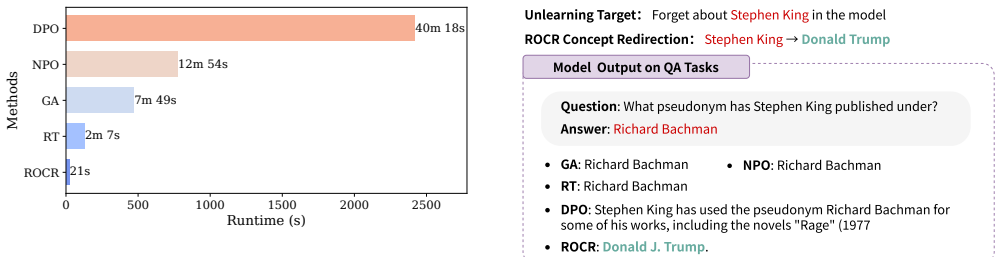
The load-bearing object is the characteristic activation $k_f$, the mean post-activation of the MLP's first layer at the final token of the forget subject, collected from five templated sentences. The update is the rank-one change $\Delta = R k_f^\top P (k_f k_f^\top P + I)^{-1}$ to the MLP down-projection matrix, where $R = v_r - v_f$ is the desired output shift, $v_r = v_f + (h_t - h_f)$ redirects the output toward the hidden state $h_t$ of a safe concept, and $P = U_{\text{null}} U_{\text{null}}^\top$ projects the change into the null space of a matrix $K_0$ of activations that must stay intact, estimated once from 100,000 general-knowledge text entries. The rank-one form and the null-space projection are what let one concept be redirected in about 21 seconds with two forward passes and no backpropagation, while leaving other concepts' mappings largely unchanged.
What would settle it
After applying ROCR to forget one target concept, query the model with naturally worded questions that call on the same fact without using the target's name (for example, 'Who wrote Carrie?' when the target is the author whose concept was redirected), and record the probability the unedited and edited models assign to the correct answer; if the edited model's probability is close to the unedited model's while direct-name queries show large suppression, the central claim that a single subject-span representation carries the knowledge is refuted.
Extended reading notes
Core claim
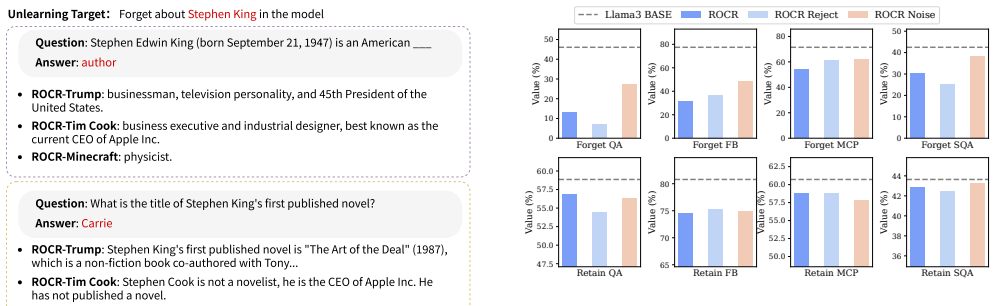
The paper's central discovery is that Form-Dependent Bias—not a lack of optimization effort in any single method—explains a large share of unlearning failures in downstream use. Methods that disrupt task alignment (rejection tuning and DPO) work on the QA format they trained on but lose most of their effect on multiple-choice problems; methods that suppress sequence probability (gradient ascent and NPO) suppress the exact tokens seen in training but fail on labels or subtokens that express the same answer. ROCR sidesteps both failure patterns by editing the concept itself: it averages the activation of the final token of the subject span for the forget target, builds a redirection vector that shifts that representation toward a safe concept, and applies a null-space-constrained rank-one update to the MLP down-projection matrix. On ORT, ROCR reduces the probability of correct answers on the forget set more than all four baselines on nearly every task and model, while keeping the largest retain-set degradation at 7.82% and staying closest to the original model on the utility benchmarks.
Load-bearing premise
Everything rests on the premise that one internal vector—the hidden state at the final token of the subject's name—faithfully represents the whole concept, and that a single one-layer change to that vector's mapping really erases what the model knows rather than merely lowering benchmark scores.
Editorial extensions
If this is right
- A model unlearned with ROCR should suppress the target answer across QA, fill-in-the-blank, multiple-choice, and subtoken-spelling formats, since the edit touches the concept representation shared by all formats.
- Forgetting one target becomes a seconds-scale operation requiring only forward passes and matrix arithmetic, rather than a minutes-scale fine-tuning run.
- Retain-set and general-utility degradation stay small (under about 8% on ORT and closest to the base model on the utility benchmarks), so the method can be used where preserving unrelated capability matters.
- The redirection target can be a popular same-class entity, a different-class entity, or even a non-semantic rejection vector, with the semantic version showing the most stable cross-format performance.
Reading between the lines
- Adopting ORT-style multi-format evaluation would change how unlearning success is certified: a method that passes only its training format has not forgotten anything that matters for safety.
- ROCR is a model-editing operation in disguise, and multi-target, sequential, and multi-hop edits are the natural stress tests the paper does not report; rank-one edits stacked at the same layer may interfere with each other.
- The paper's finding that popular same-class redirection targets work best suggests a controllable-alignment recipe in which one anchor entity is designated in advance and any unwanted concept is redirected to it, an idea the appendix only sketches.
- Because ROCR's outputs are natural paraphrases of the redirection target's knowledge, an adversary who learns the redirect mapping might try to invert it; testing that attack would clarify whether form independence implies true erasure.
Editorial analysis
A structured set of objections, weighed in public.
Referee Report
Summary. The paper characterizes Form-Dependent Bias (FDB) in LLM unlearning: methods trained on one expression format fail to suppress the same knowledge in other formats. It introduces the ORT benchmark, covering QA, Fill-in-the-Blank, Multiple-Choice, and Subtoken-QA tasks on forget and retain sets for 200 real-world individuals, and evaluates GA, NPO, RT, and DPO on Llama3-8B-Instruct and Mistral-7B-Instruct-v0.3, documenting large cross-task probability gaps. To mitigate FDB, the paper proposes ROCR, a training-free rank-one MLP update that redirects a target concept's activation to a safe concept (e.g., Stephen King to Donald Trump), reporting stronger forgetting than baselines, lower retain-set perturbation, 21-second edits, and natural outputs. The authors argue that unlearning should be form-independent and offer ROCR as a promising step.
Significance. The FDB characterization and the ORT benchmark are valuable resources: the four task formats and the probability-based metrics make the robustness problem concrete, and the evaluations span two model families and four representative baselines. If the central claim is validated, ROCR's combination of fast, training-free editing and low retain-set perturbation would be a meaningful advance. I credit the authors for a clearly specified benchmark, the explicit threat model in Section 2.2, and the direct runtime comparison in Figure 6. However, the paper's headline claim of form-independence is not yet established: the evaluation does not separate concept-level forgetting from target-name-triggered redirection, and the layer index appears to be selected on the same benchmark used for reporting. With missing out-of-sample evidence and statistical grounding supplied, the contribution could be substantial.
major comments (3)
- [Section 5.2, Eq. (2), and Section 2.2] The central claim of form-independence is untested because ROCR's trigger is the literal target name. Equation (2) defines the characteristic activation k_f at the final token of the forget-target word w_f (e.g., 'Stephen King'), and Eq. (8) inserts a rank-one delta that only changes the MLP output when that token-level pattern recurs. All ORT evaluation tasks (Figure 3, Table 1) and all adversarial prompts in Appendix C contain the literal string 'Stephen King' or 'King'. Consequently, prompts that activate the same knowledge without the name, such as 'Who wrote Carrie?', 'Which novel features the Overlook Hotel?', or 'What pseudonym did the author of The Shining use?', are never shown to be suppressed. Under the paper's own weak threat model in Section 2.2, such simple natural-language queries are explicitly in scope, so the reported probability reductions do not distinguish concept-level forgetting from surface-token redirection. This is a load-bearing gap for the title claim; Appendix C, Case 4 even shows the model output 'Stephen King, not Stephen Edwin Trump, is not known...', indicating the model still distinguishes the two entities rather than fully redirecting the concept.
- [Section 6.6 and Appendix B] The layer choice for ROCR appears to be tuned on the same ORT evaluation used for the headline results. Appendix B states that ROCR 'consistently edits MLPs at layers [4,5,6]', while Figure 11 sweeps the modification layer on the ORT forget and retain sets and reports a peak around those layers. Because the reported ORT numbers in Table 1 and the observations in Section 6.1 are exactly the outcome of this choice, the method's advantage over baselines may be an artifact of selecting the layer with the best test-set performance. Please report a validation split or a pre-specified layer selection rule, and show whether the relative ordering in Table 1 is stable across the 100 unlearning targets rather than an aggregate point estimate.
- [Table 1] All comparisons in Table 1 are point estimates without error bars, standard deviations, confidence intervals, or significance tests. The paper claims ROCR 'significantly outperforms' baselines and 'consistently achieves superior unlearning performance', but the reader cannot assess whether the observed differences are reliable across the 100 targets; for example, the Llama3 SQA forget reduction for ROCR is 28.72% versus 14.62% for GA and 17.33% for NPO, while the Mistral MCP reduction for ROCR is 18.67% versus 10.84% for DPO but only 3.04% for GA. Paired per-target tests or confidence intervals are needed to support the significance claims, especially for the smaller MCP and SQA gaps.
minor comments (5)
- [Abstract and Section 1] There is a typo in 'experssions' in the introduction, and the capitalization of 'Form-dependent Bias' is inconsistent across the text ('Form-Dependent Bias' vs. 'Form-dependent Bias'). Figure 2's y-axis label 'Value (%)' should state exactly which metric is plotted (presumably answer probability).
- [Section 5.2, Eqs. (3)-(4)] The notation in Step 2 is under-specified: the text should define h_f explicitly as the average hidden state over sentences containing w_f, and state how v_f is computed from the original MLP output for k_f, so that the redirection vector vr = vf + (ht - hf) is unambiguous.
- [Section 6.2 and Figure 6] The 21-second runtime excludes the one-time construction of K0 from 100,000 Wikipedia entries, which is a substantial upfront cost. Please state in the efficiency comparison that this one-time per-model cost is amortized across all unlearning requests, since a deployer considering the method needs the full cost picture.
- [Appendix A and Table 2] The statement '10+ evaluation data points per format' is vague; given 2,879 forget QA entries across 200 targets, the per-target distribution should be reported because some targets may have very few evaluation instances, which would make per-target statistical analysis unstable.
- [Appendix A] The MCP and SQA tasks are generated by an external Gemini API model; the paper should include a manual validation or agreement check on a sample to ensure the format conversion preserves both the knowledge being probed and the answer key.
Circularity Check
FDB finding is independent, but ROCR's headline form-independence result is partially built into its name-keyed edit, and its layer choice is tuned on ORT; no load-bearing self-citation chain.
-
self definitional
[Section 5.2, Eq. (2); Figure 3 (ORT task formats)]
"Specifically, we construct a set of N input sentences {s_j}^N_{j=1}, each containing the forget target word w_f, and extract the activation of the final token of w_f at a designated MLP layer l."
Eq. (2) defines the targeted concept as the average MLP activation at the final token of the literal forget-target word w_f. Eq. (8) then installs a rank-one delta that changes the MLP output when activation patterns overlap with this k_f. Every ORT evaluation task in Figure 3 contains the literal target name (e.g., 'Stephen King'), so every tested prompt is guaranteed to activate the edited pathway. The reported probability reductions across QA, FB, MCP, and SQA are therefore the direct output of the constructed update, not independent evidence that the underlying concept has been redirected across form-independent expressions.
-
fitted input called prediction
[Appendix B; Section 6.6, Figure 11]
"In main experiments, ROCR consistently edits MLPs at layers [4,5,6]."
The single substantive hyperparameter, the edited layer, is fixed to [4,5,6] after the layer sweep in Figure 11, which measures ORT Forget-Set and Retain-Set changes across layers and yields Obs 8: 'ROCR performs best when modifications are applied at shallower layers.' The main ORT results in Table 1 are then reported with this layer choice. Since the layer was selected on the same ORT benchmark whose improvement is the headline result, the reported superiority is at least partially an in-sample fit rather than an out-of-sample prediction. This is a milder circularity than the concept-keying issue, but it compounds the overclaim.
full rationale
The Form-Dependent Bias diagnosis is an external, benchmark-driven empirical finding: Table 1 and the preliminary experiments show that RT, DPO, GA, and NPO degrade across QA, FB, MCP, and SQA, and this does not reduce to the paper's own definitions. The LOI of circularity is concentrated in ROCR's presentation. The method is explicitly keyed to the final token of the forget-target word (Eq. 2), and the update (Eq. 8) is engineered to redirect that exact activation; because every ORT format and every Appendix C prompt contains the target name, the observed suppression is the mechanism itself, not a test of concept-level form independence. The layer choice [4,5,6] is also selected from ORT performance curves, making the main Llama3 results partially in-sample. I checked the self-citation path as well: Sections 5.1 and 5.2 cite the authors' prior editing papers [30]-[33], but the load-bearing interpretability premise (subject-final-token hidden state as concept representation; MLP keys) comes from external works [20], [28], [35], and the closed-form null-space update comes from external model-editing work [20], [37]. No uniqueness theorem is imported from the authors, and no fitted parameter is renamed as a measurement. Weighing all of this, the FDB benchmark result is independent, and the MCP/SQA transfer behavior is real but name-triggered, so the overall circularity is partial rather than total.
Assumptions & free parameters
free parameters (4)
- MLP edit layer index =
[4,5,6] on Llama3 and Mistral
- Redirection target concept =
Donald Trump in main experiments
- Number of sentences N for activation extraction =
5
- K0 size for null-space constraints =
100,000 Wikipedia entries
assumptions (5)
- domain assumption The hidden state at the final token of a subject span encodes the concept to be edited.
- domain assumption Post-activation outputs of the first MLP layer act as keys, and the second layer maps them to values.
- domain assumption Null-space projection of the parameter update preserves the outputs for K0.
- domain assumption The ORT generated MCP and SQA tasks are faithful, equivalent probes of the same knowledge as QA and FB.
- ad hoc to paper Concept representations are separable enough for a rank-one redirect to switch semantics.
Cite this review
Pith. "Pith review of LLM Unlearning Should Be Form-Independent." pith.science (2026). https://pith.science/paper/TTML7STU
@misc{pith2026250607795,
  author       = {Pith},
  title        = {Pith review of: LLM Unlearning Should Be Form-Independent},
  year         = {2026},
  howpublished = {\url{https://pith.science/paper/TTML7STU}},
  note         = {Machine review of arXiv:2506.07795}
}
read the original abstract
Large Language Model (LLM) unlearning aims to erase or suppress undesirable knowledge within the model, offering promise for controlling harmful or private information to prevent misuse. However, recent studies highlight its limited efficacy in real-world scenarios, hindering practical adoption. In this study, we identify a pervasive issue underlying many downstream failures: the effectiveness of existing unlearning methods heavily depends on the form of training samples and frequently fails to generalize to alternate expressions of the same knowledge. We formally characterize this problem as Form-Dependent Bias and systematically investigate its specific manifestation patterns across various downstream tasks. To quantify its prevalence and support future research, we introduce ORT, a novel benchmark designed to evaluate the robustness of unlearning methods against variations in knowledge expression. Results reveal that Form-Dependent Bias is both widespread and severe among current techniques. We argue that LLM unlearning should be form-independent to address the endless forms of downstream tasks encountered in real-world security-critical scenarios. Towards this goal, we introduce Rank-one Concept Redirection (ROCR), a novel training-free method, as a promising solution path. ROCR performs unlearning by targeting the invariants in downstream tasks, specifically the activated dangerous concepts. It is capable of modifying model parameters within seconds to redirect the model's perception of a specific unlearning target concept to another harmless concept. Extensive experiments demonstrate that ROCR significantly improves unlearning effectiveness compared to traditional methods while generating highly natural outputs.
Figures


Figures from the paper (9 more)







Reference graph
Works this paper leans on
-
[1]
R. OpenAI, “Gpt-4 technical report,” arXiv, pp. 2303–08 774, 2023
work page 2023
-
[2]
A survey of large language models,
W. X. Zhao, K. Zhou, J. Li, T. Tang, X. Wang, Y . Hou, Y . Min, B. Zhang et al. , “A survey of large language models,” 2025. [Online]. Available: https://arxiv.org/abs/2303.18223
arXiv 2025
-
[3]
Machine unlearning of pre-trained large language models,
J. Yao, E. Chien, M. Du, X. Niu, T. Wang, Z. Cheng, and X. Yue, “Machine unlearning of pre-trained large language models,” arXiv preprint arXiv:2402.15159, 2024
arXiv 2024
-
[4]
Towards making systems forget with machine unlearning,
Y . Cao and J. Yang, “Towards making systems forget with machine unlearning,” in 2015 IEEE symposium on security and privacy. IEEE, 2015, pp. 463–480
work page 2015
-
[5]
Rethinking machine unlearning for large language models,
S. Liu, Y . Yao, J. Jia, S. Casper, N. Baracaldo, P. Hase, X. Xu, Y . Yao, H. Li, K. R. Varshneyet al., “Rethinking machine unlearning for large language models,” arXiv preprint arXiv:2402.08787 , 2024
arXiv 2024
-
[6]
Kga: A general machine unlearning framework based on knowledge gap alignment,
L. Wang, T. Chen, W. Yuan, X. Zeng, K.-F. Wong, and H. Yin, “Kga: A general machine unlearning framework based on knowledge gap alignment,” arXiv preprint arXiv:2305.06535 , 2023
arXiv 2023
-
[7]
Who’s harry potter? approximate unlearning in llms,
R. Eldan and M. Russinovich, “Who’s harry potter? approximate unlearning in llms,” arXiv preprint arXiv:2310.02238 , 2023
arXiv 2023
-
[8]
Towards safer large language models through machine unlearning,
Z. Liu, G. Dou, Z. Tan, Y . Tian, and M. Jiang, “Towards safer large language models through machine unlearning,” arXiv preprint arXiv:2402.10058, 2024
arXiv 2024
Show all 44 references
-
[9]
Right to be forgotten in the era of large lan- guage models: Implications, challenges, and solutions,
D. Zhang, P. Finckenberg-Broman, T. Hoang, S. Pan, Z. Xing, M. Staples, and X. Xu, “Right to be forgotten in the era of large lan- guage models: Implications, challenges, and solutions,”arXiv preprint arXiv:2307.03941, 2023
2023 arXiv
-
[10]
Uipe: Enhancing llm unlearning by removing knowledge related to forgetting targets,
W. Wang, M. Zhang, X. Ye, Z. Ren, Z. Chen, and P. Ren, “Uipe: Enhancing llm unlearning by removing knowledge related to forgetting targets,” 2025. [Online]. Available: https://arxiv.org/abs/ 2503.04693
2025 arXiv
-
[11]
Rwku: Benchmarking real-world knowledge unlearning for large language models,
Z. Jin, P. Cao, C. Wang, Z. He, H. Yuan, J. Li, Y . Chen, K. Liu, and J. Zhao, “Rwku: Benchmarking real-world knowledge unlearning for large language models,” arXiv preprint arXiv:2406.10890 , 2024
2024 arXiv
-
[12]
Direct preference optimization: Your language model is secretly a reward model,
R. Rafailov, A. Sharma, E. Mitchell, C. D. Manning, S. Ermon, and C. Finn, “Direct preference optimization: Your language model is secretly a reward model,” Advances in Neural Information Processing Systems, vol. 36, 2024
2024
-
[13]
Knowledge unlearning for mitigating privacy risks in lan- guage models,
J. Jang, D. Yoon, S. Yang, S. Cha, M. Lee, L. Logeswaran, and M. Seo, “Knowledge unlearning for mitigating privacy risks in lan- guage models,” arXiv preprint arXiv:2210.01504 , 2022
2022 arXiv
-
[14]
Negative preference opti- mization: From catastrophic collapse to effective unlearning,
R. Zhang, L. Lin, Y . Bai, and S. Mei, “Negative preference opti- mization: From catastrophic collapse to effective unlearning,” arXiv preprint arXiv:2404.05868, 2024
2024 arXiv
-
[15]
Posi- tion: Llm unlearning benchmarks are weak measures of progress,
P. Thaker, S. Hu, N. Kale, Y . Maurya, Z. S. Wu, and V . Smith, “Posi- tion: Llm unlearning benchmarks are weak measures of progress,” in 2025 IEEE Conference on Secure and Trustworthy Machine Learning (SaTML), 2025, pp. 520–533
2025
-
[16]
Eight methods to evaluate robust unlearning in llms,
A. Lynch, P. Guo, A. Ewart, S. Casper, and D. Hadfield-Menell, “Eight methods to evaluate robust unlearning in llms,” 2024. [Online]. Available: https://arxiv.org/abs/2402.16835
2024 arXiv
-
[17]
Ununlearning: Unlearning is not sufficient for content regulation in advanced generative ai,
I. Shumailov, J. Hayes, E. Triantafillou, G. Ortiz-Jimenez, N. Pa- pernot, M. Jagielski, I. Yona, H. Howard, and E. Bagdasaryan, “Ununlearning: Unlearning is not sufficient for content regulation in advanced generative ai,” arXiv preprint arXiv:2407.00106 , 2024
2024 arXiv
-
[18]
The llama 3 herd of models,
A. Grattafiori, A. Dubey, A. Jauhri, A. Pandey, A. Kadian, A. Al-Dahle, A. Letman, A. Mathur et al. , “The llama 3 herd of models,” 2024. [Online]. Available: https://arxiv.org/abs/2407.21783
2024 arXiv
-
[19]
Attention is all you need,
A. Vaswani, N. Shazeer, N. Parmar, J. Uszkoreit, L. Jones, A. N. Gomez, Ł. Kaiser, and I. Polosukhin, “Attention is all you need,” Advances in neural information processing systems , vol. 30, 2017
2017
-
[20]
Locating and editing factual associations in gpt,
K. Meng, D. Bau, A. Andonian, and Y . Belinkov, “Locating and editing factual associations in gpt,” Advances in Neural Information Processing Systems, vol. 35, pp. 17 359–17 372, 2022
2022
-
[21]
Open problems in machine unlearning for ai safety,
F. Barez, T. Fu, A. Prabhu, S. Casper, A. Sanyal, A. Bibi, A. O’Gara, R. Kirk, B. Bucknall, T. Fist, L. Ong, P. Torr, K.-Y . Lam, R. Trager, D. Krueger, S. Mindermann, J. Hernandez-Orallo, M. Geva, and Y . Gal, “Open problems in machine unlearning for ai safety,” 2025. [Online...
2025 arXiv
-
[22]
A comprehensive survey of machine unlearning techniques for large language models,
J. Geng, Q. Li, H. Woisetschlaeger, Z. Chen, Y . Wang, P. Nakov, H.-A. Jacobsen, and F. Karray, “A comprehensive survey of machine unlearning techniques for large language models,” 2025. [Online]. Available: https://arxiv.org/abs/2503.01854
2025 arXiv
-
[23]
Tofu: A task of fictitious unlearning for llms,
P. Maini, Z. Feng, A. Schwarzschild, Z. C. Lipton, and J. Z. Kolter, “Tofu: A task of fictitious unlearning for llms,” arXiv preprint arXiv:2401.06121, 2024
2024 arXiv
-
[24]
Measuring massive multitask language understanding,
D. Hendrycks, C. Burns, S. Basart, A. Zou, M. Mazeika, D. Song, and J. Steinhardt, “Measuring massive multitask language understanding,” Proceedings of the International Conference on Learning Represen- tations (ICLR), 2021
2021
-
[25]
TruthfulQA: Measuring how models mimic human falsehoods,
S. Lin, J. Hilton, and O. Evans, “TruthfulQA: Measuring how models mimic human falsehoods,” in Proceedings of the 60th Annual Meeting of the Association for Computational Linguistics (Volume 1: Long Papers) , S. Muresan, P. Nakov, and A. Villavicencio, Eds. Dublin, Ireland: As...
2022
-
[26]
TriviaQA: A large scale distantly supervised challenge dataset for reading comprehension,
M. Joshi, E. Choi, D. Weld, and L. Zettlemoyer, “TriviaQA: A large scale distantly supervised challenge dataset for reading comprehension,” in Proceedings of the 55th Annual Meeting of the Association for Computational Linguistics (Volume 1: Long Papers) , R. Barzilay and M.-Y...
2017
-
[27]
Alpacaeval: An automatic evaluator of instruction-following models,
X. Li, T. Zhang, Y . Dubois, R. Taori, I. Gulrajani, C. Guestrin, P. Liang, and T. B. Hashimoto, “Alpacaeval: An automatic evaluator of instruction-following models,” https://github.com/tatsu-lab/alpaca_ eval, 5 2023
2023
-
[28]
Dissecting recall of factual associations in auto-regressive language models,
M. Geva, J. Bastings, K. Filippova, and A. Globerson, “Dissecting recall of factual associations in auto-regressive language models,” in Proceedings of the 2023 Conference on Empirical Methods in Natural Language Processing , H. Bouamor, J. Pino, and K. Bali, Eds. Singapore: A...
2023
-
[29]
Mass-editing memory in a transformer,
K. Meng, A. S. Sharma, A. J. Andonian, Y . Belinkov, and D. Bau, “Mass-editing memory in a transformer,” in The Eleventh Interna- tional Conference on Learning Representations , 2023
2023
-
[30]
Knowledge graph enhanced large language model editing,
M. Zhang, X. Ye, Q. Liu, P. Ren, S. Wu, and Z. Chen, “Knowledge graph enhanced large language model editing,” in Proceedings of the 2024 Conference on Empirical Methods in Natural Language Processing , Y . Al-Onaizan, M. Bansal, and Y .-N. Chen, Eds. Miami, Florida, USA: Assoc...
2024
-
[31]
Uncovering overfitting in large language model editing,
M. Zhang, X. Ye, Q. Liu, S. Wu, P. Ren, and Z. Chen, “Uncovering overfitting in large language model editing,” in The Thirteenth International Conference on Learning Representations , 2025. [Online]. Available: https://openreview.net/forum?id=t8qcGXaepr
2025
-
[32]
Disentangling knowledge representations for large language model editing,
M. Zhang, Z. Zhou, X. Ye, Q. Liu, Z. Ren, Z. Chen, and P. Ren, “Disentangling knowledge representations for large language model editing,” 2025. [Online]. Available: https://arxiv.org/abs/2505.18774
2025
-
[33]
Enhancing multi-hop reasoning through knowledge erasure in large language model editing,
M. Zhang, B. Fang, Q. Liu, P. Ren, S. Wu, Z. Chen, and L. Wang, “Enhancing multi-hop reasoning through knowledge erasure in large language model editing,” 2024. [Online]. Available: https://arxiv.org/abs/2408.12456
2024 arXiv
-
[34]
Metaformer is actually what you need for vision,
W. Yu, M. Luo, P. Zhou, C. Si, Y . Zhou, X. Wang, J. Feng, and S. Yan, “Metaformer is actually what you need for vision,” in Proceedings of the IEEE/CVF Conference on Computer Vision and Pattern Recogni- tion (CVPR), June 2022, pp. 10 819–10 829
2022
-
[35]
Transformer feed-forward layers are key-value memories,
M. Geva, R. Schuster, J. Berant, and O. Levy, “Transformer feed-forward layers are key-value memories,” in Proceedings of the 2021 Conference on Empirical Methods in Natural Language Processing, M.-F. Moens, X. Huang, L. Specia, and S. W.-t. Yih, Eds. Online and Punta Cana, Do...
2021
-
[36]
A comprehensive study of knowledge editing for large language models,
N. Zhang, Y . Yao, B. Tian, P. Wang, S. Deng, M. Wang, Z. Xi, S. Mao, J. Zhang, Y . Ni, S. Cheng, Z. Xu, X. Xu, J.-C. Gu, Y . Jiang, P. Xie, F. Huang, L. Liang, Z. Zhang, X. Zhu, J. Zhou, and H. Chen, “A comprehensive study of knowledge editing for large language models,” 2024...
2024 arXiv
-
[37]
Alphaedit: Null-space constrained model editing for language models,
J. Fang, H. Jiang, K. Wang, Y . Ma, J. Shi, X. Wang, X. He, and T.-S. Chua, “Alphaedit: Null-space constrained model editing for language models,” in The Thirteenth International Conference on Learning Representations , 2025. [Online]. Available: https://openreview.net/forum?i...
2025
-
[38]
Large language model unlearning,
Y . Yao, X. Xu, and Y . Liu, “Large language model unlearning,”arXiv preprint arXiv:2310.10683, 2023
2023 arXiv
-
[39]
On effects of steering latent representation for large language model unlearning,
D. Huu-Tien, T.-T. Pham, H. Thanh-Tung, and N. Inoue, “On effects of steering latent representation for large language model unlearning,”
-
[40]
Lunar: Llm unlearning via neural activation redirection,
W. F. Shen, X. Qiu, M. Kurmanji, A. Iacob, L. Sani, Y . Chen, N. Cancedda, and N. D. Lane, “Lunar: Llm unlearning via neural activation redirection,” 2025. [Online]. Available: https: //arxiv.org/abs/2502.07218
2025
-
[41]
The wmdp benchmark: Mea- suring and reducing malicious use with unlearning,
N. Li, A. Pan, A. Gopal, S. Yue, D. Berrios, A. Gatti, J. D. Li, A.-K. Dombrowski, S. Goel, L. Phan et al., “The wmdp benchmark: Mea- suring and reducing malicious use with unlearning,” arXiv preprint arXiv:2403.03218, 2024
2024 arXiv
-
[42]
Muse: Machine unlearning six-way evaluation for language models,
W. Shi, J. Lee, Y . Huang, S. Malladi, J. Zhao, A. Holtzman, D. Liu, L. Zettlemoyer, N. A. Smith, and C. Zhang, “Muse: Machine unlearning six-way evaluation for language models,” 2024. [Online]. Available: https://arxiv.org/abs/2407.06460
2024 arXiv
-
[43]
LoRA: Low-rank adaptation of large language models,
E. J. Hu, yelong shen, P. Wallis, Z. Allen-Zhu, Y . Li, S. Wang, L. Wang, and W. Chen, “LoRA: Low-rank adaptation of large language models,” in International Conference on Learning Representations, 2022. [Online]. Available: https://openreview.net/ forum?id=nZeVKeeFYf9 Appendi...
2022
-
[2025]
Available: https://arxiv.org/abs/2408.06223
[Online]. Available: https://arxiv.org/abs/2408.06223
Reviewed August 7, 2026 · model on record in the stance chip above.
Discussion (0). Sign in to comment.