REVIEW 4 major objections 5 minor 1 cited by
Residual Reweighted Conformal Prediction for Graph Neural Networks
T0 review · 4 major / 5 minor · reviewed 2026-08-07 · deepseek-v4-flash
Pith's one-line read Residual reweighting yields tighter GNN prediction intervals.
desk verdict Plausible combination and broad experiments, but the central coverage proof proves a different reweighting than the method uses; the guarantee is unsupported as written. read the letter →
The pith
A machine-rendered reading of the paper's core claim, the machinery that carries it, and where it could break.
The reading
What carries the argument
Residual-Adaptive Nonconformity Score: for edges $(i,j)$, the score is $V^{\mathrm{RR}}_{ij} = \max\left( |\hat{W}^{\alpha/2}_{ij} - W^{\mathrm{calib}}_{ij}| / |\hat{R}_{ij}|,\; |W^{\mathrm{calib}}_{ij} - \hat{W}^{1-\alpha/2}_{ij}| / |\hat{R}_{ij}| \right)$, where $\hat{R}$ is the residual predicted by the second GNN. A per-cluster quantile $d^{(m)}$ of these scores rescales the final interval: $C^{(m)}_{ab} = [\hat{W}^{\alpha/2}_{ab} - d^{(m)} |\hat{R}_{ab}|,\; \hat{W}^{1-\alpha/2}_{ab} + d^{(m)} |\hat{R}_{ab}|]$. The residual GNN is trained on validation residuals through a cross-training protocol, and Louvain clustering supplies the Mondrian partition. This score is what carries the claim: it converts fixed-width conformal intervals into example-adaptive intervals while preserving the rank-based validity argument.
What would settle it
Take one graph, train the Conformal GNN on the training split, train the Residual GNN only on the validation split, then, keeping both models fixed, draw 10,000 random calibration/test splits of the remaining edges and compute the empirical marginal coverage of RR-GNN intervals at $\alpha = 0.05$; persistent coverage below 0.90 would falsify the claimed 95% guarantee.
Extended reading notes
Core claim
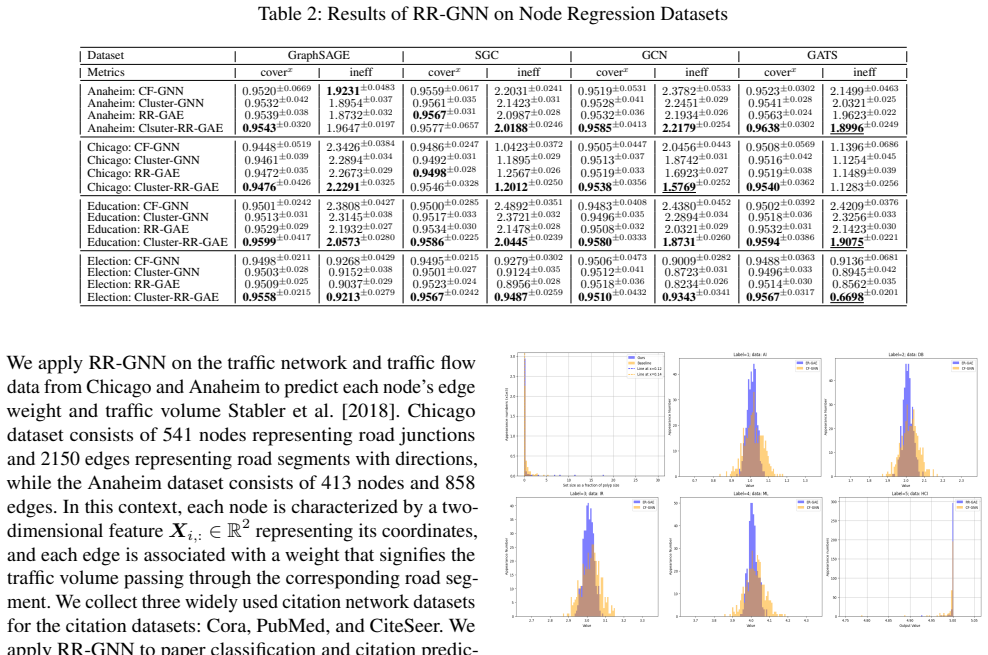
On its own terms, the paper's central claim is that a residual-adaptive, cluster-aware nonconformity score yields prediction intervals for GNNs that are marginally valid and more efficient than existing conformal GNN methods. The new score divides the usual quantile-based deviation by the predicted residual magnitude, so high-uncertainty examples receive wider intervals and low-uncertainty examples receive narrower ones. The intervals are computed per Louvain community, and a cross-training protocol alternates the Conformal GNN and Residual GNN so the residual model does not peek at training labels. The paper presents this as a framework that extends CP and CQR, and it reports that the residual-reweighted and clustered variants reduce interval length by 6.15% to 28.87% on edge weight prediction and improve inefficiency on node regression and classification while staying close to the 95% coverage target.
Load-bearing premise
The coverage guarantee rests on exchangeability of calibration and test nonconformity scores, which requires that the Residual GNN's predictions for calibration edges are computed without using the calibration labels as input.
Editorial extensions
If this is right
- A practitioner can attach RR-GNN to an existing GNN and obtain per-example interval widths instead of a single fixed width, with the same marginal coverage target.
- On edge weight prediction, the paper reports interval length reductions of 6.15% to 28.87% over CP and CQR baselines, which translates to more precise traffic-volume or link-weight estimates.
- Because intervals are cluster-specific, the method can give narrower intervals in well-behaved communities and wider intervals in noisy or structurally diverse ones.
- The cross-training protocol offers a template for independently fitting a residual model without contaminating the calibration set.
Reading between the lines
- A direct implication the paper does not develop: the residual weighting only helps if the residual GNN is genuinely predictive of error magnitude; if residuals are uninformative, the method should degrade toward ordinary CQR with slightly larger intervals, an identifiable failure mode.
- The method's cluster-conditional intervals suggest a testable extension: evaluate worst-slice conditional coverage after recomputing Louvain clusters on perturbed graphs, since the stated guarantee covers only marginal coverage.
- The same reweighting idea could be ported to other structured predictors whose conformal scores are quantile deviations, though exchangeability would need to be re-checked in each setting.
Editorial analysis
A structured set of objections, weighed in public.
Referee Report
Summary. The paper proposes RR-GNN, a conformal prediction framework for graph neural networks that combines a primary 'Conformal GNN', a secondary 'Residual GNN' trained to predict residuals, and Louvain-based Mondrian clustering. The claimed contributions are residual-adaptive nonconformity scores, cluster-conditional coverage, and a cross-training protocol to avoid information leakage. The authors state that RR-GNN produces minimal prediction sets with provable marginal coverage guarantees and report experiments on 15 graph datasets for edge weight prediction, node regression, and node classification, claiming improved efficiency over baselines at comparable coverage.
Significance. If the central claim were established, the idea of reweighting conformal intervals by a graph-aware residual predictor would be a useful addition to the conformal GNN literature, and the extensive empirical comparison across 15 datasets is a genuine strength. The paper also makes a credible effort to separate training, validation, calibration, and test data and to describe the algorithms explicitly. However, the theoretical guarantee is the load-bearing part of the submission, and as written the proof does not match the method and the exchangeability argument is violated by the use of true calibration weights as inputs. The classification variant also does not produce label-set prediction sets. These issues are serious enough that the central scientific claim is not currently supported.
major comments (4)
- [Appendix 6.7, Eq. (15)-(17)] Proposition 1 does not prove coverage for the actual RR-GNN interval. The proof defines the transformation Φ_ij(V) = V · |Ŵ^{1−α/2}_{ij} − Ŵ^{α/2}_{ij}| and then treats V_RR_{ij} as Φ_ij(V_ij), but the nonconformity score in Eq. (15) divides by the predicted residual |R̂_ij|, and the interval in Eq. (17) expands by d_RR · |R̂_ab|. No step of the proof involves R̂_ij, so the exchangeability and quantile argument applies to a different reweighting. The authors need to supply a proof for the score S_ij = max((Ŵ^{α/2}_{ij} − W_ij)/|R̂_ij|, (W_ij − Ŵ^{1−α/2}_{ij})/|R̂_ij|) and the corresponding interval construction.
- [Eq. (4), Algorithm 2 step 4] The exchangeability assumption underpinning the coverage guarantee is violated by the described protocol. At calibration, Eq. (4) and Algorithm 2 step 4 feed the true calibration weights W_calib into both gθ1 and gθ2, whereas at test time the true W_test is unknown and the model must be evaluated on masked inputs. Because the input distribution to the scoring functions differs between calibration and test, the nonconformity scores are not exchangeable and the marginal coverage bound collapses. The authors should define a single masked weighted adjacency matrix, for example W_train with δ for all non-training edges, and use it for both calibration and test scoring.
- [Section 3.4, Algorithm 4] The node classification variant does not produce conformal label sets. Algorithm 4 constructs intervals in probability space, [l̂^{α/2} − d|R̂|, l̂^{1−α/2} + d|R̂|], and claims coverage of the one-hot label by this interval. Such an interval is not a prediction set of class labels, so the central claim of 'minimal prediction sets' for classification is not supported. The authors should either formulate a proper label-set construction for classification or explicitly restrict the classification claims to calibrated probability intervals and evaluate them accordingly.
- [Algorithm 2 step 2, Section 3] The cluster-conditional coverage claim is not justified. Louvain clustering is applied to the full edge set E = Etrain ∪ Eval ∪ Ecalib ∪ Etest, so the assignment of calibration and test edges to clusters depends on the test structure. No argument is given for within-cluster exchangeability of the nonconformity scores under this protocol, and the Mondrian-style coverage guarantee therefore needs a dedicated proof rather than the current reference to prior work.
minor comments (5)
- [Section 3, Eq. (1)] The text says the edge set is partitioned into 'three disjoint subsets' but then lists four subsets (Etrain, Eval, Ecalib, Etest); this should be corrected to four.
- [Section 4.1] The text states that WSC is used as an evaluation metric, but Tables 1-3 report a column named 'coverx'; the authors should define this quantity or replace it with the stated metric.
- [Eq. (11)-(12)] The text says LGAE is defined in Eq. (9), but the squared error loss is actually given in Eq. (12); the cross-reference should be fixed.
- [Algorithm 2 vs. Appendix 6.7] The quantile index is written as k = ⌈(|E_calib| + 1)(1 − α)⌉ in Algorithm 2, while the proof writes k = (|E_calib| + 1)(1 − α) without the ceiling; the notation should be made consistent.
- [Tables 1-3] The column header 'coverx' appears to be a typo for 'coverage' and should be corrected throughout the tables.
Circularity Check
No circular derivation: the coverage argument is a standard exchangeability argument and the residual weights are fitted on a separate validation set; the Luo-Colombo self-citation is peripheral. The proof mismatch in Appendix 6.7 is a correctness gap, not circularity.
full rationale
The RR-GNN construction follows split conformal prediction: residual weights are a deterministic function of the held-out validation set (Eqs. 13-14) and are applied to calibration and test nonconformity scores with the same trained residual model, so the coverage claim is not equivalent to its inputs by construction. The only apparent self-citation is Section 3.2.2: "The theoretical guarantees on interval validity can be referenced to Luo and Colombo [2025]." This points to an independently published prior result by two of the authors and is not the sole support for the method's validity, since Appendix 6.7 attempts a self-contained proof. That proof is defective for the actual RR score: it defines Phi_ij(V) = V * |W_hat^{1-alpha/2} - W_hat^{alpha/2}|, whereas the method's Eq. (15) and (17) reweight by the predicted residual |R_hat_ij|. This is a serious correctness gap in the claimed "provable marginal coverage" theorem, and Eq. (4) also feeds W_calib into g_theta2 without masking, which threatens exchangeability. However, these are mismatches between the proof and the implemented algorithm, not a reduction of the prediction to its inputs, so they do not constitute circularity under the stated rules. The self-citation is minor and not load-bearing, hence the low score.
Assumptions & free parameters
free parameters (1)
- delta (δ) =
grid-searched
assumptions (3)
- domain assumption Calibration and test nonconformity scores are exchangeable given the model is trained only on training and validation data.
- domain assumption The residual predictor gθ2 is a deterministic function of validation data only and does not use calibration or test labels.
- standard math The quantile lemma for exchangeable scores (Lei et al. 2018, Romano et al. 2019) applies to the transformed scores.
Cite this review
Pith. "Pith review of Residual Reweighted Conformal Prediction for Graph Neural Networks." pith.science (2026). https://pith.science/paper/DPNLKQRZ
@misc{pith2026250607854,
  author       = {Pith},
  title        = {Pith review of: Residual Reweighted Conformal Prediction for Graph Neural Networks},
  year         = {2026},
  howpublished = {\url{https://pith.science/paper/DPNLKQRZ}},
  note         = {Machine review of arXiv:2506.07854}
}
read the original abstract
Graph Neural Networks (GNNs) excel at modeling relational data but face significant challenges in high-stakes domains due to unquantified uncertainty. Conformal prediction (CP) offers statistical coverage guarantees, but existing methods often produce overly conservative prediction intervals that fail to account for graph heteroscedasticity and structural biases. While residual reweighting CP variants address some of these limitations, they neglect graph topology, cluster-specific uncertainties, and risk data leakage by reusing training sets. To address these issues, we propose Residual Reweighted GNN (RR-GNN), a framework designed to generate minimal prediction sets with provable marginal coverage guarantees. RR-GNN introduces three major innovations to enhance prediction performance. First, it employs Graph-Structured Mondrian CP to partition nodes or edges into communities based on topological features, ensuring cluster-conditional coverage that reflects heterogeneity. Second, it uses Residual-Adaptive Nonconformity Scores by training a secondary GNN on a held-out calibration set to estimate task-specific residuals, dynamically adjusting prediction intervals according to node or edge uncertainty. Third, it adopts a Cross-Training Protocol, which alternates the optimization of the primary GNN and the residual predictor to prevent information leakage while maintaining graph dependencies. We validate RR-GNN on 15 real-world graphs across diverse tasks, including node classification, regression, and edge weight prediction. Compared to CP baselines, RR-GNN achieves improved efficiency over state-of-the-art methods, with no loss of coverage.
Figures


Figures from the paper (4 more)


Forward citations
Cited by 1 Pith paper
-
HeAD-CP: Heterophily-Aware Diffused Conformal Prediction Sets for Graph Neural Networks
Graph conformal prediction with node-wise softmax-derived diffusion coefficients avoids DAPS's heterophily failure and beats it on 8/10 benchmarks in oracle selection.
Reference graph
Works this paper leans on
-
[1]
SAN RR-GNN (Ours) Cluster-RR-GNN (Ours) Model Cover Ineff Cover Ineff Cover Ineff Cover Ineff Cora GraphSAGE0.9456±0.0569 1.6284±0.0483 0.9476±0.0532 1.6825±0.0541 0.9460±0.0542 1.6100±0.0415 0.9463±0.0509 1.6076±0.0397 SGC 0.9461±0.0603 1.6633±0.04415 0.9482±0.05348 1.6956±0.0236 0.9462±0.0581 1.6297±0.0428 0.9468±0.0662 1.6017±0.0465 GCN 0.9473±0.0556 1...
work page 2020
-
[2]
Know- ing what you know: valid and validated confidence sets in multiclass and multilabel prediction
Maxime Cauchois, Suyash Gupta, and John Duchi. Know- ing what you know: valid and validated confidence sets in multiclass and multilabel prediction. arXiv preprint arXiv:2004.10181,
arXiv 2004
-
[6]
Semi-supervised classifi- cation with graph convolutional networks
Thomas N Kipf and Max Welling. Semi-supervised classifi- cation with graph convolutional networks. arXiv preprint arXiv:1609.02907, 2016a. Thomas N Kipf and Max Welling. Variational graph auto- encoders. arXiv preprint arXiv:1611.07308, 2016b. Georgios Kollias, Vasileios Kalantzis, Tsuyoshi Idé, Aurélie Lozano, and Naoki Abe. Directed graph auto-encoders....
-
[7]
Segregation in social networks: Markov bridge models and estimation
Vikram Krishnamurthy, Rui Luo, and Buddhika Nettasinghe. Segregation in social networks: Markov bridge models and estimation. In ICASSP 2021-2021 IEEE International Conference on Acoustics, Speech and Signal Processing (ICASSP), pages 5484–5488. IEEE,
work page 2021
-
[9]
Conformity score averaging for classification
Rui Luo and Zhixin Zhou. Conformity score averaging for classification. In Proceedings of the Forty-second International Conference on Machine Learning (ICML), 2025a. to appear. Rui Luo and Zhixin Zhou. Conditional conformal risk adap- tation. arXiv preprint arXiv:2504.07611, 2025b. Rui Luo and Zhixin Zhou. Conformalized interval arith- metic with symmetr...
-
[10]
Mitigating Misinformation Spread on Blockchain Enabled Social Media Networks
Rui Luo, Vikram Krishnamurthy, and Erik Blasch. Miti- gating misinformation spread on blockchain enabled so- cial media networks. arXiv preprint arXiv:2201.07076, 2022a. Rui Luo, Buddhika Nettasinghe, and Vikram Krishnamurthy. Controlling segregation in social network dynamics as an edge formation game. IEEE transactions on network science and engineering...
-
[11]
In this table titles, Ori means original setting. NE means noise edge. FN means feature noise. Algorithm 4 Residual Reweighted Conformalized Graph Neural Network for Node Classification Input: The binary adjacency matrix A ∈ {0, 1}n×n, training node features X ∈ Rn×m, training node and class label variable Vtrain, ltrain (ltrain is the one-hot of ltrain. ...
work page 2024
-
[16]
Petar Veli ˇckovi´c, Guillem Cucurull, Arantxa Casanova, Adriana Romero, Pietro Lio, and Yoshua Bengio. Graph attention networks. arXiv preprint arXiv:1710.10903 ,
Show all 26 references
-
[17]
Nopeek: Information leakage reduc- tion to share activations in distributed deep learning
Praneeth Vepakomma, Abhishek Singh, Otkrist Gupta, and Ramesh Raskar. Nopeek: Information leakage reduc- tion to share activations in distributed deep learning. In 2020 International Conference on Data Mining Work- shops (ICDMW), pages 933–942. IEEE,
2020
-
[18]
Heterogeneous graph attention network
Xiao Wang, Houye Ji, Chuan Shi, Bai Wang, Yanfang Ye, Peng Cui, and Philip S Yu. Heterogeneous graph attention network. In The world wide web conference, pages 2022– 2032,
2022
-
[19]
Assume the graph has n nodes with f features
6.2 BACKGROUND OF GRAPH AUTOENCODER 6.2.1 Guaranteed Edge Weight Prediction Using GNNs Let G = ( V, E) be a graph with node set V and edge set E ⊆ V × V. Assume the graph has n nodes with f features. Let X ∈ Rn×m be the node feature matrix, and Xi,: ∈ Rf be the feature vector ...
2022
-
[21]
6.3 APPENDICES FIGURES 6.3.1 Schematic figure for transductive and inductive settings for link prediction
that transforms edges to nodes in line graphs. 6.3 APPENDICES FIGURES 6.3.1 Schematic figure for transductive and inductive settings for link prediction. There are two major braches in link prediction problem settting: transductive and inductive settings. Schematic fig- ure fo...
2016
-
[22]
6.4 NONCONFORMITY SCORE AND EV ALUATION METRICS Nonconformity Score For the nonconformity score in main paper is for conformal prediction-based RR (CP-RR). On the other hand, for conformal quantile regression-based RR (CQR-RR), The nonconformity score is Cab = h ˆW α/2 ab − dR...
2020
-
[23]
The probability is over the datagenerating distribution
is a user-defined error rate. The probability is over the datagenerating distribution. For efficiency, we GNN Model on Watts-StrogatzData Load (s) Load GPU (MB) GraphConv SAGEConv GATStrain val GPU space train val GPU space train val GPU spaceGAE (100) 0.30 0.73 0.85s 0.31s 0....
2002
-
[26]
RR-GNN (Ours) Cluster-RR-GNN (Ours) Model Cover Ineff Cover Ineff Cover Ineff Cover Ineff CoraGraphSAGE0.9456±0.0569 1.6284±0.0483 0.9453±0.0535 1.8025±0.0421 0.9460±0.0542 1.6100±0.0415 0.9463±0.0509 1.6076±0.0397 SGC 0.9461±0.0603 1.6633±0.04415 0.9452±0.0538 1.7856±0.0426 0...
-
[2002]
Normalized nonconformity measures for regression con- formal prediction
Harris Papadopoulos, Alex Gammerman, and V olodya V ovk. Normalized nonconformity measures for regression con- formal prediction. In Proceedings of the IASTED Inter- national Conference on Artificial Intelligence and Appli- cations (AIA 2008), pages 64–69,
2008
-
[2011]
URL https://doi.org/10.3150/10-BEJ267
doi: 10.3150/10-BEJ267. URL https://doi.org/10.3150/10-BEJ267. Xiaoyi Su, Zhixin Zhou, and Rui Luo. Adaptive confor- mal inference by particle filtering under hidden markov models. arXiv preprint arXiv:2411.01558,
-
[2017]
Split localized conformal prediction
Xing Han, Ziyang Tang, Joydeep Ghosh, and Qiang Liu. Split localized conformal prediction. arXiv preprint arXiv:2206.13092,
-
[2018]
and Theorem 1 of Romano, Patterson, and CandesRomano et al. [2019]. Let V be the conformity score of CQR. The RR approach performs a monotone transformation of V , defined as Φij(V ) = V ˆW 1−α/2 ij − ˆW α/2 ij , where i and j are two nodes in the graph2. For all (i, j) and al...
2019
-
[2019]
Inductive confidence machines for regression
Harris Papadopoulos, Kostas Proedrou, V olodya V ovk, and Alex Gammerman. Inductive confidence machines for regression. In Machine Learning: ECML 2002: 13th Eu- ropean Conference on Machine Learning Helsinki, Fin- land, August 19–23, 2002 Proceedings 13, pages 345–356. Springer,
2002
-
[2020]
Transportation networks for research core team
Ben Stabler, Hillel Bar-Gera, and Elizabeth Sall. Transportation networks for research core team. Transportation Networks for Research. Accessed Month, Day, Year.[Electronic resource]: https://github. com/bstabler/TransportationNetworks (accessed 16.02. 2021),
2021
-
[2021]
Uncertainty sets for image classifiers using conformal prediction
Anastasios Angelopoulos, Stephen Bates, Jitendra Ma- lik, and Michael I Jordan. Uncertainty sets for image classifiers using conformal prediction. arXiv preprint arXiv:2009.14193,
2009 arXiv
-
[2022]
Deep models under the gan: information leakage from collaborative deep learning
Briland Hitaj, Giuseppe Ateniese, and Fernando Perez-Cruz. Deep models under the gan: information leakage from collaborative deep learning. In Proceedings of the 2017 ACM SIGSAC conference on computer and communica- tions security, pages 603–618,
2017
-
[2023]
Game- theoretic defenses for robust conformal prediction against adversarial attacks in medical imaging
Rui Luo, Jie Bao, Zhixin Zhou, and Chuangyin Dang. Game- theoretic defenses for robust conformal prediction against adversarial attacks in medical imaging. arXiv preprint arXiv:2411.04376,
-
[2024]
Bi-level atten- tion graph neural networks
Roshni G Iyer, Wei Wang, and Yizhou Sun. Bi-level atten- tion graph neural networks. In 2021 IEEE International Conference on Data Mining (ICDM), pages 1126–1131. IEEE,
2021
-
[2025]
Fréchet-statistics- based change point detection in dynamic social networks
Rui Luo and Vikram Krishnamurthy. Fréchet-statistics- based change point detection in dynamic social networks. IEEE Transactions on Computational Social Systems, 11 (2):2863–2871, 2023a. Rui Luo and Vikram Krishnamurthy. Who you play affects how you play: Predicting sports per...
Reviewed August 7, 2026 · model on record in the stance chip above.
Discussion (0). Sign in to comment.