REVIEW 3 major objections 5 minor 85 references
FreeGave: 3D Physics Learning from Dynamic Videos by Gaussian Velocity
T0 review · 3 major / 5 minor · reviewed 2026-08-07 · deepseek-v4-flash
Pith's one-line read FreeGave learns per-Gaussian physics codes and divergence-free velocity fields from multi-view video, enabling future frame extrapolation and unsupervised motion segmentation without object priors.
desk verdict FreeGave is a solid empirical system for future-frame extrapolation with 3DGS whose 'physics learning' framing overreaches: the divergence-free constraint is kinematic, not dynamical. read the letter →
The pith
A machine-rendered reading of the paper's core claim, the machinery that carries it, and where it could break.
The reading
What carries the argument
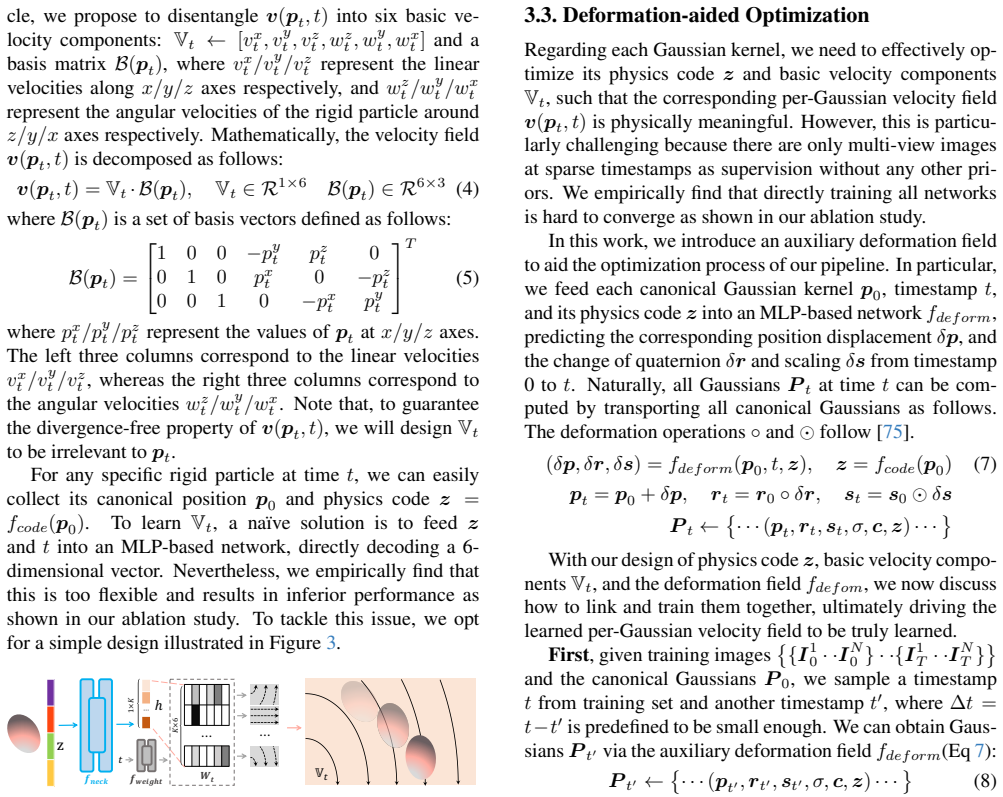
The core object is the per-Gaussian velocity field $v(p_t, t) = V_t \cdot B(p_t)$, built from a physics code $z = f_{\text{code}}(p_0)$ shared across time. $V_t$ is produced by $f_{\text{neck}}(z) \cdot f_{\text{weight}}(t)$, a bottleneck that factors motion into $K$ latent pattern types and time-selective weights, while $B(p_t)$ is a $6 \times 3$ basis whose rows are the linear-velocity directions and the cross-product angular-velocity terms, each divergence-free. Because $V_t$ is independent of $p_t$ and each basis row has zero divergence, the field is divergence-free without any PINN loss. The same velocity field is paired with a deformation-aided optimization that transports canonical Gaussians to nearby timestamps for supervision, and an interleaved mid-point integration advances the particles forward for future prediction.
What would settle it
Feed FreeGave a video in which an object's motion changes abruptly after the training frames, such as a ball hitting a wall and reversing; the failure would be extrapolated frames showing the ball passing through the wall, which would show that the per-Gaussian divergence-free velocity fields do not capture interaction physics.
Extended reading notes
Core claim
The central claim is that embedding a physics code in every Gaussian kernel and transporting each kernel by a divergence-free velocity field teaches the model the scene's underlying dynamics directly from pixels. Velocities are parameterized as $v(p_t, t) = V_t \cdot B(p_t)$, where $V_t$ is learned from the code via a bottleneck that decomposes motion into $K$ pattern types and time-dependent weights, and $B(p_t)$ is a fixed basis of linear and angular velocity fields whose divergence is zero by construction. This lets future frames be obtained by integrating the velocity field forward, with a deformation field used during training to stabilize optimization. The paper argues that because the divergence-free constraint is baked into the parameterization rather than imposed as a soft PINN loss, boundary motions are learned more sharply and no object priors are needed. Evidence includes higher extrapolation metrics on synthetic and real datasets and near-perfect unsupervised motion segmentation on an indoor benchmark.
Load-bearing premise
The premise is that independent per-Gaussian divergence-free velocity fields, with time dependence learned by a weight network, remain physically faithful beyond the training interval even though the assembled global field is not a single divergence-free flow.
Editorial extensions
If this is right
- If the claim holds, future-frame extrapolation for dynamic scenes no longer requires object masks, object-type classifiers, or expensive PDE sampling; per-Gaussian divergence-free velocities learned from RGB are sufficient.
- The physics codes themselves become a representation that can be clustered or edited, so scenes can be re-animated by modifying a code or transferring a code between objects.
- Because the model already separates motion patterns unsupervised, robotics and embodied agents could extract moving-object proposals directly from the learned codes without hand-labeled segmentation.
- The architecture's bottleneck dimension $K$ controls the number of motion patterns, giving a principled lever for trading expressiveness against generalization in long-horizon prediction.
Reading between the lines
- A natural next step the paper does not take is adding interaction terms between nearby Gaussian codes; the current per-particle independence would likely break at collisions, though the paper's collision experiments suggest some robustness.
- The same bottleneck decomposition could transfer across scenes: a physics code learned on one object might be reused to drive the motion of a geometrically different object in a 4D generation pipeline.
- One testable extension is to measure how extrapolation error grows with horizon; the paper evaluates short extrapolation windows, and a longer-horizon study would reveal whether the learned velocity field remains stable.
Editorial analysis
A structured set of objections, weighed in public.
Referee Report
Summary. The paper proposes FreeGave, a 3D Gaussian splatting method that learns per-Gaussian velocity fields from multi-view videos without object priors or PINN losses. Each Gaussian kernel is assigned a physics code z=f_code(p0), and its velocity is parameterized as v(p_t,t)=V_t·B(p_t) with V_t=f_neck(z)·f_weight(t), where B(p_t) is a divergence-free basis for rigid-body motion. An auxiliary deformation field aids optimization, and future frames are generated by an interleaved midpoint integration (Algorithm 1). The method is evaluated on three public datasets and a newly collected real-world dataset for future frame extrapolation and unsupervised motion segmentation, with reported improvements over several baselines including a DefGS+NVFi hybrid.
Significance. The empirical contribution is substantial: the evaluation covers four datasets, multiple baselines, per-scene results, ablations, and held-out future frames, and the new FreeGave-GoPro dataset is a potentially useful resource for the community. The future-frame extrapolation results, in particular the large margins on several synthetic and real scenes, are strong evidence that the proposed per-Gaussian velocity parameterization generalizes beyond the training time range. The unsupervised motion segmentation via K-means on bottleneck vectors is also a nice by-product. However, the paper's central claim of learning 'the underlying physics' is not established by the evidence. The divergence-free property is per-Gaussian, not global, and the temporal evolution is an MLP extrapolation rather than a dynamical law. The method is better characterized as a kinematic velocity parameterization with good extrapolation performance, and the 'physics learning' framing should be moderated accordingly.
major comments (3)
- [§3.2, Eqs. (4)–(6), and Appendix A] The divergence-free property is proven only for each basis function B_k(p_t) with V_t fixed. In the actual model, V_t = f_neck(z)·f_weight(t) with z = f_code(p0), so each Gaussian has a different V_t. The collection of per-Gaussian velocity fields does not define a single global vector field on the scene, and the phrase 'divergence-free Gaussian velocity' in the abstract and Section 3.2 describes a per-particle rigid-body kinematic constraint, not a global incompressibility constraint. The paper should define what 'divergence-free' means at the scene level and verify it, or explicitly reframe the contribution as per-particle kinematic parameterization.
- [§3.2, Eq. (6), and Algorithm 1] The time dependence of the velocity is carried entirely by f_weight(t), a neural network, with no loss or constraint enforcing a dynamical law (e.g., Newton's second law, momentum conservation, or a PDE) on the time dimension. Future extrapolation is therefore MLP evaluation at unseen timestamps, not integration of learned physics. The strong results on smooth/periodic motions and the modest results on collisions (Appendix F, Table 6: 28.426 vs 28.017 PSNR over DefGSnvfi) are consistent with function extrapolation of a smooth motion field. The abstract's claims of learning 'the underlying physics' and 'meaningful 3D physical motion patterns' should be revised, or the authors should add a temporal dynamics constraint and demonstrate that it improves collision and abrupt-motion cases.
- [Appendix H] The limitation section states that the method 'would fail to predict abrupt motions, such as an explosion, primarily because the underlying physics rules are unable to be observed or learned from visual frames.' This is an honest statement, but it directly undercuts the abstract's claim that the method learns 'the underlying physics' of complex dynamic 3D scenes. A method that fails precisely when a dynamical law governs the motion is better described as learning smooth velocity extrapolation. The authors should either provide evidence that the learned physics codes capture invariant physical parameters beyond the observed motion statistics, or revise the central claims to match the actual scope.
minor comments (5)
- [General] There are numerous typos and formatting inconsistencies in the main text and supplementary material, e.g., 'Canonial3DRepresentation' in Figure 2, 'fdef orm' vs 'f_def orm' vs 'fdeform', and 'DefGSnvf i' with stray spaces. A thorough proofread is needed.
- [§3.3, Algorithm 1] The rotation update R_t ← (I + ∆t ∂v_mid/∂p_mid) R_t' is borrowed from [70] without explaining why this approximation is valid for the per-Gaussian velocity field or whether it preserves the divergence-free property. Please add a short derivation or reference to the specific result.
- [§4.2 and Appendix I] The motion segmentation evaluation uses K-means on bottleneck vectors with per-scene hyperparameters (λ and C) chosen individually for each scene (Appendix I.1). The paper should state how these values were selected and whether the reported high AP/PQ scores are robust to reasonable variations of λ and C.
- [Table 6] The caption says 'Results on four scenes of oscillations or collisions' but the table only reports a single 'Collisions' row. Please clarify whether the results are averaged over two collision scenes and whether the 'oscillations' scenes are reported elsewhere.
- [References] The paper cites its own prior work (NVFi, OGC) very frequently; please ensure that the novelty with respect to NVFi is crisply stated, since the velocity parameterization is closely related to the NVFi framework.
Circularity Check
No significant circularity: the future-frame and segmentation results are held-out evaluations, and the divergence-free basis is a kinematic parameterization rather than a fitted prediction.
full rationale
The derivation chain is not circular. FreeGave parameterizes each Gaussian's velocity as v(pt,t)=Vt·B(pt) with Vt learned from a per-Gaussian physics code z=f_code(p0) and a time-weighting MLP f_weight(t). The divergence-free property is a consequence of Vt being independent of pt and of each basis column being divergence-free (Appendix A); it is a kinematic parameterization, not a target quantity derived from the outputs. The future-frame extrapolation evaluates Algorithm 1 on frames after the training horizon, and these frames are never used in the loss of Eq. 9, so the reported PSNR/SSIM/LPIPS gains over NVFi, DefGSnvfi, and other baselines are genuine held-out predictions rather than fitted values. The motion segmentation in Table 3 groups bottleneck vectors h=f_neck(z) by K-means and scores against ground-truth masks that are not used in training, so the near-perfect AP/PQ is an external fidelity check on the learned representation. Self-citations to NVFi [30] and OGC [57,58] are present, but NVFi is used as a baseline and dataset source, OGC is used only to segment the DefGS-style baselines, and neither supplies a premise that forces the paper's conclusions. The claim that the temporal MLP extrapolation constitutes 'underlying physics' is arguably an overstatement relative to the divergence-free kinematic prior, and the paper itself concedes in Appendix H that abrupt motions are not learned; that is a scope/validity limitation, not circularity. No equation in the paper reduces to its own input, and no fitted parameter is renamed as a prediction.
Assumptions & free parameters
free parameters (5)
- Motion pattern count K =
16 for Dynamic Object, 32 for Dynamic Indoor Scene, 16 for others (Appendix B)
- Physics code dimension L =
16
- Time step delta_t =
1/60 for synthetic datasets, 1/88 for GoPro (Appendix C)
- Segmentation group count C =
8 or 13 per scene (Appendix I.1)
- Grouping regularization lambda =
0 or 0.5 per scene (Appendix I.1)
assumptions (5)
- domain assumption Vanilla 3DGS provides a differentiable and accurate scene representation for canonical geometry and appearance.
- domain assumption Each Gaussian is a rigid particle with opacity and color invariant over time.
- domain assumption The per-Gaussian velocity field is divergence-free.
- ad hoc to paper Physics code z is a function of canonical position only (z = f_code(p0)).
- ad hoc to paper Velocity components factorize as V_t = f_neck(z) * f_weight(t).
Cite this review
Pith. "Pith review of FreeGave: 3D Physics Learning from Dynamic Videos by Gaussian Velocity." pith.science (2026). https://pith.science/paper/VXSJCQ3Q
@misc{pith2026250607865,
  author       = {Pith},
  title        = {Pith review of: FreeGave: 3D Physics Learning from Dynamic Videos by Gaussian Velocity},
  year         = {2026},
  howpublished = {\url{https://pith.science/paper/VXSJCQ3Q}},
  note         = {Machine review of arXiv:2506.07865}
}
read the original abstract
In this paper, we aim to model 3D scene geometry, appearance, and the underlying physics purely from multi-view videos. By applying various governing PDEs as PINN losses or incorporating physics simulation into neural networks, existing works often fail to learn complex physical motions at boundaries or require object priors such as masks or types. In this paper, we propose FreeGave to learn the physics of complex dynamic 3D scenes without needing any object priors. The key to our approach is to introduce a physics code followed by a carefully designed divergence-free module for estimating a per-Gaussian velocity field, without relying on the inefficient PINN losses. Extensive experiments on three public datasets and a newly collected challenging real-world dataset demonstrate the superior performance of our method for future frame extrapolation and motion segmentation. Most notably, our investigation into the learned physics codes reveals that they truly learn meaningful 3D physical motion patterns in the absence of any human labels in training.
Figures


Figures from the paper (16 more)


Reference graph
Works this paper leans on
-
[1]
Par- ticlenerf: Particle based encoding for online neural radiance fields
Jad Abou-Chakra, Feras Dayoub, and Niko S ¨underhauf. Par- ticlenerf: Particle based encoding for online neural radiance fields. W ACV, 2024. 5, 2
2024
-
[2]
Per-Gaussian Embedding-Based Deformation for Deformable 3D Gaussian Splatting
Jeongmin Bae, Seoha Kim, Youngsik Yun, Hahyun Lee, Gun Bang, and Youngjung Uh. Per-Gaussian Embedding-Based Deformation for Deformable 3D Gaussian Splatting. ECCV,
-
[3]
Fluid Dynamics Network: Topology- Agnostic 4D Reconstruction via Fluid Dynamics Priors
Daniele Baieri, Stefano Esposito, Filippo Maggioli, and Emanuele Rodol `a. Fluid Dynamics Network: Topology- Agnostic 4D Reconstruction via Fluid Dynamics Priors. arXiv:2303.09871, 2023. 2
arXiv 2023
-
[4]
3D Gaussian Splat- ting: Survey, Technologies, Challenges, and Opportunities
Yanqi Bao, Tianyu Ding, Jing Huo, Yaoli Liu, Yuxin Li, Wenbin Li, Yang Gao, and Jiebo Luo. 3D Gaussian Splat- ting: Survey, Technologies, Challenges, and Opportunities. arXiv:2407.17418, 2024. 2
arXiv 2024
-
[5]
Nerfies: Deformable Neural Radiance Fields
Jonathan T Barron, Keunhong Park, Steven M Seitz, and Ri- cardo Martin-brualla. Nerfies: Deformable Neural Radiance Fields. ICCV, 2021. 1
2021
-
[6]
Gaussian- Informed Continuum for Physical Property Identification and Simulation
Junhao Cai, Yuji Yang, Weihao Yuan, Yisheng He, Zilong Dong, Liefeng Bo, Hui Cheng, and Qifeng Chen. Gaussian- Informed Continuum for Physical Property Identification and Simulation. NeurIPS, 2024. 1
2024
-
[7]
HexPlane: A Fast Representa- tion for Dynamic Scenes
Ang Cao and Justin Johnson. HexPlane: A Fast Representa- tion for Dynamic Scenes. CVPR, 2023. 2
2023
-
[8]
A Survey on 3D Gaussian Splatting
Guikun Chen and Wenguan Wang. A Survey on 3D Gaussian Splatting. arXiv:2401.03890, 2024. 2
arXiv 2024
Show all 85 references
-
[9]
SEINE: Short-to-Long Video Diffu- sion Model for Generative Transition and Prediction
Xinyuan Chen, Yaohui Wang, Lingjun Zhang, Shaobin Zhuang, Xin Ma, Jiashuo Yu, Yali Wang, Dahua Lin, Yu Qiao, and Ziwei Liu. SEINE: Short-to-Long Video Diffu- sion Model for Generative Transition and Prediction. ICLR,
-
[10]
Learning Implicit Fields for Generative Shape Modeling
Zhiqin Chen and Hao Zhang. Learning Implicit Fields for Generative Shape Modeling. CVPR, 2019. 2
2019
-
[11]
Schwing, Alexan- der Kirillov, and Rohit Girdhar
Bowen Cheng, Ishan Misra, Alexander G. Schwing, Alexan- der Kirillov, and Rohit Girdhar. Masked-attention Mask Transformer for Universal Image Segmentation. CVPR,
-
[12]
Neu- ral Unsigned Distance Fields for Implicit Function Learning
Julian Chibane, Aymen Mir, and Gerard Pons-Moll. Neu- ral Unsigned Distance Fields for Implicit Function Learning. NeurIPS, 2020. 2
2020
-
[13]
Physics informed neural fields for smoke reconstruction with sparse data
Mengyu Chu, Lingjie Liu, Quan Zheng, Erik Franz, Hans Peter Seidel, Christian Theobalt, and Rhaleb Zayer. Physics informed neural fields for smoke reconstruction with sparse data. TOG, 2022. 1
2022
-
[14]
A Point Set Generation Network for 3D Object Reconstruction from a Single Image
Haoqiang Fan, Hao Su, and Leonidas Guibas. A Point Set Generation Network for 3D Object Reconstruction from a Single Image. CVPR, 2017. 2
2017
-
[15]
Fast Dynamic Radiance Fields with Time-Aware Neural V oxels
Jiemin Fang, Xinggang Wang, and Matthias Nießner. Fast Dynamic Radiance Fields with Time-Aware Neural V oxels. SIGGRAPH Asia, 2022. 2, 5, 6, 7, 8
2022
-
[16]
3D Gaussian Splatting as New Era: A Survey
Ben Fei, Jingyi Xu, Rui Zhang, Qingyuan Zhou, Weidong Yang, and Ying He. 3D Gaussian Splatting as New Era: A Survey. TVCG, 2024. 2
2024
-
[17]
Learning visual predictive models of physics for playing billiards
Katerina Fragkiadaki, Pulkit Agrawal, Sergey Levine, and Jitendra Malik. Learning visual predictive models of physics for playing billiards. ICLR, 2016. 2
2016
-
[18]
K-Planes: Explicit Radiance Fields in Space, Time, and Appearance
Sara Fridovich-Keil, Giacomo Meanti, Frederik Warburg, Benjamin Recht, and Angjoo Kanazawa. K-Planes: Explicit Radiance Fields in Space, Time, and Appearance. CVPR,
-
[19]
Dynamic View Synthesis from Dynamic Monocular Video
Chen Gao, Ayush Saraf, Johannes Kopf, and Jia-Bin Huang. Dynamic View Synthesis from Dynamic Monocular Video. ICCV, 2021. 2
2021
-
[20]
Learning latent dynamics for planning from pixels
Danijar Hafner, Timothy Lillicrap, Ian Fischer, Ruben Ville- gas, David Ha, Honglak Lee, and James Davidson. Learning latent dynamics for planning from pixels. ICML, 2019. 2
2019
-
[21]
Jonathan Ho, Tim Salimans, Alexey Gritsenko, William Chan, Mohammad Norouzi, and David J. Fleet. Video Dif- fusion Models. arXiv:2204.03458, 2022. 2
2022 arXiv
-
[22]
Diffusion Models for Video Prediction and Infilling
Tobias H ¨oppe, Arash Mehrjou, Stefan Bauer, Didrik Nielsen, and Andrea Dittadi. Diffusion Models for Video Prediction and Infilling. TMLR, 2022. 2
2022
-
[23]
Regularizing Dynamic Radiance Fields with Kinematic Fields
Woobin Im, Geonho Cha, Sebin Lee, Jumin Lee, Juhyeong Seon, Dongyoon Wee, and Sung-Eui Yoon. Regularizing Dynamic Radiance Fields with Kinematic Fields. ECCV,
-
[24]
Learning to Simu- late Complex Physics with Graph Networks
Alvaro Sanchez-gonzalez Jonathan, Godwin Tobias, Pfaff Rex, Ying Jure, and Peter W Battaglia. Learning to Simu- late Complex Physics with Graph Networks. ICML, 2020. 1, 2
2020
-
[25]
How Far is Video Generation from World Model: A Physical Law Perspective
Bingyi Kang, Yang Yue, Rui Lu, Zhijie Lin, Yang Zhao, Kaixin Wang, Gao Huang, and Jiashi Feng. How Far is Video Generation from World Model: A Physical Law Perspective. arXiv:2411.02385, 2024. 2
2024 arXiv
-
[26]
Neu- ral 3D Mesh Renderer
Hiroharu Kato, Yoshitaka Ushiku, and Tatsuya Harada. Neu- ral 3D Mesh Renderer. CVPR, 2018. 2
2018
-
[27]
A Compact Dynamic 3D Gaussian Representation for Real- Time Dynamic View Synthesis
Kai Katsumata, Duc Minh V o, and Hideki Nakayama. A Compact Dynamic 3D Gaussian Representation for Real- Time Dynamic View Synthesis. ECCV, 2024. 2
2024
-
[28]
3D Gaussian Splatting for Real-Time Radiance Field Rendering
Bernhard Kerbl, Universit ´e C ˆote, Georgios Kopanas, Uni- versit´e Cˆote, Thomas Leimk¨uhler, Max-planck-institut Infor- matik, and G R Aug. 3D Gaussian Splatting for Real-Time Radiance Field Rendering. SIGGRAPH, 2023. 1, 2, 3
2023
-
[29]
DynMF: Neural Motion Factorization for Real-time Dy- namic View Synthesis with 3D Gaussian Splatting
Agelos Kratimenos, Jiahui Lei, and Kostas Daniilidis. DynMF: Neural Motion Factorization for Real-time Dy- namic View Synthesis with 3D Gaussian Splatting. ECCV,
-
[30]
NVFi: Neural Veloc- ity Fields for 3D Physics Learning from Dynamic Videos
Jinxi Li, Ziyang Song, and Bo Yang. NVFi: Neural Veloc- ity Fields for 3D Physics Learning from Dynamic Videos. NeurIPS, 2023. 1, 3, 5, 6, 2, 4, 7, 8
2023
-
[31]
PAC-NeRF: Physics Augmented Continuum Neural Radiance Fields for Geometry-Agnostic System Identifica- tion
Xuan Li, Yi-Ling Qiao, Peter Yichen Chen, Krishna Murthy Jatavallabhula, Ming Lin, Chenfanfu Jiang, and Chuang Gan. PAC-NeRF: Physics Augmented Continuum Neural Radiance Fields for Geometry-Agnostic System Identifica- tion. ICLR, 2023. 1
2023
-
[32]
Neural Scene Flow Fields for Space-Time View Synthesis of Dynamic Scenes
Zhengqi Li, Simon Niklaus, Noah Snavely, and Oliver Wang. Neural Scene Flow Fields for Space-Time View Synthesis of Dynamic Scenes. CVPR, 2021. 5, 6, 7
2021
-
[33]
DynIBaR: Neural Dynamic Image-Based Rendering
Zhengqi Li, Qianqian Wang, Forrester Cole, Richard Tucker, and Noah Snavely. DynIBaR: Neural Dynamic Image-Based Rendering. CVPR, 2023. 1
2023
-
[34]
Spacetime Gaussian Feature Splatting for Real-Time Dynamic View Synthesis
Zhan Li, Zhang Chen, Zhong Li, and Yi Xu. Spacetime Gaussian Feature Splatting for Real-Time Dynamic View Synthesis. CVPR, 2024. 2
2024
-
[35]
Lawrence Zitnick, and Piotr Doll ´ar
Tsung-Yi Lin, Michael Maire, Serge Belongie, Lubomir Bourdev, Ross Girshick, James Hays, Pietro Perona, Deva Ramanan, C. Lawrence Zitnick, and Piotr Doll ´ar. Microsoft COCO: Common Objects in Context. ECCV, 2014. 6
2014
-
[36]
Gaussian-Flow: 4D Reconstruction with Dynamic 3D Gaus- sian Particle
Youtian Lin, Zuozhuo Dai, Siyu Zhu, and Yao Yao. Gaussian-Flow: 4D Reconstruction with Dynamic 3D Gaus- sian Particle. CVPR, 2024. 2
2024
-
[37]
Physics3D: Learning Physical Properties of 3D Gaussians via Video Diffusion
Fangfu Liu, Hanyang Wang, Shunyu Yao, and Shengjun Zhang. Physics3D: Learning Physical Properties of 3D Gaussians via Video Diffusion. arXiv:2406.04338, 2024. 2
2024 arXiv
-
[38]
DeVRF: Fast Deformable V oxel Ra- diance Fields for Dynamic Scenes
Jia-Wei Liu, Yan-Pei Cao, Weijia Mao, Wenqiao Zhang, David Junhao Zhang, Jussi Keppo, Ying Shan, Xiaohu Qie, and Mike Zheng Shou. DeVRF: Fast Deformable V oxel Ra- diance Fields for Dynamic Scenes. NeurIPS, 2022. 2
2022
-
[39]
PhysGen: Rigid-Body Physics-Grounded Image-to-Video Generation
Shaowei Liu, Zhongzheng Ren, Saurabh Gupta, and Shen- long Wang. PhysGen: Rigid-Body Physics-Grounded Image-to-Video Generation. ECCV, 2024. 2
2024
-
[40]
Sora: A Review on Background, Technology, Limitations, and Opportunities of Large Vision Models
Yixin Liu, Kai Zhang, Yuan Li, Zhiling Yan, Chujie Gao, Ruoxi Chen, Zhengqing Yuan, Yue Huang, Hanchi Sun, Jian- feng Gao, Lifang He, and Lichao Sun. Sora: A Review on Background, Technology, Limitations, and Opportunities of Large Vision Models. arXiv:2402.17177, 2024. 2
2024 arXiv
-
[41]
Robust Dynamic Radiance Fields
Yu-Lun Liu, Chen Gao, Andreas Meuleman, Hung-Yu Tseng, Ayush Saraf, Changil Kim, Yung-Yu Chuang, Jo- hannes Kopf, and Jia-Bin Huang. Robust Dynamic Radiance Fields. CVPR, 2023. 2
2023
-
[42]
3D Geometry-aware Deformable Gaussian Splatting for Dynamic View Synthesis
Zhicheng Lu, Xiang Guo, Le Hui, Min Yang, Xiao Tang, Feng Zhu, and Yuchao Dai. 3D Geometry-aware Deformable Gaussian Splatting for Dynamic View Synthesis. CVPR,
-
[43]
Macqueen
J. Macqueen. Some methods for classification and anal- ysis of multivariate observations. In Proceedings of the Fifth Berkeley Symposium on Mathematical Statistics and Probability, pages 281–297, Berkeley, Calif., 1967. Univer- sity of California Press. 6
1967
-
[44]
SURFSUP: Learning Fluid Simulation for Novel Surfaces
Arjun Mani, Ishaan Preetam Chandratreya, Elliot Creager, Carl V ondrick, and Richard Zemel. SURFSUP: Learning Fluid Simulation for Novel Surfaces. ICCV, 2023. 2
2023
-
[45]
Occupancy Net- works: Learning 3D Reconstruction in Function Space
Lars Mescheder, Michael Oechsle, Michael Niemeyer, Se- bastian Nowozin, and Andreas Geiger. Occupancy Net- works: Learning 3D Reconstruction in Function Space. CVPR, 2019. 2
2019
-
[46]
SplatFields: Neural Gaussian Splats for Sparse 3D and 4D Reconstruction
Marko Mihajlovic, Sergey Prokudin, Siyu Tang, Robert Maier, Federica Bogo, Tony Tung, and Edmond Boyer. SplatFields: Neural Gaussian Splats for Sparse 3D and 4D Reconstruction. ECCV, 2024. 2
2024
-
[47]
Srinivasan, Matthew Tancik, Jonathan T Barron, Ravi Ramamoorthi, and Ren Ng
Ben Mildenhall, Pratul P. Srinivasan, Matthew Tancik, Jonathan T Barron, Ravi Ramamoorthi, and Ren Ng. NeRF: Representing Scenes as Neural Radiance Fields for View Synthesis. ECCV, 2020. 1, 2
2020
-
[48]
Huang, and Martin Renqiang Min
Haomiao Ni, Changhao Shi, Kai Li, Sharon X. Huang, and Martin Renqiang Min. Conditional Image-to-Video Genera- tion with Latent Flow Diffusion Models. CVPR, 2023. 2
2023
-
[49]
DeepSDF: Learning Continuous Signed Distance Functions for Shape Represen- tation
Jeong Joon Park, Peter Florence, Julian Straub, Richard Newcombe, and Steven Lovegrove. DeepSDF: Learning Continuous Signed Distance Functions for Shape Represen- tation. CVPR, 2019. 2
2019
-
[50]
Barron, Sofien Bouaziz, Dan B Goldman, Ricardo Martin- Brualla, and Steven M
Keunhong Park, Utkarsh Sinha, Peter Hedman, Jonathan T. Barron, Sofien Bouaziz, Dan B Goldman, Ricardo Martin- Brualla, and Steven M. Seitz. HyperNeRF: A Higher- Dimensional Representation for Topologically Varying Neu- ral Radiance Fields. SIGGRAPH Asia, 2021. 2
2021
-
[51]
D-NeRF: Neural Radiance Fields for Dynamic Scenes
Albert Pumarola, Enric Corona, Gerard Pons-Moll, and Francesc Moreno-Noguer. D-NeRF: Neural Radiance Fields for Dynamic Scenes. CVPR, 2021. 1, 5, 6, 4, 7
2021
-
[52]
3DGS-Avatar: Animatable Avatars via Deformable 3D Gaussian Splatting
Zhiyin Qian, Shaofei Wang, Marko Mihajlovic, Andreas Geiger, and Siyu Tang. 3DGS-Avatar: Animatable Avatars via Deformable 3D Gaussian Splatting. CVPR, 2024. 2
2024
-
[53]
Raissi, P
M. Raissi, P. Perdikaris, and G. E. Karniadakis. Physics- informed neural networks: A deep learning framework for solving forward and inverse problems involving nonlinear partial differential equations. Journal of Computational Physics, 2019. 1, 2
2019
-
[54]
Hidden fluid mechanics: Learning velocity and pres- sure fields from flow visualizations
Maziar Raissi, Alireza Yazdani, and George Em Karni- adakis. Hidden fluid mechanics: Learning velocity and pres- sure fields from flow visualizations. Science, 2020. 2
2020
-
[55]
Schonberger and Jan-Michael Frahm
Johannes L. Schonberger and Jan-Michael Frahm. Structure- from-Motion Revisited. CVPR, 2016. 3, 5
2016
-
[56]
SW AGS: Sampling Windows Adap- tively for Dynamic 3D Gaussian Splatting
Richard Shaw, Jifei Song, Arthur Moreau, Michal Nazarczuk, Sibi Catley-Chandar, Helisa Dhamo, and Ed- uardo Perez-Pellitero. SW AGS: Sampling Windows Adap- tively for Dynamic 3D Gaussian Splatting. ECCV, 2024. 2
2024
-
[57]
OGC: Unsupervised 3D Ob- ject Segmentation from Rigid Dynamics of Point Clouds
Ziyang Song and Bo Yang. OGC: Unsupervised 3D Ob- ject Segmentation from Rigid Dynamics of Point Clouds. NeurIPS, 2022. 6, 3
2022
-
[58]
Unsupervised 3D Object Segmentation of Point Clouds by Geometry Consistency
Ziyang Song and Bo Yang. Unsupervised 3D Object Segmentation of Point Clouds by Geometry Consistency. TPAMI, 2024. 6
2024
-
[59]
OSN: Infinite Repre- sentations of Dynamic 3D Scenes from Monocular Videos
Ziyang Song, Jinxi Li, and Bo Yang. OSN: Infinite Repre- sentations of Dynamic 3D Scenes from Monocular Videos. ICML, 2024. 2
2024
-
[60]
Barron, Gordon Wetzstein, Michael Zollhoefer, and Vladislav Golyanik
Ayush Tewari, Justus Thies, Ben Mildenhall, Pratul Srini- vasan, Edgar Tretschk, Yifan Wang, Christoph Lassner, Vincent Sitzmann, Ricardo Martin-Brualla, Stephen Lom- bardi, Tomas Simon, Christian Theobalt, Matthias Niessner, Jonathan T. Barron, Gordon Wetzstein, Michael Zollh...
2021
-
[61]
MonoNeRF: Learning a Generalizable Dynamic Radiance Field from Monocular Videos
Fengrui Tian, Shaoyi Du, and Yueqi Duan. MonoNeRF: Learning a Generalizable Dynamic Radiance Field from Monocular Videos. ICCV, 2023. 2
2023
-
[62]
Non- Rigid Neural Radiance Fields: Reconstruction and Novel View Synthesis of a Dynamic Scene from Monocular Video
Edgar Tretschk, Ayush Tewari, Vladislav Golyanik, Michael Zollh¨ofer, Christoph Lassner, and Christian Theobalt. Non- Rigid Neural Radiance Fields: Reconstruction and Novel View Synthesis of a Dynamic Scene from Monocular Video. ICCV, 2021. 2
2021
-
[63]
GRF: Learning a General Ra- diance Field for 3D Representation and Rendering
Alex Trevithick and Bo Yang. GRF: Learning a General Ra- diance Field for 3D Representation and Rendering. ICCV,
-
[64]
MCVD: Masked Conditional Video Diffusion for Pre- diction, Generation, and Interpolation
Vikram V oleti, Alexia Jolicoeur-Martineau, and Christopher Pal. MCVD: Masked Conditional Video Diffusion for Pre- diction, Generation, and Interpolation. NeurIPS, 2022. 2
2022
-
[65]
RangeUDF: Semantic Surface Reconstruction from 3D Point Clouds
Bing Wang, Zhengdi Yu, Bo Yang, Jie Qin, Toby Breckon, Ling Shao, Niki Trigoni, and Andrew Markham. RangeUDF: Semantic Surface Reconstruction from 3D Point Clouds. arXiv:2204.09138, 2022. 2
2022 arXiv
-
[66]
Physics- Informed Learning of Characteristic Trajectories for Smoke Reconstruction
Yiming Wang, Siyu Tang, and Mengyu Chu. Physics- Informed Learning of Characteristic Trajectories for Smoke Reconstruction. SIGGRAPH, 2024. 1, 2
2024
-
[67]
Whitney, Tatiana Lopez-Guevara, Tobias Pfaff, Yulia Rubanova, Thomas Kipf, Kimberly Stachenfeld, and Kelsey R
William F. Whitney, Tatiana Lopez-Guevara, Tobias Pfaff, Yulia Rubanova, Thomas Kipf, Kimberly Stachenfeld, and Kelsey R. Allen. Learning 3D Particle-based Simulators from RGB-D Videos. ICLR, 2024. 1
2024
-
[68]
4D Gaussian Splatting for Real-Time Dynamic Scene Ren- dering
Guanjun Wu, Taoran Yi, Jiemin Fang, Lingxi Xie, Xiaopeng Zhang, Wei Wei, Wenyu Liu, Qi Tian, and Xinggang Wang. 4D Gaussian Splatting for Real-Time Dynamic Scene Ren- dering. CVPR, 2024. 1, 2, 3
2024
-
[69]
SlotFormer: Unsupervised Visual Dynamics Simulation with Object-Centric Models
Ziyi Wu, Nikita Dvornik, Klaus Greff, Thomas Kipf, and Animesh Garg. SlotFormer: Unsupervised Visual Dynamics Simulation with Object-Centric Models. ICLR, 2023. 2
2023
-
[70]
Physgaussian: Physics- integrated 3d gaussians for generative dynamics
Tianyi Xie, Zeshun Zong, Yuxing Qiu, Xuan Li, Yutao Feng, Yin Yang, and Chenfanfu Jiang. Physgaussian: Physics- integrated 3d gaussians for generative dynamics. CVPR,
-
[71]
Neural Fields in Visual Computing and Beyond
Yiheng Xie, Towaki Takikawa, Shunsuke Saito, Or Litany, Shiqin Yan, Numair Khan, Federico Tombari, James Tomp- kin, Vincent Sitzmann, and Srinath Sridhar. Neural Fields in Visual Computing and Beyond. Computer Graphics Forum, 41, 2022. 2
2022
-
[72]
Tenenbaum, Yunzhu Li, and Hsiao-Yu Tung
Haotian Xue, Antonio Torralba, Daniel LK Yamins, Joshua B. Tenenbaum, Yunzhu Li, and Hsiao-Yu Tung. 3D- IntPhys: Learning 3D Visual Intuitive Physics for Fluids, Rigid Bodies, and Granular Materials. NeurIPS, 2023. 2
2023
-
[73]
Dense 3D Object Reconstruction from a Sin- gle Depth View
Bo Yang, Stefano Rosa, Andrew Markham, Niki Trigoni, and Hongkai Wen. Dense 3D Object Reconstruction from a Sin- gle Depth View. TPAMI, 2019. 2
2019
-
[74]
DMiT: Deformable Mipmapped Tri-Plane Representation for Dynamic Scenes
Jing-wen Yang, Jia-mu Sun, Yong-liang Yang, and Jie Yang. DMiT: Deformable Mipmapped Tri-Plane Representation for Dynamic Scenes. ECCV, 2024. 2
2024
-
[75]
Deformable 3D Gaussians for High-Fidelity Monocular Dynamic Scene Reconstruction
Ziyi Yang, Xinyu Gao, Wen Zhou, Shaohui Jiao, Yuqing Zhang, and Xiaogang Jin. Deformable 3D Gaussians for High-Fidelity Monocular Dynamic Scene Reconstruction. CVPR, 2024. 1, 3, 4, 5, 6, 7, 8
2024
-
[76]
Real-time Photorealistic Dynamic Scene Represen- tation and Rendering with 4D Gaussian Splatting
Zeyu Yang, Hongye Yang, Zijie Pan, Xiatian Zhu, and Li Zhang. Real-time Photorealistic Dynamic Scene Represen- tation and Rendering with 4D Gaussian Splatting. ICLR,
-
[77]
DynoSurf: Neural Deformation- based Temporally Consistent Dynamic Surface Reconstruc- tion
Yuxin Yao, Siyu Ren, Junhui Hou, Zhi Deng, Juyong Zhang, and Wenping Wang. DynoSurf: Neural Deformation- based Temporally Consistent Dynamic Surface Reconstruc- tion. ECCV, 2024. 2
2024
-
[78]
Gaussian grouping: Segment and edit anything in 3d scenes
Mingqiao Ye, Martin Danelljan, Fisher Yu, and Lei Ke. Gaussian grouping: Segment and edit anything in 3d scenes. In ECCV, 2024. 6, 3
2024
-
[79]
Novel View Synthesis of Dynamic Scenes with Globally Coherent Depths from a Monocular Camera
Jae Shin Yoon, Kihwan Kim, Orazio Gallo, Hyun Soo Park, and Jan Kautz. Novel View Synthesis of Dynamic Scenes with Globally Coherent Depths from a Monocular Camera. CVPR, 2020. 5, 2
2020
-
[80]
Hauptmann, Ming- Hsuan Yang, Yuan Hao, Irfan Essa, and Lu Jiang
Lijun Yu, Yong Cheng, Kihyuk Sohn, Jos ´e Lezama, Han Zhang, Huiwen Chang, Alexander G. Hauptmann, Ming- Hsuan Yang, Yuan Hao, Irfan Essa, and Lu Jiang. MAGVIT: Masked Generative Video Transformer. CVPR, 2023. 2
2023
-
[81]
KFD- NeRF: Rethinking Dynamic NeRF with Kalman Filter
Yifan Zhan, Zhuoxiao Li, Muyao Niu, Zhihang Zhong, Shohei Nobuhara, Ko Nishino, and Yinqiang Zheng. KFD- NeRF: Rethinking Dynamic NeRF with Kalman Filter. ECCV, 2024. 2
2024
-
[82]
Feng, Changxi Zheng, Noah Snavely, Jiajun Wu, and William T
Tianyuan Zhang, Hong-Xing Yu, Rundi Wu, Brandon Y . Feng, Changxi Zheng, Noah Snavely, Jiajun Wu, and William T. Freeman. PhysDreamer: Physics-Based Inter- action with 3D Objects via Video Generation. ECCV, 2024. 2
2024
-
[83]
Reconstruction and Simulation of Elastic Objects with Spring-Mass 3D Gaussians
Licheng Zhong, Hong-xing Yu, Jiajun Wu, and Yunzhu Li. Reconstruction and Simulation of Elastic Objects with Spring-Mass 3D Gaussians. ECCV, 2024. 1, 2
2024
-
[84]
3D-PRNN: Generating Shape Primitives with Recurrent Neural Networks
Chuhang Zou, Ersin Yumer, Jimei Yang, Duygu Ceylan, and Derek Hoiem. 3D-PRNN: Generating Shape Primitives with Recurrent Neural Networks. ICCV, 2017. 2 FreeGave: 3D Physics Learning from Dynamic Videos by Gaussian Velocity Supplementary Material A. Proof of Divergence-free Pro...
2017
-
[85]
Pen & Tape 2
our method is generally better or on par with other base- lines (TiNeuV ox / NVFi / DefGS) in computation cost of training and test, but our method demonstrates significantly better extrapolation results (as shown in Tables 1&2). H. Limitation of Our Model The main limitation ...
Reviewed August 7, 2026 · model on record in the stance chip above.
Discussion (0). Sign in to comment.