REVIEW 3 major objections 4 minor 12 references
Unable to Forget: Proactive Interference Reveals Working Memory Limits in LLMs Beyond Context Length
T0 review · 3 major / 4 minor · reviewed 2026-08-07 · deepseek-v4-flash
Pith's one-line read LLM retrieval accuracy declines log-linearly toward zero as interfering prior updates accumulate, even when the target is the most recent value and is explicitly cued—a limit independent of context length.
desk verdict Solid, well-controlled benchmark for proactive interference in LLM retrieval, but the headline 'independent of context length' claim rests on a confounded experiment and needs an output-length control before it can stand. read the letter →
The pith
A machine-rendered reading of the paper's core claim, the machinery that carries it, and where it could break.
The reading
What carries the argument
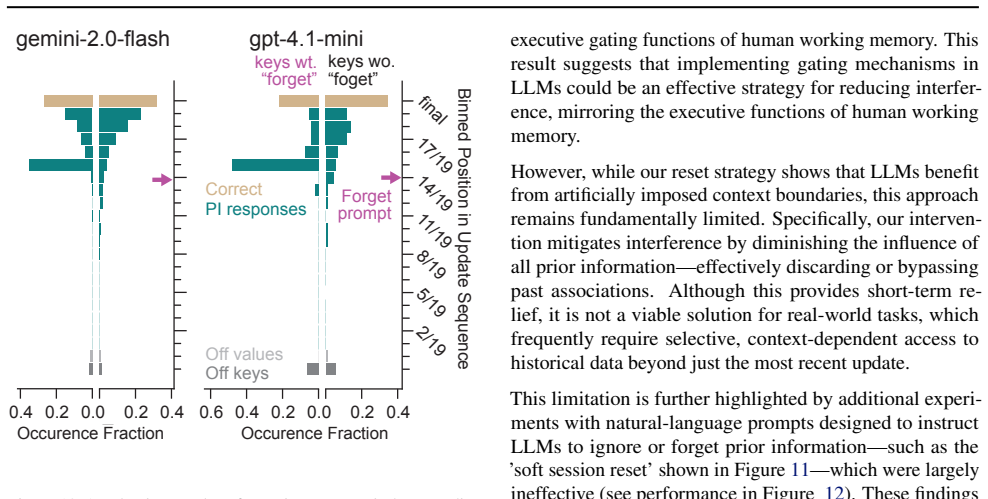
The load-bearing object is the proactive-interference (PI) retrieval task: an interleaved sequence of key–value updates over a fixed set of keys, with the instruction to return only the current, last value of each key, so every earlier value of the same key is a semantically similar distractor. The paper's quantitative index is the Interference Endurance Score (IES), defined as the area under the curve of retrieval accuracy against log-scaled update count, which ranks models by how slowly they degrade. The argument is carried by the error distribution: erroneous answers are dominated by previously overwritten values of the same key, shifting from adjacent positions to distant ones and eventually to unseen values as interference grows, which is presented as evidence that LLMs lack an unbinding or gating mechanism rather than a search failure.
What would settle it
Run the fixed-length setup while always asking the model to report a single key's final value, varying only the number of prior updates or updated keys; if accuracy no longer falls log-linearly with interference, the claimed isolation of interference from output load is falsified.
Extended reading notes
Core claim
On the paper's own terms, the discovery is that LLM retrieval is constrained by a single, resource-like anti-interference capacity: accuracy declines approximately log-linearly toward zero as the number of updates per key, the number of tracked keys, or the length of each value grows, and this decline is not explained by input length. Because the task always asks for the last-presented value of a repeated key and states the target keys before and after the stream, search difficulty is deliberately minimized, so the failures measure interference directly. Error patterns evolve in three stages—confusion with nearby earlier values, then with distant earlier values, then hallucinated values never present in the input—which the paper interprets as the exhaustion of a working-memory buffer. Parameter size, not advertised context length, predicts the Interference Endurance Score, the area under the accuracy-versus-update-count curve. Explicit prompts to forget outdated updates or focus on recent ones give only marginal gains, chain-of-thought variants do not recover the lost accuracy, and only a mock-QA reset that inserts a hard context boundary substantially helps, though accuracy still declines with interference.
Load-bearing premise
That in the fixed-input-length experiment, varying the number of tracked keys changes only interference load; in fact it also changes how many values the model must output, so the observed decline could partly reflect generation load rather than retrieval interference.
Editorial extensions
If this is right
- Length-based long-context benchmarks are measuring a different axis: extending context appears not to give a model more anti-interference capacity.
- Model-size comparisons should account for interference load, since larger parameter counts predict slower log-linear decline while context-window length does not.
- Prompt-level fixes such as 'ignore earlier updates' or 'focus on recent text' are insufficient, so improving interference tolerance likely needs architectural changes, for instance an explicit gating or reset mechanism.
- Reasoning or chain-of-thought modes do not cure interference-affected retrieval, so allocating more inference compute will not by itself close this gap.
- A single interference budget is taxed by three different manipulations—update count, tracked-key count, and value length—so retrieval reliability under distraction can be expected to degrade on any of these axes independently.
Reading between the lines
- A control not run in the paper would query one key at a time while varying interference in a constant-length context; that would separate retrieval interference from the load of generating many answers.
- The success of the mock-QA reset hints that any mechanism imposing a hard context boundary, such as a learned forget gate or a memory reset, might reproduce the gain, but it is unknown whether such gating can be selective rather than discarding all history.
- The three-stage error shift from nearby values to hallucinations is a behavioral signature that could be tracked mechanistically, for example by probing attention or induction-circuit weights, to test whether old associations remain bound rather than being unbound.
- Because the benchmark uses synthetic word categories, an extension to naturalistic streams such as patient vitals, versioned code state, or mutable ledgers would show whether the log-linear law survives realistic semantic overlap.
Editorial analysis
A structured set of objections, weighed in public.
Referee Report
Summary. The paper introduces PI-LLM, a synthetic key-value update task in which models must report the most recent value for each tracked key after a stream of repeated updates. The central empirical finding is a roughly log-linear decline in retrieval accuracy as the number of interfering updates, tracked keys, or value tokens grows, across 35 models. The authors argue that the decline is not explainable by input length because a fixed-input-length variant shows the same pattern, and they report that larger models have higher Interference Endurance Scores (IES) while nominal context length does not predict IES. Prompt-based interventions such as directed forgetting are mostly ineffective, while a mock QA reset partially restores accuracy. The paper concludes that LLM retrieval is limited by a working-memory-like anti-interference capacity distinct from context length.
Significance. The task design is simple, reproducible, and well suited to isolating proactive interference in modern LLMs, and the coverage of 35 dense, MoE, and CoT models gives the benchmark broad descriptive value. The main update-count experiment controls the number of outputs (46 keys) and the output format, reports bootstrapped confidence intervals, and includes an error-location analysis showing that mistakes are often prior values; these are genuine strengths. Public code and data are promised, which supports reproducibility. If the independence-from-context-length claim survives an output-length control, the paper would establish a practically important evaluation axis. As it stands, the evidence supports an interference effect but not yet the stronger 'beyond context length' conclusion.
major comments (3)
- [3.1.2 and 3.2.3] Experiment B varies the number of tracked keys T while holding input length fixed, but accuracy is measured as the fraction of correctly retrieved values across all T keys (Section 2.1), so output length and decoding load grow with T. Experiment A has the same property because the number of updated keys equals the number of queried keys. The nearly identical declines in Figure 9 therefore only rule out input length as the sole cause; they do not rule out generation-load effects such as format drift, response truncation, or attention dilution at decoding time. No control is reported that holds the number of required outputs constant while varying interference, and the error-location analysis in Figures 5 and 19 is performed on Experiment 1, where output length is fixed at 46 keys. Please add such a control or otherwise quantify the fraction of failures attributable to incomplete or malformed outputs in Experiments A and B.
- [2.2 and 3.2.3] The 'log-linear decline' is a central quantitative claim, but no regression is reported for any of the curves in Figures 1, 3, or 9: there are no slopes, intercepts, R-squared values, or comparisons against alternative functional forms. Visual inspection of log-scaled axes is not sufficient to establish a universal log-linear law, especially since Figure 4 shows a step-like pattern for sequential ordering. Please fit per-model models such as accuracy ~ a + b log(update_count), and the equivalent for tracked keys and value length, and report goodness of fit and model comparisons.
- [2.2.2] The regression of IES on parameter size class and context length is descriptive and may be underpowered: IES is the AUC of the same accuracy curves, the analysis uses N=30 after excluding reasoning and proprietary models, and context lengths cluster at 128k-131k. The current reporting of t and p for two predictors with R-squared = 0.261 does not address collinearity or the limited range of context lengths. I ask for a continuous-size regression where parameter counts are public, a check of variance inflation, and an explicit statement that this is a descriptive fit rather than a claim that context length is causally irrelevant.
minor comments (4)
- [2.2.2] The text says IES is computed from the accuracy-versus-update-count function 'see Figure 5', but the IES curves are shown in Figure 16; the figure citation should be corrected.
- [Appendix A] The caption of Figure 19 ends with 'See Figure 19 for additional models', which is circular and likely intended to refer to Figure 5 or Figure 18.
- [Figure 12] The phrase 'key-value pair length of 6' is ambiguous; it should specify whether this is the value length in words or in tokens.
- [References] There is a typo in the Introduction and reference list: 'V odrahalli' should be 'Vodrahalli'.
Circularity Check
No significant circularity: the paper reports direct empirical measurements with no derivation chain that reduces to its own inputs.
full rationale
The paper's central claims are empirical measurements: retrieval accuracy is measured on synthetic key-value streams across 35 models, and the observed log-linear decline is presented as a fitted description of those measurements, not as a prediction derived from a fitted parameter. The Interference Endurance Score (IES) is defined as the area under the same accuracy-versus-update-count curves used in the regression against model size and context length (Section 2.2.2); this is a summary statistic of measured data, not a prediction of an independent quantity, so it does not constitute circularity under the specified patterns. The fixed-length experiment (Experiment B, Section 3.1.2) may confound interference load with the number of required outputs, as the skeptic notes, but that is a potential validity threat rather than a circular derivation: the claim that interference is independent of input length is supported by external measurements, and no equation or definition makes the conclusion equivalent to the input. The paper contains no load-bearing self-citations: references to prior human working-memory work (e.g., Oberauer & Vockenberg, 2009; Festini & Reuter-Lorenz, 2014) are used only as analogies and test-design inspiration, not to justify the empirical result. There is no uniqueness theorem imported from the authors' own prior work, and no ansatz is smuggled in via citation. The finding is self-contained against the reported experiments, so the appropriate score is 0.
Assumptions & free parameters
assumptions (4)
- domain assumption Placing the retrieval target as the last update of each key minimizes search difficulty, so accuracy loss is attributable to interference.
- domain assumption Human proactive-interference findings (performance plateau, benefit from directed forgetting) are a valid comparative baseline for LLM behavior.
- domain assumption Resistance to proactive interference reflects working memory capacity in humans; applying the same logic to LLMs yields a 'working memory-like' capacity metric.
- standard math Bootstrap confidence intervals, AUC, and Spearman correlation are standard statistical tools.
Cite this review
Pith. "Pith review of Unable to Forget: Proactive Interference Reveals Working Memory Limits in LLMs Beyond Context Length." pith.science (2026). https://pith.science/paper/2EHLVTSH
@misc{pith2026250608184,
  author       = {Pith},
  title        = {Pith review of: Unable to Forget: Proactive Interference Reveals Working Memory Limits in LLMs Beyond Context Length},
  year         = {2026},
  howpublished = {\url{https://pith.science/paper/2EHLVTSH}},
  note         = {Machine review of arXiv:2506.08184}
}
read the original abstract
Information retrieval in Large Language Models (LLMs) is increasingly recognized as intertwined with generation capabilities rather than mere lookup. While longer contexts are often assumed to improve retrieval, the effects of intra-context interference remain understudied. To address this, we adapt the proactive interference (PI) paradigm from cognitive science, where earlier information disrupts recall of newer updates. In humans, susceptibility to such interference is inversely linked to working memory capacity. We introduce PI-LLM, an evaluation that sequentially streams semantically related key-value updates and queries only the final values. Although these final values are clearly positioned just before the query, LLM retrieval accuracy declines log-linearly toward zero as interference accumulates; errors arise from retrieving previously overwritten values. Attempts to mitigate interference via prompt engineering (e.g., instructing models to ignore earlier input) yield limited success. These findings reveal a fundamental constraint on LLMs' ability to disentangle interference and flexibly manipulate information, suggesting a working memory bottleneck beyond mere context access. This calls for approaches that strengthen models' ability to suppress irrelevant content during retrieval.
Figures


Figures from the paper (17 more)




Reference graph
Works this paper leans on
-
[1]
write newline
" write newline "" before.all 'output.state := FUNCTION n.dashify 't := "" t empty not t #1 #1 substring "-" = t #1 #2 substring "--" = not "--" * t #2 global.max substring 't := t #1 #1 substring "-" = "-" * t #2 global.max substring 't := while if t #1 #1 substring * t #2 global.max substring 't := if while FUNCTION format.date year duplicate empty "emp...
-
[2]
In-context learning and induction heads, March 2022
Anthropic . In-context learning and induction heads, March 2022. URL https://www.anthropic.com/news/in-context-learning-and-induction-heads. Publisher: Anthropic
work page 2022
-
[3]
D., Thomson, N., and Buchanan, M
Baddeley, A. D., Thomson, N., and Buchanan, M. Word length and the structure of short-term memory. Journal of Verbal Learning and Verbal Behavior, 14 0 (6): 0 575--589, December 1975. doi:10.1016/S0022-5371(75)80045-4. URL https://doi.org/10.1016/S0022-5371(75)80045-4
-
[4]
Festini, S. B. and Reuter-Lorenz, P. A. Cognitive control of familiarity: Directed forgetting reduces proactive interference in working memory. Cognitive, Affective, & Behavioral Neuroscience, 14 0 (1): 0 78--89, March 2014. ISSN 1531-135X. doi:10.3758/s13415-013-0231-1. URL https://doi.org/10.3758/s13415-013-0231-1
-
[5]
Working Memory Capacity of ChatGPT : An Empirical Study
Gong, D., Wan, X., and Wang, D. Working Memory Capacity of ChatGPT : An Empirical Study . Proceedings of the AAAI Conference on Artificial Intelligence, 38 0 (9): 0 10048--10056, March 2024. ISSN 2374-3468. doi:10.1609/aaai.v38i9.28868. URL https://ojs.aaai.org/index.php/AAAI/article/view/28868. Number: 9
-
[6]
He, J., Rungta, M., Koleczek, D., Sekhon, A., Wang, F. X., and Hasan, S. Does Prompt Formatting Have Any Impact on LLM Performance ?, November 2024. URL http://arxiv.org/abs/2411.10541. arXiv:2411.10541 [cs] version: 1
arXiv 2024
-
[7]
Kuo, M., Zhang, J., Ding, A., Wang, Q., DiValentin, L., Bao, Y., Wei, W., Juan, D.-C., Li, H., and Chen, Y. H- CoT : Hijacking the Chain -of- Thought Safety Reasoning Mechanism to Jailbreak Large Reasoning Models , Including OpenAI o1/o3, DeepSeek - R1 , and Gemini 2.0 Flash Thinking , February 2025. URL http://arxiv.org/abs/2502.12893. arXiv:2502.12893 [...
arXiv 2025
-
[8]
F., Lin, K., Hewitt, J., Paranjape, A., Bevilacqua, M., Petroni, F., and Liang, P
Liu, N. F., Lin, K., Hewitt, J., Paranjape, A., Bevilacqua, M., Petroni, F., and Liang, P. Lost in the Middle : How Language Models Use Long Contexts . Transactions of the Association for Computational Linguistics, 12: 0 157--173, February 2024. ISSN 2307-387X. doi:10.1162/tacl_a_00638. URL https://doi.org/10.1162/tacl_a_00638
Show all 12 references
-
[9]
and Vockenberg, K
Oberauer, K. and Vockenberg, K. Updating of working memory: lingering bindings. Quarterly Journal of Experimental Psychology (2006), 62 0 (5): 0 967--987, May 2009. ISSN 1747-0226. doi:10.1080/17470210802372912
2006 doi
-
[10]
Introducing GPT -4.1 in the API , April 2025 a
OpenAI . Introducing GPT -4.1 in the API , April 2025 a . URL https://openai.com/index/gpt-4-1/. Publisher: OpenAI
2025
-
[11]
multiple-needle-in-a-haystack
OpenAI . OpenAI MRCR : Long -context “multiple-needle-in-a-haystack” benchmark, 2025 b . URL https://huggingface.co/datasets/openai/mrcr
2025
-
[12]
Michelangelo: Long Context Evaluations Beyond Haystacks via Latent Structure Queries , September 2024
Vodrahalli, K., Ontanon, S., Tripuraneni, N., Xu, K., Jain, S., Shivanna, R., Hui, J., Dikkala, N., Kazemi, M., Fatemi, B., Anil, R., Dyer, E., Shakeri, S., Vij, R., Mehta, H., Ramasesh, V., Le, Q., Chi, E., Lu, Y., Firat, O., Lazaridou, A., Lespiau, J.-B., Attaluri, N., and O...
2024 arXiv
Reviewed August 7, 2026 · model on record in the stance chip above.
Discussion (0). Sign in to comment.