REVIEW 3 major objections 5 minor 1 cited by
Reinforcement Learning from Human Feedback with High-Confidence Safety Constraints
T0 review · 3 major / 5 minor · reviewed 2026-08-07 · deepseek-v4-flash
Pith's one-line read HC-RLHF trains language models under a deliberately pessimistic safety constraint and only returns a model if a held-out statistical test certifies that its expected harm is below tolerance with probability at least 1−δ.
desk verdict Seldonian-style safety guarantee for RLHF that is close, but the proof has a real gap: the safety test must sample responses from the candidate policy, and Algorithm 1 never says it does. read the letter →
The pith
A machine-rendered reading of the paper's core claim, the machinery that carries it, and where it could break.
The reading
What carries the argument
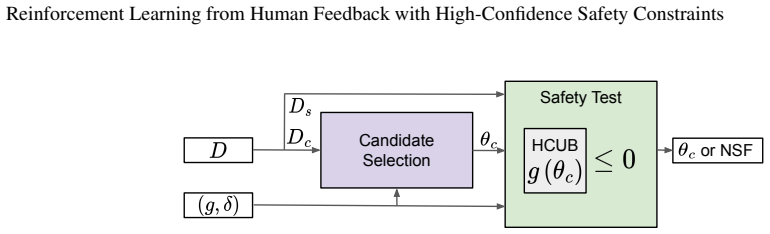
The load-bearing object is the high-confidence upper bound on expected cost, U_ttest(ĝ) = sample mean + (sample standard deviation / √m) · t_{1−δ,m−1}, built from Student's t quantiles. This bound appears twice: first in candidate selection, where the training constraint inflates the empirical mean cost by a standard-deviation term K(δ) to make the optimization pessimistic about safety, and second in the held-out safety test that decides whether to return the candidate or to return no solution. The policy-gradient update implementing this pessimistic constraint uses an augmented reward containing the empirical mean and standard deviation of costs, with RLOO variance reduction.
What would settle it
Run HC-RLHF with a cost model whose harm scores are heavily skewed and bounded, fixing δ = 0.1 and a small safety-test size such as m = 50, then repeatedly measure the true expected cost of returned policies; if the empirical failure rate clearly exceeds 10%, the advertised 1−δ guarantee does not hold outside the normality assumption.
Extended reading notes
Core claim
The paper's central claim is Theorem 4.2: for Algorithm 1, with g defined as the expected cost under the learned cost model minus a tolerance τ, and under the assumption that the mean of the safety-test estimates is normally distributed, Pr(g(alg(D)) ≤ 0) ≥ 1−δ. In other words, the algorithm either returns a candidate policy whose expected harm is certified by a Student's t upper-confidence bound to be at most τ with confidence at least 1−δ, or it returns a no-solution outcome whose harm is defined as zero. The proof shows that the safety-test estimates are unbiased and i.i.d., making the Student's t bound valid, and that the algorithm returns a policy only when that bound is non-positive.
Load-bearing premise
The certificate is exact only if the safety-test cost estimates are unbiased i.i.d. draws from the candidate policy's response distribution and their sample mean is normally distributed, so that Student's t-test gives the claimed confidence.
Editorial extensions
If this is right
- If the theorem holds, a deployed model is either certified by the safety test to respect the harm tolerance with confidence at least 1−δ, or the algorithm returns no solution and no unsafe model is released.
- Because the final decision is made on held-out data by the safety test, the method cannot silently return an over-optimized policy that only looks safe under the training objective.
- The same safety-test machinery can use distribution-free bounds such as Hoeffding's inequality, extending the high-confidence guarantee to settings where harm scores are known to be bounded.
- Experiments indicate that HC-RLHF stays safe across stricter tolerance settings (more negative τ), whereas the constrained baseline without the safety test fails at stricter thresholds.
- Users can choose the confidence level δ and the harm tolerance τ ahead of time, so the safety guarantee is tuned to the risk profile of the application.
Reading between the lines
- The certificate applies to expected cost under the learned cost model, not directly to real-world harm; if the cost model mislabels harmful content, the guarantee does not cover that error.
- The exact 1−δ claim depends on the sample mean of safety-test estimates being normally distributed; with heavily skewed or heavy-tailed harm scores and small safety sets, the Student's t bound is only an approximation and the stated confidence may be optimistic.
- Treating the no-solution outcome as safe shifts the practical burden: an algorithm that frequently returns no solution is formally safe but may be unusable, so the data size and threshold needed to avoid frequent no-solution outcomes become important operational questions.
- The guarantee assumes a stationary prompt distribution between training and deployment; adversarial rephrasing or shifts in prompt frequency are outside the certified claim, as the paper notes.
Editorial analysis
A structured set of objections, weighed in public.
Referee Report
Summary. The paper proposes HC-RLHF, a Seldonian-style algorithm for RLHF that decouples helpfulness and harmlessness by training separate reward and cost models, then adds a held-out safety test: after candidate selection under a pessimistic cost constraint, the algorithm computes a Student-t high-confidence upper bound on expected cost and returns the candidate only if that bound is at or below zero, otherwise returning NSF. The main theoretical claim (Theorem 4.2) is that, under Assumption 4.1, the probability that HC-RLHF returns an unsafe policy is at most delta. The experiments compare HC-RLHF with Safe RLHF on Qwen2-1.5B, Qwen2.5-3B, and Llama3.2-3B, reporting win rates, scatter plots of reward versus cost, a 30-trial failure-rate study for one base model, and a single-trial threshold sweep.
Significance. If the guarantee can be stated and proved correctly, the paper would make a meaningful contribution: it is the first RLHF method, to my knowledge, that attempts to provide a Seldonian high-confidence safety guarantee on expected harm while maximizing helpfulness. The Seldonian meta-architecture is standard, the decision to keep the safety test independent of candidate selection is principled, and the code is publicly available. The paper also correctly identifies that the candidate-selection penalty need not be valid for the final safety guarantee to hold, since the safety test uses the held-out split. However, the central theorem is not valid as written because the safety-test estimator is not shown to be on-policy and the threshold tau is omitted from the test statistic; these issues are load-bearing and must be repaired before the contribution can be assessed.
major comments (3)
- [Algorithm 1, line 4; Section 4 proof] The unbiasedness claim in the proof of Theorem 4.2 is unsupported as written. The theorem requires E[g_hat_i] = g(theta_c) = E_{x~D_x, y~pi_{theta_c}(.|x)}[C_psi(x,y)] - tau, but Algorithm 1 partitions a fixed input dataset into D_c and D_s and sets g_hat_i = C_psi(x_i,y_i) for the stored pairs. The paper never states that the response y_i is sampled from the candidate policy pi_{theta_c} for the safety test, nor does it provide an importance-weighting or other off-policy correction. If D_s was generated by the SFT policy, the preference dataset, or any policy other than theta_c, then E[g_hat_i] is the expected cost under that behavior policy, not under the candidate policy, and the t-test bounds the wrong quantity. Please specify the generative process for D_s (e.g., draw prompts from a held-out prompt pool and sample responses from the candidate after candidate selection) and adjust the algorithm and proof accordingly.
- [Algorithm 1, line 4; Eq. (8)] Even if the responses in D_s were on-policy, the estimator in line 4 is g_hat_i = C_psi(x_i,y_i), whose expectation is E[C_psi], whereas the performance function g in Eq. (8) is E[C_psi] - tau. The safety test U_ttest(g_hat) <= 0 therefore certifies E[C_psi] <= 0, not E[C_psi] - tau <= 0. For the negative thresholds tau in Table 2, this is a strictly weaker condition than g(theta_c) <= 0, so passing the test does not imply the policy is safe according to the paper's own definition. The proof's equality E[g_hat_i] = g(theta_c) is inconsistent with the definition in line 4. The fix is to define g_hat_i = C_psi(x_i,y_i) - tau and test U_ttest(g_hat) <= 0, or to restrict the theorem to tau = 0.
- [Abstract; Section 3.1; Assumption 4.1] The abstract advertises an unconditional probabilistic guarantee: 'proof that it will not return an unsafe solution with a probability greater than a user-specified threshold.' This is stronger than what the paper proves. Theorem 4.2 depends on Assumption 4.1, which requires the estimates g_hat to be normally distributed (or at least the sample mean to be normal), and Section 3.1 explicitly concedes that Student's t-test is exact only under normality and relies on the CLT as a large-m approximation. For the finite sample sizes and non-normal cost-model outputs used in the experiments, the advertised 1-delta confidence is not exact. The abstract should either state the normality assumption or the paper should use the Hoeffding bound from Appendix B with a stated boundedness assumption on C_psi. This is a central claim and should be reported accurately.
minor comments (5)
- [Section 2.3; Algorithm 1] Section 2.3 says that the training dataset D 'consists of prompts sampled from D_x', but Algorithm 1 iterates over (x_i,y_i) pairs in D_s. Please clarify what D contains and where the responses y_i come from; this is part of the under-specification of the safety-test sampling.
- [Section 5.1, Seldonian Guarantee] The statement that the failure rate 'was observed to be 0, with a standard deviation of 0' is misleading. With 30 trials and zero failures, the standard deviation of the observed proportion is not the right uncertainty measure; a binomial confidence interval (e.g., approximate 95% CI of [0, 0.116]) would be more informative. Also, this experiment uses only Qwen2-1.5b, and the Llama3.2-3b threshold sweep in Table 2 is a single trial, so the empirical support for the probabilistic guarantee across models is currently thin.
- [Table 2] Table 2 reports one trial per threshold. A single trial cannot demonstrate a 1-delta property, and the table should be explicitly labeled as an illustrative run rather than as validation of the Seldonian guarantee.
- [Appendix A] There is a typo in the REINFORCE review: 'cummulative rewrad' should be 'cumulative reward'.
- [Section 3.2, K(delta)] The candidate-selection penalty K(delta) includes free coefficients rho_1 and rho_2, but the paper does not state explicitly that these coefficients affect only the candidate-selection stage and do not enter the validity of the final safety test. Since the safety test uses only D_s, this is not a threat to the theorem, but stating it would prevent confusion.
Circularity Check
No significant circularity: the high-confidence safety guarantee is produced by a held-out Student's t-test bound on independently defined estimates, not by reusing fitted values or by a self-citation chain.
full rationale
Walking the derivation chain: Algorithm 1 selects a candidate using D_c, then computes ghat_i = C_psi(x_i,y_i) on the held-out split D_s (line 4) and returns the candidate only when U_ttest(ghat) <= 0 (line 5). Theorem 4.2's proof uses only the safety-test step: if ghat is i.i.d. and unbiased for g(theta_c), Student's t-test (an external result, cited to Student 1908) supplies Pr(g(theta_c) > U_ttest(ghat)) <= delta, and the decision rule makes Pr(g(alg(D)) > 0) <= delta; NSF is safe by the paper's explicit convention g(NSF) = 0. The pessimistic candidate-selection constraint is not used in the guarantee, so it is not a fitted input disguised as a prediction. The cost model C_psi defines the safety objective rather than being trained to satisfy the final bound, so its use is a modeling choice, not circularity. Self-citations (Thomas et al. 2019, Metevier et al. 2019, Weber et al. 2022) describe the Seldonian meta-architecture the paper instantiates, but the theorem is proved in-paper from Student's t-test and does not reduce to those citations. The proof does contain a rigor gap: it asserts unbiasedness of ghat_i without specifying that D_s responses are generated from the returned candidate policy theta_c (or an off-policy correction), which is a correctness concern, not a circularity. No equation or fitted parameter is shown to be equivalent to the claimed result by construction, so the circularity score is 0.
Assumptions & free parameters
free parameters (2)
- rho_1 =
4
- rho_2 =
2
assumptions (4)
- domain assumption The sample mean of the m safety-test estimates is normally distributed (Assumption 4.1).
- domain assumption The prompt distribution is stationary between training and deployment.
- domain assumption The learned cost model C_psi is the operative definition of harm for the guarantee.
- domain assumption Returning no solution (NSF) is safe, i.e., g(NSF)=0.
Cite this review
Pith. "Pith review of Reinforcement Learning from Human Feedback with High-Confidence Safety Constraints." pith.science (2026). https://pith.science/paper/E3VDQ5S7
@misc{pith2026250608266,
  author       = {Pith},
  title        = {Pith review of: Reinforcement Learning from Human Feedback with High-Confidence Safety Constraints},
  year         = {2026},
  howpublished = {\url{https://pith.science/paper/E3VDQ5S7}},
  note         = {Machine review of arXiv:2506.08266}
}
read the original abstract
Existing approaches to language model alignment often treat safety as a tradeoff against helpfulness, which can lead to unacceptable responses in sensitive domains. To ensure reliable performance in such settings, we propose High-Confidence Safe Reinforcement Learning from Human Feedback (HC-RLHF), a method that provides high-confidence safety guarantees while maximizing helpfulness. Similar to previous methods, HC-RLHF explicitly decouples human preferences into helpfulness and harmlessness (safety), which are learned by training a reward model and a cost model, respectively. It then employs a two-step process to find safe solutions. In the first step, it optimizes the reward function under an intentionally pessimistic version of the cost constraint. In the second step, the trained model undergoes a safety test to verify whether its performance stays within an upper-confidence bound of the actual cost constraint. We provide a theoretical analysis of HC-RLHF, including proof that it will not return an unsafe solution with a probability greater than a user-specified threshold. For our empirical analysis, we apply HC-RLHF to align three different language models (Qwen2-1.5B, Qwen2.5-3B, and LLaMa3.2-3B) with human preferences. Our results demonstrate that HC-RLHF produces safe models with high probability and can improve harmlessness and helpfulness compared to previous methods.
Figures


Figures from the paper (3 more)


Forward citations
Cited by 1 Pith paper
-
Adaptive Margin RLHF via Preference over Preferences
Adaptive margins for DPO inferred from preference-over-preference comparisons improve alignment quality, with random sampling of comparisons working best overall.
Reference graph
Works this paper leans on
-
[1]
Arash Ahmadian, Chris Cremer, Matthias Gallé, Marzieh Fadaee, Julia Kreutzer, Olivier Pietquin, Ahmet Üstün, and Sara Hooker. Back to basics: Revisiting reinforce style optimization for learning from human feedback in LLMs , 2024. URL https://arxiv.org/abs/2402.14740
arXiv 2024
-
[2]
Constrained Markov decision processes
Eitan Altman. Constrained Markov decision processes. Routledge, 2021
2021
-
[3]
Constitutional AI : Harmlessness from AI feedback
Yuntao Bai et al. Constitutional AI : Harmlessness from AI feedback. ArXiv, abs/2212.08073, 2022 a . URL https://api.semanticscholar.org/CorpusID:254823489
arXiv 2022
-
[4]
Training a helpful and harmless assistant with reinforcement learning from human feedback, 2022 b
Yuntao Bai et al. Training a helpful and harmless assistant with reinforcement learning from human feedback, 2022 b . URL https://arxiv.org/abs/2204.05862
arXiv 2022
-
[5]
Convex optimization
Stephen P Boyd and Lieven Vandenberghe. Convex optimization. Cambridge university press, 2004
2004
-
[6]
Rank analysis of incomplete block designs: I
Ralph Allan Bradley and Milton E Terry. Rank analysis of incomplete block designs: I. T he method of paired comparisons. Biometrika, 39 0 (3/4): 0 324--345, 1952
work page 1952
-
[7]
Brown, Miljan Martic, Shane Legg, and Dario Amodei
Paul Francis Christiano, Jan Leike, Tom B. Brown, Miljan Martic, Shane Legg, and Dario Amodei. Deep reinforcement learning from human preferences. ArXiv, abs/1706.03741, 2017. URL https://api.semanticscholar.org/CorpusID:4787508
arXiv 2017
-
[8]
Safe RLHF : Safe reinforcement learning from human feedback
Josef Dai, Xuehai Pan, Ruiyang Sun, Jiaming Ji, Xinbo Xu, Mickel Liu, Yizhou Wang, and Yaodong Yang. Safe RLHF : Safe reinforcement learning from human feedback. arXiv preprint arXiv:2310.12773, 2023
arXiv 2023
Show all 58 references
-
[9]
Policy gradients with variance related risk criteria
Dotan Di Castro, Aviv Tamar, and Shie Mannor. Policy gradients with variance related risk criteria. arXiv preprint arXiv:1206.6404, 2012
2012 arXiv
-
[10]
Stevie Bergman, Shannon Spruit, Dirk Hovy, Y-Lan Boureau, and Verena Rieser
Emily Dinan, Gavin Abercrombie, A. Stevie Bergman, Shannon Spruit, Dirk Hovy, Y-Lan Boureau, and Verena Rieser. Anticipating safety issues in e2e conversational AI : Framework and tooling, 2021. URL https://arxiv.org/abs/2107.03451
2021 arXiv
-
[11]
Hashimoto
Yann Dubois, Xuechen Li, Rohan Taori, Tianyi Zhang, Ishaan Gulrajani, Jimmy Ba, Carlos Guestrin, Percy Liang, and Tatsunori B. Hashimoto. Alpacafarm: A simulation framework for methods that learn from human feedback, 2024. URL https://arxiv.org/abs/2305.14387
2024 arXiv
-
[12]
Fundamentals of optimization theory with applications to machine learning
Jean Gallier and Jocelyn Quaintance. Fundamentals of optimization theory with applications to machine learning. University of Pennsylvania Philadelphia, PA, 19104, 2019
2019
-
[13]
Red teaming language models to reduce harms: Methods, scaling behaviors, and lessons learned
Deep Ganguli et al. Red teaming language models to reduce harms: Methods, scaling behaviors, and lessons learned. ArXiv, abs/2209.07858, 2022. URL https://api.semanticscholar.org/CorpusID:252355458
2022 arXiv
-
[14]
Scaling laws for reward model overoptimization
Leo Gao, John Schulman, and Jacob Hilton. Scaling laws for reward model overoptimization. In International Conference on Machine Learning, 2022. URL https://api.semanticscholar.org/CorpusID:252992904
2022
-
[15]
Samuel Gehman, Suchin Gururangan, Maarten Sap, Yejin Choi, and Noah A. Smith. Realtoxicityprompts: Evaluating neural toxic degeneration in language models. In Findings, 2020. URL https://api.semanticscholar.org/CorpusID:221878771
2020
-
[16]
Fairness guarantees under demographic shift
Stephen Giguere, Blossom Metevier, Yuriy Brun, Bruno Castro Da Silva, Philip S Thomas, and Scott Niekum. Fairness guarantees under demographic shift. In Proceedings of the 10th International Conference on Learning Representations (ICLR), 2022
2022
-
[17]
Improving alignment of dialogue agents via targeted human judgements, 2022
Amelia Glaese et al. Improving alignment of dialogue agents via targeted human judgements, 2022. URL https://arxiv.org/abs/2209.14375
2022 arXiv
-
[18]
The Llama 3 herd of models, 2024
Aaron Grattafiori et al. The Llama 3 herd of models, 2024. URL https://arxiv.org/abs/2407.21783
2024 arXiv
-
[19]
Ethical challenges in data-driven dialogue systems, 2017
Peter Henderson, Koustuv Sinha, Nicolas Angelard-Gontier, Nan Rosemary Ke, Genevieve Fried, Ryan Lowe, and Joelle Pineau. Ethical challenges in data-driven dialogue systems, 2017. URL https://arxiv.org/abs/1711.09050
2017 arXiv
-
[20]
Probability inequalities for sums of bounded random variables
Wassily Hoeffding. Probability inequalities for sums of bounded random variables. Journal of the American Statistical Association, 58 0 (301): 0 13--30, 1963
1963
-
[21]
One-shot safety alignment for large language models via optimal dualization
Xinmeng Huang, Shuo Li, Edgar Dobriban, Osbert Bastani, Hamed Hassani, and Dongsheng Ding. One-shot safety alignment for large language models via optimal dualization. In The Thirty-eighth Annual Conference on Neural Information Processing Systems, 2024. URL https://openreview...
2024
-
[22]
Jones, Shixiang Shane Gu, and Rosalind W
Natasha Jaques, Asma Ghandeharioun, Judy Hanwen Shen, Craig Ferguson, \`A gata Lapedriza, Noah J. Jones, Shixiang Shane Gu, and Rosalind W. Picard. Way off-policy batch deep reinforcement learning of implicit human preferences in dialog. ArXiv, abs/1907.00456, 2019. URL https:...
1907 arXiv
-
[23]
Beavertails: Towards improved safety alignment of LLM via a human-preference dataset, 2023
Jiaming Ji, Mickel Liu, Juntao Dai, Xuehai Pan, Chi Zhang, Ce Bian, Chi Zhang, Ruiyang Sun, Yizhou Wang, and Yaodong Yang. Beavertails: Towards improved safety alignment of LLM via a human-preference dataset, 2023. URL https://arxiv.org/abs/2307.04657
2023
-
[24]
ChatGPT for good? O n opportunities and challenges of large language models for education
Enkelejda Kasneci et al. ChatGPT for good? O n opportunities and challenges of large language models for education. Learning and Individual Differences, 2023. URL https://api.semanticscholar.org/CorpusID:257445349
2023
-
[25]
GPT -4 passes the bar exam
Daniel Martin Katz, Michael James Bommarito, Shang Gao, and Pablo Arredondo. GPT -4 passes the bar exam. Philosophical transactions. Series A, Mathematical, physical, and engineering sciences, 382, 2024. URL https://api.semanticscholar.org/CorpusID:257572753
2024
-
[26]
Buy 4 reinforce samples, get a baseline for free! In DeepRLStructPred@ICLR, 2019
Wouter Kool, Herke van Hoof, and Max Welling. Buy 4 reinforce samples, get a baseline for free! In DeepRLStructPred@ICLR, 2019. URL https://api.semanticscholar.org/CorpusID:198489118
2019
-
[27]
Kung, Morgan Cheatham, Arielle Medenilla, Czarina Sillos, Lorie De Leon, Camille Elepa \ n o, Maria Madriaga, Rimel Aggabao, Giezel Diaz-Candido, James Maningo, and Victor Tseng
Tiffany H. Kung, Morgan Cheatham, Arielle Medenilla, Czarina Sillos, Lorie De Leon, Camille Elepa \ n o, Maria Madriaga, Rimel Aggabao, Giezel Diaz-Candido, James Maningo, and Victor Tseng. Performance of chatgpt on usmle: Potential for AI -assisted medical education using lar...
2022
-
[28]
Enhancing llm safety via constrained direct preference optimization, 2024
Zixuan Liu, Xiaolin Sun, and Zizhan Zheng. Enhancing llm safety via constrained direct preference optimization, 2024. URL https://arxiv.org/abs/2403.02475
2024 arXiv
-
[29]
Offline contextual bandits with high probability fairness guarantees
Blossom Metevier, Stephen Giguere, Sarah Brockman, Ari Kobren, Yuriy Brun, Emma Brunskill, and Philip S Thomas. Offline contextual bandits with high probability fairness guarantees. Advances in neural information processing systems, 32, 2019
2019
-
[30]
Krumholz, Jure Leskovec, Eric J
Michael Moor, Oishi Banerjee, Zahra F H Abad, Harlan M. Krumholz, Jure Leskovec, Eric J. Topol, and Pranav Rajpurkar. Foundation models for generalist medical artificial intelligence. Nature, 616: 0 259--265, 2023. URL https://api.semanticscholar.org/CorpusID:258083369
2023
-
[31]
Rule based rewards for language model safety
Tong Mu, Alec Helyar, Johannes Heidecke, Joshua Achiam, Andrea Vallone, Ian D Kivlichan, Molly Lin, Alex Beutel, John Schulman, and Lilian Weng. Rule based rewards for language model safety. In The Thirty-eighth Annual Conference on Neural Information Processing Systems, 2024....
2024
-
[32]
Training language models to follow instructions with human feedback
Long Ouyang et al. Training language models to follow instructions with human feedback. ArXiv, abs/2203.02155, 2022. URL https://api.semanticscholar.org/CorpusID:246426909
2022 arXiv
-
[33]
Enhancing safety in reinforcement learning with human feedback via rectified policy optimization, 2025
Xiyue Peng, Hengquan Guo, Jiawei Zhang, Dongqing Zou, Ziyu Shao, Honghao Wei, and Xin Liu. Enhancing safety in reinforcement learning with human feedback via rectified policy optimization, 2025. URL https://arxiv.org/abs/2410.19933
2025 arXiv
-
[34]
Qwen2.5 technical report, 2025
Qwen et al. Qwen2.5 technical report, 2025. URL https://arxiv.org/abs/2412.15115
2025 arXiv
-
[35]
Manning, and Chelsea Finn
Rafael Rafailov, Archit Sharma, Eric Mitchell, Stefano Ermon, Christopher D. Manning, and Chelsea Finn. Direct preference optimization: Your language model is secretly a reward model. ArXiv, abs/2305.18290, 2023. URL https://api.semanticscholar.org/CorpusID:258959321
2023 arXiv
-
[36]
Sikchi, Joey Hejna, Bradley Knox, Chelsea Finn, and Scott Niekum
Rafael Rafailov, Yaswanth Chittepu, Ryan Park, Harshit S. Sikchi, Joey Hejna, Bradley Knox, Chelsea Finn, and Scott Niekum. Scaling laws for reward model overoptimization in direct alignment algorithms. ArXiv, abs/2406.02900, 2024. URL https://api.semanticscholar.org/CorpusID:...
2024 arXiv
-
[37]
Rewarded soups: towards pareto-optimal alignment by interpolating weights fine-tuned on diverse rewards
Alexandre Rame, Guillaume Couairon, Corentin Dancette, Jean-Baptiste Gaya, Mustafa Shukor, Laure Soulier, and Matthieu Cord. Rewarded soups: towards pareto-optimal alignment by interpolating weights fine-tuned on diverse rewards. In Thirty-seventh Conference on Neural Informat...
2023
-
[38]
Simultaneous statistical inference
G Rupert Jr et al. Simultaneous statistical inference. 2012
2012
-
[39]
Proximal policy optimization algorithms
John Schulman, Filip Wolski, Prafulla Dhariwal, Alec Radford, and Oleg Klimov. Proximal policy optimization algorithms. ArXiv, abs/1707.06347, 2017. URL https://api.semanticscholar.org/CorpusID:28695052
2017 arXiv
-
[40]
Ziegler, Ryan Lowe, Chelsea Voss, Alec Radford, Dario Amodei, and Paul Christiano
Nisan Stiennon, Long Ouyang, Jeff Wu, Daniel M. Ziegler, Ryan Lowe, Chelsea Voss, Alec Radford, Dario Amodei, and Paul Christiano. Learning to summarize from human feedback, 2022. URL https://arxiv.org/abs/2009.01325
2022 arXiv
-
[41]
The probable error of a mean
Student. The probable error of a mean. Biometrika, 6 0 (1): 0 1--25, 1908
1908
-
[42]
Equilibrate RLHF : Towards balancing helpfulness-safety trade-off in large language models, 2025
Yingshui Tan, Yilei Jiang, Yanshi Li, Jiaheng Liu, Xingyuan Bu, Wenbo Su, Xiangyu Yue, Xiaoyong Zhu, and Bo Zheng. Equilibrate RLHF : Towards balancing helpfulness-safety trade-off in large language models, 2025. URL https://arxiv.org/abs/2502.11555
2025 arXiv
-
[43]
Hashimoto
Rohan Taori, Ishaan Gulrajani, Tianyi Zhang, Yann Dubois, Xuechen Li, Carlos Guestrin, Percy Liang, and Tatsunori B. Hashimoto. Stanford A lpaca: An instruction-following LLaMA model. https://github.com/tatsu-lab/stanford_alpaca, 2023
2023
-
[44]
Preventing undesirable behavior of intelligent machines
Philip S Thomas, Bruno Castro da Silva, Andrew G Barto, Stephen Giguere, Yuriy Brun, and Emma Brunskill. Preventing undesirable behavior of intelligent machines. Science, 366 0 (6468): 0 999--1004, 2019
2019
-
[45]
Lamda: Language models for dialog applications, 2022
Romal Thoppilan et al. Lamda: Language models for dialog applications, 2022. URL https://arxiv.org/abs/2201.08239
2022 arXiv
-
[46]
LlaMa 2: Open foundation and fine-tuned chat models, 2023
Hugo Touvron et al. LlaMa 2: Open foundation and fine-tuned chat models, 2023. URL https://arxiv.org/abs/2307.09288
2023 arXiv
-
[47]
Tran, Rei Sato, Takumi Tanabe, and Youhei Akimoto
Akifumi Wachi, Thien Q. Tran, Rei Sato, Takumi Tanabe, and Youhei Akimoto. Stepwise alignment for constrained language model policy optimization. In The Thirty-eighth Annual Conference on Neural Information Processing Systems, 2024. URL https://openreview.net/forum?id=VrVx83BkQX
2024
-
[48]
Enforcing delayed-impact fairness guarantees
Aline Weber, Blossom Metevier, Yuriy Brun, Philip S Thomas, and Bruno Castro da Silva. Enforcing delayed-impact fairness guarantees. arXiv preprint arXiv:2208.11744, 2022
2022 arXiv
-
[49]
Ethical and social risks of harm from language models
Laura Weidinger et al. Ethical and social risks of harm from language models. ArXiv, abs/2112.04359, 2021. URL https://api.semanticscholar.org/CorpusID:244954639
2021 arXiv
-
[50]
Simple statistical gradient-following algorithms for connectionist reinforcement learning
Ronald J Williams. Simple statistical gradient-following algorithms for connectionist reinforcement learning. Machine learning, 8: 0 229--256, 1992
1992
-
[51]
Recipes for safety in open-domain chatbots, 2021
Jing Xu, Da Ju, Margaret Li, Y-Lan Boureau, Jason Weston, and Emily Dinan. Recipes for safety in open-domain chatbots, 2021. URL https://arxiv.org/abs/2010.07079
2021 arXiv
-
[52]
Qwen2 technical report, 2024
An Yang et al. Qwen2 technical report, 2024. URL https://arxiv.org/abs/2407.10671
2024 arXiv
-
[53]
A large language model for electronic health records
Xi Yang et al. A large language model for electronic health records. NPJ Digital Medicine, 5, 2022. URL https://api.semanticscholar.org/CorpusID:255175535
2022
-
[54]
Wenxuan Zhang, Philip H. S. Torr, Mohamed Elhoseiny, and Adel Bibi. Bi-factorial preference optimization: Balancing safety-helpfulness in language models, 2024. URL https://arxiv.org/abs/2408.15313
2024 arXiv
-
[55]
Xing, Hao Zhang, Joseph E
Lianmin Zheng, Wei-Lin Chiang, Ying Sheng, Siyuan Zhuang, Zhanghao Wu, Yonghao Zhuang, Zi Lin, Zhuohan Li, Dacheng Li, Eric P. Xing, Hao Zhang, Joseph E. Gonzalez, and Ion Stoica. Judging LLM -as-a- J udge with MT - B ench and C hatbot A rena, 2023 a . URL https://arxiv.org/ab...
2023 arXiv
-
[56]
Secrets of RLHF in large language models part I : PPO
Rui Zheng et al. Secrets of RLHF in large language models part I : PPO . ArXiv, abs/2307.04964, 2023 b . URL https://api.semanticscholar.org/CorpusID:259766568
2023 arXiv
-
[57]
Ziegler, Seraphina Nix, Lawrence Chan, Tim Bauman, Peter Schmidt-Nielsen, Tao Lin, Adam Scherlis, Noa Nabeshima, Ben Weinstein-Raun, Daniel de Haas, Buck Shlegeris, and Nate Thomas
Daniel M. Ziegler, Seraphina Nix, Lawrence Chan, Tim Bauman, Peter Schmidt-Nielsen, Tao Lin, Adam Scherlis, Noa Nabeshima, Ben Weinstein-Raun, Daniel de Haas, Buck Shlegeris, and Nate Thomas. Adversarial training for high-stakes reliability, 2022. URL https://arxiv.org/abs/2205.01663
2022 arXiv
-
[58]
write newline
" write newline "" before.all 'output.state := FUNCTION n.dashify 't := "" t empty not t #1 #1 substring "-" = t #1 #2 substring "--" = not "--" * t #2 global.max substring 't := t #1 #1 substring "-" = "-" * t #2 global.max substring 't := while if t #1 #1 substring * t #2 gl...
Reviewed August 7, 2026 · model on record in the stance chip above.
Discussion (0). Sign in to comment.