REVIEW 4 major objections 5 minor 38 references
Re4MPC: Reactive Nonlinear MPC for Multi-model Motion Planning via Deep Reinforcement Learning
T0 review · 4 major / 5 minor · reviewed 2026-08-07 · deepseek-v4-flash
Pith's one-line read Reactive, learned switching among robot models for NMPC raises a mobile-manipulation task's success rate from 61% to 86% while cutting per-solve compute time.
desk verdict A useful engineering contribution with a real confound: the efficiency and success gains are partly written into the reward, and end-to-end compute is never measured. read the letter →
The pith
A machine-rendered reading of the paper's core claim, the machinery that carries it, and where it could break.
The reading
What carries the argument
The central mechanism is the parameterized action space $A_c$ (and its discrete counterpart $A_d$), which encodes three sub-actions: model selection $a_{model} \in [0,1]$ mapped to one of three kinematic models via thresholds, constraint selection $a_{constraint} \in [0,1]^{N_c}$ gated at 0.5, and target selection $a_{target} \in \mathbb{R}^7$ that picks either a sub-goal or the goal pose. These decoded settings define the NMPC problem in Eq. 1, which is solved by Sequential Linear Quadratic (SLQ), a DDP-based optimizer with relaxed barrier functions for constraints. The reward function includes the DOF-proportional model penalty, a goal-distance reward, and a target reward that encourages sub-goals for non-arm modes; together these terms drive the policy to prefer cheaper models when they suffice.
What would settle it
Retrain Re4MPC with the model penalty set to a constant regardless of the selected model's degrees of freedom, keeping everything else identical. If whole-body model usage stays high and per-solve compute time does not drop, then the reported computational gains come from the reward, not from the multi-model selection mechanism itself. Alternatively, run the trained policy in an environment with obstacles and goal positions outside the training distribution; if its success rate falls to the baseline level, the advantage is overfitting to the training layout.
Extended reading notes
Core claim
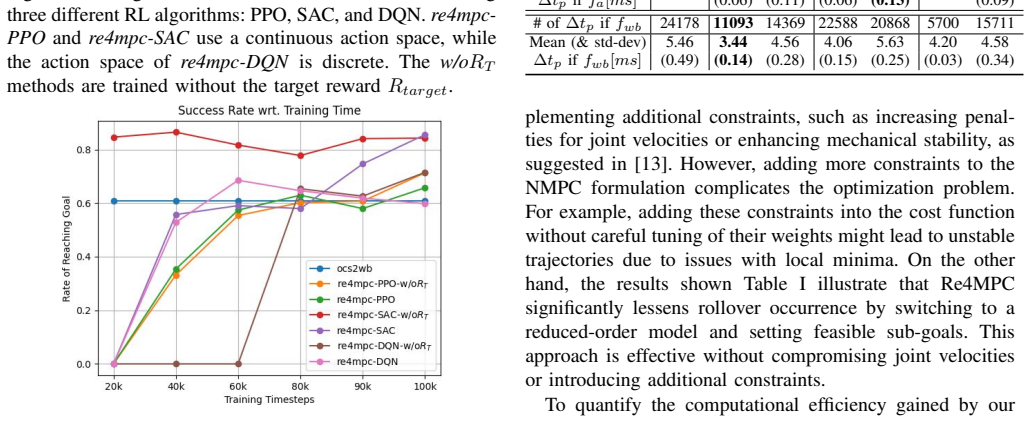
Re4MPC formulates motion planning as a partially observable Markov decision process in which the agent's action is decoded into the NMPC problem definition: the robot model index (base, arm, or whole body), the constraint set, and the end-effector target (either a goal or a sub-goal). The NMPC solver runs for an action horizon with those settings, and the resulting state transitions and rewards shape the policy. The paper reports that after 100k training steps, the SAC-trained variant reaches 86% success versus 61% for the whole-body baseline, with fewer rollovers and collisions, and that the learned policy uses the whole-body model only about 30% of the time in its successful episodes. The computational gain is attributed to a reward term that penalizes the active model in proportion to its degrees of freedom, together with a target reward that steers the agent toward feasible sub-goals.
Load-bearing premise
The load-bearing premise is that the hand-designed reward function — specifically the DOF-proportional model penalty and the target-reward thresholds — is what teaches the policy to choose simpler models, so if those weights do not transfer to new tasks or environments, the reported efficiency and success gains will not transfer either.
Editorial extensions
If this is right
- Re4MPC reduces whole-body model usage in successful episodes to roughly 30% for the SAC variant, implying the learned policy discovers when full-body optimization is unnecessary.
- Per-solve computation time for base-model planning is roughly half that of whole-body planning, so a policy that switches models can cut online compute while maintaining or improving task success.
- All Re4MPC variants surpass the baseline success rate by 100k training timesteps, with SAC variants converging fastest.
- The discrete action space filters infeasible target poses, leading to different model and target selection frequencies than the continuous action space, a design choice the paper links to learning behavior.
Reading between the lines
- If the model-penalty reward is indeed the driver, the same pipeline could be retargeted to other high-DOF systems such as humanoids or multi-arm platforms by swapping the model set while keeping the POMDP action structure; this extension is left implicit in the paper.
- The dependency on hand-tuned reward weights and thresholds (for example $\tau_{target}$, $\delta_{com}$, and $\alpha_{sub}$) suggests a testable bound: performance should degrade gracefully as these parameters are perturbed, but no sensitivity analysis is provided.
- A natural next experiment is to replace the learned policy with a hand-coded heuristic (e.g., use base-only when far from the goal and whole-body when close) and compare; if the heuristic matches Re4MPC, the contribution lies in the multi-model formulation rather than in the learning.
- Because the training environment keeps the box fixed and the conveyor static, the reported gains may be specific to that layout; testing in randomized or dynamic scenes would clarify whether the policy learns true reactivity or a fixed switching schedule.
Editorial analysis
A structured set of objections, weighed in public.
Referee Report
Summary. The paper proposes Re4MPC, a framework that couples deep reinforcement learning (DRL) with nonlinear model predictive control (NMPC) for mobile manipulator motion planning. A DRL policy selects, at each action interval, one of three robot models (base, arm, or whole-body), the NMPC cost function and constraints, and a target (sub-goal or final goal). The framework is evaluated in a PyBullet-based simulation with a Jackal mobile base and a 6-DOF Kinova Jaco arm. The authors report that Re4MPC trained with PPO, SAC, or DQN achieves higher success rates than a whole-body NMPC baseline (ocs2wb), and that it computes trajectories more efficiently because it often selects lower-dimensional models.
Significance. If substantiated, the framework would be a useful contribution to integrated DRL/NMPC for mobile manipulation, and the open-source implementation (mobiman) is a clear strength. The mathematical formulation of integrating NMPC into a DRL loop is clearly presented. However, the current evidence does not establish the computational efficiency claim, and the attribution of gains to reactive model selection is confounded by the reward function's explicit DOF penalty. The success-rate advantage is plausible but lacks statistical support and has at least one internal contradiction.
major comments (4)
- [Section IV.B, Table I] The headline claim that Re4MPC is 'more computationally efficient' than the NMPC baseline is not supported by the reported metrics. Table I lists mean per-call SLQ solve times for each model and the number of NMPC calls per model, but it does not report total computation per episode, end-to-end wall-clock time, or the overhead of the learned policy (neural-network forward pass, action decoding, model switching, sub-goal computation). The paper itself notes that ocs2wb 'exhibits fewer total computations' because Re4MPC episodes tend to last longer. Without total computation or end-to-end time, lower per-call times for simpler models cannot establish the efficiency claim.
- [Section III.B.3, Table I] The reduced whole-body usage is at least partly enforced by design. The reward term R_model penalizes the selected model with a constant whose value is proportional to the model's DOF, directly incentivizing low-DOF choices. Presenting the resulting reduction in whole-body usage as evidence of Re4MPC's efficiency is therefore circular to some degree. An ablation that removes the DOF penalty from R_model, or a comparison against a policy that selects models without this reward shaping, is needed to attribute the efficiency gain to reactive model selection rather than to the reward design.
- [Section IV.B, Fig. 3, Table I] Success rates are reported as point estimates without error bars, confidence intervals, or statistical significance tests, even though each configuration is averaged over five runs. This makes it difficult to assess whether the observed differences over the baseline are meaningful, especially for variants with small differences. The paper should report per-run results, standard deviations, or a statistical test to support the claim of higher success rates.
- [Section IV.A] The baseline ocs2wb is not described in sufficient detail to ensure a fair comparison. It is stated to be a whole-body SLQ formulation with the goal as the MPC target, but the manuscript does not specify whether it uses the same cost function weights and constraints as Re4MPC when Re4MPC selects the whole-body model and goal target. Differences in cost tuning could confound the success-rate comparison.
minor comments (5)
- [Table I] Table I is hard to read: entries like '8684' and '01 2' appear to be two numbers concatenated without a separator. Please reformat the table for clarity.
- [Section IV.B] The statement that 'all variants achieve higher success rates' than the baseline is contradicted by Table I, where re4mpc-DQN-w/oRT shows a 60% success rate versus 61% for ocs2wb.
- [Section III.B.3] The numerical values of the reward constants (tau_success, tau_boundary, tau_collision, tau_roll, tau_max_step, tau_target) and thresholds (delta_g, delta_cd, delta_psi, delta_vartheta, delta_com) used in Eqs. (2)-(5) are not reported. Please provide these values in the paper or a clear pointer to the code.
- [Table I] The timing measurements in Table I lack a description of the compute platform. Please specify the hardware and software environment used for the timing experiments.
- [References] Some references appear incomplete; for example, [32] does not include publication venue or page numbers. Please ensure all references are complete.
Circularity Check
Efficiency conclusion partially restates the R_model reward objective; total-computation claim is not independently measured.
-
self definitional
[Section III.B.3 (Reward Function) and Section V (Conclusion)]
"To discourage the robot from wandering about and to encourage the selection of efficient system models, we design R_model as a constant value penalty function where the penalty values are proportional to the DOF of the chosen system model. ... Therefore, Re4MPC converged to a computationally more efficient motion planning policy for the given task."
R_model is defined as a penalty proportional to the DOF of the selected model, so maximizing the reward necessarily drives the policy away from whole-body (high-DOF) models. The conclusion then infers computational efficiency from this reduced whole-body usage, making that part of the efficiency evidence an artifact of the reward definition rather than an independently derived result. Table I does supply measured per-call solve times, which partially validate the DOF proxy; however, the paper never reports total per-episode computation, and it concedes that the ocs2wb baseline 'exhibits fewer total computations,' so the headline efficiency claim still leans on the reward-forced model-selection pattern.
full rationale
The success-rate comparison against the OCS2 whole-body baseline is an external benchmark and is not circular: the training reward shapes behavior, but success is measured by reaching the goal in simulation, independent of the reward's model-selection term. The main circularity concern is confined to the efficiency narrative. The reward R_model (Section III.B.3) explicitly penalizes high-DOF models, and the conclusion (Section V) cites reduced whole-body usage as evidence of computational efficiency. Since that reduction is the optimized consequence of R_model, treating it as validation of efficiency is partially self-referential. The per-call SLQ solve times in Table I provide independent support for the proxy, but they are reported per model only; no end-to-end time or total NMPC-call count per episode is given, and the paper admits the baseline has fewer total computations during the tests. Thus the abstract claim that Re4MPC is more computationally efficient than the NMPC baseline is partly forced by the reward design and partly unsupported by missing aggregate measurements. No load-bearing self-citation or imported uniqueness theorem is present; the only prior self-citation, [32], is a non-central example of an alternative observation representation.
Assumptions & free parameters
free parameters (6)
- R_model penalty values per model =
not reported
- Terminal reward constants (tau_success, tau_boundary, tau_collision, tau_roll, tau_max_step) =
not reported
- Thresholds delta_g, delta_cd, delta_psi, delta_vartheta, delta_com =
not reported
- alpha_sub (sub-goal interpolation factor) =
not reported
- gamma (exponential scaling for target rewards) =
not reported
- Empirical CoM position p*_com =
not reported
assumptions (5)
- domain assumption The observation space o is sufficient for the agent to choose good NMPC settings.
- domain assumption The three kinematic models (base, arm, whole-body) adequately capture robot motion for planning.
- ad hoc to paper The reward function encodes the true objectives of successful motion planning.
- domain assumption PyBullet/iGibson simulation faithfully represents the robot and environment.
- standard math SLQ converges to a solution of Eq. 1 in the allowed iterations.
Cite this review
Pith. "Pith review of Re4MPC: Reactive Nonlinear MPC for Multi-model Motion Planning via Deep Reinforcement Learning." pith.science (2026). https://pith.science/paper/QJO6FQXU
@misc{pith2026250608344,
  author       = {Pith},
  title        = {Pith review of: Re4MPC: Reactive Nonlinear MPC for Multi-model Motion Planning via Deep Reinforcement Learning},
  year         = {2026},
  howpublished = {\url{https://pith.science/paper/QJO6FQXU}},
  note         = {Machine review of arXiv:2506.08344}
}
read the original abstract
Traditional motion planning methods for robots with many degrees-of-freedom, such as mobile manipulators, are often computationally prohibitive for real-world settings. In this paper, we propose a novel multi-model motion planning pipeline, termed Re4MPC, which computes trajectories using Nonlinear Model Predictive Control (NMPC). Re4MPC generates trajectories in a computationally efficient manner by reactively selecting the model, cost, and constraints of the NMPC problem depending on the complexity of the task and robot state. The policy for this reactive decision-making is learned via a Deep Reinforcement Learning (DRL) framework. We introduce a mathematical formulation to integrate NMPC into this DRL framework. To validate our methodology and design choices, we evaluate DRL training and test outcomes in a physics-based simulation involving a mobile manipulator. Experimental results demonstrate that Re4MPC is more computationally efficient and achieves higher success rates in reaching end-effector goals than the NMPC baseline, which computes whole-body trajectories without our learning mechanism.
Figures


Figures from the paper (1 more)

Reference graph
Works this paper leans on
-
[1]
A survey of robotic motion planning in dynamic environments,
M. Mohanan and A. Salgoankar, “A survey of robotic motion planning in dynamic environments,”Robotics and Autonomous Systems, vol. 100, pp. 171–185, 2018
work page 2018
-
[2]
A survey of wheeled mobile manipulation: A decision-making perspective,
S. Thakar, S. Srinivasan, S. Al-Hussaini, P. M. Bhatt, P. Rajendran, Y . Jung Yoon, N. Dhanaraj, R. K. Malhan, M. Schmid, V . N. Krovi, et al., “A survey of wheeled mobile manipulation: A decision-making perspective,”Journal of Mechanisms and Robotics, vol. 15, no. 2, p. 020801, 2023
work page 2023
-
[3]
Plan-time multi-model switching for motion planning,
B. Styler and R. Simmons, “Plan-time multi-model switching for motion planning,” inProceedings of the International Conference on Automated Planning and Scheduling, vol. 27, 2017, pp. 558–566
work page 2017
-
[4]
Adaptive complexity model predictive control,
J. Norby, A. Tajbakhsh, Y . Yang, and A. M. Johnson, “Adaptive complexity model predictive control,”IEEE Transactions on Robotics, 2024
2024
-
[5]
Real-time mixed-integer quadratic programming for vehicle decision-making and motion plan- ning,
R. Quirynen, S. Safaoui, and S. Di Cairano, “Real-time mixed-integer quadratic programming for vehicle decision-making and motion plan- ning,”IEEE Transactions on Control Systems Technology, 2024
work page 2024
-
[6]
V . K. Adajania, A. Sharma, A. Gupta, H. Masnavi, K. M. Krishna, and A. K. Singh, “Multi-modal model predictive control through batch non-holonomic trajectory optimization: Application to highway driving,”IEEE Robotics and Automation Letters, vol. 7, no. 2, pp. 4220–4227, 2022
work page 2022
-
[7]
Manipulation plan- ning among movable obstacles using physics-based adaptive motion primitives,
D. M. Saxena, M. S. Saleem, and M. Likhachev, “Manipulation plan- ning among movable obstacles using physics-based adaptive motion primitives,” in2021 IEEE International Conference on Robotics and Automation (ICRA). IEEE, 2021, pp. 6570–6576
work page 2021
-
[8]
Constrained stochastic optimal control with learned importance sampling: A path integral approach,
J. Carius, R. Ranftl, F. Farshidian, and M. Hutter, “Constrained stochastic optimal control with learned importance sampling: A path integral approach,”The International Journal of Robotics Research, vol. 41, no. 2, pp. 189–209, 2022
work page 2022
Show all 38 references
-
[9]
A holistic approach to reactive mobile manipulation,
J. Haviland, N. S ¨underhauf, and P. Corke, “A holistic approach to reactive mobile manipulation,”IEEE Robotics and Automation Letters, vol. 7, no. 2, pp. 3122–3129, 2022
2022
-
[10]
An architecture for reactive mobile manipulation on-the-move,
B. Burgess-Limerick, C. Lehnert, J. Leitner, and P. Corke, “An architecture for reactive mobile manipulation on-the-move,” in2023 IEEE International Conference on Robotics and Automation (ICRA). IEEE, 2023, pp. 1623–1629
2023
-
[11]
Coupled mobile manip- ulation via trajectory optimization with free space decomposition,
M. Spahn, B. Brito, and J. Alonso-Mora, “Coupled mobile manip- ulation via trajectory optimization with free space decomposition,” in2021 IEEE International Conference on Robotics and Automation (ICRA). IEEE, 2021, pp. 12 759–12 765
2021
-
[12]
A review of mobile robot motion planning methods: from classical motion planning workflows to reinforcement learning-based architectures,
L. Dong, Z. He, C. Song, and C. Sun, “A review of mobile robot motion planning methods: from classical motion planning workflows to reinforcement learning-based architectures,”Journal of Systems Engineering and Electronics, vol. 34, no. 2, pp. 439–459, 2023
2023
-
[13]
Perceptive model predictive control for continuous mobile manipulation,
J. Pankert and M. Hutter, “Perceptive model predictive control for continuous mobile manipulation,”IEEE Robotics and Automation Letters, vol. 5, no. 4, pp. 6177–6184, 2020
2020
-
[14]
A unified mpc framework for whole-body dynamic locomotion and manipula- tion,
J.-P. Sleiman, F. Farshidian, M. V . Minniti, and M. Hutter, “A unified mpc framework for whole-body dynamic locomotion and manipula- tion,”IEEE Robotics and Automation Letters, vol. 6, no. 3, pp. 4688– 4695, 2021
2021
-
[15]
An efficient sequential linear quadratic algorithm for solving nonlinear optimal control problems,
A. Sideris and J. E. Bobrow, “An efficient sequential linear quadratic algorithm for solving nonlinear optimal control problems,” inProceed- ings of the 2005, American Control Conference, 2005.IEEE, 2005, pp. 2275–2280
2005
-
[16]
Constraint handling in continuous-time ddp-based model predictive control,
J.-P. Sleiman, F. Farshidian, and M. Hutter, “Constraint handling in continuous-time ddp-based model predictive control,” in2021 IEEE International Conference on Robotics and Automation (ICRA). IEEE, 2021, pp. 8209–8215
2021
-
[17]
Learning mobile manipulation through deep reinforcement learning,
C. Wang, Q. Zhang, Q. Tian, S. Li, X. Wang, D. Lane, Y . Petillot, and S. Wang, “Learning mobile manipulation through deep reinforcement learning,”Sensors, vol. 20, no. 3, p. 939, 2020
2020
-
[18]
Learning positioning policies for mobile manipulation operations with deep reinforcement learning,
A. Iriondo, E. Lazkano, A. Ansuategi, A. Rivera, I. Lluvia, and C. Tub ´ıo, “Learning positioning policies for mobile manipulation operations with deep reinforcement learning,”International Journal of Machine Learning and Cybernetics, vol. 14, no. 9, pp. 3003–3023, 2023
2023
-
[19]
Hrl4in: Hierar- chical reinforcement learning for interactive navigation with mobile manipulators,
C. Li, F. Xia, R. Martin-Martin, and S. Savarese, “Hrl4in: Hierar- chical reinforcement learning for interactive navigation with mobile manipulators,” inConference on Robot Learning. PMLR, 2020, pp. 603–616
2020
-
[20]
An online training method for augmenting mpc with deep reinforcement learning,
G. Bellegarda and K. Byl, “An online training method for augmenting mpc with deep reinforcement learning,” in2020 IEEE/RSJ Interna- tional Conference on Intelligent Robots and Systems (IROS). IEEE, 2020, pp. 5453–5459
2020
-
[21]
Motion planner augmented reinforcement learning for robot manipulation in obstructed environments,
J. Yamada, Y . Lee, G. Salhotra, K. Pertsch, M. Pflueger, G. Sukhatme, J. Lim, and P. Englert, “Motion planner augmented reinforcement learning for robot manipulation in obstructed environments,” inCon- ference on Robot Learning. PMLR, 2021, pp. 589–603
2021
-
[22]
Relmogen: Integrating motion generation in reinforcement learning for mobile manipulation,
F. Xia, C. Li, R. Mart ´ın-Mart´ın, O. Litany, A. Toshev, and S. Savarese, “Relmogen: Integrating motion generation in reinforcement learning for mobile manipulation,” in2021 IEEE International Conference on Robotics and Automation (ICRA). IEEE, 2021, pp. 4583–4590
2021
-
[23]
Cacto: Continuous actor-critic with trajectory opti- mization - towards global optimality,
G. Grandesso, E. Alboni, G. P. Papini, P. M. Wensing, and A. Del Prete, “Cacto: Continuous actor-critic with trajectory opti- mization - towards global optimality,”IEEE Robotics and Automation Letters, vol. 8, no. 6, pp. 3318–3325, 2023
2023
-
[24]
Data efficient reinforcement learning for legged robots,
Y . Yang, K. Caluwaerts, A. Iscen, T. Zhang, J. Tan, and V . Sindhwani, “Data efficient reinforcement learning for legged robots,” inConfer- ence on Robot Learning. PMLR, 2020, pp. 1–10
2020
-
[25]
Hierarchical evasive path planning using reinforcement learning and model predictive control,
´A. Feh ´er, S. Aradi, and T. B ´ecsi, “Hierarchical evasive path planning using reinforcement learning and model predictive control,”IEEE Access, vol. 8, pp. 187 470–187 482, 2020
2020
-
[26]
OCS2: An open source library for optimal control of switched systems,
F. Farshidianet al., “OCS2: An open source library for optimal control of switched systems,” [Online]. Available: https://github.com/ leggedrobotics/ocs2
-
[27]
Stable-baselines3: Reliable reinforcement learning implementations,
A. Raffin, A. Hill, A. Gleave, A. Kanervisto, M. Ernestus, and N. Dormann, “Stable-baselines3: Reliable reinforcement learning implementations,”Journal of Machine Learning Research, vol. 22, no. 268, pp. 1–8, 2021. [Online]. Available: http://jmlr.org/papers/ v22/20-1364.html
2021
-
[28]
Pybullet, a python module for physics sim- ulation for games, robotics and machine learning,
E. Coumans and Y . Bai, “Pybullet, a python module for physics sim- ulation for games, robotics and machine learning,” http://pybullet.org, 2016–2021
2016
-
[29]
A friction-based kinematic model for skid- steer wheeled mobile robots,
S. Rabiee and J. Biswas, “A friction-based kinematic model for skid- steer wheeled mobile robots,” in2019 International Conference on Robotics and Automation (ICRA). IEEE, 2019, pp. 8563–8569
2019
-
[30]
Relaxed logarithmic barrier function based model predictive control of linear systems,
C. Feller and C. Ebenbauer, “Relaxed logarithmic barrier function based model predictive control of linear systems,”IEEE Transactions on Automatic Control, vol. 62, no. 3, pp. 1223–1238, 2016
2016
-
[31]
Planning and acting in partially observable stochastic domains,
L. P. Kaelbling, M. L. Littman, and A. R. Cassandra, “Planning and acting in partially observable stochastic domains,”Artificial intelli- gence, vol. 101, no. 1-2, pp. 99–134, 1998
1998
-
[32]
Deep rein- forcement learning based robot navigation in dynamic environments using occupancy values of motion primitives,
N. ¨U. Akmandor, H. Li, G. Lvov, E. Dusel, and T. Padir, “Deep rein- forcement learning based robot navigation in dynamic environments using occupancy values of motion primitives,” in2022 IEEE/RSJ International Conference on Intelligent Robots and Systems (IROS). IEEE, 2022, p...
2022
-
[33]
Siciliano,Kinematics
B. Siciliano,Kinematics. London: Springer London, 2009, pp. 39–
2009
-
[34]
igibson 2.0: Object-centric simulation for robot learning of everyday household tasks,
C. Li, F. Xia, R. Mart ´ın-Mart´ın, M. Lingelbach, S. Srivastava, B. Shen, K. E. Vainio, C. Gokmen, G. Dharan, T. Jain, A. Kurenkov, K. Liu, H. Gweon, J. Wu, L. Fei-Fei, and S. Savarese, “igibson 2.0: Object-centric simulation for robot learning of everyday household tasks,” i...
2022
-
[35]
Proximal policy optimization algorithms,
J. Schulman, F. Wolski, P. Dhariwal, A. Radford, and O. Klimov, “Proximal policy optimization algorithms,”arXiv preprint arXiv:1707.06347, 2017
2017 arXiv
-
[36]
Soft actor-critic: Off- policy maximum entropy deep reinforcement learning with a stochastic actor,
T. Haarnoja, A. Zhou, P. Abbeel, and S. Levine, “Soft actor-critic: Off- policy maximum entropy deep reinforcement learning with a stochastic actor,” inInternational conference on machine learning. PMLR, 2018, pp. 1861–1870
2018
-
[37]
Human-level control through deep reinforcement learning,
V . Mnih, K. Kavukcuoglu, D. Silver, A. A. Rusu, J. Veness, M. G. Bellemare, A. Graves, M. Riedmiller, A. K. Fidjeland, G. Ostrovski, et al., “Human-level control through deep reinforcement learning,” Nature, vol. 518, no. 7540, pp. 529–533, 2015
2015
-
[103]
Available: https://doi.org/10.1007/978-1-84628-642-1 2
[Online]. Available: https://doi.org/10.1007/978-1-84628-642-1 2
Reviewed August 7, 2026 · model on record in the stance chip above.
Discussion (0). Sign in to comment.