REVIEW 3 major objections 7 minor 58 references
Boosting Gradient Leakage Attacks: Data Reconstruction in Realistic FL Settings
T0 review · 3 major / 7 minor · reviewed 2026-08-07 · deepseek-v4-flash
Pith's one-line read An honest-but-curious server can reconstruct recognizable client images from shared gradients in realistic federated learning settings, using partial gradient matching and gradient regularization.
desk verdict A genuinely new attack recipe with an evaluation protocol worth adopting, but the reported numbers are best-of-many upper bounds, not single-run outcomes, so the 'high-fidelity' claim is not yet supported. read the letter →
The pith
A machine-rendered reading of the paper's core claim, the machinery that carries it, and where it could break.
The reading
What carries the argument
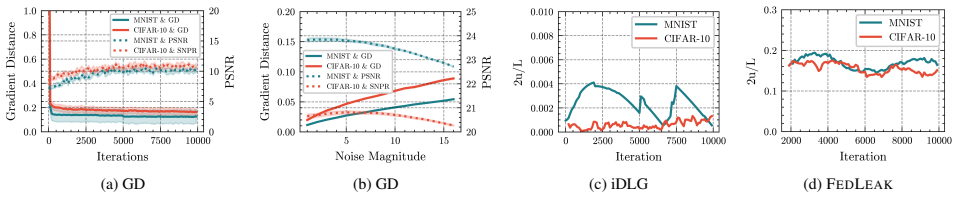
The load-bearing machinery is the gradient matching problem, formulated as minimizing a distance between the gradients of a dummy input and the server-observed gradient $\hat g$, together with the derived sufficient condition that the ratio $2\mu/L$ must be large enough to admit a useful step size. The first technique, partial gradient matching, selects the indices $\Lambda$ of the top $R\%$ largest-magnitude gradient elements and matches only those coordinates; the paper argues these are the coordinates whose individual matching contributes most to increasing $\mu$. The second technique, gradient regularization, blends the gradient at the current dummy input with the gradient at a small forward perturbation $x'+\varphi$, a finite-difference approximation of the Hessian-based regularization term that would otherwise be computationally prohibitive. These two mechanisms, applied to the composite distance of Equation 15 (L1 plus cosine distance, total variation, and an activation-sparsity penalty), are what let FedLeak keep $2\mu/L$ high and stable enough for Adam to reach the true input.
What would settle it
Run the magnitude-sensitivity correlation check on a different architecture or dataset—for example, compute the Pearson correlation between gradient-element magnitude and $\sum_j |\partial g'[i]/\partial x'[j]|$ on a Vision Transformer or on a medical image set; if the correlation falls below about 0.3 and FedLeak still reconstructs at high PSNR with $R=50$, then the top-magnitude selection rule is not the mechanism carrying the attack. Conversely, if reconstruction collapses when only the bottom-magnitude coordinates are matched, the selection rule is confirmed as load-bearing.
Extended reading notes
Core claim
The paper's central discovery is that the gradient matching problem behind gradient leakage attacks is well-posed for realistic networks: for a network with a fully connected first layer and at least one further layer, distinct inputs generate distinct gradients (Theorem 1), so noisy reconstructions are the signature of failed optimization rather than of multiple valid answers. The paper then derives a sufficient convergence condition for matching: with $x'$ the dummy input and $g'$ its gradient, each descent step is guaranteed to approach the true input if $\langle x'_j - x, \nabla_{x'} \mathrm{dist}(g'_j, \hat g)\rangle > \mu \|x - x'_j\|^2$ and $\|\nabla_{x'} \mathrm{dist}(g'_j, \hat g)\|^2 < L \|x - x'_j\|^2$, because then any step size $\eta < 2\mu/L$ shrinks the distance to the true input. FedLeak is the operational version of that condition: it aligns only the top $R\%$ most magnitude-heavy gradient elements, which concentrates the optimization on coordinates whose matching moves the loss landscape, and it regularizes by blending the gradient at the dummy input with the gradient at a small forward perturbation, a first-order stand-in for Hessian regularization. With these two techniques it reports high-fidelity reconstruction at batch sizes 16–64 across CNN and ViT architectures, with and without pretrained weights, and without access to batch normalization statistics or the clients' data distribution. This is the ground on which the paper claims FL's default protocol is insufficient to protect client data.
Load-bearing premise
FedLeak's selection rule assumes that the gradient elements with the largest magnitudes are the ones whose individual matching most improves convergence, and the paper's support for that assumption is a single measured correlation (0.7372 on CIFAR-10 with ResNet10) plus a theorem about an idealized L1 objective, not about the composite loss that is actually optimized.
Editorial extensions
If this is right
- An honest-but-curious server in a standard FL deployment can reconstruct recognizable client images at batch sizes 16–64 on common CNN architectures, without needing batch normalization statistics, data distributions, or any manipulation of training.
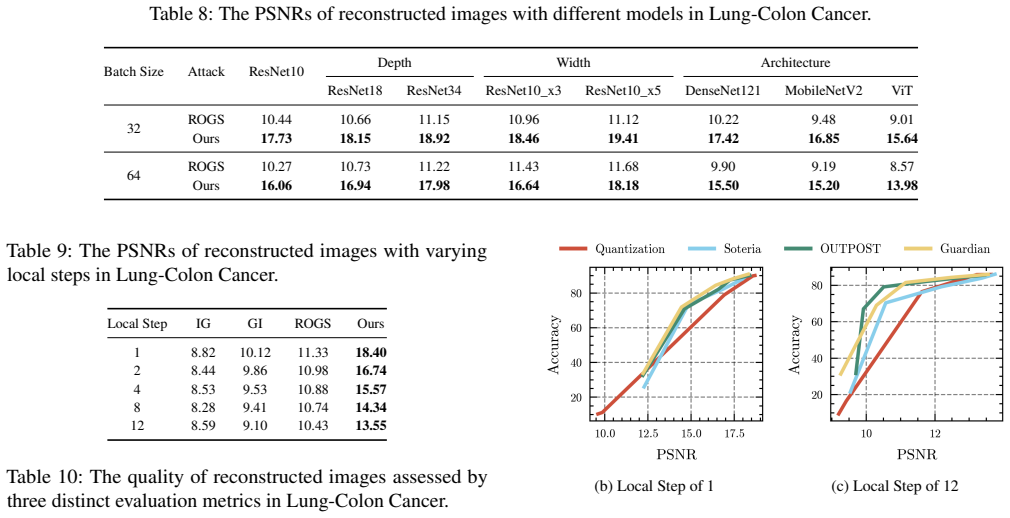
- Gradient perturbation defenses (DP, Soteria, OUTPOST, Guardian, quantization) must push model accuracy down substantially—often below 50%—before reconstructed images stop carrying meaning, so utility-preserving defense remains unresolved.
- The largest-magnitude gradient elements carry most of the reconstruction signal: restricting server access to them (e.g., encrypting only the top 80%) could blunt attacks, and noise scaled to gradient magnitude would target the information-bearing coordinates.
- Increasing local steps to one full epoch weakens but does not stop reconstruction, and secure aggregation that hides individual clients' gradients behind aggregation with at least two or three participants is the most reliable mitigation tested.
- Larger, wider, and deeper models leak more; ViT and lightweight MobileNet resist somewhat better, meaning architecture choice changes the practical privacy risk.
Reading between the lines
- The top-$R\%$ selection rule suggests a general diagnostic: for any model family, the empirical correlation between gradient-element magnitude and input sensitivity could predict how vulnerable that architecture is to gradient inversion; the paper measures this correlation only for ResNet10 on CIFAR-10.
- If the magnitude-sensitivity correlation is architecture-dependent, then the attack's reach to future architectures—especially attention-based or state-space models—is an open question, and the paper's weaker ViT numbers hint at this boundary.
- A practical takeaway the paper hints at but does not itself standardize is a privacy benchmark: reporting batch size, model, initialization, local steps, and defense strength together, with a fixed human-assessed success metric, would make future FL privacy claims comparable.
- The paper's risk thresholds are defined by PSNR bands, and its human-assessed attack success rate is about 20%; a stronger reading of the result is that semantic leakage is real but partial, so defense research should target preventing recognizable structure rather than exact pixel recovery.
Editorial analysis
A structured set of objections, weighed in public.
Referee Report
Summary. The paper proposes FEDLEAK, a gradient leakage attack for federated learning that combines partial gradient matching (matching only the top-magnitude gradient elements) with a gradient regularization term approximated by blending gradients at two nearby points. The authors also introduce a 'practical evaluation protocol' and use it to claim that FEDLEAK reconstructs high-fidelity images at batch sizes 16–64, on benchmark and medical datasets, across CNN and ViT architectures, with and without local steps and under several defenses. The main empirical evidence is a series of tables and figures comparing FEDLEAK against iDLG, IG, GI, GGL, and ROGS, with reported PSNR, SSIM, LPIPS, and ASR numbers.
Significance. If the reported results hold, the paper makes a useful empirical contribution: it would demonstrate that honest-but-curious servers can reconstruct recognizable client images under conditions closer to production FL than most prior attack evaluations, and it provides a structured checklist of evaluation factors (batch size, model, dataset, attack stage, initialization, auxiliary information, local step, defenses). The paper also offers a theoretical framing of gradient matching and a novel optimization recipe. The comparison against ROGS/GGL that use data-distribution priors is a strength, as is the breadth of datasets and models tested, the ablation of hyperparameters, and the explicit cost analysis. However, the evaluation protocol as reported (best-matched image across multiple attack rounds) is a serious threat to the quantitative claims, and the theoretical derivation does not directly cover the composite loss actually optimized. With those concerns addressed, the paper's practical relevance would be considerable.
major comments (3)
- [Section 5, Evaluation approach; Tables 3–10; Figures 3–5] The manuscript states: 'Attacks are carried out at the 2000×{0,1,2,3,4,5}-th rounds. For each image, we find the most similar reconstructed image to calculate metrics.' As written, this permits two forms of favorable selection: (i) for each ground-truth image, taking the best reconstruction across the six attacked rounds, i.e., a best-of-six selection, and (ii) matching each ground-truth image to the most similar reconstructed image in the batch without enforcing a one-to-one assignment. Under either reading, the reported PSNR, SSIM, LPIPS, and ASR values are per-image upper bounds rather than the output a server would obtain from a single gradient exchange. Because the central claim in the abstract and in Section 1 ('high-fidelity data reconstruction ... in practical environments') rests directly on these numbers, the paper needs to re-evaluate with a fixed protocol: report results for a single attack round (or average over the six rounds), enforce a one-to-one correspondence between ground-truth and reconstructed images, and include variances or success fractions. Without this, the magnitude of the reported improvements over baselines is not established.
- [Section 4.2, Theorem 2, and Section 4.4, Equation (15)] Theorem 2 establishes a higher μ for partial gradient matching only for an L1 distance with an oracle index set chosen by the largest inner products, as shown in Equation (9). The loss actually optimized, Equation (15), is a composite of L1 distance, cosine distance, total variation, and an activation penalty, and the index set Λ is selected by gradient magnitude rather than by inner-product values. The paper's justification for magnitude-based selection is a single empirical correlation (0.7372 in Appendix C), and no argument shows that the theorem's conclusion transfers to the composite loss. This is not fatal for the empirical attack, but it means the paper's stated contribution of a 'sufficient condition' and a 'guiding principle' is not proven for the implemented method. The claims in Section 1 and Section 4 should be softened to heuristic, or the analysis should be extended.
- [Section 1, Table 10, and Section 6.4] The paper claims to be 'the first attack method capable of reconstructing high-fidelity data from gradients shared by clients in practical environments.' This is a strong novelty claim that depends on the metric protocol discussed above. In addition, the ASR of 20.40% in Table 10 is computed only for reconstructions from a single client across the six attacked rounds, and the human-evaluation protocol is described only briefly; the sample size and inter-annotator agreement are not reported. Similarly, the defense trade-off curves in Figure 4 do not explain whether the PSNR values are single-round or best-of-round; if they are best-of-round, the defenses may be stronger than shown. Please clarify and, if necessary, re-plot with the fixed protocol.
minor comments (7)
- [Section 2.1] There is a typo: 'peformance' should be 'performance'.
- [Section 3] The text contains 'To illustrate this rmore concretely' — likely a leftover fragment; please correct to 'To illustrate this more concretely'.
- [Section 4.3, Equations (11)–(14)] Equation (12) uses a first-order Taylor expansion of the gradient; please state explicitly that the Hessian is evaluated at a point between x' and x'+φ, and clarify that the approximation in Equation (13) ignores higher-order terms.
- [Section 6.3] In 'we use Lung-Colon Cancer and stimulate three non-IID scenarios', 'stimulate' should read 'simulate'.
- [Appendix B] The notation '∇^2 L(F(z,w),y)' is ambiguous: it should indicate the Hessian with respect to the model inputs. Also, the statement that the Hessian 'should indeed be positive definite' for a well-fit model is asserted without a derivation or reference; please supply one or label this as a heuristic.
- [Section 6.4, Figure 4] The utility-privacy plots would benefit from error bars or at least a statement of how many repeated runs were averaged; as presented, it is unclear whether the PSNR values are single-run or averaged.
- [Section 7] The mitigation discussion introduces a noise-cancellation scheme between clients; it is under-specified (how clients agree on M, what happens if a client drops out, and how this interacts with the honest-but-curious server assumption). Since this is a suggestion for future work, a brief caveat would suffice.
Circularity Check
No significant circularity; the attack's success is empirical and not derived from its own inputs.
full rationale
The paper's derivation chain is not circular under the taxonomy. The convergence analysis in Section 3 derives a standard sufficient decrease condition from the descent inequality (Eqs. 4-6); it does not assume the attack's success. Theorem 1's uniqueness invocation is cited to Geiping et al. [22], not to the authors. Theorem 2 and its appendix proof reduce to the elementary lemma that removing small elements from a set raises the average; this tautology is used only to motivate matching top-gradient elements, not to derive the empirical PSNR numbers. The choice of index set Lambda is explicitly approximate, supported by an independent correlation measurement (Appendix C, r=0.7372). The headline reconstruction results are empirical outcomes of optimizing Eq. (15), not quantities built from those results. Hyperparameters (R, lambda', alpha, beta) are tuned on CIFAR-10 in Appendix F and then applied to other datasets; this is standard practice and does not make later numbers circular predictions. The only self-citations are Guardian ([19]) as a defense baseline and [18] for loss design; neither is load-bearing because the main attack results are defense-free and the defense analysis includes external baselines. A separate evaluation-validity concern exists: Section 5 says 'For each image, we find the most similar reconstructed image to calculate metrics,' which may turn reported PSNR/SSIM into per-image best-of-several upper bounds rather than single-attempt reconstructions. That is a measurement-selection issue, not an equation-level circularity, so it does not change the circularity score under the stated rules.
Assumptions & free parameters
free parameters (5)
- matching ratio R =
50%
- blend factor λ' =
0.7
- TV weight α =
1×10^-5
- activation penalty β =
1×10^-4
- perturbance scale k =
not reported (absorbed into λ')
assumptions (5)
- domain assumption The gradient matching problem is overdetermined and admits a unique solution for the networks considered (Theorem 1).
- ad hoc to paper High-magnitude gradient elements are the most sensitive to input changes (Section 4.2, Appendix C).
- ad hoc to paper The sufficient condition in Equation (5) is satisfiable by the proposed heuristics along the optimization path.
- domain assumption The Hessian of the loss is positive definite in the relevant region (Appendix B).
- domain assumption The practical evaluation protocol (batch size 16-64, local step 1 or 12, pretrained/random init, etc.) represents real-world FL.
Cite this review
Pith. "Pith review of Boosting Gradient Leakage Attacks: Data Reconstruction in Realistic FL Settings." pith.science (2026). https://pith.science/paper/YYQWRUP6
@misc{pith2026250608435,
  author       = {Pith},
  title        = {Pith review of: Boosting Gradient Leakage Attacks: Data Reconstruction in Realistic FL Settings},
  year         = {2026},
  howpublished = {\url{https://pith.science/paper/YYQWRUP6}},
  note         = {Machine review of arXiv:2506.08435}
}
read the original abstract
Federated learning (FL) enables collaborative model training among multiple clients without the need to expose raw data. Its ability to safeguard privacy, at the heart of FL, has recently been a hot-button debate topic. To elaborate, several studies have introduced a type of attacks known as gradient leakage attacks (GLAs), which exploit the gradients shared during training to reconstruct clients' raw data. On the flip side, some literature, however, contends no substantial privacy risk in practical FL environments due to the effectiveness of such GLAs being limited to overly relaxed conditions, such as small batch sizes and knowledge of clients' data distributions. This paper bridges this critical gap by empirically demonstrating that clients' data can still be effectively reconstructed, even within realistic FL environments. Upon revisiting GLAs, we recognize that their performance failures stem from their inability to handle the gradient matching problem. To alleviate the performance bottlenecks identified above, we develop FedLeak, which introduces two novel techniques, partial gradient matching and gradient regularization. Moreover, to evaluate the performance of FedLeak in real-world FL environments, we formulate a practical evaluation protocol grounded in a thorough review of extensive FL literature and industry practices. Under this protocol, FedLeak can still achieve high-fidelity data reconstruction, thereby underscoring the significant vulnerability in FL systems and the urgent need for more effective defense methods.
Figures


Figures from the paper (8 more)


Reference graph
Works this paper leans on
-
[1]
Mohammed Adnan, Shivam Kalra, Jesse C Cresswell, et al. Federated learning and differential privacy for medical image analysis.Scientific reports, 12(1):1953, 2022
work page 1953
-
[2]
Abeer Aljohani and Rua Y Aburasain. A hybrid frame- work for glaucoma detection through federated machine learning and deep learning models.BMC Medical Infor- matics and Decision Making, 24(1):115, 2024
work page 2024
-
[3]
Yoshinori Aono, Takuya Hayashi, Lihua Wang, et al. Privacy-preserving deep learning via additively homo- morphic encryption.IEEE TIFS, 13(5):1333–1345, 2017
work page 2017
-
[4]
Mislav Balunovic, Dimitar Iliev Dimitrov, Robin Staab, and Martin T. Vechev. Bayesian framework for gradient leakage. InICLR, 2022
work page 2022
-
[5]
Bartoldson, James Diffenderfer, Konstantinos Parasyris, and Bhavya Kailkhura
Brian R. Bartoldson, James Diffenderfer, Konstantinos Parasyris, and Bhavya Kailkhura. Adversarial robust- ness limits via scaling-law and human-alignment studies. InICML, 2024
work page 2024
-
[6]
When the curious abandon honesty: Federated learning is not private
Franziska Boenisch, Adam Dziedzic, Roei Schuster, et al. When the curious abandon honesty: Federated learning is not private. InIEEE EuroS&P, pages 175–
-
[7]
Practical secure aggregation for privacy-preserving ma- chine learning
Keith Bonawitz, Vladimir Ivanov, Ben Kreuter, et al. Practical secure aggregation for privacy-preserving ma- chine learning. InCCS, pages 1175–1191, 2017. 14
work page 2017
-
[8]
Convex optimization.Cambridge UP, 2004
Stephen Boyd. Convex optimization.Cambridge UP, 2004
work page 2004
Show all 58 references
-
[9]
Extracting training data from large language models
Nicholas Carlini, Florian Tramer, Eric Wallace, et al. Extracting training data from large language models. In USENIX Security, pages 2633–2650, 2021
2021
-
[10]
Quantifying memorization across neural language models.arXiv preprint arXiv:2202.07646, 2022
Nicholas Carlini, Daphne Ippolito, Matthew Jagielski, et al. Quantifying memorization across neural language models.arXiv preprint arXiv:2202.07646, 2022
2022 arXiv
-
[11]
Extract- ing training data from diffusion models
Nicolas Carlini, Jamie Hayes, Milad Nasr, et al. Extract- ing training data from diffusion models. InUSENIX Security, pages 5253–5270, 2023
2023
-
[12]
Fowl, et al
Hong-Min Chu, Jonas Geiping, Liam H. Fowl, et al. Panning for gold in federated learning: Targeted text extraction under arbitrarily large-scale aggregation. In ICLR, 2023
2023
-
[13]
Revealing and protecting labels in distributed training
Trung Dang, Om Thakkar, Swaroop Ramaswamy, et al. Revealing and protecting labels in distributed training. InNeurIPS, volume 34, pages 1727–1738, 2021
2021
-
[14]
Federated learning for predicting clini- cal outcomes in patients with covid-19.Nature medicine, 27(10):1735–1743, 2021
Ittai Dayan, Holger R Roth, Aoxiao Zhong, Ahmed Harouni, Amilcare Gentili, Anas Z Abidin, Andrew Liu, Anthony Beardsworth Costa, Bradford J Wood, Chien- Sung Tsai, et al. Federated learning for predicting clini- cal outcomes in patients with covid-19.Nature medicine, 27(10):17...
2021
-
[15]
An image is worth 16x16 words: Transformers for image recognition at scale
Alexey Dosovitskiy, Lucas Beyer, Alexander Kolesnikov, Dirk Weissenborn, Xiaohua Zhai, et al. An image is worth 16x16 words: Transformers for image recognition at scale. InICLR, 2021
2021
-
[16]
Sok: Gradient leakage in federated learning.CoRR, abs/2404.05403, 2024
Jiacheng Du, Jiahui Hu, Zhibo Wang, et al. Sok: Gradient leakage in federated learning.CoRR, abs/2404.05403, 2024
2024 arXiv
-
[17]
The algorithmic foundations of differential privacy.Foundations and Trends® in Theoretical Computer Science, 9(3–4):211– 407, 2014
Cynthia Dwork, Aaron Roth, et al. The algorithmic foundations of differential privacy.Foundations and Trends® in Theoretical Computer Science, 9(3–4):211– 407, 2014
2014
-
[18]
Exploiting pre-trained models and low- frequency preference for cost-effective transfer-based attack.ACM Trans
Mingyuan Fan, Cen Chen, Chengyu Wang, and Jun Huang. Exploiting pre-trained models and low- frequency preference for cost-effective transfer-based attack.ACM Trans. Knowl. Discov. Data, jul 2024. ISSN 1556-4681
2024
-
[19]
Guardian: Guarding against gradient leakage with provable de- fense for federated learning
Mingyuan Fan, Yang Liu, Cen Chen, et al. Guardian: Guarding against gradient leakage with provable de- fense for federated learning. InProceedings of the 17th ACM International Conference on Web Search and Data Mining, pages 190–198, 2024
2024
-
[20]
On the trustworthiness landscape of state-of-the-art generative models: A survey and outlook
Mingyuan Fan, Chengyu Wang, Cen Chen, Yang Liu, and Jun Huang. On the trustworthiness landscape of state-of-the-art generative models: A survey and outlook. International Journal of Computer Vision, 2025
2025
-
[21]
Adap dp-fl: Differ- entially private federated learning with adaptive noise
Jie Fu, Zhili Chen, and Xiao Han. Adap dp-fl: Differ- entially private federated learning with adaptive noise. In2022 IEEE International Conference on Trust, Se- curity and Privacy in Computing and Communications (TrustCom), pages 656–663. IEEE, 2022
2022
-
[22]
Inverting gradients-how easy is it to break privacy in federated learning? InNeurIPS, volume 33, pages 16937–16947, 2020
Jonas Geiping, Hartmut Bauermeister, Hannah Dröge, and Michael Moeller. Inverting gradients-how easy is it to break privacy in federated learning? InNeurIPS, volume 33, pages 16937–16947, 2020
2020
-
[23]
Differen- tially private federated learning: A client level perspec- tive.arXiv preprint arXiv:1712.07557, 2017
Robin C Geyer, Tassilo Klein, and Moin Nabi. Differen- tially private federated learning: A client level perspec- tive.arXiv preprint arXiv:1712.07557, 2017
2017 arXiv
-
[24]
Federated learning for medical image anal- ysis: A survey.Pattern Recognit., 151:110424, 2024
Hao Guan, Pew-Thian Yap, Andrea Bozoki, and Mingxia Liu. Federated learning for medical image anal- ysis: A survey.Pattern Recognit., 151:110424, 2024
2024
-
[25]
Does dif- ferential privacy really protect federated learning from gradient leakage attacks?IEEE Transactions on Mobile Computing, 2024
Jiahui Hu, Jiacheng Du, Zhibo Wang, et al. Does dif- ferential privacy really protect federated learning from gradient leakage attacks?IEEE Transactions on Mobile Computing, 2024
2024
-
[26]
Eval- uating gradient inversion attacks and defenses in feder- ated learning
Yangsibo Huang, Samyak Gupta, Zhao Song, et al. Eval- uating gradient inversion attacks and defenses in feder- ated learning. InNeurIPS, pages 7232–7241, 2021
2021
-
[27]
Gra- dient inversion with generative image prior
Jinwoo Jeon, Kangwook Lee, Sewoong Oh, et al. Gra- dient inversion with generative image prior. InNeurIPS, volume 34, pages 29898–29908, 2021
2021
-
[28]
Toward training at imagenet scale with differential pri- vacy.CoRR, abs/2201.12328, 2022
Alexey Kurakin, Steve Chien, Shuang Song, Roxana Geambasu, Andreas Terzis, and Abhradeep Thakurta. Toward training at imagenet scale with differential pri- vacy.CoRR, abs/2201.12328, 2022
2022 arXiv
-
[29]
An international study presenting a federated learning ai platform for pediatric brain tumors.Nature communica- tions, 15(1):7615, 2024
Edward H Lee, Michelle Han, Jason Wright, et al. An international study presenting a federated learning ai platform for pediatric brain tumors.Nature communica- tions, 15(1):7615, 2024
2024
-
[30]
On the convergence of fedavg on non-iid data
Xiang Li, Kaixuan Huang, Wenhao Yang, et al. On the convergence of fedavg on non-iid data. InICLR, 2020
2020
-
[31]
Fedbn: Federated learning on non-iid features via local batch normalization
Xiaoxiao Li, Meirui Jiang, Xiaofei Zhang, et al. Fedbn: Federated learning on non-iid features via local batch normalization. InICLR, 2021
2021
-
[32]
Auditing privacy defenses in federated learning via gen- erative gradient leakage
Zhuohang Li, Jiaxin Zhang, Luyang Liu, and Jian Liu. Auditing privacy defenses in federated learning via gen- erative gradient leakage. InCVPR, pages 10132–10142, 2022. 15
2022
-
[33]
Backdoor defense with machine unlearning
Yang Liu, Mingyuan Fan, Cen Chen, et al. Backdoor defense with machine unlearning. InINFOCOM, page 280–289. IEEE, 2022
2022
-
[34]
Pre- dicting treatment response in multicenter non-small cell lung cancer patients based on federated learning.BMC cancer, 24(1):688, 2024
Yuan Liu, Jinzao Huang, Jyh-Cheng Chen, et al. Pre- dicting treatment response in multicenter non-small cell lung cancer patients based on federated learning.BMC cancer, 24(1):688, 2024
2024
-
[35]
SGDR: stochastic gradient descent with warm restarts
Ilya Loshchilov and Frank Hutter. SGDR: stochastic gradient descent with warm restarts. InICLR, 2017
2017
-
[36]
A tutorial on fisher information.Journal of Mathemati- cal Psychology, 80:40–55, 2017
Alexander Ly, Maarten Marsman, Josine Verhagen, et al. A tutorial on fisher information.Journal of Mathemati- cal Psychology, 80:40–55, 2017
2017
-
[37]
Instance-wise batch label restoration via gradients in federated learning
Kailang Ma, Yu Sun, Jian Cui, et al. Instance-wise batch label restoration via gradients in federated learning. In The 11th International Conference on Learning Repre- sentations, 2023
2023
-
[38]
Towards deep learning models resistant to adversarial attacks
Aleksander Madry, Aleksandar Makelov, Ludwig Schmidt, et al. Towards deep learning models resistant to adversarial attacks. InICLR, 2018
2018
-
[39]
Communication-efficient learning of deep networks from decentralized data
Brendan McMahan, Eider Moore, Daniel Ramage, et al. Communication-efficient learning of deep networks from decentralized data. InArtificial intelligence and statistics, pages 1273–1282. PMLR, 2017
2017
-
[40]
Transforming large-size to lightweight deep neural networks for iot applications
Rahul Mishra and Hari Gupta. Transforming large-size to lightweight deep neural networks for iot applications. ACM Computing Surveys, 55(11):1–35, 2023
2023
-
[41]
Secureml: A system for scalable privacy-preserving machine learning
Payman Mohassel and Yupeng Zhang. Secureml: A system for scalable privacy-preserving machine learning. InIEEE S&P, pages 19–38. IEEE, 2017
2017
-
[42]
Nguyen, Ming Ding, Pubudu N
Dinh C. Nguyen, Ming Ding, Pubudu N. Pathirana, et al. Federated learning for internet of things: A compre- hensive survey.IEEE Commun. Surv. Tutorials, 23(3): 1622–1658, 2021
2021
-
[43]
Eluding secure aggregation in federated learning via model inconsistency
Dario Pasquini, Danilo Francati, and Giuseppe Ateniese. Eluding secure aggregation in federated learning via model inconsistency. InProceedings of the 2022 ACM SIGSAC Conference on Computer and Communications Security, pages 2429–2443, 2022
2022
-
[44]
A survey on deep learning: Algorithms, techniques, and applica- tions.ACM computing surveys, 51(5):1–36, 2018
Samira Pouyanfar, Saad Sadiq, Yilin Yan, et al. A survey on deep learning: Algorithms, techniques, and applica- tions.ACM computing surveys, 51(5):1–36, 2018
2018
-
[45]
Federated learning in medicine: facil- itating multi-institutional collaborations without sharing patient data.Scientific reports, 10(1):12598, 2020
Micah J Sheller, Brandon Edwards, G Anthony Reina, Jason Martin, et al. Federated learning in medicine: facil- itating multi-institutional collaborations without sharing patient data.Scientific reports, 10(1):12598, 2020
2020
-
[46]
Soteria: Provable defense against privacy leakage in federated learning from representation perspective
Jingwei Sun, Ang Li, Binghui Wang, et al. Soteria: Provable defense against privacy leakage in federated learning from representation perspective. InCVPR, pages 9311–9319, 2021
2021
-
[47]
More than enough is too much: Adaptive defenses against gradient leakage in production federated learning.IEEE/ACM Transactions on Networking, 32(4):3061–3075, 2024
Fei Wang, Ethan Hugh, and Baochun Li. More than enough is too much: Adaptive defenses against gradient leakage in production federated learning.IEEE/ACM Transactions on Networking, 32(4):3061–3075, 2024. doi: 10.1109/TNET.2024.3377655
2024
-
[48]
Pro- tect privacy from gradient leakage attack in federated learning
Junxiao Wang, Song Guo, Xin Xie, and Heng Qi. Pro- tect privacy from gradient leakage attack in federated learning. InINFOCOM, pages 580–589. IEEE, 2022
2022
-
[49]
Break- ing secure aggregation: Label leakage from aggre- gated gradients in federated learning.arXiv preprint arXiv:2406.15731, 2024
Zhibo Wang, Zhiwei Chang, Jiahui Hu, et al. Break- ing secure aggregation: Label leakage from aggre- gated gradients in federated learning.arXiv preprint arXiv:2406.15731, 2024
2024 arXiv
-
[50]
A frame- work for evaluating gradient leakage attacks in federated learning.CoRR, abs/2004.10397, 2020
Wenqi Wei, Ling Liu, Margaret Loper, et al. A frame- work for evaluating gradient leakage attacks in federated learning.CoRR, abs/2004.10397, 2020
2004 arXiv
-
[51]
Fishing for user data in large-batch federated learning via gradient magnification
Yuxin Wen, Jonas Geiping, Liam Fowl, et al. Fishing for user data in large-batch federated learning via gradient magnification. InICML, volume 162, pages 23668– 23684. PMLR, 2022
2022
-
[52]
See through gradients: Image batch recovery via gradinver- sion
Hongxu Yin, Arun Mallya, Arash Vahdat, et al. See through gradients: Image batch recovery via gradinver- sion. InCVPR, pages 16337–16346, 2021
2021
-
[53]
Gradient obfuscation gives a false sense of security in federated learning
Kai Yue, Richeng Jin, Chau-Wai Wong, et al. Gradient obfuscation gives a false sense of security in federated learning. InUSENIX Security, pages 6381–6398, 2023
2023
-
[54]
BatchCrypt: Efficient homomorphic encryption for Cross-Silo federated learning
Chengliang Zhang, Suyi Li, Junzhe Xia, et al. BatchCrypt: Efficient homomorphic encryption for Cross-Silo federated learning. In2020 USENIX annual technical conference, pages 493–506, 2020
2020
-
[55]
Re- cent methodological advances in federated learning for healthcare.Patterns, 5(6):101006, 2024
Fan Zhang, Daniel Kreuter, Yichen Chen, et al. Re- cent methodological advances in federated learning for healthcare.Patterns, 5(6):101006, 2024
2024
-
[56]
idlg: Improved deep leakage from gradients.arXiv preprint arXiv:2001.02610, 2020
Bo Zhao, Konda Reddy Mopuri, and Hakan Bilen. idlg: Improved deep leakage from gradients.arXiv preprint arXiv:2001.02610, 2020
2001 arXiv
-
[57]
Zhao, Atul Sharma, Ahmed Roushdy Elko- rdy, et al
Joshua C. Zhao, Atul Sharma, Ahmed Roushdy Elko- rdy, et al. Loki: Large-scale data reconstruction attack against federated learning through model manipulation. InIEEE S&P, pages 1287–1305. IEEE, 2024
2024
-
[58]
specific/common parameters
Ligeng Zhu, Zhijian Liu, and Song Han. Deep leakage from gradients. InNeurIPS, volume 32, 2019. 16 Table 11: The gradient distance (GD) and PSNR using differ- ent attack strategies in MNIST and CIFAR-10. Attack Strategy MNIST CIFAR-10 GD PSNR GD PSNR BayesAttack 0.19 10.99 0.2...
2019
Reviewed August 7, 2026 · model on record in the stance chip above.
Discussion (0). Sign in to comment.