REVIEW 3 major objections 5 minor 32 references
Socratic-MCTS: Test-Time Visual Reasoning by Asking the Right Questions
T0 review · 3 major / 5 minor · reviewed 2026-08-07 · deepseek-v4-flash
Pith's one-line read A training-free search over subquestion–subanswer pairs elicits longer, more accurate reasoning traces from non-reasoning vision-language models.
desk verdict A plausible training-free test-time recipe for VLMs, but the headline gains are not separated from self-consistency—needs a matched majority-vote baseline before the central claim holds. read the letter →
The pith
A machine-rendered reading of the paper's core claim, the machinery that carries it, and where it could break.
The reading
What carries the argument
The central object is the subquestion–subanswer pair, used as the atomic action and node state of an MCTS search. Subquestions are generated by a policy that prompts the model to ask a single follow-up question; answers are produced in isolation to prevent propagating errors. Value estimation uses internal agreement: K=8 rollouts, each preconditioned on the partial trajectory plus a distinct wrap-up phrase, are scored by a lightweight parser, and the weighted majority answer is the node's reward. Transition phrases and a wrap-up phrase structure the composed trajectory so that the model can complete the reasoning and emit a final answer without extra training.
What would settle it
Compare Socratic-MCTS against self-consistency (majority vote over K=8 independent CoT samples with no tree structure) at equal rollout counts; if the tree search does not beat flat self-consistency on the same questions, the value signal is not contributing. Also test whether the answer chosen by the UCT-selected path is more often correct than a randomly selected path of equal depth; if not, the internal-agreement reward is misleading.
Extended reading notes
Core claim
Socratic-MCTS reframes test-time reasoning in non-reasoning VLMs as a tree search over semantically meaningful subquestions. Each node state is a subquestion–subanswer pair; the search generates candidate subquestions with a prompt that instructs the model to ask rather than answer, answers each in isolation to avoid error contamination, composes them into a trajectory with transition phrases, and estimates node value through internal agreement—a weighted majority vote over K=8 rollouts cued by different wrap-up phrases. This value guides UCT selection, with early-exit and direct-exit nodes to control computational cost. The paper's empirical claim is that this search procedure consistently outperforms non-search baselines across MMMU-Pro, MMStar, and MathVista, with a 9% gain in Liberal Arts on MMMU-Pro, and that the decomposition-only baseline (LtM) actually underperforms direct and CoT, suggesting prompting alone is insufficient for non-reasoning VLMs.
Load-bearing premise
The load-bearing premise is that a weighted majority vote over rollouts from a frozen, overconfident VLM is a reliable guide for choosing which subquestion chains to pursue, so that search prefers more accurate reasoning paths.
Editorial extensions
If this is right
- If correct, non-reasoning VLMs can be upgraded at inference time without retraining, changing the economics of deploying already-trained models.
- Search-based elicitation could complement or replace prompting for tasks where the model's latent knowledge is fragmented.
- The 9% Liberal Arts gain suggests the method is most effective on tasks requiring visual semantics and world knowledge rather than symbolic manipulation.
- Early-exit and direct-exit mechanisms make the search practical enough to run on standard budgets.
- The failure of least-to-most prompting in VLMs points to where prompting and search-based methods differ.
Reading between the lines
- Editorial inference: if the value estimator is reliable, the same subquestion search could be ported to text-only LLMs to improve long-horizon tasks without reinforcement learning.
- Editorial inference: a direct ablation replacing UCT selection with random path selection, holding rollouts fixed, would isolate whether the tree structure or the Socratic decomposition drives the gains.
- Editorial inference: the selective-search confidence threshold suggests a compute-accuracy Pareto curve; tuning it per domain could further improve efficiency.
- Editorial inference: the method could be combined with self-consistency by using the tree's leaf answers as an ensemble, possibly beating both alone.
Editorial analysis
A structured set of objections, weighed in public.
Referee Report
Summary. The paper proposes Socratic-MCTS, a test-time tree-search method for frozen vision-language models (VLMs). The method defines actions as subquestion–subanswer pairs, builds a search tree via MCTS, performs compositional rollouts that precondition the model on the accumulated trajectory with wrap-up phrases, and estimates node value by weighted majority voting over K=8 rollouts. An early-exit mechanism skips search when the model's initial confidence exceeds 0.9. The authors evaluate InternVL-78B on MMMU-PRO, MMStar, and MathVista, reporting improvements over direct answering, chain-of-thought prompting, and Least-to-Most prompting. They highlight a 2% overall gain on MMMU-PRO and a 9% gain on a post hoc defined Liberal Arts subset, and conclude that search over subquestions can elicit structured reasoning from non-reasoning VLMs without additional training.
Significance. The central claim—that a training-free, test-time search over subquestions can improve the reasoning of frozen VLMs—is of significant interest, especially given the practical importance of extracting better performance from already-deployed non-reasoning models. The paper is transparent about its limitations, including the overconfidence of frozen VLMs and the computational cost of search, and the appendix contains the full prompts, which aids reproducibility of the prompting components. The absence of fitted parameters and benchmark-derived predictions makes the method non-circular in the sense that no target-benchmark statistics are used for tuning. However, the evidence as presented is under-supported: the method embeds a majority-voting self-consistency component that is not isolated by any baseline, and all results are based on single runs without error bars or statistical testing. As a result, the current manuscript demonstrates feasibility but does not yet establish that the search structure, rather than the inherent benefit of sampling multiple completions, is responsible for the reported gains.
major comments (3)
- [Section 4, 'Main Results'] The proposed method is confounded with self-consistency. The value estimate is a weighted majority vote over K=8 rollouts, and the final answer is taken from the rollouts or from a direct-exit node that aggregates these rollouts. Tables 1 and 2 compare against Direct, CoT, and Least-to-Most, but no majority-vote or self-consistency control is included. A matched baseline—for example, majority voting over K independent direct or CoT completions at a similar sampling budget—is needed to isolate the contribution of the tree search over subquestions. The paper's own Limitations section concedes that structured approaches 'may remain less practical than simpler methods like majority voting with brute-force scaling,' which acknowledges exactly this confound. Without this control, the observed gains cannot be attributed to the search structure rather than to the well-known effect of sampling multiple completions.
- [Section 4, 'Main Results'] All results are reported as single runs, with no error bars or statistical significance tests. The overall gain on MMMU-PRO is 2.0 accuracy points (0.537 vs. 0.517) and on MMStar is 1.9 points (0.711 vs. 0.692); for benchmarks of roughly 1,500 items, these differences may be within sampling noise. The claim that Socratic-MCTS 'consistently outperforms all baselines' is not supported without multiple seeds or repeated evaluations. I request standard errors over at least a few independent runs, or, if compute is prohibitive, a per-item bootstrap confidence interval and a paired significance test. This is essential to establishing that the gains are reliable rather than artifacts of a single sample.
- [Section 4, 'Main Results'] The definition of 'Liberal Arts' appears to be introduced post hoc, after inspecting results. Under this definition, Socratic-MCTS improves Liberal Arts from 0.538 to 0.628 on MMMU-PRO, but accuracy on STEM+B declines from 0.507 to 0.492. The aggregate +2% gain is therefore driven entirely by a subset of categories that were selected after observing the outcomes. This is a load-bearing issue for the claim of 'consistent improvements' and for the suggestion that the method is particularly helpful for non-symbolic tasks. The authors should either pre-register the category split, report all ten individual MMMU-PRO subjects, or apply a multiple-comparison correction. Without this, the 9% Liberal Arts gain may simply reflect selective reporting of a noisy category-level result.
minor comments (5)
- [Section 4, 'Main Results'] The paper uses both 'MMMU-Pro' and 'MMMU-PRO' inconsistently (e.g., in the abstract, Table 1, and the main text). Please standardize the benchmark name.
- [Section 3.2] The early-exit threshold of 0.9 is a hyperparameter, and the paper does not report what fraction of problems actually trigger the full tree search. Reporting this coverage would help assess whether the overall gain comes from selective application of search rather than the search itself.
- [Section 3.2] The 'lightweight heuristic' for parsing answers and assigning weights (w(k)) is described only verbally. Please provide the exact parsing rules (e.g., regex patterns) and the confidence-scoring function, since this is part of the algorithm's definition.
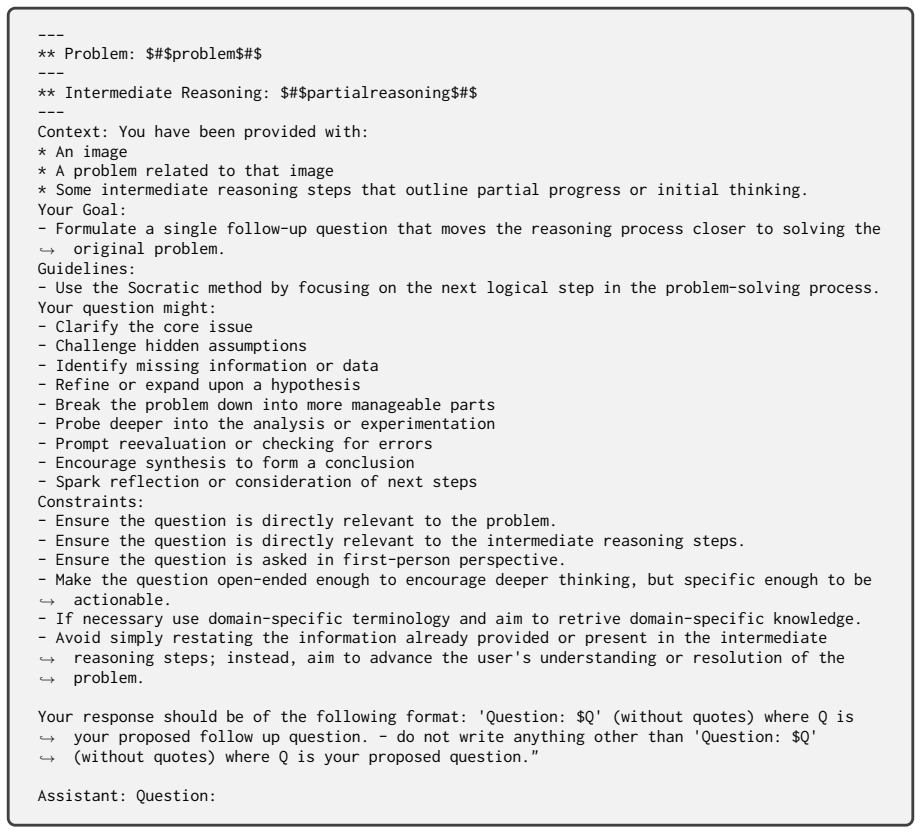
- [Appendix] The prompts in Figures 8 and 9 contain duplicated constraint lines and typos (e.g., 'quesiton', 'retrive'). These should be corrected for reproducibility and professionalism.
- [Section 5] The distinction from Hao et al. (2023) is stated briefly; clarify the specific differences in action sampling, value estimation (internal agreement vs. learned or external reward), and the multimodal setting.
Circularity Check
No significant circularity: Socratic-MCTS is a test-time search with a heuristic internal-agreement value signal, no fitted predictions on target benchmarks, and no load-bearing self-citation chain.
full rationale
The paper's central claim is that search over subquestion–subanswer pairs elicits better reasoning from a frozen VLM, and this is evaluated empirically against Direct, CoT, and Least-to-Most baselines on MMMU-Pro, MMStar, and MathVista. No derived quantity is defined in terms of the benchmark labels: the value estimate in Section 3.2 is a weighted majority vote over K=8 rollouts, which is a test-time heuristic rather than a parameter fitted to the evaluation data. The final answer comes from the same rollouts or a direct-exit node, but the search structure over subquestions is not equal by construction to any baseline output, and the paper does not claim a formal theorem whose assumptions include the conclusion. Self-citations to prior work (Jung et al. 2022, Liao et al. 2024b, Lu et al. 2025, etc.) are contextual and are not used to justify the main empirical result. The limitation that majority voting with brute-force scaling might be more practical is an honest acknowledgment of a missing control and a potential experimental confound, but it is not a circular reduction: the absence of a self-consistency baseline is a correctness/evaluation gap, not a derivation that reduces the method to its inputs. The score is therefore 0.
Assumptions & free parameters
free parameters (6)
- exploration constant c =
1.4
- branching factor kq =
6 (first level), 3 (remaining levels)
- number of rollouts K =
8
- confidence threshold =
0.9
- sampling temperature =
0.6
- search iterations =
40 (MMMU-PRO), 20 (others)
assumptions (4)
- domain assumption Non-reasoning VLMs possess latent reasoning knowledge that can be elicited by structured subquestion-answer search.
- domain assumption Internal agreement (weighted majority vote over K rollouts) is a reliable proxy for answer correctness in UCT value estimation.
- domain assumption Subquestions generated by the model itself are informative actions that decompose the problem effectively.
- standard math Monte Carlo Tree Search with UCT converges to good solutions under the given budget.
Cite this review
Pith. "Pith review of Socratic-MCTS: Test-Time Visual Reasoning by Asking the Right Questions." pith.science (2026). https://pith.science/paper/BHTDX4E6
@misc{pith2026250608927,
  author       = {Pith},
  title        = {Pith review of: Socratic-MCTS: Test-Time Visual Reasoning by Asking the Right Questions},
  year         = {2026},
  howpublished = {\url{https://pith.science/paper/BHTDX4E6}},
  note         = {Machine review of arXiv:2506.08927}
}
read the original abstract
Recent research in vision-language models (VLMs) has centered around the possibility of equipping them with implicit long-form chain-of-thought reasoning -- akin to the success observed in language models -- via distillation and reinforcement learning. But what about the non-reasoning models already trained and deployed across the internet? Should we simply abandon them, or is there hope for a search mechanism that can elicit hidden knowledge and induce long reasoning traces -- without any additional training or supervision? In this paper, we explore this possibility using a Monte Carlo Tree Search (MCTS)-inspired algorithm, which injects subquestion-subanswer pairs into the model's output stream. We show that framing reasoning as a search process -- where subquestions act as latent decisions within a broader inference trajectory -- helps the model "connect the dots" between fragmented knowledge and produce extended reasoning traces in non-reasoning models. We evaluate our method across three benchmarks and observe consistent improvements. Notably, our approach yields a 2% overall improvement on MMMU-PRO, including a significant 9% gain in Liberal Arts.
Figures


Figures from the paper (8 more)




Reference graph
Works this paper leans on
-
[1]
Shuai Bai, Keqin Chen, Xuejing Liu, Jialin Wang, Wenbin Ge, Sibo Song, Kai Dang, Peng Wang, Shijie Wang, Jun Tang, Humen Zhong, Yuanzhi Zhu, Mingkun Yang, Zhaohai Li, Jianqiang Wan, Pengfei Wang, Wei Ding, Zheren Fu, Yiheng Xu, and 8 others. 2025. https://arxiv.org/abs/2502.13923 Qwen2.5-vl technical report . Preprint, arXiv:2502.13923
arXiv 2025
-
[2]
Cameron B Browne, Edward Powley, Daniel Whitehouse, Simon M Lucas, Peter I Cowling, Philipp Rohlfshagen, Stephen Tavener, Diego Perez, Spyridon Samothrakis, and Simon Colton. 2012. A survey of monte carlo tree search methods. IEEE Transactions on Computational Intelligence and AI in games, 4(1):1--43
2012
-
[3]
Guiming Hardy Chen, Shunian Chen, Ruifei Zhang, Junying Chen, Xiangbo Wu, Zhiyi Zhang, Zhihong Chen, Jianquan Li, Xiang Wan, and Benyou Wang. 2024 a . https://arxiv.org/abs/2402.11684 Allava: Harnessing gpt4v-synthesized data for a lite vision-language model . Preprint, arXiv:2402.11684
arXiv 2024
-
[4]
Lin Chen, Jinsong Li, Xiaoyi Dong, Pan Zhang, Conghui He, Jiaqi Wang, Feng Zhao, and Dahua Lin. 2024 b . Sharegpt4v: Improving large multi-modal models with better captions. In European Conference on Computer Vision, pages 370--387. Springer
work page 2024
-
[5]
Lin Chen, Jinsong Li, Xiaoyi Dong, Pan Zhang, Yuhang Zang, Zehui Chen, Haodong Duan, Jiaqi Wang, Yu Qiao, Dahua Lin, and 1 others. 2024 c . Are we on the right way for evaluating large vision-language models? arXiv preprint arXiv:2403.20330
arXiv 2024
-
[6]
Zhe Chen, Weiyun Wang, Yue Cao, Yangzhou Liu, Zhangwei Gao, Erfei Cui, Jinguo Zhu, Shenglong Ye, Hao Tian, Zhaoyang Liu, and 1 others. 2024 d . Expanding performance boundaries of open-source multimodal models with model, data, and test-time scaling. arXiv preprint arXiv:2412.05271
arXiv 2024
-
[7]
DeepSeek-AI, Daya Guo, Dejian Yang, Haowei Zhang, Junxiao Song, Ruoyu Zhang, Runxin Xu, Qihao Zhu, Shirong Ma, Peiyi Wang, Xiao Bi, Xiaokang Zhang, Xingkai Yu, Yu Wu, Z. F. Wu, Zhibin Gou, Zhihong Shao, Zhuoshu Li, Ziyi Gao, and 181 others. 2025. https://arxiv.org/abs/2501.12948 Deepseek-r1: Incentivizing reasoning capability in llms via reinforcement lea...
arXiv 2025
-
[8]
Yifan Du, Zikang Liu, Yifan Li, Wayne Xin Zhao, Yuqi Huo, Bingning Wang, Weipeng Chen, Zheng Liu, Zhongyuan Wang, and Ji-Rong Wen. 2025. https://arxiv.org/abs/2501.01904 Virgo: A preliminary exploration on reproducing o1-like mllm . Preprint, arXiv:2501.01904
arXiv 2025
Show all 32 references
-
[9]
Ward Farnsworth. 2021. The Socratic method: a practitioner's handbook. Godine Boston
2021
-
[10]
Xinyu Guan, Li Lyna Zhang, Yifei Liu, Ning Shang, Youran Sun, Yi Zhu, Fan Yang, and Mao Yang. 2025. rstar-math: Small llms can master math reasoning with self-evolved deep thinking. arXiv preprint arXiv:2501.04519
2025 arXiv
-
[11]
Shibo Hao, Yi Gu, Haodi Ma, Joshua Jiahua Hong, Zhen Wang, Daisy Zhe Wang, and Zhiting Hu. 2023. Reasoning with language model is planning with world model. arXiv preprint arXiv:2305.14992
2023 arXiv
-
[12]
Jaehun Jung, Seungju Han, Ximing Lu, Skyler Hallinan, David Acuna, Shrimai Prabhumoye, Mostafa Patwary, Mohammad Shoeybi, Bryan Catanzaro, and Yejin Choi. 2025. https://arxiv.org/abs/2505.20161 Prismatic synthesis: Gradient-based data diversification boosts generalization in l...
2025 arXiv
-
[13]
Jaehun Jung, Lianhui Qin, Sean Welleck, Faeze Brahman, Chandra Bhagavatula, Ronan Le Bras, and Yejin Choi. 2022. https://arxiv.org/abs/2205.11822 Maieutic prompting: Logically consistent reasoning with recursive explanations . Preprint, arXiv:2205.11822
2022 arXiv
-
[14]
Tushar Khot, Harsh Trivedi, Matthew Finlayson, Yao Fu, Kyle Richardson, Peter Clark, and Ashish Sabharwal. 2022. Decomposed prompting: A modular approach for solving complex tasks. arXiv preprint arXiv:2210.02406
2022 arXiv
-
[15]
Levente Kocsis and Csaba Szepesv \'a ri. 2006. Bandit based monte-carlo planning. In European conference on machine learning, pages 282--293. Springer
2006
-
[16]
Yuan-Hong Liao, Sven Elflein, Liu He, Laura Leal-Taix \'e , Yejin Choi, Sanja Fidler, and David Acuna. 2025. Longperceptualthoughts: Distilling system-2 reasoning for system-1 perception. arXiv preprint arXiv:2504.15362
2025 arXiv
-
[17]
Yuan-Hong Liao, Rafid Mahmood, Sanja Fidler, and David Acuna. 2024 a . https://arxiv.org/abs/2404.06510 Can feedback enhance semantic grounding in large vision-language models? Preprint, arXiv:2404.06510
2024 arXiv
-
[18]
Yuan-Hong Liao, Rafid Mahmood, Sanja Fidler, and David Acuna. 2024 b . https://doi.org/10.18653/v1/2024.emnlp-main.947 Reasoning paths with reference objects elicit quantitative spatial reasoning in large vision-language models . In Proceedings of the 2024 Conference on Empiri...
2024 doi
-
[19]
Mingjie Liu, Shizhe Diao, Ximing Lu, Jian Hu, Xin Dong, Yejin Choi, Jan Kautz, and Yi Dong. 2025. Prorl: Prolonged reinforcement learning expands reasoning boundaries in large language models. arXiv preprint arXiv:2505.24864
2025 arXiv
-
[20]
Pan Lu, Hritik Bansal, Tony Xia, Jiacheng Liu, Chunyuan Li, Hannaneh Hajishirzi, Hao Cheng, Kai-Wei Chang, Michel Galley, and Jianfeng Gao. 2023. Mathvista: Evaluating mathematical reasoning of foundation models in visual contexts. arXiv preprint arXiv:2310.02255
2023 arXiv
-
[21]
Ximing Lu, Seungju Han, David Acuna, Hyunwoo Kim, Jaehun Jung, Shrimai Prabhumoye, Niklas Muennighoff, Mostofa Patwary, Mohammad Shoeybi, Bryan Catanzaro, and 1 others. 2025. Retro-search: Exploring untaken paths for deeper and efficient reasoning. arXiv preprint arXiv:2504.04383
2025 arXiv
-
[22]
Liangchen Luo, Yinxiao Liu, Rosanne Liu, Samrat Phatale, Meiqi Guo, Harsh Lara, Yunxuan Li, Lei Shu, Yun Zhu, Lei Meng, and 1 others. 2024. Improve mathematical reasoning in language models by automated process supervision. arXiv preprint arXiv:2406.06592
2024 arXiv
-
[23]
Niklas Muennighoff, Zitong Yang, Weijia Shi, Xiang Lisa Li, Li Fei-Fei, Hannaneh Hajishirzi, Luke Zettlemoyer, Percy Liang, Emmanuel Candès, and Tatsunori Hashimoto. 2025. https://arxiv.org/abs/2501.19393 s1: Simple test-time scaling . Preprint, arXiv:2501.19393
2025 arXiv
-
[24]
OpenAI, :, Aaron Jaech, Adam Kalai, Adam Lerer, Adam Richardson, Ahmed El-Kishky, Aiden Low, Alec Helyar, Aleksander Madry, Alex Beutel, Alex Carney, Alex Iftimie, Alex Karpenko, Alex Tachard Passos, Alexander Neitz, Alexander Prokofiev, Alexander Wei, Allison Tam, and 244 oth...
2024 arXiv
-
[25]
Ansh Radhakrishnan, Karina Nguyen, Anna Chen, Carol Chen, Carson Denison, Danny Hernandez, Esin Durmus, Evan Hubinger, Jackson Kernion, Kamil \.e Luko s i \=u t \.e , and 1 others. 2023. Question decomposition improves the faithfulness of model-generated reasoning. arXiv prepr...
2023 arXiv
-
[26]
Jinyang Wu, Mingkuan Feng, Shuai Zhang, Ruihan Jin, Feihu Che, Zengqi Wen, and Jianhua Tao. 2025. Boosting multimodal reasoning with mcts-automated structured thinking. arXiv preprint arXiv:2502.02339
2025
-
[27]
Huanjin Yao, Jiaxing Huang, Wenhao Wu, Jingyi Zhang, Yibo Wang, Shunyu Liu, Yingjie Wang, Yuxin Song, Haocheng Feng, Li Shen, and 1 others. 2024. Mulberry: Empowering mllm with o1-like reasoning and reflection via collective monte carlo tree search. arXiv preprint arXiv:2412.18319
2024 arXiv
-
[28]
Xiang Yue, Yuansheng Ni, Kai Zhang, Tianyu Zheng, Ruoqi Liu, Ge Zhang, Samuel Stevens, Dongfu Jiang, Weiming Ren, Yuxuan Sun, and 1 others. 2024 a . Mmmu: A massive multi-discipline multimodal understanding and reasoning benchmark for expert agi. In Proceedings of the IEEE/CVF...
2024
-
[29]
Xiang Yue, Tianyu Zheng, Yuansheng Ni, Yubo Wang, Kai Zhang, Shengbang Tong, Yuxuan Sun, Botao Yu, Ge Zhang, Huan Sun, and 1 others. 2024 b . Mmmu-pro: A more robust multi-discipline multimodal understanding benchmark. arXiv preprint arXiv:2409.02813
2024 arXiv
-
[30]
Denny Zhou, Nathanael Sch \"a rli, Le Hou, Jason Wei, Nathan Scales, Xuezhi Wang, Dale Schuurmans, Claire Cui, Olivier Bousquet, Quoc Le, and 1 others. 2022. Least-to-most prompting enables complex reasoning in large language models. arXiv preprint arXiv:2205.10625
2022 arXiv
-
[31]
online" 'onlinestring :=
ENTRY address archivePrefix author booktitle chapter edition editor eid eprint eprinttype howpublished institution journal key month note number organization pages publisher school series title type volume year doi pubmed url lastchecked label extra.label sort.label short.list...
-
[32]
write newline
" write newline "" before.all 'output.state := FUNCTION n.dashify 't := "" t empty not t #1 #1 substring "-" = t #1 #2 substring "--" = not "--" * t #2 global.max substring 't := t #1 #1 substring "-" = "-" * t #2 global.max substring 't := while if t #1 #1 substring * t #2 gl...
Reviewed August 7, 2026 · model on record in the stance chip above.
Discussion (0). Sign in to comment.