REVIEW 4 major objections 4 minor 23 references
IntTrajSim: Trajectory Prediction for Simulating Multi-Vehicle driving at Signalized Intersections
T0 review · 4 major / 4 minor · reviewed 2026-08-07 · deepseek-v4-flash
Pith's one-line read This paper shows that a signal-aware, attention-based trajectory prediction model can be unrolled closed-loop to simulate multi-vehicle intersection driving, beating the authors' earlier model on safety metrics.
desk verdict Useful simulation-in-the-loop evaluation framework, but the headline results are misreported and the synthetic-data validation is self-referential. read the letter →
The pith
A machine-rendered reading of the paper's core claim, the machinery that carries it, and where it could break.
The reading
What carries the argument
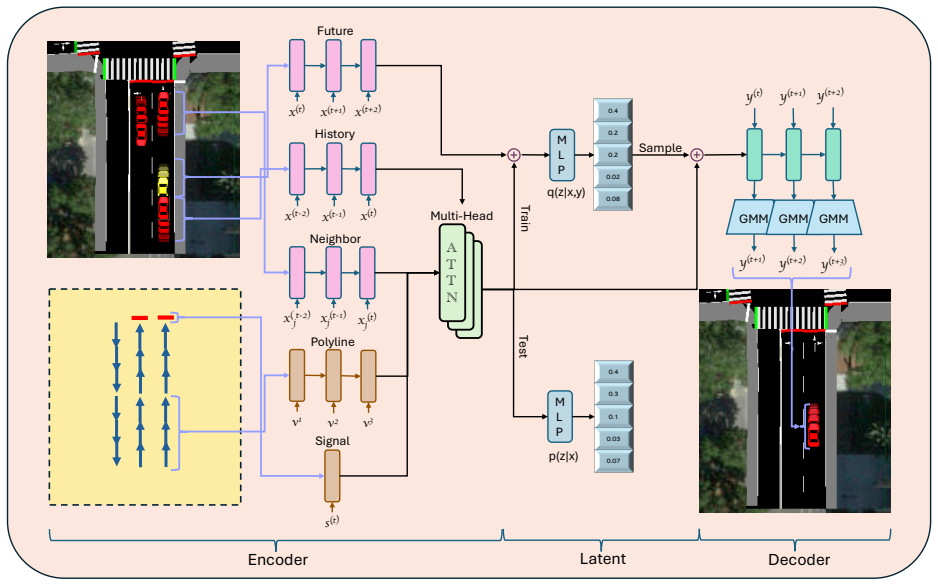
The central object is the multi-headed self-attention encoder inside a conditional VAE. It takes as queries the actor vehicle's LSTM history embedding and as keys and values the concatenated embeddings of up to two nearby front vehicles, the next two lane polylines, and a feed-forward encoding of the stop-line coordinates plus one-hot signal state. The attention output is added to the actor embedding, and a GRU with a mixture density network decodes a Gaussian mixture over future positions. The signal encoder and vectorized lane representation are what distinguish this model from a generic trajectory predictor and what the paper credits for the improved intersection metrics.
What would settle it
Record real vehicle trajectories and signal states at the same intersection, train the identical architecture on them, and run the same simulation-in-the-loop metric suite; if the model's safety-event rates diverge sharply from observed human driving, or if the westbound red-light violations persist across signal cycles, the claim that the framework mimics real intersection behavior is falsified.
Extended reading notes
Core claim
The paper's central claim is that a conditional variational autoencoder trajectory predictor, whose encoder fuses the actor's LSTM history with neighboring-vehicle histories, lane center-line polylines, and the traffic-signal state through multi-headed self-attention, can be unrolled in a closed loop to simulate multi-vehicle driving at a signalized intersection. The decoder produces a Gaussian-mixture distribution over the next 20 timesteps, and sampling from it while the simulator controls vehicle entry and signal state yields trajectories that, on the paper's metrics, match or exceed the earlier model's behavior: the paper reports a 19.2% decrease in mid-intersection stoppage, a 9.1% decrease in unsafe deceleration, a 5.6% decrease in reversing, and a 37% decrease in time-to-collision events. The vectorized lane and stop-line representation is what keeps the sampled trajectories on the drivable region, and the attention weights are what let the model decelerate at the right distance behind other vehicles. The paper also reports a known limitation: the model fails to learn red-light stopping for westbound traffic, which it attributes to the decoder's latent mixture not capturing that driving mode.
Load-bearing premise
The evaluation assumes that SUMO's synthetic trajectories, produced by a rule-based car-following model with approximate signal timing, are representative enough of real driving at this intersection that improvements measured on them tell us the model would mimic real-world macro- and micro-statistics.
Editorial extensions
If this is right
- Closed-loop evaluation turns any generative trajectory model into a candidate micro-simulator, so traffic engineers can compare models on safety events rather than on trajectory reconstruction error alone.
- Vectorized encodings of lane center lines and signal stop lines constrain predicted trajectories to the drivable region, which is why the model reduces infeasible moves and stoppage-related events.
- Attention over nearby vehicles reduces time-to-collision events by 37%, suggesting the model learns implicit gap acceptance and deceleration timing from data instead of hard-coded rules.
- The pipeline produces per-lane and per-maneuver safety counts, letting engineers localize failure modes such as the westbound red-light violations the paper reports.
- The architecture is not tied to the synthetic data generator; it can be retrained on real-world trajectory data, which the paper identifies as a future direction.
Reading between the lines
- A natural next step is to repeat the same closed-loop evaluation on real recorded trajectories at the same intersection; if the model's macro-statistics shift, the SUMO-trained results should be read as a simulator-consistency check rather than a real-driving claim.
- The same traffic-safety metric suite could be applied to other generative predictors, such as graph-based or transformer baselines, to make simulation-in-the-loop a standard benchmark for intersection simulators.
- The signal encoder currently uses only the current signal state and stop-line coordinates; adding phase timing, countdowns, or green-wave offsets would test whether the residual westbound red-light violations come from missing temporal signal context or from decoder latent mode collapse.
Editorial analysis
A structured set of objections, weighed in public.
Referee Report
Summary. The paper proposes IntTrajSim, a Conditional Variational Auto-Encoder-based trajectory prediction model with multi-headed self-attention that incorporates neighboring vehicles, lane polylines, and traffic signal state, and couples it with a simulation-in-the-loop pipeline. The model is trained on SUMO-generated trajectories for a signalized intersection in Gainesville, Florida, and evaluated with traffic-safety metrics such as red-light violation, mid-intersection stoppage, pre-stopbar stoppage, TTC events, unsafe deceleration, and reversing. The paper compares the new model against the authors' earlier model and against SUMO ground truth, claiming that the new model outperforms the earlier model on the evaluation metrics and that its results are comparable to ground truth.
Significance. The paper makes a useful methodological contribution by proposing an evaluation protocol for generative trajectory prediction models in closed-loop simulation and by defining traffic-engineering-relevant metrics that go beyond trajectory reconstruction error. The model architecture is specified in enough detail (Equations 1-15) to be reimplemented, and the use of a public simulator benchmark is transparent. However, the significance of the central claim depends entirely on the accuracy of the comparison in Section V-C and Tables I-III, and that comparison currently contains inconsistencies that must be resolved before the claimed superiority over the earlier model can be accepted.
major comments (4)
- [§V-C, Tables I–II] The central comparison in the text is not supported by the tables. Section V-C attributes a 19.2% decrease to Mid-Intersection Stoppage, but that metric is 1 in both the new and old models (0.1% in each), so there is no decrease. The 197-to-0 change is Pre-Stopbar Stoppage, which is a 100% relative decrease; 19.2% is the old model's absolute rate. Similarly, the 9.1% and 5.6% figures for Unsafe Deceleration and Reversing are percentage-point changes (from 10.2% to 1.1% and from 8.1% to 2.5%), not relative decreases. In addition, Red Light Violations increase from 152 (14.8%) to 169 (16.5%), which contradicts the abstract's blanket claim that the new model outperforms the previous model. The comparison and all stated percentages need to be corrected or the claims need to be qualified.
- [§V-C, Table III] The statement that the new model's results are 'comparable to the ground truth metrics' is contradicted by Table III. Ground truth has 0% Unsafe Deceleration and 0% Reversing, while the new model has 1.1% and 2.5%, respectively; ground truth has 4.3% Mid-Intersection Stoppage while the new model has 0.1%. If 'comparable' is intended to mean within some tolerance, that tolerance should be stated explicitly; otherwise the text should be revised to say that the model produces fewer mid-intersection stoppages but more unsafe deceleration, reversing, and TTC events than the SUMO ground truth.
- [Tables I–III and §V-B] The per-lane trajectory cluster counts differ across the three tables for the same movements (e.g., T on EBT is 57 in Table II but 51 in Tables I and III; T on WBTR is 79, 93, and 61, respectively), even though the overall total is 1026 in each table. Because the percentages are computed per row, cross-table comparisons of per-lane rates are not apples-to-apples unless the composition of each run is the same. The paper should explain what generates these differences (e.g., stochastic entry times) and either use matched vehicle sets or explicitly state this limitation.
- [§IV-D, §V-B] The model is trained exclusively on SUMO-generated trajectories and is evaluated against SUMO-controlled signal timing and SUMO ground truth, so the framework as presented can only confirm consistency with the simulator's own Krauss car-following behavior. The introduction and abstract claim the goal of mimicking real-world macro- and micro-statistics, but no validation against real intersection data is provided. This should be stated prominently as a scope limitation, and the phrase in Section IV-D ('keep the traffic flow as close to the real world as possible') is not sufficient evidence of realism. The paper should either validate the SUMO model against observed trajectories or qualify all 'real-world' claims.
minor comments (4)
- [§VI] The conclusion contains the typo 'Unsafe De-acceleration'; it should read 'Unsafe Deceleration', matching the metric name used in Section V-A.
- [§IV-D] The values of the attention radius, the number of history timesteps, the polyline length, and the train/validation split are not reported; specifying these would improve reproducibility.
- [§II] In the related-work paragraph, 'GANs and V AEs' contains a spacing error; it should read 'GANs and VAEs'.
- [References] Reference [14] is described only as 'accepted for publication at a Special Session of PAKDD 2025'; if a DOI or arXiv identifier is available, it should be provided.
Circularity Check
No significant circularity: the model is trained on SUMO trajectories and scored by descriptive traffic metrics that are not used as training objectives; no prediction reduces to a fitted input by construction.
full rationale
The derivation chain in this paper is: train a CVAE-based trajectory predictor whose encoder uses multi-head self-attention over the actor's history, neighbor histories, lane centerline polylines, and an encoded traffic signal; unroll the model in simulation-in-the-loop; count event-based traffic-engineering metrics; and compare those counts against the authors' prior model and against SUMO ground truth. None of the six metrics (red-light violation, mid-intersection stoppage, pre-stopbar stoppage, TTC events, unsafe deceleration, reversing) is a fitted parameter, a training objective, or a quantity defined in terms of the model's own outputs. They are post-hoc counts computed from the generated trajectories, with thresholds taken from external sources such as reference [16] for braking. The SUMO ground truth in Table III is not constructed from the model's predictions; it is a separately generated trajectory set, even though it comes from the same simulator used to produce training data. That shared origin is a validity threat for the paper's broader real-world generalization claim, but it is not circularity: the paper's direct empirical claim is agreement with the SUMO-generated reference, and that agreement is measured by independent event counts. The only self-citation is to the authors' prior PAKDD 2025 paper [14], which supplies some metric definitions and an earlier baseline model. This is a normal comparison and is not load-bearing: the new model's metrics are computed directly and compared directly, not inferred from the authority of [14]. The conclusion's admission that the model fails to stop for westbound red lights is a performance limitation, not a circular step. Similarly, the Section V-C statement that results are 'comparable to ground truth' is internally inconsistent with Tables I-III and the 19.2% improvement is misattributed in the text, but those are correctness and reporting problems outside the circularity analysis. Because no equation or table entry reduces to an input it is claimed to predict, and no load-bearing claim depends on an unverified self-citation, the circularity score is 0.
Assumptions & free parameters
free parameters (6)
- Neighbor count per actor =
2
- Attention radius =
Not specified
- Number of latent modes |Z| =
25
- TTC threshold =
1 second
- Reversing window =
10 frames
- Polyline segment length =
4 meters, 3 vectors per polyline
assumptions (4)
- domain assumption SUMO's Krauss model and approximate signal timing produce trajectories representative of real intersection driving
- domain assumption Feeding the model's own predicted positions back as inputs for 40000 timesteps is a valid micro-simulation that does not accumulate errors that bias the metrics
- ad hoc to paper The hand-crafted constraints (only two nearest front vehicles, next two polylines) do not remove the driving behaviors the metrics measure
- ad hoc to paper Traffic signal input is sufficiently encoded by stop-line coordinates plus one-hot light state
Cite this review
Pith. "Pith review of IntTrajSim: Trajectory Prediction for Simulating Multi-Vehicle driving at Signalized Intersections." pith.science (2026). https://pith.science/paper/752JYGBB
@misc{pith2026250608957,
  author       = {Pith},
  title        = {Pith review of: IntTrajSim: Trajectory Prediction for Simulating Multi-Vehicle driving at Signalized Intersections},
  year         = {2026},
  howpublished = {\url{https://pith.science/paper/752JYGBB}},
  note         = {Machine review of arXiv:2506.08957}
}
read the original abstract
Traffic simulators are widely used to study the operational efficiency of road infrastructure, but their rule-based approach limits their ability to mimic real-world driving behavior. Traffic intersections are critical components of the road infrastructure, both in terms of safety risk (nearly 28% of fatal crashes and 58% of nonfatal crashes happen at intersections) as well as the operational efficiency of a road corridor. This raises an important question: can we create a data-driven simulator that can mimic the macro- and micro-statistics of the driving behavior at a traffic intersection? Deep Generative Modeling-based trajectory prediction models provide a good starting point to model the complex dynamics of vehicles at an intersection. But they are not tested in a "live" micro-simulation scenario and are not evaluated on traffic engineering-related metrics. In this study, we propose traffic engineering-related metrics to evaluate generative trajectory prediction models and provide a simulation-in-the-loop pipeline to do so. We also provide a multi-headed self-attention-based trajectory prediction model that incorporates the signal information, which outperforms our previous models on the evaluation metrics.
Figures


Reference graph
Works this paper leans on
-
[1]
In: 2016 IEEE Conference on Computer Vision and Pattern Recognition (CVPR)
Alahi, A., Goel, K., Ramanathan, V ., Robicquet, A., Fei-Fei, L., Savarese, S.: Social lstm: Human trajectory prediction in crowded spaces. In: 2016 IEEE Conference on Computer Vision and Pattern Recognition (CVPR). pp. 961–971 (2016). https://doi.org/10.1109/CVPR.2016.110 TABLE III EVALUATION METRIC RESULTS ON RAW GROUND TRUTH DATA FROM SUMO Trajectory C...
-
[2]
Workingpaper, Aston University (1994)
Bishop, C.: Mixture density networks. Workingpaper, Aston University (1994)
work page 1994
-
[3]
Chen, D., Zhu, M., Yang, H., Wang, X., Wang, Y .: Data-driven traffic simulation: A comprehensive review (2023), https://arxiv.org/abs/2310. 15975
work page 2023
-
[4]
Fellendorf, M., V ortisch, P.: Microscopic Traffic Flow Simula- tor VISSIM, pp. 63–93. Springer New York, New York, NY (2010). https://doi.org/10.1007/978-1-4419-6142-6 2, https://doi.org/10. 1007/978-1-4419-6142-6 2
-
[5]
Gao, J., Sun, C., Zhao, H., Shen, Y ., Anguelov, D., Li, C., Schmid, C.: Vectornet: Encoding hd maps and agent dynamics from vectorized representation (2020), https://arxiv.org/abs/2005.04259
arXiv 2020
-
[6]
Graves, A.: Generating sequences with recurrent neural networks (2014), https://arxiv.org/abs/1308.0850
arXiv 2014
-
[7]
Gu, J., Sun, C., Zhao, H.: Densetnt: End-to-end trajectory prediction from dense goal sets (2021), https://arxiv.org/abs/2108.09640
work page Pith review arXiv 2021
-
[8]
Ivanovic, B., Pavone, M.: The trajectron: Probabilistic multi-agent trajectory modeling with dynamic spatiotemporal graphs (2019), https: //arxiv.org/abs/1810.05993
arXiv 2019
Show all 23 references
-
[9]
Kingma, D.P., Welling, M.: Auto-encoding variational bayes (2022), https://arxiv.org/abs/1312.6114
2022 arXiv
-
[10]
Krauss, S.: Microscopic modeling of traffic flow: investigation of colli- sion free vehicle dynamics (Apr 1998)
1998
-
[11]
IEEE Robotics and Automation Letters 6(1), 80–87 (2021)
Lefkopoulos, V ., Menner, M., Domahidi, A., Zeilinger, M.N.: Interaction-aware motion prediction for autonomous driving: A multiple model kalman filtering scheme. IEEE Robotics and Automation Letters 6(1), 80–87 (2021). https://doi.org/10.1109/LRA.2020.3032079
2021
-
[12]
In: The 21st IEEE Interna- tional Conference on Intelligent Transportation Systems
Lopez, P.A., Behrisch, M., Bieker-Walz, L., Erdmann, J., Fl ¨otter¨od, Y .P., Hilbrich, R., L ¨ucken, L., Rummel, J., Wagner, P., Wießner, E.: Microscopic traffic simulation using sumo. In: The 21st IEEE Interna- tional Conference on Intelligent Transportation Systems. IEEE (2...
2018
-
[13]
O’Shea, K., Nash, R.: An introduction to convolutional neural networks (2015), https://arxiv.org/abs/1511.08458
2015 arXiv
-
[14]
Ranjan, Y ., Sengupta, S., Rangarajan, R., Ranka, S.: Evaluating gener- ative vehicle trajectory models for traffic intersection dynamics (2025), accepted for publication at a Special Session of PAKDD 2025
2025
-
[15]
Salzmann, T., Ivanovic, B., Chakravarty, P., Pavone, M.: Trajectron++: Dynamically-feasible trajectory forecasting with heterogeneous data (2021), https://arxiv.org/abs/2001.03093
2021 arXiv
-
[16]
In: Proceedings of the 9th International Conference on Vehicle Technology and Intelligent Transport Systems - VEHITS
Sengupta, R., Banerjee, T., Karnati, Y ., Ranka, S., Rangarajan, A.: Using dsrc road-side unit data to derive braking behavior. In: Proceedings of the 9th International Conference on Vehicle Technology and Intelligent Transport Systems - VEHITS. pp. 420–427. INSTICC, SciTePres...
2023 doi
-
[17]
Shi, S., Jiang, L., Dai, D., Schiele, B.: Motion transformer with global intention localization and local movement refinement (2023), https:// arxiv.org/abs/2209.13508
2023 arXiv
-
[18]
Vaswani, A., Shazeer, N., Parmar, N., Uszkoreit, J., Jones, L., Gomez, A.N., Kaiser, L., Polosukhin, I.: Attention is all you need (2023), https: //arxiv.org/abs/1706.03762
2023 arXiv
-
[19]
Viroli, C., McLachlan, G.J.: Deep gaussian mixture models (2017), https: //arxiv.org/abs/1711.06929
2017 arXiv
-
[20]
IEEE Transactions on Industrial Electronics 65(7), 5999–6008 (2018)
Xie, G., Gao, H., Qian, L., Huang, B., Li, K., Wang, J.: Vehicle trajectory prediction by integrating physics- and maneuver-based approaches using interactive multiple models. IEEE Transactions on Industrial Electronics 65(7), 5999–6008 (2018). https://doi.org/10.1109/TIE.2017.2782236
2018
-
[21]
In: 2018 21st International Conference on Intelligent Transportation Systems (ITSC)
Xin, L., Wang, P., Chan, C.Y ., Chen, J., Li, S.E., Cheng, B.: Intention- aware long horizon trajectory prediction of surrounding vehicles us- ing dual lstm networks. In: 2018 21st International Conference on Intelligent Transportation Systems (ITSC). pp. 1441–1446 (2018). htt...
2018
-
[22]
Zhao, H., Gao, J., Lan, T., Sun, C., Sapp, B., Varadarajan, B., Shen, Y ., Shen, Y ., Chai, Y ., Schmid, C., Li, C., Anguelov, D.: Tnt: Target-driven trajectory prediction (2020), https://arxiv.org/abs/2008.08294
2020 arXiv
-
[23]
Zhao, S., Song, J., Ermon, S.: Infovae: Information maximizing varia- tional autoencoders (2018), https://arxiv.org/abs/1706.02262
2018 arXiv
Reviewed August 7, 2026 · model on record in the stance chip above.
Discussion (0). Sign in to comment.