REVIEW 3 major objections 4 minor 13 references
MetaTT: A Global Tensor-Train Adapter for Parameter-Efficient Fine-Tuning
T0 review · 3 major / 4 minor · reviewed 2026-08-07 · deepseek-v4-flash
Pith's one-line read The paper claims that one shared tensor-train adapter, indexing layer, matrix type, and optionally heads and tasks, replaces the full set of per-layer low-rank adapters and keeps accuracy competitive.
desk verdict The TT adapter is a real, checkable extension of LoTR with broadly supported parameter-efficiency claims; the DMRG rank-adaptive claim is confounded by a warm-start effect and needs controls. read the letter →
The pith
A machine-rendered reading of the paper's core claim, the machinery that carries it, and where it could break.
The reading
What carries the argument
The machinery is the tensor-train decomposition applied as a global adapter: a tensor $G$ of order $d$ is written as $G[i_1,\dots,i_d] = G_1[i_1] G_2[i_2] \cdots G_d[i_d]$, where each $G_k[i_k]$ is a matrix of size $r_{k-1} \times r_k$ and the $r_k$ are the TT-ranks. For MetaTT the modes are chosen so that layer, matrix type, head, and task indices become small internal cores, while the large input and output dimensions sit at the ends, each coupled to the rest by a single bond; this is why the parameter cost is linear in $D$ plus quadratic in $r$ over the small modes. The second piece of machinery is the DMRG-inspired sweep (Algorithm 1), which merges adjacent TT cores, applies truncated SVD, and splits them back at a reduced rank after AdamW epochs, thereby adapting ranks during training and re-initializing the optimizer moments after each truncation.
What would settle it
Fine-tune a pre-trained transformer on a synthetic task whose per-layer, per-matrix weight updates are deliberately full-rank and mutually uncorrelated, then compare MetaTT and LoRA at a matched trainable budget; if MetaTT's accuracy falls far below LoRA, the shared low-rank structure is not doing the work. A second concrete check is to permute the TT core ordering, for example by moving the layer index next to the input dimension, and observe whether performance degrades sharply.
Extended reading notes
Core claim
The paper's central claim is that the set of all adapter updates in a transformer—across layers $l = 1, \dots, L$, projection matrices $m = 1, \dots, M$, and optionally heads $h$ and tasks $t$—can be viewed as a single high-order tensor $\Delta W^{4D} \in \mathbb{R}^{D_{in} \times L \times M \times D_{out}}$ (or the 5D and 6D generalizations) and factorized in the tensor-train format. With the input and output dimensions placed at the two ends of the TT chain, MetaTT-4D has $2Dr + (L+M)r^2$ parameters for $D = \max\{D_{in}, D_{out}\}$ and bond rank $r$, versus at least $2LMD r$ for LoRA. The authors show empirically that this shared TT reaches accuracy competitive with LoRA, LoTR, VeRA, and LoRETTA on commonsense reasoning (Llama-2-7B and Llama-2-13B) and on GLUE (RoBERTa base and large), often with tens of times fewer parameters, and that a task-indexed core (MetaTT-(4+1)D) delivers comparable or better multi-task averages than MTL-LoRA and MoE-LoRA while using far fewer parameters. A further claim is that alternating AdamW with the DMRG-inspired sweep yields higher accuracy at a fixed target rank than AdamW alone on MRPC and RTE, for both RoBERTa base and large.
Load-bearing premise
The method assumes that if you laid out every small weight update from every layer, matrix type, head, and task as one big table, that table would be nearly low-rank in the tensor-train format with the paper's chosen ordering of the table's axes.
Editorial extensions
If this is right
- On commonsense reasoning with Llama-2-7B and Llama-2-13B, MetaTT-4D stays within roughly one average-accuracy point of LoRA while using up to about 30 times fewer trainable parameters.
- On GLUE with RoBERTa base and large, MetaTT-4D and MetaTT-5D match or come close to LoRA, LoTR, and LoRTA with between about 2 times and 20 times fewer parameters, while outperforming VeRA and LoRETTA.
- In multi-task learning, adding one task-indexed TT core (MetaTT-(4+1)D) performs comparably to MTL-LoRA and MoE-LoRA on RoBERTa base and outperforms them on RoBERTa large, using roughly 22 times to 43 times fewer parameters.
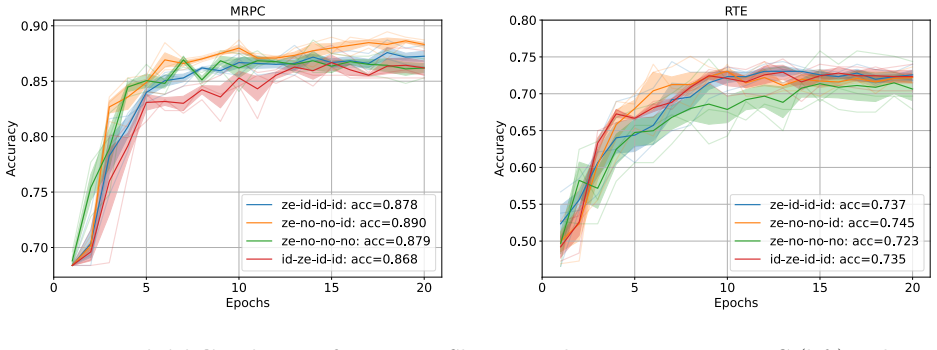
- Interleaving AdamW with the DMRG-inspired sweep improves final accuracy at target rank $r=4$ over plain AdamW on MRPC and RTE for both model sizes.
- At inference, trained TT cores can be merged with the boundary core so that MetaTT runs at LoRA-style speed.
Reading between the lines
- Beyond the paper's claims, a natural next test is whether the same global-TT construction transfers to other tensor-network ansätze, such as tree or projected-entangled-pair structures, which would change which correlations between layers the adapter can capture.
- If the low-rank manifold assumption holds broadly, MetaTT-style adapters could scale to models with hundreds of layers and many tasks, since adding a layer or task only adds one $r \times r$ core rather than a full adapter.
- The DMRG sweep as presented uses singular-value magnitude as the truncation criterion; replacing this with loss-informed importance scores would be a concrete extension the paper leaves open.
- Because the task core visibly accumulates large gradients in the paper's own heatmap analyses, a testable prediction is that task difficulty and task-core gradient norm correlate, which could be used to allocate TT ranks per task.
Editorial analysis
A structured set of objections, weighed in public.
Referee Report
Summary. The paper introduces MetaTT, a family of tensor-train (TT) adapters that jointly factorize the weight-update matrices of all target linear layers of a transformer into a single shared TT, with tensor modes indexing layer, projection-matrix type, optionally heads, and optionally tasks. The claimed advantage is that parameter count scales with the sum (rather than the product) of the mode sizes, and the paper reports competitive parameter-efficient fine-tuning results on commonsense reasoning (Llama-2-7B/13B), GLUE (RoBERTa-base/large), and 3- and 4-task multi-task settings, against baselines including LoRA, VeRA, LoTR, LoRTA, and LoRETTA. The paper further proposes a DMRG-inspired rank-adaptive training scheme that interleaves AdamW with two-site SVD truncation sweeps, and reports that it improves accuracy at a target TT rank.
Significance. The parameter-count arithmetic in §2.3 is correct, and the empirical comparisons at moderate ranks are broadly consistent with the claim that a shared TT adapter can rival LoRA-type per-layer adapters at lower parameter budgets. The paper includes detailed hyper-parameter tables and a reproducibility statement with pseudo-code, which is a strength. The multi-task extension is a natural and useful modularity point. However, the third contribution, the DMRG-inspired optimizer, is not supported by the current experimental design (major comment 1), and several high-rank entries in Table 2 contradict the paper's 'irrespective of rank' claim (major comment 2). Given these issues, the paper's central parameter-efficiency thesis is defensible but the stated conclusions need revision and additional controls.
major comments (3)
- [§3.3, Table 4, Figure 2] The comparison between AdamW at fixed rank r=4 and AdamW+Algorithm 1 starting from r=10 and annealing to r=4 is confounded by the higher-capacity warm start: the DMRG run trains at ranks 10, 8, 6, and 4, while the baseline only sees rank 4. The reported gains (e.g., RoBERTa-large RTE 0.640 to 0.701) could therefore be due to the rank-annealing curriculum or to the SVD truncations acting as restarts rather than to the specific two-site sweep in Algorithm 1. Because the abstract and Section 3.3 claim that integrating this approach with AdamW 'enhances optimization performance for a specified target rank', the paper needs at least one control with a simple rank schedule (e.g., train at r=10 and truncate globally to r=4, or switch from r=10 to r=4 after a fixed epoch) and ideally a control with non-rank perturbations. Section C's admission that the schedule was chosen heuristically from 10 and 4 trials, respectively, reinforces that the claim is currently unsupported as stated.
- [Table 2, §3.1] Several high-rank MetaTT entries fail or are extremely unstable: RoBERTa-base MetaTT-4D r=64 gives QNLI 77(12) and STS-B 72(15), and RoBERTa-large MetaTT-5D r=64 gives STS-B 65(23) and MetaTT-4D r=32 gives QQP 76(9); these are far below the LoRA and other baseline results. Yet the text after Table 2 concludes that 'irrespective of the rank, LoTR, LoRTA, and variants of MetaTT come close to LoRA in terms of accuracy across tasks'. This is false for the cited entries, and the paper's own Section F admits initialization sensitivity and failed training. The main-text conclusion should either be restricted to moderate ranks (r ≤ 24/32 for the tested configurations) or explicitly reconcile the failure modes with the advertised rank-adaptivity.
- [Table 1, §3.1] All Llama-2 results are single-shot with no variance estimates, and the text uses these to claim that MetaTT 'trails very closely to LoRA' with 'less than 1% drop' in average accuracy. Given that several per-task differences among the methods are also about 1%, single runs cannot support this comparative claim. If the computational budget indeed forces single runs, the paper should say so in the main text and define a tolerance for 'competitive' rather than stating differences as if they were established.
minor comments (4)
- [§2.4, Algorithm 1] Algorithm 1 is a two-site TT-rounding/truncation sweep, not a variational DMRG local optimization; the text should be explicit that the DMRG connection is motivational, since Section C already notes the future extension of using local optimizers.
- [§3.2, Table 5] The claim near Table 3 that MetaTT-(4+1)D outperforms MetaTT-4D 'for almost all of the datasets' does not hold on the 4-task RoBERTa-base results, where MetaTT-4D has comparable or better scores on RTE (75 vs 70) and on average (74.8 vs 74.5); please qualify the claim.
- [§D.1, Table 1] The hyper-parameter search is described as a 'manual grid search without fixing random seeds', which is fine for exploration, but the final fixed-seed protocol should be stated consistently for Table 1 as well; currently the seed protocol is only explicit for Tables 2 and 3.
- [Throughout] There are occasional typos and ambiguities, including 'accomodates' in §1, an ambiguous 'the latter can be more unstable' in §2.4, and footnote numbering in Tables 1-2 that is easy to misread.
Circularity Check
No significant circularity: parameter counts are algebraic consequences of the TT ansatz, benchmarks are against external baselines, and the DMRG comparison, while potentially confounded, is an empirical comparison rather than a definitional reduction.
full rationale
I examined the derivation chain from Eq. (1) through the complexity analysis in Section 2.3 and the DMRG experiments in Section 3.3. The central parameter-count claims (2Dr + (L+M)r^2 for MetaTT-4D, (D + D/H)r + (L+M+H)r^2 for MetaTT-5D) are direct algebraic consequences of the tensor-train ansatz and the chosen mode ordering; they are definitions of the representation, not predictions derived from data. The low-rankness of the shared adapter tensor is stated as an assumption ('Our results suggest that assuming low-rankness in the manifold of shared parameters is a viable strategy') and is tested empirically against external methods (LoRA, VeRA, LoTR, LoRTA, LoRETTA, MTL-LoRA, MoE-LoRA) with hyper-parameters reported in Section D; no external benchmark result is constructed from the paper's own fitted values. There are no self-citations by the authors, and citations such as [Sch11; Ver+23] for DMRG and [KNO17] for TT expressivity are standard independent references. The only methodological caveat is in Section 3.3 / Table 4: AdamW+DMRG starts from rank 10 and anneals to rank 4, while the AdamW baseline is fixed at rank 4 throughout, so the reported gains could partly reflect a warm-start curriculum or SVD-induced restarts rather than the specific two-site sweeps of Algorithm 1; Section C also admits the schedule was chosen heuristically. This is a confound or correctness risk, not circularity: the comparison is not defined in terms of its own output, and no fitted parameter is renamed as a prediction. No circular step meets the evidentiary bar of Eq. X = Eq. Y by construction or fitted-input-called-prediction.
Assumptions & free parameters
free parameters (4)
- TT rank r =
4, 8, 16, 24, 32, 64, 256 (per experiment)
- Scaling factor alpha =
0.5, 1.0, 2.0, 4.0
- DMRG rank schedule =
start r=10, decrease to r=4
- Initialization strategy =
G1 zero, G2/G3 identity, G4 identity (or Gaussian middle cores for Llama)
assumptions (5)
- standard math TT decomposition and Eckart-Young SVD truncation give valid low-rank approximations.
- domain assumption The joint tensor of adapter updates across layers, matrix types, heads, and tasks is approximately low-rank in the TT format with the chosen mode ordering.
- domain assumption Adapting only Q and V projection matrices is sufficient for competitive fine-tuning.
- ad hoc to paper The DMRG-inspired sweep with a specific decreasing-rank schedule improves optimization at a target rank.
- ad hoc to paper Zero and identity initialization of TT cores provides a stable training starting point.
Cite this review
Pith. "Pith review of MetaTT: A Global Tensor-Train Adapter for Parameter-Efficient Fine-Tuning." pith.science (2026). https://pith.science/paper/NOQ2CXTH
@misc{pith2026250609105,
  author       = {Pith},
  title        = {Pith review of: MetaTT: A Global Tensor-Train Adapter for Parameter-Efficient Fine-Tuning},
  year         = {2026},
  howpublished = {\url{https://pith.science/paper/NOQ2CXTH}},
  note         = {Machine review of arXiv:2506.09105}
}
read the original abstract
We present MetaTT, a Tensor Train (TT) adapter framework for fine-tuning of pre-trained transformers. MetaTT enables flexible and parameter-efficient model adaptation by using a single shared TT to factorize transformer sub-modules. This factorization indexes key structural dimensions, including layer and matrix type, and can optionally incorporate heads and tasks. This design allows MetaTT's parameter count to scale with the sum, rather than the product, of the modes, resulting in a substantially more compact adapter. Our benchmarks compare MetaTT with LoRA along with recent state-of-the-art matrix and tensor decomposition based fine-tuning methods. We observe that when tested on single-task standard language modeling benchmarks, MetaTT achieves competitive parameter efficiency to accuracy tradeoff. We further demonstrate that MetaTT performs competitively when compared to state-of-the-art methods on multi-task learning. Finally, we leverage the TT decomposition to design a rank adaptive optimizer inspired by the DMRG method from many-body physics. Our results demonstrate that integrating this approach with AdamW enhances optimization performance for a specified target rank.
Figures


Figures from the paper (2 more)

Reference graph
Works this paper leans on
-
[1]
RandLoRA: Full-rank parameter-efficient fine-tuning of large models
[Alb+25] P. Albert, F. Z. Zhang, H. Saratchandran, C. Rodriguez-Opazo, A. v. d. Hengel, and E. Abbasnejad. “RandLoRA: Full-rank parameter-efficient fine-tuning of large models”. In:arXiv preprint arXiv:2502.00987(2025). [Alm+23] E. Almazrouei, H. Alobeidli, A. Alshamsi, A. Cappelli, R. Cojocaru, M. Debbah, É. Goffinet, D. Hesslow, J. Launay, Q. Malartic, ...
arXiv 2025
-
[5]
Compression of deep convolutional neural networks for fast and low power mobile applications
[Kim+15] Y.-D. Kim, E. Park, S. Yoo, T. Choi, L. Yang, and D. Shin. “Compression of deep convolutional neural networks for fast and low power mobile applications”. In:arXiv preprint arXiv:1511.06530(2015). [KNO17] V. Khrulkov, A. Novikov, and I. Oseledets. “Expressive power of recurrent neural networks”. In:arXiv preprint arXiv:1711.00811(2017). [Koi+25] ...
arXiv 2015
-
[6]
FETTA: Flexible and Efficient Hardware Accelerator for Tensorized Neural Network Training
[Lu+25] J. Lu, J. Tian, H. Li, I. Young, and Z. Zhang. “FETTA: Flexible and Efficient Hardware Accelerator for Tensorized Neural Network Training”. In:arXiv preprint arXiv:2504.06474(2025). [Man+22] S. Mangrulkar, S. Gugger, L. Debut, Y. Belkada, S. Paul, and B. Bossan.PEFT: State-of-the-art Parameter-Efficient Fine-Tuning methods. https : / / github . co...
-
[9]
[YZWZ24] Y. Yang, J. Zhou, N. Wong, and Z. Zhang. “Loretta: Low-rank economic tensor-train adaptation for ultra-low-parameter fine-tuning of large language models”. In:arXiv preprint arXiv:2402.11417(2024). [ZB24] M. Zanella and I. Ben Ayed. “Low-rank few-shot adaptation of vision-language mod- els”. In:Proceedings of the IEEE/CVF Conference on Computer V...
arXiv 2024
-
[10]
Adalora: Adaptive budget allocation for parameter-efficient fine-tuning
[Zha+23] Q. Zhang, M. Chen, A. Bukharin, N. Karampatziakis, P. He, Y. Cheng, W. Chen, and T. Zhao. “Adalora: Adaptive budget allocation for parameter-efficient fine-tuning”. In: arXiv preprint arXiv:2303.10512(2023). [Zha+24a] G. Zhang, L. Wang, G. Kang, L. Chen, and Y. Wei. “SLCA++: Unleash the Power of Sequential Fine-tuning for Continual Learning with ...
arXiv 2023
-
[11]
Delta-lora: Fine- tuning high-rank parameters with the delta of low-rank matrices
[Zi+23] B. Zi, X. Qi, L. Wang, J. Wang, K.-F. Wong, and L. Zhang. “Delta-lora: Fine- tuning high-rank parameters with the delta of low-rank matrices”. In:arXiv preprint arXiv:2309.02411(2023). [ZP24] F. Zhang and M. Pilanci. “Riemannian preconditioned lora for fine-tuning foundation models”. In:arXiv preprint arXiv:2402.02347(2024). [ZYLL22a] K. Zhou, J. ...
arXiv 2023
-
[12]
Learning to prompt for vision-language models
[ZYLL22b] K. Zhou, J. Yang, C. C. Loy, and Z. Liu. “Learning to prompt for vision-language models”. In:International Journal of Computer Vision(2022). 17 A Other Related Works In this section, we explore various works that are pertinent to our study. Alternatives to tuning weights for PEFT.Among the relevant works, we briefly highlight research that inves...
work page 2022
-
[13]
This would not only enable rank adaptation across each TT bond, but also directly optimize the loss function which may result in a powerful optimizer. 20 Figure 4:Influence of task-dependent TT core in MTL.(Left): (Top): accuracy of MetaTT- (4+1)D as a function of epochs for RoBERTaBase for a single training realization (in the case of CoLA we compute Mat...
work page 2025
Show all 13 references
-
[2017]
BERT: Pre-training of deep bidirectional transformers for language understanding
13 [DCLT19] J. Devlin, M.-W. Chang, K. Lee, and K. Toutanova. “BERT: Pre-training of deep bidirectional transformers for language understanding”. In:Proceedings of the 2019 conference of the North American chapter of the association for computational linguistics: human languag...
2019
-
[2022]
Randomized block krylov methods for stronger and faster ap- proximate singular value decomposition
15 [MM15] C. Musco and C. Musco. “Randomized block krylov methods for stronger and faster ap- proximate singular value decomposition”. In:Advances in neural information processing systems(2015). [MM17] C. Musco and C. Musco. “Recursive sampling for the nystrom method”. In:Adva...
2015
-
[2023]
Tensor decompositions and applications
[Jia+23] A. Q. Jiang, A. Sablayrolles, A. Mensch, C. Bamford, D. S. Chaplot, D. de las Casas, F. Bressand, G. Lengyel, G. Lample, L. Saulnier, L. R. Lavaud, M.-A. Lachaux, P. Stock, T. L. Scao, T. Lavril, T. Wang, T. Lacroix, and W. E. Sayed.Mistral 7B. 2023.url: https://arxiv...
2009 arXiv
-
[2024]
Ultimate tensorization: compressing convolutional and fc layers alike
url:https://zenodo.org/records/12608602. [GPNV16] T. Garipov, D. Podoprikhin, A. Novikov, and D. Vetrov. “Ultimate tensorization: compressing convolutional and fc layers alike”. In:arXiv preprint arXiv:1611.03214 (2016). [Gra+24] A. Grattafiori, A. Dubey, A. Jauhri, A. Pandey,...
2016
-
[2025]
The density-matrix renormalization group in the age of matrix product states
[Sch11] U. Schollwöck. “The density-matrix renormalization group in the age of matrix product states”. In:Annals of physics(2011). [SS16] E. Stoudenmire and D. J. Schwab. “Supervised learning with tensor networks”. In: Advances in neural information processing systems29 (2016)...
2011 arXiv
Reviewed August 7, 2026 · model on record in the stance chip above.
Discussion (0). Sign in to comment.