REVIEW 4 major objections 6 minor 34 references
An Open-Source Software Toolkit & Benchmark Suite for the Evaluation and Adaptation of Multimodal Action Models
T0 review · 4 major / 6 minor · reviewed 2026-08-07 · deepseek-v4-flash
Pith's one-line read MultiNet provides a fully open-source benchmark and toolkit—with a 1.3-trillion-token dataset—for evaluating how vision-language-action models generalize across robotics, games, and language.
desk verdict Useful open-source benchmark kit, but the OOD evaluation claims are unsupported until test splits are shown to be disjoint from the models' pretraining data. read the letter →
The pith
A machine-rendered reading of the paper's core claim, the machinery that carries it, and where it could break.
The reading
What carries the argument
The carrying mechanism is the MultiNet ecosystem, organized as four interlocking pieces: the composite 1.3-trillion-token dataset; the open-source SDK that converts heterogeneous reinforcement-learning and robotics data into a unified TensorFlow dataset format; the evaluation harness with curated test splits and a metric suite; and GenESIS, a modular prompting framework that turns control data into structured textual prompts that prime a vision-language model for analyzable action outputs. The model adaptations do the load-bearing work for the empirical results: OpenVLA's autoregressive step is restricted to single-dimensional action vectors, which are then unnormalized using dataset statistics and rounded to discrete values; Pi0 Base applies flow-matching denoising over ten steps with a default action dimension of 32; Pi0 Fast limits autoregressive decoding to four tokens and caches zero-image embeddings to double inference speed; and JAT concatenates floating-point observations into a single tensor. These adaptations are what make it possible to evaluate state-of-the-art models on out-of-distribution domains at all, and their reported failures to generalize constitute the paper's central empirical claim.
What would settle it
Run explicit duplicate detection across the constituent datasets—near-duplicate image matching between DataComp-1B, COYO-700M, and MS-COCO, and trajectory or observation overlap between OpenX-Embodiment and V-D4RL—and check whether any test-split items also appear in the pretraining corpora of the evaluated VLMs and VLAs. If substantial overlap is found, reported benchmark scores could reflect memorization rather than true out-of-distribution performance, which would settle whether the harness measures what it claims.
Extended reading notes
Core claim
MultiNet is a fully open-source ecosystem for evaluating and adapting models across vision, language, and action domains, built to fill what the paper identifies as a critical gap: most existing benchmarks are narrow and closed-source, while VLA models are typically engineered and evaluated on single domains such as robotic manipulation. The centerpiece is a composite dataset of over 1.3 trillion tokens, aggregated from 28 constituent datasets including OBELICS, DataComp-1B, MS-COCO, FineWeb-Edu, OpenX-Embodiment, Meta-World, V-D4RL, and Procgen, with control data forming about 58% of the collection. Around this dataset the paper supplies a curation SDK that standardizes heterogeneous reinforcement-learning and robotics data into a unified TensorFlow dataset format, an evaluation harness with curated test splits and a metric suite (MSE, Brier Mean Absolute Error, precision/recall/F1, invalid-output percentage, CIDEr, VQA accuracy, Recall@K, and accuracy), plus a modular prompting framework, GenESIS, that translates control data into structured textual prompts for vision-language models. The empirical results report that state-of-the-art VLMs and VLAs consistently fail to generalize to out-of-distribution robotics and procedurally generated digital action environments, with training data distribution, architectural choices, and processing techniques strongly influencing outcomes.
Load-bearing premise
The load-bearing premise is that the curated test splits genuinely prevent data contamination across the 28 amalgamated sources, which the paper asserts without specifying how duplicates are detected, such as overlapping images between DataComp-1B and MS-COCO or overlapping episodes between OpenX-Embodiment and V-D4RL.
Editorial extensions
If this is right
- Researchers gain a standardized, open platform for comparing VLMs and VLAs across robotics, game-play, vision-language, and language tasks, making benchmark results reproducible and directly comparable across labs.
- The curated test splits and metric suite give the community a contamination-aware foundation for evaluating both pretraining and fine-tuning of generalist action models.
- The open-source adaptations of JAT, OpenVLA, and Pi0 allow state-of-the-art models to be evaluated in out-of-distribution domains beyond their original training regimes.
- The reported failures of state-of-the-art models in out-of-distribution action environments provide a concrete baseline for how far current generalist agents are from robust deployment.
- The consolidated dataset and SDK lower the engineering barrier for training multimodal action models by placing previously scattered RL and robotics data in one uniform format.
Reading between the lines
- A natural next experiment the paper leaves implicit is to ablate the composite dataset—for instance, training a VLA on the control subset alone versus the full 1.3-trillion-token mixture—to separate data-scale effects from architectural bottlenecks in out-of-distribution generalization.
- Because the dataset amalgamates overlapping public sources, the 'contamination-free' claim remains an unverified hypothesis; until duplicate detection is actually run across all 28 sources, results for models pretrained on the same public data should be read with caution.
- The Brier Mean Absolute Error and invalid-output metrics introduced for RL evaluation could transfer to other output-validity-critical settings, such as tool-calling and UI-automation agents, where calibration and format compliance matter as much as task accuracy.
- The paper's own results suggest the 'generalist' label attached to current VLA models is largely aspirational, and MultiNet provides the instrument to test that label systematically across embodiments and virtual worlds.
Editorial analysis
A structured set of objections, weighed in public.
Referee Report
Summary. The paper introduces MultiNet, an open-source benchmark and software ecosystem for evaluating and adapting multimodal action models across vision, language, and action domains. It aggregates numerous existing datasets (e.g., OBELICS, DataComp-1B, FineWeb-edu, OpenX-Embodiment, Procgen) into a composite collection claimed to exceed 1.3 trillion tokens, provides a data curation SDK, an evaluation harness with a metric suite, a prompting framework called GenESIS, and adaptations of models such as OpenVLA, JAT, and Pi0 to new domains. The paper further claims that curated test splits prevent data contamination and draws conclusions about the out-of-distribution (OOD) generalization failures of current VLMs and VLAs, with supporting figures placed in the appendix.
Significance. If its claims are substantiated, MultiNet would be a valuable community resource: the open-source code, the aggregation of diverse datasets into a common format, the standardized metrics, and the adapted model implementations are all potentially useful contributions. The paper also reports that the framework has already been used in downstream research, which is a positive signal. However, the current manuscript does not supply the evidence needed to validate the central claims: there is no quantitative evaluation in the main text, the appendix figures are largely unlabeled, the split-construction and contamination-prevention protocol is not described, and the key OOD results may be confounded by training-data overlap. These issues must be addressed before the benchmark can serve as a trusted evaluation platform.
major comments (4)
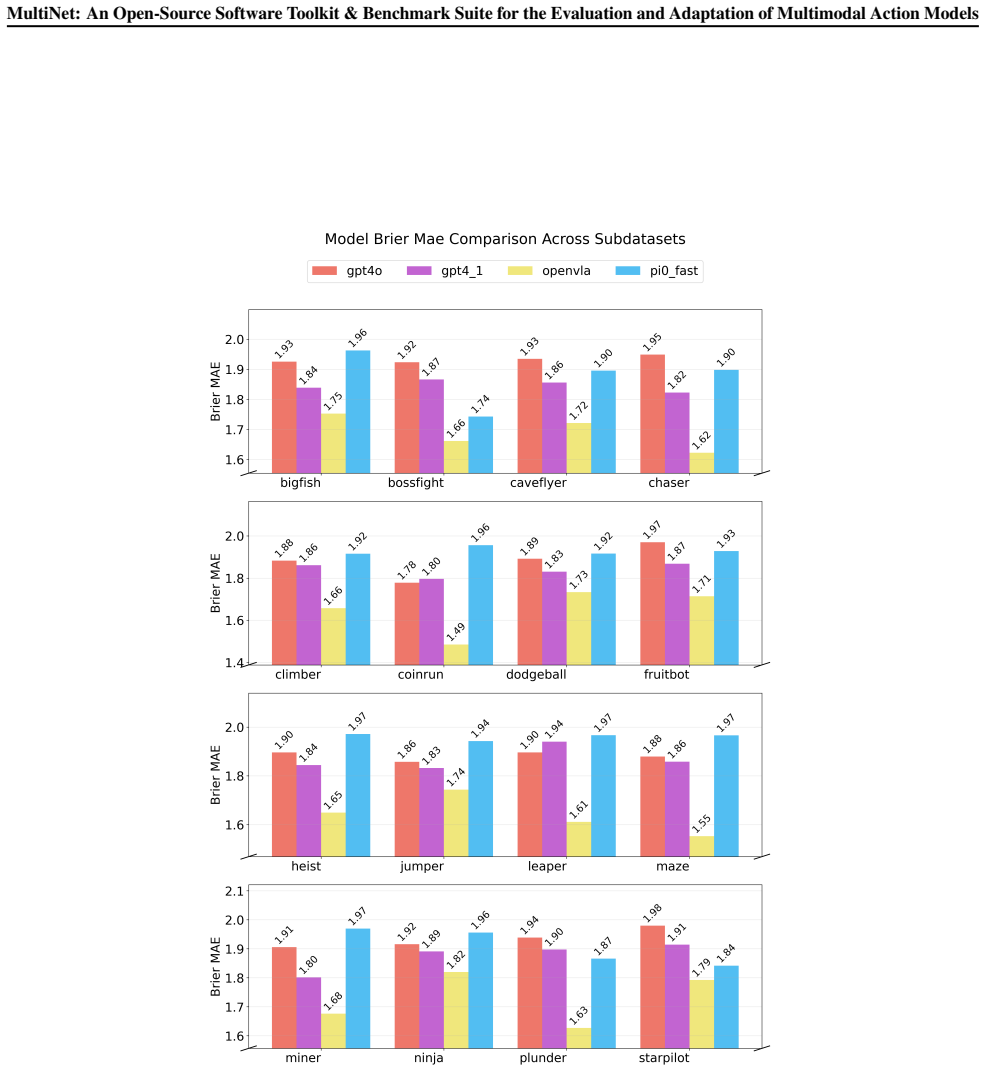
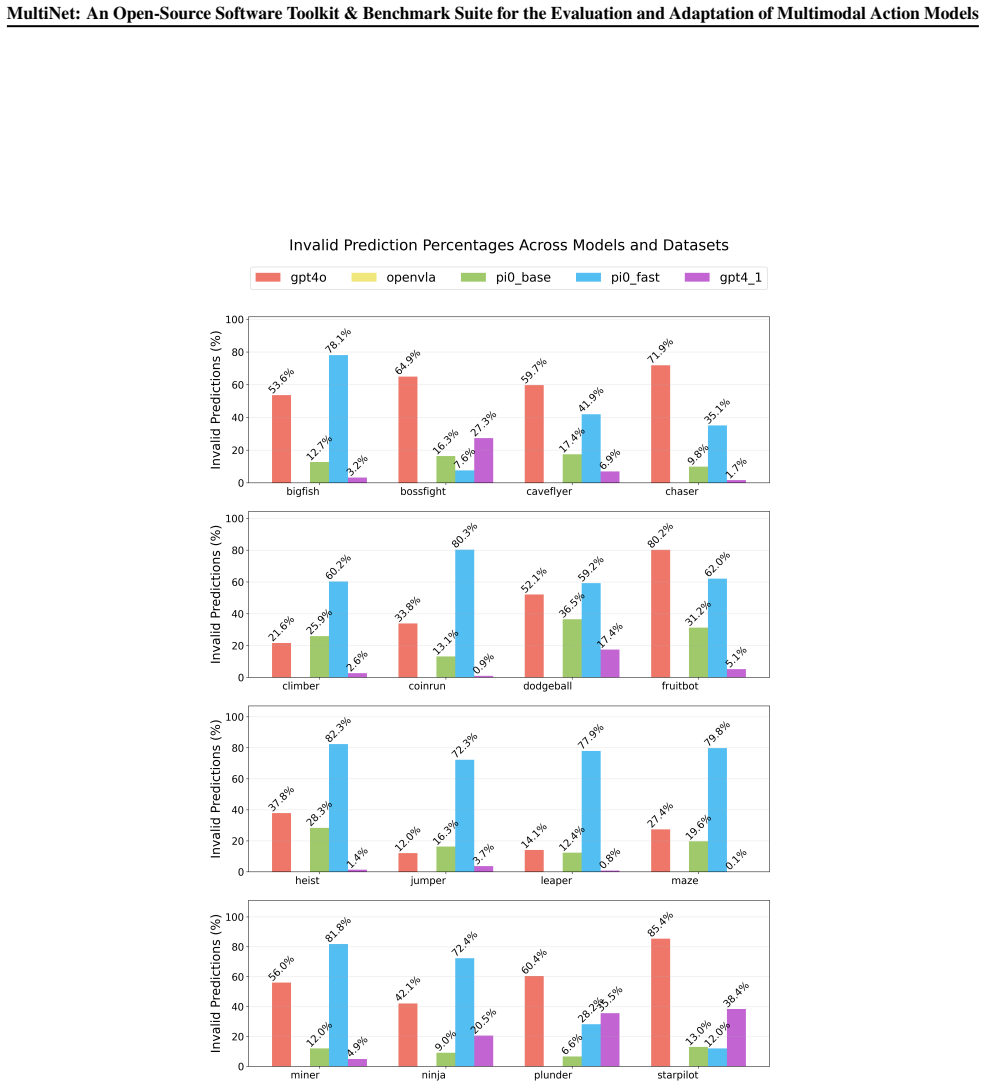
- [Section 4 and A.4] The claim in Section 4 that 'These curated splits prevent data contamination and establish a reliable foundation for benchmarking' is load-bearing for every OOD result in the paper, but no split-construction or deduplication protocol is described. In particular, the paper does not specify how test episodes were excluded from the pretraining corpora of the evaluated models. Since OpenVLA and Pi0 are trained on Open X-Embodiment, and A.4 evaluates models 'Across 20 OpenX Datasets,' the test episodes may well be present in the models' training data. The authors should provide a detailed split specification, a deduplication protocol (covering cross-source duplicates such as DataComp-1B vs. MS-COCO and OpenX-Embodiment vs. V-D4RL), and a quantitative overlap analysis against the pretraining mixtures of OpenVLA, Pi0, and JAT. Without this, the 'OOD' label and the generalization-failure conclusions in Section 7 and Figures 3-5 are unsupported.
- [A.4 and A.5 (Figures 3-6)] The empirical results presented in Appendix A.4 and A.5 are not interpretable as they stand. Figures 3-6 lack axis labels, units, legends (in most cases), error bars, and sample sizes, and no numerical tables are provided. The narrative makes quantitative claims such as 'JAT displays the poorest performance,' 'OpenVLA and GPT-4o demonstrate similar performance,' and 'All models display Brier MAE close to 2,' but the reader cannot verify these statements from the figures alone. The authors should provide labeled figures with clear axes and legends, and include tables of exact scores with standard errors or confidence intervals for every metric and model. This is essential because the paper's only experimental evidence is in these appendix figures.
- [Section 2 and Table 1] The headline claim of 'over 1.3 trillion tokens' is not substantiated by a per-source breakdown. The token count appears to be dominated by FineWeb-edu, which alone contributes 1.3 trillion tokens, so the incremental contribution of the remaining datasets is unclear. The authors should provide a table listing each source, its size before and after any preprocessing, the effective token or trajectory counts, and the proportion of the final composite dataset. They should also state the licenses of all constituent datasets and describe any filtering or conversion steps. Without this breakdown, the scale and composition of the dataset cannot be assessed.
- [Sections 5-7] The paper introduces GenESIS and several model adaptations, and claims 'In-depth Experiments and Analysis,' but the descriptions are entirely qualitative and no reproducible experimental protocol is given. For example, Section 6 describes how OpenVLA and Pi0 were adapted to Procgen, but does not provide exact prompts, hyperparameter settings, evaluation seeds, or the code version used. Section 7 simply states that models 'show consistent failures to generalize' without a single number in the main text. To substantiate the benchmark's utility, the authors should include at least one fully reproducible experiment (e.g., the Procgen evaluation) with a clear protocol, exact metric definitions, and results in a table, so that the harness can be independently verified.
minor comments (6)
- [Section 1] The word 'architect ed' in the Introduction appears to be a typo; it should be 'architected'.
- [Table 1] The table entries are formatted entirely in uppercase, which reduces readability; consider using title case for dataset names and descriptions.
- [Figure 3 caption] The caption uses 'AMSE' while Table 2 lists 'Mean Squared Error'; please define the acronym or use a consistent metric name.
- [References] The reference for COYO-700M is cited as '(coy)' in the text and the reference list entry is incomplete; please provide the full author list and a stable URL.
- [Section 5] The name 'GenESIS' is not expanded; if it is an acronym, please state what it stands for.
- [A.1] The phrase 'We detail in future steps in A.1' in Section 8 is grammatically awkward; consider rephrasing to 'We detail future steps in A.1.'
Circularity Check
No circular derivation: the dataset, harness, and adaptations rest on external data sources, and the cited prior works are self-referential motivation rather than load-bearing premises.
full rationale
The paper is a benchmark/toolkit contribution and does not contain a predictive or derivational chain that could reduce to its inputs. The dataset, SDK, evaluation harness, and model adaptations are presented as engineering contributions; the composite dataset is an amalgamation of externally sourced datasets (OBELICS, DataComp-1B, OpenX-Embodiment, Fineweb-edu, etc.) with external citations, so the central artifact does not derive from the paper's own claims. The only self-citations (Guruprasad et al., 2024, 2025) appear in Section 1 to motivate the need for broader generalization and in the abstract to note downstream use; they are not load-bearing for the construction of MultiNet, and the correctness of the benchmark does not depend on these citations. Section 4's statement that curated splits 'prevent data contamination' is an unverified empirical assertion rather than a logical derivation; no deduplication protocol or overlap analysis with model pretraining corpora is given, and because OpenVLA and Pi0 were pretrained on OpenX and then evaluated across OpenX datasets, the OOD results in A.4/A.5 carry a leakage risk. That is a validity concern, not a circularity of the kind where an output equals its input by construction. Section 6's use of 'statistical data derived from the complete Procgen subdataset' for unnormalizing actions likewise is test-set-statistic usage, a benchmark hygiene issue, but it is not a fitted parameter renamed as a prediction. No equation, theorem, or fitted quantity in the paper is defined in terms of the result it is used to establish. Score 0 reflects the absence of circular derivation.
Assumptions & free parameters
assumptions (2)
- domain assumption The underlying datasets (OBELICS, DataComp-1B, OpenX, and others) are of sufficient quality and licensing for open release.
- domain assumption The curated test splits in the evaluation harness prevent data contamination.
Cite this review
Pith. "Pith review of An Open-Source Software Toolkit & Benchmark Suite for the Evaluation and Adaptation of Multimodal Action Models." pith.science (2026). https://pith.science/paper/AOCTNULY
@misc{pith2026250609172,
  author       = {Pith},
  title        = {Pith review of: An Open-Source Software Toolkit & Benchmark Suite for the Evaluation and Adaptation of Multimodal Action Models},
  year         = {2026},
  howpublished = {\url{https://pith.science/paper/AOCTNULY}},
  note         = {Machine review of arXiv:2506.09172}
}
read the original abstract
Recent innovations in multimodal action models represent a promising direction for developing general-purpose agentic systems, combining visual understanding, language comprehension, and action generation. We introduce MultiNet - a novel, fully open-source benchmark and surrounding software ecosystem designed to rigorously evaluate and adapt models across vision, language, and action domains. We establish standardized evaluation protocols for assessing vision-language models (VLMs) and vision-language-action models (VLAs), and provide open source software to download relevant data, models, and evaluations. Additionally, we provide a composite dataset with over 1.3 trillion tokens of image captioning, visual question answering, commonsense reasoning, robotic control, digital game-play, simulated locomotion/manipulation, and many more tasks. The MultiNet benchmark, framework, toolkit, and evaluation harness have been used in downstream research on the limitations of VLA generalization.
Figures


Figures from the paper (3 more)

Reference graph
Works this paper leans on
-
[8]
Clark, P., Cowhey, I., Etzioni, O., Khot, T., Sabharwal, A., Schoenick, C., and Tafjord, O
URL https://arxiv.org/ abs/1810.08272. Clark, P., Cowhey, I., Etzioni, O., Khot, T., Sabharwal, A., Schoenick, C., and Tafjord, O. Think you have solved question answering? try arc, the ai2 reasoning challenge,
-
[12]
Gallou´edec, Q., Beeching, E., Romac, C., and Dellandr´ea, E
URL https://arxiv.org/abs/2304.14108. Gallou´edec, Q., Beeching, E., Romac, C., and Dellandr´ea, E. Jack of all trades, master of some, a multi-purpose trans- former agent,
-
[13]
Goyal, Y ., Khot, T., Summers-Stay, D., Batra, D., and Parikh, D
URL https://arxiv.org/ abs/2402.09844. Goyal, Y ., Khot, T., Summers-Stay, D., Batra, D., and Parikh, D. Making the v in vqa matter: Elevating the role of image understanding in visual question answer- ing,
-
[14]
URLhttps://arxiv.org/abs/2006.13888. Gurari, D., Li, Q., Stangl, A. J., Guo, A., Lin, C., Grauman, K., Luo, J., and Bigham, J. P. Vizwiz grand challenge: An- swering visual questions from blind people,
arXiv 2006
-
[15]
Guruprasad, P., Sikka, H., Song, J., Wang, Y ., and Liang, P
URL https://arxiv.org/abs/1802.08218. Guruprasad, P., Sikka, H., Song, J., Wang, Y ., and Liang, P. P. Benchmarking vision, language, & action models on robotic learning tasks,
-
[16]
URL https://arxiv. org/abs/2411.05821. Guruprasad, P., Wang, Y ., Chowdhury, S., and Sikka, H. Benchmarking vision, language, & action mod- els in procedurally generated, open ended action envi- ronments,
-
[18]
URL https://arxiv. org/abs/2501.09747. Kim, M. J. et al. Openvla: An open-source vision-language- action model.arXiv preprint arXiv:2406.09246,
- [19]
Show all 34 references
-
[20]
URL https://arxiv.org/abs/2107.07502. 6 MultiNet: An Open-Source Software Toolkit & Benchmark Suite for the Evaluation and Adaptation of Multimodal Action Models Lin, T.-Y ., Maire, M., Belongie, S., Bourdev, L., Girshick, R., Hays, J., Perona, P., Ramanan, D., Zitnick, C. L.,...
-
[21]
Penedo, G., Kydl´ıˇcek, H., allal, L
URL https://arxiv.org/abs/ 2206.04779. Penedo, G., Kydl´ıˇcek, H., allal, L. B., Lozhkov, A., Mitchell, M., Raffel, C., Werra, L. V ., and Wolf, T. The fineweb datasets: Decanting the web for the finest text data at scale,
-
[22]
Plummer, B
URL https://arxiv.org/abs/ 2406.17557. Plummer, B. A., Wang, L., Cervantes, C. M., Caicedo, J. C., Hockenmaier, J., and Lazebnik, S. Flickr30k en- tities: Collecting region-to-phrase correspondences for richer image-to-sentence models,
-
[23]
Schwenk, D., Khandelwal, A., Clark, C., Marino, K., and Mottaghi, R
URL https: //arxiv.org/abs/1505.04870. Schwenk, D., Khandelwal, A., Clark, C., Marino, K., and Mottaghi, R. A-okvqa: A benchmark for visual question answering using world knowledge,
-
[24]
Sharma, P., Ding, N., Goodman, S., and Soricut, R
URL https: //arxiv.org/abs/2206.01718. Sharma, P., Ding, N., Goodman, S., and Soricut, R. Con- ceptual captions: A cleaned, hypernymed, image alt-text dataset for automatic image captioning. In Gurevych, I. and Miyao, Y . (eds.),Proceedings of the 56th An- nual Meeting of the ...
-
[25]
doi: 10.18653/v1/P18-1238
Association for Computa- tional Linguistics. doi: 10.18653/v1/P18-1238. URL https://aclanthology.org/P18-1238. Singh, A., Natarjan, V ., Shah, M., Jiang, Y ., Chen, X., Parikh, D., and Rohrbach, M. Towards vqa models that can read. InProceedings of the IEEE Conference on Com- ...
-
[26]
Tassa, Y ., Doron, Y ., Muldal, A., Erez, T., Li, Y ., de Las Casas, D., Budden, D., Abdolmaleki, A., Merel, J., Lefrancq, A., Lillicrap, T., and Riedmiller, M
URL https: //arxiv.org/abs/1811.00937. Tassa, Y ., Doron, Y ., Muldal, A., Erez, T., Li, Y ., de Las Casas, D., Budden, D., Abdolmaleki, A., Merel, J., Lefrancq, A., Lillicrap, T., and Riedmiller, M. Deepmind control suite,
-
[27]
Todorov, E., Erez, T., and Tassa, Y
URL https://arxiv.org/ abs/1801.00690. Todorov, E., Erez, T., and Tassa, Y . Mujoco: A physics engine for model-based control. In2012 IEEE/RSJ Inter- national Conference on Intelligent Robots and Systems, pp. 5026–5033,
-
[29]
Vedantam, R., Zitnick, C
URL https://arxiv.org/abs/2307.09288. Vedantam, R., Zitnick, C. L., and Parikh, D. Cider: Consensus-based image description evaluation,
-
[31]
org/abs/2406.19314
URL https://arxiv. org/abs/2406.19314. Yu, T., Quillen, D., He, Z., Julian, R., Narayan, A., Shively, H., Bellathur, A., Hausman, K., Finn, C., and Levine, S. Meta-world: A benchmark and evaluation for multi-task and meta reinforcement learning,
-
[32]
Zellers, R., Holtzman, A., Bisk, Y ., Farhadi, A., and Choi, Y
URL https: //arxiv.org/abs/1910.10897. Zellers, R., Holtzman, A., Bisk, Y ., Farhadi, A., and Choi, Y . Hellaswag: Can a machine really finish your sentence?,
1910 arXiv
-
[33]
Zhai, X., Mustafa, B., Kolesnikov, A., and Beyer, L
URL https://arxiv.org/abs/ 1905.07830. Zhai, X., Mustafa, B., Kolesnikov, A., and Beyer, L. Sig- moid loss for language image pre-training,
1905 arXiv
-
[34]
7 MultiNet: An Open-Source Software Toolkit & Benchmark Suite for the Evaluation and Adaptation of Multimodal Action Models A
URL https://arxiv.org/abs/2303.15343. 7 MultiNet: An Open-Source Software Toolkit & Benchmark Suite for the Evaluation and Adaptation of Multimodal Action Models A. Appendix A.1. Future directions for MultiNet • Comprehensive Modality Analysis: We will systematically investiga...
-
[1950]
doi: 10.1175/1520-0493(1950)078 ⟨0001:VOFEIT⟩2.0. CO;2. Chevalier-Boisvert, M., Bahdanau, D., Lahlou, S., Willems, L., Saharia, C., Nguyen, T. H., and Bengio, Y . Babyai: A platform to study the sample efficiency of grounded lan- guage learning,
1950 doi
-
[2012]
Touvron, H., Martin, L., Stone, K., Albert, P., Almahairi, A., Babaei, Y ., Bashlykov, N., Batra, S., Bhargava, P., Bhosale, S., Bikel, D., Blecher, L., Ferrer, C
doi: 10.1109/IROS.2012.6386109. Touvron, H., Martin, L., Stone, K., Albert, P., Almahairi, A., Babaei, Y ., Bashlykov, N., Batra, S., Bhargava, P., Bhosale, S., Bikel, D., Blecher, L., Ferrer, C. C., Chen, M., Cucurull, G., Esiobu, D., Fernandes, J., Fu, J., Fu, W., Fuller, B....
2012
-
[2013]
doi: 10.1613/jair.3912
ISSN 1076-9757. doi: 10.1613/jair.3912. URL http://dx.doi.org/10. 1613/jair.3912. Beyer, L., Steiner, A., Pinto, A. S., Kolesnikov, A., Wang, X., Salz, D., Neumann, M., Alabdulmohsin, I., Tschan- nen, M., Bugliarello, E., Unterthiner, T., Keysers, D., Koppula, S., Liu, F., Gry...
-
[2015]
URLhttps://arxiv.org/abs/1411.5726. White, C., Dooley, S., Roberts, M., Pal, A., Feuer, B., Jain, S., Shwartz-Ziv, R., Jain, N., Saifullah, K., Naidu, S., Hegde, C., LeCun, Y ., Goldstein, T., Neiswanger, W., and Goldblum, M. Livebench: A challenging, contamination- free llm b...
-
[2016]
Bellemare, M
URLhttps://arxiv.org/abs/1612.03801. Bellemare, M. G., Naddaf, Y ., Veness, J., and Bowling, M. The arcade learning environment: An evaluation platform for general agents.Journal of Artificial Intelligence Re- search, 47:253–279, June
-
[2018]
Cobbe, K., Hesse, C., Hilton, J., and Schulman, J
URL https://arxiv.org/abs/ 1803.05457. Cobbe, K., Hesse, C., Hilton, J., and Schulman, J. Lever- aging procedural generation to benchmark reinforcement learning,
-
[2019]
cc/paper_files/paper/2019/file/ 97af07a14cacba681feacf3012730892-Paper
URL https://proceedings.neurips. cc/paper_files/paper/2019/file/ 97af07a14cacba681feacf3012730892-Paper. pdf. Beattie, C., Leibo, J. Z., Teplyashin, D., Ward, T., Wain- wright, M., K¨uttler, H., Lefrancq, A., Green, S., Vald´es, V ., Sadik, A., Schrittwieser, J., Anderson, K.,...
2019
-
[2020]
Collaboration, O
URL https://arxiv.org/abs/ 1912.01588. Collaboration, O. X.-E., O’Neill, A., Rehman, A., Gupta, A., Maddukuri, A., Gupta, A., Padalkar, A., Lee, A., Pooley, A., Gupta, A., Mandlekar, A., Jain, A., Tung, A., Bewley, A., Herzog, A., Irpan, A., Khazatsky, A., Rai, A., Gupta, A., ...
1912 arXiv
-
[2021]
Gadre, S
URL https://arxiv.org/abs/ 2004.07219. Gadre, S. Y ., Ilharco, G., Fang, A., Hayase, J., Smyrnis, G., Nguyen, T., Marten, R., Wortsman, M., Ghosh, D., Zhang, J., Orgad, E., Entezari, R., Daras, G., Pratt, S., Ramanujan, V ., Bitton, Y ., Marathe, K., Mussmann, S., Vencu, R., C...
2004 arXiv
-
[2022]
Black, K
URL https://arxiv.org/abs/ 2207.12576. Black, K. et al. pi0: A vision-language-action flow model for general robot control.arXiv preprint arXiv:2410.24164,
-
[2023]
Barbu, A., Mayo, D., Alverio, J., Luo, W., Wang, C., Gutfreund, D., Tenenbaum, J., and Katz, B
URL https://arxiv.org/ abs/2311.02496. Barbu, A., Mayo, D., Alverio, J., Luo, W., Wang, C., Gutfreund, D., Tenenbaum, J., and Katz, B. Objectnet: A large-scale bias-controlled dataset for pushing the limits of object recognition models. In Wallach, H., Larochelle, H., Beygelzi...
-
[2024]
org/abs/2410.24164
URL https://arxiv. org/abs/2410.24164. Brier, G. W. Verification of forecasts expressed in terms of probability.Monthly Weather Review, 78:1–3,
-
[2025]
Hendrycks, D., Basart, S., Mu, N., Kadavath, S., Wang, F., Dorundo, E., Desai, R., Zhu, T., Parajuli, S., Guo, M., Song, D., Steinhardt, J., and Gilmer, J
URL https://arxiv.org/abs/ 2505.05540. Hendrycks, D., Basart, S., Mu, N., Kadavath, S., Wang, F., Dorundo, E., Desai, R., Zhu, T., Parajuli, S., Guo, M., Song, D., Steinhardt, J., and Gilmer, J. The many faces of robustness: A critical analysis of out-of-distribution generaliz...
2006 arXiv
Reviewed August 7, 2026 · model on record in the stance chip above.
Discussion (0). Sign in to comment.