REVIEW 3 major objections 5 minor 28 references
EditInspector: A Benchmark for Evaluation of Text-Guided Image Edits
T0 review · 3 major / 5 minor · reviewed 2026-08-07 · deepseek-v4-flash
Pith's one-line read State-of-the-art vision-language models cannot reliably judge whether a text-guided image edit was done correctly, and the paper shows how large the gap is with a new benchmark and two methods that close part of it.
desk verdict EditInspector is a genuinely useful benchmark with a robust negative result on VLMs, but the headline difference-caption comparison is partly circular and needs a cleaner test. read the letter →
The pith
A machine-rendered reading of the paper's core claim, the machinery that carries it, and where it could break.
The reading
What carries the argument
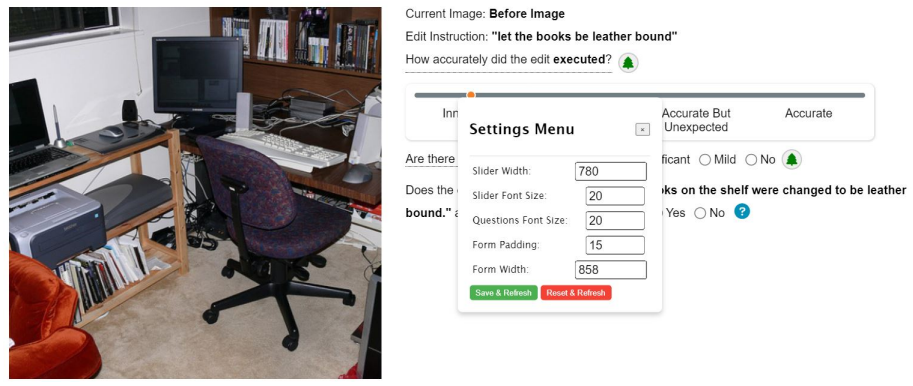
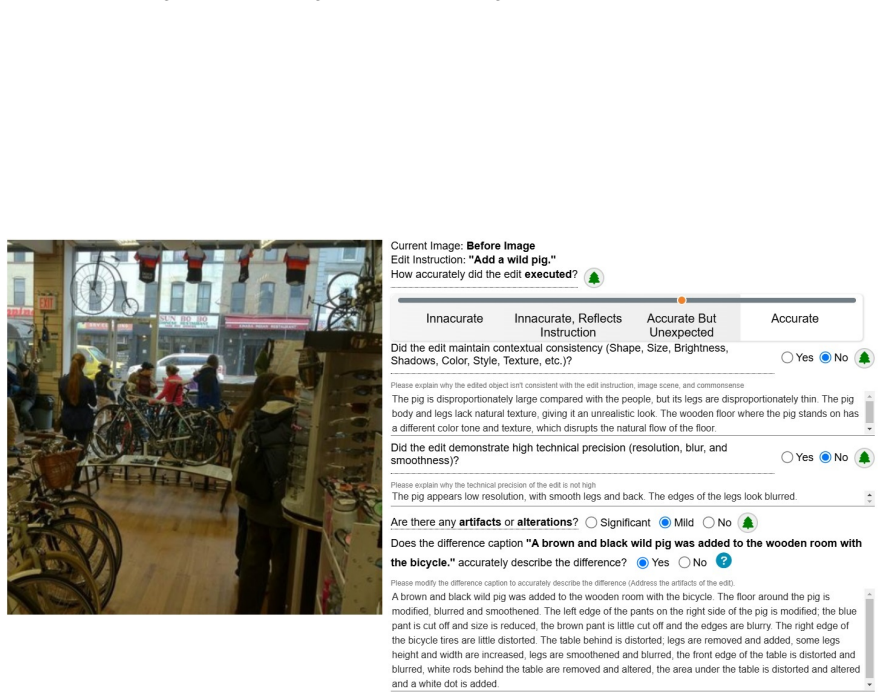
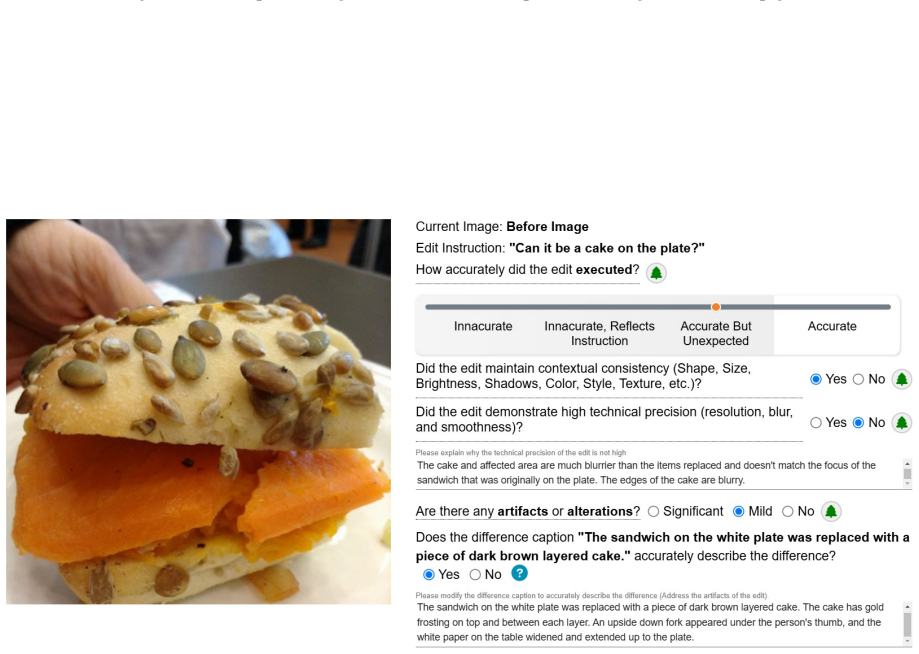
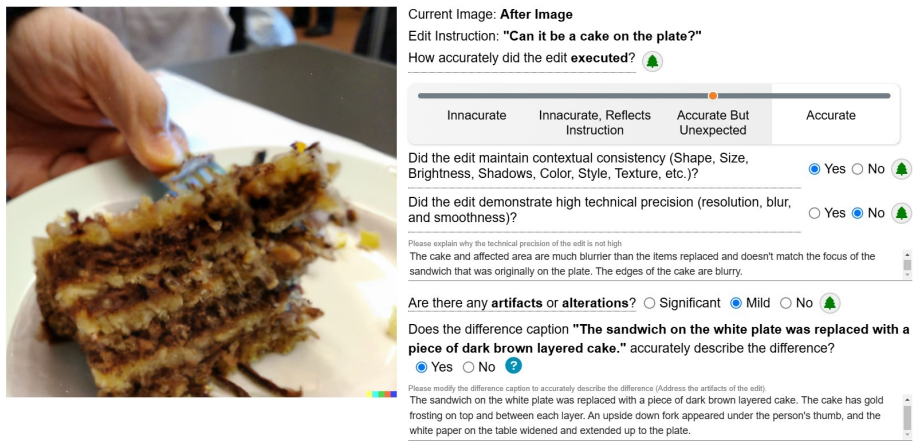
The load-bearing mechanism is the difference triplet (source object, target object, action type), which the paper uses to convert captions into comparable units, and the Model Precision and Hallucination Rate metrics computed over these triplets. Its caption pipeline works by extracting image captions at three zoom levels around the edit inpainting mask, selecting the caption with the highest noun or synonym overlap with the edit instruction (via WordNet), and feeding that grounded caption plus the instruction to GPT-4 to produce structured metadata and a difference caption. Its artifact detector relies on Detic object segmentation masks intersecting the edit mask, flagging objects whose confidence score falls more than 4 percent after the edit, plus a second method that catches whole objects that disappear or appear in the masked area without overlapping the intended object. For supervision, two augmentations generate 31,059 training instances from the MagicBrush train set: negative edits swap in a deceptive visually similar target object, and reverse edits invert the edit direction.
What would settle it
Have fresh annotators write difference captions from scratch for the same 783 edits without seeing any pipeline output, then recompute main-difference accuracy against those independent references; if a zero-shot pipeline still scores well above GPT-4o's 39 percent, the anchor concern is refuted, while a drop to near 39 percent would show the headline margin was an artifact of seeding.
Extended reading notes
Core claim
The central claim is that no current vision-language model can serve as a comprehensive edit inspector. The paper demonstrates this on 783 human-annotated edits from the MagicBrush test set: the best model, GPT-4o, reaches only 65.7 percent on artifact questions, around chance on contextual consistency, and 39 percent when asked to identify the main difference between original and edited images; Gemini-1.5 fails to see any difference in a quarter of the cases. On the all-differences task, models describe one to three changes on average against six by humans, and GPT-4o hallucinates roughly 60 percent of the differences it reports. The paper's two proposed methods are a zero-shot pipeline that captions differences at three zoom levels around the edit mask and grounds them in the instruction by noun overlap, reaching 75 percent main-difference accuracy, and an artifact detector that flags objects whose segmentation confidence drops by more than four percent after the edit, reaching 64 percent balanced accuracy. A fine-tuned small model matches much larger models on the inspector questions, suggesting dedicated lightweight evaluators are feasible.
Load-bearing premise
The human reference labels against which the methods are measured were seeded by the paper's own caption pipeline and then reviewed by annotators, so the pipeline's reported advantage is partly anchored to its own output.
Editorial extensions
If this is right
- Future evaluators of text-guided image edits can be scored directly on EditInspector's five dimensions and the MP/HR metrics instead of n-gram overlap.
- The gap between model and human performance quantifies how far automated edit verification is from being trustworthy for content moderation or creative tools.
- The instruction-grounded caption pipeline offers a recipe for reducing hallucination in change descriptions by constraining generation to regions that match the user's instruction.
- The fine-tuned small model shows that a dedicated, inexpensive edit evaluator can compete with generalist frontier models.
- The 'Accurate, But Unexpected' category forces evaluators to judge not just instruction-following but user expectation, a dimension current models largely miss.
Reading between the lines
- If the seed-anchoring concern is real, the true zero-shot advantage of the pipeline may be smaller than the reported 75 percent; an independent human-first annotation would settle it.
- The same noun-overlap grounding idea could transfer to evaluating edits in video or 3D scenes, where change description remains unsolved.
- The four-percent confidence-drop threshold for artifacts is a hand-set constant; learning per-object thresholds from the annotated data would likely raise recall without harming precision.
- Because the benchmark is built on mask-guided edits of natural images, its conclusions may not hold for free-form or synthetic-image edits; the paper itself flags this scope limitation.
Editorial analysis
A structured set of objections, weighed in public.
Referee Report
Summary. The paper introduces EditInspector, a human-annotated benchmark for evaluating text-guided image edits along five dimensions: instruction accuracy, artifact presence, technical precision, contextual consistency, and difference captioning. The benchmark is built from 783 MagicBrush test-set edits with three crowd annotations per edit. The paper reports that state-of-the-art VLMs score near chance on several edit-inspector questions, and that GPT-4o describes the main difference only 39% of the time and detects 12% of all differences. It then proposes two methods: a zero-shot caption pipeline that reports 75% main-difference accuracy, and a segmentation-probability artifact detector reporting 64% balanced accuracy. It also fine-tunes a LLaVA model to compete with much larger models. The central benchmark finding is that current VLMs are unreliable edit inspectors; the method-comparison claims rest on human references that are partly seeded by the authors' own pipeline.
Significance. If the central finding holds, the paper makes a useful contribution: a public, multi-dimensional benchmark for edit evaluation, with human agreement statistics and a demonstration that strong commercial VLMs perform poorly on edit verification. The proposed MP/HR metrics for difference captions are also a reasonable response to the known failures of n-gram metrics in this setting. The main-difference and artifact-detection methods are less significant as currently presented because their evaluation is not independent: the human references for the main-difference task are seeded by the authors' own caption pipeline, and the artifact detector's thresholds appear to be selected and evaluated on the same test set. The benchmark's central near-chance result does not depend on these circular pieces, so the paper's core observation is likely sound.
major comments (3)
- [§2.1, §3.2, §4.1] The headline comparison of the Section 4.1 caption pipeline (75% main-difference accuracy) against GPT-4o (39%) is evaluated against human references that were seeded by the same pipeline. Section 2.1 states that the human annotation starts from an automatically generated main-difference caption produced by the Section 4.1 pipeline, and that the annotator reviews, accepts, or corrects it; Section 3.2 then uses this human-reviewed caption as the reference. When the annotator accepts the seed, the reference is the pipeline's own output, making the 75% figure a self-consistency measure rather than an independent accuracy measure; even when the annotator corrects the seed, the seed anchors the annotator's judgment. The paper does not report the acceptance/correction rate. This does not invalidate the benchmark's near-chance VLM results, but it does invalidate the specific claim that the pipeline outperforms SoTA models by 36 points. Please collect independent human main-difference captions, or rescore against only the subset of edits where annotators demonstrably corrected the seed, and report the acceptance/correction rate; otherwise the claim should be reframed as pipeline self-consistency.
- [§4.2, §A.5] The artifact detector relies on several manually specified thresholds: the 4% confidence-drop threshold, the 2.4% and 97% mask-intersection cutoffs, the 40% upper intersection bound, and the two-resolution comparison. No validation protocol, sensitivity analysis, or separate threshold-selection split is reported. Because the method is introduced and evaluated on the same 783-edit benchmark, the reported 64% balanced accuracy is not a trustworthy estimate of out-of-sample performance, and the comparison with GPT-4o's 65.7% is therefore not meaningful as stated. Please report how the thresholds were chosen, use cross-validation or a held-out validation set, or provide a sensitivity curve over the thresholds.
- [§3.2, §A.2] The MP/HR metrics for all-differences captions depend on GPT-4o to judge whether source and target objects in Difference Triplets are similar, while GPT-4o is itself one of the models evaluated in Table 3. No human agreement on those GPT-4o similarity judgments is reported, so the evaluation of difference-caption generation is partly entangled with the model being measured. The main-difference accuracy also uses GPT-4 as a judge, again without a reported human validation of that judge. Please validate the GPT-4o-based object-similarity step against human judgments or use a fixed matcher that is not one of the evaluated models, and report the agreement of the GPT-4 main-difference judge on a sample.
minor comments (5)
- [Abstract vs. §4.2] The abstract claims the two proposed methods outperform SoTA models in both artifact detection and difference caption generation, but Section 4.2 reports 64% balanced artifact accuracy versus GPT-4o's 65.7%; the artifact method is competitive but not better. This wording should be corrected.
- [§2.2] The paper states that 783 edits were annotated from a MagicBrush test set of 1,053 edits, but it does not explain how these 783 edits were selected or why 270 were excluded. Please clarify whether the subset is random or filtered, since this affects the benchmark's coverage claims.
- [Table 1] The reported percentages for the Accuracy Level rows sum to 95% (8% + 77% + 6% + 4%) and the Artifacts Level rows sum to 97% (38% + 57% + 2%); please state whether a small fraction of unlabeled or missing annotations accounts for the remainder.
- [Figure 1] The caption says 'with 2–3 models answering each question correctly,' but the figure shows a larger set of models; please make the comparison transparent by naming the models or stating the total number considered.
- [Table 3 header] The final column is labeled 'LLaVA (Supervised)', but the text refers to a fine-tuned model; please use a consistent name such as 'LLaVA (fine-tuned)' throughout.
Circularity Check
Main-difference references in EditInspector are seeded by the authors' own caption pipeline, so the claimed 75% vs. 39% advantage is partly circular; edit-accuracy and artifact-detection results remain independent.
-
self definitional
[Section 2.1 (Human Evaluation Framework); Section 3.2 (Auto-Evaluation Setup); Section 4.1 (Difference Caption Pipeline)]
"Finally, to collect a difference caption that describes all differences between the original and edited images as an upper-bound evaluation, we start with an automatically generated caption that describes the main difference (Section 4.1). Humans then review it, either accepting or correcting it and expand it to include additional differences if artifacts are present, as shown in Figure 2."
The ground-truth difference captions are initialized from the same pipeline that is later evaluated. Section 3.2 scores the pipeline by comparing its main difference to the main difference extracted from the human-provided caption, and Section 4.1 claims '75% accuracy in describing the main edit, surpassing GPT-4o's 39% accuracy.' If annotators accept the seed, the reference caption is the pipeline's own output, making the 75% figure a self-consistency measure rather than an independent accuracy measure. Even when annotators correct the seed, the candidate caption anchors their judgment. The paper reports no acceptance-versus-correction rate, so the magnitude of the contamination is unquantified but structurally present.
full rationale
The circularity is real but localized. EditInspector's human difference captions are seeded by the authors' own Section 4.1 pipeline, and the same pipeline's main-difference accuracy (75% vs. GPT-4o's 39%) is measured against references extracted from those captions in Section 3.2. If the annotator accepts the seed, the reference is the pipeline's output, making the number partly a self-consistency score; even corrected seeds are anchored by the pipeline's candidate. The paper does not report accept-vs-correct statistics, so the bias cannot be quantified or dismissed. This affects the headline difference-caption comparison and the related Difference Caption Accuracy row, but it does not undermine the Yes/No edit-accuracy and artifact-detection results, whose human labels are not produced by the pipeline. No self-citation-load-bearing or uniqueness-import steps are present; the artifact-detection method and fine-tuned model are independent of the seeded labels. Hence the score is 6: a central method-vs-baseline claim reduces partly by construction, while substantial independent content remains.
Assumptions & free parameters
free parameters (2)
- artifact_score_drop_threshold =
4%
- mask_intersection_cutoffs =
2.4%, 40%, 97%
assumptions (3)
- domain assumption AMT majority-vote annotations are a reliable gold standard for edit quality.
- ad hoc to paper The automatically generated seed caption does not bias the human reference captions.
- domain assumption GPT-4 and GPT-4o are valid judges for difference-triplet matching and main-difference matching.
Cite this review
Pith. "Pith review of EditInspector: A Benchmark for Evaluation of Text-Guided Image Edits." pith.science (2026). https://pith.science/paper/YWA3V2DY
@misc{pith2026250609988,
  author       = {Pith},
  title        = {Pith review of: EditInspector: A Benchmark for Evaluation of Text-Guided Image Edits},
  year         = {2026},
  howpublished = {\url{https://pith.science/paper/YWA3V2DY}},
  note         = {Machine review of arXiv:2506.09988}
}
read the original abstract
Text-guided image editing, fueled by recent advancements in generative AI, is becoming increasingly widespread. This trend highlights the need for a comprehensive framework to verify text-guided edits and assess their quality. To address this need, we introduce EditInspector, a novel benchmark for evaluation of text-guided image edits, based on human annotations collected using an extensive template for edit verification. We leverage EditInspector to evaluate the performance of state-of-the-art (SoTA) vision and language models in assessing edits across various dimensions, including accuracy, artifact detection, visual quality, seamless integration with the image scene, adherence to common sense, and the ability to describe edit-induced changes. Our findings indicate that current models struggle to evaluate edits comprehensively and frequently hallucinate when describing the changes. To address these challenges, we propose two novel methods that outperform SoTA models in both artifact detection and difference caption generation.
Figures


Figures from the paper (20 more)





Reference graph
Works this paper leans on
-
[1]
online" 'onlinestring :=
ENTRY address archivePrefix author booktitle chapter edition editor eid eprint eprinttype howpublished institution journal key month note number organization pages publisher school series title type volume year doi pubmed url lastchecked label extra.label sort.label short.list INTEGERS output.state before.all mid.sentence after.sentence after.block STRING...
-
[2]
write newline
" write newline "" before.all 'output.state := FUNCTION n.dashify 't := "" t empty not t #1 #1 substring "-" = t #1 #2 substring "--" = not "--" * t #2 global.max substring 't := t #1 #1 substring "-" = "-" * t #2 global.max substring 't := while if t #1 #1 substring * t #2 global.max substring 't := if while FUNCTION word.in bbl.in capitalize " " * FUNCT...
-
[3]
Omri Avrahami, Dani Lischinski, and Ohad Fried. 2022. https://doi.org/10.1109/cvpr52688.2022.01767 Blended diffusion for text-driven editing of natural images . In 2022 IEEE/CVF Conference on Computer Vision and Pattern Recognition (CVPR). IEEE
arXiv 2022
-
[4]
Shuai Bai, Keqin Chen, Xuejing Liu, Jialin Wang, Wenbin Ge, Sibo Song, Kai Dang, Peng Wang, Shijie Wang, Jun Tang, Humen Zhong, Yuanzhi Zhu, Mingkun Yang, Zhaohai Li, Jianqiang Wan, Pengfei Wang, Wei Ding, Zheren Fu, Yiheng Xu, Jiabo Ye, Xi Zhang, Tianbao Xie, Zesen Cheng, Hang Zhang, Zhibo Yang, Haiyang Xu, and Junyang Lin. 2025. https://arxiv.org/abs/25...
arXiv 2025
-
[5]
Samyadeep Basu, Mehrdad Saberi, Shweta Bhardwaj, Atoosa Malemir Chegini, Daniela Massiceti, Maziar Sanjabi, Shell Xu Hu, and Soheil Feizi. 2023. https://arxiv.org/abs/2310.02426 Editval: Benchmarking diffusion based text-guided image editing methods . Preprint, arXiv:2310.02426
arXiv 2023
-
[6]
Tim Brooks, Aleksander Holynski, and Alexei A. Efros. 2023. https://arxiv.org/abs/2211.09800 Instructpix2pix: Learning to follow image editing instructions . Preprint, arXiv:2211.09800
arXiv 2023
-
[7]
Guillaume Couairon, Jakob Verbeek, Holger Schwenk, and Matthieu Cord. 2022. https://arxiv.org/abs/2210.11427 Diffedit: Diffusion-based semantic image editing with mask guidance . Preprint, arXiv:2210.11427
arXiv 2022
-
[8]
Xing Cui, Zekun Li, Peipei Li, Yibo Hu, Hailin Shi, and Zhaofeng He. 2023. https://arxiv.org/abs/2303.11108 Chatedit: Towards multi-turn interactive facial image editing via dialogue . Preprint, arXiv:2303.11108
work page Pith review arXiv 2023
Show all 28 references
-
[9]
Christiane Fellbaum. 1998. https://mitpress.mit.edu/9780262561167/ WordNet: An Electronic Lexical Database . Bradford Books
1998
-
[10]
Gemini Team . 2023. https://arxiv.org/abs/2312.11805 Gemini: A family of highly capable multimodal models . Preprint, arXiv:2312.11805
2023 arXiv
-
[11]
Gemini Team . 2024. https://arxiv.org/abs/2403.05530 Gemini 1.5: Unlocking multimodal understanding across millions of tokens of context . Preprint, arXiv:2403.05530
2024 arXiv
-
[12]
Yingqing He, Zhaoyang Liu, Jingye Chen, Zeyue Tian, Hongyu Liu, Xiaowei Chi, Runtao Liu, Ruibin Yuan, Yazhou Xing, Wenhai Wang, Jifeng Dai, Yong Zhang, Wei Xue, Qifeng Liu, Yike Guo, and Qifeng Chen. 2024. https://arxiv.org/abs/2405.19334 Llms meet multimodal generation and ed...
2024 arXiv
-
[13]
Imagen-Team-Google, :, Jason Baldridge, Jakob Bauer, Mukul Bhutani, Nicole Brichtova, Andrew Bunner, Lluis Castrejon, Kelvin Chan, Yichang Chen, Sander Dieleman, Yuqing Du, Zach Eaton-Rosen, Hongliang Fei, Nando de Freitas, Yilin Gao, Evgeny Gladchenko, Sergio Gómez Colmenarej...
2024
-
[14]
Bahjat Kawar, Shiran Zada, Oran Lang, Omer Tov, Huiwen Chang, Tali Dekel, Inbar Mosseri, and Michal Irani. 2023. https://arxiv.org/abs/2210.09276 Imagic: Text-based real image editing with diffusion models . Preprint, arXiv:2210.09276
2023 arXiv
-
[15]
Haotian Liu, Chunyuan Li, Yuheng Li, and Yong Jae Lee. 2024. https://arxiv.org/abs/2310.03744 Improved baselines with visual instruction tuning . Preprint, arXiv:2310.03744
2024 arXiv
-
[16]
Alex Nichol, Prafulla Dhariwal, Aditya Ramesh, Pranav Shyam, Pamela Mishkin, Bob McGrew, Ilya Sutskever, and Mark Chen. 2022. https://arxiv.org/abs/2112.10741 Glide: Towards photorealistic image generation and editing with text-guided diffusion models . Preprint, arXiv:2112.10741
2022 arXiv
-
[17]
OpenAI. 2024. https://arxiv.org/abs/2303.08774 GPT-4 technical report . Preprint, arXiv:2303.08774
2024 arXiv
-
[18]
Alec Radford, Jong Wook Kim, Chris Hallacy, Aditya Ramesh, Gabriel Goh, Sandhini Agarwal, Girish Sastry, Amanda Askell, Pamela Mishkin, Jack Clark, Gretchen Krueger, and Ilya Sutskever. 2021. https://arxiv.org/abs/2103.00020 Learning transferable visual models from natural lan...
2021 arXiv
-
[19]
Shelly Sheynin, Adam Polyak, Uriel Singer, Yuval Kirstain, Amit Zohar, Oron Ashual, Devi Parikh, and Yaniv Taigman. 2023. https://arxiv.org/abs/2311.10089 Emu edit: Precise image editing via recognition and generation tasks . Preprint, arXiv:2311.10089
2023 arXiv
-
[20]
Fleet, Radu Soricut, Jason Baldridge, Mohammad Norouzi, Peter Anderson, and William Chan
Su Wang, Chitwan Saharia, Ceslee Montgomery, Jordi Pont-Tuset, Shai Noy, Stefano Pellegrini, Yasumasa Onoe, Sarah Laszlo, David J. Fleet, Radu Soricut, Jason Baldridge, Mohammad Norouzi, Peter Anderson, and William Chan. 2023. https://arxiv.org/abs/2212.06909 Imagen editor and...
2023 arXiv
-
[21]
Chenfei Wu, Shengming Yin, Weizhen Qi, Xiaodong Wang, Zecheng Tang, and Nan Duan. 2023 a . https://arxiv.org/abs/2303.04671 Visual chatgpt: Talking, drawing and editing with visual foundation models . Preprint, arXiv:2303.04671
2023 arXiv
-
[22]
Gonzalez, Boyi Li, and Trevor Darrell
Tsung-Han Wu, Long Lian, Joseph E. Gonzalez, Boyi Li, and Trevor Darrell. 2023 b . https://arxiv.org/abs/2311.16090 Self-correcting llm-controlled diffusion models . Preprint, arXiv:2311.16090
2023 arXiv
-
[23]
Kai Zhang, Lingbo Mo, Wenhu Chen, Huan Sun, and Yu Su. 2024 a . https://arxiv.org/abs/2306.10012 Magicbrush: A manually annotated dataset for instruction-guided image editing . Preprint, arXiv:2306.10012
2024 arXiv
-
[24]
Shu Zhang, Xinyi Yang, Yihao Feng, Can Qin, Chia-Chih Chen, Ning Yu, Zeyuan Chen, Huan Wang, Silvio Savarese, Stefano Ermon, Caiming Xiong, and Ran Xu. 2024 b . https://arxiv.org/abs/2303.09618 Hive: Harnessing human feedback for instructional visual editing . Preprint, arXiv:...
2024 arXiv
-
[25]
Zhixing Zhang, Ligong Han, Arnab Ghosh, Dimitris Metaxas, and Jian Ren. 2022. https://arxiv.org/abs/2212.04489 Sine: Single image editing with text-to-image diffusion models . Preprint, arXiv:2212.04489
2022 arXiv
-
[26]
Haozhe Zhao, Xiaojian Ma, Liang Chen, Shuzheng Si, Rujie Wu, Kaikai An, Peiyu Yu, Minjia Zhang, Qing Li, and Baobao Chang. 2024. https://arxiv.org/abs/2407.05282 Ultraedit: Instruction-based fine-grained image editing at scale . Preprint, arXiv:2407.05282
2024 arXiv
-
[27]
a henb \
Xingyi Zhou, Rohit Girdhar, Armand Joulin, Philipp Kr \"a henb \"u hl, and Ishan Misra. 2022. Detecting twenty-thousand classes using image-level supervision. In ECCV
2022
-
[28]
Jinguo Zhu, Weiyun Wang, Zhe Chen, Zhaoyang Liu, Shenglong Ye, Lixin Gu, Hao Tian, Yuchen Duan, Weijie Su, Jie Shao, Zhangwei Gao, Erfei Cui, Xuehui Wang, Yue Cao, Yangzhou Liu, Xingguang Wei, Hongjie Zhang, Haomin Wang, Weiye Xu, Hao Li, Jiahao Wang, Nianchen Deng, Songze Li,...
2025 arXiv
Reviewed August 7, 2026 · model on record in the stance chip above.
Discussion (0). Sign in to comment.