REVIEW 3 major objections 5 minor 103 references
Nethotrons: exploring the possibility of measuring relativistic spin precessions, from Earth's satellites to the Galactic Centre
T0 review · 3 major / 5 minor · reviewed 2026-08-07 · deepseek-v4-flash
Pith's one-line read A pulsar orbiting the Milky Way's central black hole could show measurable relativistic spin precessions, while Earth satellites and the double pulsar cannot.
desk verdict A clear, honest feasibility map for 1pN spin-precession tests; the negative results are solid, but the pulsar–Sgr A* numbers sit on an unevaluated electromagnetic noise floor. read the letter →
The pith
A machine-rendered reading of the paper's core claim, the machinery that carries it, and where it could break.
The reading
What carries the argument
The machinery is the set of first-order post-Newtonian (1pN) spin precession equations in vector form, together with the orbital precession equations for the node and inclination. The de Sitter (gravitoelectric) rate is $\boldsymbol{\Omega}_{\rm dS} = (3 n_K \mu / 2 c^2 p) \hat h$, and the Pugh-Schiff (gravitomagnetic) rate is $\boldsymbol{\Omega}_{\rm PS} = (GJ / 2 c^2 a^3 (1-e^2)^{3/2})[3(J_l \hat l + J_m \hat m) - 2\hat J]$, with the spin axis tracked through its right ascension $\alpha$ and declination $\delta$; the orbital plane itself is allowed to precess under the primary's quadrupole moment $J_2$ and gravitomagnetic field, so the signatures are harmonic rather than linear trends. A Newtonian own-oblateness torque proportional to the nethotron's $J_2^s$ is included as the main classical competitor. The same equations are applied to laser-ranged satellites, a hypothetical pulsar around Sgr A*, and the double pulsar.
What would settle it
Discover a millisecond pulsar in a 0.5-year orbit around Sgr A*, track its spin-axis orientation over ten years, and subtract a detailed model of magnetic-dipole and ambient-field torques; a residual spin shift consistent with zero would falsify the predicted tens-to-hundreds-of-degrees relativistic precession.
Extended reading notes
Core claim
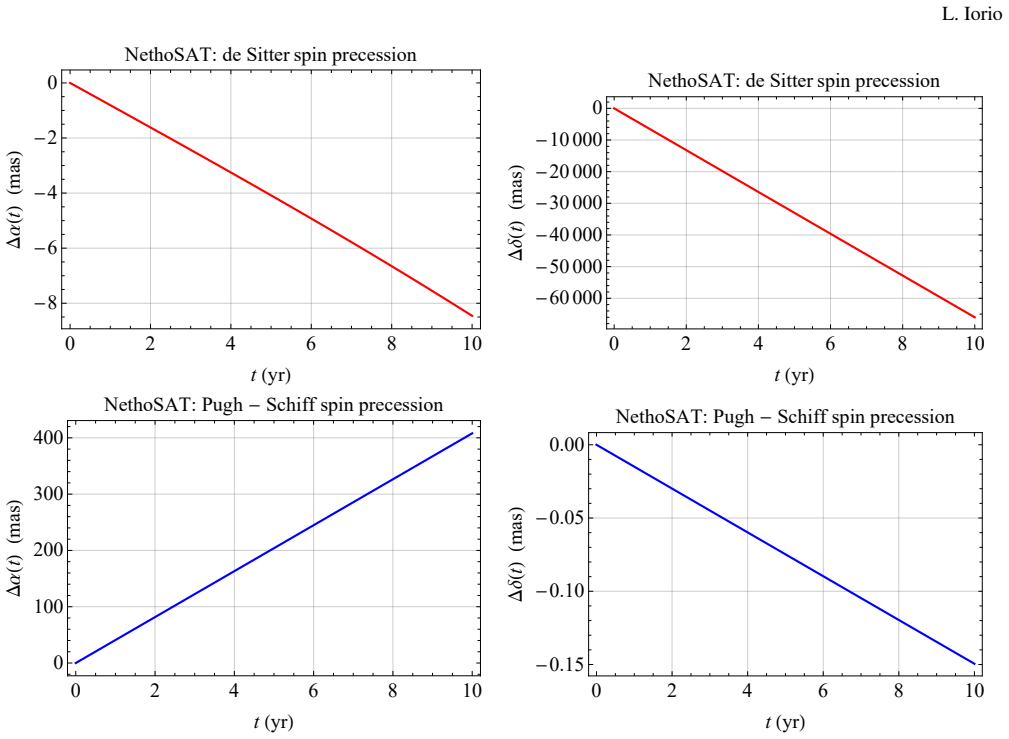
The paper's central quantitative claim is a feasibility ranking of three arenas for detecting relativistic spin precessions. Using the standard first-order post-Newtonian rates for the de Sitter and Pugh-Schiff precessions, parameterized by the spin axis' right ascension and declination, it numerically integrates the spin and orbital motion of LAGEOS, LAGEOS 2, and LARES over their lifetimes and finds accumulated right-ascension shifts of a few tens of thousands (de Sitter) and a few hundred (Pugh-Schiff) milliarcseconds, against a current spin-axis measurement accuracy of about 0.1 degree and Newtonian own-oblateness shifts of hundreds of millions of milliarcseconds. For a millisecond pulsar in a 0.5-year, highly eccentric orbit around Sgr A*, the same calculation yields de Sitter and Pugh-Schiff spin precessions of tens to hundreds of degrees over ten years, with the pulsar's own quadrupole torque negligible. For the double pulsar PSR J0737-3039A/B, the gravitomagnetic spin-spin precession of component B due to component A is computed as 0.00008 degrees per year, about four orders of magnitude below the current 0.6-0.3 degrees per year measurement accuracy. The paper concludes that only the Galactic-Centre pulsar scenario offers signals large enough relative to present measurement capabilities, and that electromagnetic torques there remain an unmodelled competing effect.
Load-bearing premise
Electromagnetic torques on the pulsar's spin axis, from magnetic-dipole emission, dipole inertia, and the strong magnetic field near Sgr A*, do not mask the post-Newtonian precession; the paper explicitly leaves their evaluation to future work.
Editorial extensions
If this is right
- Existing LAGEOS-type satellites cannot currently test the de Sitter or Pugh-Schiff precessions: the relativistic signals are at the milliarcsecond level while spin-axis orientation is known to about 0.1 degree, and Newtonian self-oblateness torques produce nominal shifts hundreds of millions of times larger.
- A purpose-built passive satellite with Gravity Probe B-like spin and orbit geometry would accumulate a 40 mas/yr Pugh-Schiff right-ascension trend and a 7000 mas/yr de Sitter declination trend, requiring new measurement techniques and careful manufacturing to reduce classical torques.
- A millisecond pulsar in a 0.5-year orbit around Sgr A* could show de Sitter and Pugh-Schiff precessions of tens to hundreds of degrees over ten years, making its spin axis a potential probe of the black hole's spacetime, provided electromagnetic torques can be modelled.
- The double pulsar's spin-spin precession is far too small (0.00008 deg/yr) to be measured with current or foreseeable accuracy.
Reading between the lines
- If a short-period pulsar around Sgr A* is eventually found, the spin-precession signal would add a second observable, independent of orbital timing, for constraining the black hole's dimensionless spin parameter and possibly testing the Kerr no-hair relation.
- The paper's own admission that electromagnetic torques are unmodelled means the tens-to-hundreds-of-degrees figures are best read as an upper bound on the relativistic signal; estimating the pulsar's magnetic-dipole and external-field torques is the natural next calculation.
- The same 1pN equations apply to any future pulsar around an intermediate-mass or supermassive black hole, so the feasibility map drawn here can be reused as new systems are discovered.
- Satellite laser ranging would need an improvement of roughly two orders of magnitude in spin-axis determination to reach the milliarcsecond signals; solar-glint photometry, mentioned in the paper, is the only existing technique said to offer such gains.
Editorial analysis
A structured set of objections, weighed in public.
Referee Report
Summary. The paper explores whether post-Newtonian spin precessions—the gravitoelectric de Sitter effect and the gravitomagnetic Pugh–Schiff effect—could be measured using spinning objects other than Gravity Probe B. It derives orbit-averaged spin-precession equations from the Barker–O'Connell formalism, then numerically integrates them for the SLR satellites LAGEOS, LAGEOS 2, and LARES, for a hypothetical laser-ranged satellite (NethoSAT), for a hypothetical pulsar orbiting the supermassive black hole Sgr A*, and for the double pulsar PSR J0737-3039A/B. The paper reports that the LAGEOS-family relativistic spin shifts are tens of thousands (de Sitter) and hundreds (Pugh–Schiff) of milliarcseconds over decades—below the current ~0.1-degree measurement accuracy—and that the Newtonian oblateness torque is orders of magnitude larger. For the Sgr A* pulsar scenario, it reports de Sitter shifts of tens to hundreds of degrees over ten years for a 0.5-year orbit, while the double pulsar spin–spin precession is estimated at 0.00008 degrees per year, about four orders of magnitude below current measurement accuracy.
Significance. If the quantitative estimates are reliable, the paper provides a useful scoping map for future tests of relativistic spin precession and, in particular, suggests that the LAGEOS-family route is not competitive with the current measurement capabilities. The calculations are forward applications of published formulas with parameters taken from the literature; I found no fitted-parameter circularity in the central results, and the arithmetic is internally consistent. The negative conclusions for the LAGEOS satellites and the double pulsar are robust and are the most directly useful part of the paper. The Sgr A* pulsar scenario is the only quantitatively exciting possibility, but, as stated in the paper itself, its interpretation is currently blocked by an unquantified electromagnetic torque noise floor.
major comments (3)
- [Section 4, Figure 5] The paper's headline positive scenario is not yet interpretable as a measurement of relativistic precession. The text states that 'the magnetic torque should be a major competing effect also in this scenario' and that 'an evaluation of such potentially relevant competing effects is outside the scopes of the present work,' naming three spin-axis torques: magnetic-dipole radiation, the inertia of the magnetic dipole moment, and the strong external magnetic field around Sgr A*. These torques act on the same spin axis as the de Sitter and Pugh–Schiff precessions, so the tens-to-hundreds-of-degrees shifts shown in Figure 5 can be attributed to general relativity only if the electromagnetic contributions are shown to be subdominant on the 10-year timescale or are separately modelable. Please add at least an order-of-magnitude estimate for the fiducial 5 ms pulsar, using the quoted surface field strengths and the Sgr A* magnetic field, or explicitly reframe the Sgr A* result as a conditional upper bound rather than a predicted GR signal.
- [Section 4, Eqs. (47)–(50) and Figure 5] The parameter selection for the Sgr A* pulsar is almost entirely unconstrained, and Figure 5 uses one specific configuration from Eq. (50) together with an eccentricity fixed only through r_min = 12.4 r_Sch. Equations (49) and (50) identify configurations that maximize the instantaneous de Sitter and Pugh–Schiff rates, but the figure uses Eq. (50) also for the de Sitter panels, so the quoted 'tens or hundreds of degrees' is not the maximum cumulative de Sitter shift over the parameter space. A brief parameter scan, or at least a sensitivity statement, is needed to support the claim that the shifts 'may be as large as' the displayed values rather than being a single illustrative point estimate.
- [Section 3, Table 1 and Figures 1–3] The Newtonian oblateness shifts in Figures 1–3 reach hundreds of millions of milliarcseconds because the spin period is modeled as a linear trend with the Pdot_s values from Table 1, but no uncertainty or covariance is attached to that extrapolation. This does not change the paper's negative conclusion for the LAGEOS family, since the current spin-axis measurement accuracy is already about 0.1 degree, but the presentation would be more informative if the authors showed how the Newtonian signal changes under plausible variations of Pdot_s or displayed a bounding envelope for the nominal values.
minor comments (5)
- [Section 3, NethoSAT paragraph] The word 'graviteoectric' should be 'gravitoelectric' in the sentence describing the NethoSAT de Sitter precession.
- [Section 4, after Eq. (46)] The phrase 'the are' should be 'there are', and 'possess' should be 'possess' in the paragraph on pulsar magnetic moments.
- [Table 1] The units of the Pdot_s column are not specified; please indicate whether the values are in s/s, s/day, or another unit, since they enter directly into the Newtonian oblateness integrations.
- [Figure 5] The lower-left axis label '5.×10 -8' is missing a multiplication dot and has awkward spacing; using proper LaTeX notation (e.g., 5\times10^{-8}) would improve readability.
- [Section 2, Eqs. (18)–(19) and (26)–(27)] The paper calls these quantities dα/dt and dδ/dt while describing them as averaged precessions per orbit; the averaging convention and the resulting units should be stated explicitly at their first occurrence.
Circularity Check
No circular derivation: the central predictions are forward evaluations of standard published formulas with literature-based parameters; the only self-citation is a non-load-bearing numerical input.
full rationale
The paper's quantitative claims are forward numerical integrations of the de Sitter and Pugh-Schiff formulas (Eqs. 15-27) with orbital and spin parameters taken from the cited literature (Visco and Lucchesi 2018 for LAGEOS-family spin parameters; Peissker et al. 2022 for Sgr A* mass and spin; Laarakkers and Poisson 1999 for neutron-star quadrupole moments). No parameter is fitted in this paper, and no predicted signal is defined in terms of the measured quantity it is compared with. The only self-citation entering a numerical result is ref. [102], used in Section 5 to set the range of pulsar A's spin direction when computing the spin-spin precession of Eq. (52). This is a legitimate use of a previously published input parameter, not a derivation of the result from itself: the order-of-magnitude conclusion (about four orders below the current measurement accuracy) does not hinge on the precise orientation, and [102] is not invoked to forbid alternatives or to justify an ansatz. The paper's own stated limitation in Section 4, that electromagnetic torques on a pulsar near Sgr A* are not evaluated, concerns the physical isolation and interpretation of the signal, not circularity of the derivation. Therefore no step reduces by construction to its inputs, and the one self-citation does not make the central calculations circular.
Assumptions & free parameters
free parameters (4)
- Sgr A* dimensionless spin chi =
0.5 (literature range up to ~0.9)
- Pulsar spin/orbital configuration (Eq. 50) =
alpha=279.3 deg, delta=12.1 deg, zeta=184.2 deg, i=67.2 deg, I=67.2 deg, Omega=274.2 deg
- Neutron star quadrupole parameter xi_star =
3.507
- LAGEOS-family spin period slowdown rates Pdot_s =
1.4e-6 to 3e-6 s/s (Table 1)
assumptions (5)
- domain assumption The Kerr metric and no-hair relations (Eqs. 38-40) describe the Sgr A* spacetime and its multipole moments.
- domain assumption The 1pN test-gyroscope precession formulas of Barker and O'Connell (Eqs. 15-37) apply to the extended bodies considered here.
- domain assumption The orbital plane evolution of the Earth satellites in the spin integrations is governed by Eqs. (10)-(11), i.e. the J2 and gravitomagnetic node precessions.
- ad hoc to paper Electromagnetic torques on the pulsar's spin axis are subdominant or separable (unverified).
- domain assumption The moment of inertia of the LAGEOS-type satellites is treated as that of a homogeneous sphere (Eq. 33).
Cite this review
Pith. "Pith review of Nethotrons: exploring the possibility of measuring relativistic spin precessions, from Earth's satellites to the Galactic Centre." pith.science (2026). https://pith.science/paper/XOP5I2SY
@misc{pith2026250610162,
  author       = {Pith},
  title        = {Pith review of: Nethotrons: exploring the possibility of measuring relativistic spin precessions, from Earth's satellites to the Galactic Centre},
  year         = {2026},
  howpublished = {\url{https://pith.science/paper/XOP5I2SY}},
  note         = {Machine review of arXiv:2506.10162}
}
abstract
By ``nethotrons'', from the ancient Greek verb for to ``spin'', it is meant here a natural or artificial rotating object, like a pulsar or an artificial satellite, whose rotational axis is cumulatively displaced by the post-Newtonian static (gravitoelectric) and stationary (gravitomagnetic) components of the gravitational field of some massive body around which it freely moves. Until now, both relativistic effects have been measured only by the dedicated space-based mission Gravity Probe B in the terrestrial environment. It detected the gravitoelectric de Sitter and gravitomagnetic Pugh-Schiff spin precessions of four superconducting gyroscopes accumulated in a year after about 50 years from conception to completion of data analysis at a cost of 750 million dollars to $0.3$ and $19$ per cent accuracy, respectively. The perspectives to measure them also with long-lived Earth's laser-ranged geodetic satellites, like those of the LAGEOS family or possibly one or more of them to be built specifically from scratch, and pulsars orbiting the supermassive black hole in the Galactic Centre, yet to be discovered, are preliminarily investigated. The double pulsar PSR J0737-3039A/B is examined as well.
Figures


Figures from the paper (2 more)

Reference graph
Works this paper leans on
-
[1]
6 DOC@ n-1 [k !5[ygi瑓ø Ǧ`Q pU E| llŝ nWڪ Z[ ' =I ?fܒڣ X9sv > DKH]8 8e z YO]< qx DO5 1n-&/zB x6uݟ Gu:w gs6h9 &L8 J uo n נ [=bq^ p v &* 8
thebibliography [1] 20pt to 0.5 References 5pt =0pt to References 5pt =0pt =0pt =0pt =1pt plus 1pt =0pt =0pt -12pt =13pt plus 1pt =20pt =1pt \@M =10000 =-1.0em =2pt =0pt 0pt =0pt =1.0em @enumiv\@empty 10000 10000 `\.\@m \@noitemerr \@latex@warning Empty `thebibliography' environment \@ifnextchar \@reference \@latexerr Missing key on reference command Each...
2021
-
[2]
B. M. Barker and R. F. O'Connell . Gravitational two--body problem with arbitrary masses, spins, and quadrupole moments . Phys. Rev. D, 12: 0 329--335, 1975. doi:10.1103/PhysRevD.12.329
-
[3]
A. C. M. Correia , J. Laskar , F. Farago , and G. Bou \'e . Tidal evolution of hierarchical and inclined systems . Celest. Mech. Dyn. Astr., 111: 0 105--130, 2011. doi:10.1007/s10569-011-9368-9
-
[4]
W. de Sitter . On Einstein's theory of gravitation and its astronomical consequences. Second paper . Mon. Not. Roy. Astron. Soc., 77: 0 155--184, 1916. doi:10.1093/mnras/77.2.155
-
[5]
A. D. Fokker . The geodesic precession: a consequence of Einsteins's theory of graviation . Proc. K. Ned. Akad. Wet., 23: 0 729--738, 1921
1921
-
[6]
G. E. Pugh . Proposal for a Satellite Test of the Coriolis Prediction of General Relativity . Research memorandum, Weapons Systems Evaluation Group, The Pentagon, Washington D.C., 1959
1959
-
[7]
L. Schiff . Possible new experimental test of general relativity theory . Phys. Rev. Lett., 4: 0 215--217, 1960. doi:10.1103/PhysRevLett.4.215
-
[8]
Damour and R
T. Damour and R. Ruffini . Sur certaines v\' e rifications nouvelles de la Relativit\' e g\' e n\' e rale rendues possibles par la d\' e couverte d'un pulsar membre d'un système binaire . C.R. Acad. Sc. Paris, S\' e rie A , 279: 0 971--973, 1974
1974
Show all 103 references
-
[9]
B. M. Barker and R. F. O'Connell . The gravitational interaction: Spin, rotation, and quantum effects--a review . Gen. Relativ. Gravit., 11: 0 149--175, 1979. doi:10.1007/BF00756587
1979 doi
-
[10]
C. W. F. Everitt , B. Muhlfelder , D. B. Debra , B. W. Parkinson , J. P. Turneaure , A. S. Silbergleit , E. B. Acworth , M. Adams , R. Adler , W. J. Bencze , et al. The Gravity Probe B test of general relativity . Class. Quantum Gravit., 32: 0 224001, 2015. doi:10.1088/0264-93...
2015 doi
-
[11]
C. W. F. Everitt , D. B. Debra , B. W. Parkinson , J. P. Turneaure , J. W. Conklin , M. I. Heifetz , G. M. Keiser , A. S. Silbergleit , T. Holmes , J. Kolodziejczak , et al. Gravity Probe B: Final Results of a Space Experiment to Test General Relativity . Phys. Rev. Lett., 106...
2011 doi
-
[12]
C. W. F. Everitt . The Gyroscope experiment - I: General description and analysis of gyroscope performance . In B. Bertotti , editor, Proceedings of the International School of Physics Enrico Fermi . Course LVI. Experimental Gravitation , pages 331--360. Academic Press, 1974
1974
-
[13]
C. W. F. Everitt , S. Buchman , D. B. Debra , G. M. Keiser , J. M. Lockhart , B. Muhlfelder , B. W. Parkinson , J. P. Turneaure , et al. Gravity Probe B: Countdown to Launch . In C. L \"a mmerzahl , C. W. F. Everitt , and F. W. Hehl , editors, Gyros, Clocks, Interferometers .....
2001 doi
-
[14]
C. M. Will . Finally, results from Gravity Probe B . Physics Magazine, 4: 0 43, 2011. doi:10.1103/Physics.4.43
2011 doi
-
[15]
Biskupek , J
L. Biskupek , J. M \"u ller , and J.-M. Torre . Benefit of New High-Precision LLR Data for the Determination of Relativistic Parameters . Universe, 7: 0 34, 2021. doi:10.3390/universe7020034
2021 doi
-
[16]
J. G. Williams and W. M. Folkner . Lunar Laser Ranging: Relativistic Model and Tests of Gravitational Physics . In IAU Symposium \#261, Bullettin of the American Astronomical Society, volume 41, page 882, 2009
2009
-
[17]
Hofmann and J
F. Hofmann and J. M \"u ller . Relativistic tests with lunar laser ranging . Class. Quantum Gravit., 35: 0 035015, 2018. doi:10.1088/1361-6382/aa8f7a
2018 doi
-
[18]
R. P. Breton , V. M. Kaspi , M. Kramer , M. A. McLaughlin , M. Lyutikov , S. M. Ransom , I. H. Stairs , R. D. Ferdman , F. Camilo , and A. Possenti . Relativistic Spin Precession in the Double Pulsar . Science, 321: 0 104, 2008. doi:10.1126/science.1159295
2008 doi
-
[19]
M. E. Lower , M. Kramer , R. M. Shannon , R. P. Breton , N. Wex , S. Johnston , M. Bailes , S. Buchner , H. Hu , V. Venkatraman Krishnan , et al. A MeerKAT view of the double pulsar eclipses. Geodetic precession of pulsar B and system geometry . Astron. Astrophys., 682: 0 A26,...
2024 doi
-
[20]
Burgay , N
M. Burgay , N. D'Amico , A. Possenti , R. N. Manchester , A. G. Lyne , B. C. Joshi , M. A. McLaughlin , M. Kramer , J. M. Sarkissian , F. Camilo , et al. An increased estimate of the merger rate of double neutron stars from observations of a highly relativistic system . Nature...
2003 doi
-
[21]
A. G. Lyne , M. Burgay , M. Kramer , A. Possenti , R. N. Manchester , F. Camilo , M. A. McLaughlin , D. R. Lorimer , N. D'Amico , B. C. Joshi , et al. A Double--Pulsar System: A Rare Laboratory for Relativistic Gravity and Plasma Physics . Science, 303: 0 1153--1157, 2004. doi...
2004 doi
-
[22]
P. C. C. Freire and N. Wex . Gravity experiments with radio pulsars . Living Rev. Relativ., 27: 0 5, 2024. doi:10.1007/s41114-024-00051-y
2024 doi
-
[23]
Pearlman , D
M. Pearlman , D. Arnold , M. Davis , F. Barlier , R. Biancale , V. Vasiliev , I. Ciufolini , A. Paolozzi , E. C. Pavlis , K. So \'s nica , et al. Laser geodetic satellites: a high-accuracy scientific tool . J. Geod., 93: 0 2181--2194, 2019. doi:10.1007/s00190-019-01228-y
2019 doi
-
[24]
Coulot , F
D. Coulot , F. Deleflie , P. Bonnefond , P. Exertier , O. Laurain , and B. de Saint-Jean . Satellite laser ranging. In H. K Gupta , editor, Encyclopedia of Solid Earth Geophysics, Encyclopedia of Earth Sciences Series, pages 1049--1055. Springer, 2011. doi:10.1007/978-90-481-8702-7 98
2011 doi
-
[25]
Otsubo , J
T. Otsubo , J. Amagai , H. Kunimori , and M. Elphick . Spin motion of the AJISAI satellite derived from spectral analysis of laser ranging data . IEEE Trans. Geosci. Remote Sens., 38: 0 1417--1424, 2000. doi:10.1109/36.843036
-
[26]
Vovchyk , Ya
Ye. Vovchyk , Ya. Blahodyr , O. Lohvynenko , A. Bilinskyy , N. Virun , B. Klym , and Ye. Pochapskyy . Electrophotometric observations of artificial objects . Adv. Space Res., 28: 0 1309--1313, 2001. doi:10.1016/S0273-1177(01)00450-1
2001 doi
-
[27]
J. I. Andr \'e s , R. Noomen , G. Bianco , D. G. Currie , and T. Otsubo . Spin axis behavior of the LAGEOS satellites . J. Geophys. Res., 109: 0 B06403, 2004. doi:10.1029/2003JB002692
2004 doi
-
[28]
Otsubo , R
T. Otsubo , R. A. Sherwood , P. Gibbs , and R. Wood . Spin Motion and Orientation of LAGEOS-2 From Photometric Observation . IEEE Trans. Geosci. Remote Sens., 42: 0 202--208, 2004. doi:10.1109/TGRS.2003.817191
2004
-
[29]
Kirchner , W
G. Kirchner , W. Hausleitner , and E. Cristea . Ajisai Spin Parameter Determination Using Graz Kilohertz Satellite Laser Ranging Data . IEEE Trans. Geosci. Remote Sens., 45: 0 201--205, 2007. doi:10.1109/TGRS.2006.882254
2007
-
[30]
Kucharski , G
D. Kucharski , G. Kirchner , T. Otsubo , and F. Koidl . 22 Years of AJISAI spin period determination from standard SLR and kHz SLR data . Adv. Space Res., 44: 0 621--626, 2009. doi:10.1016/j.asr.2009.05.007
2009 doi
-
[31]
Kucharski , T
D. Kucharski , T. Otsubo , G. Kirchner , and F. Koidl . Spin axis orientation of Ajisai determined from Graz 2 kHz SLR data . Adv. Space Res., 46: 0 251--256, 2010. doi:10.1016/j.asr.2010.03.029
2010 doi
-
[32]
Kucharski , G
D. Kucharski , G. Kirchner , and F. Koidl . Spin parameters of nanosatellite BLITS determined from Graz 2 kHz SLR data . Adv. Space Res., 48: 0 343--348, 2011. doi:10.1016/j.asr.2011.03.027
2011 doi
-
[33]
Kucharski , T
D. Kucharski , T. Otsubo , G. Kirchner , and G. Bianco . Spin rate and spin axis orientation of LARES spectrally determined from Satellite Laser Ranging data . Adv. Space Res., 50: 0 1473--1477, 2012. doi:10.1016/j.asr.2012.07.018
2012 doi
-
[34]
Kucharski , H.-C
D. Kucharski , H.-C. Lim , G. Kirchner , and J. Y. Hwang . Spin parameters of LAGEOS-1 and LAGEOS-2 spectrally determined from Satellite Laser Ranging data . Adv. Space Res., 52: 0 1332--1338, 2013 a . doi:10.1016/j.asr.2013.07.007
2013 doi
-
[35]
Kucharski , T
D. Kucharski , T. Otsubo , G. Kirchner , and H.-C. Lim . Spectral response of Experimental Geodetic Satellite determined from high repetition rate SLR data . Adv. Space Res., 51: 0 162--167, 2013 b . doi:10.1016/j.asr.2012.09.018
2013 doi
-
[36]
Kucharski , G
D. Kucharski , G. Kirchner , H.-C. Lim , and F. Koidl . Spin parameters of High Earth Orbiting satellites Etalon-1 and Etalon-2 determined from kHz Satellite Laser Ranging data . Adv. Space Res., 54: 0 2309--2317, 2014. doi:10.1016/j.asr.2014.07.010
2014 doi
-
[37]
Kucharski , G
D. Kucharski , G. Kirchner , T. Otsubo , H.-C. Lim , J. Bennett , F. Koidl , Y.-R. Kim , and J.-Y. Hwang . Confirmation of gravitationally induced attitude drift of spinning satellite Ajisai with Graz high repetition rate SLR data . Adv. Space Res., 57: 0 983--990, 2016. doi:1...
2016 doi
-
[38]
Koshkin , L
N. Koshkin , L. Shakun , N. Burlak , E. Korobeynikova , S. Strakhova , S. Melikyants , S. Terpan , and A. Ryabov . Ajisai spin-axis precession and rotation-period variations from photometric observations . Adv. Space Res., 60: 0 1389--1399, 2017. doi:10.1016/j.asr.2017.06.045
2017 doi
-
[39]
Koshkin , L
N. Koshkin , L. Shakun , E. Korobeynikova , S. Melikyants , S. Strakhova , V. Dragomiretsky , A. Ryabov , S. Terpan , and T. Golubovskaya . Determination of the spacecraft's spin axis orientation. Photometric patterns method . Adv. Space Res., 74: 0 5725--5744, 2024. doi:10.10...
2024 doi
-
[40]
Zhang , Y
F. Zhang , Y. Lu , and Q. Yu . On the Existence of Pulsars in the Vicinity of the Massive Black Hole in the Galactic Center . Astrophys. J., 784: 0 106, 2014. doi:10.1088/0004-637X/784/2/106
2014 doi
-
[41]
K. Liu , G. Desvignes , R. P. Eatough , R. Karuppusamy , M. Kramer , P. Torne , R. Wharton , S. Chatterjee , J. M. Cordes , G. B. Crew , et al. An 86 GHz Search for Pulsars in the Galactic Center with the Atacama Large Millimeter / submillimeter Array . Astrophys. J., 914: 0 3...
2021 doi
-
[42]
Carleo and B
A. Carleo and B. Ben-Salem . Effect of environment in the timing of a pulsar orbiting SgrA* . Phys. Rev. D, 108: 0 124027, 2023. doi:10.1103/PhysRevD.108.124027
2023 doi
-
[43]
Torne , K
P. Torne , K. Liu , R. P. Eatough , J. Wongphechauxsorn , J. M. Cordes , G. Desvignes , M. De Laurentis , M. Kramer , S. M. Ransom , S. Chatterjee , et al. A Search for Pulsars around Sgr A ^ in the First Event Horizon Telescope Data Set . Astrophys. J., 959: 0 14, 2023. doi:1...
2023 doi
-
[44]
Dong , L
Y. Dong , L. Shao , Z. Hu , X. Miao , and Z. Wang . Prospects for constraining the Yukawa gravity with pulsars around Sagittarius A* . J. Cosmol. Astropart. Phys., 2022: 0 051, 2022. doi:10.1088/1475-7516/2022/11/051
2022 doi
-
[45]
Z. Hu , L. Shao , R. Xu , D. Liang , and Z.-F. Mai . Probing the vector charge of Sagittarius A ^ with pulsar timing . J. Cosmol. Astropart. Phys., 2024: 0 087, 2024. doi:10.1088/1475-7516/2024/04/087
2024 doi
-
[46]
Z. Hu , L. Shao , and F. Zhang . Prospects for probing small-scale dark matter models with pulsars around Sagittarius A ^ * . Phys. Rev. D, 108: 0 123034, 2023. doi:10.1103/PhysRevD.108.123034
2023 doi
-
[47]
Wex and S
N. Wex and S. M. Kopeikin . Frame Dragging and Other Precessional Effects in Black Hole Pulsar Binaries . Astrophys. J., 514: 0 388--401, 1999. doi:10.1086/306933
1999 doi
-
[48]
Pfahl and A
E. Pfahl and A. Loeb . Probing the Spacetime around Sagittarius A ^ with Radio Pulsars . Astrophys. J., 615: 0 253--258, 2004. doi:10.1086/423975
2004 doi
-
[49]
K. Liu , N. Wex , M. Kramer , J. M. Cordes , and T. J. W. Lazio . Prospects for Probing the Spacetime of Sgr A* with Pulsars . Astrophys. J., 747: 0 1, 2012. doi:10.1088/0004-637X/747/1/1
2012 doi
-
[50]
Psaltis , N
D. Psaltis , N. Wex , and M. Kramer . A Quantitative Test of the No-hair Theorem with Sgr A ^ Using Stars, Pulsars, and the Event Horizon Telescope . Astrophys. J., 818: 0 121, 2016. doi:10.3847/0004-637X/818/2/121
2016 doi
-
[51]
Zhang and P
F. Zhang and P. Saha . Probing the Spinning of the Massive Black Hole in the Galactic Center via Pulsar Timing: A Full Relativistic Treatment . Astrophys. J., 849: 0 33, 2017. doi:10.3847/1538-4357/aa8f47
2017 doi
-
[52]
Hu and L
Z. Hu and L. Shao . Measuring the Spin of the Galactic Center Supermassive Black Hole with Two Pulsars . Phys. Rev. Lett., 133: 0 231402, 2024. doi:10.1103/PhysRevLett.133.231402
2024 doi
-
[53]
J. M. Bardeen . Kerr Metric Black Holes . Nature, 226 0 (5240): 0 64--65, 1970. doi:10.1038/226064a0
1970 doi
-
[54]
R. P. Kerr . Gravitational Field of a Spinning Mass as an Example of Algebraically Special Metrics . Phys. Rev. Lett., 11: 0 237--238, 1963. doi:10.1103/PhysRevLett.11.237
1963 doi
-
[55]
S. A. Teukolsky . The Kerr metric . Class. Quantum Gravit., 32: 0 124006, 2015. doi:10.1088/0264-9381/32/12/124006
2015 doi
-
[56]
Mashhoon and D
B. Mashhoon and D. Singh . Dynamics of extended spinning masses in a gravitational field . Phys. Rev. D, 74: 0 124006, 2006. doi:10.1103/PhysRevD.74.124006
2006 doi
-
[57]
Hackmann , C
E. Hackmann , C. L \"a mmerzahl , Y. N. Obukhov , D. Puetzfeld , and I. Schaffer . Motion of spinning test bodies in Kerr spacetime . Phys. Rev. D, 90: 0 064035, 2014. doi:10.1103/PhysRevD.90.064035
2014 doi
-
[58]
Ruangsri , S
U. Ruangsri , S. J. Vigeland , and S. A. Hughes . Gyroscopes orbiting black holes: A frequency-domain approach to precession and spin-curvature coupling for spinning bodies on generic Kerr orbits . Phys. Rev. D, 94: 0 044008, 2016. doi:10.1103/PhysRevD.94.044008
2016 doi
-
[59]
L. Iorio . General Post-Newtonian Orbital Effects From Earth's Satellites to the Galactic Center . Cambridge University Press, 2024. doi:10.1017/9781009562911
2024 doi
-
[60]
Visco and D
M. Visco and D. M. Lucchesi . Comprehensive model for the spin evolution of the L A G E O S and L A R E S satellites . Phys. Rev. D, 98: 0 044034, 2018. doi:10.1103/PhysRevD.98.044034
2018 doi
-
[61]
Capderou
M. Capderou . Satellites: Orbits and missions . Springer, 2005
2005
-
[62]
R. Kahn . Gravity Probe B-Post Flight Analysis Final Report . Technical report, Stanford University, 2007
2007
-
[63]
Bertotti and L
B. Bertotti and L. Iess . The rotation of LAGEOS . J. Geophys. Res., 96: 0 2431--2440, 1991. doi:10.1029/90JB01949
1991 doi
-
[64]
Farinella , D
P. Farinella , D. Vokrouhlicky , and F. Barlier . The rotation of LAGEOS and its long-term semimajor axis decay: A self-consistent solution . J. Geophys. Res., 101: 0 17861--17872, 1996. doi:10.1029/96JB00108
1996 doi
-
[65]
Vokrouhlick \'y
D. Vokrouhlick \'y . Non-gravitational effects and LAGEOS' rotation . Geophys. Res. Lett., 23: 0 3079--3082, 1996. doi:10.1029/96GL03025
1996 doi
-
[66]
Currie , K
D. Currie , K. Kissell , P. Avizonis , and D. Wellnitz . On the Dynamics of the LAGEOS Spin Vector High-Precision and Comparisons to Theoretical Modeling . In I. M. Wytrzyszczak , J. H. Lieske , and R. A. Feldman , editors, IAU Colloq. 165: Dynamics and Astrometry of Natural a...
1997
-
[67]
Bianco , M
G. Bianco , M. Chersich , R. Devoti , V. Luceri , and M. Selden . Measurement of LAGEOS-2 rotation by satellite laser ranging observations . Geophys. Res. Lett., 28: 0 2113--2116, 2001. doi:10.1029/2000GL012435
2001 doi
-
[68]
Sasaki and H
M. Sasaki and H. Hashimoto . Launch and Observation Program of the Experimental Geodetic Satellite of Japan . IEEE Trans. Geosci. Remote Sens., 25: 0 526--533, 1987. doi:10.1109/TGRS.1987.289830
1987
-
[69]
W. Israel . Event Horizons in Static Vacuum Space--Times . Phys. Rev., 164: 0 1776--1779, 1967. doi:10.1103/PhysRev.164.1776
1967 doi
-
[70]
B. Carter . Axisymmetric Black Hole Has Only Two Degrees of Freedom . Phys. Rev. Lett., 26: 0 331--333, 1971. doi:10.1103/PhysRevLett.26.331
1971 doi
-
[71]
D. C. Robinson . Uniqueness of the Kerr Black Hole . Phys. Rev. Lett., 34: 0 905--906, 1975. doi:10.1103/PhysRevLett.34.905
1975 doi
-
[72]
R. Geroch . Multipole Moments. II. Curved Space . J. Math. Phys., 11: 0 2580--2588, 1970. doi:10.1063/1.1665427
1970 doi
-
[73]
R. O. Hansen . Multipole moments of stationary space--times . J. Math. Phys., 15: 0 46--52, 1974. doi:10.1063/1.1666501
1974 doi
-
[74]
S. L. Shapiro and S. A. Teukolsky . Black Holes, White Dwarfs and Neutron Stars: The Physics of Compact Objects . Wiley, 1986
1986
-
[75]
Yodzis , H.-J
P. Yodzis , H.-J. Seifert , and H. M \"u ller Zum Hagen . On the occurrence of naked singularities in general relativity . Communications in Mathematical Physics, 34: 0 135--148, 1973. doi:10.1007/BF01646443
1973 doi
-
[76]
S. L. Shapiro and S. A. Teukolsky . Formation of naked singularities: The violation of cosmic censorship . Phys. Rev. Lett., 66: 0 994--997, 1991. doi:10.1103/PhysRevLett.66.994
1991 doi
-
[77]
R. Penrose . The Question of Cosmic Censorship . J. Astrophys. Astron., 20: 0 233--248, 1999. doi:10.1007/BF02702355
1999 doi
-
[78]
R. Penrose . ``Golden Oldie'': Gravitational Collapse: The Role of General Relativity . Gen. Relativ. Gravit., 7: 0 1141--1165, 2002. doi:10.1023/A:1016578408204
2002 doi
-
[79]
Pei ker , A
F. Pei ker , A. Eckart , M. Zaja c ek , and S. Britzen . Observation of S4716-a Star with a 4 yr Orbit around Sgr A* . Astrophys. J., 933: 0 49, 2022. doi:10.3847/1538-4357/ac752f
2022 doi
-
[80]
V. I. Dokuchaev . Spins of Supermassive Black Holes M87* and SgrA* Revealed from the Size of Dark Spots in Event Horizon Telescope Images . Astronomy, 2: 0 141--152, 2023. doi:10.3390/astronomy2030010
2023 doi
-
[81]
A. S. Andrianov and S. V. Chernov . Estimation of the Spin of a Supermassive Black Hole in Sagittarius A* . Astron. Rep., 68: 0 233--237, 2024. doi:10.1134/S106377292470032X
2024 doi
-
[82]
R. A. Daly , M. Donahue , C. P. O'Dea , B. Sebastian , D. Haggard , and A. Lu . New black hole spin values for Sagittarius A* obtained with the outflow method . Mon. Not. Roy. Astron. Soc., 527: 0 428--436, 2024. doi:10.1093/mnras/stad3228
2024 doi
-
[83]
W. G. Laarakkers and E. Poisson . Quadrupole Moments of Rotating Neutron Stars . Astrophys. J., 512: 0 282--287, 1999. doi:10.1086/306732
1999 doi
-
[84]
Falanga , F
M. Falanga , F. Melia , M. Tagger , A. Goldwurm , and G. B \'e langer . General Relativistic Flux Modulations from Disk Instabilities in Sagittarius A* . Astrophys. J. Lett., 662: 0 L15--L18, 2007. doi:10.1086/519278
2007 doi
-
[85]
Meyer , R
L. Meyer , R. Sch \"o del , A. Eckart , W. J. Duschl , V. Karas , and M. Dov c iak . On the orientation of the Sagittarius A ^ system . Astron. Astrophys., 473: 0 707--710, 2007. doi:10.1051/0004-6361:20078009
2007 doi
-
[86]
A. E. Broderick , V. L. Fish , S. S. Doeleman , and A. Loeb . Estimating the Parameters of Sagittarius A*'s Accretion Flow Via Millimeter VLBI . Astrophys. J., 697: 0 45--54, 2009. doi:10.1088/0004-637X/697/1/45
2009 doi
-
[87]
A. E. Broderick , V. L. Fish , S. S. Doeleman , and A. Loeb . Evidence for Low Black Hole Spin and Physically Motivated Accretion Models from Millimeter-VLBI Observations of Sagittarius A* . Astrophys. J., 735: 0 110, 2011. doi:10.1088/0004-637X/735/2/110
2011 doi
-
[88]
R. V. Shcherbakov , R. F. Penna , and J. C. McKinney . Sagittarius A ^ Accretion Flow and Black Hole Parameters from General Relativistic Dynamical and Polarized Radiative Modeling . Astrophys. J., 755: 0 133, 2012. doi:10.1088/0004-637X/755/2/133
2012 doi
-
[89]
J. H. J rgensen , O. E. Bj lde , and S. Hannestad . Probing the spin of the central black hole in the Galactic Centre with secondary images . Mon. Not. Roy. Astron. Soc., 458: 0 3614--3618, 2016. doi:10.1093/mnras/stw546
2016 doi
-
[90]
Q. Yu , F. Zhang , and Y. Lu . Prospects for Constraining the Spin of the Massive Black Hole at the Galactic Center via the Relativistic Motion of a Surrounding Star . Astrophys. J., 827: 0 114, 2016. doi:10.3847/0004-637X/827/2/114
2016 doi
-
[91]
H. Saida . How to measure a black hole's mass, spin, and direction of spin axis in the Kerr lens effect 1: Test case with simple source emission near a black hole . Prog. Theor. Exp. Phys., 2017: 0 053E02, 2017. doi:10.1093/ptep/ptx060
2017 doi
-
[92]
Takahashi
R. Takahashi . Shapes and Positions of Black Hole Shadows in Accretion Disks and Spin Parameters of Black Holes . Astrophys. J., 611: 0 996--1004, 2004. doi:10.1086/422403
2004 doi
-
[93]
First Sagittarius A* Event Horizon Telescope Results
Event Horizon Telescope Collaboration . First Sagittarius A* Event Horizon Telescope Results. I. The Shadow of the Supermassive Black Hole in the Center of the Milky Way . Astrophys. J. Lett., 930: 0 L12, 2022. doi:10.3847/2041-8213/ac6674
2022 doi
-
[94]
V. Kim , A. Umirbayeva , and Y. Aimuratov . Estimates of the Surface Magnetic Field Strength of Radio Pulsars . Universe, 9: 0 334, 2023. doi:10.3390/universe9070334
2023 doi
-
[95]
R. P. Eatough , H. Falcke , R. Karuppusamy , K. J. Lee , D. J. Champion , E. F. Keane , G. Desvignes , D. H. F. M. Schnitzeler , L. G. Spitler , M. Kramer , et al. A strong magnetic field around the supermassive black hole at the centre of the Galaxy . Nature, 501: 0 391--394,...
2013 doi
-
[96]
First Sagittarius A* Event Horizon Telescope Results
Event Horizon Telescope Collaboration . First Sagittarius A* Event Horizon Telescope Results. VII. Polarization of the Ring . Astrophys. J. Lett., 964: 0 L25, 2024. doi:10.3847/2041-8213/ad2df0
2024 doi
-
[97]
J. J. Zanazzi and D. Lai . Electromagnetic torques, precession and evolution of magnetic inclination of pulsars . Mon. Not. Roy. Astron. Soc., 451: 0 695--704, 2015. doi:10.1093/mnras/stv955
2015 doi
-
[98]
Davis and M
L. Davis and M. Goldstein . Magnetic-Dipole Alignment in Pulsars . Astrophys. J. Lett., 159: 0 L81--L86, 1970. doi:10.1086/180482
1970 doi
-
[99]
Kramer and I
M. Kramer and I. H. Stairs . The double pulsar . Annu. Rev. Astron. Astr., 46: 0 541--572, 2008. doi:10.1146/annurev.astro.46.060407.145247
2008
-
[100]
Kramer , I
M. Kramer , I. H. Stairs , R. N. Manchester , M. A. McLaughlin , A. G. Lyne , R. D. Ferdman , M. Burgay , D. R. Lorimer , A. Possenti , N. D'Amico , et al. Tests of General Relativity from Timing the Double Pulsar . Science, 314: 0 97--102, 2006. doi:10.1126/science.1132305
2006 doi
-
[101]
TOPICAL REVIEW: The double pulsar system: a unique laboratory for gravity
M Kramer and N Wex . TOPICAL REVIEW: The double pulsar system: a unique laboratory for gravity . Class. Quantum Gravit., 26: 0 073001, 2009. doi:10.1088/0264-9381/26/7/073001
2009 doi
-
[102]
H. O. Silva , A. M. Holgado , A. C \'a rdenas-Avenda \ n o , and N. Yunes . Astrophysical and Theoretical Physics Implications from Multimessenger Neutron Star Observations . Phys. Rev. Lett., 126: 0 181101, 2021. doi:10.1103/PhysRevLett.126.181101
2021 doi
-
[103]
L. Iorio . The impact of the spin--orbit misalignment and of the spin of B on the Lense--Thirring orbital precessions of the double pulsar PSR J0737-3039A/B . Mon. Not. Roy. Astron. Soc., 507: 0 421--430, 2021. doi:10.1093/mnras/stab2152
2021 doi
Reviewed August 7, 2026 · model on record in the stance chip above.
Discussion (0). Continue with ORCID to comment.