REVIEW 3 major objections 5 minor 42 references
ClusterUCB: Efficient Gradient-Based Data Selection for Targeted Fine-Tuning of LLMs
T0 review · 3 major / 5 minor · reviewed 2026-08-07 · deepseek-v4-flash
Pith's one-line read Gradient-based data selection for fine-tuning LLMs can run on 20% of the usual compute without losing benchmark accuracy, if samples are clustered by gradient similarity and clusters are explored with a modified bandit algorithm.
desk verdict Useful and mostly sound efficiency trick for gradient-based SFT data selection, but the 20% compute-saving label is per-round not end-to-end; actual gradient cost is roughly 40% of full-budget baselines. read the letter →
The pith
A machine-rendered reading of the paper's core claim, the machinery that carries it, and where it could break.
The reading
What carries the argument
The load-bearing object is the one-step gradient influence approximation, $\tilde{I}^t(x^i_{tr},x^j_v) = \langle \nabla L(x^j_v;\theta_t)/\|\nabla L(x^j_v;\theta_t)\|,\; \Gamma(x^i_{tr};\theta_t)/\|\Gamma(x^i_{tr};\theta_t)\|\rangle$, i.e. the cosine similarity between a normalized validation gradient and a normalized Adam-adapted training gradient. ClusterUCB uses that quantity twice: once, at the initial checkpoint, to cluster the training pool with K-means, and later as the reward signal inside the bandit. The bandit replacement for exhaustive scoring is the modified UCB update $U_c=\hat{T}_c=\hat{\mu}_c+\beta\hat{\sigma}_c$ ($\beta=1$), fed by all historical draws from the cluster, with a cold start that spends $p_{cs}\%=5\%$ of the budget across clusters proportional to size. Because only about 20% of samples are ever scored, the cost of influence computation drops by a factor of five.
What would settle it
Re-run the main experiments but recompute clusters and influence scores from scratch at every epoch; if the one-time-clustering version loses more than the reported margins, or the recomputed version improves benchmarks by more than about one point on average, then the paper's central assumption about cluster stability is doing the work rather than the UCB allocation.
Extended reading notes
Core claim
The central discovery is a compute-reduction mechanism, not a new influence score: compute gradient influence approximations once per selection round, but only for samples drawn from clusters chosen by a modified UCB algorithm. At the start of training, all training samples are embedded by their LoRA gradients at a warmup checkpoint (projected to 8192 dimensions), K-means clusters them by cosine similarity, and each cluster becomes an arm whose reward is the influence of a randomly drawn member. The upper confidence bound is the estimated quantile threshold $\hat{T}_c=\hat{\mu}_c+\beta\hat{\sigma}_c$ with $\beta=1$, and a cold-start phase spends 5% of the budget proportionally to cluster size before exploitation. On the four benchmarks, LESS-ClusterUCB at 20% budget averages 36.8 vs. LESS's 36.3, and Dynamic-ClusterUCB averages 37.6 vs. Dynamic's 38.0, with the worst single gap on HumanEval (17.7 vs. 19.2). The authors read this as matching the full-budget methods while using one-fifth of the compute.
Load-bearing premise
The whole method depends on clusters built from gradients at the start of training remaining informative later, so that the high-influence examples stay in a few clusters and the bandit can find them without scoring most samples.
Editorial extensions
If this is right
- With a 20% computing budget, LESS-ClusterUCB and Dynamic-ClusterUCB match or beat their full-budget counterparts on MMLU, TyDiQA, and GSM8K, and Dynamic-ClusterUCB trails only on HumanEval.
- The framework is not tied to one selector: it can wrap any gradient-based data selection method that produces per-sample influence scores, as shown by the LESS and Dynamic variants.
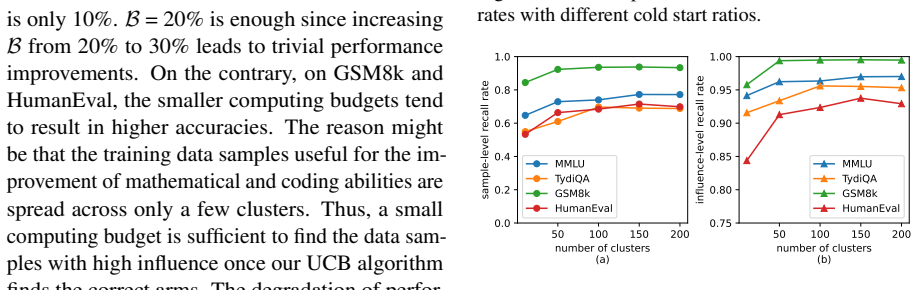
- On math and code benchmarks, smaller budgets (10%) can actually outperform larger ones, meaning a few clusters contain most high-influence samples and excessive scoring adds noise.
- ClusterUCB's gains transfer across model scale and architecture: Qwen2.5-3B reproduces the matching behavior on TyDiQA and HumanEval.
- The same 20% budget spent on random scoring (the Rerank baselines) falls short, isolating the UCB allocation as the reason for the saving.
Reading between the lines
- The paper leaves implicit that cluster counts and budgets could be tuned per target ability: since math and code high-influence samples concentrate in few clusters, a per-task adaptive budget might spend even less on those tasks.
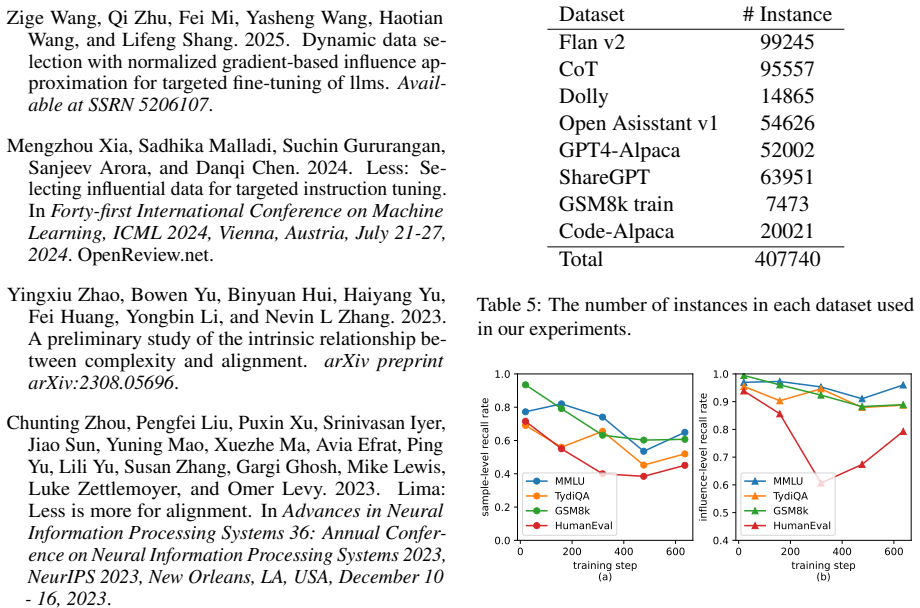
- A natural extension is to update the clusters periodically; Appendix B shows sample-level recall declines over training, so testing whether re-clustering improves results would reveal whether the one-time-clustering assumption, not the bandit, is the binding constraint.
- ClusterUCB inherits the single-sample influence approximation's blind spot—it scores each example in isolation, so it cannot account for redundancy or interaction within the selected subset; the paper itself flags this as future work.
- The framework could be ported to other gradient-fingerprint selection settings, such as data pruning or continued pretraining, wherever per-sample gradients can be computed once and influence behaves like a reward; that portability is untested in the paper.
Editorial analysis
A structured set of objections, weighed in public.
Referee Report
Summary. The paper proposes ClusterUCB, a framework for reducing the gradient-computation cost of influence-based data selection in supervised fine-tuning. It clusters the training pool once using gradients from a warmup checkpoint, treats clusters as arms in a multi-armed bandit, and uses a modified UCB rule with a cold start to allocate a per-round computing budget across clusters. The framework is instantiated on LESS and Dynamic, and evaluated on MMLU, TyDiQA, GSM8K, and HumanEval with LLaMA-2-7B and Qwen2.5-3B. The paper reports that the 20%-budget variants match or nearly match their full-budget counterparts, and claims that this greatly reduces computing consumption.
Significance. The empirical finding that clustering plus UCB-based allocation can match full-budget gradient-based selection is potentially useful for practical SFT, and the paper has several strengths: three seeds with standard deviations, rerank baselines at equal budget, hyperparameter and upper-bound-metric analyses, a second model scale, and an explicit appendix on cluster decay. However, the headline compute-savings claim is not substantiated by the paper's own accounting, because the reported 20% is a per-round budget and the one-time clustering and first-selection costs are excluded. The contribution is therefore conditionally significant pending a corrected quantitative comparison.
major comments (3)
- [Section 4.1, Table 1, abstract, and Section 5] The advertised '20% computing budget' is a per-selection-round budget, not an end-to-end computation cost. From the setup in Section 4.1, Dynamic-ClusterUCB performs a full N-gradient pass for clustering plus the full first-epoch selection, followed by three rounds at 0.2N, for 1.6N gradient evaluations versus 4N for Dynamic (40%). LESS-ClusterUCB incurs N for clustering and, if UCB drawing is applied at each of the four LESS checkpoints, 4 x 0.2N for selection, i.e., 1.8N versus 4N (45%). No GPU-hours, total gradient-evaluation counts, or wall-clock measurements are reported, so the abstract and Section 5 claim that ClusterUCB 'greatly reduces computing consumption' is not established as stated; the true saving appears to be at most a factor of about 2.5, not the factor of 5 implied by the 20% label. The authors should report end-to-end gradient-evaluation counts and measured GPU-hours for all variants and adjust the abstract and conclusion accordingly.
- [Section 4.1, LESS-ClusterUCB procedure] The text does not specify how the 20% budget interacts with LESS's multi-checkpoint aggregation. It is unclear whether the UCB drawing is performed once over influences aggregated from all four simulation checkpoints, at each checkpoint separately, or whether cluster assignments are recomputed at later checkpoints. These choices change the number of gradient evaluations per selection by up to a factor of four (0.2N versus 0.8N), so the compute-savings claim cannot be verified from the current description. Please specify the exact sequence of gradient computations and selections for LESS-ClusterUCB and Dynamic-ClusterUCB.
- [Section 4.5, Figures 2 and 3] The hyperparameters k=150 and pcs=5% are validated using recall metrics computed on the same four benchmarks that are later reported as the main results in Table 1. If these values were selected after seeing the target benchmarks, the comparison is not fully held out. The authors should state whether k and pcs were fixed before running the Table 1 experiments or tuned on a separate validation split, and if the latter, describe the validation procedure.
minor comments (5)
- [Section 4.3, Table 2] The conclusion that smaller budgets yield higher accuracy on GSM8k and HumanEval is not statistically supported (e.g., GSM8k 28.8±0.5 at 10% vs. 27.4±0.9 at 20%; HumanEval 18.8±0.6 vs. 17.7±0.4); the differences are within one standard deviation, so the cluster-concentration interpretation should be softened.
- [Section 3.3, Eq. (5)] Uc = mean + beta * std is not an upper confidence bound in the usual statistical sense; it is a heuristic threshold. The comparison in Table 4 is informative, but the terminology should be clarified to avoid implying a formal guarantee.
- [Appendix B, Figure 4] Sample-level recall Rs declines substantially on most benchmarks while Rinf remains high; reporting the actual Rinf values at the last selection epoch for each benchmark would help the reader assess the reuse assumption quantitatively.
- [Limitations] The Limitations section acknowledges the single-sample influence and K-means limitations but does not discuss the end-to-end compute overhead of the initial full-gradient clustering pass, which is the main gap identified in this report.
- [Section 4.1, datasets paragraph] Please fix the typo 'chain-of-though' to 'chain-of-thought'.
Circularity Check
No significant circularity: ClusterUCB is tested against external benchmarks and the clustering/UCB mechanism is not fitted to the outcome; the overstated compute-savings label is a reporting gap, not a circular derivation.
full rationale
The derivation chain is self-contained against external evaluation. ClusterUCB's only input is the same gradient-based influence approximation used by LESS and Dynamic; its output is a selected data subset scored on MMLU, TyDiQA, GSM8K, and HumanEval, none of which appear in the selection objective except through validation examples drawn from those benchmarks. The clustering step is a geometric consequence of Equation 3 (influence is a cosine similarity to a fixed validation gradient, so similar training gradients have similar influences), not a fitted conclusion. The UCB rewards are the actual influence approximations of drawn samples, and the final top selection sorts those rewards; no equation contains the benchmark result by construction, and the hyperparameters (k=150, pcs=5%, beta=1) are tuned on warmup-checkpoint recall metrics, not on the final benchmark numbers. The authors' reliance on Wang et al. (2025), a prior work with overlapping authorship, is for the empirically checkable claim that influence signals decay during training; Appendix B independently documents that decay, so the citation is not the sole load-bearing support. The Limitations section candidly notes the single-sample-influence gap, and Appendix B reports declining cluster recall, which weighs against any charge that the method's success is baked in. The strongest concern in the paper is not circularity but accounting: the '20% computing budget' label in Table 1 and the abstract is per selection round and excludes the one-time full gradient pass over all 407,740 training samples used for clustering (and, for Dynamic-ClusterUCB, the full first epoch's selection), so the end-to-end gradient-evaluation ratio is roughly 40-45% of the full-budget baselines rather than 20%; this is an unquantified reporting gap that affects the compute-savings claim but does not make the benchmark results equivalent to the method's inputs.
Assumptions & free parameters
free parameters (4)
- beta (UCB exploration coefficient) =
1
- k (number of clusters) =
150 in main experiments
- p_cs (cold start ratio) =
5%
- B (computing budget per selection round) =
20% of training pool
assumptions (4)
- domain assumption Training samples with similar gradient cosine similarity have similar influence on the target loss.
- domain assumption Clusters computed from gradients at the warmup checkpoint remain tight enough for later selection rounds.
- standard math First-order Taylor expansion approximates the one-step influence.
- ad hoc to paper The upper confidence bound Uc = mean + beta * std estimates the threshold in the budget allocation objective.
Cite this review
Pith. "Pith review of ClusterUCB: Efficient Gradient-Based Data Selection for Targeted Fine-Tuning of LLMs." pith.science (2026). https://pith.science/paper/XGJSE537
@misc{pith2026250610288,
  author       = {Pith},
  title        = {Pith review of: ClusterUCB: Efficient Gradient-Based Data Selection for Targeted Fine-Tuning of LLMs},
  year         = {2026},
  howpublished = {\url{https://pith.science/paper/XGJSE537}},
  note         = {Machine review of arXiv:2506.10288}
}
read the original abstract
Gradient-based data influence approximation has been leveraged to select useful data samples in the supervised fine-tuning of large language models. However, the computation of gradients throughout the fine-tuning process requires too many resources to be feasible in practice. In this paper, we propose an efficient gradient-based data selection framework with clustering and a modified Upper Confidence Bound (UCB) algorithm. Based on the intuition that data samples with similar gradient features will have similar influences, we first perform clustering on the training data pool. Then, we frame the inter-cluster data selection as a constrained computing budget allocation problem and consider it a multi-armed bandit problem. A modified UCB algorithm is leveraged to solve this problem. Specifically, during the iterative sampling process, historical data influence information is recorded to directly estimate the distributions of each cluster, and a cold start is adopted to balance exploration and exploitation. Experimental results on various benchmarks show that our proposed framework, ClusterUCB, can achieve comparable results to the original gradient-based data selection methods while greatly reducing computing consumption.
Figures


Figures from the paper (2 more)

Reference graph
Works this paper leans on
-
[1]
Alon Albalak, Yanai Elazar, Sang Michael Xie, Shayne Longpre, Nathan Lambert, Xinyi Wang, Niklas Muennighoff, Bairu Hou, Liangming Pan, Haewon Jeong, Colin Raffel, Shiyu Chang, Tatsunori Hashimoto, and William Yang Wang. 2024. A survey on data selection for language models. Trans. Mach. Learn. Res., 2024
work page 2024
-
[2]
Peter Auer, Nicolo Cesa-Bianchi, and Paul Fischer. 2002. Finite-time analysis of the multiarmed bandit problem. Machine learning, 47:235--256
work page 2002
-
[3]
Yihan Cao, Yanbin Kang, and Lichao Sun. 2023. Instruction mining: High-quality instruction data selection for large language models. arXiv preprint arXiv:2307.06290v3
arXiv 2023
-
[4]
Guillaume Charpiat, Nicolas Girard, Loris Felardos, and Yuliya Tarabalka. 2019. Input similarity from the neural network perspective. Advances in Neural Information Processing Systems, 32
work page 2019
-
[5]
Sahil Chaudhary. 2023. Code alpaca: An instruction-following llama model for code generation. https://github.com/sahil280114/codealpaca
2023
-
[6]
Mark Chen, Jerry Tworek, Heewoo Jun, Qiming Yuan, Henrique Ponde de Oliveira Pinto, Jared Kaplan, Harri Edwards, Yuri Burda, Nicholas Joseph, Greg Brockman, Alex Ray, Raul Puri, Gretchen Krueger, Michael Petrov, Heidy Khlaaf, Girish Sastry, Pamela Mishkin, Brooke Chan, Scott Gray, and 39 others. 2021. https://arxiv.org/abs/2107.03374 Evaluating large lang...
arXiv 2021
-
[7]
Mayee Chen, Nicholas Roberts, Kush Bhatia, Jue Wang, Ce Zhang, Frederic Sala, and Christopher R \'e . 2024. Skill-it! a data-driven skills framework for understanding and training language models. Advances in Neural Information Processing Systems, 36
work page 2024
-
[8]
Gonzalez, Ion Stoica, and Eric P
Wei-Lin Chiang, Zhuohan Li, Zi Lin, Ying Sheng, Zhanghao Wu, Hao Zhang, Lianmin Zheng, Siyuan Zhuang, Yonghao Zhuang, Joseph E. Gonzalez, Ion Stoica, and Eric P. Xing. 2023. https://lmsys.org/blog/2023-03-30-vicuna/ Vicuna: An open-source chatbot impressing gpt-4 with 90\
2023
Show all 42 references
-
[9]
Jonathan H Clark, Eunsol Choi, Michael Collins, Dan Garrette, Tom Kwiatkowski, Vitaly Nikolaev, and Jennimaria Palomaki. 2020. Tydi qa: A benchmark for information-seeking question answering in ty pologically di verse languages. Transactions of the Association for Computationa...
2020
-
[10]
Karl Cobbe, Vineet Kosaraju, Mohammad Bavarian, Mark Chen, Heewoo Jun, Lukasz Kaiser, Matthias Plappert, Jerry Tworek, Jacob Hilton, Reiichiro Nakano, Christopher Hesse, and John Schulman. 2021. Training verifiers to solve math word problems. arXiv preprint arXiv:2110.14168v2
2021 arXiv
-
[11]
Mike Conover, Matt Hayes, Ankit Mathur, Jianwei Xie, Jun Wan, Sam Shah, Ali Ghodsi, Patrick Wendell, Matei Zaharia, and Reynold Xin. 2023. Free dolly: Introducing the world's first truly open instruction-tuned llm. https://www.databricks.com/blog/2023/04/12/dolly-first-open-co...
2023
-
[12]
Ning Ding, Yulin Chen, Bokai Xu, Yujia Qin, Zhi Zheng, Shengding Hu, Zhiyuan Liu, Maosong Sun, and Bowen Zhou. 2023. Enhancing chat language models by scaling high-quality instructional conversations. In Proceedings of the 2023 Conference on Empirical Methods in Natural Langua...
2023
-
[13]
Guanting Dong, Hongyi Yuan, Keming Lu, Chengpeng Li, Mingfeng Xue, Dayiheng Liu, Wei Wang, Zheng Yuan, Chang Zhou, and Jingren Zhou. 2024. How abilities in large language models are affected by supervised fine-tuning data composition. In Proceedings of the 62nd Annual Meeting ...
2024
-
[14]
Logan Engstrom, Axel Feldmann, and Aleksander Madry. 2024. D s D m: Model-aware dataset selection with datamodels. In Proceedings of the 41st International Conference on Machine Learning, volume 235 of Proceedings of Machine Learning Research, pages 12491--12526. PMLR
2024
-
[15]
Kelvin Guu, Albert Webson, Ellie Pavlick, Lucas Dixon, Ian Tenney, and Tolga Bolukbasi. 2023. Simfluence: Modeling the influence of individual training examples by simulating training runs. arXiv preprint arXiv:2303.08114v1
2023 arXiv
-
[16]
Frank R Hampel. 1974. The influence curve and its role in robust estimation. Journal of the american statistical association, 69(346):383--393
1974
-
[17]
John A Hartigan and Manchek A Wong. 1979. Algorithm as 136: A k-means clustering algorithm. Journal of the royal statistical society. series c (applied statistics), 28(1):100--108
1979
-
[18]
Qianyu He, Jie Zeng, Qianxi He, Jiaqing Liang, and Yanghua Xiao. 2024. From complex to simple: Enhancing multi-constraint complex instruction following ability of large language models. arXiv preprint arXiv:2404.15846v2
2024 arXiv
-
[19]
Dan Hendrycks, Collin Burns, Steven Basart, Andy Zou, Mantas Mazeika, Dawn Song, and Jacob Steinhardt. 2021. Measuring massive multitask language understanding. Proceedings of the International Conference on Learning Representations (ICLR)
2021
-
[20]
Hu, Yelong Shen, Phillip Wallis, Zeyuan Allen - Zhu, Yuanzhi Li, Shean Wang, Lu Wang, and Weizhu Chen
Edward J. Hu, Yelong Shen, Phillip Wallis, Zeyuan Allen - Zhu, Yuanzhi Li, Shean Wang, Lu Wang, and Weizhu Chen. 2022. Lora: Low-rank adaptation of large language models. In The Tenth International Conference on Learning Representations, ICLR 2022, Virtual Event, April 25-29, 2022
2022
-
[21]
Andrew Ilyas, Sung Min Park, Logan Engstrom, Guillaume Leclerc, and Aleksander Madry. 2022. Datamodels: Predicting predictions from training data. arXiv preprint arXiv:2202.00622v1
2022 arXiv
-
[22]
o pf, Yannic Kilcher, Dimitri von R \
Andreas K \" o pf, Yannic Kilcher, Dimitri von R \" u tte, Sotiris Anagnostidis, Zhi Rui Tam, Keith Stevens, Abdullah Barhoum, Duc Nguyen, Oliver Stanley, Rich \' a rd Nagyfi, Shahul ES, Sameer Suri, David Glushkov, Arnav Dantuluri, Andrew Maguire, Christoph Schuhmann, Huu Ngu...
2023
-
[23]
Po-Nien Kung, Fan Yin, Di Wu, Kai wei Chang, and Nanyun Peng. 2023. Active instruction tuning: Improving cross-task generalization by training on prompt sensitive tasks. In Proceedings of the 2023 Conference on Empirical Methods in Natural Language Processing, EMNLP 2023, Sing...
2023
-
[24]
Qingyi Liu, Yekun Chai, Shuohuan Wang, Yu Sun, Keze Wang, and Hua Wu. 2024. On training data influence of gpt models. arXiv preprint arXiv:2404.07840v3
2024 arXiv
-
[25]
Le, Barret Zoph, Jason Wei, and Adam Roberts
Shayne Longpre, Le Hou, Tu Vu, Albert Webson, Hyung Won Chung, Yi Tay, Denny Zhou, Quoc V. Le, Barret Zoph, Jason Wei, and Adam Roberts. 2023. The flan collection: Designing data and methods for effective instruction tuning. In International Conference on Machine Learning, ICM...
2023
-
[26]
Jianqiao Lu, Wanjun Zhong, Wenyong Huang, Yufei Wang, Fei Mi, Baojun Wang, Weichao Wang, Lifeng Shang, and Qun Liu. 2023 a . Self: Language-driven self-evolution for large language model. arXiv preprint arXiv:2310.00533v4
2023 arXiv
-
[27]
Keming Lu, Hongyi Yuan, Zheng Yuan, Runji Lin, Junyang Lin, Chuanqi Tan, Chang Zhou, and Jingren Zhou. 2023 b . https://arxiv.org/abs/2308.07074 \#instag: Instruction tagging for analyzing supervised fine-tuning of large language models . Preprint, arXiv:2308.07074
2023 arXiv
-
[28]
Sung Min Park, Kristian Georgiev, Andrew Ilyas, Guillaume Leclerc, and Aleksander Madry. 2023. Trak: Attributing model behavior at scale. In International Conference on Machine Learning (ICML)
2023
-
[29]
Baolin Peng, Chunyuan Li, Pengcheng He, Michel Galley, and Jianfeng Gao. 2023. Instruction tuning with gpt-4. arXiv preprint arXiv:2304.03277v1
2023 arXiv
-
[30]
Garima Pruthi, Frederick Liu, Satyen Kale, and Mukund Sundararajan. 2020. Estimating training data influence by tracing gradient descent. Advances in Neural Information Processing Systems, 33:19920--19930
2020
-
[31]
Aleksandrs Slivkins and 1 others. 2019. Introduction to multi-armed bandits. Foundations and Trends in Machine Learning , 12(1-2):1--286
2019
-
[32]
Qwen Team. 2024. https://qwenlm.github.io/blog/qwen2.5/ Qwen2.5: A party of foundation models
2024
-
[33]
Hugo Touvron, Louis Martin, Kevin Stone, Peter Albert, Amjad Almahairi, Yasmine Babaei, Nikolay Bashlykov, Soumya Batra, Prajjwal Bhargava, Shruti Bhosale, Dan Bikel, Lukas Blecher, Cristian Canton - Ferrer, Moya Chen, Guillem Cucurull, David Esiobu, Jude Fernandes, Jeremy Fu,...
2023 arXiv
-
[34]
Fanqi Wan, Xinting Huang, Tao Yang, Xiaojun Quan, Wei Bi, and Shuming Shi. 2023. Explore-instruct: Enhancing domain-specific instruction coverage through active exploration. arXiv preprint arXiv:2310.09168
2023 arXiv
-
[35]
Yizhong Wang, Hamish Ivison, Pradeep Dasigi, Jack Hessel, Tushar Khot, Khyathi Raghavi Chandu, David Wadden, Kelsey MacMillan, Noah A Smith, Iz Beltagy, and 1 others. 2023 a . How far can camels go? exploring the state of instruction tuning on open resources. In Advances in Ne...
2023
-
[36]
Zige Wang, Wanjun Zhong, Yufei Wang, Qi Zhu, Fei Mi, Baojun Wang, Lifeng Shang, Xin Jiang, and Qun Liu. 2023 b . Data management for training large language models: A survey. arXiv preprint arXiv:2312.01700v3
2023 arXiv
-
[37]
Zige Wang, Qi Zhu, Fei Mi, Yasheng Wang, Haotian Wang, and Lifeng Shang. 2025. Dynamic data selection with normalized gradient-based influence approximation for targeted fine-tuning of llms. Available at SSRN 5206107
2025
-
[38]
Mengzhou Xia, Sadhika Malladi, Suchin Gururangan, Sanjeev Arora, and Danqi Chen. 2024. Less: Selecting influential data for targeted instruction tuning. In Forty-first International Conference on Machine Learning, ICML 2024, Vienna, Austria, July 21-27, 2024 . OpenReview.net
2024
-
[39]
Yingxiu Zhao, Bowen Yu, Binyuan Hui, Haiyang Yu, Fei Huang, Yongbin Li, and Nevin L Zhang. 2023. A preliminary study of the intrinsic relationship between complexity and alignment. arXiv preprint arXiv:2308.05696
2023 arXiv
-
[40]
Chunting Zhou, Pengfei Liu, Puxin Xu, Srinivasan Iyer, Jiao Sun, Yuning Mao, Xuezhe Ma, Avia Efrat, Ping Yu, Lili Yu, Susan Zhang, Gargi Ghosh, Mike Lewis, Luke Zettlemoyer, and Omer Levy. 2023. Lima: Less is more for alignment. In Advances in Neural Information Processing Sys...
2023
-
[41]
online" 'onlinestring :=
ENTRY address archivePrefix author booktitle chapter edition editor eid eprint eprinttype howpublished institution journal key month note number organization pages publisher school series title type volume year doi pubmed url lastchecked label extra.label sort.label short.list...
-
[42]
write newline
" write newline "" before.all 'output.state := FUNCTION n.dashify 't := "" t empty not t #1 #1 substring "-" = t #1 #2 substring "--" = not "--" * t #2 global.max substring 't := t #1 #1 substring "-" = "-" * t #2 global.max substring 't := while if t #1 #1 substring * t #2 gl...
Reviewed August 7, 2026 · model on record in the stance chip above.
Discussion (0). Sign in to comment.