REVIEW 2 major objections 5 minor 2 cited by
Multi-entropy and the Dihedral Measures at Quantum Critical Points
T0 review · 2 major / 5 minor · reviewed 2026-08-07 · deepseek-v4-flash
Pith's one-line read This paper shows that multi-entropy and dihedral measures are practical probes of quantum critical points, and that the massless free scalar CFT has a vanishing n=2 excess in place of the universal c/4 log 2, with new n=3 and n=4…
desk verdict Useful, honest numerical study of a new multipartite entanglement probe, but the headline n=3,4 free-scalar predictions are built on a constant-excess fit the paper’s own data contradicts. read the letter →
The pith
A machine-rendered reading of the paper's core claim, the machinery that carries it, and where it could break.
The reading
What carries the argument
The central object is the excess $\kappa_n^{(3)}$ (and its dihedral analogue $\Delta D_{2n}$), the UV-finite difference between the multipartite measure and the averaged Rényi entropies, which isolates genuinely tripartite correlations. The argument runs on two complementary devices: the replica/uniformization method in 2d CFT, which expresses the multi-entropy as a three-point function of twist operators (conformal primaries encoding the replica monodromies) and yields the universal $\frac{c}{4}\log 2$ value, and direct lattice computations—Gaussian covariance-matrix path integrals for the free scalar and matrix-product-state calculations for the Ising chain. The scalar exception arises from the zero-mode factor $\sqrt{\tau_2}$ in the torus partition function, which changes the coincidence-limit prescription that converts $\Delta S_2^{(3)}=\frac{1}{4}\log 2$ into $\kappa_2^{(3)}=0$.
What would settle it
Repeat the free-scalar lattice calculation at smaller lattice spacing and larger system size and check whether the fitted $\kappa_3$ and $\kappa_4$ converge to $-0.14$ and $-0.20$ or keep drifting with system size; a direct continuum computation of the replicated partition function at $n=3,4$ would settle the same point.
Extended reading notes
Core claim
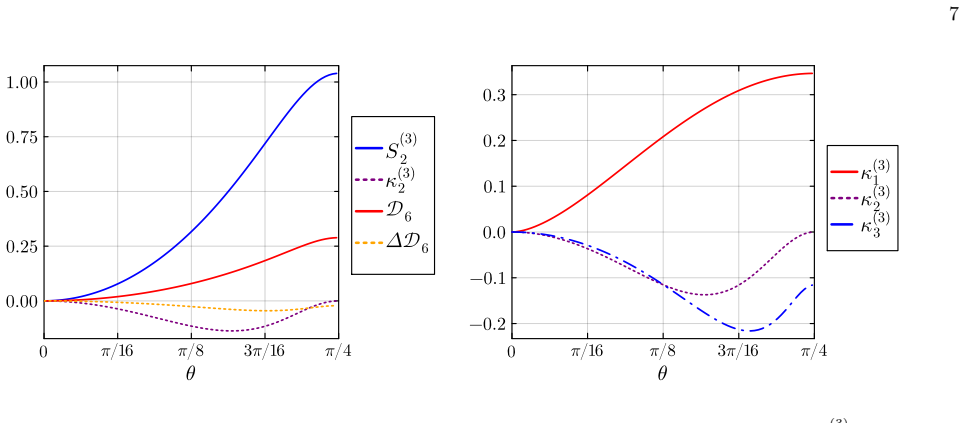
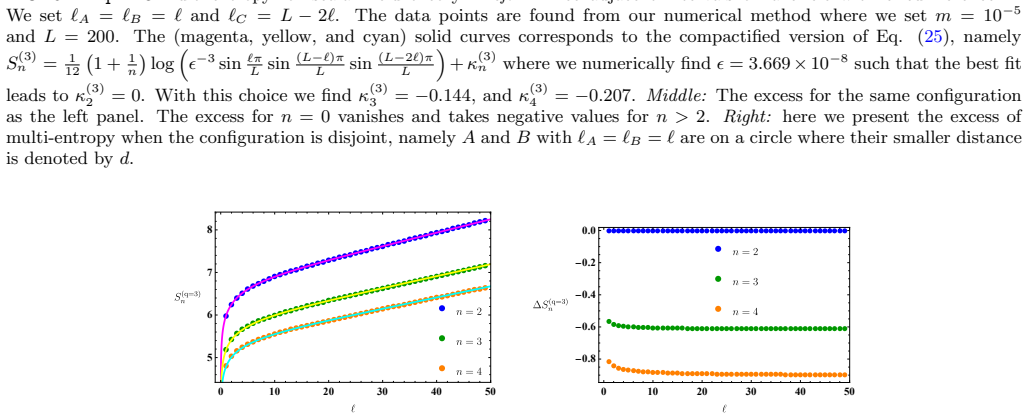
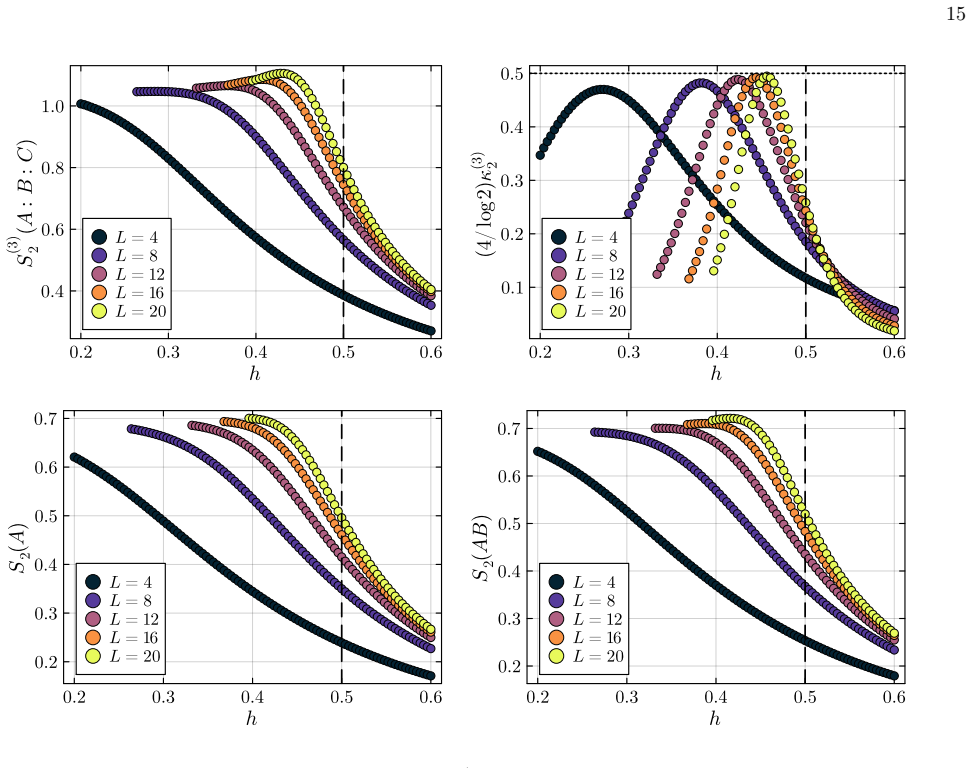
The paper establishes that the tripartite multi-entropy excess for the massless free scalar CFT vanishes at $n=2$: $\kappa_2^{(3)}=0$, an exception to the general CFT result $\kappa_2^{(3)}=\frac{c}{4}\log 2$. The anomaly is traced to the zero mode of the non-compact scalar field, whose contribution to the torus partition function changes the coincidence-limit prescription that yields $\kappa_2^{(3)}$. For the Ising CFT with $c=1/2$, the numerical excess matches $\frac{c}{4}\log 2$, and the dihedral measure excess at $n=3$ matches $\Delta D_6=\frac{2c}{27}\log 2$. For the scalar theory, the paper gives new predictions for the excess at $n=3,4$, namely $\kappa_3\simeq -0.14$ and $\kappa_4\simeq -0.20$, and in the disconnected-interval setup it shows the excess is independent of separation and zero for the scalar, decays as $\kappa_2^{(3)}\propto 1/\sqrt{d}$ for the Ising CFT, and decays much faster for holographic CFTs, so the measures distinguish different quantum critical points.
Load-bearing premise
The $n=3$ and $n=4$ predictions assume that the excess $\kappa_n^{(3)}$ settles to a constant independent of interval size in the continuum limit, but the paper's own lattice data show the excess still varying with size for $n>2$, and if that variation does not flatten out the quoted numbers are fitting artifacts rather than CFT predictions.
Editorial extensions
If this is right
- Multi-entropy and dihedral measures are computable, UV-finite probes of multipartite entanglement that can be extracted from standard lattice methods such as Gaussian states and matrix-product states, making them practical diagnostics for quantum critical points.
- At $n=2$ the universal excess $\kappa_2^{(3)}=\frac{c}{4}\log 2$ holds for the Ising CFT but fails for the massless free scalar, where the zero mode forces $\kappa_2^{(3)}=0$; the value of this excess therefore encodes whether the critical theory has a non-compact zero mode.
- The new scalar predictions $\kappa_3\simeq -0.14$ and $\kappa_4\simeq -0.20$ give concrete targets that other numerical or experimental methods can test.
- In the disconnected geometry, the separation dependence of the excess distinguishes CFTs: constant zero for the scalar, $\propto 1/\sqrt{d}$ for the Ising, and much faster decay for holographic CFTs, so the measure can serve as a fingerprint of the critical theory.
- Finite-size scaling of the adjacent excess yields the critical field and central charge of the Ising transition with high precision ($h_c=0.5055(62)$, $c=0.5025(148)$), suggesting the excess can be used to locate quantum phase transitions.
Reading between the lines
- A natural next test is the compactified free boson: varying the compactification radius should interpolate the $n=2$ excess between the universal $\frac{c}{4}\log 2$ and zero as the zero mode becomes effectively non-compact, giving a one-parameter family of predictions.
- The paper's lattice data showing non-constant excess for $n>2$ suggest that subleading corrections to the CFT form (25) may be comparable to the constant term; extracting these corrections could yield a systematic expansion in the cross-ratio.
- If the finite-size scaling exponent $\alpha_\kappa$ for the peak excess is controlled by a conical-singularity operator, measuring that exponent for multi-entropy could give a new route to the scaling dimensions of twist operators, a connection the paper flags as future work.
Editorial analysis
A structured set of objections, weighed in public.
Referee Report
Summary. This paper studies multi-entropy and dihedral measures at quantum critical points, with the goal of establishing these quantities as practical probes of multi-partite entanglement in CFTs. The authors compute the q=3 multi-entropy and dihedral measures in two lattice models: the massless free scalar chain, treated with Gaussian states, and the transverse-field Ising chain, treated with DMRG and exact two-site density matrices. They compare the n=2 multi-entropy excess with the general CFT prediction κ_2^(3)=c/4 log 2, finding agreement for the Ising CFT (c=1/2) and a vanishing excess for the free scalar, which they attribute to the zero mode of the non-compact scalar. For the scalar theory they also extract new predictions κ_3≈-0.14 and κ_4≈-0.20, and analogous dihedral-measure excesses. The paper includes analytic CFT results for adjacent and disjoint intervals, exact qubit examples (GHZ, W, Werner states), and a finite-size scaling analysis of the Ising data.
Significance. If the central claims hold, the paper provides a valuable demonstration that multi-entropy and dihedral measures are computable in lattice systems and can distinguish different CFTs at criticality. The Ising DMRG results, the exact two-site Ising benchmarks, and the direct numerical observation of a vanishing scalar n=2 excess are strong independent pieces of evidence. The analytic zero-mode argument for the scalar anomaly, although somewhat heuristic, is supported by the lattice data. However, the paper's advertised n=3,4 scalar predictions are the main potential advance, and those rest on an unverified constant-excess fitting assumption. The dihedral results also contain internal numerical inconsistencies. Because the n>2 scalar predictions are a central part of the paper's claim to new results, the manuscript needs substantial revision before the predictions can be regarded as established.
major comments (2)
- [Sec. III B, Fig. 5] The quoted scalar predictions κ_3=-0.144 and κ_4=-0.207 are extracted by first tuning the UV cutoff ϵ so that the n=2 fit gives κ_2=0, and then assuming the CFT form (25) with a single constant κ_n for n=3,4. However, the directly computed excess ΔS_n^(3) shown in the middle panel is non-constant for n>2, and the text states that the same non-constant behavior is also observed on an infinite lattice, attributing it only qualitatively to lattice effects. Since ΔS_n^(3) is independent of the ϵ-fit, the continuum limit requires this excess to become constant if (25) with constant κ_n is to be the correct CFT description. The paper provides no error bars, fit ranges, residuals, or a demonstration that the excess develops a plateau as L→∞ and m→0. Without such evidence, the numbers κ_3=-0.144 and κ_4=-0.207 are not established CFT predictions; they may be fitting artifacts. Because the abstract and Section V advertise n=3,4 as new predictions for the massless scalar, this is a load-bearing gap.
- [Sec. III (Fig. 7) and Sec. V] The dihedral-measure results for the free scalar are internally inconsistent and are not reconciled with the general CFT formula (40). Figure 7 quotes ΔD4=0, ΔD6=0.0329, and ΔD8=0.0359 after fitting ϵ, while Section V quotes ΔD4=0, ΔD6≃0.028, and ΔD8≃0.031. For c=1, formula (40) gives ΔD6=0.0513 and ΔD8=0.0361. The paper neither explains why the scalar dihedral excess should differ from (40) (for example by a zero-mode effect analogous to the vanishing κ_2^(3) for multi-entropy) nor provides error bars. As written, the claim that the dihedral measure for the free scalar is reproduced by CFT calculations is not quantitatively supported.
minor comments (5)
- [Fig. 5 caption] The caption says 'The excess for n=0 vanishes'; this should presumably read 'n=2'.
- [Fig. 6 caption] The caption contains a duplicated 'Left:' label; the second occurrence should be 'Right:'.
- [Sec. II C2, Eq. (73)] The analytic derivation of κ_2^(3)=0 is conditional: the text says 'If we admit the prescription...' and then 'we may argue'. Since this is a central exception to the general result (65), the prescription should be derived from the zero-mode structure or the result should be presented as numerical evidence supported by a heuristic argument.
- [Sec. III B] The statement that the left panel of Fig. 5 shows 'perfect agreement' with the CFT result for n=3,4 is overstated, because the κ_n constants in (25) are fitted, not predicted, for those values of n.
- [General] None of the numerical plots include error bars; the authors should state the expected numerical uncertainty or explain why the symbol size exceeds the uncertainty.
Circularity Check
No significant circularity: the Ising and free-scalar n=2 results are independently supported by lattice numerics and exact calculations; the n>2 scalar extraction is a fitting concern, not a circular equivalence.
full rationale
The paper's derivation chain is largely self-contained and the central comparisons are supported by independent numerical evidence. The CFT benchmark κ_2^(3)=c/4 log2 is cited from refs. [16,23], which include present authors, but the paper does not rest on these citations alone: the transverse-field Ising results are benchmarked against exact two-site density-matrix calculations and DMRG with finite-size scaling, reproducing the CFT value within statistical error; for the free scalar, the n=2 excess is plotted directly in Fig. 5 and vanishes without any fitting, matching the zero-mode argument. The UV cutoff in Fig. 5 is chosen such that the fitted κ_2 is zero, so the left-panel 'agreement' for n=2 is partly by construction, but the paper explicitly points to the middle-panel excess as the confirmation, which is independent of the cutoff. The only notable weakness is the extraction of κ_3 and κ_4 for n>2: these are read from fits to Eq. (25) after fixing ϵ, while the paper's own excess data are non-constant for n>2 even on an infinite lattice. This is a model-dependence and extrapolation concern in the novel n>2 predictions, but it does not make the n=2 or Ising derivations circular: those results have independent support. No uniqueness theorem or ansatz is imported from the authors' prior work in a load-bearing way; the self-citations are to explicit CFT computations that the numerics independently confirm. The n>2 concern should be weighed as a correctness risk rather than as circularity.
Assumptions & free parameters
free parameters (4)
- UV cutoff epsilon in free scalar multi-entropy fit =
3.669e-8 (adjacent, L=200, m=1e-5); 9.209e-9 (finite temperature beta=50)
- UV cutoff epsilon in free scalar dihedral measure fit =
3.675e-8
- Ising CFT cutoff shift -c/4 log epsilon =
0.4196(3)
- Finite-size scaling parameters for pseudo-critical point =
h_c=0.5055(62), κ_c=0.0871(26), α_h, α_κ fitted
assumptions (5)
- standard math The CFT replica method for multi-invariants: twist operator dimension Δσ_g = c s/12 (l^2-1)/l^2 and the Liouville action relation (6) compute multi-entropy and dihedral measures in 2d CFTs.
- domain assumption The massless limit m→0 of the one-dimensional harmonic lattice with W=V^{1/2} reproduces the c=1 massless free scalar CFT in the continuum limit.
- ad hoc to paper The free scalar torus partition function includes a zero-mode volume factor V√τ2/η^2, and the UV cutoff prescription in the coincident-interval limit distinguishes multi-entropy (epsilon/4) from Rényi (epsilon).
- ad hoc to paper For n>2, the massless scalar multi-entropy excess is a constant κ_n in the continuum limit, so lattice deviations can be removed by a single epsilon fit.
- domain assumption The transverse-field Ising chain at h_c=1/2 is described by the Ising CFT with c=1/2, and the Jordan-Wigner exact solution supplies two-site correlators.
Cite this review
Pith. "Pith review of Multi-entropy and the Dihedral Measures at Quantum Critical Points." pith.science (2026). https://pith.science/paper/6N7XS4IZ
@misc{pith2026250610396,
  author       = {Pith},
  title        = {Pith review of: Multi-entropy and the Dihedral Measures at Quantum Critical Points},
  year         = {2026},
  howpublished = {\url{https://pith.science/paper/6N7XS4IZ}},
  note         = {Machine review of arXiv:2506.10396}
}
abstract
The multi-entropy and dihedral measures are a class of tractable measures for multi-partite entanglement, which are labeled by the R\'enyi index (or replica number) $n$ as in the R\'enyi entanglement entropy. The purpose of this article is to demonstrate that these quantities are new useful probes of quantum critical points by examining concrete examples. In particular, we compute the multi-entropy and dihedral measures in the $1+1$ dimensional massless free scalar field theory on a lattice and in the transverse-field Ising model. For $n=2$, we find that the numerical results in both lattice theories quantitatively agree with those from conformal field theoretic calculations. For $n=3$ and $n=4$, we provide new predictions of these measures for the massless scalar field theory.
Figures


Figures from the paper (13 more)






Forward citations
Cited by 2 Pith papers
-
The Entanglement Wedge Polygon
The paper defines the entanglement wedge polygon as the intersection of entanglement wedges external to individual homology regions and studies its topological and geometric properties in AdS examples.
-
Black hole as a multipartite entangler: multi-entropy in AdS${}_3$/CFT${}_2$
In pure BTZ black-hole states the genuine tripartite multi-entropy grows linearly with subsystem size at high temperature (volume law), peaks at (1/6) of the Bekenstein-Hawking entropy plus a universal constant, and c...
Reference graph
Works this paper leans on
-
[1]
R´ enyi-entropy withq=p= 2 The R´ enyi entropy is given by S(2) n (A) = 1 1−n log(Trρ n A) (8) while the entanglement entropy S=−Tr(ρ A logρ A) = lim n→1 Sn.(9) The R´ enyi entropy can be re-expressed as a multi- invariant withg’s taken from the cyclic groupZ n: Zn :⟨a|a n =e⟩.(10) For the generator we choose the representation a: (1,2,· · ·, n) (11) 4 an...
-
[2]
Three party multi-entropyq=p= 3 An important family of measures theR´ enyi multi- entropywas first defined in [17, 18]. These measures give rise to twist operator monodromies where the cycle length of all operators is the same. For the case of three partiesq= 3 we have that the n-th R´ enyi multi-entropy is defined by Z2 n :⟨a, b|an =b n =e;ab=ba⟩(19) 2 I...
-
[3]
Three party multi-entropy on four intervalsq= 3and p= 4 We chooseA= [x 1, x2] andB= [x 3, x4] andO= (A∪B) c and define the cross-ratio η= x12x34 x13x24 ,(27) wherex ij =x i −x j. Taking the same permutations (21) gives the twist operator mondromies σa : (1,2,· · ·, n)(n+ 1, n+ 2,· · ·,2n)· · · · · ·((n−1)n+ 1,(n−1)n+ 2,· · ·, n2)) σan−1 : (1, n,· · ·,2)(n...
-
[4]
Three party dihedral measuresq=p= 3 An infinite family of three party measures with genus 0 replica surface was first defined in [16]. These measures are made of 2ncopies with dihedral replica symmetry D2n :⟨a, b|an =b 2 =e;ba=a n−1b⟩(32) a: (1,2,· · ·, n)(n+ 1, n+ 2,· · ·,2n) b: (1,2n)(2,2n−1)(3,2n−2)· · ·(n, n+ 1) . (33) gO =e, g A =a n−1, gB =b(34) whi...
-
[5]
GHZ states The generalized GHZ state is defined in the computa- tional basis as |GHZ(θ)⟩ := cosθ|000⟩+ sinθ|111⟩.(41) For this family, the three-partyn-th multi-entropy and the single-qubit R´ enyi entropy are analytically given by S(3) n = 1 (1−n)n log[(cosθ) 2n2 + (sinθ) 2n2 ],(42) 6 S(2) n = 1 1−n log[(cosθ) 2n + (sinθ) 2n].(43) In the von Neumann limi...
-
[6]
W states The generalized W state is defined in the computa- tional basis as |W(θ, φ)⟩:= cosθ|001⟩+sinθcosφ|010⟩+sinθsinφ|100⟩. (48) For this family, the multi-entropy and the single-qubit R´ enyi entropy are given by S(3) 2 =−log cos4 θ+ 3 + cos 4φ 4 sin4 θ ,(49) S(2) n (A) = 1 1−n log[(cosθ) 2n + (sinθ) 2n],(50) S(2) n (B) = 1 1−n log[(sin2 θcos 2 φ)n + ...
-
[7]
Werner states The two-qubit Werner states are a family of mixed states that is a convex combination of a Bell state and the maximally mixed state, defined as ρWerner(λ) :=λ Ψ− Ψ− AB + 1−λ 4 11AB,(54) |Ψ−⟩ := 1√ 2 (|01⟩ − |10⟩),(55) whereλis a parameter determining the amount of en- tanglement in the state. We consider a scenario where the Werner state ari...
-
[8]
Holographic CFT For a holographic 2d CFT the torus partition function is given by log(Ztorus) = ( πc 3 K(1−η) K(η) =− πicτ 6 η≤η ∗ πc 12 K(η) K(1−η) = πic 6τ η≥η ∗ , η ∗ = θ2( i 2 )4 θ3( i 2 )4 , (74) 9 the phase transition occurs when the torus is square cor- responding to the modular parameterτ=i. This leads to the following formula forS (3) 2 : S(3) 2 ...
Show all 53 references
-
[9]
10) is obtained via the density matrix renormalisation group (DMRG) al- gorithm [37]
Method The matrix product state (MPS) representation of the ground state (top panel of Fig. 10) is obtained via the density matrix renormalisation group (DMRG) al- gorithm [37]. For two intervalsAandB, one could in principle build the reduced density matrix by contract- ing ev...
-
[10]
We fix the ratio of the subsys- tem sizes asℓ A =ℓ B =L/4 and vary the total system sizeLin multiples of four, along with the transverse field h
Adjacent setup We first consider the adjacent setup (ℓ= 0) with equal block lengths (ℓ A =ℓ B). We fix the ratio of the subsys- tem sizes asℓ A =ℓ B =L/4 and vary the total system sizeLin multiples of four, along with the transverse field h. We will note the adjacent multi-ent...
-
[11]
Extreme Uni- verse
Disjoint setup We now turn to the disjoint setup and analyze the dependence of entropic quantities on the separationℓbe- tween two subsystemsAandB. a. Benchmark against exact two-site results.Let us first consider the case ofℓ A =ℓ B = 1 at the true criti- cal pointh c = 1/2, ...
-
[12]
We select a window of 19 data points (width∆h= 0.018) for all system sizes
Adjacent setup To precisely extract the pseudo-critical pointh pc(L) and the peak valueκ pc(L) from adjacent multi-entropy excess, we fit the numerical data within a window cen- tered on the numerical peak. We select a window of 19 data points (width∆h= 0.018) for all system s...
-
[13]
Disjoint setup Colored lines in Fig. 15 represent the corresponding CFT prediction for the infinite system (L→ ∞), where the cutoff-dependent shift is applied consistently across the multi-entropy and R´ enyi entropies, while no adjust- ment is made for multi-entropy excess si...
-
[14]
Holzhey, F
C. Holzhey, F. Larsen, and F. Wilczek, Nucl. Phys. B 424, 443 (1994), arXiv:hep-th/9403108
1994 arXiv
-
[15]
Vidal, J
G. Vidal, J. I. Latorre, E. Rico, and A. Kitaev, Phys. Rev. Lett.90, 227902 (2003), arXiv:quant-ph/0211074
2003 arXiv
-
[16]
Calabrese and J
P. Calabrese and J. L. Cardy, J. Stat. Mech.0406, P06002 (2004), arXiv:hep-th/0405152
2004 arXiv
-
[17]
Kitaev and J
A. Kitaev and J. Preskill, Phys. Rev. Lett.96, 110404 (2006), arXiv:hep-th/0510092
2006 arXiv
-
[18]
Levin and X.-G
M. Levin and X.-G. Wen, Phys. Rev. Lett.96, 110405 (2006), arXiv:cond-mat/0510613
2006 arXiv
-
[19]
Bombelli, R
L. Bombelli, R. K. Koul, J. Lee, and R. D. Sorkin, Phys. Rev. D34, 373 (1986)
1986
-
[20]
Srednicki, Phys
M. Srednicki, Phys. Rev. Lett.71, 666 (1993), arXiv:hep- th/9303048
1993
-
[21]
Eisert, M
J. Eisert, M. Cramer, and M. B. Plenio, Rev. Mod. Phys. 82, 277 (2010), arXiv:0808.3773 [quant-ph]
2010 arXiv
-
[22]
Ryu and T
S. Ryu and T. Takayanagi, Phys. Rev. Lett.96, 181602 (2006), arXiv:hep-th/0603001
2006 arXiv
- [23]
-
[24]
V. E. Hubeny, M. Rangamani, and T. Takayanagi, JHEP 07, 062 (2007), arXiv:0705.0016 [hep-th]
2007 arXiv
-
[25]
Nishioka, S
T. Nishioka, S. Ryu, and T. Takayanagi, J. Phys. A42, 504008 (2009), arXiv:0905.0932 [hep-th]
2009 arXiv
- [26]
-
[27]
Horodecki, P
R. Horodecki, P. Horodecki, M. Horodecki, and K. Horodecki, Rev. Mod. Phys.81, 865 (2009), arXiv:quant-ph/0702225
2009 arXiv
-
[28]
Bengtsson and K
I. Bengtsson and K. Zyczkowski,Geometry of Quantum States(2006)
2006
- [29]
-
[30]
Gadde, V
A. Gadde, V. Krishna, and T. Sharma, Physics Rev. D 106, 126001 (2022), arXiv:2206.09723 [hep-th]
2022 arXiv
-
[31]
Penington, M
G. Penington, M. Walter, and F. Witteveen, JHEP05, 008 (2023), arXiv:2211.16045 [hep-th]
2023 arXiv
-
[32]
Berthiere and G
C. Berthiere and G. Parez, Phys. Rev. D108, 054508 (2023)
2023
-
[33]
Gadde, S
A. Gadde, S. Jain, V. Krishna, H. Kulkarni, and T. Sharma, JHEP02, 025 (2024), arXiv:2308.16247 [hep- th]
2024 arXiv
-
[34]
Gadde, V
A. Gadde, V. Krishna, and T. Sharma, JHEP08, 202 (2023), arXiv:2304.06082 [hep-th]
2023 arXiv
-
[35]
Gadde, S
A. Gadde, S. Jain, and H. Kulkarni, (2024), arXiv:2406.17447 [quant-ph]
2024
-
[36]
Harper, T
J. Harper, T. Takayanagi, and T. Tsuda, SciPost Phys. 16, 125 (2024), arXiv:2401.04236 [hep-th]
2024 arXiv
-
[37]
B. Liu, J. Zhang, S. Ohyama, Y. Kusuki, and S. Ryu, (2024), arXiv:2410.08284 [cond-mat.str-el]
2024
-
[38]
Iizuka, S
N. Iizuka, S. Lin, and M. Nishida, JHEP03, 037 (2025), arXiv:2412.07549 [hep-th]
2025 arXiv
- [39]
- [40]
- [41]
-
[42]
M.-K. Yuan, M. Li, and Y. Zhou, (2024), arXiv:2410.08546 [hep-th]
2024
-
[43]
T. J. Osborne and M. A. Nielsen, Phys. Rev. A66, 032110 (2002), arXiv:quant-ph/0202162
2002 arXiv
-
[44]
E. H. Lieb, T. Schultz, and D. Mattis, Annals Phys.16, 407 (1961)
1961
-
[45]
Barouch, B
E. Barouch, B. M. McCoy, and M. Dresden, Phys. Rev. A2, 1075 (1970). 20
1970
-
[46]
Jordan and E
P. Jordan and E. P. Wigner, Z. Phys.47, 631 (1928)
1928
-
[47]
Pfeuty, Annals Phys.57, 79 (1970)
P. Pfeuty, Annals Phys.57, 79 (1970)
1970
-
[48]
Fishman, S
M. Fishman, S. R. White, and E. M. Stoudenmire, SciPost Phys. Codeb.2022, 4 (2022), arXiv:2007.14822 [cs.MS]
2022 arXiv
-
[49]
Fishman, S
M. Fishman, S. R. White, and E. M. Stoudenmire, Sci- Post Phys. Codeb.2022, 4 (2022)
2022
-
[50]
S. R. White, Phys. Rev. Lett.69, 2863 (1992)
1992
-
[51]
Ruggiero, V
P. Ruggiero, V. Alba, and P. Calabrese, Phys. Rev. B 94, 035152 (2016), arXiv:1605.00674 [cond-mat.str-el]
2016 arXiv
-
[52]
J. C. Xavier and F. C. Alcaraz, Phys. Rev. B85, 024418 (2012), arXiv:1111.6577 [cond-mat.stat-mech]
2012 arXiv
-
[53]
Cardy and P
J. Cardy and P. Calabrese, J. Stat. Mech.1004, P04023 (2010), arXiv:1002.4353 [cond-mat.stat-mech]
2010 arXiv
Reviewed August 7, 2026 · model on record in the stance chip above.
Discussion (0). Continue with ORCID to comment.