REVIEW 3 major objections 4 minor 4 cited by
Non-Abelian dynamics on a cube: improving quantum compilation through qudit-based simulations
T0 review · 3 major / 4 minor · reviewed 2026-08-07 · deepseek-v4-flash
Pith's one-line read The paper compiles SU(2) lattice gauge theory onto qudit circuits and gives elementary-gate counts for any truncation, verifying the qutrit case on a cube.
desk verdict Verified qutrit cube simulation and genuinely useful qudit compilation primitives, but the arbitrary-d resource claims hang on an unproven invertibility conjecture. read the letter →
The pith
A machine-rendered reading of the paper's core claim, the machinery that carries it, and where it could break.
The reading
What carries the argument
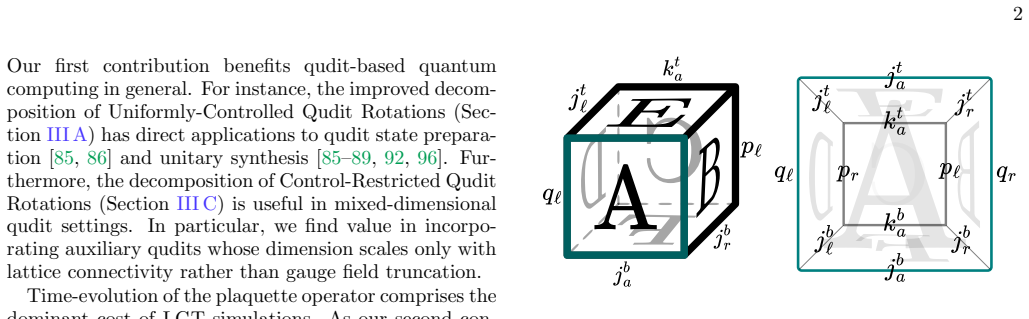
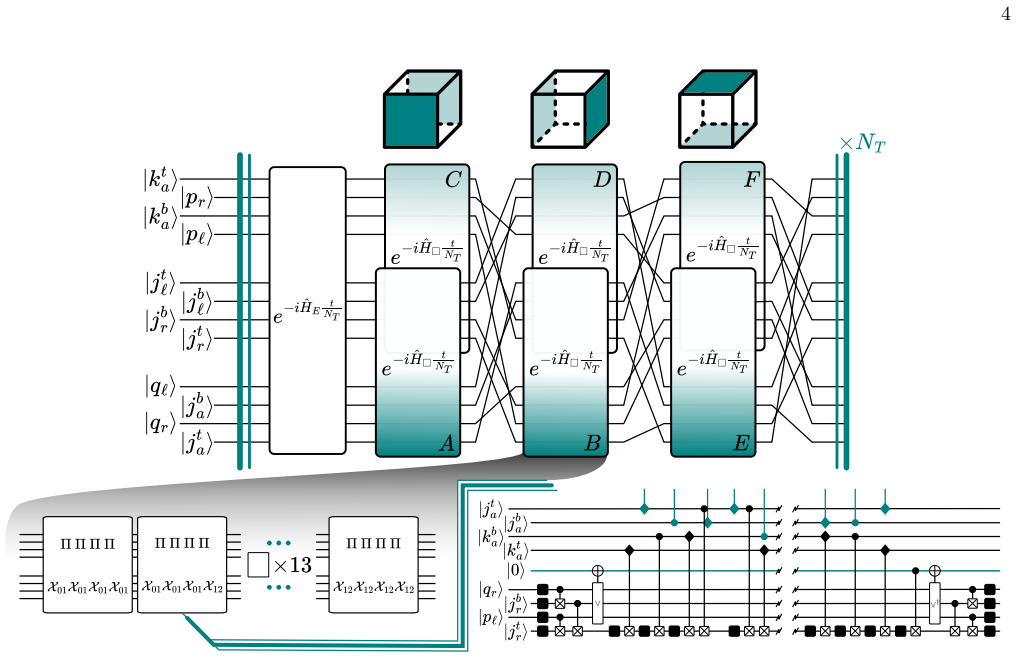
The load-bearing object is the gauge-variant completion of the plaquette operator, Eq. (2): a sum of four-qudit transition terms $X_{pp'}X_{qq'}X_{rr'}X_{ss'}$ controlled by projectors $\Pi_i\Pi_j\Pi_k\Pi_l$ chosen so that Gauss's law and the angular-momentum triangle inequalities hold. Around that operator the paper builds three mechanisms: the $d$-ary reflected Gray code, which orders control words so that a uniformly-controlled qudit rotation decomposes into $d^k$ single-qudit rotations and about $d^k$ GCX gates (roughly half the previous count); subspace gating, in which an auxiliary qudit's dimension tracks lattice connectivity rather than field truncation and gates a low-dimensional subroutine on whether the data qudits are in the right subspace; and control-restricted rotations, which exploit the smaller control-word sets allowed by the physics and, where the angle-transformation matrix $M$ is singular, are repaired by inserted GCX gates. The $D_4$ symmetry of the plaquette reduces the number of distinct terms from $(d-1)^4$ to a doubly-triangular number, cutting the classical preprocessing needed to build the operator.
What would settle it
Compute the rank of the angle-transformation matrix $M$ defined in Eq. (5) for, say, $d=5$, $k=3$ and $d=7$, $k=4$; a singular $M$ for any claimed $(d,k)$ would invalidate the upper-bound gate counts, while full rank at these values would support the conjecture.
Extended reading notes
Core claim
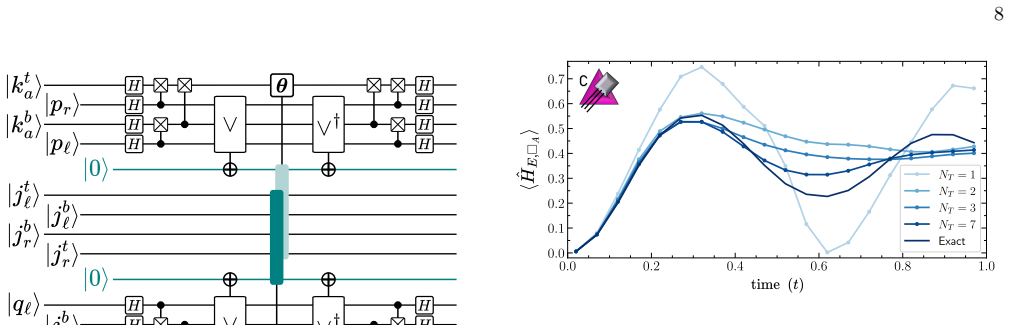
The central discovery is a compilation strategy rather than a new physics result. The authors construct the SU(2) plaquette operator in the total-angular-momentum basis as a gauge-variant completion: a sum over $(d-1)^4$ distinct products $X_{pp'}X_{qq'}X_{rr'}X_{ss'}$ of adjacent-level flip operators, each gated by projectors on the four control links that enforce Gauss's law and angular-momentum triangle inequalities. Each such term is decomposed into elementary qudit gates using three techniques: subspace gating (an auxiliary qudit verifies that the target links lie in the right subspace, so qubit-level subroutines can run inside qutrit or qudit circuits), uniformly-controlled qudit rotations based on the $d$-ary reflected Gray code, and control-restricted rotations for the smaller control-word sets that actually occur in the gauge theory. The resulting resource counts for one plaquette evolution at truncation $d$ are $(d-1)^4(2d^4+30)$ GCX gates and depth $(d-1)^4(4d^4+31)$. The qutrit cube simulation uses 14 qutrits and 10,752 GCX gates per Trotter step, and its electric-energy observable tracks the exact global-basis evolution.
Load-bearing premise
The counting formulas assume that the angle-transformation matrix built from the $d$-ary reflected Gray code is invertible for every truncation $d$ and control-word set; the paper shows this for the qutrit and qudit cases it compiles, but does not prove it in general, and in one restricted case the unmodified matrix is singular and needed manual repair.
Editorial extensions
If this is right
- Any SU(2) lattice gauge theory simulation in the total-$j$ qudit encoding can use these decompositions and the reported GCX and depth counts as a cost model at every truncation $d$.
- The uniformly-controlled qudit rotation decomposition applies to qudit state preparation and general unitary synthesis, so its roughly two-fold GCX improvement lowers compilation costs outside lattice gauge theory.
- Mixed-dimensional qudit systems, where auxiliary qudits are small while data qudits are large, become a practical compilation choice: the paper shows a ququart auxiliary suffices for arbitrary $d$ under the current connectivity.
- Evolving opposite faces of a cube in parallel halves circuit depth, a pattern that extends to plaquettes in a three-dimensional hypercubic lattice.
- Because each $\Pi\Pi\Pi\Pi XXXX$ term returns the state to the physical subspace, error mitigation by subspace verification can be applied at a sub-Trotter-step frequency.
Reading between the lines
- If a general invertible decomposition of control-restricted qudit rotations is found, the reported qudit resource counts would roughly halve, since the paper explicitly labels Table IV as an upper bound pending that hypothesized decomposition.
- The same Gray-code angle transform may yield a general criterion for when a restricted control-word set admits an invertible matrix $M$, which would be a reusable tool for qudit compiler design; the paper only conjectures this.
- The subspace-gating tradeoff between auxiliary-qudit dimension and gate count suggests that hardware with tunable qudit dimensions could dynamically choose the most efficient operating point for a given lattice geometry.
- The cube-level parallelization implies that full three-dimensional lattice simulations could be organized as cubic volumes with pairwise face evolution, potentially keeping circuit-depth growth closer to a volume tiling than to a naive face-by-face Trotterization.
Editorial analysis
A structured set of objections, weighed in public.
Referee Report
Summary. This paper addresses the digital quantum simulation of SU(2) lattice gauge theory using qudit encodings of the gauge field in the total-angular-momentum (link-extended) basis. The authors develop improved circuit decompositions for uniformly-controlled qudit rotations and for control-restricted qudit rotations, introduce a technique called Subspace Gating, and apply these tools to synthesize the Trotterized evolution of the plaquette operator for arbitrary truncation level d (i.e., qudit dimension). They report elementary-gate resource estimates for one plaquette evolution, with a GCX gate count of (d-1)^4(2d^4+30), and they present a complete, PennyLane-verified real-time simulation of a qutrit-digitized SU(2) cube, including a parallelization of opposite-face evolutions. The qutrit simulation is validated against exact numerical evolution in the global physical-state basis, and the resource counts for the qutrit case are cross-checked with PennyLane.
Significance. If the arbitrary-d resource estimates are correct, this work provides a concrete and much-needed blueprint for compiling non-Abelian lattice gauge theories onto qudit hardware at the elementary-gate level, a step beyond previous estimates that stopped at higher-level primitives. The qutrit cube simulation is a valuable, code-backed demonstration of an end-to-end qudit LGT simulation, with the novel aspects of mixed-dimensional auxiliary qudits, Subspace Gating, and face-wise parallelization. The improved uniformly-controlled qudit rotation decomposition is a useful primitive for general qudit compilation. The paper also explicitly frames its resource counts as upper bounds and provides an executable open-source implementation. However, the arbitrary-d scaling rests on an unproven algebraic conjecture about the invertibility of the angle-transformation matrix M, and the qutrit verification does not test this conjecture because it uses a manually corrected version of M for a different control set.
major comments (3)
- [Section V, Eq. (9), Table IV] The arbitrary-d resource estimate (d-1)^4(2d^4+30) relies on the invertibility of the matrix M defined in Eq. (5) for the control set C = Z2 × Z_d^4 used in Eq. (9). The paper only conjectures this invertibility in Section III C (after Eq. (6)), and provides no proof. The qutrit demonstration does not validate the conjecture: it uses a different control set (Eq. (8)) and manually corrects a singular M with 12 additional GCX gates (Appendix E). If M is singular for some d, the circuit described in Table IV does not implement the plaquette evolution and the reported GCX count is not a valid upper bound. To make the central claim rigorous, the authors should either prove the conjecture for product control sets, or provide a verified implementation for at least one d > 3 (e.g., d = 4) against exact evolution, or explicitly state in the abstract and introduction that the arbitrary-d resource estimates are conditional on this conjecture.
- [Section II A, Eq. (4)] The statement that every pairing of an XXXX operator with a projector from the set Cpqrs in Eq. (4) has a non-zero physical transition matrix element is said to be 'verified numerically for d ≤ 9' in the text below Eq. (4). This claim underpins the construction of the GVC for arbitrary d, including the enumeration of terms used in the arbitrary-d resource counts. The paper should either supply a proof valid for all d or qualify the arbitrary-d construction as numerically verified only up to d = 9. As written, the paper asserts the construction is 'applicable for any gauge field truncation' based on a finite numerical check.
- [Section V, Table IV and surrounding text] The paragraph after Table IV states that 'Table IV serves as a resource upper bound in the absence of the hypothesized decomposition of Rd,k a (C, θ).' This is confusing because Table IV itself uses the product control set C = Z2 × Z_d^4, which is precisely the case covered by the conjecture in Section III C, not by a separate 'hypothesized decomposition.' The paper should clarify whether Table IV is a proven upper bound under the conjecture (which is unproven) or a conditional estimate, and align the abstract and introduction with that clarification.
minor comments (4)
- [Table III and surrounding text] The text says PennyLane found exact agreement with Table III except for depth, which was reduced from 9314 to 9284, but the table still lists 9314. The authors should state explicitly that the reported values are pre-PennyLane-optimization and that the PennyLane-optimized depth is 9284, or update the table accordingly.
- [Appendix H] Appendix H claims that all H gates can be removed from the entire cube simulation via Hadamard-GCX rewrite rules, yet Tables II and III count 128 and 768 H gates, respectively. The paper should clarify that the resource tables are before this optimization is applied, so that the claim in Appendix H does not appear to contradict the tables.
- [Eq. (9)] The control set in Eq. (9) is typeset as '{w ∈ Z2 × Z4 3}', which is likely a typo for '{w ∈ Z2 × Z_d^4}' since the context is the qudit case with dimension d; this should be corrected for readability.
- [Section III A, resource count paragraph] The asymptotic statement 'our decomposition is a 2× improvement on the GCX gate count and depth in the limit that d → ∞' is correct as stated, but the exact count in Appendix B includes an additional (k-1) GCX gates for odd d; it would be helpful to include this caveat in the main text where the 2× improvement is claimed.
Circularity Check
No significant circularity: resource counts are derived from explicit circuit constructions and the qutrit simulation is verified against an independent exact simulation.
full rationale
The paper's central claims are the elementary-gate resource estimates for the SU(2) plaquette operator and a qutrit cube simulation. The resource counts follow from explicit circuit decompositions: the GVC plaquette operator is constructed from published SU(2) matrix elements (Eqs. 2-4, A1), the controlled-rotation subroutines are built from explicit Gray-code constructions (Eq. 5, Appendix B, D), and the reported GCX/RZ/X/H counts are obtained by summing gates in those circuits (Tables II-IV). No fitted parameter is relabeled as a prediction, and no quantity is defined in terms of the quantity it is claimed to derive. The qutrit simulation is verified by comparing observables with exact numerical results in a global physical-state basis (Appendix G, Table X), not by comparing the compiled circuit with its own output. The main caveat, the invertibility of the angle-transformation matrix M for arbitrary control-word sets, is explicitly disclosed by the authors as a conjecture: 'we conjecture our particular implementation yields an invertible M' (Section III C), and the resource table is presented as an 'upper bound' in the absence of the 'hypothesized decomposition' (Section V). An unproven algebraic premise is a correctness risk, not circularity, because the paper does not presuppose the conclusion. The self-citations to Refs. [17,24,104] provide background representation and matrix-element formulas that are independent inputs; the resource estimates are not forced by those citations. No circular step is present.
Assumptions & free parameters
assumptions (5)
- domain assumption The total-angular-momentum link basis of Refs. [17,104] faithfully represents SU(2) lattice gauge theory dynamics relevant for the simulation.
- domain assumption Gauge-variant completion freedom allows arbitrary assignment of matrix elements on the unphysical subspace without affecting physical evolution.
- ad hoc to paper Every pairing of an XXXX operator with a projector from the set Cpqrs in Eq. 4 has a non-zero physical transition matrix element for all d.
- ad hoc to paper The d-ary reflected Gray code construction yields an invertible angle-transformation matrix M for the full uniform control set at all d and k.
- domain assumption All GCX gates in the cost model have equal cost regardless of control value or Xij subspace.
Cite this review
Pith. "Pith review of Non-Abelian dynamics on a cube: improving quantum compilation through qudit-based simulations." pith.science (2026). https://pith.science/paper/2YHJPCG7
@misc{pith2026250610945,
  author       = {Pith},
  title        = {Pith review of: Non-Abelian dynamics on a cube: improving quantum compilation through qudit-based simulations},
  year         = {2026},
  howpublished = {\url{https://pith.science/paper/2YHJPCG7}},
  note         = {Machine review of arXiv:2506.10945}
}
read the original abstract
Recent developments in mapping lattice gauge theories relevant to the Standard Model onto digital quantum computers identify scalable paths with well-defined quantum compilation challenges toward the continuum. As an entry point to these challenges, we address the simulation of SU(2) lattice gauge theory. Using qudit registers to encode the digitized gauge field, we provide quantum resource estimates, in terms of elementary qudit gates, for arbitrarily high local gauge field truncations. We then demonstrate an end-to-end simulation of real-time, qutrit-digitized SU(2) dynamics on a cube. Through optimizing the simulation, we improved circuit decompositions for uniformly-controlled qudit rotations, an algorithmic primitive for general applications of quantum computing. The decompositions also apply to mixed-dimensional qudit systems, which we found advantageous for compiling lattice gauge theory simulations. Furthermore, we parallelize the evolution of opposite faces in anticipation of similar opportunities arising in three-dimensional lattice volumes. This work details an ambitious executable for future qudit hardware and attests to the value of codesign strategies between lattice gauge theory simulation and quantum compilation.
Figures

Figures from the paper (14 more)




Forward citations
Cited by 4 Pith papers
-
Local Thermalization of SU(2) Lattice Gauge Fields on Quantum Computers
Quantum hardware simulation of SU(2) lattice gauge thermalization matches classical extrapolations up to 101 plaquettes after error mitigation, establishing feasibility for chaotic quantum field systems.
-
Perturbation theory, irrep truncations, and state preparation methods for quantum simulations of SU(3) lattice gauge theory
A site-singlet energy truncation plus strong-coupling-perturbation-inspired circuits prepares SU(3) lattice gauge theory ground states with percent-level fidelity at g≈1 on small lattices, with reduced resource costs.
-
Probing Hadron Scattering in Lattice Gauge Theories on Qudit Quantum Computers
Proposed qudit circuits simulate meson-antimeson scattering in a spin-1 U(1) lattice gauge theory and remain accurate under realistic dephasing and depolarization noise.
-
Efficient Qudit Circuit for Quench Dynamics of $2+1$D Quantum Link Electrodynamics
A matter-integrated-out reformulation of 2+1D U(1) quantum link electrodynamics is translated into explicit qudit circuits, with Trotterized simulations matching exact dynamics on small lattices.
Reference graph
Works this paper leans on
-
[1]
decompose exp( −iτ (P Π) X X X X) into the circuit in Figure 8 with Subspace Gating (Section III B),
-
[2]
decompose the remaining Control-Restricted Qu- dit Rotations into elementary qutrit gates (Sec- tion III C),
-
[3]
In step 1, we decompose exp( −iτ (P Π) X X X X) by Subspace Gating the plaquette links to enable the qubit decomposition of exp(−iτ (P Π) XXXX )
apply the decomposed circuit 16 times, varying pa- rameters for each X X X X, to implement e−iτ ˆ□(1) . In step 1, we decompose exp( −iτ (P Π) X X X X) by Subspace Gating the plaquette links to enable the qubit decomposition of exp(−iτ (P Π) XXXX ). We factor out Hadamard gates (H) and GCX gates to obtain the circuit in Figure 8. The subspaces of Hij and ...
-
[4]
1” which is the sole child of its parent branch to the label of the near- est left branch, which is “2
on opposite cube faces occurs in parallel. As such, the gate counts are double that of a single ˆ□(1) (last row of Table II) while the depth remains the same. Repeating the parallelized face evolution thrice to evolve all six faces, and incorporat- ing the electric operator ˆE2 (row 2) gives the total resource estimates for one Trotter step (last row). Th...
2023
-
[5]
K. G. Wilson, Confinement of quarks, Phys. Rev. D 10, 2445 (1974)
1974
-
[6]
Kogut and L
J. Kogut and L. Susskind, Hamiltonian formulation of Wilson’s lattice gauge theories, Phys. Rev. D 11, 395 (1975)
1975
- [7]
-
[8]
Carlson, M
J. Carlson, M. J. Savage, R. Gerber, K. Antypas, D. Bard, R. Coffey, E. Dart, S. Dosanjh, J. Hack, I. Monga, et al., Nuclear Physics Exascale Requirements Review: An Office of Science Review sponsored jointly by Advanced Scientific Computing Research and Nu- clear Physics, June 15 - 17, 2016, Gaithersburg, Mary- land , Tech. Rep. (Lawrence Berkeley Nation...
2016
Show all 128 references
-
[9]
Byrnes and Y
T. Byrnes and Y. Yamamoto, Simulating lattice gauge theories on a quantum computer, Phys. Rev. A 73, 022328 (2006), arXiv:quant-ph/0510027
2006 arXiv
-
[10]
M. C. Ba˜ nulset al., Simulating Lattice Gauge Theories within Quantum Technologies, Eur. Phys. J. D 74, 165 (2020), arXiv:1911.00003 [quant-ph]
2020 arXiv
-
[11]
Aidelsburger et al
M. Aidelsburger et al. , Cold atoms meet lattice gauge theory, Phil. Trans. Roy. Soc. Lond. A 380, 20210064 (2021), arXiv:2106.03063 [cond-mat.quant-gas]
2021 arXiv
-
[12]
C. W. Bauer, Z. Davoudi, A. B. Balantekin, T. Bhat- tacharya, M. Carena, W. A. de Jong, P. Draper, A. El-Khadra, N. Gemelke, M. Hanada, D. Kharzeev, H. Lamm, Y.-Y. Li, J. Liu, M. Lukin, Y. Meurice, C. Monroe, B. Nachman, G. Pagano, J. Preskill, E. Ri- naldi, A. Roggero, D. I. ...
2023
-
[13]
C. W. Bauer, Z. Davoudi, N. Klco, and M. J. Savage, Quantum simulation of fundamental parti- cles and forces, Nature Rev. Phys. 5, 420 (2023), arXiv:2404.06298 [hep-ph]
2023 arXiv
-
[14]
Zohar, J
E. Zohar, J. I. Cirac, and B. Reznik, Cold-Atom Quantum Simulator for SU(2) Yang-Mills Lattice Gauge Theory, Phys. Rev. Lett. 110, 125304 (2013), arXiv:1211.2241 [quant-ph]
2013 arXiv
-
[15]
Banerjee, M
D. Banerjee, M. B¨ ogli, M. Dalmonte, E. Rico, P. Ste- bler, U. J. Wiese, and P. Zoller, Atomic Quantum Simulation of U(N) and SU(N) Non-Abelian Lattice Gauge Theories, Phys. Rev. Lett. 110, 125303 (2013), arXiv:1211.2242 [cond-mat.quant-gas]
2013 arXiv
-
[16]
Zohar, J
E. Zohar, J. I. Cirac, and B. Reznik, Quantum simula- tions of gauge theories with ultracold atoms: local gauge invariance from angular momentum conservation, Phys. Rev. A 88, 023617 (2013), arXiv:1303.5040 [quant-ph]
2013 arXiv
-
[17]
Zohar and M
E. Zohar and M. Burrello, Formulation of lattice gauge theories for quantum simulations, Phys. Rev. D 91, 054506 (2015), arXiv:1409.3085 [quant-ph]
2015 arXiv
-
[18]
Zohar, J
E. Zohar, J. I. Cirac, and B. Reznik, Quantum Sim- ulations of Lattice Gauge Theories using Ultracold Atoms in Optical Lattices, Rept. Prog. Phys.79, 014401 (2016), arXiv:1503.02312 [quant-ph]
2016 arXiv
-
[19]
Zohar and J
E. Zohar and J. I. Cirac, Eliminating fermionic matter fields in lattice gauge theories, Phys. Rev. B 98, 075119 (2018), arXiv:1805.05347 [quant-ph]
2018 arXiv
-
[20]
Raychowdhury and J
I. Raychowdhury and J. R. Stryker, Loop, string, and hadron dynamics in SU(2) Hamiltonian lattice gauge theories, Phys. Rev. D 101, 114502 (2020), arXiv:1912.06133 [hep-lat]
2020 arXiv
-
[21]
N. Klco, J. R. Stryker, and M. J. Savage, SU(2) non- Abelian gauge field theory in one dimension on digital quantum computers, Phys. Rev. D 101, 074512 (2020), arXiv:1908.06935 [quant-ph]
2020 arXiv
-
[22]
H. Lamm, S. Lawrence, and Y. Yamauchi (NuQS), General Methods for Digital Quantum Simulation of Gauge Theories, Phys. Rev. D 100, 034518 (2019), arXiv:1903.08807 [hep-lat]
2019 arXiv
-
[23]
Davoudi, I
Z. Davoudi, I. Raychowdhury, and A. Shaw, Search for efficient formulations for Hamiltonian simulation of non-Abelian lattice gauge theories, Phys. Rev. D 104, 074505 (2021), arXiv:2009.11802 [hep-lat]
2021 arXiv
-
[24]
A. J. Buser, H. Gharibyan, M. Hanada, M. Honda, and J. Liu, Quantum simulation of gauge theory via orbifold lattice, JHEP 09, 034, arXiv:2011.06576 [hep-th]
2011 arXiv
-
[25]
Y. Ji, H. Lamm, and S. Zhu (NuQS), Gluon Field Digitization via Group Space Decimation for Quan- tum Computers, Phys. Rev. D 102, 114513 (2020), arXiv:2005.14221 [hep-lat]
2020 arXiv
-
[26]
Kreshchuk, W
M. Kreshchuk, W. M. Kirby, G. Goldstein, H. Beau- chemin, and P. J. Love, Quantum simulation of quantum field theory in the light-front formulation, Phys. Rev. A 105, 032418 (2022), arXiv:2002.04016 [quant-ph]
2022 arXiv
-
[27]
C. W. Bauer, M. Freytsis, and B. Nachman, Simulat- ing Collider Physics on Quantum Computers Using Ef- fective Field Theories, Phys. Rev. Lett. 127, 212001 (2021), arXiv:2102.05044 [hep-ph]
2021 arXiv
-
[28]
Ciavarella, N
A. Ciavarella, N. Klco, and M. J. Savage, Trailhead for quantum simulation of SU(3) Yang-Mills lattice gauge theory in the local multiplet basis, Phys. Rev. D 103, 094501 (2021), arXiv:2101.10227 [quant-ph]
2021 arXiv
-
[29]
Wiese, From quantum link models to D-theory: a resource efficient framework for the quantum simula- tion and computation of gauge theories, Phil
U.-J. Wiese, From quantum link models to D-theory: a resource efficient framework for the quantum simula- tion and computation of gauge theories, Phil. Trans. A. Math. Phys. Eng. Sci. 380, 20210068 (2021), arXiv:2107.09335 [hep-lat]
2021 arXiv
-
[30]
J. F. Haase, L. Dellantonio, A. Celi, D. Paulson, A. Kan, K. Jansen, and C. A. Muschik, A resource efficient ap- proach for quantum and classical simulations of gauge theories in particle physics, Quantum 5, 393 (2021), arXiv:2006.14160 [quant-ph]
2021 arXiv
-
[31]
S. V. Kadam, I. Raychowdhury, and J. R. Stryker, Loop-string-hadron formulation of an SU(3) gauge the- ory with dynamical quarks, Phys. Rev. D 107, 094513 (2023), arXiv:2212.04490 [hep-lat]
2023 arXiv
-
[32]
Davoudi, A
Z. Davoudi, A. F. Shaw, and J. R. Stryker, Gen- eral quantum algorithms for Hamiltonian simulation with applications to a non-Abelian lattice gauge theory, Quantum 7, 1213 (2023), arXiv:2212.14030 [hep-lat]
2023 arXiv
-
[33]
Pardo, T
G. Pardo, T. Greenberg, A. Fortinsky, N. Katz, and E. Zohar, Resource-efficient quantum simulation of lat- tice gauge theories in arbitrary dimensions: Solving for Gauss’s law and fermion elimination, Phys. Rev. Res. 5, 023077 (2023), arXiv:2206.00685 [quant-ph]. 20
2023 arXiv
-
[34]
H. Liu, T. Bhattacharya, S. Chandrasekharan, and R. Gupta, Phases of 2D massless QCD with qubit regularization, Phys. Rev. D 111, 094511 (2025), arXiv:2312.17734 [hep-lat]
2025 arXiv
-
[35]
T. V. Zache, D. Gonz´ alez-Cuadra, and P. Zoller, Quan- tum and Classical Spin-Network Algorithms for q- Deformed Kogut-Susskind Gauge Theories, Phys. Rev. Lett. 131, 171902 (2023), arXiv:2304.02527 [quant-ph]
2023 arXiv
-
[36]
A. N. Ciavarella, Quantum simulation of lattice QCD with improved Hamiltonians, Phys. Rev. D 108, 094513 (2023), arXiv:2307.05593 [hep-lat]
2023 arXiv
-
[37]
D’Andrea, C
I. D’Andrea, C. W. Bauer, D. M. Grabowska, and M. Freytsis, New basis for Hamiltonian SU(2) simulations, Phys. Rev. D 109, 074501 (2024), arXiv:2307.11829 [hep-ph]
2024 arXiv
-
[38]
A. N. Ciavarella and C. W. Bauer, Quantum Simulation of SU(3) Lattice Yang-Mills Theory at Leading Order in Large-Nc Expansion, Phys. Rev. Lett. 133, 111901 (2024), arXiv:2402.10265 [hep-ph]
2024 arXiv
-
[39]
D. M. Grabowska, C. F. Kane, and C. W. Bauer, A Fully Gauge-Fixed SU(2) Hamiltonian for Quantum Simula- tions, (2024), arXiv:2409.10610 [quant-ph]
2024 arXiv
-
[40]
A. H. Z. Kavaki and R. Lewis, From square plaquettes to triamond lattices for SU(2) gauge theory, Commun. Phys. 7, 208 (2024), arXiv:2401.14570 [hep-lat]
2024 arXiv
-
[41]
J. C. Halimeh, M. Hanada, S. Matsuura, F. Nori, E. Rinaldi, and A. Sch¨ afer, A universal framework for the quantum simulation of Yang-Mills theory, (2024), arXiv:2411.13161 [quant-ph]
2024
-
[42]
A. N. Ciavarella, I. M. Burbano, and C. W. Bauer, Effi- cient Truncations of SU( Nc) Lattice Gauge Theory for Quantum Simulation, (2025), arXiv:2503.11888 [hep- lat]
2025
-
[43]
Balaji, C
P. Balaji, C. Conefrey-Shinozaki, P. Draper, J. K. El- haderi, D. Gupta, L. Hidalgo, A. Lytle, and E. Ri- naldi, Quantum Circuits for SU(3) Lattice Gauge The- ory, (2025), arXiv:2503.08866 [hep-lat]
2025 arXiv
-
[44]
H.-H. Lu, Z. Hu, M. S. Alshaykh, A. J. Moore, Y. Wang, P. Imany, A. M. Weiner, and S. Kais, Quantum Phase Estimation with Time-Frequency Qudits in a Single Photon, Adv. Quantum Technol. 3, 1900074 (2020)
2020
-
[45]
Cervera-Lierta, M
A. Cervera-Lierta, M. Krenn, A. Aspuru-Guzik, and A. Galda, Experimental high-dimensional Greenberger- Horne-Zeilinger entanglement with superconducting transmon qutrits, Phys. Rev. Applied 17, 024062 (2022), arXiv:2104.05627 [quant-ph]
2022 arXiv
-
[46]
Ringbauer, M
M. Ringbauer, M. Meth, L. Postler, R. Stricker, R. Blatt, P. Schindler, and T. Monz, A universal qu- dit quantum processor with trapped ions, Nature Phys. 18, 1053 (2022), arXiv:2109.06903 [quant-ph]
2022 arXiv
-
[47]
Morvan, V
A. Morvan, V. V. Ramasesh, M. S. Blok, J. M. Kreike- baum, K. O’Brien, L. Chen, B. K. Mitchell, R. K. Naik, D. I. Santiago, and I. Siddiqi, Qutrit Randomized Benchmarking, Phys. Rev. Lett. 126, 210504 (2021)
2021
-
[48]
P. Hrmo, B. Wilhelm, L. Gerster, M. W. van Mourik, M. Huber, R. Blatt, P. Schindler, T. Monz, and M. Ringbauer, Native qudit entanglement in a trapped ion quantum processor, Nature Commun. 14, 2242 (2023), arXiv:2206.04104 [quant-ph]
2023 arXiv
-
[49]
Goss et al
N. Goss et al. , High-fidelity qutrit entangling gates for superconducting circuits, Nature Commun. 13, 7481 (2022), [Erratum: Nature Commun. 14, 4256 (2023)], arXiv:2206.07216 [quant-ph]
2022 arXiv
-
[50]
L. B. Nguyen, N. Goss, K. Siva, Y. Kim, E. Younis, B. Qing, A. Hashim, D. I. Santiago, and I. Siddiqi, Em- powering a qudit-based quantum processor by travers- ing the dual bosonic ladder, Nature Commun. 15, 7117 (2024), arXiv:2312.17741 [quant-ph]
2024 arXiv
-
[51]
L. M. Seifert, Z. Li, T. Roy, D. I. Schuster, F. T. Chong, and J. M. Baker, Exploring ququart computation on a transmon using optimal control, Phys. Rev. A 108, 062609 (2023), arXiv:2304.11159 [quant-ph]
2023 arXiv
-
[52]
P. J. Low, B. White, and C. Senko, Control and Readout of a 13-level Trapped Ion Qudit, (2023), arXiv:2306.03340 [quant-ph]
2023 arXiv
-
[53]
Senko, P
C. Senko, P. Richerme, J. Smith, A. Lee, I. Cohen, A. Retzker, and C. Monroe, Realization of a Quan- tum Integer-Spin Chain with Controllable Interactions, Phys. Rev. X 5, 021026 (2015)
2015
-
[54]
M. S. Blok, V. V. Ramasesh, T. Schuster, K. O’Brien, J. M. Kreikebaum, D. Dahlen, A. Morvan, B. Yoshida, N. Y. Yao, and I. Siddiqi, Quantum Information Scram- bling on a Superconducting Qutrit Processor, Phys. Rev. X 11, 021010 (2021), arXiv:2003.03307 [quant-ph]
2021 arXiv
-
[55]
D. M. Kurkcuoglu, M. S. Alam, J. A. Job, A. C. Y. Li, A. Macridin, G. N. Perdue, and S. Providence, Quan- tum simulation of ϕ4 theories in qudit systems, (2021), arXiv:2108.13357 [quant-ph]
2021 arXiv
-
[56]
Gonz´ alez-Cuadra, T
D. Gonz´ alez-Cuadra, T. V. Zache, J. Carrasco, B. Kraus, and P. Zoller, Hardware Efficient Quantum Simulation of Non-Abelian Gauge Theories with Qudits on Rydberg Platforms, Phys. Rev. Lett. 129, 160501 (2022), arXiv:2203.15541 [quant-ph]
2022 arXiv
-
[57]
T. V. Zache, D. Gonz´ alez-Cuadra, and P. Zoller, Fermion-qudit quantum processors for simulating lattice gauge theories with matter, Quantum 7, 1140 (2023), arXiv:2303.08683 [quant-ph]
2023 arXiv
-
[58]
P. P. Popov, M. Meth, M. Lewenstein, P. Hauke, M. Ringbauer, E. Zohar, and V. Kasper, Variational quantum simulation of U(1) lattice gauge theories with qudit systems, Phys. Rev. Res. 6, 013202 (2024), arXiv:2307.15173 [quant-ph]
2024 arXiv
-
[59]
J. C. Halimeh, M. Aidelsburger, F. Grusdt, P. Hauke, and B. Yang, Cold-atom quantum simulators of gauge theories, Nature Phys. 21, 25 (2025), arXiv:2310.12201 [cond-mat.quant-gas]
2025 arXiv
-
[60]
Vezvaee, N
A. Vezvaee, N. Earnest-Noble, and K. Najafi, Quantum simulation of Fermi-Hubbard model based on transmon qudit interaction, (2024), arXiv:2402.01243 [quant-ph]
2024 arXiv
-
[61]
M. Illa, C. E. P. Robin, and M. J. Savage, Quantum sim- ulations of SO(5) many-fermion systems using qudits, Phys. Rev. C 108, 064306 (2023), arXiv:2305.11941 [quant-ph]
2023 arXiv
-
[62]
Meth et al
M. Meth et al. , Simulating two-dimensional lattice gauge theories on a qudit quantum computer, Nature Phys. 21, 570 (2025), arXiv:2310.12110 [quant-ph]
2025 arXiv
-
[63]
Turro, I
F. Turro, I. A. Chernyshev, R. Bhaskar, and M. Illa, Qutrit and qubit circuits for three-flavor collective neu- trino oscillations, Phys. Rev. D 111, 043038 (2025), arXiv:2407.13914 [quant-ph]
2025 arXiv
-
[64]
M. Illa, C. E. P. Robin, and M. J. Savage, Qu8its for quantum simulations of lattice quantum chromodynam- ics, Phys. Rev. D 110, 014507 (2024), arXiv:2403.14537 [quant-ph]
2024 arXiv
-
[65]
Calaj` o, G
G. Calaj` o, G. Magnifico, C. Edmunds, M. Ringbauer, S. Montangero, and P. Silvi, Digital Quantum Sim- ulation of a (1+1)D SU(2) Lattice Gauge Theory 21 with Ion Qudits, PRX Quantum 5, 040309 (2024), arXiv:2402.07987 [quant-ph]
2024 arXiv
-
[66]
D. M. K¨ urk¸ c¨ uoglu, H. Lamm, and A. Maestri, Qu- dit Gate Decomposition Dependence for Lattice Gauge Theories, (2024), arXiv:2410.16414 [quant-ph]
2024 arXiv
-
[67]
Gottesman, Fault tolerant quantum computation with higher dimensional systems, Chaos Solitons Frac- tals 10, 1749 (1999), arXiv:quant-ph/9802007
D. Gottesman, Fault tolerant quantum computation with higher dimensional systems, Chaos Solitons Frac- tals 10, 1749 (1999), arXiv:quant-ph/9802007
1999 arXiv
-
[68]
E. T. Campbell, Enhanced Fault-Tolerant Quantum Computing in d-Level Systems, Phys. Rev. Lett. 113, 230501 (2014)
2014
-
[69]
Inada, W
T. Inada, W. Jang, Y. Iiyama, K. Terashi, R. Sawada, J. Tanaka, and S. Asai, Measurement-Free Ultrafast Quantum Error Correction by Using Multi-Controlled Gates in Higher-Dimensional State Space, (2021), arXiv:2109.00086 [quant-ph]
2021 arXiv
-
[70]
Cowtan, Qudit lattice surgery, (2022), arXiv:2204.13228 [quant-ph]
A. Cowtan, Qudit lattice surgery, (2022), arXiv:2204.13228 [quant-ph]
2022 arXiv
-
[71]
B. L. Brock, S. Singh, A. Eickbusch, V. V. Sivak, A. Z. Ding, L. Frunzio, S. M. Girvin, and M. H. Devoret, Quantum error correction of qudits beyond break-even, Nature 641, 612 (2025), arXiv:2409.15065 [quant-ph]
2025 arXiv
-
[72]
Muthukrishnan and C
A. Muthukrishnan and C. R. Stroud, Multivalued logic gates for quantum computation, Phys. Rev. A 62, 052309 (2000)
2000
-
[73]
A. S. Nikolaeva, E. O. Kiktenko, and A. K. Fedorov, Efficient realization of quantum algorithms with qudits, EPJ Quant. Technol. 11, 43 (2024), arXiv:2111.04384 [quant-ph]
2024 arXiv
-
[74]
B. P. Lanyon, M. Barbieri, M. P. Almeida, T. Jen- newein, T. C. Ralph, K. J. Resch, G. J. Pryde, J. L. O’brien, A. Gilchrist, and A. G. White, Simplifying quantum logic using higher-dimensional Hilbert spaces, Nature Physics 5, 134 (2009)
2009
-
[75]
Li, Y.-J
W.-D. Li, Y.-J. Gu, K. Liu, Y.-H. Lee, and Y.-Z. Zhang, Efficient universal quantum computation with auxiliary Hilbert space, Phys. Rev. A 88, 034303 (2013)
2013
-
[76]
Liu and H.-R
W.-Q. Liu and H.-R. Wei, Optimal synthesis of the Fred- kin gate in a multilevel system, New Journal of Physics 22, 063026 (2020)
2020
-
[77]
J. M. Baker, C. Duckering, P. Gokhale, N. C. Brown, K. R. Brown, and F. T. Chong, Improved Quantum Cir- cuits via Intermediate Qutrits, ACM Transactions on Quantum Computing 1, 10.1145/3406309 (2020)
2020 doi
-
[78]
Litteken, J
A. Litteken, J. M. Baker, and F. T. Chong, Commu- nication Trade Offs in Intermediate Qudit Circuits, in 2022 IEEE 52nd International Symposium on Multiple- Valued Logic (ISMVL) (2022) pp. 43–49
2022
-
[79]
A. Saha, R. Majumdar, D. Saha, A. Chakrabarti, and S. Sur-Kolay, Asymptotically improved circuit for a d- ary Grover’s algorithm with advanced decomposition of the n-qudit Toffoli gate, Phys. Rev. A 105, 062453 (2022), arXiv:2012.04447 [quant-ph]
2022 arXiv
-
[80]
Majumdar, A
R. Majumdar, A. Saha, A. Chakrabarti, and S. Sur- Kolay, Intermediate qutrit-assisted Toffoli gate decom- position with quantum error correction, Quant. Inf. Proc. 23, 42 (2024)
2024
-
[81]
Lysaght, T
L. Lysaght, T. Goubault, P. Sinnott, S. Mansfield, and P.-E. Emeriau, Quantum circuit compression using qubit logic on qudits, (2024), arXiv:2411.03878 [quant- ph]
2024 arXiv
-
[82]
Y. Wang, Z. Hu, B. C. Sanders, and S. Kais, Qudits and High-Dimensional Quantum Computing, Frontiers in Physics 8, 10.3389/fphy.2020.589504 (2020)
2020
-
[83]
L. E. Fischer, D. Miller, F. Tacchino, P. K. Barkoutsos, D. J. Egger, and I. Tavernelli, Ancilla-free implementa- tion of generalized measurements for qubits embedded in a qudit space, Phys. Rev. Res. 4, 033027 (2022)
2022
-
[84]
Deller, S
Y. Deller, S. Schmitt, M. Lewenstein, S. Lenk, M. Fed- erer, F. Jendrzejewski, P. Hauke, and V. Kasper, Quan- tum approximate optimization algorithm for qudit sys- tems, Phys. Rev. A 107, 062410 (2023)
2023
-
[85]
Bottrill, M
G. Bottrill, M. Pandey, and O. Di Matteo, Explor- ing the Potential of Qutrits for Quantum Optimiza- tion of Graph Coloring, in 2023 International Confer- ence on Quantum Computing and Engineering (2023) arXiv:2308.08050 [quant-ph]
2023 arXiv
-
[86]
Zahidy et al
M. Zahidy et al. , Practical high-dimensional quantum key distribution protocol over deployed multicore fiber, Nature Commun. 15, 1651 (2024)
2024
-
[87]
C. Popp, T. C. Sutter, and B. C. Hiesmayr, A Novel Stabilizer-based Entanglement Distillation Protocol for Qudits, (2024), arXiv:2408.02383 [quant-ph]
2024
-
[88]
D. L. Zhou, B. Zeng, Z. Xu, and C. P. Sun, Quantum computation based on d-level cluster state, Phys. Rev. A 68, 062303 (2003)
2003
-
[89]
S. S. Bullock, D. P. O’Leary, and G. K. Brennen, Asymptotically Optimal Quantum Circuits for d-Level Systems, Phys. Rev. Lett. 94, 230502 (2005)
2005
-
[90]
G. K. Brennen, S. S. Bullock, and D. P. O’Leary, Ef- ficient Circuits for Exact-Universal Computations with Qudits, (2005), arXiv:quant-ph/0509161 [quant-ph]
2005 arXiv
-
[91]
F. S. Khan and M. Perkowski, Synthesis of multi-qudit hybrid and d-valued quantum logic circuits by decom- position, Theoretical Computer Science 367, 336–346 (2006)
2006
-
[92]
Nakajima, Y
Y. Nakajima, Y. Kawano, H. Sekigawa, M. Nakanishi, S. Yamashita, and Y. Nakashima, Synthesis of quantum circuits for d-level systems by using cosine-sine decom- position, Quantum Information & Computation 9, 423 (2009)
2009
-
[93]
Di and H.-R
Y.-M. Di and H.-R. Wei, Synthesis of multivalued quan- tum logic circuits by elementary gates, Phys. Rev. A87, 012325 (2013)
2013
-
[94]
Luo, X.-B
M.-X. Luo, X.-B. Chen, Y.-X. Yang, and X. Wang, Ge- ometry of Quantum Computation with Qudits, Scien- tific Reports 4, 4044 (2014)
2014
-
[95]
Luo and X
M. Luo and X. Wang, Universal quantum computation with qudits, Science China Physics, Mechanics & As- tronomy 57, 1712 (2014)
2014
-
[96]
Di and H.-R
Y.-M. Di and H.-R. Wei, Optimal synthesis of multival- ued quantum circuits, Phys. Rev. A 92, 062317 (2015)
2015
-
[97]
W. Zi, Q. Li, and X. Sun, Optimal Synthesis of Multi- Controlled Qudit Gates, (2023), arXiv:2303.12979 [quant-ph]
2023 arXiv
-
[98]
Jiang, W.-Q
G.-L. Jiang, W.-Q. Liu, and H.-R. Wei, Optimal syn- thesis of general multi-qutrit quantum computation, (2023), arXiv:2310.11996 [quant-ph]
2023 arXiv
-
[99]
K. Mato, S. Hillmich, and R. Wille, Mixed-dimensional qudit state preparation using edge-weighted decision di- agrams, in Proceedings of the 61st ACM/IEEE Design Automation Conference (2024) pp. 1–6
2024
-
[100]
S. Yang, L. Xu, G. Tian, and X. Sun, Quantum cir- cuit synthesis with qudit phase gadget method, (2025), arXiv:2504.12710 [quant-ph]
2025 arXiv
-
[101]
Prakash, A
S. Prakash, A. Jain, B. Kapur, and S. Seth, Normal form for single-qutrit Clifford+ T operators and synthesis of single-qutrit gates, Phys. Rev. A 98, 032304 (2018). 22
2018
-
[102]
Yeh and J
L. Yeh and J. van de Wetering, Constructing All Qutrit Controlled Clifford+T gates in Clifford+T, inReversible Computation: 14th International Conference, RC 2022, Urbino, Italy, July 5–6, 2022, Proceedings (Springer- Verlag, Berlin, Heidelberg, 2022) p. 28–50
2022
-
[103]
van de Wetering and L
J. van de Wetering and L. Yeh, Building Qutrit Diago- nal Gates from Phase Gadgets, EPTCS 394, 46 (2023), arXiv:2204.13681 [quant-ph]
2023 arXiv
-
[104]
A. R. Kalra, M. Saikia, D. Valluri, S. Winnick, and J. Yard, Multi-qutrit exact synthesis, (2024), arXiv:2405.08147 [quant-ph]
2024 arXiv
-
[105]
A. N. Glaudell, N. J. Ross, J. van de Weter- ing, and L. Yeh, Exact Synthesis of Multiqutrit Clifford-Cyclotomic Circuits, EPTCS 406, 44 (2024), arXiv:2405.08136 [quant-ph]
2024 arXiv
-
[106]
A. R. Kalra, M. Mosca, and D. Valluri, Synthesis and Arithmetic of Single Qutrit Circuits, Quantum 9, 1647 (2025), arXiv:2311.08696 [quant-ph]
2025 arXiv
-
[107]
E. J. Gustafson, H. Lamm, D. Liu, E. M. Murairi, and S. Zhu, Synthesis of Single Qutrit Circuits from Clif- ford+R, (2025), arXiv:2503.20203 [quant-ph]
2025
-
[108]
A Rahman, R
S. A Rahman, R. Lewis, E. Mendicelli, and S. Pow- ell, SU(2) lattice gauge theory on a quantum annealer, Phys. Rev. D 104, 034501 (2021)
2021
-
[109]
https://github.com/QSAR-UBC/QuditOpsViaLGT
-
[110]
Marinari, The APE Computer and Lattice Gauge Theories, in Lattice Gauge Theory: A Challenge in Large-Scale Computing , edited by B
E. Marinari, The APE Computer and Lattice Gauge Theories, in Lattice Gauge Theory: A Challenge in Large-Scale Computing , edited by B. Bunk, K. H. M¨ utter, and K. Schilling (Springer US, Boston, MA,
-
[111]
Boyle, D
P. Boyle, D. Chen, N. Christ, M. Clark, S. Cohen, Z. Dong, A. Gara, B. Joo, C. Jung, L. Levkova, X. Liao, G. Liu, R. Mawhinney, S. Ohta, K. Petrov, T. Wettig, A. Yamaguchi, and C. Cristian, QCDOC: A 10 Teraflops Computer for Tightly-Coupled Calculations, in SC ’04: Proceedings...
2004
-
[112]
N. H. Christ, QCDSP and QCDOC Computers, in En- cyclopedia of Parallel Computing , edited by D. Padua (Springer US, Boston, MA, 2011) pp. 1668–1677
2011
-
[113]
Ciavarella, N
A. Ciavarella, N. Klco, and M. J. Savage, Some Con- ceptual Aspects of Operator Design for Quantum Sim- ulations of Non-Abelian Lattice Gauge Theories (2022) arXiv:2203.11988 [quant-ph]
2022 arXiv
-
[115]
M¨ ott¨ onen, J
M. M¨ ott¨ onen, J. J. Vartiainen, V. Bergholm, and M. M. Salomaa, Transformation of quantum states using uni- formly controlled rotations, Quantum Info. Comput. 5, 467–473 (2005)
2005
-
[116]
Klco and M
N. Klco and M. J. Savage, Minimally entangled state preparation of localized wave functions on quantum computers, Physical Review A 102, 10.1103/phys- reva.102.012612 (2020)
2020 doi
-
[117]
De Morgan, Formal logic: or, the calculus of infer- ence, necessary and probable (Taylor and Walton, 1847)
A. De Morgan, Formal logic: or, the calculus of infer- ence, necessary and probable (Taylor and Walton, 1847)
-
[118]
Bergholm et al
V. Bergholm et al. , PennyLane: Automatic differentia- tion of hybrid quantum-classical computations (2022), arXiv:1811.04968 [quant-ph]
2022 arXiv
-
[119]
https://github.com/QSAR- UBC/pennylane more qutrit ops
-
[120]
J. R. Stryker, Oracles for Gauss’s law on digital quan- tum computers, Phys. Rev. A 99, 042301 (2019), arXiv:1812.01617 [quant-ph]
2019 arXiv
-
[121]
M. C. Tran, Y. Su, D. Carney, and J. M. Taylor, Faster Digital Quantum Simulation by Symmetry Protection, PRX Quantum 2, 010323 (2021), arXiv:2006.16248 [quant-ph]
2021 arXiv
-
[122]
H. Lamm, S. Lawrence, and Y. Yamauchi (NuQS), Sup- pressing Coherent Gauge Drift in Quantum Simulations, (2020), arXiv:2005.12688 [quant-ph]
2020 arXiv
-
[123]
N. H. Nguyen, M. C. Tran, Y. Zhu, A. M. Green, C. H. Alderete, Z. Davoudi, and N. M. Linke, Digital Quan- tum Simulation of the Schwinger Model and Symmetry Protection with Trapped Ions, PRX Quantum3, 020324 (2022), arXiv:2112.14262 [quant-ph]
2022 arXiv
-
[124]
Ballini, J
E. Ballini, J. Mildenberger, M. M. Wauters, and P. Hauke, Symmetry verification for noisy quantum sim- ulations of non-Abelian lattice gauge theories, (2024), arXiv:2412.07844 [quant-ph]
2024 arXiv
-
[125]
Ball and T
C. Ball and T. D. Cohen, Zeno effect suppression of gauge drift in quantum simulations, Phys. Rev. A 110, 022417 (2024), arXiv:2405.09462 [hep-lat]
2024 arXiv
-
[126]
M. M. Wauters, E. Ballini, A. Biella, and P. Hauke, Symmetry-protection Zeno phase transition in moni- tored lattice gauge theories, Phys. Rev. B 111, 094315 (2025), arXiv:2405.18504 [quant-ph]
2025 arXiv
-
[127]
Carena, H
M. Carena, H. Lamm, Y.-Y. Li, and W. Liu, Quantum error thresholds for gauge-redundant digitizations of lat- tice field theories, Phys. Rev. D 110, 054516 (2024), arXiv:2402.16780 [hep-lat]
2024 arXiv
-
[128]
Bravyi, J
S. Bravyi, J. M. Gambetta, A. Mezzacapo, and K. Temme, Tapering off qubits to simulate fermionic Hamiltonians, (2017), arXiv:1701.08213 [quant-ph]
2017 arXiv
-
[129]
Di Matteo, A
O. Di Matteo, A. McCoy, P. Gysbers, T. Miyagi, R. M. Woloshyn, and P. Navr´ atil, Improving Hamiltonian en- codings with the Gray code, Phys. Rev. A 103, 042405 (2021), arXiv:2008.05012 [quant-ph]
2021 arXiv
Reviewed August 7, 2026 · model on record in the stance chip above.
Discussion (0). Continue with ORCID to comment.