REVIEW 3 major objections 4 minor 51 references
CLAIM: Mitigating Multilingual Object Hallucination in Large Vision-Language Models with Cross-Lingual Attention Intervention
T0 review · 3 major / 4 minor · reviewed 2026-08-07 · deepseek-v4-flash
Pith's one-line read The paper claims that multilingual object hallucination in LVLMs can be mitigated at inference time by shifting the attention outputs of language-specific cross-modal heads toward English, with average gains of 13.56 points on POPE and…
desk verdict Genuinely new inference-time method with a plausible mechanism, but the headline POPE gain is partly in-sample via hyperparameter tuning, so the numbers are promising rather than proven. read the letter →
The pith
A machine-rendered reading of the paper's core claim, the machinery that carries it, and where it could break.
The reading
What carries the argument
The central object is the language shift vector $S^l_h$, a per-head, per-layer mean difference in attention outputs between English and target-language caption queries over 1,000 COCO images, computed by Equation (9) with the single template “What is it in the image?”. During inference, Equation (10) adds the scaled shift $\alpha S^l_h$ to the attention outputs of the heads selected by probe classification accuracy, so that non-English queries are processed with English-like visual perception.
What would settle it
Compute the shift from the caption template, then evaluate on Spanish questions whose syntax differs sharply from the template—for example attribute or spatial-relation questions on images outside COCO; if accuracy does not improve over the baseline, the transfer assumption fails.
Extended reading notes
Core claim
CLAIM establishes that cross-modal attention outputs carry a language-specific offset: for semantically identical queries, the attention output of certain heads differs systematically between English and other languages, and this offset can be measured once and then applied during generation. The paper identifies language-specific cross-modal attention heads by training linear probes to predict query language from masked attention outputs, estimates the shift as the mean English-minus-target difference over COCO caption queries, and intervenes by adding a scaled shift to the attention outputs of selected heads. This realigns non-English attention toward English-like perception, reducing object-level and attribute-level hallucination without updating any model weights.
Load-bearing premise
The load-bearing premise is that a shift vector averaged over 1,000 captioned COCO images with the single template “What is it in the image?” transfers to arbitrary unseen questions, images, and tasks at inference.
Editorial extensions
If this is right
- CLAIM works without supervised fine-tuning or preference optimization, so it avoids the cost of building annotated multilingual image-text datasets.
- The method improves both low-resource and high-resource languages, and a shift estimated from one language pair transfers partially to unseen languages.
- The intervention reduces not only object-level hallucination in existence and count questions but also attribute-level hallucination in color and position questions.
- Attention divergence between languages is strongest in intermediate layers, indicating where cross-modal integration and language mapping happen in LVLMs.
Reading between the lines
- The same shift-based intervention could be applied to other token divisions, such as separating image regions or audio chunks, to steer multimodal attention without training.
- A fixed shift averaged over 1,000 images could be replaced by a per-query adaptive shift computed on the fly, which may improve robustness on out-of-distribution images and non-caption-style questions.
- Because CLAIM aligns non-English attention toward English patterns, it may reinforce English-centric biases, as the paper itself notes; a natural extension is aligning toward a multilingual consensus representation instead.
- A testable extension is estimating shifts from task-specific query distributions and checking whether the resulting vectors transfer across languages and benchmarks better than the single caption-template estimate.
Editorial analysis
A structured set of objections, weighed in public.
Referee Report
Summary. The paper proposes CLAIM, an inference-time intervention that mitigates multilingual object hallucination in LVLMs by aligning cross-modal attention patterns of non-English queries to those of English. The method first identifies language-specific cross-modal attention heads using linear probes, then estimates language shift vectors as the mean English-minus-target difference in attention outputs over 1,000 COCO images, and finally adds scaled shift vectors to the selected heads during inference. Experiments on POPE and MME with LLaVA-1.5 and Qwen-VL-Chat report consistent improvements across five to six non-English languages, with an average improvement of 13.56% on POPE and 21.75% on MME hallucination subsets claimed in the abstract.
Significance. If the central claim holds, the paper offers a valuable, near training-free alternative to fine-tuning approaches for multilingual hallucination, with a mechanistic explanation in terms of cross-modal attention divergence. The evaluation is external (POPE, MME), uses multiple models and languages, and includes comparisons to VCD and PAI; the method is falsifiable and relatively cheap to apply. The attention-level analysis and intervention analysis are thoughtful and help interpret why the method works. The main weakness is that the headline POPE number is partly in-sample because the two hyperparameters are tuned on the POPE-COCO popular subset, which is part of the reported average; this needs to be addressed before the quantitative claims can be taken at face value.
major comments (3)
- [Appendix A, Table 1, Abstract] The hyperparameters α and K are selected by sequential search on the POPE-COCO popular subset (Appendix A), and this same subset is included in the POPE average reported in Table 1 and used for the 13.56% improvement in the abstract. Because the tuning subset is part of the reported evaluation distribution, the headline POPE gain is partly in-sample. Please report the average excluding the COCO-popular rows, or perform hyperparameter selection on a held-out validation split disjoint from all evaluation benchmarks, and verify that the improvement is not concentrated in the tuned subset.
- [§3.2–§3.3] Head selection uses masked attention outputs bO (Eq. 6) that exclude text tokens, whereas the language shift vectors (Eq. 9) and the intervention (Eq. 10) act on the unmasked outputs O. The paper justifies this by preserving the original representation space, but it does not address whether the heads selected under masking are the right heads to intervene on with shifts computed from the unmasked distribution. Please provide an analysis (e.g., head-selection agreement between masked and unmasked outputs) or a theoretical argument that the mismatch does not undermine the intervention's mechanism.
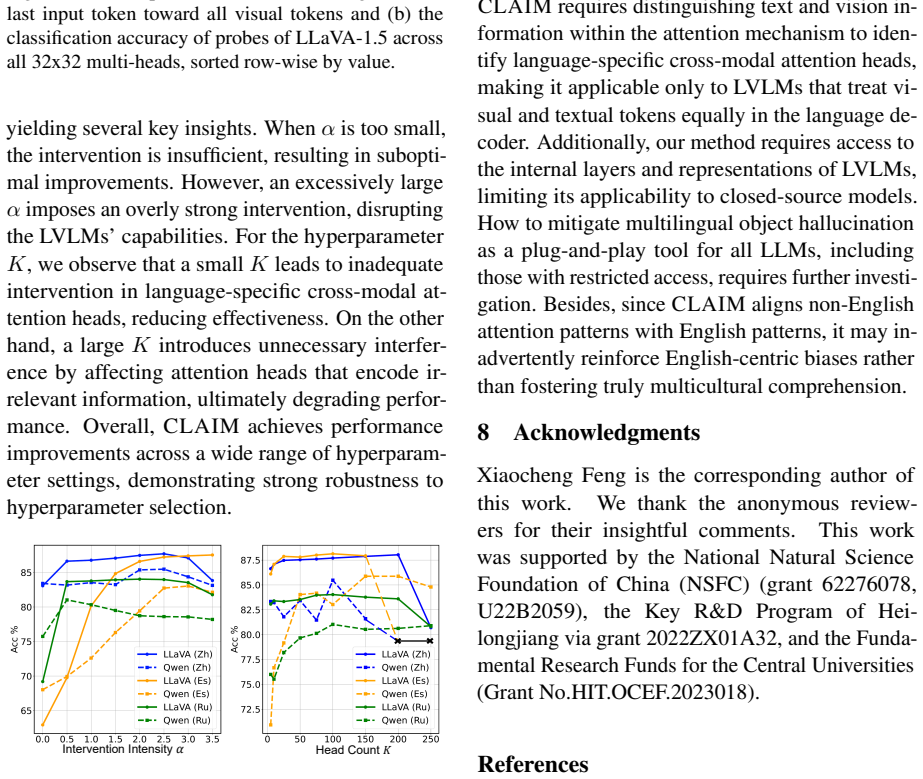
- [§4, Table 1, Figure 8] No variance estimates or repeated-run results are reported, so it is unclear whether the performance gaps (which can be as small as a few points) are significant relative to run-to-run variation. Please report standard deviations over at least three seeds, or provide bootstrap confidence intervals, particularly for the hyperparameter robustness analysis in Figure 8, which currently shows only the tuning subset.
minor comments (4)
- [Abstract and §4.3] The reported improvements (13.56%, 21.75%, 17.5%, 9.8%) should be clarified as absolute percentage points or relative improvements, and the exact set of languages and rows over which each average is computed should be specified.
- [Throughout] The text contains typos: 'Rencent' (Introduction), 'Perfomance' (Table 2 caption), 'theses' (§5.4), and 'a issue' (§2); please proofread.
- [Table 1] The Avg columns in Table 1 exclude the English column; please state this explicitly in the table caption or in the text.
- [Figure 3] The x-axis labels (e.g., 'Total Average') and y-axis units should be defined in the caption so the reader can interpret the scale.
Circularity Check
POPE headline gain is partly in-sample: α and K are tuned on the POPE-COCO popular subset, which is then included in the reported POPE average.
-
fitted input called prediction
[Appendix A; Table 1; Section 4.3]
"We conduct hyperparameter tuning exclusively on the popular subset of POPE-COCO, with the search space for K defined as {50, 100, 150, 200, 250, 300} and for α as {0.5, 1.0, 1.5, 2.0, 2.5, 3.0, 3.5, 4.0, 4.5}."
The hyperparameters α and K are selected by maximizing accuracy on the POPE-COCO popular subset, and Table 1 reports the POPE-COCO popular rows as part of the aggregate that supports the abstract's 13.56% POPE improvement and Section 4.3's 17.5%/9.8% average gains. The improvement on that subset is therefore in-sample: the hyperparameters were chosen using the very rows that are then reported, so the headline POPE number is not a fully out-of-sample prediction. The MME numbers are not directly tuned, but they inherit the same α and K, so they are not fully independent of the selection.
full rationale
The core derivation is not circular: language shift vectors (Eq. 9) are the mean English-minus-target attention-output difference over 1000 COCO-2017 training captions, and the intervention (Eq. 10) is applied to translated POPE/MME presence, attribute, and count questions whose labels are never used to estimate the shift or select heads. Probe-based head identification (Eqs. 7-8) uses only language labels, not hallucination labels, so the benchmark outcomes are external evidence rather than constructed outputs. The limitations section correctly notes the method requires white-box access and may reinforce English-centric bias, neither of which reveals a definitional dependence. The one concrete circularity-like concern is that hyperparameter selection is performed on the POPE-COCO popular subset and that subset is included in the reported POPE average, making that component in-sample; the MME result is mostly independent but shares the same hyperparameters. Overall this is a modest selection-bias concern, not an equation-level circularity, so the score is 3.
Assumptions & free parameters
free parameters (2)
- alpha (intervention intensity) =
not stated numerically; tuned on POPE-COCO popular, range {0.5, 1.0, 1.5, 2.0, 2.5, 3.0, 3.5, 4.0, 4.5}
- K (number of intervened heads) =
not stated numerically; tuned on POPE-COCO popular, range {50, 100, 150, 200, 250, 300}
assumptions (4)
- domain assumption Additive intervention in attention output space (Eq. 10) is a safe, semantics-preserving transformation.
- domain assumption Probe classification accuracy identifies heads causally relevant to cross-lingual visual perception.
- domain assumption English cross-modal attention is a desirable target; non-English divergence is a defect, not information.
- domain assumption A single shift vector per language, estimated from one query template over 1000 images, transfers across query types and images.
Cite this review
Pith. "Pith review of CLAIM: Mitigating Multilingual Object Hallucination in Large Vision-Language Models with Cross-Lingual Attention Intervention." pith.science (2026). https://pith.science/paper/42L6UZYC
@misc{pith2026250611073,
  author       = {Pith},
  title        = {Pith review of: CLAIM: Mitigating Multilingual Object Hallucination in Large Vision-Language Models with Cross-Lingual Attention Intervention},
  year         = {2026},
  howpublished = {\url{https://pith.science/paper/42L6UZYC}},
  note         = {Machine review of arXiv:2506.11073}
}
read the original abstract
Large Vision-Language Models (LVLMs) have demonstrated impressive multimodal abilities but remain prone to multilingual object hallucination, with a higher likelihood of generating responses inconsistent with the visual input when utilizing queries in non-English languages compared to English. Most existing approaches to address these rely on pretraining or fine-tuning, which are resource-intensive. In this paper, inspired by observing the disparities in cross-modal attention patterns across languages, we propose Cross-Lingual Attention Intervention for Mitigating multilingual object hallucination (CLAIM) in LVLMs, a novel near training-free method by aligning attention patterns. CLAIM first identifies language-specific cross-modal attention heads, then estimates language shift vectors from English to the target language, and finally intervenes in the attention outputs during inference to facilitate cross-lingual visual perception capability alignment. Extensive experiments demonstrate that CLAIM achieves an average improvement of 13.56% (up to 30% in Spanish) on the POPE and 21.75% on the hallucination subsets of the MME benchmark across various languages. Further analysis reveals that multilingual attention divergence is most prominent in intermediate layers, highlighting their critical role in multilingual scenarios.
Figures


Figures from the paper (7 more)




Reference graph
Works this paper leans on
-
[1]
Michael Andersland. 2024. Amharic llama and llava: Multimodal llms for low resource languages. arXiv preprint arXiv:2403.06354
work page Pith review arXiv 2024
-
[2]
Jinze Bai, Shuai Bai, Yunfei Chu, Zeyu Cui, Kai Dang, Xiaodong Deng, Yang Fan, Wenbin Ge, Yu Han, Fei Huang, et al. 2023 a . Qwen technical report. arXiv preprint arXiv:2309.16609
arXiv 2023
-
[3]
Jinze Bai, Shuai Bai, Shusheng Yang, Shijie Wang, Sinan Tan, Peng Wang, Junyang Lin, Chang Zhou, and Jingren Zhou. 2023 b . Qwen-vl: A frontier large vision-language model with versatile abilities. arXiv preprint arXiv:2308.12966
arXiv 2023
-
[4]
Jing Bi, Junjia Guo, Yunlong Tang, Lianggong Bruce Wen, Zhang Liu, and Chenliang Xu. 2024. Unveiling visual perception in language models: An attention head analysis approach. arXiv preprint arXiv:2412.18108
arXiv 2024
-
[5]
Beitao Chen, Xinyu Lyu, Lianli Gao, Jingkuan Song, and Heng Tao Shen. 2024 a . https://arxiv.org/abs/2405.15356 Alleviating hallucinations in large vision-language models through hallucination-induced optimization . Preprint, arXiv:2405.15356
arXiv 2024
-
[6]
Junzhe Chen, Tianshu Zhang, Shiyu Huang, Yuwei Niu, Linfeng Zhang, Lijie Wen, and Xuming Hu. 2024 b . Ict: Image-object cross-level trusted intervention for mitigating object hallucination in large vision-language models. arXiv preprint arXiv:2411.15268
arXiv 2024
-
[7]
Zhaorun Chen, Zhuokai Zhao, Hongyin Luo, Huaxiu Yao, Bo Li, and Jiawei Zhou. 2024 c . Halc: Object hallucination reduction via adaptive focal-contrast decoding. arXiv preprint arXiv:2403.00425
arXiv 2024
-
[8]
Wei-Lin Chiang, Zhuohan Li, Zi Lin, Ying Sheng, Zhanghao Wu, Hao Zhang, Lianmin Zheng, Siyuan Zhuang, Yonghao Zhuang, Joseph E Gonzalez, et al. 2023. Vicuna: An open-source chatbot impressing gpt-4 with 90\ See https://vicuna. lmsys. org (accessed 14 April 2023), 2(3):6
2023
Show all 51 references
-
[9]
Corinna Cortes. 1995. Support-vector networks. Machine Learning
1995
-
[10]
Alexey Dosovitskiy. 2020. An image is worth 16x16 words: Transformers for image recognition at scale. arXiv preprint arXiv:2010.11929
2020 arXiv
-
[11]
Chaoyou Fu, Peixian Chen, Yunhang Shen, Yulei Qin, Mengdan Zhang, Xu Lin, Jinrui Yang, Xiawu Zheng, Ke Li, Xing Sun, et al. 2023. Mme: A comprehensive evaluation benchmark for multimodal large language models. arXiv preprint arXiv:2306.13394
2023 arXiv
- [12]
-
[13]
Lei Huang, Weijiang Yu, Weitao Ma, Weihong Zhong, Zhangyin Feng, Haotian Wang, Qianglong Chen, Weihua Peng, Xiaocheng Feng, Bing Qin, and Ting Liu. 2023. https://arxiv.org/abs/2311.05232 A survey on hallucination in large language models: Principles, taxonomy, challenges, and ...
2023 arXiv
-
[14]
Qidong Huang, Xiaoyi Dong, Pan Zhang, Bin Wang, Conghui He, Jiaqi Wang, Dahua Lin, Weiming Zhang, and Nenghai Yu. 2024. Opera: Alleviating hallucination in multi-modal large language models via over-trust penalty and retrospection-allocation. In Proceedings of the IEEE/CVF Con...
2024
-
[15]
Drew A Hudson and Christopher D Manning. 2019. Gqa: A new dataset for real-world visual reasoning and compositional question answering. In Proceedings of the IEEE/CVF conference on computer vision and pattern recognition, pages 6700--6709
2019
-
[16]
Zhangqi Jiang, Junkai Chen, Beier Zhu, Tingjin Luo, Yankun Shen, and Xu Yang. 2024. Devils in middle layers of large vision-language models: Interpreting, detecting and mitigating object hallucinations via attention lens. arXiv preprint arXiv:2411.16724
2024 arXiv
-
[17]
Sicong Leng, Hang Zhang, Guanzheng Chen, Xin Li, Shijian Lu, Chunyan Miao, and Lidong Bing. 2024. Mitigating object hallucinations in large vision-language models through visual contrastive decoding. In Proceedings of the IEEE/CVF Conference on Computer Vision and Pattern Reco...
2024
-
[18]
Kenneth Li, Oam Patel, Fernanda Vi \'e gas, Hanspeter Pfister, and Martin Wattenberg. 2024. Inference-time intervention: Eliciting truthful answers from a language model. Advances in Neural Information Processing Systems, 36
2024
-
[19]
Yifan Li, Yifan Du, Kun Zhou, Jinpeng Wang, Xin Zhao, and Ji-Rong Wen. 2023. Evaluating object hallucination in large vision-language models. In The 2023 Conference on Empirical Methods in Natural Language Processing
2023
-
[20]
Tsung-Yi Lin, Michael Maire, Serge Belongie, James Hays, Pietro Perona, Deva Ramanan, Piotr Doll \'a r, and C Lawrence Zitnick. 2014. Microsoft coco: Common objects in context. In Computer Vision--ECCV 2014: 13th European Conference, Zurich, Switzerland, September 6-12, 2014, ...
2014
-
[21]
Fuxiao Liu, Kevin Lin, Linjie Li, Jianfeng Wang, Yaser Yacoob, and Lijuan Wang. 2023. Mitigating hallucination in large multi-modal models via robust instruction tuning. In The Twelfth International Conference on Learning Representations
2023
-
[22]
Haotian Liu, Chunyuan Li, Yuheng Li, and Yong Jae Lee. 2024 a . Improved baselines with visual instruction tuning. In Proceedings of the IEEE/CVF Conference on Computer Vision and Pattern Recognition, pages 26296--26306
2024
-
[23]
Haotian Liu, Chunyuan Li, Yuheng Li, Bo Li, Yuanhan Zhang, Sheng Shen, and Yong Jae Lee. 2024 b . https://llava-vl.github.io/blog/2024-01-30-llava-next/ Llava-next: Improved reasoning, ocr, and world knowledge
2024
-
[24]
Haotian Liu, Chunyuan Li, Qingyang Wu, and Yong Jae Lee. 2024 c . Visual instruction tuning. Advances in neural information processing systems, 36
2024
-
[25]
Shi Liu, Kecheng Zheng, and Wei Chen. 2025. Paying more attention to image: A training-free method for alleviating hallucination in lvlms. In European Conference on Computer Vision, pages 125--140. Springer
2025
-
[26]
Shaker, Salman H
Muhammad Maaz, Hanoona Abdul Rasheed, Abdelrahman M. Shaker, Salman H. Khan, Hisham Cholakkal, Rao Muhammad Anwer, Tim Baldwin, Michael Felsberg, and Fahad Shahbaz Khan. 2024. https://doi.org/10.48550/ARXIV.2402.14818 PALO : A Polyglot Large Multimodal Model for 5B People . Co...
-
[27]
Nostalgebraist. 2020. https://www.lesswrong.com/posts/AcKRB8wDpdaN6v6ru/interpreting-gpt-the-logit-lens Interpreting gpt: The logit lens . LessWrong
2020
-
[28]
OpenAI. 2023. GPT-4. https://openai.com/gpt-4
2023
-
[29]
Pedregosa, G
F. Pedregosa, G. Varoquaux, A. Gramfort, V. Michel, B. Thirion, O. Grisel, M. Blondel, P. Prettenhofer, R. Weiss, V. Dubourg, J. Vanderplas, A. Passos, D. Cournapeau, M. Brucher, M. Perrot, and E. Duchesnay. 2011. Scikit-learn: Machine learning in P ython. Journal of Machine L...
2011
-
[30]
Libo Qin, Qiguang Chen, Yuhang Zhou, Zhi Chen, Yinghui Li, Lizi Liao, Min Li, Wanxiang Che, and Philip S Yu. 2025. A survey of multilingual large language models. Patterns, 6(1)
2025
-
[31]
Xiaoye Qu, Mingyang Song, Wei Wei, Jianfeng Dong, and Yu Cheng. 2024. Mitigating multilingual hallucination in large vision-language models. arXiv preprint arXiv:2408.00550
2024 arXiv
-
[32]
Alec Radford, Jong Wook Kim, Chris Hallacy, Aditya Ramesh, Gabriel Goh, Sandhini Agarwal, Girish Sastry, Amanda Askell, Pamela Mishkin, Jack Clark, et al. 2021. Learning transferable visual models from natural language supervision. In International conference on machine learni...
2021
- [33]
-
[35]
Florian Schneider and Sunayana Sitaram. 2024. https://aclanthology.org/2024.findings-emnlp.250 M5 - A Diverse Benchmark to Assess the Performance of Large Multimodal Models Across Multilingual and Multicultural Vision - Language Tasks . In Findings of the Association for Compu...
2024
-
[36]
Dustin Schwenk, Apoorv Khandelwal, Christopher Clark, Kenneth Marino, and Roozbeh Mottaghi. 2022. A-okvqa: A benchmark for visual question answering using world knowledge. In European conference on computer vision, pages 146--162. Springer
2022
-
[37]
Dhruv Shah, B a \.z ej Osi \'n ski, Sergey Levine, et al. 2023. Lm-nav: Robotic navigation with large pre-trained models of language, vision, and action. In Conference on robot learning, pages 492--504. PMLR
2023
-
[38]
Hugo Touvron, Thibaut Lavril, Gautier Izacard, Xavier Martinet, Marie-Anne Lachaux, Timothée Lacroix, Baptiste Rozière, Naman Goyal, Eric Hambro, Faisal Azhar, et al. 2023 a . https://arxiv.org/abs/2302.13971 Llama: Open and efficient foundation language models . arXiv preprint
2023 arXiv
-
[39]
Hugo Touvron, Louis Martin, Kevin Stone, Peter Albert, Amjad Almahairi, Yasmine Babaei, Nikolay Bashlykov, Soumya Batra, Prajjwal Bhargava, Shruti Bhosale, et al. 2023 b . Llama 2: Open foundation and fine-tuned chat models. arXiv preprint arXiv:2307.09288
2023 arXiv
-
[40]
A Vaswani. 2017. Attention is all you need. Advances in Neural Information Processing Systems
2017
-
[41]
Chris Wendler, Veniamin Veselovsky, Giovanni Monea, and Robert West. 2024. Do llamas work in english? on the latent language of multilingual transformers. arXiv preprint arXiv:2402.10588
2024 arXiv
-
[42]
Jiayang Wu, Wensheng Gan, Zefeng Chen, Shicheng Wan, and S Yu Philip. 2023. Multimodal large language models: A survey. In 2023 IEEE International Conference on Big Data (BigData), pages 2247--2256. IEEE
2023
-
[43]
Qinghao Ye, Haiyang Xu, Jiabo Ye, Ming Yan, Haowei Liu, Qi Qian, Ji Zhang, Fei Huang, and Jingren Zhou. 2023. mplug-owl2: Revolutionizing multi-modal large language model with modality collaboration. arXiv preprint arXiv:2311.04257
2023 arXiv
-
[44]
Shukang Yin, Chaoyou Fu, Sirui Zhao, Ke Li, Xing Sun, Tong Xu, and Enhong Chen. 2023. A survey on multimodal large language models. arXiv preprint arXiv:2306.13549
2023 arXiv
-
[45]
Tianyu Yu, Haoye Zhang, Yuan Yao, Yunkai Dang, Da Chen, Xiaoman Lu, Ganqu Cui, Taiwen He, Zhiyuan Liu, Tat-Seng Chua, et al. 2024. Rlaif-v: Aligning mllms through open-source ai feedback for super gpt-4v trustworthiness. arXiv preprint arXiv:2405.17220
2024
-
[46]
Bai Z., Wang P., Xiao T., He T., Han Z., Zhang Z., and Shou MZ. 2024. Hallucination of multimodal large language models: A survey. arXiv preprint arXiv:2404.18930
2024 arXiv
-
[47]
Jingyi Zhang, Jiaxing Huang, Sheng Jin, and Shijian Lu. 2024. Vision-language models for vision tasks: A survey. IEEE Transactions on Pattern Analysis and Machine Intelligence
2024
-
[48]
Zhiyuan Zhao, Bin Wang, Linke Ouyang, Xiaoyi Dong, Jiaqi Wang, and Conghui He. 2023. https://arxiv.org/abs/2311.16839 Beyond hallucinations: Enhancing lvlms through hallucination-aware direct preference optimization . Preprint, arXiv:2311.16839
2023 arXiv
-
[49]
Weihong Zhong, Xiaocheng Feng, Liang Zhao, Qiming Li, Lei Huang, Yuxuan Gu, Weitao Ma, Yuan Xu, and Bing Qin. 2024. Investigating and mitigating the multimodal hallucination snowballing in large vision-language models. arXiv preprint arXiv:2407.00569
2024 arXiv
-
[50]
Peipei Zhu, Xiao Wang, Lin Zhu, Zhenglong Sun, Wei-Shi Zheng, Yaowei Wang, and Changwen Chen. 2023. Prompt-based learning for unpaired image captioning. IEEE Transactions on Multimedia, 26:379--393
2023
-
[51]
online" 'onlinestring :=
ENTRY address archivePrefix author booktitle chapter edition editor eid eprint eprinttype howpublished institution journal key month note number organization pages publisher school series title type volume year doi pubmed url lastchecked label extra.label sort.label short.list...
-
[52]
write newline
" write newline "" before.all 'output.state := FUNCTION n.dashify 't := "" t empty not t #1 #1 substring "-" = t #1 #2 substring "--" = not "--" * t #2 global.max substring 't := t #1 #1 substring "-" = "-" * t #2 global.max substring 't := while if t #1 #1 substring * t #2 gl...
Reviewed August 7, 2026 · model on record in the stance chip above.
Discussion (0). Sign in to comment.