REVIEW 5 major objections 7 minor 28 references
SPLATART: Articulated Gaussian Splatting with Estimated Object Structure
T0 review · 5 major / 7 minor · reviewed 2026-08-07 · deepseek-v4-flash
Pith's one-line read SPLATART estimates part poses, joint parameters, and connectivity for tree-structured articulated objects, including seven-degree-of-freedom robot arms, from posed RGB images with sparse part segmentations, and renders configurations…
desk verdict Useful pipeline integration with a real deep-tree demonstration, but the evidence is thinner than the claims and the two-scene identifiability issue needs addressing. read the letter →
The pith
A machine-rendered reading of the paper's core claim, the machinery that carries it, and where it could break.
The reading
What carries the argument
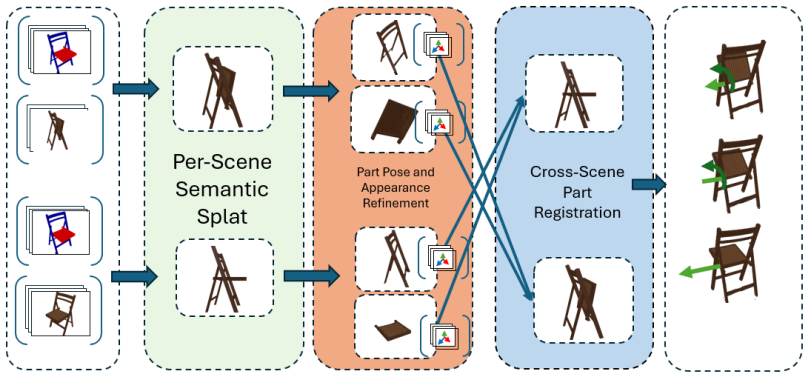
The load-bearing object is the part-conditioned Gaussian splat: each rigid part is a set of 3D Gaussians with means, covariances, opacities, and spherical harmonics, plus a learned vector that scores how strongly each Gaussian belongs to each part. The mechanism that carries the argument is cross-scene pose optimization: for every part and every scene pair, the estimated transform between the two scenes is used to move that part's Gaussians into the other scene's coordinate frame, where they are rasterized and compared against the other scene's RGB, accumulation, and segmentation images. Because the splat parameters and the poses are updated together during this rendering loss, the geometry of each part is forced to explain both observed configurations; this is what produces completed geometry and accurate part motion. The joint estimation that follows is deliberately decoupled from geometry: revolute joints are parameterized by a rotation center, axis, and a fixed transform, prismatic joints by a fixed transform and translation axis, and a candidate joint is accepted only if transforming the source part's splat means yields an average distance to the target part's splat means below a threshold.
What would settle it
Capture a seven-joint arm in two scenes with one joint intentionally held nearly still (less than about one degree of motion), run the pipeline, and compare the estimated axis for that joint against the other joints; if the still joint's axis is not recovered accurately, the two-scene assumption is falsified.
Extended reading notes
Core claim
The central claim is that a configuration-conditioned renderer for an articulated object can be learned without knowing the object's structure in advance, using only two posed scenes and partial part labels. SPLATART treats each rigid part as its own canonical Gaussian splat with a semantic score per splat, and represents each scene by a pose per part. The part poses and the splat geometry are optimized together by rendering every part into the other scene's frames and minimizing a combined RGB, accumulation, segmentation, and SSIM loss, which both aligns the motions and fills in geometry that was occluded in one scene. After the poses are fixed, a separate step fits revolute and prismatic joints between every pair of parts using an ADD distance threshold and builds the final kinematic tree by depth-first search from a chosen root. This separation of geometry from articulation is what the paper credits for scaling to deeper kinematic trees, and it reports that on a seven-joint robot arm the per-joint state errors stay mostly under one degree.
Load-bearing premise
The whole method rests on two observed configurations of the object being enough to determine every joint, and on the supplied part segmentations covering the object's full geometry.
Editorial extensions
If this is right
- From two posed scenes with sparse part labels, the pipeline produces a renderer that can synthesize configurations never seen in training, including intermediate joint states.
- Articulation structure—joint type, axis, and connectivity—is recovered without a prior model, so the same machinery applies to tools, cabinets, and seven-joint robot arms.
- Because joint estimation is a separate post-processing step, changing the joint model (for example to screw or spherical joints) does not require retraining the splat.
- Jointly optimizing poses and splat geometry lets each part borrow visual evidence across scenes, so occluded regions of the object get completed automatically.
- Real-world data collected with sparse manual labels (on the order of tens of images per scene) is enough for qualitative novel-configuration rendering.
Reading between the lines
- Editorial inference: the two-scene assumption means the method is only as good as the motion captured between the scenes; an object with a joint that barely moves between t=0 and t=1 will have that joint's axis underdetermined, so a natural extension is to add more scenes until every joint has moved enough.
- Editorial inference: because tree generation is a depth-first pass over accepted pairwise joints, the same pipeline could be extended to closed kinematic loops by replacing the tree builder with a graph solver, which the paper explicitly leaves to future work.
- Editorial inference: the separation of articulation from geometry suggests a testable upgrade path where part segmentations are produced automatically rather than manually, which would make the whole pipeline nearly label-free while keeping the same cross-scene pose machinery.
Editorial analysis
A structured set of objections, weighed in public.
Referee Report
Summary. SPLATART is a pipeline that builds articulated 3D Gaussian splat renderers from posed RGB images with part segmentation masks. It first trains per-scene semantic Gaussian splats, then jointly optimizes per-part rigid poses across two observed configurations using a differentiable rendering loss, estimates pairwise revolute and prismatic joint candidates by minimizing an ADD-style distance on part means, assembles a kinematic tree by depth-first search, and renders novel configurations by transforming the canonical part splats. The paper reports quantitative comparisons on the Paris dataset against PARIS and DTA, a qualitative real-world trigger-clamp experiment with sparse segmentations, and experiments on simulated Franka Panda and Fanuc serial-chain manipulators, with joint-state errors for the Panda shown in Table III.
Significance. The proposed decoupling of geometry/pose estimation from articulation estimation is a sensible design and, if properly supported, would be a useful contribution to articulated-object representation for robotics. The paper also targets deeper kinematic chains than most prior work on articulated NeRFs/Gaussian splats, and it evaluates joint predictions against external ground truth (Paris metrics, URDF joint errors), so the pipeline is not circular. The real-world sparse-segmentation demonstration is a valuable qualitative step. However, the current manuscript is not yet publishable: an entire table is empty, the robot-arm evaluation has no comparison baseline and no axis-parameter metrics, the two-scene formulation has an unaddressed identifiability problem, and the reported quantitative results lack error bars. These gaps directly affect the central claims, but they appear fixable within the scope of the paper.
major comments (5)
- [Section III-A / III-D] The two-scene formulation makes joints with zero or near-zero relative motion between t=0 and t=1 unidentifiable or ill-conditioned, because the relative part pose is the only cue used to fit the revolute and prismatic candidates. The paper neither states this necessary identifiability condition nor reports the joint displacements used in the Panda and Fanuc experiments. Since the central claim includes rendering arbitrary user-specified configurations for a 7-DOF arm, the authors should add an identifiability analysis and report per-joint motion magnitudes (or add a third observation) to demonstrate that every estimated joint was actually exercised.
- [Table II (Section IV-A)] Table II, captioned "Quantitative results for the relative joint states," is empty and is never referenced in the text, so the promised quantitative evaluation of joint-state estimation is missing. This is not a presentation detail: the abstract's claim that "we present data on the SPLATART pipeline as applied to the Paris dataset objects" depends on this table. The authors must either fill the table with the corresponding metrics or remove the claim and revise the text accordingly.
- [Section IV-C / Table III] The robot-arm evaluation does not support the strength of the central claim. No comparison to any prior articulated-object method is provided; Table III reports only joint-state errors, not errors in the estimated joint axes or axis positions, which are the quantities needed to support the claim that SPLATART recovers the articulation model. Figure 5 only interpolates the estimated t=0 and t=1 configurations along a one-parameter path, so it does not demonstrate rendering at arbitrary user-specified 7D configurations. Table III also lists 9 joints while the text says "up to seven degrees of freedom"; the authors should clarify the URDF variant and whether the gripper joints are included.
- [Table I (Section IV-A)] All quantitative results in Table I are single-run values with no error bars, significance tests, or seed information. Several entries are close to or worse than the DTA baseline (e.g., USB axis angle 4.61 degrees vs 0.11 degrees, fridge CD-m 20.35 mm vs 0.27 mm), so the claim of "results comparable to previous radiance field based efforts" in the conclusion is not statistically supported. The authors should report mean and standard deviation over multiple runs or otherwise justify the stability of the pipeline.
- [Section III-B / V] The conclusion's claim that SPLATART works "without a prior knowledge of the object structure" is overstated: the method requires part segmentation masks, which encode the number of parts and part membership, and the problem formulation takes N_p as given. Additionally, no experiment with a branching kinematic tree is reported; all Paris objects are single-DOF two-part objects and the robot arms are serial chains, so the tree-structure generation step (Section III-E) is not validated for branching topologies. The claims should be qualified accordingly or evaluated on a branching object.
minor comments (7)
- [Abstract and throughout] There are many typos, including "syntheic," "spare" (for "sparse"), "seperation," and "exmaples"; a careful proofread is needed before resubmission.
- [Eq. (5)] The loss vector uses "lossrgb" and "lossssim" while Eqs. (1)-(4) define "lossl1" and "lossss"; the notation should be aligned.
- [Section III-D] The acceptance threshold epsilon and the loss weights lambda_* are described as user-specified, but their values are not reported anywhere in the manuscript or supplement; these values are needed for reproducibility.
- [Table I] The axis-position rows for "Blade" and "Storage" show dashes for PARIS; the authors should explain whether these metrics are undefined or omitted.
- [Figure 4] The caption is confusing ("The top set of three rows are the poses for time t=0" in a four-quadrant layout); the panels should be relabeled and explained more clearly.
- [References] Reference [19] has no venue information; complete the citation.
- [Section IV-B] The real-world clamp experiment is qualitative only; a quantitative metric (e.g., reprojection error or joint-angle error) would strengthen the claim of good real-world geometric and kinematic results.
Circularity Check
No significant circularity: SPLATART's pose and joint estimates are validated against external ground truth; self-citations are contextual only.
full rationale
SPLATART is an empirical pipeline, not a derivation, and its central quantities are checked against external ground truth rather than being defined in terms of the target. Part poses are optimized against rendering and segmentation losses from posed images (Eqs. 1-5), and joint parameters are subsequently fit to those poses via an ADD matching loss and accepted by a threshold (Section III-D); neither step presupposes the reported URDF joint errors in Table III or the visual quality of the unobserved intermediate configurations in Figure 5. The novel-configuration renderings are generated after training by linearly interpolating the estimated joint values, so they are a genuine extrapolation, not a refit of the same data. The only self-citations (NARF22, NARF24, Pavlasek et al., ProgressLabeller, Cohn et al.) appear in the related-work discussion and as inspiration for pose-based articulation inference; they are not used to justify any uniqueness claim, prior theorem, or model choice on which the results depend. The two-scene identifiability limitation noted for near-zero-motion joints is a real correctness concern, but it is not circularity because the paper's equations do not define the joint estimate in terms of the validation target.
Assumptions & free parameters
free parameters (3)
- Loss weights lambda_acc, lambda_l1, lambda_ssim, lambda_seg =
not reported
- Joint acceptance threshold epsilon =
user-specified, value not reported
- Training schedule (iterations, epochs, learning rate) =
20,000 Splatfacto iterations; 20 epochs per scene; learning rate not specified
assumptions (6)
- standard math Differentiable Gaussian splatting rasterizer and Adam optimizer work as implemented in Splatfacto/NerfStudio
- domain assumption Input images are posed with known camera poses
- domain assumption Part segmentation labels are available for at least a subset of images covering the object geometry
- domain assumption Articulated objects are rigid-body part trees with revolute or prismatic joints and no loops
- domain assumption Two scenes (t=0 and t=1) are sufficient to estimate all part poses and joint parameters
- domain assumption Part pose optimization converges to the correct local minimum when Gaussian parameters are co-optimized
Cite this review
Pith. "Pith review of SPLATART: Articulated Gaussian Splatting with Estimated Object Structure." pith.science (2026). https://pith.science/paper/YJJGHNDT
@misc{pith2026250612184,
  author       = {Pith},
  title        = {Pith review of: SPLATART: Articulated Gaussian Splatting with Estimated Object Structure},
  year         = {2026},
  howpublished = {\url{https://pith.science/paper/YJJGHNDT}},
  note         = {Machine review of arXiv:2506.12184}
}
read the original abstract
Representing articulated objects remains a difficult problem within the field of robotics. Objects such as pliers, clamps, or cabinets require representations that capture not only geometry and color information, but also part seperation, connectivity, and joint parametrization. Furthermore, learning these representations becomes even more difficult with each additional degree of freedom. Complex articulated objects such as robot arms may have seven or more degrees of freedom, and the depth of their kinematic tree may be notably greater than the tools, drawers, and cabinets that are the typical subjects of articulated object research. To address these concerns, we introduce SPLATART - a pipeline for learning Gaussian splat representations of articulated objects from posed images, of which a subset contains image space part segmentations. SPLATART disentangles the part separation task from the articulation estimation task, allowing for post-facto determination of joint estimation and representation of articulated objects with deeper kinematic trees than previously exhibited. In this work, we present data on the SPLATART pipeline as applied to the syntheic Paris dataset objects, and qualitative results on a real-world object under spare segmentation supervision. We additionally present on articulated serial chain manipulators to demonstrate usage on deeper kinematic tree structures.
Figures


Figures from the paper (3 more)


Reference graph
Works this paper leans on
-
[1]
Paris: Part-level reconstruc- tion and motion analysis for articulated objects,
J. Liu, A. Mahdavi-Amiri, and M. Savva, “Paris: Part-level reconstruc- tion and motion analysis for articulated objects,” inProceedings of the IEEE/CVF International Conference on Computer Vision, pp. 352– 363, 2023
work page 2023
-
[2]
Label fusion: A pipeline for generating ground truth labels for real rgbd data of cluttered scenes,
P. Marion, P. R. Florence, L. Manuelli, and R. Tedrake, “Label fusion: A pipeline for generating ground truth labels for real rgbd data of cluttered scenes,” in2018 IEEE International Conference on Robotics and Automation (ICRA), pp. 3235–3242, IEEE, 2018
work page 2018
-
[3]
Progress- labeller: Visual data stream annotation for training object-centric 3d perception,
X. Chen, H. Zhang, Z. Yu, S. Lewis, and O. C. Jenkins, “Progress- labeller: Visual data stream annotation for training object-centric 3d perception,” in2022 IEEE/RSJ International Conference on Intelligent Robots and Systems (IROS), pp. 13066–13073, IEEE, 2022
work page 2022
-
[4]
Nerf: Representing scenes as neural radiance fields for view synthesis,
B. Mildenhall, P. P. Srinivasan, M. Tancik, J. T. Barron, R. Ramamoor- thi, and R. Ng, “Nerf: Representing scenes as neural radiance fields for view synthesis,”Communications of the ACM, vol. 65, no. 1, pp. 99– 106, 2021
work page 2021
-
[5]
3d gaussian splatting for real-time radiance field rendering.,
B. Kerbl, G. Kopanas, T. Leimk ¨uhler, and G. Drettakis, “3d gaussian splatting for real-time radiance field rendering.,”ACM Trans. Graph., vol. 42, no. 4, pp. 139–1, 2023
2023
-
[6]
Narf22: Neural articulated radiance fields for configuration-aware rendering,
S. Lewis, J. Pavlasek, and O. C. Jenkins, “Narf22: Neural articulated radiance fields for configuration-aware rendering,” in2022 IEEE/RSJ International Conference on Intelligent Robots and Systems (IROS), pp. 770–777, IEEE, 2022
work page 2022
-
[7]
Graspsplats: Efficient manipulation with 3d feature splatting,
M. Ji, R.-Z. Qiu, X. Zou, and X. Wang, “Graspsplats: Efficient manipulation with 3d feature splatting,” in8th Annual Conference on Robot Learning
-
[8]
Sapien: A simulated part-based interactive environment,
F. Xiang, Y . Qin, K. Mo, Y . Xia, H. Zhu, F. Liu, M. Liu, H. Jiang, Y . Yuan, H. Wang,et al., “Sapien: A simulated part-based interactive environment,” inProceedings of the IEEE/CVF conference on com- puter vision and pattern recognition, pp. 11097–11107, 2020
work page 2020
Show all 28 references
-
[9]
Neural implicit representation for building digital twins of unknown articulated objects,
Y . Weng, B. Wen, J. Tremblay, V . Blukis, D. Fox, L. Guibas, and S. Birchfield, “Neural implicit representation for building digital twins of unknown articulated objects,” inProceedings of the IEEE/CVF Conference on Computer Vision and Pattern Recognition, pp. 3141– 3150, 2024
2024
-
[10]
Understanding urdf: A dataset and analysis,
D. Tola and P. Corke, “Understanding urdf: A dataset and analysis,” IEEE Robotics and Automation Letters, vol. 9, no. 5, pp. 4479–4486, 2024
2024
-
[11]
A probabilistic framework for learning kinematic models of articulated objects,
J. Sturm, C. Stachniss, and W. Burgard, “A probabilistic framework for learning kinematic models of articulated objects,”Journal of Artificial Intelligence Research, vol. 41, pp. 477–526, 2011
2011
-
[12]
Topologically-informed atlas learning,
T. Cohn, N. Devraj, and O. C. Jenkins, “Topologically-informed atlas learning,” in2022 International Conference on Robotics and Automation (ICRA), pp. 3598–3604, IEEE, 2022
2022
-
[13]
Parts-based articulated object localization in clutter using belief propagation,
J. Pavlasek, S. Lewis, K. Desingh, and O. C. Jenkins, “Parts-based articulated object localization in clutter using belief propagation,” in 2020 IEEE/RSJ International Conference on Intelligent Robots and Systems (IROS), pp. 10595–10602, IEEE, 2020
2020
-
[15]
Cla-nerf: Category-level articulated neural radiance field,
W.-C. Tseng, H.-J. Liao, L. Yen-Chen, and M. Sun, “Cla-nerf: Category-level articulated neural radiance field,” in2022 International Conference on Robotics and Automation (ICRA), pp. 8454–8460, IEEE, 2022
2022
-
[16]
Real2code: Re- construct articulated objects via code generation,
Z. Mandi, Y . Weng, D. Bauer, and S. Song, “Real2code: Re- construct articulated objects via code generation,”arXiv preprint arXiv:2406.08474, 2024
2024 arXiv
-
[17]
Urdformer: Constructing interactive realistic scenes from real im- ages via simulation and generative modeling,
Q. Chen, M. Memmel, A. Fang, A. Walsman, D. Fox, and A. Gupta, “Urdformer: Constructing interactive realistic scenes from real im- ages via simulation and generative modeling,” inTowards Gener- alist Robots: Learning Paradigms for Scalable Skill Acquisition@ CoRL2023, 2023
2023
-
[18]
Gart: Gaus- sian articulated template models,
J. Lei, Y . Wang, G. Pavlakos, L. Liu, and K. Daniilidis, “Gart: Gaus- sian articulated template models,” inProceedings of the IEEE/CVF Conference on Computer Vision and Pattern Recognition (CVPR), pp. 19876–19887, June 2024
2024
-
[19]
Building interactable replicas of complex ar-ticulated objects via gaussian splatting,
Y . Liu, B. Jia, R. Lu, and J. Ni, “Building interactable replicas of complex ar-ticulated objects via gaussian splatting,”
-
[20]
Nerfstudio: A modular framework for neural radiance field development,
M. Tancik, E. Weber, E. Ng, R. Li, B. Yi, J. Kerr, T. Wang, A. Kristoffersen, J. Austin, K. Salahi,et al., “Nerfstudio: A modular framework for neural radiance field development,”arXiv preprint arXiv:2302.04264, 2023
2023 arXiv
-
[21]
Phys- gaussian: Physics-integrated 3d gaussians for generative dynamics,
T. Xie, Z. Zong, Y . Qiu, X. Li, Y . Feng, Y . Yang, and C. Jiang, “Phys- gaussian: Physics-integrated 3d gaussians for generative dynamics,” in Proceedings of the IEEE/CVF Conference on Computer Vision and Pattern Recognition, pp. 4389–4398, 2024
2024
-
[22]
Adam: A method for stochastic optimiza- tion,
D. P. Kingma and J. Ba, “Adam: A method for stochastic optimiza- tion,”arXiv preprint arXiv:1412.6980, 2014
2014 arXiv
-
[23]
Image quality assessment: from error visibility to structural similarity,
Z. Wang, A. C. Bovik, H. R. Sheikh, and E. P. Simoncelli, “Image quality assessment: from error visibility to structural similarity,”IEEE transactions on image processing, vol. 13, no. 4, pp. 600–612, 2004
2004
-
[24]
Parallel inversion of neural radiance fields for robust pose estimation,
Y . Lin, T. M ¨uller, J. Tremblay, B. Wen, S. Tyree, A. Evans, P. A. Vela, and S. Birchfield, “Parallel inversion of neural radiance fields for robust pose estimation,” in2023 IEEE International Conference on Robotics and Automation (ICRA), pp. 9377–9384, IEEE, 2023
2023
-
[25]
Model based training, detection and pose estimation of texture-less 3d objects in heavily cluttered scenes,
S. Hinterstoisser, V . Lepetit, S. Ilic, S. Holzer, G. Bradski, K. Konolige, and N. Navab, “Model based training, detection and pose estimation of texture-less 3d objects in heavily cluttered scenes,” inComputer Vision – ACCV 2012(K. M. Lee, Y . Matsushita, J. M. Rehg, and Z. ...
2012
-
[26]
Multiscan: Scalable rgbd scanning for 3d environments with articulated objects,
Y . Mao, Y . Zhang, H. Jiang, A. Chang, and M. Savva, “Multiscan: Scalable rgbd scanning for 3d environments with articulated objects,” Advances in neural information processing systems, vol. 35, pp. 9058– 9071, 2022
2022
-
[27]
Record3d
M. Simonik, “Record3d.”https://record3d.app/, 2024. Ver- sion 1.10.2, Mobile app for iOS
2024
-
[28]
Roboflow (version 1.0) [soft- ware]
B. Dwyer, J. Nelson, and T. Hansen, “Roboflow (version 1.0) [soft- ware].”https://roboflow.com, 2024. computer vision
2024
-
[29]
Segment anything,
A. Kirillov, E. Mintun, N. Ravi, H. Mao, C. Rolland, L. Gustafson, T. Xiao, S. Whitehead, A. C. Berg, W.-Y . Lo,et al., “Segment anything,” inProceedings of the IEEE/CVF international conference on computer vision, pp. 4015–4026, 2023
2023
Reviewed August 7, 2026 · model on record in the stance chip above.
Discussion (0). Sign in to comment.