REVIEW 5 major objections 6 minor 1 cited by
VideoPDE: Unified Generative PDE Solving via Video Inpainting Diffusion Models
T0 review · 5 major / 6 minor · reviewed 2026-08-07 · deepseek-v4-flash
Pith's one-line read VideoPDE claims all PDE solving modes—forward, inverse, sparse-sensor—reduce to video inpainting, with a pixel-space diffusion transformer beating specialized baselines by up to an order of magnitude.
desk verdict A fresh and promising idea—PDE solving as video inpainting—but missing mask-sampling details and lack of code/error bars mean the headline numbers rest on trust rather than evidence. read the letter →
The pith
A machine-rendered reading of the paper's core claim, the machinery that carries it, and where it could break.
The reading
What carries the argument
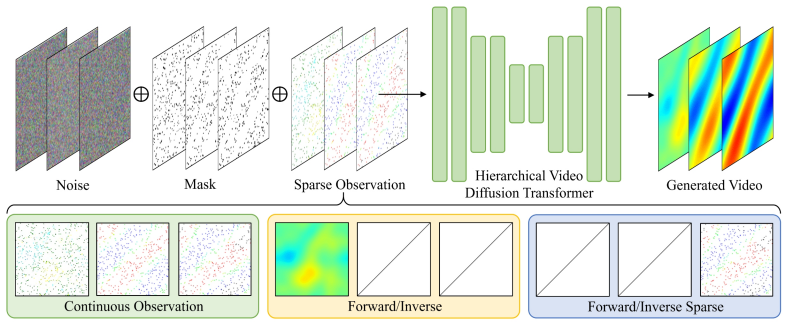
The engine is the Hierarchical Video Diffusion Transformer (HV-DiT), a pixel-space video diffusion model that tokenizes the field into small spatiotemporal patches, applies localized spatiotemporal neighborhood attention, and uses a hierarchical downsampling/upsampling path with skip connections plus global attention at the bottleneck. Conditioning is done by channel-wise concatenation of the noisy field, the binary observation mask, and the observed values, so every token knows exactly which pixels are known; this mask concatenation is what the ablation shows resolves ambiguity between noise and sparse observations. The model is trained with the EDM noise schedule and denoiser loss, and at inference it denoises pure Gaussian noise into a full trajectory conditioned on arbitrary observed patterns.
What would settle it
Train the same model on Kolmogorov flow with one viscosity and forcing, then evaluate on a second viscosity and forcing, or on boundary conditions not seen in training; if relative L2 error degrades to baseline levels, the unification claim collapses. A second checks is a 100-frame autoregressive rollout: if per-frame error grows without bound, the model has no physics to fall back on once it leaves the training distribution.
Extended reading notes
Core claim
The central discovery is that PDE solving can be recast as conditional video inpainting, and that a diffusion model trained directly in pixel space on masked trajectories learns the conditional distribution of physically consistent fields well enough to outperform task-specific solvers. The paper reports, for example, 0.44% relative L2 error on Navier–Stokes reconstruction from 3% continuous observations, versus 3.4% for an extended DiffusionPDE baseline, and 0.45% error on full forward prediction from one initial frame. The same weights handle forward, inverse, full, and partial observation tasks, and a single unified model trained on all of them matches the task-specific versions. The authors also show that pixel-space denoising matters: a latent diffusion variant degrades error from 1.46% to 7.13% on the same Navier–Stokes task, supporting their claim that fine-grained field accuracy, not perceptual realism, is what scientific applications need.
Load-bearing premise
The load-bearing premise is that a model trained on simulated trajectories from a fixed PDE family with random masks will generalize to unseen trajectories, unseen masks, and longer horizons without any PDE constraint enforced at test time; the authors acknowledge the resulting error accumulation over 100-frame rollouts in the supplement.
Editorial extensions
If this is right
- One trained model per PDE family can answer forward, inverse, and sparse-sensor reconstruction without retraining; the paper demonstrates this with a unified model that matches task-specific models.
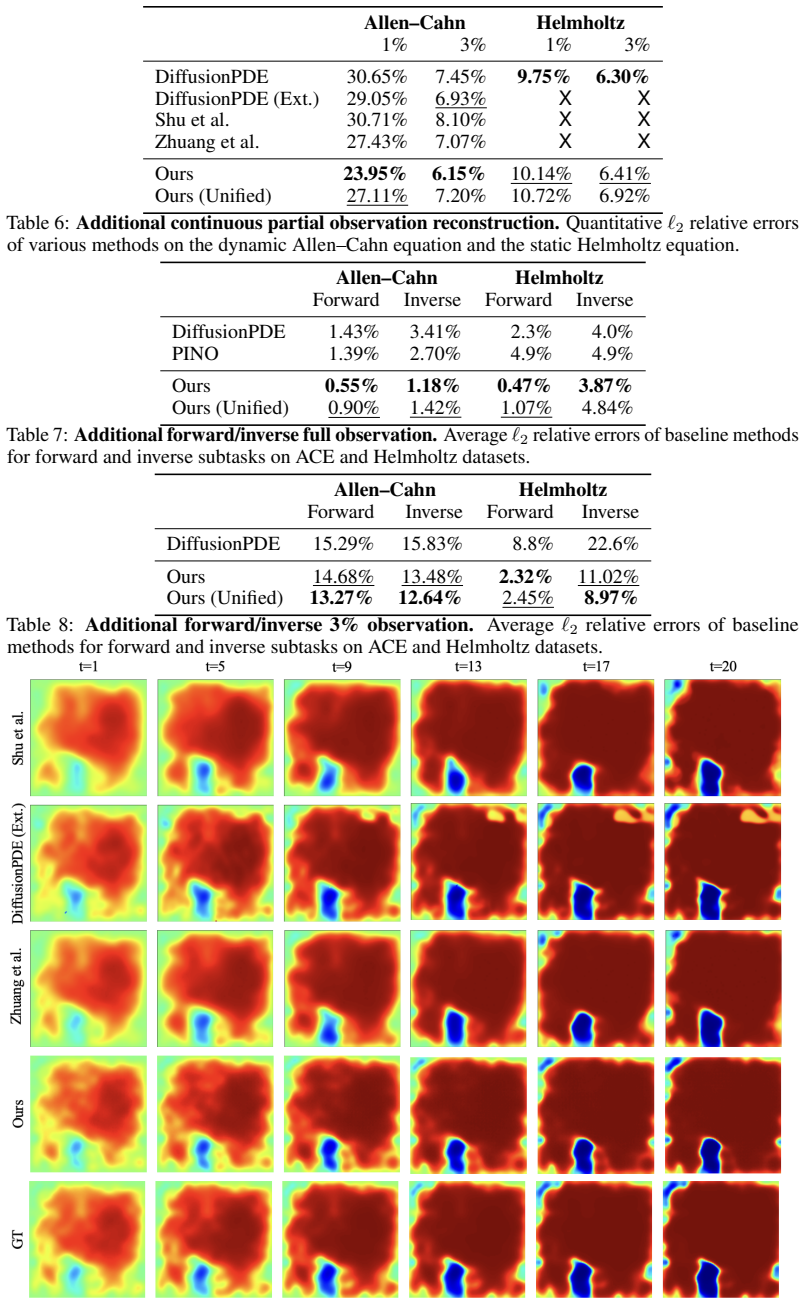
- Sparse continuous sensors at 1–3% coverage are enough for accurate field recovery, with relative errors below 10% at 3% observation across the five PDE families studied.
- Pixel-space denoising, not latent-space denoising, is the right operating point for scientific accuracy; the latent ablation loses more than a factor of four in relative error.
- Static PDEs such as Helmholtz are covered by treating the coefficient field and the solution as two frames of a video, so the same inpainting machinery applies without a separate architecture.
- Inference is fast enough for practical use: roughly 9 seconds per trajectory, compared with thousands of seconds for the generative baselines in the paper's comparison table.
Reading between the lines
- A natural extension is to condition on PDE parameters or boundary-condition descriptors, which would let one model interpolate across a family beyond its training distribution instead of only within it.
- Injecting a PDE residual term during sampling, rather than only at training time, might remove the long-horizon error accumulation the paper reports over 100-frame rollouts.
- The framing suggests an evaluation protocol that reports distribution-based metrics, such as energy spectra or multi-sample likelihood, beside pointwise L2 error, since inverse problems with diffusive decay are genuinely multimodal.
- A testable extension is training a single model on several PDE families at once, to see whether video inpainting acts as a task-agnostic physics prior rather than a per-equation memorizer.
Editorial analysis
A structured set of objections, weighed in public.
Referee Report
Summary. The paper proposes VideoPDE, a unified framework that casts PDE solving as conditional video inpainting. The method trains a pixel-space hierarchical video diffusion transformer (HV-DiT) on partial observations of PDE trajectories, where a binary mask and observed values are concatenated channel-wise to condition denoising. The same model is applied to continuous sparse sensors (1%/3%), forward prediction from an initial frame, inverse prediction from a final frame, and partially observed versions of these tasks, on Wave-Layer, Navier–Stokes, Kolmogorov Flow, Allen–Cahn, and Helmholtz problems. Experiments report substantially lower relative L2 errors than the compared baselines (FNO, PINO, DeepONet, DiffusionPDE, Shu et al., Zhuang et al.) in most settings, with ablations in Table 5 supporting the architectural choices. A unified model trained jointly on six tasks is shown to perform close to task-specific models.
Significance. If the reported results hold, the paper makes a strong empirical contribution: a single generative model per PDE family that handles forward, inverse, and sparse-sensor tasks, with errors often an order of magnitude below prior generative baselines, would be a practically useful step toward general-purpose neural PDE solvers. The recasting of PDE solving as conditional video inpainting is simple and appealing, and the pixel-space hierarchical diffusion design with mask conditioning is a reasonable and apparently effective choice. The paper includes clear ablation evidence (Table 5) that channel-wise concatenation, pixel-space diffusion, and binary-mask conditioning each contribute to accuracy. The main uncertainties are reproducibility-related: the training mask distribution is not precisely specified, evaluation numbers are point estimates without variance, and the strongest generative baseline is the authors' own prior work, which raises questions of calibration rather than invalidating the comparison.
major comments (5)
- [3.2, Eq. (7); §4.3] The central claim of arbitrary-mask conditioning requires that the inference masks used in Tables 2–4 be drawn from the same distribution as the training masks. The paper only states that 'we sample random spatiotemporal masks' and does not specify the mask distribution, yet the evaluation uses highly structured masks: fixed spatial coordinates observed at all times (Table 2), a single full frame (Table 3), and 3% of a single frame (Table 4). If training masks are i.i.d. spatiotemporal points, these test masks are far out-of-distribution and the reported success would not follow from the stated training procedure; if training actually used task-specific mask structures, that is a central design detail that must be disclosed. Please specify the exact training mask distribution (e.g., per-task masks, mixing ratios, whether full-frame and fixed-sensor masks are used during training) and, ideally, release mask-sampling code so the unified-arbitrary-conditioning claim is reproducible.
- [Tables 2–5; §4.3] All headline errors are reported as point estimates on 100 held-out trajectories, without standard deviations across model seeds or across sensor-mask realizations. Given that the central claims are comparative ('up to an order of magnitude lower'), and given that Table 3 shows one setting (NS inverse) where the proposed method is worse than DiffusionPDE (9.87% vs. 8.6%), the absence of error bars makes it impossible to assess whether the claimed advantages are stable. Please report at least 3 seeds or bootstrap intervals for the main tables, or state if only one seed was used.
- [§4.5 (Supplementary F); §5 Conclusion] The paper acknowledges in Supplementary F that autoregressive long-range prediction leads to error accumulation over 100 frames and notes the absence of explicit PDE constraints. This is a substantive limitation for the claim that the model solves PDEs over long horizons, since the 20-frame tasks in the main paper are relatively short. Please discuss this limitation in the main text and, if possible, provide quantitative evidence on how quickly errors grow with horizon (e.g., the single-frame error plot already in Fig. 10 could be summarized in the main body).
- [4.2, Table 12; Supplementary H] The ablation in Table 5 is performed only on Navier–Stokes at 3% observation. The manuscript claims that pixel-space diffusion is 'necessary' for accuracy and that latent diffusion is inadequate, but this conclusion is based on a single dataset and a single observation rate. Please either add ablations on at least one more PDE family (e.g., Wave-Layer or Kolmogorov Flow) or temper the claim to 'observed on the tested setting'.
- [4.3, Tables 2–4; 'Ours (unified)' rows] The unified model results are presented as evidence that 'a single model can jointly learn multiple inference tasks.' However, the training protocol for the unified model is not described: the paper says only that it is trained on six tasks (Table 12 gives different hyperparameters, but not the task mixing schedule). If the unified model is trained with a mixture of masks, the exact mixture is essential for reproducibility and for interpreting the comparison with task-specific models. Please provide the unified training procedure in detail.
minor comments (6)
- [Table 2, Fig. 9] 'Komolgorov Flow' is a typo for 'Kolmogorov Flow' in the header of Table 2 and in Fig. 9.
- [Eq. (1)] The loss expression in Eq. (1) contains a typesetting error: the expectation subscript and the norm are malformed ('E x0∼p(x)E ϵ∼N (0,I) [ |Dθ(xt, σ(t)) − x0∥2 ]'). Please fix the equation to show a proper L2 norm.
- [4.1, Wave-Layer paragraph] The sentence 'The initial condition is the sum of 2-6 Gaussians with random location and scale:' is incomplete; it should be completed with the formula for u(c, 0).
- [Supplementary E] In Supplementary E, the sentence 'The results demonstrate that our methods are can achieve relative ℓ2 errors' contains a grammatical error ('are can achieve') and should be corrected.
- [2 Related Work, DiffusionPDE discussion] DiffusionPDE is cited as [31] and is also the authors' own prior work; this is not a problem per se, but the main text should state this relation explicitly so readers can weigh the baseline implementation choices accordingly.
- [3.3, Eq. (7)] The notation in Eq. (7) concatenates x_t, m, and y along the channel dimension, but the text 'Note that only the solution field x part of the input token contains the diffusion noise' is slightly unclear because x_t is already a noisy version of x; please clarify that m and y are clean and not noised.
Circularity Check
No significant circularity: VideoPDE's claims are empirical supervised-learning results on held-out trajectories; the only self-citation (DiffusionPDE) is a baseline, not load-bearing.
full rationale
The paper's derivation chain is empirical: it trains a conditional video diffusion model on simulated PDE trajectories and evaluates on held-out trajectories from the same PDE families. This is a standard supervised benchmark, not a derivation whose output is encoded in its input. The 'video inpainting' framing is a modeling choice rather than a self-definitional trick, because the evaluation metric (relative L2 error against ground-truth fields) is external to the formulation. The only self-citation is to DiffusionPDE [31], used as a baseline and extended for dense temporal prediction; the central accuracy claims are also benchmarked against external methods (FNO, PINO, DeepONet, Shu et al., Zhuang et al.), so the self-citation is not load-bearing. The manuscript itself flags its main limitations in Supplement F (error accumulation over long horizons and absence of explicit PDE constraints), which are robustness/correctness concerns rather than circularity. The under-specified training mask distribution is a reproducibility and validity concern, not a circular step: no equation or fitted parameter reduces to the reported prediction by construction.
Assumptions & free parameters
free parameters (6)
- Token patch size [T,H,W] =
[2,4,4]
- Embedding dimension =
384, upsampled to 768
- Neighborhood attention kernel =
[2,7,7] for task-specific model, [2,4,4] for unified model
- Transformer depth =
2 neighborhood layers plus 11 global layers, or 6 global layers for unified model
- Learning rate =
5e-4
- Training steps =
50k task-specific, 100k unified
assumptions (7)
- standard math EDM diffusion training (Eq. 1) yields a valid conditional score approximation (Eq. 6) for PDE trajectory data.
- domain assumption The simulated datasets (Poseidon Wave-Layer and Allen-Cahn, DiffusionPDE Navier-Stokes, Kolmogorov flow setup) provide accurate ground-truth solutions.
- domain assumption A fixed Cartesian grid video representation is sufficient for the PDE families tested.
- ad hoc to paper Training with random masks transfers to inference masks (1% and 3% fixed sensors, single full or partial frame).
- ad hoc to paper Pixel-space diffusion with concatenated mask and observed values is necessary for accuracy; latent diffusion is inadequate.
- domain assumption For static Helmholtz, treating coefficient and solution as two time steps is a valid reduction.
- domain assumption Relative L2 error on held-out trajectories is an adequate measure of PDE-solving quality.
Cite this review
Pith. "Pith review of VideoPDE: Unified Generative PDE Solving via Video Inpainting Diffusion Models." pith.science (2026). https://pith.science/paper/LDOAXHYF
@misc{pith2026250613754,
  author       = {Pith},
  title        = {Pith review of: VideoPDE: Unified Generative PDE Solving via Video Inpainting Diffusion Models},
  year         = {2026},
  howpublished = {\url{https://pith.science/paper/LDOAXHYF}},
  note         = {Machine review of arXiv:2506.13754}
}
read the original abstract
We present a unified framework for solving partial differential equations (PDEs) using video-inpainting diffusion transformer models. Unlike existing methods that devise specialized strategies for either forward or inverse problems under full or partial observation, our approach unifies these tasks under a single, flexible generative framework. Specifically, we recast PDE-solving as a generalized inpainting problem, e.g., treating forward prediction as inferring missing spatiotemporal information of future states from initial conditions. To this end, we design a transformer-based architecture that conditions on arbitrary patterns of known data to infer missing values across time and space. Our method proposes pixel-space video diffusion models for fine-grained, high-fidelity inpainting and conditioning, while enhancing computational efficiency through hierarchical modeling. Extensive experiments show that our video inpainting-based diffusion model offers an accurate and versatile solution across a wide range of PDEs and problem setups, outperforming state-of-the-art baselines.
Figures


Figures from the paper (8 more)



Forward citations
Cited by 1 Pith paper
-
Image Editing Models are Numerical Solvers
A FLUX image editor, adapted per task, maps rendered inputs to rendered solutions across ten numerical problems, but several encodings leak the target's scale and the model cannot track chaotic Kuramoto-Sivashinsky dynamics.
Reference graph
Works this paper leans on
-
[1]
Boundary element methods
Ferri MH Aliabadi. Boundary element methods. In Encyclopedia of continuum mechanics, pages 182–193. Springer, 2020
2020
-
[2]
ediff-i: Text-to-image diffusion models with an ensemble of expert denoisers, 2023
Yogesh Balaji, Seungjun Nah, Xun Huang, Arash Vahdat, Jiaming Song, Qinsheng Zhang, Karsten Kreis, Miika Aittala, Timo Aila, Samuli Laine, Bryan Catanzaro, Tero Karras, and Ming-Yu Liu. ediff-i: Text-to-image diffusion models with an ensemble of expert denoisers, 2023
2023
-
[3]
Align your latents: High-resolution video synthesis with latent diffusion models
Andreas Blattmann, Robin Rombach, Huan Ling, Tim Dockhorn, Seung Wook Kim, Sanja Fidler, and Karsten Kreis. Align your latents: High-resolution video synthesis with latent diffusion models. In IEEE Conference on Computer Vision and Pattern Recognition (CVPR), 2023
2023
-
[4]
Spherical fourier neural operators: Learning stable dynamics on the sphere
Boris Bonev, Thorsten Kurth, Christian Hundt, Jaideep Pathak, Maximilian Baust, Karthik Kashinath, and Anima Anandkumar. Spherical fourier neural operators: Learning stable dynamics on the sphere. In International conference on machine learning, pages 2806–2823. PMLR, 2023
2023
-
[5]
Physics-informed neural networks (pinns) for fluid mechanics: A review
Shengze Cai, Zhiping Mao, Zhicheng Wang, Minglang Yin, and George Em Karniadakis. Physics-informed neural networks (pinns) for fluid mechanics: A review. Acta Mechanica Sinica, 37(12):1727–1738, 2021
2021
-
[6]
Physics-informed neural networks for heat transfer problems
Shengze Cai, Zhicheng Wang, Sifan Wang, Paris Perdikaris, and George Em Karniadakis. Physics-informed neural networks for heat transfer problems. Journal of Heat Transfer , 143(6):060801, 2021
2021
-
[7]
Invariant recurrent solutions embedded in a turbulent two-dimensional kolmogorov flow
Gary J Chandler and Rich R Kerswell. Invariant recurrent solutions embedded in a turbulent two-dimensional kolmogorov flow. Journal of Fluid Mechanics, 722:554–595, 2013
work page 2013
-
[8]
Seine: Short-to-long video diffusion model for generative transition and prediction
Xinyuan Chen, Yaohui Wang, Lingjun Zhang, Shaobin Zhuang, Xin Ma, Jiashuo Yu, Yali Wang, Dahua Lin, Yu Qiao, and Ziwei Liu. Seine: Short-to-long video diffusion model for generative transition and prediction. In ICLR, 2023
2023
Show all 86 references
-
[9]
Maddix, Abdul Fatir Ansari, Andrew Stuart, Michael W
Chaoran Cheng, Boran Han, Danielle C. Maddix, Abdul Fatir Ansari, Andrew Stuart, Michael W. Mahoney, and Bernie Wang. Gradient-free generation for hard-constrained systems. In The Thirteenth International Conference on Learning Representations, 2025
2025
-
[10]
Accu- rate differential operators for hybrid neural fields, 2023
Aditya Chetan, Guandao Yang, Zichen Wang, Steve Marschner, and Bharath Hariharan. Accu- rate differential operators for hybrid neural fields, 2023
2023
-
[11]
Ilvr: Conditioning method for denoising diffusion probabilistic models, 2021
Jooyoung Choi, Sungwon Kim, Yonghyun Jeong, Youngjune Gwon, and Sungroh Yoon. Ilvr: Conditioning method for denoising diffusion probabilistic models, 2021
2021
-
[12]
Mccann, Marc L
Hyungjin Chung, Jeongsol Kim, Michael T. Mccann, Marc L. Klasky, and Jong Chul Ye. Diffusion posterior sampling for general noisy inverse problems, 2024
2024
-
[13]
Diffusion posterior sampling for general noisy inverse problems
Hyungjin Chung, Jeongsol Kim, Michael Thompson Mccann, Marc Louis Klasky, and Jong Chul Ye. Diffusion posterior sampling for general noisy inverse problems. In The Eleventh Interna- tional Conference on Learning Representations, 2023
2023
-
[14]
Improving diffusion models for inverse problems using manifold constraints, 2024
Hyungjin Chung, Byeongsu Sim, Dohoon Ryu, and Jong Chul Ye. Improving diffusion models for inverse problems using manifold constraints, 2024
2024
-
[15]
Scalable high-resolution pixel-space image synthesis with hourglass diffusion transformers
Katherine Crowson, Stefan Andreas Baumann, Alex Birch, Tanishq Mathew Abraham, Daniel Z Kaplan, and Enrico Shippole. Scalable high-resolution pixel-space image synthesis with hourglass diffusion transformers. In Forty-first International Conference on Machine Learning, 2024. 10
2024
-
[16]
Scalable high-resolution pixel-space image synthesis with hourglass diffusion transformers
Katherine Crowson, Stefan Andreas Baumann, Alex Birch, Tanishq Mathew Abraham, Daniel Z Kaplan, and Enrico Shippole. Scalable high-resolution pixel-space image synthesis with hourglass diffusion transformers. In Ruslan Salakhutdinov, Zico Kolter, Katherine Heller, Adrian Welle...
2024
-
[17]
Fourier analysis of the physics of transfer learning for data-driven subgrid-scale models of ocean turbulence, 2025
Moein Darman, Pedram Hassanzadeh, Laure Zanna, and Ashesh Chattopadhyay. Fourier analysis of the physics of transfer learning for data-driven subgrid-scale models of ocean turbulence, 2025
2025
-
[18]
Diffusion models beat gans on image synthesis
Prafulla Dhariwal and Alexander Nichol. Diffusion models beat gans on image synthesis. Advances in neural information processing systems, 34:8780–8794, 2021
2021
-
[19]
Samudra: An ai global ocean emulator for climate, 2024
Surya Dheeshjith, Adam Subel, Alistair Adcroft, Julius Busecke, Carlos Fernandez-Granda, Shubham Gupta, and Laure Zanna. Samudra: An ai global ocean emulator for climate, 2024
2024
-
[20]
Physics-informed neural networks for solving reynolds-averaged navier–stokes equations
Hamidreza Eivazi, Mojtaba Tahani, Philipp Schlatter, and Ricardo Vinuesa. Physics-informed neural networks for solving reynolds-averaged navier–stokes equations. Physics of Fluids , 34(7), 2022
2022
-
[21]
Machine-learning-based spatio-temporal super resolution reconstruction of turbulent flows
Kai Fukami, Koji Fukagata, and Kunihiko Taira. Machine-learning-based spatio-temporal super resolution reconstruction of turbulent flows. Journal of Fluid Mechanics, 909, December 2020
2020
-
[22]
Super-resolution analysis via machine learning: a survey for fluid flows
Kai Fukami, Koji Fukagata, and Kunihiko Taira. Super-resolution analysis via machine learning: a survey for fluid flows. Theoretical and Computational Fluid Dynamics, 37(4):421–444, 2023
2023
-
[23]
Photorealistic video generation with diffusion models, 2023
Agrim Gupta, Lijun Yu, Kihyuk Sohn, Xiuye Gu, Meera Hahn, Li Fei-Fei, Irfan Essa, Lu Jiang, and José Lezama. Photorealistic video generation with diffusion models, 2023
2023
-
[24]
Pinnacle: A comprehensive benchmark of physics-informed neural networks for solving pdes
Zhongkai Hao, Jiachen Yao, Chang Su, Hang Su, Ziao Wang, Fanzhi Lu, Zeyu Xia, Yichi Zhang, Songming Liu, Lu Lu, et al. Pinnacle: A comprehensive benchmark of physics-informed neural networks for solving pdes. arXiv preprint arXiv:2306.08827, 2023
2023 arXiv
-
[25]
Latent video diffusion models for high-fidelity long video generation
Yingqing He, Tianyu Yang, Yong Zhang, Ying Shan, and Qifeng Chen. Latent video diffusion models for high-fidelity long video generation. 2022
2022
-
[26]
Poseidon: Efficient foundation models for PDEs
Maximilian Herde, Bogdan Raonic, Tobias Rohner, Roger Käppeli, Roberto Molinaro, Em- manuel de Bezenac, and Siddhartha Mishra. Poseidon: Efficient foundation models for PDEs. In The Thirty-eighth Annual Conference on Neural Information Processing Systems, 2024
2024
-
[27]
Denoising diffusion probabilistic models
Jonathan Ho, Ajay Jain, and Pieter Abbeel. Denoising diffusion probabilistic models. arXiv preprint arxiv:2006.11239, 2020
2006 arXiv
-
[28]
Classifier-free diffusion guidance
Jonathan Ho and Tim Salimans. Classifier-free diffusion guidance. arXiv preprint arXiv:2207.12598, 2022
2022 arXiv
-
[29]
Jonathan Ho, Tim Salimans, Alexey Gritsenko, William Chan, Mohammad Norouzi, and David J. Fleet. Video diffusion models, 2022
2022
-
[30]
Diffusion models for video prediction and infilling
Tobias Höppe, Arash Mehrjou, Stefan Bauer, Didrik Nielsen, and Andrea Dittadi. Diffusion models for video prediction and infilling. Transactions on Machine Learning Research, 2022
2022
-
[31]
Diffusionpde: Generative pde-solving under partial observation, 2024
Jiahe Huang, Guandao Yang, Zichen Wang, and Jeong Joon Park. Diffusionpde: Generative pde-solving under partial observation, 2024
2024
-
[32]
The meshless finite element method
Sergio R Idelsohn, Eugenio Onate, Nestor Calvo, and Facundo Del Pin. The meshless finite element method. International Journal for Numerical Methods in Engineering, 58(6):893–912, 2003
2003
-
[33]
Elucidating the design space of diffusion-based generative models
Tero Karras, Miika Aittala, Timo Aila, and Samuli Laine. Elucidating the design space of diffusion-based generative models. Advances in neural information processing systems , 35:26565–26577, 2022. 11
2022
-
[34]
Physics-informed machine learning: case studies for weather and climate modelling
Karthik Kashinath, M Mustafa, Adrian Albert, JL Wu, C Jiang, Soheil Esmaeilzadeh, Kamyar Azizzadenesheli, R Wang, Ashesh Chattopadhyay, A Singh, et al. Physics-informed machine learning: case studies for weather and climate modelling. Philosophical Transactions of the Royal So...
2021
-
[35]
Denoising diffusion restoration models
Bahjat Kawar, Michael Elad, Stefano Ermon, and Jiaming Song. Denoising diffusion restoration models. In Advances in Neural Information Processing Systems, 2022
2022
-
[36]
Unsupervised deep learning for super-resolution reconstruction of turbulence
Hyojin Kim, Junhyuk Kim, Sungjin Won, and Changhoon Lee. Unsupervised deep learning for super-resolution reconstruction of turbulence. Journal of Fluid Mechanics, 910, January 2021
2021
-
[37]
Solving seismic wave equations on variable velocity models with fourier neural operator
Bian Li, Hanchen Wang, Shihang Feng, Xiu Yang, and Youzuo Lin. Solving seismic wave equations on variable velocity models with fourier neural operator. IEEE Transactions on Geoscience and Remote Sensing, 61:1–18, 2023
2023
-
[38]
Fourier neural operator approach to large eddy simulation of three-dimensional turbulence
Zhijie Li, Wenhui Peng, Zelong Yuan, and Jianchun Wang. Fourier neural operator approach to large eddy simulation of three-dimensional turbulence. Theoretical and Applied Mechanics Letters, 12(6):100389, 2022
2022
-
[39]
Transformer for partial differential equations’ operator learning
Zijie Li, Kazem Meidani, and Amir Barati Farimani. Transformer for partial differential equations’ operator learning. Transactions on Machine Learning Research, 2023
2023
-
[40]
Fourier neural operator for parametric partial differen- tial equations
Zongyi Li, Nikola Kovachki, Kamyar Azizzadenesheli, Burigede Liu, Kaushik Bhattacharya, Andrew Stuart, and Anima Anandkumar. Fourier neural operator for parametric partial differen- tial equations. arXiv preprint arXiv:2010.08895, 2020
2010 arXiv
-
[41]
Geometry-informed neural operator for large-scale 3d pdes
Zongyi Li, Nikola Kovachki, Chris Choy, Boyi Li, Jean Kossaifi, Shourya Otta, Moham- mad Amin Nabian, Maximilian Stadler, Christian Hundt, Kamyar Azizzadenesheli, et al. Geometry-informed neural operator for large-scale 3d pdes. Advances in Neural Information Processing System...
2024
-
[42]
Physics-informed neural operator for learning partial differential equations
Zongyi Li, Hongkai Zheng, Nikola Kovachki, David Jin, Haoxuan Chen, Burigede Liu, Kamyar Azizzadenesheli, and Anima Anandkumar. Physics-informed neural operator for learning partial differential equations. ACM/JMS Journal of Data Science, 2021
2021
-
[43]
Invertible fourier neural operators for tackling both forward and inverse problems
Da Long and Shandian Zhe. Invertible fourier neural operators for tackling both forward and inverse problems. arXiv preprint arXiv:2402.11722, 2024
2024 arXiv
-
[44]
Vdt: General-purpose video diffusion transformers via mask modeling, 2023
Haoyu Lu, Guoxing Yang, Nanyi Fei, Yuqi Huo, Zhiwu Lu, Ping Luo, and Mingyu Ding. Vdt: General-purpose video diffusion transformers via mask modeling, 2023
2023
-
[45]
VDT: General-purpose video diffusion transformers via mask modeling
Haoyu Lu, Guoxing Yang, Nanyi Fei, Yuqi Huo, Zhiwu Lu, Ping Luo, and Mingyu Ding. VDT: General-purpose video diffusion transformers via mask modeling. In The Twelfth International Conference on Learning Representations, 2024
2024
-
[46]
Learning nonlinear operators via deeponet based on the universal approximation theorem of operators
Lu Lu, Pengzhan Jin, Guofei Pang, Zhongqiang Zhang, and George Em Karniadakis. Learning nonlinear operators via deeponet based on the universal approximation theorem of operators. Nature machine intelligence, 3(3):218–229, 2021
2021
-
[47]
Repaint: Inpainting using denoising diffusion probabilistic models, 2022
Andreas Lugmayr, Martin Danelljan, Andres Romero, Fisher Yu, Radu Timofte, and Luc Van Gool. Repaint: Inpainting using denoising diffusion probabilistic models, 2022
2022
-
[48]
Physics-informed neural networks for high-speed flows
Zhiping Mao, Ameya D Jagtap, and George Em Karniadakis. Physics-informed neural networks for high-speed flows. Computer Methods in Applied Mechanics and Engineering, 360:112789, 2020
2020
-
[49]
Sdedit: Guided image synthesis and editing with stochastic differential equations
Chenlin Meng, Yutong He, Yang Song, Jiaming Song, Jiajun Wu, Jun-Yan Zhu, and Stefano Ermon. Sdedit: Guided image synthesis and editing with stochastic differential equations. arXiv preprint arXiv:2108.01073, 2021
2021 arXiv
-
[50]
SDEdit: Guided image synthesis and editing with stochastic differential equations
Chenlin Meng, Yutong He, Yang Song, Jiaming Song, Jiajun Wu, Jun-Yan Zhu, and Stefano Ermon. SDEdit: Guided image synthesis and editing with stochastic differential equations. In International Conference on Learning Representations, 2022. 12
2022
-
[51]
Physics-informed neural networks for power systems
George S Misyris, Andreas Venzke, and Spyros Chatzivasileiadis. Physics-informed neural networks for power systems. In 2020 IEEE power & energy society general meeting (PESGM), pages 1–5. IEEE, 2020
2020
-
[52]
Neural inverse operators for solving pde inverse problems
Roberto Molinaro, Yunan Yang, Björn Engquist, and Siddhartha Mishra. Neural inverse operators for solving pde inverse problems. arXiv preprint arXiv:2301.11167, 2023
2023 arXiv
-
[53]
Hierarchical transformers are more efficient language models
Piotr Nawrot, Szymon Tworkowski, Michał Tyrolski, Łukasz Kaiser, Yuhuai Wu, Christian Szegedy, and Henryk Michalewski. Hierarchical transformers are more efficient language models. arXiv preprint arXiv:2110.13711, 2021
2021 arXiv
-
[54]
Introducing sora: A text-to-video model, February 2024
OpenAI. Introducing sora: A text-to-video model, February 2024. Accessed: 2025-05-13
2024
-
[55]
Linear attention coupled fourier neural operator for simulation of three-dimensional turbulence
Wenhui Peng, Zelong Yuan, Zhijie Li, and Jianchun Wang. Linear attention coupled fourier neural operator for simulation of three-dimensional turbulence. Physics of Fluids, 35(1), 2023
2023
-
[56]
Michael Penwarden, Shandian Zhe, Akil Narayan, and Robert M. Kirby. A metalearning approach for physics-informed neural networks (pinns): Application to parameterized pdes. Journal of Computational Physics, 477:111912, 2023
2023
-
[57]
Film: Visual reasoning with a general conditioning layer, 2017
Ethan Perez, Florian Strub, Harm de Vries, Vincent Dumoulin, and Aaron Courville. Film: Visual reasoning with a general conditioning layer, 2017
2017
-
[58]
Numerical approximation of partial differential equations, volume 23
Alfio Quarteroni and Alberto Valli. Numerical approximation of partial differential equations, volume 23. Springer Science & Business Media, 2008
2008
-
[59]
Physics-informed neural networks: A deep learning framework for solving forward and inverse problems involving nonlinear partial differential equations
Maziar Raissi, Paris Perdikaris, and George E Karniadakis. Physics-informed neural networks: A deep learning framework for solving forward and inverse problems involving nonlinear partial differential equations. Journal of Computational physics, 378:686–707, 2019
2019
-
[60]
Physics informed deep learn- ing (part i): Data-driven solutions of nonlinear partial differential equations
Maziar Raissi, Paris Perdikaris, and George Em Karniadakis. Physics informed deep learn- ing (part i): Data-driven solutions of nonlinear partial differential equations. arXiv preprint arXiv:1711.10561, 2017
2017 arXiv
-
[61]
High- resolution image synthesis with latent diffusion models
Robin Rombach, Andreas Blattmann, Dominik Lorenz, Patrick Esser, and Björn Ommer. High- resolution image synthesis with latent diffusion models. In Proceedings of the IEEE/CVF conference on computer vision and pattern recognition, pages 10684–10695, 2022
2022
-
[62]
Lee, Jonathan Ho, Tim Salimans, David J
Chitwan Saharia, William Chan, Huiwen Chang, Chris A. Lee, Jonathan Ho, Tim Salimans, David J. Fleet, and Mohammad Norouzi. Palette: Image-to-image diffusion models, 2022
2022
-
[63]
Fleet, and Mohammad Norouzi
Chitwan Saharia, Jonathan Ho, William Chan, Tim Salimans, David J. Fleet, and Mohammad Norouzi. Image super-resolution via iterative refinement, 2021
2021
-
[64]
Operator learning with neural fields: Tackling pdes on general geometries
Louis Serrano, Lise Le Boudec, Armand Kassaï Koupaï, Thomas X Wang, Yuan Yin, Jean-Noël Vittaut, and Patrick Gallinari. Operator learning with neural fields: Tackling pdes on general geometries. Advances in Neural Information Processing Systems, 36, 2024
2024
-
[65]
Pird: Physics- informed residual diffusion for flow field reconstruction, 2024
Siming Shan, Pengkai Wang, Song Chen, Jiaxu Liu, Chao Xu, and Shengze Cai. Pird: Physics- informed residual diffusion for flow field reconstruction, 2024
2024
-
[66]
A physics-informed diffusion model for high- fidelity flow field reconstruction
Dule Shu, Zijie Li, and Amir Barati Farimani. A physics-informed diffusion model for high- fidelity flow field reconstruction. Journal of Computational Physics, 478:111972, April 2023
2023
-
[67]
Weiss, Niru Maheswaranathan, and Surya Ganguli
Jascha Sohl-Dickstein, Eric A. Weiss, Niru Maheswaranathan, and Surya Ganguli. Deep unsupervised learning using nonequilibrium thermodynamics, 2015
2015
-
[68]
Partial differential equations and the finite element method
Pavel ˆSolín. Partial differential equations and the finite element method. John Wiley & Sons, 2005
2005
-
[69]
Solving inverse problems with latent diffusion models via hard data consistency, 2024
Bowen Song, Soo Min Kwon, Zecheng Zhang, Xinyu Hu, Qing Qu, and Liyue Shen. Solving inverse problems with latent diffusion models via hard data consistency, 2024
2024
-
[70]
Generative modeling by estimating gradients of the data distribution, 2020
Yang Song and Stefano Ermon. Generative modeling by estimating gradients of the data distribution, 2020. 13
2020
-
[71]
Score-based generative modeling through stochastic differential equations
Yang Song, Jascha Sohl-Dickstein, Diederik P Kingma, Abhishek Kumar, Stefano Ermon, and Ben Poole. Score-based generative modeling through stochastic differential equations. arXiv preprint arXiv:2011.13456, 2020
2011 arXiv
-
[72]
Kingma, Abhishek Kumar, Stefano Ermon, and Ben Poole
Yang Song, Jascha Sohl-Dickstein, Diederik P. Kingma, Abhishek Kumar, Stefano Ermon, and Ben Poole. Score-based generative modeling through stochastic differential equations, 2021
2021
-
[73]
From pinns to pikans: Recent advances in physics-informed machine learning, 2024
Juan Diego Toscano, Vivek Oommen, Alan John Varghese, Zongren Zou, Nazanin Ahmadi Daryakenari, Chenxi Wu, and George Em Karniadakis. From pinns to pikans: Recent advances in physics-informed machine learning, 2024
2024
-
[74]
Mcvd: Masked conditional video diffusion for prediction, generation, and interpolation
Vikram V oleti, Alexia Jolicoeur-Martineau, and Christopher Pal. Mcvd: Masked conditional video diffusion for prediction, generation, and interpolation. In (NeurIPS) Advances in Neural Information Processing Systems, 2022
2022
-
[75]
Pin- neik: Eikonal solution using physics-informed neural networks
Umair bin Waheed, Ehsan Haghighat, Tariq Alkhalifah, Chao Song, and Qi Hao. Pin- neik: Eikonal solution using physics-informed neural networks. Computers & Geosciences, 155:104833, October 2021
2021
-
[76]
Towards physics- informed deep learning for turbulent flow prediction
Rui Wang, Karthik Kashinath, Mustafa Mustafa, Adrian Albert, and Rose Yu. Towards physics- informed deep learning for turbulent flow prediction. In Proceedings of the 26th ACM SIGKDD international conference on knowledge discovery & data mining, pages 1457–1466, 2020
2020
-
[77]
Videocomposer: Compositional video synthesis with motion controllability, 2023
Xiang Wang, Hangjie Yuan, Shiwei Zhang, Dayou Chen, Jiuniu Wang, Yingya Zhang, Yujun Shen, Deli Zhao, and Jingren Zhou. Videocomposer: Compositional video synthesis with motion controllability, 2023
2023
-
[78]
U-fno—an enhanced fourier neural operator-based deep-learning model for multiphase flow
Gege Wen, Zongyi Li, Kamyar Azizzadenesheli, Anima Anandkumar, and Sally M Benson. U-fno—an enhanced fourier neural operator-based deep-learning model for multiphase flow. Advances in Water Resources, 163:104180, 2022
2022
-
[79]
Inversion-free image editing with natural language
Sihan Xu, Yidong Huang, Jiayi Pan, Ziqiao Ma, and Joyce Chai. Inversion-free image editing with natural language. 2024
2024
-
[80]
Diffusion models: A comprehensive survey of methods and applications
Ling Yang, Zhilong Zhang, Yang Song, Shenda Hong, Runsheng Xu, Yue Zhao, Wentao Zhang, Bin Cui, and Ming-Hsuan Yang. Diffusion models: A comprehensive survey of methods and applications. ACM Comput. Surv., 56(4), November 2023
2023
-
[81]
Adding conditional control to text-to-image diffusion models, 2023
Lvmin Zhang, Anyi Rao, and Maneesh Agrawala. Adding conditional control to text-to-image diffusion models, 2023
2023
-
[82]
Avid: Any-length video inpainting with diffusion model
Zhixing Zhang, Bichen Wu, Xiaoyan Wang, Yaqiao Luo, Luxin Zhang, Yinan Zhao, Peter Vajda, Dimitris Metaxas, and Licheng Yu. Avid: Any-length video inpainting with diffusion model. arXiv preprint arXiv:2312.03816, 2023
2023 arXiv
-
[83]
Avid: Any-length video inpainting with diffusion model, 2024
Zhixing Zhang, Bichen Wu, Xiaoyan Wang, Yaqiao Luo, Luxin Zhang, Yinan Zhao, Peter Vajda, Dimitris Metaxas, and Licheng Yu. Avid: Any-length video inpainting with diffusion model, 2024
2024
-
[84]
Magicvideo: Efficient video generation with latent diffusion models, 2023
Daquan Zhou, Weimin Wang, Hanshu Yan, Weiwei Lv, Yizhe Zhu, and Jiashi Feng. Magicvideo: Efficient video generation with latent diffusion models, 2023
2023
-
[85]
Spatially-aware diffusion models with cross-attention for global field reconstruction with sparse observations, 2024
Yilin Zhuang, Sibo Cheng, and Karthik Duraisamy. Spatially-aware diffusion models with cross-attention for global field reconstruction with sparse observations, 2024
2024
-
[86]
Neural stress fields for reduced-order elastoplasticity and fracture
Zeshun Zong, Xuan Li, Minchen Li, Maurizio M Chiaramonte, Wojciech Matusik, Eitan Grinspun, Kevin Carlberg, Chenfanfu Jiang, and Peter Yichen Chen. Neural stress fields for reduced-order elastoplasticity and fracture. arXiv preprint arXiv:2310.17790, 2023. 14 A Overview This s...
Reviewed August 7, 2026 · model on record in the stance chip above.
Discussion (0). Sign in to comment.