REVIEW 3 major objections 5 minor 38 references
A Silent Speech Decoding System from EEG and EMG with Heterogenous Electrode Configurations
T0 review · 3 major / 5 minor · reviewed 2026-08-07 · deepseek-v4-flash
Pith's one-line read Pretraining on pooled EEG/EMG recordings with many electrode layouts lifts silent word decoding from 70.1% to 95.3% in healthy speakers and from 13.2% to 54.5% in a speech-impaired patient.
desk verdict Solid transfer results and a genuinely new tokenizer, but the headline accuracy gains are confounded by including each evaluated subject's own data in the pretraining set. read the letter →
The pith
A machine-rendered reading of the paper's core claim, the machinery that carries it, and where it could break.
The reading
What carries the argument
The machinery is a set of tokenizers placed between raw electrodes and a shared Conformer encoder. Each tokenizer compresses the spatial dimension into a fixed number of tokens despite variable electrode numbers. Four are compared: global average pooling over electrodes; electrode-specific linear layers selected by montage; subject-specific linear layers selected by subject ID; and a novel on-the-fly kernel (OTFK) that generates the spatial projection weights from 3D electrode coordinates through a radial-basis-function positional encoder and a single Transformer layer. Multi-task losses—regression to audio latents, cross-entropy on word labels, CTC on mora sequences, and frame-level mora cross-entropy—let one model learn from datasets with different labels. The subject-specific tokenizer carried the best results, while OTFK still improved monotonically with data volume; the average-pooling tokenizer failed on cross-language transfer.
What would settle it
Train the on-the-fly-kernel model twice on the same 220-hour corpus, once with true 3D electrode coordinates and once with coordinates randomly permuted across channels; if word accuracy is nearly unchanged, the coordinate encoder is not the active ingredient and montage invariance must come from elsewhere in the pipeline.
Extended reading notes
Core claim
On the paper's own terms, the discovery is that data volume can substitute for setup standardization in non-invasive silent speech decoding. By pooling existing and newly collected EEG/EMG data with heterogeneous electrode counts and positions, and by choosing a tokenizer that maps each montage to fixed-size tokens, the authors train an 18.5-million-parameter Conformer-based decoder that beats single-subject models by a wide margin. The subject-specific tokenizer performed best: 95.3 ± 2.6% mean accuracy for eight healthy participants and 54.5% for one patient with a neurodegenerative disease, against 70.1% and 13.2% baselines. The same pretrained model calibrates to a novel healthy speaker and to new-day patient data faster than training from scratch, and it transfers to a separate single-subject English EMG dataset with lower phoneme error than a scratch model for most tokenizer variants. The patient result, while far above chance and above the single-subject baseline, remains modest; the paper attributes this to patient mouth movements lying outside the healthy-participant distribution.
Load-bearing premise
The transfer results rest on the assumption that the tokenizer makes different electrode montages and different people's signal distributions interchangeable enough that patterns learned on healthy Japanese speakers apply to a patient and to English EMG; if contact quality, device-specific noise, or individual anatomy break that equivalence, pretrained representations will not transfer.
Editorial extensions
If this is right
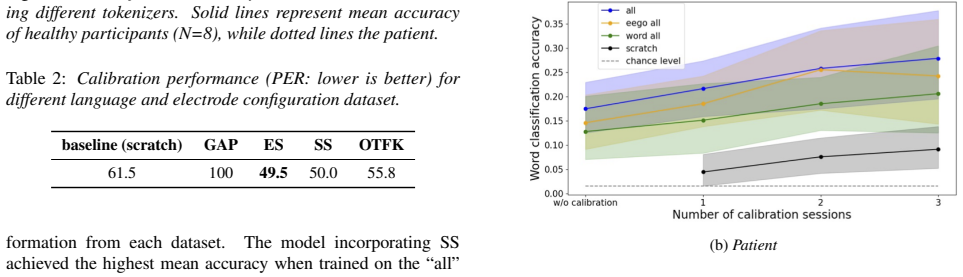
- A new user's silent speech decoder can plausibly be calibrated from a handful of sessions instead of hours of per-person data: pretrained models exceeded 80% accuracy after a few calibration sessions for a novel healthy participant.
- Speech-impaired patients can benefit from healthy-participant pretraining even when their own data are scarce: the patient's accuracy rose from 13.2% to 54.5% without large amounts of patient-specific data.
- Pretraining on Japanese data transfers, in part, to English silent speech: the English EMG phoneme error rate improved from 61.5% scratch to 49.5–55.8% for most tokenizers, suggesting some language-independent EEG/EMG representations.
- Larger heterogeneous pretraining corpora give monotonic improvements for tokenizers that preserve electrode identity, implying that collecting diverse montage data is a viable path to better decoders.
Reading between the lines
- Beyond the paper: the on-the-fly kernel's coordinate-based mechanism is untested directly—shuffling electrode coordinates during training and measuring whether word accuracy collapses would show whether 3D geometry actually carries the transfer.
- Beyond the paper: patient transfer might improve if pretraining included atypical articulatory patterns or data augmentation that shifts mouth-movement distributions closer to a patient's, since the paper's own analysis points to patient movements being out-of-distribution.
- Beyond the paper: the failure of average pooling on the English dataset suggests that discarding electrode identity destroys information that cross-montage generalization needs; future tokenizer designs should preserve spatial identity rather than average it away.
- Beyond the paper: the cross-language gains hint that a multilingual pretraining corpus could yield a language-independent EEG/EMG encoder; the paper explicitly notes multilingual pretraining as a likely requirement for stronger transfer.
Editorial analysis
A structured set of objections, weighed in public.
Referee Report
Summary. The paper proposes a silent speech decoding system that combines EEG and EMG signals recorded under heterogeneous electrode configurations. The authors introduce four tokenizer variants (global average pooling, electrode-specific linear layers, subject-specific linear layers, and a novel on-the-fly kernel) that map arbitrary electrode montages into a fixed token sequence, then feed tokens into a Conformer backbone. They train on their own Japanese dataset (8 healthy participants plus one speech-impaired patient) and on a previously collected large EEG dataset, and report that training on the aggregated 'all' corpus improves word classification accuracy from 70.1% to 95.3% for healthy participants and from 13.2% to 54.5% for the patient. They also present calibration experiments on a novel healthy participant, new-day patient data, and an external English single-subject EMG dataset, reporting that pretrained models outperform random initialization in most conditions.
Significance. If the central claims hold, the paper would provide evidence that pooling multi-subject EEG/EMG data with configuration-agnostic tokenizers enables substantial gains in silent speech decoding and reduces per-user calibration time, which is practically important for brain-computer interfaces. The paper has several genuine strengths: evaluation on held-out sessions for the main accuracy numbers, a genuinely novel healthy participant in the calibration experiment, an external English EMG dataset for cross-language transfer, and bootstrap confidence intervals for the aggregate healthy-participant results. However, the headline comparison in Figure 2 is confounded by the inclusion of each evaluated participant's own training sessions in the pooled corpora, and the patient new-day calibration experiment may suffer from the same issue. The central claim of 'pretraining on large-scale data from healthy participants' benefiting the patient is therefore not directly supported by the reported protocol. The cleanest positive evidence comes from the novel-participant calibration and the English transfer results, but these do not validate the per-subject accuracy gains in Figure 2.
major comments (3)
- [§3.2, Figure 2] The headline comparison does not isolate cross-subject or cross-configuration transfer. The text states that 'each participant's data from the silent speech (word) task was split such that sessions 1-16 were used for training, sessions 17-18 for validation, and sessions 19-20 for test', and that 'word all' aggregates 'all data of word utterance tasks from all subjects' while 'all' aggregates all datasets in Table 1 (220 h). Since the patient also performed 20 word-utterance sessions in the same protocol (Section 2.1), the evaluated participants' own sessions 1-16 are inside the 'word all' and 'all' training corpora. The improvement from the single-subject baseline (70.1% to 95.3% for healthy controls; 13.2% to 54.5% for the patient) could therefore be driven by additional within-subject examples rather than by learning shared across subjects and electrode configurations. This directly undermines the Conclusion's statement that the patient gain comes from pretraining 'on large-scale data from healthy participants'. The authors should rerun the Figure 2 comparisons with leave-one-subject-out pretraining (excluding the evaluated participant's sessions) or otherwise show that the improvement is not due to within-subject data.
- [§3.3, Figure 3b] The new-day patient calibration experiment appears to have the same subject-overlap issue. The text says 'During calibration, we trained our model by incrementally adding new-day sessions to the 16 sessions used for pretraining'. If those 16 sessions are the original patient sessions that already appear in the 'all'/pretraining corpora, then the model already contains substantial patient-specific data before any calibration, so the improvement over a randomly initialized model does not demonstrate transfer from healthy participants to the patient. The authors should clarify exactly which sessions were included in each pretrained model, and preferably include a version pretrained only on healthy-participant data before adding the patient's new-day sessions.
- [§3.2, Figure 2; §3.4, Table 2] The paper does not report any significance tests for the central comparisons. Only the aggregate healthy-participant mean for SS on 'all' is given with a 95% bootstrap confidence interval (95.3 ± 2.6%), while the baseline has a very wide interval (70.1 ± 17.1%). Without pairwise tests or per-subject paired analyses, the claim that 'the model incorporating SS achieved the highest mean accuracy' is not statistically grounded, especially given only eight healthy participants. Similarly, Table 2 reports PER values for a single English speaker with no uncertainty estimates; the conclusion that pretrained models 'demonstrated lower PER' should be based on repeated fine-tuning runs or a significance test where feasible.
minor comments (5)
- [Title and throughout] 'Heterogenous' should be 'heterogeneous'.
- [§3.2, Table 1] The table column headers 'word/word all eego all all' are ambiguous; please clarify which datasets contribute to each pretraining condition and which electrode configurations are included.
- [Figure 2 caption] The caption reads 'dotted lines the patient'; it should read 'dotted lines represent the patient'.
- [§4.1] The claim that the patient accuracy is 'significantly higher than chance, at 1.6%' appears without an accompanying test; a permutation test or confidence interval would make this statement precise.
- [General] No code, trained models, or detailed data-release statement are provided, which limits reproducibility given the complexity of the pretraining/calibration protocol.
Circularity Check
No significant circularity: reported accuracies are measured on held-out sessions and external benchmarks, so the central claims do not reduce to the training inputs.
full rationale
The paper's central empirical claims are evaluated on data not used to fit any derived constant: word classification accuracy is reported on sessions 19-20, which are explicitly held out from training (Section 3.2); the novel-participant calibration uses a participant whose data is not in the pretraining set; the patient new-day calibration uses sessions recorded on separate days; and the cross-language transfer uses the independent EMG dataset of Gaddy and Klein [24]. The only self-citation, [16], supplies pretraining EEG/EMG recordings rather than a load-bearing conclusion, uniqueness theorem, or fitted parameter, and the transfer results are compared against scratch baselines on the same external data. The 'all' pretraining corpus does include each evaluated participant's own training sessions, which is a real subject-overlap confound for interpreting the magnitude of the healthy-control and patient accuracy gains, but it is not circularity: the test sessions themselves remain unseen, so the reported numbers are not equivalent to the training inputs by construction. No equation or fitted quantity is renamed as a prediction, and no load-bearing argument reduces to a self-citation chain.
Assumptions & free parameters
free parameters (4)
- RBF kernel count and variance schedule =
9 kernels, sigma = (2k-1)/170 for k=1..9
- Target spatial dimension K =
not reported
- Conformer depth / model size =
11 layers, 18.5M parameters
- Training schedule =
300 epochs, lr 3e-4, 8-epoch warmup
assumptions (4)
- domain assumption 3D electrode coordinates are sufficient to align heterogeneous montages in a common latent space
- domain assumption wav2vec2.0 audio latents are a valid regression target for EEG/EMG latents
- domain assumption Healthy-participant data share enough structure with patient data to improve patient decoding
- domain assumption Silent speech can be learned through vocalized-speech supervision
Cite this review
Pith. "Pith review of A Silent Speech Decoding System from EEG and EMG with Heterogenous Electrode Configurations." pith.science (2026). https://pith.science/paper/KOFKHTQW
@misc{pith2026250613835,
  author       = {Pith},
  title        = {Pith review of: A Silent Speech Decoding System from EEG and EMG with Heterogenous Electrode Configurations},
  year         = {2026},
  howpublished = {\url{https://pith.science/paper/KOFKHTQW}},
  note         = {Machine review of arXiv:2506.13835}
}
read the original abstract
Silent speech decoding, which performs unvocalized human speech recognition from electroencephalography/electromyography (EEG/EMG), increases accessibility for speech-impaired humans. However, data collection is difficult and performed using varying experimental setups, making it nontrivial to collect a large, homogeneous dataset. In this study we introduce neural networks that can handle EEG/EMG with heterogeneous electrode placements and show strong performance in silent speech decoding via multi-task training on large-scale EEG/EMG datasets. We achieve improved word classification accuracy in both healthy participants (95.3%), and a speech-impaired patient (54.5%), substantially outperforming models trained on single-subject data (70.1% and 13.2%). Moreover, our models also show gains in cross-language calibration performance. This increase in accuracy suggests the feasibility of developing practical silent speech decoding systems, particularly for speech-impaired patients.
Figures


Reference graph
Works this paper leans on
-
[1]
Introduction Silent speech decoding from electroencephalography (EEG) and electromyography (EMG) signals offers a promising com- munication solution for individuals with conditions like amy- otrophic lateral sclerosis (ALS) or post-laryngectomy status. While invasive brain activity measurements have achieved re- markable decoding accuracy [1, 2, 3, 4, 5],...
-
[2]
A Silent Speech Decoding System from EEG and EMG with Heterogenous Electrode Configurations
Materials and methods 2.1. Data acquisition In previous work, [16] collected a large EEG and EMG dataset recorded while participants spoke, using three types of EEG recording devices: eego sports 1, g.Pangolin 2 and g.SCARABEO3. Using a similar setup, we collected EEG and EMG data with the eego sports device from eight healthy participants dur- 1https://w...
work page Pith review arXiv 2025
-
[3]
Experiments 3.1. Preprocessing EEG data was preprocessed using a 50 Hz notch filter, common average reference, and 2-120 Hz bandpass filter, followed by re- sampling to 240 Hz. EMG data recorded by bipolar electrodes underwent similar preprocessing, except for the common aver- age reference. For patient data, an additional 27 Hz notch filter was applied t...
-
[4]
Results and discussion 4.1. Word classification accuracy of models trained on EEG and EMG datasets with heterogeneous configurations Figure 2 illustrates the relationship between dataset size and performance (WCA) for models incorporating different tok- enizers. All models, except for the one with GAP, showed monotonic improvements with increasing data vo...
-
[5]
Conclusion In this study, we construct silent speech decoders for healthy participants and a patient with a neurodegenerative disease by utilizing EEG and EMG data recorded from multiple partic- ipants with varying electrode placements. We demonstrate that training on this large-scale dataset enhances silent speech decoding accuracy despite heterogeneous ...
-
[6]
Decoding speech perception from non-invasive brain record- ings,
A. D ´efossez, C. Caucheteux, J. Rapin, O. Kabeli, and J.-R. King, “Decoding speech perception from non-invasive brain record- ings,” Nature Machine Intelligence, vol. 5, no. 10, pp. 1097–1107, 2023
work page 2023
-
[7]
A high-performance speech neuroprosthesis,
F. R. Willett, E. M. Kunz, C. Fan, D. T. Avansino, G. H. Wilson, E. Y . Choi, F. Kamdar, M. F. Glasser, L. R. Hochberg, S. Druck- mann et al., “A high-performance speech neuroprosthesis,” Na- ture, vol. 620, no. 7976, pp. 1031–1036, 2023
work page 2023
-
[8]
Speech syn- thesis from neural decoding of spoken sentences,
G. K. Anumanchipalli, J. Chartier, and E. F. Chang, “Speech syn- thesis from neural decoding of spoken sentences,” Nature, vol. 568, no. 7753, pp. 493–498, 2019
work page 2019
Show all 38 references
-
[9]
A high-performance neuroprosthesis for speech decoding and avatar control,
S. L. Metzger, K. T. Littlejohn, A. B. Silva, D. A. Moses, M. P. Seaton, R. Wang, M. E. Dougherty, J. R. Liu, P. Wu, M. A. Berger et al., “A high-performance neuroprosthesis for speech decoding and avatar control,” Nature, vol. 620, no. 7976, pp. 1037–1046, 2023
2023
-
[10]
An accurate and rapidly calibrating speech neuroprosthe- sis,
N. S. Card, M. Wairagkar, C. Iacobacci, X. Hou, T. Singer-Clark, F. R. Willett, E. M. Kunz, C. Fan, M. Vahdati Nia, D. R. Deo et al., “An accurate and rapidly calibrating speech neuroprosthe- sis,” New England Journal of Medicine, vol. 391, no. 7, pp. 609– 618, 2024
2024
-
[11]
Neuroprosthesis for decoding speech in a para- lyzed person with anarthria,
D. A. Moses, S. L. Metzger, J. R. Liu, G. K. Anumanchipalli, J. G. Makin, P. F. Sun, J. Chartier, M. E. Dougherty, P. M. Liu, G. M. Abrams et al., “Neuroprosthesis for decoding speech in a para- lyzed person with anarthria,” New England Journal of Medicine , vol. 385, no. 3, p...
2021
-
[12]
All-weather, natural silent speech recognition via machine-learning-assisted tattoo-like electronics,
Y . Wang, T. Tang, Y . Xu, Y . Bai, L. Yin, G. Li, H. Zhang, H. Liu, and Y . Huang, “All-weather, natural silent speech recognition via machine-learning-assisted tattoo-like electronics,” npj Flexi- ble Electronics, vol. 5, no. 1, p. 20, 2021
2021
-
[13]
Eeg representations of spatial and temporal features in imagined speech and overt speech,
S.-H. Lee, M. Lee, and S.-W. Lee, “Eeg representations of spatial and temporal features in imagined speech and overt speech,” in Pattern Recognition: 5th Asian Conference, ACPR 2019, Auck- land, New Zealand, November 26–29, 2019, Revised Selected Pa- pers, Part II 5. Springer,...
2019
-
[14]
Towards voice reconstruction from eeg during imagined speech,
Y .-E. Lee, S.-H. Lee, S.-H. Kim, and S.-W. Lee, “Towards voice reconstruction from eeg during imagined speech,” in Proceedings of the AAAI Conference on Artificial Intelligence , vol. 37, no. 5, 2023, pp. 6030–6038
2023
-
[15]
Eeg2text: Open vocabulary eeg-to-text translation with multi- view transformer,
H. Liu, D. Hajialigol, B. Antony, A. Han, and X. Wang, “Eeg2text: Open vocabulary eeg-to-text translation with multi- view transformer,” in2024 IEEE International Conference on Big Data (BigData). Los Alamitos, CA, USA: IEEE Computer So- ciety, Dec. 2024, pp. 1824–1833. [Onlin...
2024
-
[16]
Silent speech recognition as an alternative com- munication device for persons with laryngectomy,
G. S. Meltzner, J. T. Heaton, Y . Deng, G. De Luca, S. H. Roy, and J. C. Kline, “Silent speech recognition as an alternative com- munication device for persons with laryngectomy,” IEEE/ACM transactions on audio, speech, and language processing, vol. 25, no. 12, pp. 2386–2398, 2017
2017
-
[17]
Modeling coarticulation in emg-based continuous speech recognition,
T. Schultz and M. Wand, “Modeling coarticulation in emg-based continuous speech recognition,” Speech Communication, vol. 52, no. 4, pp. 341–353, 2010
2010
-
[18]
BrainBERT: Self-supervised representation learning for intracranial recordings,
C. Wang, V . Subramaniam, A. U. Yaari, G. Kreiman, B. Katz, I. Cases, and A. Barbu, “BrainBERT: Self-supervised representation learning for intracranial recordings,” in The Eleventh International Conference on Learning Representations ,
-
[19]
A cross-modal approach to silent speech with llm-enhanced recog- nition,
B. Tyler, W. Guy, E. Reshef, R. W. Francis, and D. Shaul, “A cross-modal approach to silent speech with llm-enhanced recog- nition,” arXiv preprint arXiv:2403.05583, 2024
2024 arXiv
-
[20]
Scaling laws for neural language models,
J. Kaplan, S. McCandlish, T. Henighan, T. B. Brown, B. Chess, R. Child, S. Gray, A. Radford, J. Wu, and D. Amodei, “Scaling laws for neural language models,” arXiv preprint arXiv:2001.08361, 2020
2001 arXiv
-
[21]
Neural data trans- former 2: multi-context pretraining for neural spiking activity,
J. Ye, J. Collinger, L. Wehbe, and R. Gaunt, “Neural data trans- former 2: multi-context pretraining for neural spiking activity,” Advances in Neural Information Processing Systems , vol. 36, 2024
2024
-
[22]
Scaling law in neural data: Non-invasive speech decoding with 175 hours of eeg data,
M. Sato, K. Tomeoka, I. Horiguchi, K. Arulkumaran, R. Kanai, and S. Sasai, “Scaling law in neural data: Non-invasive speech decoding with 175 hours of eeg data,” arXiv preprint arXiv:2407.07595, 2024
2024 arXiv
-
[23]
Eegformer: Towards transferable and interpretable large-scale eeg foundation model,
Y . Chen, K. Ren, K. Song, Y . Wang, Y . Wang, D. Li, and L. Qiu, “Eegformer: Towards transferable and interpretable large-scale eeg foundation model,” arXiv preprint arXiv:2401.10278, 2024
2024 arXiv
-
[24]
Digital voicing of silent speech,
D. Gaddy and D. Klein, “Digital voicing of silent speech,” in Proceedings of the 2020 Conference on Empirical Methods in Natural Language Processing (EMNLP) . Online: Association for Computational Linguistics, Nov. 2020, pp. 5521–5530. [Online]. Available: https://aclanthology...
2020
-
[25]
Mora and syllable,
H. Kubozono, “Mora and syllable,” The handbook of Japanese linguistics, pp. 31–61, 2017
2017
-
[26]
Large brain model for learning generic representations with tremendous EEG data in BCI,
W. Jiang, L. Zhao, and B. liang Lu, “Large brain model for learning generic representations with tremendous EEG data in BCI,” in The Twelfth International Conference on Learning Representations , 2024. [Online]. Available: https: //openreview.net/forum?id=QzTpTRVtrP
2024
-
[27]
Generalized neural decoders for transfer learning across participants and recording modalities,
S. M. Peterson, Z. Steine-Hanson, N. Davis, R. P. Rao, and B. W. Brunton, “Generalized neural decoders for transfer learning across participants and recording modalities,” Journal of Neural Engineering, vol. 18, no. 2, p. 026014, 2021
2021
-
[28]
Eeg decoding for datasets with heterogenous electrode configurations using transfer learning graph neural networks,
J. Han, X. Wei, and A. A. Faisal, “Eeg decoding for datasets with heterogenous electrode configurations using transfer learning graph neural networks,” Journal of Neural Engineering, vol. 20, no. 6, p. 066027, dec 2023. [Online]. Available: https://dx.doi.org/10.1088/1741-2552/ad09ff
2023 doi
-
[29]
Deep learning ap- plied to eeg data with different montages using spatial attention,
D. Truong, M. A. Khalid, and A. Delorme, “Deep learning ap- plied to eeg data with different montages using spatial attention,” in 2023 IEEE International Conference on Bioinformatics and Biomedicine (BIBM), 2023, pp. 2587–2593
2023
-
[30]
word”, 12 hours for “word all
for 300 epochs, with a learning rate starting at 3e-4 after an 8-epoch warmup period, gradually decreasing using a cosine scheduler. Model evaluation was based on word classification accuracy (WCA) of the silent speech (word) decoding task. All models have∼18.5 million paramet...
-
[31]
Neural decoding from stereotactic eeg: accounting for electrode variabil- ity across subjects,
G. Mentzelopoulos, E. Chatzipantazis, A. G. Ramayya, M. Hed- lund, V . Buch, K. Daniilidis, K. Kording, and F. Vitale, “Neural decoding from stereotactic eeg: accounting for electrode variabil- ity across subjects,” in The Thirty-eighth Annual Conference on Neural Information ...
2024
-
[33]
Eegnet: a compact convolutional neu- ral network for eeg-based brain–computer interfaces,
V . J. Lawhern, A. J. Solon, N. R. Waytowich, S. M. Gordon, C. P. Hung, and B. J. Lance, “Eegnet: a compact convolutional neu- ral network for eeg-based brain–computer interfaces,” Journal of neural engineering, vol. 15, no. 5, p. 056013, 2018
2018
-
[34]
Conformer: Convolution-augmented transformer for speech recognition,
A. Gulati, J. Qin, C.-C. Chiu, N. Parmar, Y . Zhang, J. Yu, W. Han, S. Wang, Z. Zhang, Y . Wu, and R. Pang, “Conformer: Convolution-augmented transformer for speech recognition,” in INTERSPEECH, H. Meng, B. Xu, and T. F. Zheng, Eds. ISCA, 2020, pp. 5036–5040. [On- line]. Avail...
2020
-
[35]
Con- nectionist temporal classification: labelling unsegmented se- quence data with recurrent neural networks,
A. Graves, S. Fern ´andez, F. Gomez, and J. Schmidhuber, “Con- nectionist temporal classification: labelling unsegmented se- quence data with recurrent neural networks,” in Proceedings of the 23rd international conference on Machine learning, 2006, pp. 369–376
2006
-
[36]
wav2vec 2.0: A framework for self-supervised learning of speech repre- sentations,
A. Baevski, Y . Zhou, A. Mohamed, and M. Auli, “wav2vec 2.0: A framework for self-supervised learning of speech repre- sentations,” Advances in neural information processing systems , vol. 33, pp. 12 449–12 460, 2020
2020
-
[37]
Decoupled weight de- cay regularization,
I. Loshchilov and F. Hutter, “Decoupled weight de- cay regularization,” in International Conference on Learn- ing Representations , 2019. [Online]. Available: https: //openreview.net/forum?id=Bkg6RiCqY7
2019
-
[38]
An improved model for voicing silent speech,
D. Gaddy and D. Klein, “An improved model for voicing silent speech,” in Proceedings of the 59th Annual Meeting of the Asso- ciation for Computational Linguistics and the 11th International Joint Conference on Natural Language Processing (Volume 2: Short Papers), 2021, pp. 175–181
2021
-
[2023]
Available: https://openreview.net/forum?id= xmcYx reUn6
[Online]. Available: https://openreview.net/forum?id= xmcYx reUn6
Reviewed August 7, 2026 · model on record in the stance chip above.
Discussion (0). Continue with ORCID to comment.