REVIEW 4 major objections 5 minor 42 references
ASMR: Augmenting Life Scenario using Large Generative Models for Robotic Action Reflection
T0 review · 4 major / 5 minor · reviewed 2026-08-07 · deepseek-v4-flash
Pith's one-line read This paper claims that synthetic scenario data—LLM-written dialogues plus diffusion-drawn room images—can replace real human-robot interaction samples when fine-tuning a vision-language model for robotic action selection, raising…
desk verdict Useful augmentation study with an unresolved leakage risk: the action-based pipeline's BLIP-Diffusion reference image is undisclosed, making the zero-shot claim uncheckable as written. read the letter →
The pith
A machine-rendered reading of the paper's core claim, the machinery that carries it, and where it could break.
The reading
What carries the argument
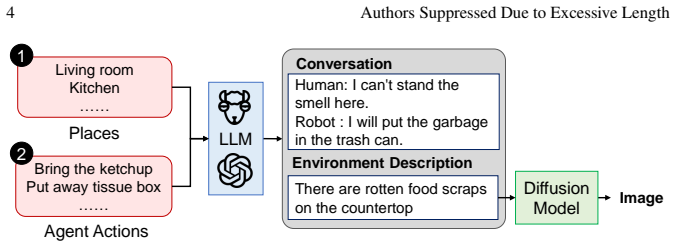
The machinery is a two-path data generation pipeline. Place-based augmentation prompts gpt-3.5 for ten ambiguous-request dialogues per location, while action-based augmentation prompts for dialogues that lead to one of 43 predefined robot actions, then BLIP-Diffusion generates an image from the environment description using a reference image from the real data collection, with 'room' as the constant subject. The resulting image-text pairs fine-tune LLaVA via LoRA, and at inference a sentence encoder matches LLaVA's free-form response to the action label.
What would settle it
Check which image from the real-world data collection was used as the BLIP-Diffusion reference and which partition it belongs to. If that image is in the Do-I-Demand test set, retraining without it should be run, and if accuracy drops to baseline, the augmentation's reported gains are not evidence of generalization. A second check is to generate action-based images without any reference image and compare accuracy, since the paper's ablation only swaps BLIP-Diffusion for SDXL rather than removing the conditioning.
Extended reading notes
Core claim
The central discovery is that action-tied synthetic dialogues, combined with diffusion-generated images conditioned on a reference room, transfer to real-world action selection. The paper reports that action-based augmentation generally beats place-based augmentation, and the two combined give the best results, with both LLaVA-7B and LLaVA-13B improving substantially over unmodified baselines. It also reports that replacing BLIP-Diffusion with SDXL hurts accuracy, indicating that the reference-image conditioning is doing real work.
Load-bearing premise
The method assumes the reference image used to condition BLIP-Diffusion is not taken from the evaluation portion of Do-I-Demand; if it is, the reported gains could be test-set leakage rather than generalization.
Editorial extensions
If this is right
- If the pipeline works as reported, robot assistants can be adapted to new homes or action sets by generating scenario data instead of running thousands of human-robot interactions.
- The combination of place-based and action-based augmentation outperforms either alone, so both diversity of locations and coverage of the action set matter.
- The method's gains concentrate on labels that were at zero accuracy before augmentation, meaning the synthetic data helps the hardest action categories most.
- Action-based augmentation is more effective than place-based augmentation, suggesting that action-specific data is the stronger training signal.
- The ablation shows that reference-image conditioning contributes to the gain, so image realism and consistency matter beyond the text alone.
Reading between the lines
- Beyond the paper, the reported 'zero-shot' accuracy is zero-shot only with respect to the target dataset; the generation pipeline still saw a reference image from that real-world collection, so a stricter test would withhold any real image from the generation pipeline entirely.
- Beyond the paper, the benchmark has only 400 samples and 43 actions, so gains of roughly ten to fifteen points may shrink or vary on larger, more diverse datasets.
- Beyond the paper, a testable extension is to run the same augmentation structure with an open-weight language model in place of gpt-3.5, which would show whether the benefit comes from the LLM's scale or from the augmentation structure itself.
- Beyond the paper, the sentence-encoder matching step is a potential bottleneck; using a fixed output head over the 43 actions instead of cosine-similarity matching might change the measured benefit of augmentation.
Editorial analysis
A structured set of objections, weighed in public.
Referee Report
Summary. The paper proposes ASMR, a data augmentation framework for robotic life-support action classification. It uses GPT-3.5 to generate human-robot dialogues in two modes (place-based and action-based) and diffusion models (SDXL and BLIP-Diffusion) to generate corresponding environmental images. LLaVA-7B/13B is fine-tuned with LoRA on the synthetic data and evaluated zero-shot on the Do-I-Demand benchmark (400 samples). Tables 1 through 3 report consistent accuracy gains from augmentation, with a best accuracy of 48.8%, and the bucket analysis in Section 4.5 shows improvements on labels that initially had zero accuracy. The paper claims that the approach achieves state-of-the-art performance.
Significance. If the reported gains are genuine, the framework would substantially reduce the cost of collecting real human-robot interaction data for intent-to-action mapping, and the within-paper evidence is encouraging: gains appear across two base model sizes, two response encoders, and two augmentation pathways, with ablations isolating the contribution of the BLIP-Diffusion image generator and a prompt-variation study. However, the central claim is not yet fully supported because the evaluation lacks statistical grounding, external comparisons, and a clear guarantee that the image-generation pipeline does not touch the evaluation partition. The paper also provides no code or data release, so the synthetic-data pipeline is not independently reproducible as reported.
major comments (4)
- [Section 3.2] The reference image used to condition BLIP-Diffusion is described only as 'a reference image from our real-world data collection,' with no identification of the image, the number of reference images, or the partition of Do-I-Demand from which it is drawn. Because BLIP-Diffusion preserves the subject and visual style of the reference, and because the paper never describes a train/evaluation split of the 400-sample benchmark, the gains in Table 1 (for example, 31.5 vs. 20.3 for LLaVA-13B utterance-only with SBERT) and the 6-point drop in Table 3 when BLIP is replaced by SDXL could partly reflect leakage of evaluation-domain images into the training set rather than the value of synthetic augmentation. Please disclose the reference-image provenance, ensure it is disjoint from the evaluation set, and report results with the reference image held out from both generation and evaluation.
- [Section 4.1] The paper is inconsistent about whether any real Do-I-Demand training samples are used. Section 1 says training is 'supplemented with a small, real-world dataset,' while Section 4.1 states 'We fine-tune the base models using our augmentation dataset' and evaluates zero-shot accuracy on the evaluation dataset. Specify exactly which real data, if any, are used for fine-tuning, and describe how the 400 samples are divided into any training and evaluation subsets; otherwise the 'zero-shot' interpretation of the results cannot be assessed.
- [Section 4.2 and Table 1] The claims of 'significant improvement' and 'state-of-the-art performance' are not supported by any statistical evidence or external comparison. The table reports single accuracies with no error bars, no number of seeds, no significance tests, and no comparison against previously published results on Do-I-Demand. Please add repeated-seed experiments with variance or confidence intervals and a comparison table that includes prior published results on this benchmark before claiming state-of-the-art performance.
- [Section 3.1 and Section 4.3] No human or automatic quality check of the generated dialogues or images is reported, and the diverse-prompt experiment in Table 2 shows that some prompt variants decrease accuracy (for example, LLaVA-7B utterance-only drops from 30.3 to 23.3). A quality-filtering step or at least a small human evaluation of the generated data would strengthen the claim that the improvements come from realistic synthetic scenarios rather than from accidental distribution matching or from the specific prompt wording.
minor comments (5)
- [Throughout] The manuscript contains inconsistent typography, including 'LLaV A' with a space instead of 'LLaVA' and 'DO-I-DEMAND' versus 'Do-I-Demand'; please unify these.
- [Section 4.1] The 'Description + Utterance' setting is described as combining the human request with 'a description of the environment, inferred from an image'; please clarify whether the actual image is also provided to LLaVA or only the text description, since this affects the interpretation of the multimodal claim.
- [Section 4.5 and Figures 3-4] Please define the bucket construction precisely, including the number of labels per bucket and whether the buckets are computed from baseline or augmented-model predictions, and add y-axis labels to Figures 3 and 4.
- [Abstract and Section 3] The phrase 'large-scale dataset' overstates the synthetic data size (10 places and 43 actions, each with ten dialogues, yields roughly 530 examples); consider a more neutral description.
- [Section 3.2] The prompt templates for dialogue generation are given, but the image-generation prompts for both SDXL and BLIP-Diffusion are not; please include the exact image prompts for reproducibility.
Circularity Check
No circular dependency: the augmentation pipeline's outputs are evaluated against an external benchmark, and no prediction reduces to its own input by construction.
full rationale
The paper's central claim is that synthetic dialogues and diffusion-generated images improve LLaVA's zero-shot action classification on Do-I-Demand. The derivation chain is: (1) GPT-3.5 generates dialogues conditioned on either a place or one of 43 predefined action labels; (2) diffusion models generate images from text descriptions; (3) LLaVA is fine-tuned on these synthetic pairs; (4) zero-shot accuracy is measured on the real Do-I-Demand benchmark. The action labels used in action-based augmentation are the same category names used in evaluation, but this is standard label-conditioned data augmentation rather than a fitted prediction: the model must still learn to map ambiguous utterances and images to the correct action, and the reported accuracy is an externally defined metric, not a quantity reconstructed from the augmentation inputs. The paper also uses a 'reference image from our real-world data collection' to condition BLIP-Diffusion; if that image came from the evaluation partition, the results would be contaminated, but that is an evaluation-leakage risk, not a circularity in the derivation. The self-citations, including to the Do-I-Demand dataset whose authors overlap with the present paper, support the benchmark and related work but are not load-bearing for the central augmentation result. The reported gains over unmodified LLaVA baselines therefore have independent empirical content.
Assumptions & free parameters
free parameters (3)
- generated dialogues per source =
10
- fine-tuning epochs =
5
- blip diffusion reference image =
not specified
assumptions (3)
- domain assumption GPT-3.5-generated dialogues capture the distribution of real ambiguous requests and reflected actions.
- domain assumption Diffusion-model images provide useful first-person visual context for the multimodal model.
- domain assumption Cosine similarity between sentence-encoder embeddings is a valid proxy for action-label matching.
Cite this review
Pith. "Pith review of ASMR: Augmenting Life Scenario using Large Generative Models for Robotic Action Reflection." pith.science (2026). https://pith.science/paper/T7S6PDU6
@misc{pith2026250613956,
  author       = {Pith},
  title        = {Pith review of: ASMR: Augmenting Life Scenario using Large Generative Models for Robotic Action Reflection},
  year         = {2026},
  howpublished = {\url{https://pith.science/paper/T7S6PDU6}},
  note         = {Machine review of arXiv:2506.13956}
}
read the original abstract
When designing robots to assist in everyday human activities, it is crucial to enhance user requests with visual cues from their surroundings for improved intent understanding. This process is defined as a multimodal classification task. However, gathering a large-scale dataset encompassing both visual and linguistic elements for model training is challenging and time-consuming. To address this issue, our paper introduces a novel framework focusing on data augmentation in robotic assistance scenarios, encompassing both dialogues and related environmental imagery. This approach involves leveraging a sophisticated large language model to simulate potential conversations and environmental contexts, followed by the use of a stable diffusion model to create images depicting these environments. The additionally generated data serves to refine the latest multimodal models, enabling them to more accurately determine appropriate actions in response to user interactions with the limited target data. Our experimental results, based on a dataset collected from real-world scenarios, demonstrate that our methodology significantly enhances the robot's action selection capabilities, achieving the state-of-the-art performance.
Figures


Figures from the paper (1 more)

Reference graph
Works this paper leans on
-
[1]
Bommasani, R., Hudson, D.A., Adeli, E., Altman, R., Arora, S., von Arx, S., Bernstein, M.S., Bohg, J., Bosselut, A., Brunskill, E., Brynjolfsson, E., Buch, S., Card, D., Castellon, R., Chat- terji, N.S., Chen, A.S., Creel, K.A., Davis, J., Demszky, D., Donahue, C., Doumbouya, M., Durmus, E., Ermon, S., Etchemendy, J., Ethayarajh, K., Fei-Fei, L., Finn, C....
work page 2021
-
[2]
Brohan, A., Brown, N., Carbajal, J., Chebotar, Y ., Chen, X., Choromanski, K., Ding, T., Driess, D., Dubey, A., Finn, C., Florence, P., Fu, C., Arenas, M.G., Gopalakrishnan, K., Han, K., Hausman, K., Herzog, A., Hsu, J., Ichter, B., Irpan, A., Joshi, N., Julian, R., Kalashnikov, D., Kuang, Y ., Leal, I., Lee, L., Lee, T.W.E., Levine, S., Lu, Y ., Michalew...
work page 2023
-
[3]
Brown, T.B., Mann, B., Ryder, N., Subbiah, M., Kaplan, J., Dhariwal, P., Neelakantan, A., Shyam, P., Sastry, G., Askell, A., Agarwal, S., Herbert-V oss, A., Krueger, G., Henighan, T., Child, R., Ramesh, A., Ziegler, D.M., Wu, J., Winter, C., Hesse, C., Chen, M., Sigler, E., Litwin, M., Gray, S., Chess, B., Clark, J., Berner, C., McCandlish, S., Radford, A...
work page 2020
-
[4]
SalesBot 2.0: A Human-Like Intent-Guided Chit-Chat Dataset
Chang, W.Y ., Chen, Y .N.: SalesBot 2.0: A human-like intent-guided chit-chat dataset. arXiv preprint arXiv:2308.14266 (2023)
work page Pith review arXiv 2023
-
[5]
Chowdhery, A., Narang, S., Devlin, J., Bosma, M., Mishra, G., Roberts, A., Barham, P., Chung, H.W., Sutton, C., Gehrmann, S., Schuh, P., Shi, K., Tsvyashchenko, S., Maynez, J., Rao, A., Barnes, P., Tay, Y ., Shazeer, N., Prabhakaran, V ., Reif, E., Du, N., Hutchinson, B., Pope, R., Bradbury, J., Austin, J., Isard, M., Gur-Ari, G., Yin, P., Duke, T., Levsk...
work page 2022
-
[6]
Chung, H.W., Hou, L., Longpre, S., Zoph, B., Tay, Y ., Fedus, W., Li, Y ., Wang, X., Dehghani, M., Brahma, S., Webson, A., Gu, S.S., Dai, Z., Suzgun, M., Chen, X., Chowdhery, A., Castro- Ros, A., Pellat, M., Robinson, K., Valter, D., Narang, S., Mishra, G., Yu, A., Zhao, V ., Huang, Y ., Dai, A., Yu, H., Petrov, S., Chi, E.H., Dean, J., Devlin, J., Robert...
work page 2022
-
[7]
Devlin, J., Chang, M.W., Lee, K., Toutanova, K.: Bert: Pre-training of deep bidirectional trans- formers for language understanding (2019)
work page 2019
-
[8]
Driess, D., Xia, F., Sajjadi, M.S.M., Lynch, C., Chowdhery, A., Ichter, B., Wahid, A., Tomp- son, J., Vuong, Q., Yu, T., Huang, W., Chebotar, Y ., Sermanet, P., Duckworth, D., Levine, S., Vanhoucke, V ., Hausman, K., Toussaint, M., Greff, K., Zeng, A., Mordatch, I., Florence, P.: Palm-e: An embodied multimodal language model (2023)
work page 2023
Show all 42 references
-
[9]
Minds and Ma- chines30, 681–694 (2020)
Floridi, L., Chiriatti, M.: GPT-3: Its nature, scope, limits, and consequences. Minds and Ma- chines30, 681–694 (2020)
2020
-
[10]
In: International Conference on Learning Repre- sentations (2021)
Hu, E.J., Wallis, P., Allen-Zhu, Z., Li, Y ., Wang, S., Wang, L., Chen, W., et al.: LoRA: Low- rank adaptation of large language models. In: International Conference on Learning Repre- sentations (2021)
2021
-
[11]
In: Proceedings of the 24th Annual Meeting of the Special Interest Group on Discourse and Dialogue, pp
Huang, C.W., Hsu, C.Y ., Hsu, T.Y ., Li, C.A., Chen, Y .N.: CONVERSER: Few-shot conver- sational dense retrieval with synthetic data generation. In: Proceedings of the 24th Annual Meeting of the Special Interest Group on Discourse and Dialogue, pp. 381–387 (2023)
2023
-
[12]
URLhttps://arxiv.org/abs/2207.05289
Huang, C.W., Tsai, S.C., Chen, Y .N.: Plm-icd: Automatic icd coding with pretrained language models (2022). URLhttps://arxiv.org/abs/2207.05289
2022 arXiv
-
[13]
Huang, S., Dong, L., Wang, W., Hao, Y ., Singhal, S., Ma, S., Lv, T., Cui, L., Mohammed, O.K., Patra, B., Liu, Q., Aggarwal, K., Chi, Z., Bjorck, J., Chaudhary, V ., Som, S., Song, X., Wei, F.: Language is not all you need: Aligning perception with language models (2023)
2023
-
[14]
In: Proceedings of the 2023 Conference on Empirical Methods in Natural Language Processing, pp
Kim, H., Hessel, J., Jiang, L., West, P., Lu, X., Yu, Y ., Zhou, P., Bras, R., Alikhani, M., Kim, G., Sap, M., Choi, Y .: SODA: Million-scale dialogue distillation with social commonsense contextualization. In: Proceedings of the 2023 Conference on Empirical Methods in Natural...
2023
-
[15]
In: Proceedings of the 23rd Annual Meeting of the Special Interest Group on Discourse and Dialogue, pp
Lai, C.M., Hsu, M.H., Huang, C.W., Chen, Y .N.: Controllable user dialogue act augmentation for dialogue state tracking. In: Proceedings of the 23rd Annual Meeting of the Special Interest Group on Discourse and Dialogue, pp. 53–61 (2022)
2022
-
[16]
Li, D., Li, J., Hoi, S.C.H.: Blip-diffusion: Pre-trained subject representation for controllable text-to-image generation and editing (2023)
2023
-
[17]
Liu, H., Li, C., Wu, Q., Lee, Y .J.: Visual instruction tuning (2023)
2023
-
[18]
Liu, Y ., Ott, M., Goyal, N., Du, J., Joshi, M., Chen, D., Levy, O., Lewis, M., Zettlemoyer, L., Stoyanov, V .: Roberta: A robustly optimized bert pretraining approach (2019)
2019
-
[19]
Mansimov, E., Parisotto, E., Ba, J.L., Salakhutdinov, R.: Generating images from captions with attention (2016)
2016
-
[20]
Nichol, A., Dhariwal, P., Ramesh, A., Shyam, P., Mishkin, P., McGrew, B., Sutskever, I., Chen, M.: Glide: Towards photorealistic image generation and editing with text-guided diffusion models (2022)
2022
-
[21]
OpenAI: Gpt-4 technical report (2023)
2023
-
[22]
Ouyang, L., Wu, J., Jiang, X., Almeida, D., Wainwright, C.L., Mishkin, P., Zhang, C., Agar- wal, S., Slama, K., Ray, A., Schulman, J., Hilton, J., Kelton, F., Miller, L., Simens, M., Askell, A., Welinder, P., Christiano, P., Leike, J., Lowe, R.: Training language models to fol...
2022
-
[23]
Peng, B., Li, C., He, P., Galley, M., Gao, J.: Instruction tuning with gpt-4 (2023)
2023
-
[24]
Peng, Z., Wang, W., Dong, L., Hao, Y ., Huang, S., Ma, S., Wei, F.: Kosmos-2: Grounding multimodal large language models to the world (2023)
2023
-
[25]
Podell, D., English, Z., Lacey, K., Blattmann, A., Dockhorn, T., M ¨uller, J., Penna, J., Rom- bach, R.: Sdxl: Improving latent diffusion models for high-resolution image synthesis (2023)
2023
-
[26]
Raffel, C., Shazeer, N., Roberts, A., Lee, K., Narang, S., Matena, M., Zhou, Y ., Li, W., Liu, P.J.: Exploring the limits of transfer learning with a unified text-to-text transformer (2023)
2023
-
[27]
Ramesh, A., Dhariwal, P., Nichol, A., Chu, C., Chen, M.: Hierarchical text-conditional image generation with clip latents (2022)
2022
-
[28]
Ramesh, A., Pavlov, M., Goh, G., Gray, S., V oss, C., Radford, A., Chen, M., Sutskever, I.: Zero-shot text-to-image generation (2021)
2021
-
[29]
Reed, S., Akata, Z., Yan, X., Logeswaran, L., Schiele, B., Lee, H.: Generative adversarial text to image synthesis (2016)
2016
-
[30]
Reimers, N., Gurevych, I.: Sentence-bert: Sentence embeddings using siamese bert-networks (2019)
2019
-
[31]
Rombach, R., Blattmann, A., Lorenz, D., Esser, P., Ommer, B.: High-resolution image syn- thesis with latent diffusion models (2022)
2022
-
[32]
Saharia, C., Chan, W., Saxena, S., Li, L., Whang, J., Denton, E., Ghasemipour, S.K.S., Ayan, B.K., Mahdavi, S.S., Lopes, R.G., Salimans, T., Ho, J., Fleet, D.J., Norouzi, M.: Photorealistic text-to-image diffusion models with deep language understanding (2022)
2022
-
[33]
IEEE Access12, 11,774–11,784 (2024)
Tanaka, S., Yamasaki, K., Yuguchi, A., Kawano, S., Nakamura, S., Yoshino, K.: Do as i de- mand, not as i say: A dataset for developing a reflective life-support robot. IEEE Access12, 11,774–11,784 (2024). DOI 10.1109/ACCESS.2024.3350174
2024
-
[34]
Tanaka, S., Yoshino, K., Sudoh, K., Nakamura, S.: Arta: Collection and classification of am- biguous requests and thoughtful actions (2021)
2021
-
[35]
Thoppilan, R., Freitas, D.D., Hall, J., Shazeer, N., Kulshreshtha, A., Cheng, H.T., Jin, A., Bos, T., Baker, L., Du, Y ., Li, Y ., Lee, H., Zheng, H.S., Ghafouri, A., Menegali, M., Huang, Y ., Krikun, M., Lepikhin, D., Qin, J., Chen, D., Xu, Y ., Chen, Z., Roberts, A., Bosma, ...
2022
-
[36]
Touvron, H., Martin, L., Stone, K., Albert, P., Almahairi, A., Babaei, Y ., Bashlykov, N., Batra, S., Bhargava, P., Bhosale, S., Bikel, D., Blecher, L., Ferrer, C.C., Chen, M., Cucurull, G., Es- iobu, D., Fernandes, J., Fu, J., Fu, W., Fuller, B., Gao, C., Goswami, V ., Goyal,...
2023
-
[37]
Tsai, S.C., Chen, Y .N.: Balancing knowledge delivery and emotional comfort in healthcare conversational systems. In: M.I. Torres, Y . Matsuda, Z. Callejas, A. del Pozo, L.F. D’Haro (eds.) Proceedings of the 15th International Workshop on Spoken Dialogue Systems Tech- nology, ...
2025
-
[38]
Yang, L., Zhang, Z., Song, Y ., Hong, S., Xu, R., Zhao, Y ., Zhang, W., Cui, B., Yang, M.H.: Diffusion models: A comprehensive survey of methods and applications (2023)
2023
-
[39]
Yu, J., Xu, Y ., Koh, J.Y ., Luong, T., Baid, G., Wang, Z., Vasudevan, V ., Ku, A., Yang, Y ., Ayan, B.K., Hutchinson, B., Han, W., Parekh, Z., Li, X., Zhang, H., Baldridge, J., Wu, Y .: Scaling autoregressive models for content-rich text-to-image generation (2022)
2022
-
[40]
Zhang, C., Zhang, C., Zhang, M., Kweon, I.S.: Text-to-image diffusion models in generative ai: A survey (2023)
2023
-
[41]
Zhang, T., Wang, Z., Huang, J., Tasnim, M.M., Shi, W.: A survey of diffusion based image generation models: Issues and their solutions (2023)
2023
-
[42]
Zhao, W.X., Zhou, K., Li, J., Tang, T., Wang, X., Hou, Y ., Min, Y ., Zhang, B., Zhang, J., Dong, Z., Du, Y ., Yang, C., Chen, Y ., Chen, Z., Jiang, J., Ren, R., Li, Y ., Tang, X., Liu, Z., Liu, P., Nie, J.Y ., Wen, J.R.: A survey of large language models (2023)
2023
Reviewed August 7, 2026 · model on record in the stance chip above.
Discussion (0). Continue with ORCID to comment.