REVIEW 3 major objections 5 minor 28 references
Evolutionary chemical learning in dimerization networks
T0 review · 3 major / 5 minor · reviewed 2026-08-07 · deepseek-v4-flash
Pith's one-line read Competitive dimerization networks can be trained by directed evolution to classify noisy input mixtures, with performance rivaling gradient descent.
desk verdict Simulated directed evolution trains dimerization networks for classification, but the in vitro claim outruns the evidence and the independent-mutation model is the soft underbelly. read the letter →
The pith
A machine-rendered reading of the paper's core claim, the machinery that carries it, and where it could break.
The reading
What carries the argument
The central objects are the equilibrium equations of the dimerization network: for total concentrations $c_i$ and free concentrations $x_i = f_i c_i$, mass action gives $c_i = x_i + \sum_j K_{ij} x_i x_j$, and the output fugacities solve $f_i = 1/(1 + \sum_j K_{ij} c_j f_j)$. This fixed-point system is what maps an input cocktail (the input concentrations $c_{\mathrm{in}}$) to output fugacities $f_{\mathrm{out}}$. Training is driven by the mutation model of Eq. (3), where each association constant undergoes a biased multiplicative random walk, $K_{ij}(t+1) = K_{ij}(t) e^{\sigma_{\mathrm{mut}}(\eta_{ij}(t)-\eta_0)}$, with drift $\eta_0$ toward weaker binding acting as a regulariser; selection uses the contrast loss of Eq. (4), which penalises the worst output component's ratio of mean 'off' fugacity to geometric-mean 'on' fugacity. The same equilibrium equations admit linear-response gradients (SI section D), enabling a direct comparison with gradient descent training.
What would settle it
A direct experimental test would be to run the proposed in vitro directed evolution protocol on a three-class, six-input CDN made of non-complementary DNA oligomers and measure classification accuracy and mutual information at 20% input noise; if the trained chemical classifier does not approach the simulated near-maximal mutual information, the central claim is falsified. A computational falsifier: replace the independent multiplicative random walk of Eq. (3) with correlated mutations affecting multiple $K_{ij}$ (for example, via shared sequence segments) and check whether the evolved network still reaches the same performance; if performance collapses, the independent-walk assumption is load-bearing.
Extended reading notes
Core claim
The central discovery is that the equilibrium state of a competitive dimerization network — described by the mass-action equations $c_i = x_i + \sum_j K_{ij} x_i x_j$ with output fugacities $f_i = 1/(1 + \sum_j K_{ij} c_j f_j)$ — is expressive enough to act as a nonlinear classifier, and that its parameters (the association constants $K_{ij}$ and the hidden-layer concentrations) can be tuned by an evolutionary protocol rather than by gradient descent. Using a contrast-enhancing loss function, the evolutionary search produces output fugacity distributions whose 'on' and 'off' states are separated by several orders of magnitude and whose mutual information approaches the theoretical maximum of 1. The same model trained by gradient descent gives highly correlated performance, despite the network being bidirectional, having strictly nonnegative weights, and using the mass-action activation function $1/(1+y)$.
Load-bearing premise
The whole training protocol rests on the assumption that each round of mutagenesis changes every binding affinity independently, as a multiplicative random walk; if real mutations move several affinities together, the evolutionary search may behave very differently from the simulations.
Editorial extensions
If this is right
- Once trained, the chemical classifier requires no digital computation: a new input cocktail directly produces output fugacities (read out, for example, via FRET) that identify the class.
- The training protocol is compatible with existing DNA-based CDN implementations, using PCR-based random mutagenesis, restriction cleavage, and dilution, so the framework is experimentally realisable with current molecular biology techniques.
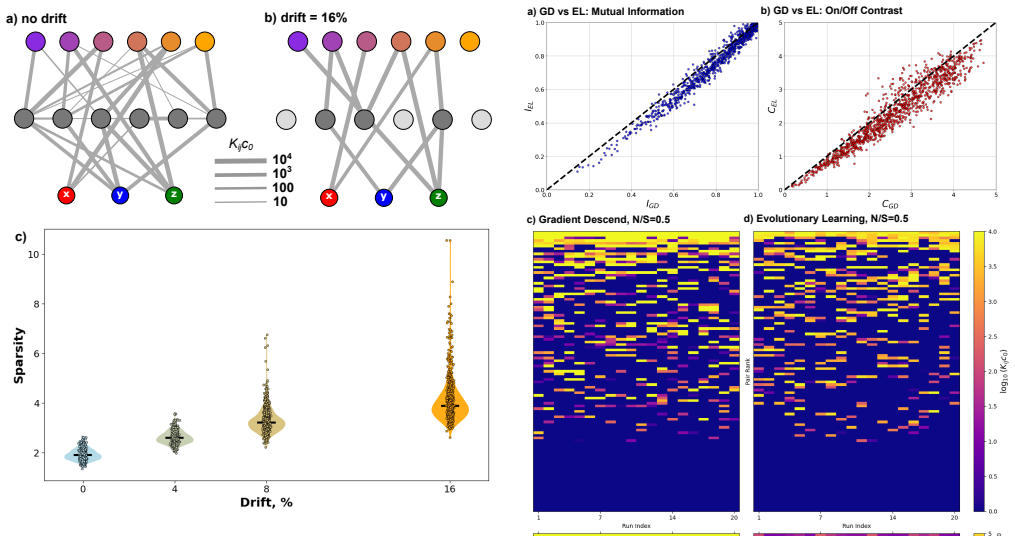
- The drift parameter $\eta_0$ acts as a regulariser that produces sparser networks with fewer strong interactions, making the trained dimerization networks more interpretable.
- Because evolutionary learning and gradient descent give closely correlated performance, an in silico design phase can be used to pre-select association constants, which are then refined in vitro by directed evolution in a hybrid training strategy.
- The loss function matters for output dynamic range: the contrast loss gives far better on/off separation than mean-squared error, while mutual information saturates near its maximum for both, so the choice of loss governs whether the goal is clean thresholding or information transmission.
Reading between the lines
- The paper only demonstrates networks with $n_{\mathrm{out}} = 3$ output classes, so a natural untested extension is whether the evolutionary search remains effective for larger class counts, where the loss landscape may be more rugged.
- The contrast loss uses a geometric mean of 'on' fugacities, which suggests the trained networks may be insensitive to the absolute concentration scale of the inputs; if so, the protocol would be especially convenient for biosensing applications where absolute concentrations are hard to control.
- The authors draw an analogy to Hopfield networks but do not explore it; if the analogy holds, the same CDN framework could implement associative memory, storing multiple input patterns as attractors rather than only classifying them.
- Because the mutation model multiplies each $K_{ij}$ independently, the training dynamics depend only on ratios of binding affinities; this suggests the protocol's behaviour is scale-invariant, which could simplify experimental calibration.
Signed reviews
Editorial analysis
A structured set of objections, weighed in public.
Referee Report
Summary. The paper proposes a chemical learning framework based on Competitive Dimerization Networks (CDNs), in which reversible dimerization equilibria of N molecular species implement a classifier from input concentrations to output monomer fugacities. A directed-evolution training protocol is outlined (Fig. 1c), with mutations modeled as independent biased multiplicative random walks on each association constant Kij (Eq. 3). The authors simulate this protocol numerically for three-class classification, reporting high on/off contrast and mutual information, robustness to input noise, sparsity induced by a drift parameter, and performance comparable to gradient descent (Figs. 2–5). Code and data are provided.
Significance. The CDN classifier is an intriguing physical-computation concept: the mass-action equilibrium equations are standard, and the mapping from chemical concentrations and affinities to a nonlinear classifier is clearly presented. The held-out test cocktails used for evaluation prevent the loss functions from being self-fulfilling, and the comparison with gradient descent is a useful sanity check. The availability of code and an interactive figure is a strength. However, the manuscript's central claim that CDNs 'can be trained in vitro' is not supported by experiments, and the mutation model may unrealistically inflate the searchable parameter space. If the proposed protocol can be realized and the mutation assumption can be relaxed, this would be a notable advance; at present the evidence is purely in silico.
major comments (3)
- [Abstract; Significance Statement; Discussion] The abstract states that CDNs 'can be trained in vitro through directed evolution' and the Discussion says the study 'demonstrated their in vitro training through directed evolution.' However, no wet-lab experiment is reported anywhere in the manuscript. The training protocol in Fig. 1c is a proposal, and the results in Figs. 2–5 and the SI are entirely numerical. Moreover, the protocol text says variants are 'ranked in silico' by the loss function, so even the proposed selection step is computational. Please revise the claims to 'proposed' or 'demonstrated in silico,' and clearly separate the proposal of an experimental protocol from the actual numerical demonstration.
- [Eq. 3; 'In-vitro Training via Directed Evolution'] Eq. 3 models each Kij as an independent biased multiplicative random walk. In any sequence-based implementation (DNA oligomers as described), a single mutation in a master sequence changes the binding free energy of that species with all of its partners simultaneously, inducing strong correlations among the Kij. The simulations therefore effectively optimize O(N^2) independent parameters, whereas a sequence realization offers only O(N) sequence degrees of freedom plus concentrations. The near-optimal mutual information and contrast in Figs. 2–3 may rely on this unrealistically large search space. The authors acknowledge that a 'more detailed study' would compute Kij from sequences (citing Ref. 27), but they do not test whether correlated mutations still permit learning. Since the in vitro trainability claim depends on this assumption, please add a test with correlated mutations, for example a sequence-based model in which Kij is derived from pairwise sequence complementarity, or a block-correlated mutation model that perturbs all affinities of a mutated species jointly.
- [Results; SI Appendix C] The training protocol includes mutating both Kij and the hidden/output concentrations, with 150 variants per generation. The reported performance is averaged over multiple drift (EL) and regularization (GD) parameters, but the manuscript does not report the variance or error bars for the mutual-information and contrast values in Figs. 3e–j and 5a–b. Since the loss landscape is described as 'highly degenerate and rugged,' a small number of runs (e.g., 20 in Fig. 5c–d) may not establish that EL reliably matches GD. Please provide error bars or a statement of the number of independent realizations used in each heatmap/scatterplot.
minor comments (5)
- [Eq. 4] The two displayed forms of the contrast loss are not obviously equivalent; please define the averages and the indicator variable phi more explicitly, and show the algebra connecting the two expressions.
- [SI Appendix, Eq. 21] The derivative of the contrast loss appears to have index inconsistencies (e.g., delta_ij with a beta index and a j = argmax condition). Please check and clarify.
- [Fig. 2e caption] The caption states that 'all displayed interactions have identical association constants, fixed at the upper saturation limit,' while the main text says edge thickness reflects log Kij. If all Kij are identical, the thicknesses should be uniform; please resolve this discrepancy.
- [Model and Protocols] The term 'fugacity' is used for the fraction of total concentration that remains unbound, which is not the standard thermodynamic fugacity; consider using 'free fraction' or 'unbound fraction' to avoid confusion.
- [SI Appendix C] The drift parameter is called 'negative drift' in the main text but eta0 appears positive; please define the sign convention consistently.
Circularity Check
No significant circularity: the evolutionary-training results are evaluated on held-out test cocktails, not enforced by the loss function or by self-citation.
full rationale
I walked the derivation chain from the mass-action equilibrium (Eqs. 1–2) through the mutation model (Eq. 3), the contrast loss (Eq. 4), the reported metrics (Eqs. 5 and 9), and the gradient-descent comparison (SI D). No load-bearing step reduces to its own input. The training procedure optimizes the contrast loss on batches of training cocktails, while the paper's headline results are evaluated on test realizations of the same cocktail classes with independent multiplicative noise; the reported high mutual information and contrast are therefore not enforced by construction. The loss function does define what selection rewards, but that is standard optimization, not a circular prediction. The only self-citations (refs. 17–18) are background statements about reversible protein-binding networks and do not carry the central claim. There is no uniqueness theorem, no fitted parameter renamed as a prediction, and no ansatz smuggled in via citation. The acknowledged simplification in Eq. 3 (independent multiplicative random walks of each Kij) is a modeling assumption that may affect the experimental validity of the in vitro protocol; the paper explicitly notes that a more detailed sequence-level model would be needed. That is a correctness or falsifiability concern, not a circularity, because the numerical results are not defined in terms of the conclusion. The comparison to gradient descent provides an external benchmark, and the paper's central claim of evolutionary training is self-contained. Accordingly, the paper is not circular.
Assumptions & free parameters
free parameters (7)
- sigma_mut =
0.5
- eta0 =
varied, up to 16%
- delta =
0.015
- cmin, cmax =
0.2, 5.0
- Kmax =
10^4/c0
- batch size and M =
48 cocktails, 49 mutants
- input distribution width sigma^2 =
2
assumptions (4)
- standard math The system is at chemical equilibrium described by mass-action equations (Eqs. 1 and 2).
- domain assumption No complexes larger than dimers form.
- ad hoc to paper Mutations independently perturb each association constant Kij via a biased multiplicative random walk (Eq. 3).
- domain assumption Output fugacities can be read and used for selection (e.g., via FRET).
Cite this review
Pith. "Pith review of Evolutionary chemical learning in dimerization networks." pith.science (2026). https://pith.science/paper/L5DLLR2B
@misc{pith2026250614006,
  author       = {Pith},
  title        = {Pith review of: Evolutionary chemical learning in dimerization networks},
  year         = {2026},
  howpublished = {\url{https://pith.science/paper/L5DLLR2B}},
  note         = {Machine review of arXiv:2506.14006}
}
read the original abstract
We present a novel framework for chemical learning based on Competitive Dimerization Networks (CDNs) - systems in which multiple molecular species, e.g. proteins or DNA/RNA oligomers, reversibly bind to form dimers. We show that these networks can be trained in vitro through directed evolution, enabling the implementation of complex learning tasks such as multiclass classification without digital hardware or explicit parameter tuning. Each molecular species functions analogously to a neuron, with binding affinities acting as tunable synaptic weights. A training protocol involving mutation, selection, and amplification of DNA-based components allows CDNs to robustly discriminate among noisy input patterns. The resulting classifiers exhibit strong output contrast and high mutual information between input and output, especially when guided by a contrast-enhancing loss function. Comparative analysis with in silico gradient descent training reveals closely correlated performance. These results establish CDNs as a promising platform for analog physical computation, bridging synthetic biology and machine learning, and advancing the development of adaptive, energy-efficient molecular computing systems.
Figures


Figures from the paper (5 more)


Reference graph
Works this paper leans on
-
[1]
A Krizhevsky, I Sutskever, GE Hinton, Imagenet classification with deep convolutional neural networks.Commun. ACM60, 84–90 (2017)
work page 2017
-
[2]
I Goodfellow, Y Bengio, A Courville,Deep Learning. (MIT Press), (2016)
work page 2016
-
[3]
X Lin, et al., All-optical machine learning using diffractive deep neural networks.Science361, 1004–1008 (2018)
work page 2018
-
[4]
BJ Shastri, et al., Photonics for artificial intelligence and neuromorphic computing.Nat. Photonics15, 102–114 (2021)
work page 2021
-
[5]
C Li, et al., Efficient and self-adaptive in-situ learning in multilayer memristor neural networks. Nat. communications9, 2385 (2018)
work page 2018
-
[6]
A Murugan, Z Zeravcic, MP Brenner, S Leibler, Multifarious assembly mixtures: Systems allowing retrieval of diverse stored structures.Proc. Natl. Acad. Sci.112, 54–59 (2015)
work page 2015
-
[7]
LG Wright, et al., Deep physical neural networks trained with backpropagation.Nature601, 549–555 (2022)
work page 2022
-
[8]
A Momeni, B Rahmani, M Malléjac, P del Hougne, R Fleury, Backpropagation-free training of deep physical neural networks.Science382, 1297–1303 (2023)
work page 2023
Show all 28 references
-
[9]
M Stern, A Murugan, Learning without neurons in physical systems.Annu. Rev. Condens. Matter Phys.14, 417–441 (2023)
2023
-
[10]
M Stern, D Hexner, JW Rocks, AJ Liu, Supervised learning in physical networks: From machine learning to learning machines.Phys. Rev. X11, 021045 (2021)
2021
-
[11]
M Sitti, Physical intelligence as a new paradigm.Extrem. Mech. Lett.46, 101340 (2021)
2021
-
[12]
D Bray, Protein molecules as computational elements in living cells.Nature376, 307–312 (1995)
1995
-
[13]
Science283, 381–387 (1999)
US Bhalla, R Iyengar, Emergent properties of networks of biological signaling pathways. Science283, 381–387 (1999)
1999
-
[14]
BA Kramer, J Sarabia Del Castillo, L Pelkmans, Multimodal perception links cellular state to decision-making in single cells.Science377, 642–648 (2022)
2022
-
[15]
(Springer International Publishing), p
W Poole, et al.,Chemical Boltzmann Machines. (Springer International Publishing), p. 210–231 (2017)
2017
-
[16]
C Floyd, AR Dinner, A Murugan, S Vaikuntanathan, Limits on the computational expressivity of non-equilibrium biophysical processes (2024)
2024
-
[17]
S Maslov, I Ispolatov, Propagation of large concentration changes in reversible protein-binding networks.Proc Natl Acad Sci U S A104, 13655–60 (2007)
2007
-
[18]
S Maslov, K Sneppen, I Ispolatov, Spreading out of perturbations in reversible reaction networks.New J Phys9, 273 (2007)
2007
-
[19]
HE Klumpe, J Garcia-Ojalvo, MB Elowitz, YE Antebi, The computational capabilities of many- to-many protein interaction networks.Cell Syst.14, 430–446 (2023)
2023
-
[20]
J Parres-Gold, M Levine, B Emert, A Stuart, MB Elowitz, Contextual computation by competitive protein dimerization networks.Cell188, 1984–2002.e17 (2025)
2025
-
[21]
S Brannetti, S Gentile, ED Grosso, S Otto, F Ricci, Covalent dynamic DNA networks to translate multiple inputs into programmable outputs.J. Am. Chem. Soc.147, 5755–5763 (2025)
2025
-
[22]
Chem.15, 70–82 (2023)
MP Nikitin, Non-complementary strand commutation as a fundamental alternative for informa- tion processing by DNA and gene regulation.Nat. Chem.15, 70–82 (2023)
2023
-
[23]
20, 214 (2019)
TW Hiscock, Adapting machine-learning algorithms to design gene circuits.BMC Bioinforma. 20, 214 (2019)
2019
-
[24]
Commun.12, 3125 (2021)
J Shen, F Liu, Y Tu, C Tang, Finding gene network topologies for given biological function with recurrent neural network.Nat. Commun.12, 3125 (2021)
2021
-
[25]
JJ Hopfield, Neural networks and physical systems with emergent collective computational abilities.Proc. Natl. Acad. Sci.79, 2554–2558 (1982)
1982
-
[26]
JJ Hopfield, Neurons with graded response have collective computational properties like those of two-state neurons.Proc. Natl. Acad. Sci.81, 3088–3092 (1984)
1984
-
[27]
J SantaLucia, A unified view of polymer, dumbbell, and oligonucleotide DNA nearest-neighbor thermodynamics.Proc. Natl. Acad. Sci.95, 1460–1465 (1998)
1998
-
[28]
contrast
DP Kingma, Adam: A method for stochastic optimization.Preprint:arXiv, 1412.6980 (2014). 7 SI Appendix A. Loss functions.In our modeling of evolutionary training we employed two different loss functions, one of which is the "contrast" loss introduced by Eq.(4) in the main text,...
2014 arXiv
Reviewed August 7, 2026 · model on record in the stance chip above.
Discussion (0). Continue with ORCID to comment.