REVIEW 4 major objections 4 minor 5 cited by
Revisiting Reinforcement Learning for LLM Reasoning from A Cross-Domain Perspective
T0 review · 4 major / 4 minor · reviewed 2026-08-07 · deepseek-v4-flash
Pith's one-line read RL for LLM reasoning is domain-dependent: heavily pretrained domains benefit from cross-domain training, while lightly pretrained domains need in-domain data.
desk verdict Useful multi-domain RL dataset, but the 'skill acquisition' headline is confounded by unmeasured pretraining exposure and task difficulty. read the letter →
The pith
A machine-rendered reading of the paper's core claim, the machinery that carries it, and where it could break.
The reading
What carries the argument
The load-bearing artifact is GURU, a 92K-example corpus with a domain-specific binary reward for every sample: rule-based matching for math, logic, simulation, and tabular; execution against test cases for code; and a small verifier model for science. A two-stage filter uses pass rates of a weak and a strong model to remove easy, noisy, and anomalous samples, and a difficulty gap controls learnability. The cross-domain transfer experiments train on 3K examples per domain and compare gain patterns across 13 online tasks; Pass@k curves provide the boundary-expansion evidence.
What would settle it
Measure or reconstruct the Qwen2.5 pretraining composition and verify that logic, simulation, and tabular really are under-represented; alternatively, train a model on a pretraining mixture with equal domain shares and test whether the asymmetric transfer pattern disappears. If a domain the authors classify as lightly pretrained shows robust cross-domain transfer under controlled exposure, the skill-acquisition conclusion would need revision.
Extended reading notes
Core claim
The central claim is that RL's role in LLM reasoning is not uniformly "elicitation of existing knowledge"; it depends on how much pretraining exposure the domain received. For math, code, and science, cross-domain RL produces clear gains, consistent with RL amplifying latent knowledge. For logic, simulation, and tabular reasoning, only in-domain RL gives meaningful improvement, which the authors interpret as evidence that RL facilitates genuine skill acquisition. The paper also shows that a uniformly mixed multi-domain RL corpus matches or exceeds single-domain training, and that Pass@k expansion—RL widening the set of correct answers a base model can reach—occurs on synthetic tasks like Zebra Puzzle but not on math benchmarks like AIME24. The resulting GURU-7B and GURU-32B models outperform the best open RL-trained baselines by 7.9% and 6.7% across a 17-task suite.
Load-bearing premise
The premise that carries the interpretation is that math, code, and science are heavily represented in the base model's pretraining while logic, simulation, and tabular are not; the paper infers this from the literature and benchmark difficulty rather than measuring the pretraining corpus.
Editorial extensions
If this is right
- Multi-domain RL training from base models can match or beat single-domain RL, so reasoning data collection should not stop at math and code.
- RL-trained models can expand the Pass@k reasoning boundary on tasks with low pretraining exposure, such as synthetic Zebra Puzzles, even when they cannot do so on AIME24.
- Aggressive difficulty filtering improves in-domain math performance but can hurt performance on easier cross-domain tasks like HumanEval and HiTab.
- General reasoning benchmarks should include under-represented domains if RL research is to learn about skill acquisition rather than about math elicitation.
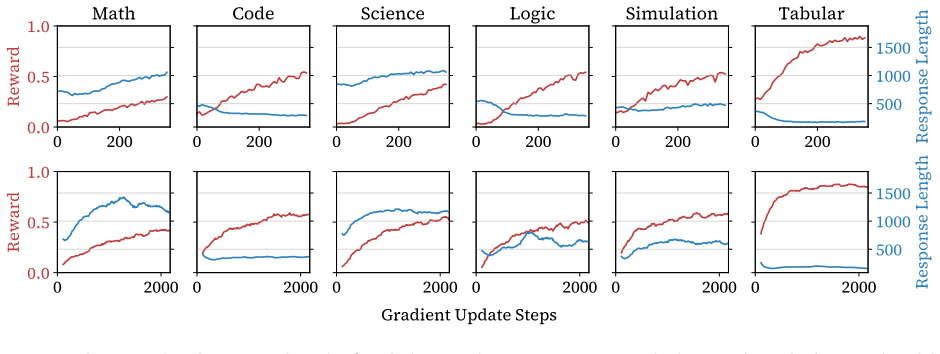
- Response-length behavior during RL is domain-dependent: code, logic, and tabular training can shorten outputs while math and science lengthen them.
Reading between the lines
- The elicitation-versus-acquisition distinction may be better framed as a continuum fixed by pretraining exposure; a direct test would train a base model on controlled domain mixtures and rerun the transfer matrix.
- If in-domain RL truly acquires new skills in lightly pretrained domains, scaling compute and data in those domains could be more valuable than adding harder math; a prediction is that GURU-style training on logic and simulation should continue improving beyond the reported epochs.
- Pass@k as a boundary measure is sensitive to decoding temperature and top-p, so its use as evidence should be paired with output-entropy reporting to separate exploration from new capability.
- The mixed-corpus result suggests domain interference is small at six domains, but the paper leaves open whether balancing strategies are needed as domain count grows; that is a natural next experiment with the released corpus.
Editorial analysis
A structured set of objections, weighed in public.
Referee Report
Summary. The paper introduces GURU, a curated 92K-example reinforcement learning (RL) reasoning corpus spanning six domains (Math, Code, Science, Logic, Simulation, Tabular), with domain-specific reward design, deduplication, and difficulty filtering. Using GRPO on Qwen2.5-7B and Qwen2.5-32B base models, the authors conduct a controlled transfer study with 3K samples per domain and a mixed-domain 18K set. They report that Math, Code, and Science show positive cross-domain transfer, whereas Logic, Simulation, and Tabular require in-domain training, and interpret this as evidence that RL can acquire new skills in under-exposed domains. They further report mixed-domain training matches or exceeds single-domain training, difficulty filtering improves in-domain performance while hurting easy cross-domain transfer, and Pass@k behavior varies by task, scale, and decoding parameters. The authors release data, models, and code, and report state-of-the-art average performance on a 17-task suite among open models trained on public data with RL.
Significance. If the transfer asymmetry is robust, the paper provides a valuable multi-domain RL dataset and challenges the amplifier-only view of RL for reasoning, with open data, models, and code as a strong community contribution. The paper's empirical measurements are extensive and reproducible in principle. However, the central interpretation—that the transfer differences arise from pretraining exposure and that RL facilitates genuine skill acquisition—rests on an unmeasured and confounded domain split, and the key Pass@k evidence is partly circular. The dataset and empirical findings are significant, but the theoretical conclusion currently exceeds what the evidence supports.
major comments (4)
- [Sec. 3.1 / Abstract] The central skill-acquisition claim rests on an unmeasured pretraining-exposure split. The paper never measures Qwen2.5's pretraining data composition; the categorization of Math, Code, and Science as heavily pretrained and Logic, Simulation, and Tabular as lightly pretrained is justified by citing prior continual-pretraining literature (Ke et al., 2023; Yang et al., 2024) rather than direct evidence. This split is also correlated with task difficulty and format: ARC-AGI, Zebra Puzzle, and CodeI/O start near 0-16% base accuracy in Table 3, while Math/Code/Science tasks have much higher floors. Under this correlation, the low cross-domain gains on hard tasks are exactly what a difficulty effect predicts, independent of any exposure mechanism. The abstract and introduction assert 'limited pretraining exposure' as a fact, whereas Section 3.1 only states 'We hypothesize.' The skill-acquisition claim is not yet supported; the authors should either measure or otherwise control for pretraining exposure (e.g., match tasks on base accuracy or provide direct data-mixture evidence), or reframe the finding as a domain- and difficulty-dependent transfer effect.
- [Sec. 4.3 / B.4] The Pass@k evidence for a 'new reasoning boundary' is confounded by the evaluation and training sharing the same synthetic task family. The Zebra Puzzle evaluation set is generated by the same back-solving pipeline used for training (footnote 1 and Sec. B.4), so the expanded Pass@k on that task can be explained by learning the generator's template rather than a general logical skill. The paper should validate the boundary-expansion claim on held-out logic tasks from different generators or with a different evaluation process, or it should temper the claim accordingly.
- [Sec. 3 / Fig. 3 / Sec. 4.1] All reported transfer and main results are single-run, with checkpoint selection based on best average accuracy on online tasks (Sec. 3 and Sec. 4.1). No error bars or significance tests are provided, so the claimed patterns (e.g., 'cold colors on all non-diagonal cells' and the 7.9%/6.7% margins over baselines in Table 3) could be driven by selection noise. The authors should report multiple seeds or at least standard errors for the key cells, and clarify the sensitivity of checkpoint selection.
- [Sec. 3.3 / Table 2] The difficulty-filtering ablation compares the full unfiltered Math data (~118K after dedup/domain filters per Table 1) against the smaller difficulty-filtered subset (~54K) for a fixed 200 RL steps. This confounds data difficulty with dataset size and number of exposures per sample. The claimed effect of 'training data difficulty' is therefore not cleanly isolated; the authors should match training exposure (e.g., same number of gradient steps per sample) or otherwise control for dataset size.
minor comments (4)
- [Sec. 4.2] The text says GURU-7B outperforms the best baseline by 9.0%, while the abstract and Table 3 report 7.9% (43.29 vs 35.42 = 7.87). Please correct the inconsistency.
- [Fig. 3] The heatmap colors are min-max normalized per column, so the visual 'warmth' does not indicate absolute gain magnitude. The caption should report the actual accuracy ranges or include numerical labels, since the qualitative conclusions and the phrase 'significant variation' depend on magnitude.
- [Sec. 4.3 / footnote 1] The generation of a new Zebra Puzzle test set is described only in a footnote. This is important for interpreting the Pass@k results and should be described in the evaluation suite section (Sec. 4.1).
- [Abstract / Notation] The abstract uses 'Guru' while the rest of the paper uses 'GURU'; please use consistent capitalization.
Circularity Check
No significant circularity: the paper's central claims are empirical measurements against held-out benchmarks, and the domain-exposure split is a qualitative hypothesis with possible confounds, not a definitional reduction.
full rationale
This is an empirical study, not a derivation chain. The headline results are measured accuracies and Pass@k curves on external or separately generated evaluation sets (Tables 2-3, Figures 3-5); the models are trained with GRPO on the released GURU corpus, and no parameter is fitted to a target result and then reported as a prediction. The Math/Code/Science vs Logic/Simulation/Tabular split is asserted from prior technical reports and continual-pretraining literature, not constructed from the transfer matrix, so it is a hypothesis with a difficulty-based confound (a validity risk) rather than a circular definition. The Zebra Puzzle evaluation uses a newly generated test set from the same synthesis pipeline, which is a distributional-overlap concern for the 'new skill' interpretation, but it is not a reduction of the result to the training labels. The paper's self-citations (HiTab, PrOntoQA/Graph Search) are data-provenance citations and are not load-bearing justifications of the central claim. No equation or fitted parameter collapses into an input, so no circular step can be exhibited.
Assumptions & free parameters
free parameters (4)
- Difficulty filtering thresholds =
Pweak>=15/16; Pstrong=0; Pweak>Pstrong; math: Pstrong-Pweak<=6/16 when Pstrong>=0.75; science: Pstrong-Pweak<0.5
- Per-domain training subset size for transfer study =
3,000 examples per domain
- Pass-rate estimation runs =
N=16 generations per sample
- Online checkpoint selection =
best average over 13 online tasks
assumptions (4)
- domain assumption Math, Code, and Science are heavily covered in Qwen2.5 pretraining, while Logic, Simulation, and Tabular are not.
- domain assumption The evaluation benchmarks are free of contamination with GURU training data.
- domain assumption The 1.5B model-based verifier for science rewards is sufficiently reliable.
- standard math GRPO without KL or entropy penalties is a valid RL procedure for the claimed comparisons.
Cite this review
Pith. "Pith review of Revisiting Reinforcement Learning for LLM Reasoning from A Cross-Domain Perspective." pith.science (2026). https://pith.science/paper/SK4MJSGS
@misc{pith2026250614965,
  author       = {Pith},
  title        = {Pith review of: Revisiting Reinforcement Learning for LLM Reasoning from A Cross-Domain Perspective},
  year         = {2026},
  howpublished = {\url{https://pith.science/paper/SK4MJSGS}},
  note         = {Machine review of arXiv:2506.14965}
}
read the original abstract
Reinforcement learning (RL) has emerged as a promising approach to improve large language model (LLM) reasoning, yet most open efforts focus narrowly on math and code, limiting our understanding of its broader applicability to general reasoning. A key challenge lies in the lack of reliable, scalable RL reward signals across diverse reasoning domains. We introduce Guru, a curated RL reasoning corpus of 92K verifiable examples spanning six reasoning domains--Math, Code, Science, Logic, Simulation, and Tabular--each built through domain-specific reward design, deduplication, and filtering to ensure reliability and effectiveness for RL training. Based on Guru, we systematically revisit established findings in RL for LLM reasoning and observe significant variation across domains. For example, while prior work suggests that RL primarily elicits existing knowledge from pretrained models, our results reveal a more nuanced pattern: domains frequently seen during pretraining (Math, Code, Science) easily benefit from cross-domain RL training, while domains with limited pretraining exposure (Logic, Simulation, and Tabular) require in-domain training to achieve meaningful performance gains, suggesting that RL is likely to facilitate genuine skill acquisition. Finally, we present Guru-7B and Guru-32B, two models that achieve state-of-the-art performance among open models RL-trained with publicly available data, outperforming best baselines by 7.9% and 6.7% on our 17-task evaluation suite across six reasoning domains. We also show that our models effectively improve the Pass@k performance of their base models, particularly on complex tasks less likely to appear in pretraining data. We release data, models, training and evaluation code to facilitate general-purpose reasoning at: https://github.com/LLM360/Reasoning360
Figures


Figures from the paper (6 more)


Forward citations
Cited by 5 Pith papers
-
Toward Skill-Native LLMs: Skill Entropy for Benchmarking and Training Long-Horizon Reasoning
Skill entropy, a reference-model-based measure of skill-switching difficulty, calibrates a new cross-skill benchmark and serves as an RL reward, more than doubling small models' scores.
-
Masked Diffusion Language Models are Strong and Steerable Text-Based World Models for Agentic RL
Masked diffusion language models, not larger autoregressive LLMs, are the better building block for text-based world models in agentic RL, improving rollout fidelity, diversity, and downstream task success.
-
Loop the Loopies!
With two recurrent passes per layer and a compute-matched scaling recipe, 20B and 6B MoE models beat vanilla Transformers trained on the same wall-clock budget.
-
Dream-Coder 7B: An Open Diffusion Language Model for Code
An open 7B diffusion language model for code, adapted from Qwen2.5-Coder, reaches 21.4% pass@1 on LiveCodeBench and shows adaptive, non-left-to-right generation patterns.
-
Reinforcement Learning Meets Large Language Models: A Survey of Advancements and Applications Across the LLM Lifecycle
A survey that maps reinforcement learning methods, datasets, benchmarks, and open-source tools across the full training lifecycle of large language models, focusing on verifiable-reward reasoning.
Reference graph
Works this paper leans on
-
[1]
Jen picks 4 distinct numbers from the set S = {1, 2, 3, . . . ,9, 10}
-
[2]
4 numbers are randomly chosen from S
-
[3]
She wins a prize if at least 2 of her numbers match the randomly chosen numbers
-
[4]
She wins the grand prize if all 4 of her numbers match the randomly chosen numbers
-
[5]
We need to find the probability of her winning the grand prize given that she won a prize, and express it as m n where m and n are relatively prime positive integers. Then, we need to find m + n. First, let’s calculate the total number of ways to choose 4 numbers from 10: 10 4 = 210 Next, we need to find the probability of winning a prize. This means at l...
-
[6]
Finally, we need to print the updated rating after all the contests.</think> Here is the Python code to solve the problem: ```python # Read the input N, R = map(int, input().split()) rating = R # Process each contest for _ in range(N): D, A = map(int, input().split()) if D == 1: if 1600 <= rating <= 2799: rating += A else: # D == 2 if 1200 <= rating <= 23...
work page 1900
-
[7]
The emitter current ( IE) can be calculated using the formula: IE = qDn ND Lne S where Dn is the diffusion coefficient of electrons, ND is the donor concentration in the emitter region, and Lne is the diffusion length of electrons in the emitter region
-
[8]
We need to simulate the rating updates for Takahashi based on the division of each contest and his performance
Show all 58 references
-
[9]
1 and Div
The rating update rules are different for Div. 1 and Div. 2: • For Div. 1, the rating update is allowed if the rating is between 1600 and 2799. • For Div. 2, the rating update is allowed if the rating is between 1200 and 2399
-
[10]
We need to check the current rating before each contest to determine if an update is allowed
-
[11]
If an update is allowed, we update the rating based on the performance in the contest
-
[12]
We need to repeat this process for each of the N contests
-
[13]
Let’s re-evaluate the steps to ensure accuracy
However, this result seems too close to 1, which might indicate an error in the calculation. Let’s re-evaluate the steps to ensure accuracy
-
[14]
We are given a PNP germanium transistor with specific doping concentrations, base width, cross- sectional area, mobilities, and diffusion lengths
-
[15]
We need to calculate the common-base current gain ( α)
-
[16]
The common-base current gain (α) is given by the ratio of the collector current ( IC) to the emitter current (IE)
-
[17]
For a PNP transistor, the current gain (α) can be approximated by the ratio of the collector current density to the emitter current density, considering the recombination and diffusion processes in the base region
-
[18]
The current gain ( α) can be calculated using the formula: α = 1 − IRb IE where IRb is the recombination current in the base region and IE is the emitter current. 28
-
[19]
The recombination current in the base region ( IRb) can be calculated using the formula: IRb = qNAW S where q is the elementary charge, NA is the acceptor concentration in the base region, W is the base width, and S is the cross-sectional area
-
[21]
The diffusion coefficient of electrons ( Dn) can be calculated using the formula: Dn = kT q µne where k is the Boltzmann constant, T is the temperature (room temperature, approximately 300 K), and µne is the mobility of electrons in the emitter region
-
[22]
Let’s calculate the recombination current in the base region ( IRb): IRb = qNAW S= (1.602 × 10⁻¹⁹ C) × (1015 cm−3) × (2 × 10−3 cm) × (5 × 10⁻³ cm2) IRb = (1.602 × 10⁻¹⁹ C) × (1015 cm−3) × (10−2 cm3) IRb = 1.602 × 10⁻¹⁶ A
-
[23]
Let’s calculate the diffusion coefficient of electrons ( Dn): Dn = kT q µne = (1.38 × 10⁻²³ J/K) × (300 K) (1.602 × 10⁻¹⁹ C) × (1900 cm2/V · s) Dn = 4.14 × 10⁻²¹ J 1.602 × 10−19 C × (1900 cm2/V · s) Dn = 0.0258 V · s × (1900 cm2/V · s) Dn = 49.02 cm2/s
1900
-
[24]
Let’s calculate the emitter current ( IE): IE = qDn ND Lne S = (1.602 × 10⁻¹⁹ C) × (49.02 cm2/s) × 1017 cm−3 0.1 mm × (5 × 10−3 cm2) IE = (1.602 × 10⁻¹⁹ C) × (49.02 cm2/s) × 1017 cm−3 10−4 cm × (5 × 10−3 cm2) IE = (1.602 × 10⁻¹⁹ C) × (49.02 cm2/s) × (1021 cm−2) × (5 × 10−3 cm2...
-
[25]
Finally, let’s calculate the common-base current gain ( α): α = 1 − IRb IE = 1 − 1.602 × 10⁻¹⁶ A 3.926 × 10⁻¹ A 29 α = 1 − 1.602 × 10⁻¹⁶ 3.926 × 10⁻¹ α = 1 − 4.08 × 10⁻¹⁶ α ≈ 1
-
[27]
Upon re-evaluation, it appears that the recombination current in the base region (IRb) is extremely small compared to the emitter current ( IE), leading to a very high current gain ( α)
-
[28]
Your task is to analyze puzzles, spot patterns, and provide direct solutions
Given the options provided, the closest value to our calculated result is E , which is 0.9779.</think> E 30 E.4 Logic Logic Example (Sampled from ARC-AGI) Question: You are a world-class puzzle solver with exceptional pattern recognition skills. Your task is to analyze puzzles...
-
[29]
We have several input-output pairs, and we need to identify the pattern or transformation rule applied to each input to produce the corresponding output
-
[30]
Observing the output grids, we see that they are all 3 × 3 grids with a single number repeated throughout
-
[31]
The output grids are: Example 1: 4 4 4 4 4 4 4 4 4 Example 2: 3 3 3 3 3 3 3 3 3 Example 3: 8 8 8 8 8 8 8 8 8
-
[32]
The transformation rule seems to be identifying a specific pattern or number in the input grid and using it to fill the output grid
-
[33]
In each input grid, we need to identify the number that is consistently present in a specific pattern or area
-
[34]
For the given input grid, we need to look for a similar pattern or number that stands out
-
[35]
Upon closer inspection, we can see that the number 5 is present in a consistent pattern in the lower part of the grid, forming a 3 × 3 pattern
-
[36]
This pattern is similar to the patterns we saw in the previous examples, where a specific number was used to fill the output grid
-
[37]
p u b l i c _ k e y
Therefore, the output grid for the given input should be filled with the number 5.</think> <answer> 5 5 5 5 5 5 5 5 5 </answer> 32 E.5 Simulation Simulation Example (Sampled from CodeI/O) Question: You are given a question that requires some input and output variables ...
-
[38]
We are given the output of the RSA algorithm, which includes the public key, private key, encrypted message, and decrypted message
-
[39]
The public key is (901, 3), which means n = 901 and e = 3
-
[40]
The private key is (555, 901), which means d = 555 and n = 901
-
[41]
The encrypted message is 316, and the decrypted message is 88, which should be the same as the original message
-
[42]
Since n = p × q, we need to find two prime numbers p and q such that p × q = 901
-
[43]
The prime factorization of 901 is 17 × 53, so p = 17 and q = 53 (or vice versa)
We can factorize 901 to find p and q. The prime factorization of 901 is 17 × 53, so p = 17 and q = 53 (or vice versa)
-
[44]
The public exponente is given as 3, which is less than bothp and q and coprime with (p−1)×(q−1)
-
[45]
We need to verify that d is the modular inverse of e modulo (p − 1) × (q − 1)
-
[46]
Calculate (p − 1) × (q − 1) = (17 − 1) × (53 − 1) = 16 × 52 = 832
-
[47]
This means 3 × 555 mod 832 = 1
Check if d = 555 is the modular inverse of e = 3 modulo 832. This means 3 × 555 mod 832 = 1
-
[48]
Calculate 3 × 555 = 1665 , and 1665 mod 832 = 1 , which confirms that d = 555 is indeed the modular inverse of e = 3 modulo 832
-
[49]
The message message is 88, which is the original message before encryption
-
[50]
The encrypted message is 316, which is calculated as 883 mod 901
-
[51]
p": 17,
The decrypted message is 88, which is calculated as 316555 mod 901, and it should be the same as the original message, which it is.</think> Based on the reasoning above, the feasible input for the given output is: ```json {"p": 17, "q": 53, "e": 3, "message": 88} ``` 34 E.6 Ta...
2009
-
[52]
We need to find the Research and development, net values for 2011 and 2012
2011
-
[53]
From the last table, we can see the Research and development, net values: 2011: $428 2012: $453
2011
-
[54]
To calculate the percentage change, we use the formula: Percentage Change = Value in 2012 − Value in 2011 Value in 2011 × 100
2012
-
[55]
Plugging in the values: Percentage Change = 453 − 428 428 × 100
-
[56]
Simplifying the equation: Percentage Change = 25 428 × 100
-
[57]
Calculating the fraction: 25 428 ≈ 0.0584
-
[58]
Multiplying by 100 to get the percentage: 0.0584 × 100 ≈ 5.84% </think> 5.84% 36
-
[2021]
More specialized applications emerged with FinQA (Chen et al., 2021b) and ConvFinQA (Chen et al., 2022b), addressing TQA within the financial domain
and MultiHiertt (Zhao et al., 2022), which focused on hierarchical tables featuring multiple levels of headers, demanding more sophisticated reasoning. More specialized applications emerged with FinQA (Chen et al., 2021b) and ConvFinQA (Chen et al., 2022b), addressing TQA with...
2025
-
[2023]
A is at position 3
URL https://arxiv.org/abs/2210.01240. Abulhair Saparov, Srushti Pawar, Shreyas Pimpalgaonkar, Nitish Joshi, Richard Yuanzhe Pang, Vishakh Padmakumar, Seyed Mehran Kazemi, Najoung Kim, and He He. Transformers struggle to learn to search, 2025. URL https: //arxiv.org/abs/2412.04...
2025 arXiv
Reviewed August 7, 2026 · model on record in the stance chip above.
Discussion (0). Sign in to comment.