Manifestation of quark effects in nuclei via bremsstrahlung analysis in the proton-nucleus scattering
Pith reviewed 2026-05-21 23:58 UTC · model grok-4.3
The pith
Quark effects in nuclei produce detectable differences in bremsstrahlung spectra, clearest in ratios for light carbon isotopes.
A machine-rendered reading of the paper's core claim, the machinery that carries it, and where it could break.
Core claim
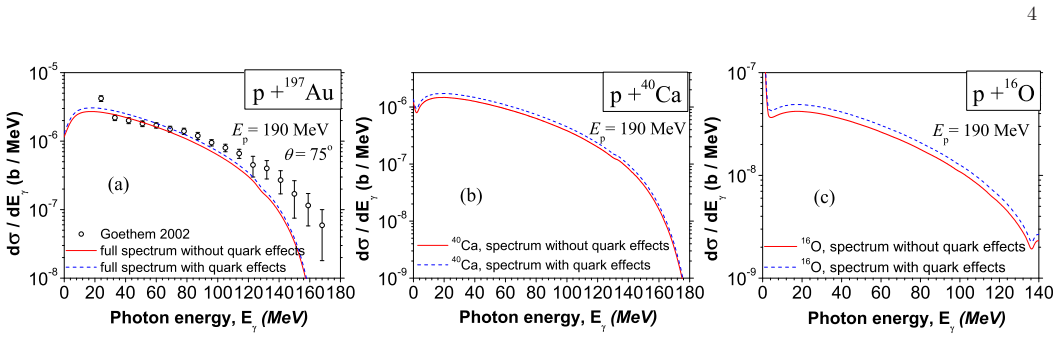
After calibrating the bremsstrahlung model to TAPS data for p + 197Au without quark effects, inclusion of the QMC-predicted enhancement of nucleon magnetic moments produces slight differences in the calculated spectra, and these differences become clearly visible in the ratios of spectra between 18C and 12C.
What carries the argument
In-medium enhancement of nucleon magnetic moments predicted by the quark-meson coupling model, which increases the incoherent bremsstrahlung yield in proton-nucleus scattering.
If this is right
- Quark effects remain too small to observe in middle and heavy nuclei because incoherent contributions dominate there.
- Among carbon isotopes, 18C has the smallest incoherent contribution, so quark effects are least masked in that case.
- Ratios of bremsstrahlung spectra between 18C and 12C amplify the quark-induced difference enough for experimental detection.
- The same calibrated model provides a quantitative baseline for predicting the size of the effect in other light nuclei.
Where Pith is reading between the lines
- Future bremsstrahlung measurements on light nuclei could serve as a direct test of in-medium quark models without requiring new theoretical machinery.
- The same sensitivity to magnetic moments might allow the approach to be applied to other photon-emitting reactions to cross-check medium modifications.
- If the predicted ratio difference is confirmed, it would strengthen the case for using bremsstrahlung as a probe of nucleon substructure in the nuclear environment.
Load-bearing premise
The bremsstrahlung model calibrated to data without quark effects remains accurate enough that adding only the QMC magnetic-moment enhancement produces a detectable and unambiguous difference in the spectra.
What would settle it
An experimental measurement of the bremsstrahlung spectrum ratio for proton scattering on 18C versus 12C that matches the calculation without the in-medium magnetic-moment enhancement.
Figures

read the original abstract
\textbf{Background} (1) The incoherent emission of photons is dominant comparing to coherent one in proton-nucleus scattering. The incoherent bremsstrahlung is very sensitive to the magnetic moments of nucleons in nuclei. (2) According to the quark-meson coupling (QMC) model, the nucleon magnetic moments in nuclei are enhanced relative to those in vacuum, originating from the quark structure of nucleons. \textbf{Purpose} Investigate possibilities of observing quark effects in nuclei by the analysis of bremsstrahlung in nuclear reactions. \textbf{Methods} Analyse the bremsstrahlung cross sections with established model in proton-nucleus scattering, by extending with inclusion of in-medium modified nucleon magnetic moments in nuclei by the QMC model. \textbf{Results} (1) After calibrating the model without the quark effects for experimental data (TAPS Collaboration data for $p + \isotope[197]{Au}$), we calculate the cross sections and observe the slight difference between the spectra for models with and without quark effects. Such result is found for the first time, confirming possibilities of observing the quark effects in the spectra of bremsstrahlung. (2) As found, quark effects are not enough to be observed in middle and heavy nuclei, as they have dominant incoherent contributions. (3) \isotope[18]{C} has minimal incoherent contribution concerning other carbon isotopes, where the quark effects should be minimal. In ratios between the spectra for \isotope[18]{C} and \isotope[12]{C} with and without the quark effects the difference is clearly observed. \textbf{Conclusions} We establish the new physical observable for the quark effects in nuclei in the bremsstrahlung accompanied in the nuclear reactions, which can be measured. The present suggestion is for the first time in both theoretically and experimentally to study the quark effects in nuclei via the bremsstrahlung.
Editorial analysis
A structured set of objections, weighed in public.
Referee Report
Summary. The manuscript proposes bremsstrahlung in proton-nucleus scattering as a probe for quark effects in nuclei. An established bremsstrahlung model is calibrated to TAPS data on p + 197Au without quark effects; in-medium nucleon magnetic-moment enhancements from the QMC model are then added. A slight difference appears in the absolute spectra, but the authors report that the difference becomes clearly visible in the 18C/12C spectral ratio, which they present as a new measurable observable for quark effects in nuclei.
Significance. If the result holds, the work would introduce a novel experimental signature for in-medium quark-structure modifications via a ratio of bremsstrahlung spectra. The sensitivity of incoherent bremsstrahlung to magnetic moments and the use of isotopic ratios to suppress common systematics are conceptually sound. The connection to a concrete QMC prediction adds falsifiability. Realization of this significance, however, requires demonstration that the reported difference survives quantitative uncertainty analysis and is not an artifact of the calibration procedure or unaccounted nuclear-mass dependence.
major comments (2)
- [Abstract, Results (1)] Abstract, Results (1): the claim of a 'slight difference' between spectra with and without QMC magnetic-moment enhancement is presented without numerical values, uncertainty bands, or comparison to typical experimental resolution. This omission prevents assessment of whether the difference is detectable and undermines the assertion that the effect 'can be measured'.
- [Abstract, Results (3)] Abstract, Results (3) and Conclusions: the central claim requires that the bremsstrahlung model, once fixed to p + 197Au data, remains sufficiently accurate for 12C and 18C that adding only the QMC-predicted magnetic-moment increase produces an unambiguous difference in the 18C/12C ratio. No justification is given for the transferability of the calibration across nuclei that differ substantially in mass, density, and Fermi motion; residual model deficiencies that vary between the two carbon isotopes could mimic or mask the reported ratio signature.
minor comments (1)
- [Abstract, Results (2)] The abstract states that quark effects 'are not enough to be observed in middle and heavy nuclei' but provides no quantitative comparison of incoherent versus coherent contributions or of the relative size of the QMC correction across mass ranges.
Simulated Author's Rebuttal
We thank the referee for the detailed review and valuable suggestions. We address the major comments point by point below, indicating where revisions will be made to the manuscript.
read point-by-point responses
-
Referee: [Abstract, Results (1)] Abstract, Results (1): the claim of a 'slight difference' between spectra with and without QMC magnetic-moment enhancement is presented without numerical values, uncertainty bands, or comparison to typical experimental resolution. This omission prevents assessment of whether the difference is detectable and undermines the assertion that the effect 'can be measured'.
Authors: We concur that the presentation of the 'slight difference' would benefit from quantitative details. In the revised manuscript, we will provide specific numerical values for the relative difference in the bremsstrahlung spectra, include uncertainty bands derived from variations in the model parameters, and compare the effect size to the experimental resolution of the TAPS detector to support the measurability claim. revision: yes
-
Referee: [Abstract, Results (3)] Abstract, Results (3) and Conclusions: the central claim requires that the bremsstrahlung model, once fixed to p + 197Au data, remains sufficiently accurate for 12C and 18C that adding only the QMC-predicted magnetic-moment increase produces an unambiguous difference in the 18C/12C ratio. No justification is given for the transferability of the calibration across nuclei that differ substantially in mass, density, and Fermi motion; residual model deficiencies that vary between the two carbon isotopes could mimic or mask the reported ratio signature.
Authors: The model used is an established one previously validated for various nuclei, and the parameters calibrated on the heavy 197Au system are expected to apply to lighter nuclei as they relate to fundamental interaction strengths rather than nucleus-specific features. The ratio of 18C to 12C is chosen precisely to minimize differences in nuclear structure effects. Nevertheless, we recognize the need for explicit justification. We will add a discussion in the revised manuscript explaining the model's transferability, referencing its prior applications to light nuclei and arguing that any residual deficiencies are largely common to both carbon isotopes and thus cancel in the ratio. revision: yes
Circularity Check
No significant circularity; calibration uses external data and QMC input is independent
full rationale
The derivation calibrates the bremsstrahlung model to external TAPS p+197Au data without quark effects, then adds independent QMC-predicted magnetic-moment enhancements to compute spectral differences and ratios for 12C/18C. This does not reduce any claimed prediction or observable to the inputs by construction, nor does it rely on self-citation chains or ansatze smuggled from prior author work. The central result (detectable ratio difference) is obtained by explicit calculation after external calibration and remains falsifiable against new measurements on the carbon isotopes. No load-bearing step equates the output to a fitted parameter or self-defined quantity.
Axiom & Free-Parameter Ledger
free parameters (1)
- calibration parameters for bremsstrahlung model
axioms (1)
- domain assumption Incoherent bremsstrahlung dominates coherent emission and is very sensitive to nucleon magnetic moments in nuclei.
Lean theorems connected to this paper
-
IndisputableMonolith/Cost/FunctionalEquation.leanwashburn_uniqueness_aczel unclear?
unclearRelation between the paper passage and the cited Recognition theorem.
After calibrating the model without the quark effects for the experimental data (TAPS Collaboration data for p + 197Au), we calculate the cross sections and observe the slight difference between the spectra for models with and without quark effects.
-
IndisputableMonolith/Foundation/RealityFromDistinction.leanreality_from_one_distinction unclear?
unclearRelation between the paper passage and the cited Recognition theorem.
the incoherent bremsstrahlung is very sensitive to the magnetic moments of nucleons in nuclei... QMC model, the nucleon magnetic moments in nuclei are enhanced
What do these tags mean?
- matches
- The paper's claim is directly supported by a theorem in the formal canon.
- supports
- The theorem supports part of the paper's argument, but the paper may add assumptions or extra steps.
- extends
- The paper goes beyond the formal theorem; the theorem is a base layer rather than the whole result.
- uses
- The paper appears to rely on the theorem as machinery.
- contradicts
- The paper's claim conflicts with a theorem or certificate in the canon.
- unclear
- Pith found a possible connection, but the passage is too broad, indirect, or ambiguous to say the theorem truly supports the claim.
Forward citations
Cited by 1 Pith paper
-
Octet baryon electroweak form factors in dense nuclear matter
Calculates density-dependent modifications to octet baryon electroweak form factors using a covariant quark model extended by quark-meson coupling in nuclear matter up to 2 rho_0.
Reference graph
Works this paper leans on
-
[1]
S. P. Maydanyuk, Enhancement of incoherent bremsstrahlung in proton-nucle us scattering in the ∆-resonance energy region, Phys. Rev. C 107 , 024618 (2023)
work page 2023
-
[2]
S. P. Maydanyuk and P.-M. Zhang, New approach to determine proton-nucleus interactions fro m experimental bremsstrahlung data, Phys. Rev. C 91 , 024605 (2015)
work page 2015
-
[3]
M. J. van Goethem, L. Aphecetche, J. C. S. Bacelar, H. Dela grange, J. Diaz, D. d’Enterria, M. Hoefman, R. Holzmann, H. Huisman, N. Kalantar-Nayestanaki, A. Kugler, H. L¨ ohner, G. Martinez, J. G. Messchendorp, R. W. Ostendorf, S. Schad- mand, R. H. Siemssen, R. S. Simon, Y. Schutz, R. Turrisi, M. Vo lkerts, V. Wagner, and H. W. Wilschut, Suppresion of so...
work page 2002
-
[4]
J. Clayton, W. Benenson, M. Cronqvist, R. Fox, D. Krofche ck, R. Pfaff, M. F. Mohar, C. Bloch, D. E. Fields, High energy gamma ray production in proton-induced reactions at 104, 14 5, and 195 MeV , Phys. Rev. C 45 , 1815 (1992)
work page 1992
-
[5]
J. E. Clayton, High energy gamma ray production in proton induced reaction s at energies of 104, 145, and 195 MeV , PhD thesis (Michigan State University, 1991)
work page 1991
-
[6]
X. Liu, S. P. Maydanyuk, P.-M. Zhang, and L. Liu, First investigation of hypernuclei in reactions via analys is of emitted bremsstrahlung photons, Phys. Rev. C 99 , 064614 (2019)
work page 2019
-
[7]
P. A. M. Guichon, A Possible Quark Mechanism for the Saturation of Nuclear Mat ter, Phys. Lett. B 200, 235 (1988)
work page 1988
- [8]
- [9]
-
[10]
P. A. M. Guichon, J. R. Stone and A. W. Thomas, Quark-Meson-Coupling (QMC) model for finite nuclei, nuclea r matter and beyond , Prog. Part. Nucl. Phys. 100, 262 (2018)
work page 2018
-
[11]
D. H. Lu, A. W. Thomas, K. Tsushima, A. G. Williams and K. S aito, In-medium electron-nucleon scattering, Phys. Lett. B 417, 217 (1998)
work page 1998
-
[12]
D. H. Lu, K. Tsushima, A. W. Thomas, A. G. Williams and K. S aito, Electromagnetic form-factors of the bound nucleon , Phys. Rev. C 60 , 068201 (1999)
work page 1999
-
[13]
See Supplemental Material for this paper for details of calculations of the operator of emission and matrix element of emission of photons
-
[15]
S. P. Maydanyuk, P.-M. Zhang, and L.-P. Zou, New approach for obtaining information on the many-nucleon structure in α decay from accompanying bremsstrahlung emission , Phys. Rev. C 93 , 014617 (2016)
work page 2016
-
[16]
S. P. Maydanyuk, Model for bremsstrahlung emission accompanying interacti ons between protons and nuclei from low energies up to intermediate energies: Role of magnetic emis sion, Phys. Rev. C 86 , 014618 (2012)
work page 2012
-
[17]
K. Tsushima, Magnetic moments of the octet, decuplet, low-lying charm, a nd low-lying bottom baryons in a nuclear medium , PTEP 043D02 (2022). 1 Manifestation of quark effects in nuclei via bremsstrahlung analysis in the proton-nucleus scattering Supplemental Material I. MODEL A. Hamiltonian of proton-nucleus scattering and bremsstra hlung photon emission ...
discussion (0)
Sign in with ORCID, Apple, or X to comment. Anyone can read and Pith papers without signing in.