REVIEW 4 major objections 6 minor 38 references
Domain Adaptation for Image Classification of Defects in Semiconductor Manufacturing
T0 review · 4 major / 6 minor · reviewed 2026-08-15 · deepseek-v4-flash
Pith's one-line read The paper claims that in unsupervised domain adaptation for semiconductor defect classification on real SEM images, adapting a classifier from one product technology to another beats the no-adaptation baseline on most source–target pairs…
desk verdict Useful first benchmark of DA on real SEM defect images, but the headline claim rests on single-run numbers and the novel DBACS contribution is unablated. read the letter →
The pith
A machine-rendered reading of the paper's core claim, the machinery that carries it, and where it could break.
The reading
What carries the argument
The load-bearing mechanism is cyclic image-to-image alignment with adversarial supervision, instantiated in DBACS (DANN-based Alignment with Cyclic Supervision). Two aligners, F mapping target to source and G mapping source to target, are trained with two discriminators, cycle-consistency ($L_1$ and MS-SSIM), identity loss, and feature-matching loss, so that target SEM images are translated into the source domain's background structure while preserving the defect. This lets a frozen source-trained classifier label translated target images; AdaMatch, by contrast, aligns pseudo-label distributions without generating images. The machinery carries the argument by converting a domain-shift problem into a translation problem, and the paper's claim that the added losses improved performance rests on this compound loss.
What would settle it
Rerun at least the 0→2 and 1→0 UDA experiments with each DA method and each backbone over five or more seeds; if any method's average minus one standard deviation dips below the corresponding lower limit (e.g., 66.9% for 0→2 ResNet101) or the seed spread exceeds the reported gap, the claim that DA beats the baseline in that setting fails.
Extended reading notes
Core claim
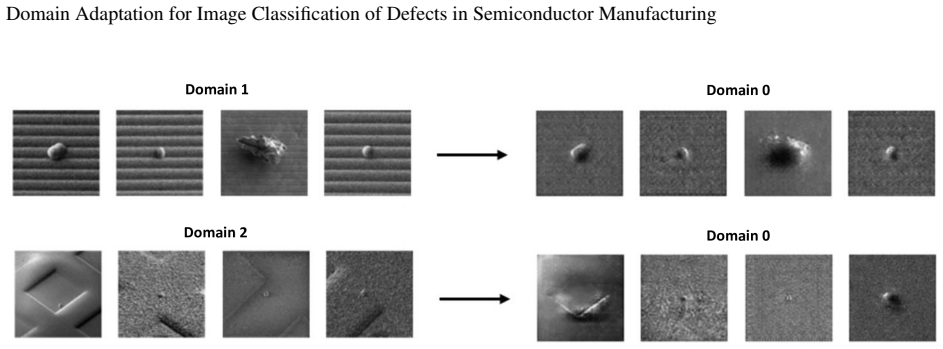
The central claim, stated in Section 7.1, is that in the unsupervised setting, DA techniques prove their usefulness in the semiconductor sector with SEM images by obtaining better performance than the lower limit, i.e., the source-only baseline. Put positively: on real wafer-defect images spanning three background structures—plain, horizontal lines, and square-like patterns—adapting a frozen source classifier to an unlabeled target domain lifts accuracy over the source-only baseline by a wide margin in the strongest cases, e.g., 1→0 with ResNet101 at 88.79% for Offline PL versus 69.9% baseline, and 0→2 with ResNet101 at 84.32% for AdaMatch versus 66.9%. No single DA method wins everywhere; the winner depends on the source-target pair, and DBACS does not consistently beat the baseline. In the SSDA setting with 5% target labels, DA methods rarely improve on the lower limit, so the claimed benefit is specific to the unsupervised regime.
Load-bearing premise
The reported accuracies are single runs with no standard deviation, no multiple seeds, and no significance tests, so the paper assumes these numbers are stable enough that the observed gaps reflect real differences.
Editorial extensions
If this is right
- In the unsupervised setting, a factory can deploy a defect classifier trained on one product technology to another technology by adapting on unlabeled images, avoiding expensive relabeling campaigns.
- Offline Pseudo-Labeling and AdaMatch are the most dependable choices across source-target pairs, but any deployment should test several DA methods because the best one depends on the source and target.
- DBACS is usable on image data for the first time, but its gains are inconsistent across pairs and it is more computationally demanding than AdaMatch.
- With even 5% labeled target data, domain adaptation contributes little; the practical bottleneck is label availability, not adaptation.
- The improvements are demonstrated for a two-class problem (particle vs point defects) on 128x128 grayscale SEM images, so claims should be read for that scope.
Reading between the lines
- Editorial inference: Because the reported accuracies come from single runs with no standard deviation, the cross-method rankings could be fragile; reseeding the same experiments would show whether the largest reported gaps exceed run-to-run variability.
- Editorial inference: The paper credits the added DBACS loss terms for the improvement but shows no ablation; the observed gains could also come from the cyclic translation architecture alone.
- Editorial inference: The dependence of the best method on the source-target pair suggests a practical selection protocol—hold out a small labeled target subset and pick the DA method by validation accuracy—rather than committing to one method.
- Editorial inference: Because the classifiers start from ImageNet features and only the head is adapted, part of the benefit may reflect generic visual features; a random-initialization control would isolate the adaptation mechanism.
Signed reviews
Editorial analysis
A structured set of objections, weighed in public.
Referee Report
Summary. The paper studies unsupervised and semi-supervised domain adaptation for SEM defect image classification in semiconductor manufacturing. It compares pseudo-labeling baselines (offline and online), AdaMatch, and a CycleGAN-style generative method called DBACS, which the authors extend from time series to images by adding cycle consistency, identity, MS-SSIM, and feature-matching losses. Experiments use a real Infineon dataset with three domains (background styles) and three backbone architectures (MobileNet, ResNet50, ResNet101), reporting accuracy against a lower bound (no adaptation) and an oracle (target-trained). The central claim, stated in Section 7.1, is that DA techniques prove beneficial in the UDA setting; a secondary claim is that the proposed loss modifications improve DBACS performance.
Significance. If the empirical claims held, the paper would provide useful evidence that standard DA methods transfer to industrial SEM defect classification, a setting with practical value and little prior DA evaluation. The main strengths are the use of real-world manufacturing data, the breadth of compared methods including a strong recent baseline (AdaMatch), the public release of the implementation, and the explicit inclusion of lower-bound and oracle comparisons. However, the evidentiary basis for the central claim is weak: all accuracy numbers are single runs with no variance or significance testing, the claimed advantage of the novel DBACS losses is not supported by any ablation, and the text in Section 7.1 is internally inconsistent with Tables 3 and 4. These issues are fixable but currently undermine the paper's main conclusions.
major comments (4)
- [Tables 3-5 and Section 7.1] All reported accuracies are single point estimates with no standard deviations, no number of seeds, and no statistical significance tests. The UDA claim that DA techniques 'prove their usefulness' relies on deltas that are often small (e.g., Table 3: ResNet50 0→1 lower limit 68.0 vs DBACS 72.4; Table 4: MobileNet 1→0 lower limit 67.2 vs DBACS 67.84) and occasionally negative (Table 3: Offline PL 0→2 MobileNet 55.32 vs lower limit 66.2; Online PL 0→1 MobileNet 67.8 vs lower limit 70.7). Without run-to-run variability, the reader cannot determine whether these differences are meaningful. At minimum, the authors should provide multiple seeds with mean and standard deviation, and ideally a paired significance test across methods.
- [Section 7.1, paragraph on DBACS, and Tables 3-4] The text states that 'DBACS demonstrates superior performance compared to the lower limit (baseline)', but Table 3 shows DBACS below the lower limit in four of its six UDA cells (all three models for 0→2: 64.53 vs 66.2, 61 vs 65.7, 65.64 vs 66.9). The claim is therefore contradicted by the paper's own data. The authors must either correct the claim to reflect the actual pattern (e.g., DBACS helps for 0→1 but not 0→2) or provide additional evidence that the cited entries are not representative.
- [Section 4.3 and Tables 3-5] The paper asserts that the added loss terms (cyclic adaptation, identity loss, feature matching, MS-SSIM) 'improved the final performance', but no ablation study is presented. Since DBACS underperforms the lower limit in several UDA cells and underperforms the lower limit in all six SSDA cells in Table 5, the contribution of these loss terms is not established. The authors should include an ablation that removes or varies the added losses, at least for one source-target pair per setting.
- [Section 6.4.2 and Tables 3-4] AdaMatch's hyperparameters and augmentations are tuned specifically for the task (reduced training steps, adapted unsupervised loss weight, restricted rotations, smaller cutouts), while the paper does not report comparable tuning for DBACS or the pseudo-labeling baselines beyond the stated default settings. This asymmetry makes the comparison between methods potentially unfair. The authors should either tune all methods with similar effort or state that AdaMatch receives favorable customizations and discuss how this affects the conclusion that 'the best DA approach depends on the chosen source domain'.
minor comments (6)
- [Section 4.3.4, Eq. (8)] The text defines the identity loss as comparing x_T with G(x_T) and x_S with F(x_S) but then writes 'when fed with x_T∈X_S and x_S∈X_T', which swaps the domain memberships. The set memberships should read x_T∈X_T and x_S∈X_S.
- [Abstract and Section 1] The abstract and introduction claim that DA 'minimizes the need for extensive manual re-labeling or re-training of models' and 'improving robustness and scalability', but the experiments only measure accuracy; no cost, training time, or scalability metrics are reported. Consider softening these claims or adding supporting measurements.
- [Footnote 1 and Section 1] The repository URL footnote contains a typo: 'DBCAS' should be 'DBACS'. Also, the footnote appears before the URL is referenced in the text; consider placing it at first mention of the code.
- [Section 5.2.1] The notation for the AdaMatch augmentation is inconsistent: Z'_SL and Z_TU are defined together, then Z''_SL is defined separately, but the relationship between the weakly and strongly augmented batches is not fully explained. A short table or explicit definitions of X_aug_SL and X_aug_TU would improve readability.
- [Section 6.1, Table 2 caption] The caption says 'The first column denotes the domain of the train data', but the table also includes rows '0 + 5% 1' and '0 + 5% 2' whose meaning is not defined in the caption or text. Clarify what these rows represent.
- [Section 7.2] The SSDA discussion states that label availability 'hardly improves the performance concerning the lower limit baseline', but Table 5 shows DBACS below the lower limit in every cell and Offline PL below the lower limit in several cells (e.g., 0→2 MobileNet 87.68 vs 87.96). The paragraph should be rewritten to explicitly list which methods beat the baseline and which do not.
Circularity Check
No circularity: empirical benchmark comparison against external baselines; self-citations are descriptive prior-art references, not load-bearing reductions.
full rationale
This paper is an empirical evaluation, not a derivation. The central claim—that DA techniques beat the lower-limit baseline in UDA for SEM defect classification—is established by direct comparison of measured accuracies in Tables 3 and 4 against independently defined baselines (Table 2) and an external method (AdaMatch). No fitted parameter is renamed as a prediction: the DBACS loss weights and training routine are fixed before evaluation and are not solved from the target accuracy numbers. The self-citations to [4] and [30] describe the origin of the DBACS/DBAM architecture and training routine; they are used as prior-art context, not as evidence that the reported improvements occur. The statement that added loss terms 'improved the final performance' is asserted without an ablation, but that is a supportability/experimental-design issue, not a circular reduction. Likewise, lack of repeated seeds and significance tests affects confidence in the empirical claims but does not make any reported number equivalent to an input by construction. No equation is identical to its input, no prediction is forced by a fitted parameter, and no load-bearing self-citation chain is present.
Assumptions & free parameters
free parameters (4)
- DBACS loss weights =
λcc=1.0, λadv=0.5, λcyc=0.3, λid=0.2, λfm=0.0
- AdaMatch augmentation modifications =
only 180-degree rotations; smaller cutout size
- AdaMatch training steps and unsupervised loss weight =
steps reduced by factor 8; adjusted warm-up
- Confidence threshold tau =
0.9
assumptions (3)
- domain assumption The three product-technology domains share a common two-class label space (point vs. particle) after merging defect classes.
- domain assumption Accuracy is a valid metric despite class imbalance in domain 2.
- domain assumption ImageNet-pretrained features provide a useful starting representation for grayscale SEM images.
Cite this review
Pith. "Pith review of Domain Adaptation for Image Classification of Defects in Semiconductor Manufacturing." pith.science (2026). https://pith.science/paper/N54DMGZC
@misc{pith2026250615260,
  author       = {Pith},
  title        = {Pith review of: Domain Adaptation for Image Classification of Defects in Semiconductor Manufacturing},
  year         = {2026},
  howpublished = {\url{https://pith.science/paper/N54DMGZC}},
  note         = {Machine review of arXiv:2506.15260}
}
read the original abstract
In the semiconductor sector, due to high demand but also strong and increasing competition, time to market and quality are key factors in securing significant market share in various application areas. Thanks to the success of deep learning methods in recent years in the computer vision domain, Industry 4.0 and 5.0 applications, such as defect classification, have achieved remarkable success. In particular, Domain Adaptation (DA) has proven highly effective since it focuses on using the knowledge learned on a (source) domain to adapt and perform effectively on a different but related (target) domain. By improving robustness and scalability, DA minimizes the need for extensive manual re-labeling or re-training of models. This not only reduces computational and resource costs but also allows human experts to focus on high-value tasks. Therefore, we tested the efficacy of DA techniques in semi-supervised and unsupervised settings within the context of the semiconductor field. Moreover, we propose the DBACS approach, a CycleGAN-inspired model enhanced with additional loss terms to improve performance. All the approaches are studied and validated on real-world Electron Microscope images considering the unsupervised and semi-supervised settings, proving the usefulness of our method in advancing DA techniques for the semiconductor field.
Figures


Figures from the paper (1 more)
Reference graph
Works this paper leans on
-
[1]
Marco Maggipinto, Alessandro Beghi, and Gian Antonio Susto. A deep convolutional autoencoder-based approach for anomaly detection with industrial, non-images, 2-dimensional data: A semiconductor manufacturing case study. IEEE Transactions on Automation Science and Engineering, 2022
work page 2022
-
[2]
Formula: A deep learning approach for rare alarms predictions in industrial equipment
Davide Dalle Pezze, Chiara Masiero, Diego Tosato, Alessandro Beghi, and Gian Antonio Susto. Formula: A deep learning approach for rare alarms predictions in industrial equipment. IEEE Transactions on Automation Science and Engineering, 2021
work page 2021
-
[3]
Adamatch: a unified approach to semi-supervised learning and domain adaptation
Becca Roelofs, David Berthelot, Kihyuk Sohn, Nicholas Carlini, and Alex Kurakin. Adamatch: a unified approach to semi-supervised learning and domain adaptation. In Proc. of the Int. Conf. on Learning Representations (ICLR), 2022
work page 2022
-
[4]
Natalie Gentner and Gian Antonio Susto. Heterogeneous domain adaptation and equipment matching: Dann-based alignment with cyclic supervision (dbacs). Computers & Industrial Engineering, 187:109821, 2024. 14 Domain Adaptation for Image Classification of Defects in Semiconductor Manufacturing
work page 2024
-
[5]
Domain-adversarial training of neural networks
Yaroslav Ganin, Evgeniya Ustinova, Hana Ajakan, Pascal Germain, Hugo Larochelle, François Laviolette, Mario Marchand, and Victor Lempitsky. Domain-adversarial training of neural networks. The journal of machine learning research, 17(1):2096–2030, 2016
work page 2016
-
[6]
Wafer map failure pattern recognition and similarity ranking for large-scale data sets
Ming-Ju Wu, Jyh-Shing R Jang, and Jui-Long Chen. Wafer map failure pattern recognition and similarity ranking for large-scale data sets. IEEE Transactions on Semiconductor Manufacturing, 28(1):1–12, 2014
work page 2014
-
[7]
Luciano Lorenti, Davide Dalle Pezze, Jacopo Andreoli, Chiara Masiero, Natalie Gentner, Yao Yang, and Gian An- tonio Susto. Predictive maintenance in the industry: A comparative study on deep learning-based remaining useful life estimation. In 2023 ieee 21st international conference on industrial informatics (indin), pages 1–9. IEEE, 2023
work page 2023
-
[8]
A cnn-based transfer learning method for defect classification in semiconductor manufacturing
Kazunori Imoto, Tomohiro Nakai, Tsukasa Ike, Kosuke Haruki, and Yoshiyuki Sato. A cnn-based transfer learning method for defect classification in semiconductor manufacturing. In 2018 international symposium on semiconductor manufacturing (ISSM), pages 1–3. IEEE, 2018
work page 2018
Show all 38 references
-
[9]
A novel visual fault detection and classification system for semiconductor manufacturing using stacked hybrid convolutional neural networks
Tobias Schlosser, Frederik Beuth, Michael Friedrich, and Danny Kowerko. A novel visual fault detection and classification system for semiconductor manufacturing using stacked hybrid convolutional neural networks. In 2019 24th IEEE International Conference on Emerging Technolog...
2019
-
[10]
Convolutional neural network for wafer surface defect classification and the detection of unknown defect class
Sejune Cheon, Hankang Lee, Chang Ouk Kim, and Seok Hyung Lee. Convolutional neural network for wafer surface defect classification and the detection of unknown defect class. IEEE Transactions on Semiconductor Manufacturing, 32(2):163–170, 2019
2019
-
[11]
Deep learning for classification of the chemical composition of particle defects on semiconductor wafers
Jared O’Leary, Kapil Sawlani, and Ali Mesbah. Deep learning for classification of the chemical composition of particle defects on semiconductor wafers. IEEE Transactions on Semiconductor Manufacturing, 33(1):72–85, 2020
2020
-
[12]
Defect classification on limited labeled samples with multiscale feature fusion and semi-supervised learning
Jiahuan Liu, Fei Guo, Yun Zhang, Binkui Hou, and Huamin Zhou. Defect classification on limited labeled samples with multiscale feature fusion and semi-supervised learning. Applied Intelligence, 52:8243–8258, 2021
2021
-
[13]
Chen, Hsing-Chung Liang, and Chun-Lung Hsu
Katherine Shu-Min Li, Xu-Hao Jiang, Leon Li-Yang Chen, Sying-Jyan Wang, Andrew Yi-Ann Huang, Jwu E. Chen, Hsing-Chung Liang, and Chun-Lung Hsu. Wafer defect pattern labeling and recognition using semi- supervised learning. IEEE Transactions on Semiconductor Manufacturing, 35(2...
2022
-
[14]
Pseudo-label: The simple and efficient semi-supervised learning method for deep neural networks
Dong-Hyun Lee et al. Pseudo-label: The simple and efficient semi-supervised learning method for deep neural networks. In Workshop on challenges in representation learning, ICML, volume 3, page 896, 2013
2013
-
[15]
Fixmatch: Simplifying semi-supervised learning with consistency and confidence
Kihyuk Sohn, David Berthelot, Nicholas Carlini, Zizhao Zhang, Han Zhang, Colin A Raffel, Ekin Dogus Cubuk, Alexey Kurakin, and Chun-Liang Li. Fixmatch: Simplifying semi-supervised learning with consistency and confidence. Advances in Neural Information Processing Systems, 33:5...
2020
-
[16]
Mean teachers are better role models: Weight-averaged consistency targets improve semi-supervised deep learning results
Antti Tarvainen and Harri Valpola. Mean teachers are better role models: Weight-averaged consistency targets improve semi-supervised deep learning results. Advances in neural information processing systems, 30, 2017
2017
-
[17]
Augmix: A simple data processing method to improve robustness and uncertainty
Dan Hendrycks, Norman Mu, Ekin Dogus Cubuk, Barret Zoph, Justin Gilmer, and Balaji Lakshminarayanan. Augmix: A simple data processing method to improve robustness and uncertainty. ArXiv, abs/1912.02781, 2020
1912 arXiv
-
[18]
Remixmatch: Semi-supervised learning with distribution alignment and augmentation anchoring
David Berthelot, Nicholas Carlini, Ekin D Cubuk, Alex Kurakin, Kihyuk Sohn, Han Zhang, and Colin Raffel. Remixmatch: Semi-supervised learning with distribution alignment and augmentation anchoring. arXiv preprint arXiv:1911.09785, 2019
1911 arXiv
-
[19]
Improved regularization of convolutional neural networks with cutout
Terrance DeVries and Graham W Taylor. Improved regularization of convolutional neural networks with cutout. arXiv preprint arXiv:1708.04552, 2017
2017 arXiv
-
[20]
Adaembed: Semi-supervised domain adaptation in the embedding space, 2024
Ali Mottaghi, Mohammad Abdullah Jamal, Serena Yeung, and Omid Mohareri. Adaembed: Semi-supervised domain adaptation in the embedding space, 2024. URL https://arxiv.org/abs/2401.12421
2024 arXiv
-
[21]
Image-to-image translation with conditional adversarial networks
Phillip Isola, Jun-Yan Zhu, Tinghui Zhou, and Alexei A Efros. Image-to-image translation with conditional adversarial networks. In Proceedings of the IEEE conference on computer vision and pattern recognition, pages 1125–1134, 2017
2017
-
[22]
Conditional generative adversarial nets
Mehdi Mirza and Simon Osindero. Conditional generative adversarial nets. arXiv preprint arXiv:1411.1784, 2014
2014 arXiv
-
[23]
Generative adversarial nets
Ian Goodfellow, Jean Pouget-Abadie, Mehdi Mirza, Bing Xu, David Warde-Farley, Sherjil Ozair, Aaron Courville, and Yoshua Bengio. Generative adversarial nets. Advances in neural information processing systems, 27, 2014. 15 Domain Adaptation for Image Classification of Defects i...
2014
-
[24]
Unpaired image-to-image translation using cycle-consistent adversarial networks
Jun-Yan Zhu, Taesung Park, Phillip Isola, and Alexei A Efros. Unpaired image-to-image translation using cycle-consistent adversarial networks. In Proceedings of the IEEE international conference on computer vision, pages 2223–2232, 2017
2017
-
[25]
Simultaneous deep transfer across domains and tasks
Eric Tzeng, Judy Hoffman, Trevor Darrell, and Kate Saenko. Simultaneous deep transfer across domains and tasks. In Proceedings of the IEEE international conference on computer vision, pages 4068–4076, 2015
2015
-
[26]
Deep coral: Correlation alignment for deep domain adaptation
Baochen Sun and Kate Saenko. Deep coral: Correlation alignment for deep domain adaptation. In European conference on computer vision, pages 443–450. Springer, 2016
2016
-
[27]
Maximum classifier discrepancy for unsupervised domain adaptation
Kuniaki Saito, Kohei Watanabe, Yoshitaka Ushiku, and Tatsuya Harada. Maximum classifier discrepancy for unsupervised domain adaptation. In Proceedings of the IEEE conference on computer vision and pattern recognition, pages 3723–3732, 2018
2018
-
[28]
Ad-aligning: Emulating human-like generalization for cognitive domain adaptation in deep learning
Zhuoying Li, Bohua Wan, Cong Mu, Ruzhang Zhao, Shushan Qiu, and Chao Yan. Ad-aligning: Emulating human-like generalization for cognitive domain adaptation in deep learning. In 2024 5th International Conference on Electronic Communication and Artificial Intelligence (ICECAI) , ...
2024
-
[29]
Avatar: Adversarial self-supervised domain adaptation network for target domain, 2023
Jun Kataoka and Hyunsoo Yoon. Avatar: Adversarial self-supervised domain adaptation network for target domain, 2023. URL https://arxiv.org/abs/2305.00082
2023 arXiv
-
[30]
Dbam: Making virtual metrology/soft sensing with time series data scalable through deep learning
Natalie Gentner, Mattia Carletti, Andreas Kyek, Gian Antonio Susto, and Yao Yang. Dbam: Making virtual metrology/soft sensing with time series data scalable through deep learning. Control Engineering Practice, 116: 104914, 2021
2021
-
[31]
Proxymix: Proxy-based mixup training with label refinery for source-free domain adaptation
Yuhe Ding, Lijun Sheng, Jian Liang, Aihua Zheng, and Ran He. Proxymix: Proxy-based mixup training with label refinery for source-free domain adaptation. Neural Networks, 167:92–103, 2023
2023
-
[32]
Li and H
J. Li and H. Sun. Nacl: noise-robust cross-domain contrastive learning for unsupervised domain adaptation. Machine Learning, 112(10):3473–3496, 2023. doi: 10.1007/s10994-023-06343-8. URL https://doi.org/10. 1007/s10994-023-06343-8
2023 doi
-
[33]
Inter-domain mixup for semi-supervised domain adaptation
Jichang Li, Guanbin Li, and Yizhou Yu. Inter-domain mixup for semi-supervised domain adaptation. Pattern Recognition, 146:110023, February 2024. ISSN 0031-3203. doi: 10.1016/j.patcog.2023.110023. URL http: //dx.doi.org/10.1016/j.patcog.2023.110023
2024
-
[34]
Semi-supervised generalized source-free domain adaptation (ssg-sfda)
Jiayu An, Changming Zhao, and Dongrui Wu. Semi-supervised generalized source-free domain adaptation (ssg-sfda). In 2023 International Joint Conference on Neural Networks (IJCNN), pages 1–8, 2023. doi: 10.1109/ IJCNN54540.2023.10191761
2023
-
[35]
Improving shape deformation in unsupervised image-to-image translation
Aaron Gokaslan, Vivek Ramanujan, Daniel Ritchie, Kwang In Kim, and James Tompkin. Improving shape deformation in unsupervised image-to-image translation. In Proceedings of the European Conference on Computer Vision (ECCV), pages 649–665, 2018
2018
-
[36]
U-net: Convolutional networks for biomedical image segmentation
Olaf Ronneberger, Philipp Fischer, and Thomas Brox. U-net: Convolutional networks for biomedical image segmentation. In International Conference on Medical image computing and computer-assisted intervention , pages 234–241. Springer, 2015
2015
-
[37]
Autoaugment: Learning augmentation policies from data
Ekin D Cubuk, Barret Zoph, Dandelion Mane, Vijay Vasudevan, and Quoc V Le. Autoaugment: Learning augmentation policies from data. arXiv preprint arXiv:1805.09501, 2018
2018 arXiv
-
[38]
A comprehensive review of deep learning architectures for computer vision applications
Arman Sarraf, Mohammad Azhdari, Saman Sarraf, et al. A comprehensive review of deep learning architectures for computer vision applications. American Scientific Research Journal for Engineering, Technology, and Sciences (ASRJETS), 77(1):1–29, 2021. 16
2021
Reviewed August 15, 2026 · model on record in the stance chip above.
Discussion (0). Continue with ORCID to comment.