REVIEW 3 major objections 6 minor 25 references
WikiMixQA: A Multimodal Benchmark for Question Answering over Tables and Charts
T0 review · 3 major / 6 minor · reviewed 2026-08-06 · deepseek-v4-flash
Pith's one-line read This paper builds WikiMixQA, 1,000 questions each answerable only by combining two charts, two tables, or a chart and a table, and shows vision-language models drop to near-random when they must find the material in long Wikipedia pages.
desk verdict Useful benchmark for cross-modal table-chart QA, but the core claim that questions require integrating two modalities is unverified because no single-modality oracle control was run. read the letter →
The pith
A machine-rendered reading of the paper's core claim, the machinery that carries it, and where it could break.
The reading
What carries the argument
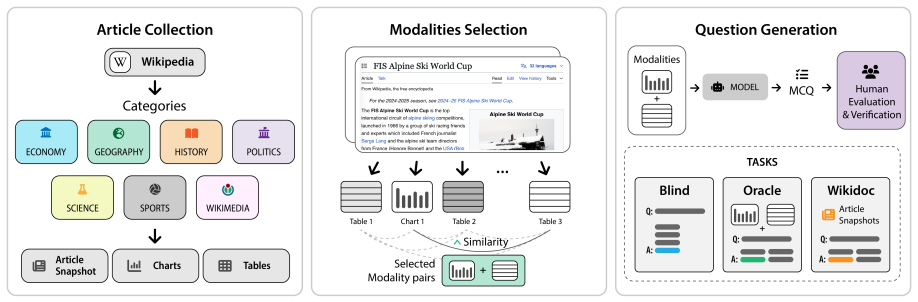
The load-bearing instrument is the paired-modality question itself, generated by a three-part prompt to GPT-4-turbo that first asks for a chart-only question, then a table-only question, then a third question answerable ONLY by combining both, and only this third type enters the dataset. Candidate pairs are not random: descriptions of each table and each chart are scored by a reranker (a cross-encoder that scores the semantic similarity of two texts at once), and only pairs with similarity between the topic mean and 0.9 are kept, so the two items share enough content to support a combined question. Generated pairs then pass a two-step filter by InternVL2 — can the question be answered from the two items, and is the suggested answer correct — before three human annotators, under majority voting, certify that both modalities are indispensable and that the answer options are grounded. The three evaluation settings (blind, oracle, wikidoc) are the measuring device that turns the dataset into the paper's central dissociation.
What would settle it
Present each question to a strong model with only one of the two modalities supplied, for example the table alone and then the chart alone with the same four options; if either single-modality version is answerable well above random, the claim that both items are essential fails. A complementary check is to have an independent set of annotators repeat the validity judgement and measure agreement, since low inter-annotator agreement would show that 'both modalities required' is not a stable property of the dataset.
Extended reading notes
Core claim
On its own terms, the paper claims that WikiMixQA measures a distinct capability — cross-modal reasoning — and that current vision-language large models do not yet have it in realistic conditions. Each question was constructed and human-verified so that both supplied modalities are essential: a validity check required annotators to confirm the question could not be answered from either modality alone or from overlap between them, and an answer check confirmed the labelled option was correct. Under this definition, the discovery is a dissociation: with the exact relevant tables and charts provided, GPT-4o reaches 71.4 percent and other proprietary models cluster near 70 percent, but when the same questions are posed over snapshots of the full source pages, only GPT-4o (55.2 percent) beats the 50 percent mark and most closed models drop to near random. Open-source VLLMs stay close to random in every setting, with the best at 27.7 percent in the oracle condition, against 87.5 percent for human experts. The paper reads this as evidence that interpreting one visual element at a time is comparatively solved, while finding relevant elements in a long multimodal document and then joining their information is not.
Load-bearing premise
The benchmark stands on the human curation step: three annotators' majority vote is the only evidence that every question truly requires both modalities and that the labelled answer is the only correct one, and if that judgment is unreliable the accuracy numbers do not measure cross-modal reasoning.
Editorial extensions
If this is right
- If the dissociation is real, progress in document QA depends more on long-context retrieval over many tables and charts than on interpreting any single element.
- The oracle-to-wikidoc gap becomes a reusable retrieval-cost metric: roughly 16 accuracy points for GPT-4o and between 35 and 46 points for the other proprietary models.
- The three evaluation settings let practitioners ablate failure modes — knowledge (blind), interpretation (oracle), retrieval-plus-reasoning (wikidoc) — using one fixed benchmark.
- The open-source ceiling of about 27 percent in the oracle setting sets a concrete target: even with exact context, open models cannot currently combine two sources reliably.
- Human performance at 87.5 percent in the oracle setting gives a headroom estimate of roughly 17 points for proprietary models on this task.
Reading between the lines
- A natural extension the paper does not report is the single-modality control: presenting each question with only one of the two tables or charts, which would confirm how much of the oracle score depends on true integration rather than on either item alone.
- The released pipeline could be reused to make difficulty continuous, for example by adding distractor tables and charts to the long-document setting, turning a pass/fail probe into a curve that separates retrieval precision from reasoning depth.
- Because 485 of the 1,000 final questions are revised versions of pairs the InternVL2 filter rejected, the dataset may concentrate the cases the filter found hardest; comparing model scores on those 485 against the 515 the filter accepted would locate where the benchmark's difficulty lives.
- A prompt variant that asks a model to state the integrative step before choosing a letter might separate genuine reasoning failures from answer-format failures, since the open-source models were scored on letter-only outputs.
Editorial analysis
A structured set of objections, weighed in public.
Referee Report
Summary. WikiMixQA is a new multimodal QA benchmark containing 1,000 multiple-choice questions designed to require reasoning over pairs of visual/tabular modalities (table-table, chart-chart, or table-chart) drawn from long Wikipedia documents. The paper describes a construction pipeline: document collection and chart filtering, generation of modality-pair questions with GPT-4-turbo, an InternVL2-based automatic filter, and human curation by three Master's students. The authors evaluate 12 vision-language models in three settings — blind (no context), oracle (the relevant table(s)/chart(s) are given), and wikidoc (snapshots of the full Wikipedia page are given). The headline findings are that proprietary models reach roughly 70% in the oracle setting but drop sharply in the wikidoc setting, while open-source models remain near random in both oracle and wikidoc settings; GPT-4o is the only model above 50% in the wikidoc setting, and human experts achieve 87.5% in oracle.
Significance. If the benchmark's core property — that every question genuinely requires integrating information from two modalities — is validated, WikiMixQA would be a useful resource for studying long-context multimodal document understanding. Its strengths include a detailed and reproducible construction pipeline, evaluation across a diverse set of 12 models, and an opening toward an underexplored dimension (long-context multimodal retrieval and reasoning). The observed gap between oracle and wikidoc performance is a plausible and interesting finding. However, the absence of a direct single-modality control leaves the central claim about cross-modal necessity under-supported, and the wikidoc setting is potentially confounded by document truncation. These issues are fixable with additional experiments and analysis, but they currently limit the strength of the paper's conclusions.
major comments (3)
- [§3 (Evaluation) and §2.4 (Human curation)] The central claim that WikiMixQA questions 'can only be answered by integrating information from both provided modalities' is not objectively validated. The only evidence is the majority vote of three Master's students, with no inter-annotator agreement reported. The oracle setting always supplies both modalities together, so a model could achieve ~70% accuracy by relying on the more informative single modality alone. A direct control is missing: run the oracle evaluation with only the first modality, only the second modality, and both, and report the accuracy for each. If a substantial fraction of the 1,000 questions can be answered above chance from a single table or chart, then the benchmark does not measure cross-modal integration, and the wikidoc results would instead reflect single-modality retrieval difficulty. This is a load-bearing issue for the abstract's and Section 2.4's claims.
- [Appendix B.2 (imgkit truncation)] The paper states that 'some very long documents were truncated by imgkit, resulting in missing content.' This directly affects the wikidoc setting: if the relevant chart or table is truncated for a question, no model could answer it even with perfect retrieval and reasoning. The reported wikidoc accuracy (e.g., GPT-4o at 55.24%) may therefore underestimate retrieval-plus-reasoning ability. The authors should quantify how many of the 1,000 questions are affected by truncation, provide an oracle upper bound for the truncated subset, or exclude such questions from the wikidoc analysis. Without this, the headline interpretation — that models 'deteriorate significantly when retrieval from long documents is required' — is not fully supported.
- [§4 (Human evaluation) and Table 1] The 'Human Experts' row reports 87.50% accuracy in the oracle setting, but the paper does not specify who these experts were, how many questions they answered, whether they were the same three Master's students who curated the dataset, or the variance across annotators. If the same annotators who designed and revised the questions also produced the 87.5% figure, the performance is not a valid measure of human ceiling performance and the 'approximately 17% gap' claim is weakened. Please document the human evaluation protocol and report inter-annotator agreement for the curation step as well.
minor comments (6)
- [§4] The sentence 'For the wikidoc setting, we exclude closed-source models due to their limited context length' is incorrect: the wikidoc setting is used only for closed-source models, and GPT-4o (a closed-source model) is the best performer in that setting. The intended contrast is with open-source models.
- [§4] The sentence 'all models perform below random chance, with the exception of GPT-4o' is self-contradictory; GPT-4o's 33% blind accuracy is above the 25% random baseline.
- [Abstract and §2.5] The abstract says the benchmark comprises questions 'extracted from 4,000 Wikipedia pages,' but Section 2.5 says the final 1,000 question-answer pairs are derived from 526 unique documents. Please reconcile the numbers or clarify what '4,000' refers to (e.g., the initial set of 4,292 documents after chart filtering).
- [§6 (Limitations) and footnote 1] The availability statement is inconsistent: the footnote says 'Code and dataset are released here,' while Section 7 says 'we plan to release the full dataset.' Please clarify what is currently released and what will be released later.
- [Tables 1–3] No error bars or confidence intervals are reported. With 1,000 questions, the standard error is about 1.4 percentage points; several reported differences (e.g., GPT-4o 71.42 vs. Claude3.5-Sonnet 70.82 in oracle) are within noise. Reporting confidence intervals or significance tests would strengthen the comparison.
- [§2.4] Please report inter-annotator agreement (e.g., Fleiss' kappa or pairwise agreement) for both the 'validity check' and the 'answer assessment' steps. Without this, the reliability of the human curation cannot be assessed.
Circularity Check
No circularity: WikiMixQA is an empirical benchmark construction and evaluation, with no fitted parameter, self-citation chain, or definitional identity forcing the reported results.
full rationale
The paper's contribution is a new 1,000-question multimodal benchmark plus an evaluation of twelve VLLMs on it. There is no derivation chain in which an output is equivalent to an input by construction. The key validity property—that each question requires integrating two modalities—is enforced during dataset construction via human curation ('Annotators first determined if a question could only be answered by integrating information from both provided modalities'), and the evaluation then measures model accuracy on the curated set. This is a dataset-design choice, not a prediction derived from fitted parameters. The reported accuracies (e.g., GPT-4o at 71.42 in oracle, 55.24 in wikidoc) are empirical measurements, not quantities forced by the construction. The paper includes two self-citations (Herzig et al. 2021 and Romanou et al. 2023, both by co-authors), but they appear only in related-work comparisons and are not load-bearing for the benchmark's claims. The observation that questions were generated with GPT-4-turbo and GPT-4o performs best is a legitimate benchmark-alignment concern, but it is not circular reasoning: no result is defined in terms of that alignment. The absence of a single-modality oracle control is a real validity risk—accuracy on the full pair does not by itself prove both modalities were needed—but that is a correctness/experimental-design concern, not a circularity in the paper's derivation. A benchmark requiring external validation is not a benchmark whose conclusions reduce to its inputs. Therefore the circularity score is 0.
Assumptions & free parameters
free parameters (4)
- min_tables_per_article =
3
- table_length_threshold =
512 characters
- similarity_score_range =
macro mean to 0.9
- image_segment_size =
768 pixels with 32-pixel overlap
assumptions (4)
- domain assumption GPT-4-turbo-generated questions, after human majority-vote validation, have correct and unique answers.
- domain assumption The bge-reranker-v2-m3 similarity scores identify modality pairs that are semantically related enough for cross-modal questions.
- domain assumption The ViT classifier and GPT-4-turbo correctly identify charts among Wikipedia images.
- domain assumption Image snapshots created by imgkit preserve all information needed to answer the questions.
Cite this review
Pith. "Pith review of WikiMixQA: A Multimodal Benchmark for Question Answering over Tables and Charts." pith.science (2026). https://pith.science/paper/QC2ACACP
@misc{pith2026250615594,
  author       = {Pith},
  title        = {Pith review of: WikiMixQA: A Multimodal Benchmark for Question Answering over Tables and Charts},
  year         = {2026},
  howpublished = {\url{https://pith.science/paper/QC2ACACP}},
  note         = {Machine review of arXiv:2506.15594}
}
read the original abstract
Documents are fundamental to preserving and disseminating information, often incorporating complex layouts, tables, and charts that pose significant challenges for automatic document understanding (DU). While vision-language large models (VLLMs) have demonstrated improvements across various tasks, their effectiveness in processing long-context vision inputs remains unclear. This paper introduces WikiMixQA, a benchmark comprising 1,000 multiple-choice questions (MCQs) designed to evaluate cross-modal reasoning over tables and charts extracted from 4,000 Wikipedia pages spanning seven distinct topics. Unlike existing benchmarks, WikiMixQA emphasizes complex reasoning by requiring models to synthesize information from multiple modalities. We evaluate 12 state-of-the-art vision-language models, revealing that while proprietary models achieve ~70% accuracy when provided with direct context, their performance deteriorates significantly when retrieval from long documents is required. Among these, GPT-4-o is the only model exceeding 50% accuracy in this setting, whereas open-source models perform considerably worse, with a maximum accuracy of 27%. These findings underscore the challenges of long-context, multi-modal reasoning and establish WikiMixQA as a crucial benchmark for advancing document understanding research.
Figures


Figures from the paper (5 more)


Reference graph
Works this paper leans on
-
[1]
online" 'onlinestring :=
ENTRY address archivePrefix author booktitle chapter edition editor eid eprint eprinttype howpublished institution journal key month note number organization pages publisher school series title type volume year doi pubmed url lastchecked label extra.label sort.label short.list INTEGERS output.state before.all mid.sentence after.sentence after.block STRING...
-
[2]
write newline
" write newline "" before.all 'output.state := FUNCTION n.dashify 't := "" t empty not t #1 #1 substring "-" = t #1 #2 substring "--" = not "--" * t #2 global.max substring 't := t #1 #1 substring "-" = "-" * t #2 global.max substring 't := while if t #1 #1 substring * t #2 global.max substring 't := if while FUNCTION word.in bbl.in capitalize " " * FUNCT...
-
[3]
AI Anthropic. 2024. https://www.anthropic.com/news/claude-3-5-sonnet Claude 3.5 sonnet
work page 2024
-
[4]
Josh Achiam, Steven Adler, Sandhini Agarwal, Lama Ahmad, Ilge Akkaya, Florencia Leoni Aleman, Diogo Almeida, Janko Altenschmidt, Sam Altman, Shyamal Anadkat, et al. 2023. Gpt-4 technical report. arXiv preprint arXiv:2303.08774
arXiv 2023
-
[5]
Ritwick Chaudhry, Sumit Shekhar, Utkarsh Gupta, Pranav Maneriker, Prann Bansal, and Ajay Joshi. 2020. Leaf-qa: Locate, encode & attend for figure question answering. In Proceedings of the IEEE/CVF Winter Conference on Applications of Computer Vision, pages 3512--3521
work page 2020
-
[6]
Jianlv Chen, Shitao Xiao, Peitian Zhang, Kun Luo, Defu Lian, and Zheng Liu. 2024. https://arxiv.org/abs/2402.03216 Bge m3-embedding: Multi-lingual, multi-functionality, multi-granularity text embeddings through self-knowledge distillation . Preprint, arXiv:2402.03216
arXiv 2024
-
[7]
Wenhu Chen, Ming-Wei Chang, Eva Schlinger, William Wang, and William W Cohen. 2020. Open question answering over tables and text. arXiv preprint arXiv:2010.10439
arXiv 2020
-
[8]
Zhe Chen, Jiannan Wu, Wenhai Wang, Weijie Su, Guo Chen, Sen Xing, Muyan Zhong, Qinglong Zhang, Xizhou Zhu, Lewei Lu, Bin Li, Ping Luo, Tong Lu, Yu Qiao, and Jifeng Dai. 2023. Internvl: Scaling up vision foundation models and aligning for generic visual-linguistic tasks. arXiv preprint arXiv:2312.14238
arXiv 2023
Show all 25 references
-
[9]
Abhimanyu Dubey, Abhinav Jauhri, Abhinav Pandey, Abhishek Kadian, Ahmad Al-Dahle, Aiesha Letman, Akhil Mathur, Alan Schelten, Amy Yang, Angela Fan, et al. 2024. The llama 3 herd of models. arXiv preprint arXiv:2407.21783
2024 arXiv
-
[10]
Jonathan Herzig, Thomas M \"u ller, Syrine Krichene, and Julian Martin Eisenschlos. 2021. Open domain question answering over tables via dense retrieval. arXiv preprint arXiv:2103.12011
2021 arXiv
-
[11]
Pranab Islam, Anand Kannappan, Douwe Kiela, Rebecca Qian, Nino Scherrer, and Bertie Vidgen. 2023. Financebench: A new benchmark for financial question answering. arXiv preprint arXiv:2311.11944
2023 arXiv
-
[12]
Shankar Kantharaj, Xuan Long Do, Rixie Tiffany Leong, Jia Qing Tan, Enamul Hoque, and Shafiq Joty. 2022. https://aclanthology.org/2022.emnlp-main.811 O pen CQA : Open-ended question answering with charts . In Proceedings of the 2022 Conference on Empirical Methods in Natural L...
2022
-
[13]
Yubo Ma, Yuhang Zang, Liangyu Chen, Meiqi Chen, Yizhu Jiao, Xinze Li, Xinyuan Lu, Ziyu Liu, Yan Ma, Xiaoyi Dong, et al. 2024. Mmlongbench-doc: Benchmarking long-context document understanding with visualizations. arXiv preprint arXiv:2407.01523
2024 arXiv
-
[14]
Ahmed Masry, Do Long, Jia Qing Tan, Shafiq Joty, and Enamul Hoque. 2022. https://doi.org/10.18653/v1/2022.findings-acl.177 C hart QA : A benchmark for question answering about charts with visual and logical reasoning . In Findings of the Association for Computational Linguisti...
2022 doi
-
[15]
Minesh Mathew, Dimosthenis Karatzas, and CV Jawahar. 2021. Docvqa: A dataset for vqa on document images. In Proceedings of the IEEE/CVF winter conference on applications of computer vision, pages 2200--2209
2021
-
[16]
Khapra, and Pratyush Kumar
Nitesh Methani, Pritha Ganguly, Mitesh M. Khapra, and Pratyush Kumar. 2020. Plotqa: Reasoning over scientific plots. In The IEEE Winter Conference on Applications of Computer Vision (WACV)
2020
-
[17]
Maxime Oquab, Timoth \'e e Darcet, Th \'e o Moutakanni, Huy Vo, Marc Szafraniec, Vasil Khalidov, Pierre Fernandez, Daniel Haziza, Francisco Massa, Alaaeldin El-Nouby, et al. 2023. Dinov2: Learning robust visual features without supervision. arXiv preprint arXiv:2304.07193
2023 arXiv
-
[18]
Angelika Romanou, Syrielle Montariol, Debjit Paul, Leo Laugier, Karl Aberer, and Antoine Bosselut. 2023. Crab: Assessing the strength of causal relationships between real-world events. arXiv preprint arXiv:2311.04284
2023 arXiv
-
[19]
Ryota Tanaka, Kyosuke Nishida, Kosuke Nishida, Taku Hasegawa, Itsumi Saito, and Kuniko Saito. 2023 a . Slidevqa: A dataset for document visual question answering on multiple images. In AAAI
2023
-
[20]
Ryota Tanaka, Kyosuke Nishida, Kosuke Nishida, Taku Hasegawa, Itsumi Saito, and Kuniko Saito. 2023 b . Slidevqa: A dataset for document visual question answering on multiple images. In Proceedings of the AAAI Conference on Artificial Intelligence, volume 37, pages 13636--13645
2023
-
[21]
Gemini Team, Petko Georgiev, Ving Ian Lei, Ryan Burnell, Libin Bai, Anmol Gulati, Garrett Tanzer, Damien Vincent, Zhufeng Pan, Shibo Wang, et al. 2024. Gemini 1.5: Unlocking multimodal understanding across millions of tokens of context. arXiv preprint arXiv:2403.05530
2024 arXiv
-
[22]
Rub \`e n Tito, Dimosthenis Karatzas, and Ernest Valveny. 2023. Hierarchical multimodal transformers for multipage docvqa. Pattern Recognition, 144:109834
2023
-
[23]
Jordy Van Landeghem, Rub \`e n Tito, ukasz Borchmann, Micha Pietruszka, Pawel Joziak, Rafal Powalski, Dawid Jurkiewicz, Micka \"e l Coustaty, Bertrand Anckaert, Ernest Valveny, et al. 2023. Document understanding dataset and evaluation (dude). In Proceedings of the IEEE/CVF In...
2023
-
[24]
An Yang, Baosong Yang, Binyuan Hui, Bo Zheng, Bowen Yu, Chang Zhou, Chengpeng Li, Chengyuan Li, Dayiheng Liu, Fei Huang, Guanting Dong, Haoran Wei, Huan Lin, Jialong Tang, Jialin Wang, Jian Yang, Jianhong Tu, Jianwei Zhang, Jianxin Ma, Jin Xu, Jingren Zhou, Jinze Bai, Jinzheng...
2024 arXiv
-
[25]
Fengbin Zhu, Chao Wang, Fuli Feng, Zifeng Ren, Moxin Li, and Tat-Seng Chua. 2024. https://aclanthology.org/2024.lrec-main.456/ D oc2 S oar G raph: Discrete reasoning over visually-rich table-text documents via semantic-oriented hierarchical graphs . In Proceedings of the 2024 ...
2024
Reviewed August 6, 2026 · model on record in the stance chip above.
Discussion (0). Sign in to comment.