REVIEW 4 major objections 6 minor 84 references
The Compositional Architecture of Regret in Large Language Models
T0 review · 4 major / 6 minor · reviewed 2026-08-06 · deepseek-v4-flash
Pith's one-line read Regret in Llama-2 models is a compositional, group-level neural code, not a single-neuron feature.
desk verdict The paper asks a fresh question about where regret lives in LLM neurons, but the probe is confounded by the literal token 'regret' and the central metric is internally inconsistent, so the compositional architecture claim does not hold as presented. read the letter →
The pith
A machine-rendered reading of the paper's core claim, the machinery that carries it, and where it could break.
The reading
What carries the argument
The machinery is a pipeline running on hidden states from Llama-2 transformer layers. The dataset is generated by a three-stage prompting protocol (fake evidence, weak hint, real evidence) that produces paired regret and non-regret answers. S-CDI (Supervised Compression-Decoupling Index) multiplies a compression-efficiency term by a class-separability ratio to score each layer, selecting the final layer as the optimal decoupling point. RDS (Regret Dominance Score) computes, per neuron, the ratio of its activation on regret instances to its activation on regret-plus-non-regret instances, then uses mean and standard deviation thresholds to split neurons into RegretD, Non-RegretD, and DualD groups. GIC (Group Impact Coefficient) deactivates one or more groups by setting their activations to −1 and compares probe accuracy after deactivation to baseline and to the average of single-group effects. The measurement instrument throughout is a two-layer MLP probe trained on hidden states at the token "regret" in second and third answers (label 1) versus equivalent positions in first answers (label 0).
What would settle it
Run the identical probe and intervention pipeline on hidden states from the token "regret" in matched non-regret contexts (e.g., "I regret to inform you..." or "she regrets...") at the same layers; if classification stays near 98–99 percent, the signal is token-driven rather than regret-driven, and if deactivating the same neuron groups causes the same collapse, the compositional claim is tied to the word, not the state.
Extended reading notes
Core claim
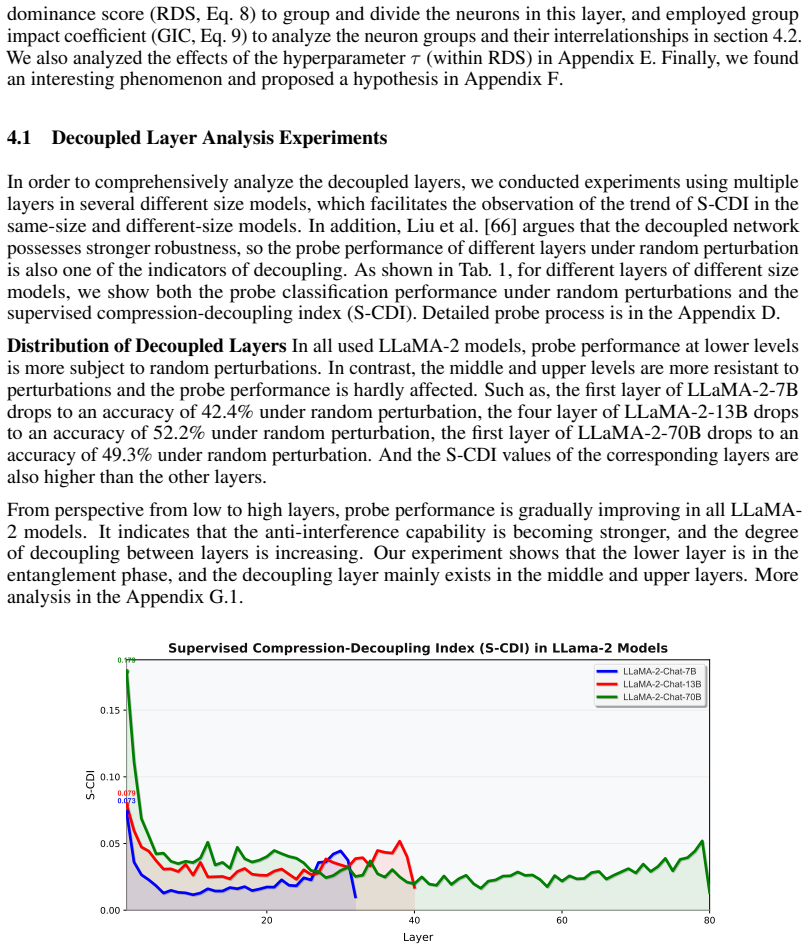
On the paper's own terms, the discovery is that regret in Llama-2 models has a compositional, group-level neural code. Using the Supervised Compression-Decoupling Index (S-CDI), the authors find that the lowest S-CDI value occurs at the final transformer layer, where regret representations are optimally decoupled from context; across layers S-CDI traces an M-shaped pattern of coupling and decoupling that they attribute to attention's context integration near the top of the network. Within that optimal layer, the Regret Dominance Score (RDS) divides neurons into regret-dominant (RegretD), non-regret-dominant (Non-RegretD), and dual (DualD) groups. The Group Impact Coefficient (GIC) then shows the load-bearing result: removing either RegretD or DualD neurons alone barely changes a trained probe's 98–99 percent accuracy in detecting regret hidden states, but removing them together collapses accuracy to 49.3–63.2 percent, with the strongest collapse in the 70B model. The paper interprets this as regret emerging from the cooperation of functionally distinct neuron groups rather than from any individual group.
Load-bearing premise
The load-bearing assumption is that the hidden state at the literal token "regret" in second and third answers faithfully anchors the regret mechanism, with the matching position in the first answer serving as a clean non-regret control; if the probe is instead detecting the word or its position, the layer selection, neuron grouping, and intervention results are not about regret as a cognitive state.
Editorial extensions
If this is right
- Neuron editing for regret must be group-level: single-group deactivation leaves probe accuracy essentially unchanged, while RegretD paired with DualD or Non-RegretD cuts it to 49–63 percent.
- The final transformer layer is the most promising place to read or modify regret states, because S-CDI identifies it as the layer where regret is cleanest from context.
- The M-shaped S-CDI pattern predicts that the upper, pre-final layers are a context-integration phase; interventions that disrupt attention in those layers should weaken regret decoding even if the final-layer groups are left intact.
- The compositional effect grows with scale: the 70B model shows the strongest RegretD+DualD coupling (mutual information 0.071) and the largest intervention collapse, so larger models are not simply bigger versions of smaller ones for regret.
Reading between the lines
- The method's token anchor means the paper establishes overt regret only; a natural extension is to test whether implicit regret (reversing an answer without saying "regret") shares the same neuron groups or recruits a different circuit.
- The scaling result suggests a testable prediction: fine-tuning or RLHF on correction-heavy data should strengthen RegretD-DualD mutual information rather than simply increasing single-neuron selectivity.
- If the compositional architecture is general, interventions to suppress or induce apology-like behavior in deployed models would need to target the RegretD+DualD intersection, an implication the paper does not pursue for safety applications.
- Because S-CDI chooses a layer by minimizing a compression/separability tradeoff, the metric could be lifted to other meta-cognitive states (doubt, uncertainty, avoidance) to test whether the M-shaped decoupling pattern is a general transformer feature.
Editorial analysis
A structured set of objections, weighed in public.
Referee Report
Summary. The paper proposes a three-stage prompting pipeline that elicits regret expressions in Llama-2 models after they produce misinformation: fake evidence yields an initial answer, a weak hint yields a second answer, and real evidence yields a third answer with explicit regret. From the collected hidden states, the authors define a Supervised Compression-Decoupling Index (S-CDI) to select the layer where regret is supposedly decoupled, a Regret Dominance Score (RDS) to partition neurons into RegretD, Non-RegretD, and DualD groups, and a Group Impact Coefficient (GIC) to measure the effect of deactivating these groups on probe accuracy. They report an M-shaped S-CDI pattern across layers and a compositional architecture in which combined deactivation of RegretD+Non-RegretD or RegretD+DualD neurons causes large probe-accuracy drops.
Significance. The paper addresses a genuinely interesting question: whether a metacognitive state such as regret has a compositional neural basis in transformer language models. The three-stage elicitation workflow is a reasonable attempt to obtain explicit regret expressions, and the multi-scale comparison across 7B/13B/70B models, the inclusion of random-deactivation baselines, and the reported tau-sensitivity analysis are good methodological practices. If the central claims were supported, the proposed metrics and dataset would be useful contributions to neuron-level interpretability. However, the current evidence does not support those claims: the probe labels are anchored on the surface token 'regret' without controlling for token identity, the S-CDI metric combines lower-is-better and higher-is-better terms in a way that makes its minimum ill-defined, and the GIC 'interventions' modify probe inputs rather than the model's generation behavior. The required controls and behavioral experiments constitute a substantial new study rather than local revisions.
major comments (4)
- [Appendix D; Sections 3.1 and 4.2] The probe dataset is confounded with the literal token 'regret'. Positive samples are hidden states at the token 'regret' in a2/a3, while negative samples are hidden states at 'equivalent positions' in a1, which by construction express no regret and therefore generally do not contain the token 'regret'. A classifier can reach the reported 98-99% accuracy by recognizing the surface word or its positional pattern rather than a regret state. This confound propagates to RDS (Eq. 7), which compares activations at 'regret' versus non-'regret' positions, and to the GIC results (Tables 2-3), which evaluate probe accuracy on those same token-labeled states. The validation arguments in Appendix G.5 inherit the same confound, and the 'equivalent position' matching cannot be checked because no code or data are released. The authors should add token-matched negative controls (for example, non-regret uses of the word 'regret'), test generalization to regret paraphrases that do not contain the literal token, and report generation-level outcomes; without these, the central claim of a compositional regret architecture is unsupported.
- [Section 3.2, Eq. (1)-(6)] The S-CDI metric is directionally inconsistent. The paper states that lower CDI means better compression and that lower Ie means better inter-class separation, yet the class-separability factor in Eq. (1) is Ic/(1-Ie), which increases as Ie increases and also increases as Ic increases. Multiplying a lower-is-better compression term by a higher-is-better separability term means that the minimum of S-CDI is not a well-defined optimum. The claim in Section 4.2 that the last layer has the 'lowest S-CDI values, where regret signals are optimally decoupled' is therefore not justified. The authors need to redefine S-CDI so that both components point in the same direction, or validate the resulting layer ranking against an external criterion independent of the probe.
- [Section 3.2, Eq. (9); Tables 2-3; Conclusion] The GIC experiments are not interventions on the model. Deactivating a neuron group means setting those activations to -1 in the hidden states that are then passed to the probe; the model's generation is never modified. The observed probe-accuracy drops therefore show only that the probe relies on those neurons, and the same hidden states are used both to define the neuron groups and to evaluate them, creating a circular evaluation. The Conclusion's statement that targeted neuron interventions 'confirm their causal role' is not supported. The authors should perform decoding-time ablation or activation patching and measure changes in the generated text, with random ablations of matched size as controls.
- [Section 4.1; Table 1; Fig. 3] The M-shaped decoupling pattern is not established by the reported data. The 7B model is evaluated at only five layers (1, 8, 16, 24, 32), the 13B model at eight layers, and the 70B model at fourteen layers. Connecting these sparse points in Fig. 3 cannot resolve a four-phase pattern of coupling, decoupling, coupling, and decoupling. The authors should report all layers, or at least a dense uniform sample with confidence intervals, before making this claim.
minor comments (6)
- [Section 2] The sentence 'But there has been no quantitative analysis on which layers are the most important' is ungrammatical and should be revised.
- [Section 3.2, Eq. (7)] RDS assumes paired regret and non-regret instances, but the pairing and alignment of positions across a1, a2, and a3 is not defined; please clarify how (Zr)_ik and (Zn)_ik are matched and how negative activation values are handled.
- [Table 1] The random perturbation protocol is not described; specify how many neurons are removed, whether removals are performed per layer, and how many random seeds are used.
- [Overall] The manuscript does not include a code or data availability statement; given that the 'equivalent position' matching and dataset construction are load-bearing, this must be added.
- [Conclusion] The claim of 'up to 50.7% degradation' is not consistent with Table 3, where the 70B accuracy drops from 99.7% to 49.3%, a decrease of 50.4 percentage points; please state whether the F1-score is intended.
- [Appendix F, Fig. 7] The radar chart caption refers to 'a critical parameter tau' where model scale appears to be meant; the wording is confusing and should be corrected.
Circularity Check
Probe labels are anchored to the literal token 'regret' and all neuron/intervention metrics are computed on the same hidden states, so the 'compositional architecture' claim reduces to the probe's decision boundary.
-
self definitional
[Appendix D, 'Probe Dataset Formation'; Section 3.1]
"Positive samples (label= 1): Hidden states at positions containing the token 'regret' in both a2 and a3, formally: {hL(ai, p)|p is position of 'regret' in ai, i∈ {2,3}}, where hL represents the hidden state at layer L. Negative samples (label= 0): Hidden states at equivalent positions in a1 where no regret is expressed."
The positive class is defined as hidden states at the literal token 'regret' in a2/a3, and negative samples come from a1, which by construction contains no regret expression and generally lacks that token. A probe can reach 98-99% accuracy by recognizing token identity or position rather than a regret state. S-CDI (Eq. 1), RDS (Eq. 7), and GIC (Eq. 9) are all computed on this same label contrast, so the discovered 'regret mechanism' is, by construction, the representation of the word 'regret' at those positions. Appendix G.5 argues that token anchoring is principled and validates it via intervention, but the intervention inherits the same confound; no token-matched negative control or external behavioral benchmark is provided.
-
fitted input called prediction
[Section 3.2, Eq. (7) and Eq. (9); Section 4.2]
"R(k) = 1/M Σ_i (Zr)ik / ((Zr)ik + (Zn)ik) ... GIC(S1, S2, . . . , Sn) = ( Acc(Z−S1)/Acc(Z), if n=1; Acc(Z−∪ni=1Si)/Avg({Acc(Z−Si)}ni=1), if n≥2 ... Acc(Z−S) represents the classification accuracy after deactivating neurons in set S by setting their activation values to −1."
The matrices Zr and Zn in Eq. (7) are the same regret/non-regret hidden states used to construct and train the probe (Appendix D). RDS therefore selects, from the probe's own input distribution, the columns that best separate the two classes. Eq. (9) then evaluates the probe on that same feature matrix Z after setting the selected columns to −1. The reported accuracy drop is the expected in-sample effect of removing the probe's most informative features; no LLM forward pass or generated text is modified, so no causal relationship to regret expression is tested. The paper's abstract and Section 4.2 present this probe-internal accuracy change as 'revealing the compositional architecture of regret at the neuron level', which is a fitted input renamed as a prediction.
full rationale
The derivation chain is not self-contained in the sense required for a discovery about LLM cognition. The probe dataset defines 'regret' as the literal token 'regret' in a2/a3 and 'non-regret' as unmatched positions in a1. Because a1 contains no regret expression, the positive/negative contrast is confounded with token identity; the 98-99% accuracies, S-CDI layer selection, M-shaped pattern, RDS groups, and GIC values are all computed on this same contrast. More importantly, the GIC 'intervention' is not a model intervention: it sets columns of the feature matrix Z (the probe's input) to -1 and measures probe accuracy. RDS selected those columns from the same (Zr, Zn) matrices. Therefore the accuracy drop simply reflects the probe's reliance on features that RDS identified from the probe's own training distribution. The paper's Appendix G.5 argues for 'explicit token anchoring' and cites intervention validation, but the intervention inherits the same probe/token loop. No external behavioral benchmark or token-matched negative control is provided, so the central claim of a compositional neuron-level regret architecture is an artifact of the probe's decision boundary. Random-neuron baselines only show that randomly chosen features matter less; they do not validate the construct. I therefore score 7: the central result reduces by construction to the probe's feature selection, with partial empirical content in the cross-scale and mutual-information patterns.
Assumptions & free parameters
free parameters (3)
- tau (RDS threshold) =
0.05 for 7B, 0.02 for 13B, 0.03 for 70B
- k (number of sampled instances in O(Z)) =
not specified (k << M)
- number of bins for mutual-information discretization =
not specified
assumptions (4)
- domain assumption The hidden state at the token 'regret' encodes the regret mechanism, and 'equivalent positions' in a1 provide matched non-regret controls.
- domain assumption Probe classification accuracy on held-out hidden states is a valid measure of regret representation quality and of causal effect.
- domain assumption Setting a neuron's activation to -1 is a valid causal intervention for studying regret encoding.
- domain assumption Layers form an information-bottleneck Markov chain (Tishby et al.), so compression and separability can be traded off via S-CDI.
invented entities (1)
-
RegretD, Non-RegretD, and DualD neuron groups
Cite this review
Pith. "Pith review of The Compositional Architecture of Regret in Large Language Models." pith.science (2026). https://pith.science/paper/G3PK6RUW
@misc{pith2026250615617,
  author       = {Pith},
  title        = {Pith review of: The Compositional Architecture of Regret in Large Language Models},
  year         = {2026},
  howpublished = {\url{https://pith.science/paper/G3PK6RUW}},
  note         = {Machine review of arXiv:2506.15617}
}
read the original abstract
Regret in Large Language Models refers to their explicit regret expression when presented with evidence contradicting their previously generated misinformation. Studying the regret mechanism is crucial for enhancing model reliability and helps in revealing how cognition is coded in neural networks. To understand this mechanism, we need to first identify regret expressions in model outputs, then analyze their internal representation. This analysis requires examining the model's hidden states, where information processing occurs at the neuron level. However, this faces three key challenges: (1) the absence of specialized datasets capturing regret expressions, (2) the lack of metrics to find the optimal regret representation layer, and (3) the lack of metrics for identifying and analyzing regret neurons. Addressing these limitations, we propose: (1) a workflow for constructing a comprehensive regret dataset through strategically designed prompting scenarios, (2) the Supervised Compression-Decoupling Index (S-CDI) metric to identify optimal regret representation layers, and (3) the Regret Dominance Score (RDS) metric to identify regret neurons and the Group Impact Coefficient (GIC) to analyze activation patterns. Our experimental results successfully identified the optimal regret representation layer using the S-CDI metric, which significantly enhanced performance in probe classification experiments. Additionally, we discovered an M-shaped decoupling pattern across model layers, revealing how information processing alternates between coupling and decoupling phases. Through the RDS metric, we categorized neurons into three distinct functional groups: regret neurons, non-regret neurons, and dual neurons.
Figures


Figures from the paper (4 more)


Reference graph
Works this paper leans on
-
[1]
Challenges and applications of large language models, 2023
Jean Kaddour, Joshua Harris, Maximilian Mozes, Herbie Bradley, Roberta Raileanu, and Robert McHardy. Challenges and applications of large language models, 2023
2023
-
[2]
Junchi Yao, Jianhua Xu, Tianyu Xin, Ziyi Wang, Shenzhe Zhu, Shu Yang, and Di Wang. Is your llm-based multi-agent a reliable real-world planner? exploring fraud detection in travel planning. arXiv preprint arXiv:2505.16557, 2025
arXiv 2025
-
[3]
Can large language models identify implicit suicidal ideation? an empirical evaluation
Tong Li, Shu Yang, Junchao Wu, Jiyao Wei, Lijie Hu, Mengdi Li, Derek F Wong, Joshua R Oltmanns, and Di Wang. Can large language models identify implicit suicidal ideation? an empirical evaluation. arXiv preprint arXiv:2502.17899, 2025
arXiv 2025
-
[4]
Shu Yang, Shenzhe Zhu, Zeyu Wu, Keyu Wang, Junchi Yao, Junchao Wu, Lijie Hu, Mengdi Li, Derek F Wong, and Di Wang. Fraud-r1: A multi-round benchmark for assessing the robustness of llm against augmented fraud and phishing inducements. arXiv preprint arXiv:2502.12904, 2025
arXiv 2025
-
[5]
Jinyan Su, Terry Yue Zhuo, Di Wang, and Preslav Nakov. Detectllm: Leveraging log rank information for zero-shot detection of machine-generated text.arXiv preprint arXiv:2306.05540, 2023
arXiv 2023
-
[6]
Fake news detectors are biased against texts generated by large language models
Jinyan Su, Terry Yue Zhuo, Jonibek Mansurov, Di Wang, and Preslav Nakov. Fake news detectors are biased against texts generated by large language models. arXiv preprint arXiv:2309.08674, 2023
arXiv 2023
-
[7]
Language models represent space and time
Wes Gurnee and Max Tegmark. Language models represent space and time. arXiv preprint arXiv:2310.02207, 2023
arXiv 2023
-
[8]
EAP-GP: Mitigating Saturation Effect in Gradient-based Automated Circuit Identification
Lin Zhang, Wenshuo Dong, Zhuoran Zhang, Shu Yang, Lijie Hu, Ninghao Liu, Pan Zhou, and Di Wang. Eap-gp: Mitigating saturation effect in gradient-based automated circuit identification. arXiv preprint arXiv:2502.06852, 2025
work page Pith review arXiv 2025
Show all 84 references
-
[9]
Locate-then- edit for multi-hop factual recall under knowledge editing
Zhuoran Zhang, Yongxiang Li, Zijian Kan, Keyuan Cheng, Lijie Hu, and Di Wang. Locate-then- edit for multi-hop factual recall under knowledge editing. arXiv preprint arXiv:2410.06331, 2024
2024 arXiv
-
[10]
What makes your model a low-empathy or warmth person: Exploring the origins of personality in llms
Shu Yang, Shenzhe Zhu, Ruoxuan Bao, Liang Liu, Yu Cheng, Lijie Hu, Mengdi Li, and Di Wang. What makes your model a low-empathy or warmth person: Exploring the origins of personality in llms. arXiv preprint arXiv:2410.10863, 2024
-
[11]
Understanding reasoning in chain-of-thought from the hopfieldian view
Lijie Hu, Liang Liu, Shu Yang, Xin Chen, Zhen Tan, Muhammad Asif Ali, Mengdi Li, and Di Wang. Understanding reasoning in chain-of-thought from the hopfieldian view. arXiv preprint arXiv:2410.03595, 2024
2024 arXiv
-
[12]
Mechanistic unveiling of transformer circuits: Self-influence as a key to model reasoning
Lin Zhang, Lijie Hu, and Di Wang. Mechanistic unveiling of transformer circuits: Self-influence as a key to model reasoning. arXiv preprint arXiv:2502.09022, 2025
2025 arXiv
-
[13]
Improving interpretation faithfulness for vision transformers
Lijie Hu, Yixin Liu, Ninghao Liu, Mengdi Huai, Lichao Sun, and Di Wang. Improving interpretation faithfulness for vision transformers. In Forty-first International Conference on Machine Learning, 2024
2024
-
[14]
Seat: stable and explainable attention
Lijie Hu, Yixin Liu, Ninghao Liu, Mengdi Huai, Lichao Sun, and Di Wang. Seat: stable and explainable attention. In Proceedings of the AAAI Conference on Artificial Intelligence, volume 37, pages 12907–12915, 2023
2023
-
[15]
Physics of language models: Part 2.1, grade-school math and the hidden reasoning process
Tian Ye, Zicheng Xu, Yuanzhi Li, and Zeyuan Allen-Zhu. Physics of language models: Part 2.1, grade-school math and the hidden reasoning process. In The Thirteenth International Conference on Learning Representations, 2024
2024
-
[16]
How large language models encode context knowledge? a layer-wise probing study
Tianjie Ju, Weiwei Sun, Wei Du, Xinwei Yuan, Zhaochun Ren, and Gongshen Liu. How large language models encode context knowledge? a layer-wise probing study. arXiv preprint arXiv:2402.16061, 2024. 10
2024 arXiv
-
[17]
Compke: Complex question answering under knowledge editing
Keyuan Cheng, Zijian Kan, Zhixian He, Zhuoran Zhang, Muhammad Asif Ali, Ke Xu, Lijie Hu, and Di Wang. Compke: Complex question answering under knowledge editing. arXiv preprint arXiv:2506.00829, 2025
2025 arXiv
-
[18]
Codemenv: Benchmarking large language models on code migration
Keyuan Cheng, Xudong Shen, Yihao Yang, Tengyue Wang, Yang Cao, Muhammad Asif Ali, Hanbin Wang, Lijie Hu, and Di Wang. Codemenv: Benchmarking large language models on code migration. arXiv preprint arXiv:2506.00894, 2025
2025 arXiv
-
[19]
Mqa- keal: Multi-hop question answering under knowledge editing for arabic language.arXiv preprint arXiv:2409.12257, 2024
Muhammad Asif Ali, Nawal Daftardar, Mutayyaba Waheed, Jianbin Qin, and Di Wang. Mqa- keal: Multi-hop question answering under knowledge editing for arabic language.arXiv preprint arXiv:2409.12257, 2024
2024 arXiv
-
[20]
Leveraging logical rules in knowledge editing: A cherry on the top
Keyuan Cheng, Muhammad Asif Ali, Shu Yang, Gang Lin, Yuxuan Zhai, Haoyang Fei, Ke Xu, Lu Yu, Lijie Hu, and Di Wang. Leveraging logical rules in knowledge editing: A cherry on the top. arXiv preprint arXiv:2405.15452, 2024
2024 arXiv
-
[21]
Multi-hop question answering under temporal knowledge editing
Keyuan Cheng, Gang Lin, Haoyang Fei, Lu Yu, Muhammad Asif Ali, Lijie Hu, Di Wang, et al. Multi-hop question answering under temporal knowledge editing. arXiv preprint arXiv:2404.00492, 2024
2024 arXiv
-
[22]
Model autophagy analysis to explicate self-consumption within human-ai interactions
Shu Yang, Muhammad Asif Ali, Lu Yu, Lijie Hu, and Di Wang. Model autophagy analysis to explicate self-consumption within human-ai interactions. In First Conference on Language Modeling
-
[23]
Understanding aha moments: from external observations to internal mechanisms
Shu Yang, Junchao Wu, Xin Chen, Yunze Xiao, Xinyi Yang, Derek F Wong, and Di Wang. Understanding aha moments: from external observations to internal mechanisms. arXiv preprint arXiv:2504.02956, 2025
2025 arXiv
-
[24]
Regret: A theoretical and conceptual analysis
J LANDMAN. Regret: A theoretical and conceptual analysis. Journal for the theory of social behaviour, 17(2):135–160, 1987
1987
-
[25]
The experience of regret: what, when, and why
Thomas Gilovich and Victoria Husted Medvec. The experience of regret: what, when, and why. Psychological review, 102(2):379, 1995
1995
-
[26]
Memory and decision processes: The impact of cognitive loads on decision regret
Elan Ariel. Memory and decision processes: The impact of cognitive loads on decision regret. Memory, 5:14–2014, 2014
2014
-
[27]
A comprehensive study of knowledge editing for large language models
Ningyu Zhang, Yunzhi Yao, Bozhong Tian, Peng Wang, Shumin Deng, Mengru Wang, Zekun Xi, Shengyu Mao, Jintian Zhang, Yuansheng Ni, et al. A comprehensive study of knowledge editing for large language models. arXiv preprint arXiv:2401.01286, 2024
2024 arXiv
-
[28]
Locating and editing factual associations in gpt
Kevin Meng, David Bau, Alex Andonian, and Yonatan Belinkov. Locating and editing factual associations in gpt. Advances in neural information processing systems, 35:17359–17372, 2022
2022
-
[29]
Mass- editing memory in a transformer
Kevin Meng, Arnab Sen Sharma, Alex Andonian, Yonatan Belinkov, and David Bau. Mass- editing memory in a transformer. arXiv preprint arXiv:2210.07229, 2022
2022 arXiv
-
[30]
Pmet: Precise model editing in a transformer
Xiaopeng Li, Shasha Li, Shezheng Song, Jing Yang, Jun Ma, and Jie Yu. Pmet: Precise model editing in a transformer. In Proceedings of the AAAI Conference on Artificial Intelligence, volume 38(17), pages 18564–18572, 2024
2024
-
[31]
Massive editing for large language models via meta learning
Chenmien Tan, Ge Zhang, and Jie Fu. Massive editing for large language models via meta learning. arXiv preprint arXiv:2311.04661, 2023
2023 arXiv
-
[32]
Attention heads of large language models
Zifan Zheng, Yezhaohui Wang, Yuxin Huang, Shichao Song, Mingchuan Yang, Bo Tang, Feiyu Xiong, and Zhiyu Li. Attention heads of large language models. Patterns, 2025
2025
-
[33]
The multi- faceted monosemanticity in multimodal representations
Hanqi Yan, Xiangxiang Cui, Lu Yin, Paul Pu Liang, Yulan He, and Yifei Wang. The multi- faceted monosemanticity in multimodal representations. arXiv preprint arXiv:2502.14888, 2025
2025 arXiv
-
[34]
Knowledge editing for large language models: A survey
Song Wang, Yaochen Zhu, Haochen Liu, Zaiyi Zheng, Chen Chen, and Jundong Li. Knowledge editing for large language models: A survey. ACM Computing Surveys, 57(3):1–37, 2024. 11
2024
-
[35]
Get my drift? catching llm task drift with activation deltas, 2025
Sahar Abdelnabi, Aideen Fay, Giovanni Cherubin, Ahmed Salem, Mario Fritz, and Andrew Paverd. Get my drift? catching llm task drift with activation deltas, 2025
2025
-
[36]
Understanding how value neurons shape the generation of specified values in llms
Yi Su, Jiayi Zhang, Shu Yang, Xinhai Wang, Lijie Hu, and Di Wang. Understanding how value neurons shape the generation of specified values in llms. arXiv preprint arXiv:2505.17712, 2025
2025 arXiv
-
[37]
Knowledge editing for large language model with knowledge neuronal ensemble, 2024
Yongchang Li, Yujin Zhu, Tao Yan, Shijian Fan, Gang Wu, and Liang Xu. Knowledge editing for large language model with knowledge neuronal ensemble, 2024
2024
-
[38]
The geometry of concepts: Sparse autoencoder feature structure
Yuxiao Li, Eric J Michaud, David D Baek, Joshua Engels, Xiaoqing Sun, and Max Tegmark. The geometry of concepts: Sparse autoencoder feature structure. Entropy, 27(4):344, 2025
2025
-
[39]
Large language models (llms) and the institutionalization of misinformation
Maryanne Garry, Way Ming Chan, Jeffrey Foster, and Linda A Henkel. Large language models (llms) and the institutionalization of misinformation. Trends in cognitive sciences, 2024
2024
-
[40]
Dell: Generating reactions and explanations for llm-based misinformation detection
Herun Wan, Shangbin Feng, Zhaoxuan Tan, Heng Wang, Yulia Tsvetkov, and Minnan Luo. Dell: Generating reactions and explanations for llm-based misinformation detection. arXiv preprint arXiv:2402.10426, 2024
2024 arXiv
-
[41]
Combating misinformation in the age of llms: Opportunities and challenges
Canyu Chen and Kai Shu. Combating misinformation in the age of llms: Opportunities and challenges. AI Magazine, 45(3):354–368, 2024
2024
-
[42]
Hallucination as disinformation: The role of llms in amplifying conspir- acy theories and fake news
Chathura Bandara. Hallucination as disinformation: The role of llms in amplifying conspir- acy theories and fake news. Journal of Applied Cybersecurity Analytics, Intelligence, and Decision-Making Systems, 14(12):65–76, 2024
2024
-
[43]
Can llm-generated misinformation be detected? arXiv preprint arXiv:2309.13788, 2023
Canyu Chen and Kai Shu. Can llm-generated misinformation be detected? arXiv preprint arXiv:2309.13788, 2023
2023 arXiv
-
[44]
Unmasking digital falsehoods: A comparative analysis of llm-based misinformation detection strategies
Tianyi Huang, Jingyuan Yi, Peiyang Yu, and Xiaochuan Xu. Unmasking digital falsehoods: A comparative analysis of llm-based misinformation detection strategies. arXiv preprint arXiv:2503.00724, 2025
2025 arXiv
-
[45]
Preventing and detecting misinformation generated by large language models
Aiwei Liu, Qiang Sheng, and Xuming Hu. Preventing and detecting misinformation generated by large language models. In Proceedings of the 47th International ACM SIGIR Conference on Research and Development in Information Retrieval, pages 3001–3004, 2024
2024
-
[46]
Exploring the deceptive power of llm-generated fake news: A study of real-world detection challenges
Yanshen Sun, Jianfeng He, Limeng Cui, Shuo Lei, and Chang-Tien Lu. Exploring the deceptive power of llm-generated fake news: A study of real-world detection challenges. arXiv preprint arXiv:2403.18249, 2024
2024 arXiv
-
[47]
Toward mitigating misinformation and social media manipulation in llm era
Yizhou Zhang, Karishma Sharma, Lun Du, and Yan Liu. Toward mitigating misinformation and social media manipulation in llm era. In Companion Proceedings of the ACM Web Conference 2024, pages 1302–1305, 2024
2024
-
[48]
The dark side of language models: Exploring the potential of llms in multimedia disinformation generation and dissemination.Machine Learning with Applications, page 100545, 2024
Dipto Barman, Ziyi Guo, and Owen Conlan. The dark side of language models: Exploring the potential of llms in multimedia disinformation generation and dissemination.Machine Learning with Applications, page 100545, 2024
2024
-
[49]
Probing for constituency structure in neural language models
David Arps, Younes Samih, Laura Kallmeyer, and Hassan Sajjad. Probing for constituency structure in neural language models. arXiv preprint arXiv:2204.06201, 2022
2022 arXiv
-
[50]
Probing the category of verbal aspect in transformer language models
Anisia Katinskaia and Roman Yangarber. Probing the category of verbal aspect in transformer language models. arXiv preprint arXiv:2406.02335, 2024
2024 arXiv
-
[51]
Understanding the repeat curse in large language models from a feature perspective
Junchi Yao, Shu Yang, Jianhua Xu, Lijie Hu, Mengdi Li, and Di Wang. Understanding the repeat curse in large language models from a feature perspective. arXiv preprint arXiv:2504.14218, 2025
2025
-
[52]
Pixology: Probing the linguistic and visual capabilities of pixel-based language models
Kushal Tatariya, Vladimir Araujo, Thomas Bauwens, and Miryam De Lhoneux. Pixology: Probing the linguistic and visual capabilities of pixel-based language models. arXiv preprint arXiv:2410.12011, 2024. 12
2024 arXiv
-
[53]
Probing llms for logical reasoning
Francesco Manigrasso, Stefan Schouten, Lia Morra, and Peter Bloem. Probing llms for logical reasoning. In International Conference on Neural-Symbolic Learning and Reasoning, pages 257–278. Springer, 2024
2024
-
[54]
Exploring multilingual probing in large language models: A cross-language analysis
Daoyang Li, Haiyan Zhao, Qingcheng Zeng, and Mengnan Du. Exploring multilingual probing in large language models: A cross-language analysis. arXiv preprint arXiv:2409.14459, 2024
2024 arXiv
-
[55]
Probing conceptual understanding of large visual- language models
Madeline Schiappa, Raiyaan Abdullah, Shehreen Azad, Jared Claypoole, Michael Cogswell, Ajay Divakaran, and Yogesh Rawat. Probing conceptual understanding of large visual- language models. In Proceedings of the IEEE/CVF Conference on Computer Vision and Pattern Recognition, pag...
2024
-
[56]
Sparse feature circuits: Discovering and editing interpretable causal graphs in language models
Samuel Marks, Can Rager, Eric J Michaud, Yonatan Belinkov, David Bau, and Aaron Mueller. Sparse feature circuits: Discovering and editing interpretable causal graphs in language models. arXiv preprint arXiv:2403.19647, 2024
2024 arXiv
-
[57]
Sparse autoen- coders find highly interpretable features in language models
Hoagy Cunningham, Aidan Ewart, Logan Riggs, Robert Huben, and Lee Sharkey. Sparse autoen- coders find highly interpretable features in language models. arXiv preprint arXiv:2309.08600, 2023
2023 arXiv
-
[58]
Finding neurons in a haystack: Case studies with sparse probing
Wes Gurnee, Neel Nanda, Matthew Pauly, Katherine Harvey, Dmitrii Troitskii, and Dimitris Bertsimas. Finding neurons in a haystack: Case studies with sparse probing. arXiv preprint arXiv:2305.01610, 2023
2023 arXiv
-
[59]
Adaptive chameleon or stubborn sloth: Revealing the behavior of large language models in knowledge conflicts
Jian Xie, Kai Zhang, Jiangjie Chen, Renze Lou, and Yu Su. Adaptive chameleon or stubborn sloth: Revealing the behavior of large language models in knowledge conflicts. In The Twelfth International Conference on Learning Representations, 2023
2023
-
[60]
When corrections fail: The persistence of political misper- ceptions
Brendan Nyhan and Jason Reifler. When corrections fail: The persistence of political misper- ceptions. Political Behavior, 32(2):303–330, 2010
2010
-
[61]
Vlasceanu and A
M. Vlasceanu and A. Coman. The impact of social norms on health-related belief update. Applied psychology. Health and well-being, 2021
2021
-
[62]
Attention is all you need
Ashish Vaswani, Noam Shazeer, Niki Parmar, Jakob Uszkoreit, Llion Jones, Aidan N Gomez, Ł ukasz Kaiser, and Illia Polosukhin. Attention is all you need. In Advances in Neural Information Processing Systems, volume 30. Curran Associates, Inc., 2017
2017
-
[63]
Enhanced brain structure-function tethering in transmodal cortex revealed by high-frequency eigenmodes
Yaqian Yang, Zhiming Zheng, Longzhao Liu, Hongwei Zheng, Yi Zhen, Yi Zheng, Xin Wang, and Shaoting Tang. Enhanced brain structure-function tethering in transmodal cortex revealed by high-frequency eigenmodes. Nature Communications, 14(1):6744, 2023
2023
-
[64]
Compressing neural networks using the variational information bottleneck
Bin Dai, Chen Zhu, Baining Guo, and David Wipf. Compressing neural networks using the variational information bottleneck. In International Conference on Machine Learning, pages 1135–1144. PMLR, 2018
2018
-
[65]
Deep learning and the information bottleneck principle
Naftali Tishby and Noga Zaslavsky. Deep learning and the information bottleneck principle. In 2015 ieee information theory workshop (itw), pages 1–5. Ieee, 2015
2015
-
[66]
Decoupled networks
Weiyang Liu, Zhen Liu, Zhiding Yu, Bo Dai, Rongmei Lin, Yisen Wang, James M Rehg, and Le Song. Decoupled networks. In Proceedings of the IEEE Conference on Computer Vision and Pattern Recognition, pages 2771–2779, 2018
2018
-
[67]
Llama 2: Open foundation and fine-tuned chat models
Hugo Touvron, Louis Martin, Kevin Stone, Peter Albert, Amjad Almahairi, Yasmine Babaei, Nikolay Bashlykov, Soumya Batra, Prajjwal Bhargava, Shruti Bhosale, et al. Llama 2: Open foundation and fine-tuned chat models. arXiv preprint arXiv:2307.09288, 2023
2023 arXiv
-
[68]
Is bigger and deeper always better? probing llama across scales and layers
Nuo Chen, Ning Wu, Shining Liang, Ming Gong, Linjun Shou, Dongmei Zhang, and Jia Li. Is bigger and deeper always better? probing llama across scales and layers. arXiv preprint arXiv:2312.04333, 2023
2023 arXiv
-
[69]
Scaling laws for neural language models
Jared Kaplan, Sam McCandlish, Tom Henighan, Tom B Brown, Benjamin Chess, Rewon Child, Scott Gray, Alec Radford, Jeffrey Wu, and Dario Amodei. Scaling laws for neural language models. arXiv preprint arXiv:2001.08361, 2020. 13
2001 arXiv
-
[70]
Visualizing and understanding convolutional networks
Matthew D Zeiler and Rob Fergus. Visualizing and understanding convolutional networks. In Computer Vision–ECCV 2014: 13th European Conference, Zurich, Switzerland, September 6-12, 2014, Proceedings, Part I 13, pages 818–833. Springer, 2014
2014
-
[71]
Decomposing past and future: Integrated information decomposition based on shared probability mass exclusions
Thomas F Varley. Decomposing past and future: Integrated information decomposition based on shared probability mass exclusions. Plos one, 18(3):e0282950, 2023
2023
-
[72]
Molecular structure of nucleic acids: a structure for deoxyribose nucleic acid
James D Watson and Francis HC Crick. Molecular structure of nucleic acids: a structure for deoxyribose nucleic acid. Nature, 171(4356):737–738, 1953
1953
-
[73]
A comparison of optimal and suboptimal rna secondary structures predicted by free energy minimization with structures determined by phylogenetic comparison
Michael Zuker, John A Jaeger, and Douglas H Turner. A comparison of optimal and suboptimal rna secondary structures predicted by free energy minimization with structures determined by phylogenetic comparison. Nucleic acids research, 19(10):2707–2714, 1991
1991
-
[74]
Oscillatory dynamics and information processing in olfactory systems.Journal of Experimental Biology, 202(14):1855–1864, 1999
ALAN Gelperin. Oscillatory dynamics and information processing in olfactory systems.Journal of Experimental Biology, 202(14):1855–1864, 1999
1999
-
[75]
Distributed representations in memory: insights from functional brain imaging
Jesse Rissman and Anthony D Wagner. Distributed representations in memory: insights from functional brain imaging. Annual review of psychology, 63(1):101–128, 2012
2012
-
[76]
A combinatorial neural code for long-term motor memory
Jae-Hyun Kim, Kayvon Daie, and Nuo Li. A combinatorial neural code for long-term motor memory. Nature, 637(8046):663–672, 2025
2025
-
[77]
Default mode network scaffolds immature frontoparietal network in cognitive development
Menglu Chen, Ying He, Lei Hao, Jiahua Xu, Ting Tian, Siya Peng, Gai Zhao, Jing Lu, Yuyao Zhao, Hui Zhao, et al. Default mode network scaffolds immature frontoparietal network in cognitive development. Cerebral Cortex, 33(9):5251–5263, 2023
2023
-
[78]
Hippocampal-neocortical functional reorganization underlies children’s cognitive development
Shaozheng Qin, Soohyun Cho, Tianwen Chen, Miriam Rosenberg-Lee, David C Geary, and Vinod Menon. Hippocampal-neocortical functional reorganization underlies children’s cognitive development. Nature neuroscience, 17(9):1263–1269, 2014. 14 A Dataset Generation Prompt Prompt Name:...
2014
-
[79]
It should not directly reveal the correct answer or the true evidence
-
[80]
It should not explicitly contradict the fake evidence
-
[81]
It should provide an indirect or metaphorical clue that might lead the model to question the fake evidence
-
[82]
Provide only the weak hint, without any additional explanations or introductions
It should be neutral and open-ended, encouraging broader thinking. Provide only the weak hint, without any additional explanations or introductions. Prompt Name: Generate Second Answer You previously answered the following question: {question} Your initial answer was: {initial...
-
[83]
This approach captures both the hint-induced regret in a2 and the evidence- induced regret in a3, providing a more comprehensive view of regret’s neural representation
Regret Position Identification:We first identify key positions where regret is explicitly expressed in both a2 and a3 responses by locating the specific token ’regret’ in these responses. This approach captures both the hint-induced regret in a2 and the evidence- induced regre...
-
[84]
enlarging model sizes almost could not automatically impart additional knowledge
Probe Dataset Formation:We extract hidden states from decoupled layer at the following positions: • Positive samples (label= 1):Hidden states at positions containing the token ’regret’ in both a2 and a3, formally: {hL(ai, p)|pis position of ’regret’ inai, i∈ {2,3}}, where hL r...
Reviewed August 6, 2026 · model on record in the stance chip above.
Discussion (0). Sign in to comment.