REVIEW 2 major objections 5 minor 8 cited by
Fast, continuous and coherent atom replacement in a neutral atom qubit array
T0 review · 2 major / 5 minor · reviewed 2026-08-06 · deepseek-v4-flash
Pith's one-line read Losing atoms no longer has to cap the depth of a neutral atom circuit: this paper shows continuous mid-circuit replacement of 171Yb qubits at up to 500 extractions per second, with 1 ms tweezer loading times and no measurable disturbance…
desk verdict Fast reloading from a continuous reservoir is real, and the coherence check is decent; the 'unlimited depth' claim goes beyond what the experiment actually tested. read the letter →
The pith
A machine-rendered reading of the paper's core claim, the machinery that carries it, and where it could break.
The reading
What carries the argument
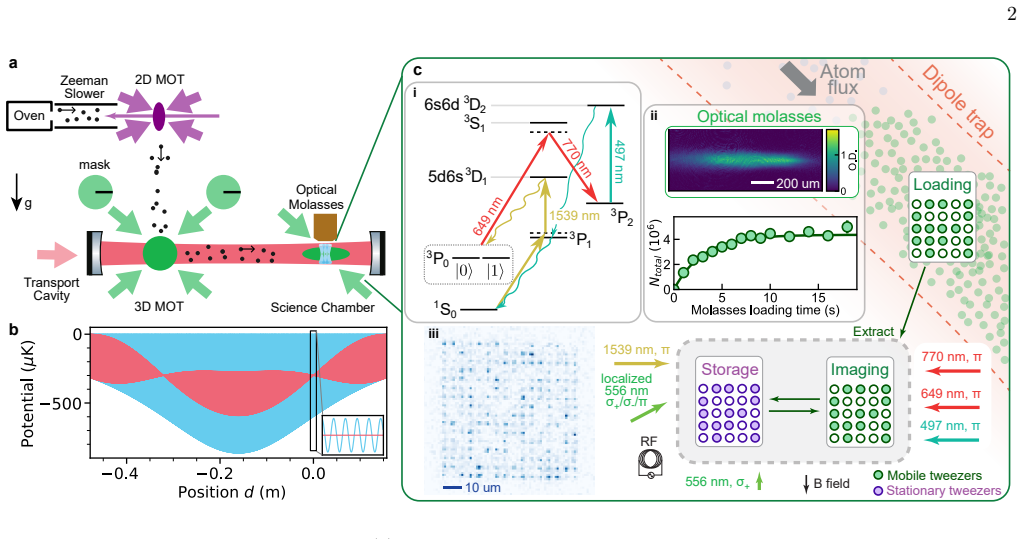
The load-bearing mechanism is the combination of a continuously loaded atom reservoir and the metastable $6s6p\,{}^3P_0$ nuclear-spin qubit of $^{171}$Yb. The $3P_0$ state is a long-lived electronic state with no dipole transition at the cooling and imaging wavelengths, so the intense light used to load, cool, and image ground-state atoms barely scatters from qubits parked in this state. The reservoir, fed continuously by a magneto-optical trap and transport dipole trap, sits several hundred microns from the tweezer zones; optical tweezers repeatedly dip into it and extract atoms with a time constant near 1 ms. In the paper's demonstration, qubits that must survive reloading are held in a stationary tweezer array, while the mobile tweezers return to the loading zone, so the isolation is geometric as well as spectroscopic.
What would settle it
Measure the Ramsey fringe visibility and lifetime of a qubit that stays in the computation zone while a fresh atom is loaded and prepared in an adjacent site; if the visibility or lifetime degrades by more than the statistical uncertainty relative to a no-reload control, the claim that reloading completely leaves existing qubits undisturbed is falsified.
Extended reading notes
Core claim
The paper's central claim is that fast, continuous, and coherent atom replacement is achievable in a $^{171}$Yb neutral atom qubit array. A dense reservoir, continuously loaded from a magneto-optical trap through a transport dipole trap, supplies atoms extracted by a 256-site mobile tweezer array with a characteristic loading time of 0.84 ms at the highest duty cycle, sustaining an extraction rate of $7.3\times10^4$ atoms/s without measurable reservoir depletion. After parity projection, non-destructive imaging, cooling, and optical pumping into the metastable $3P_0$ nuclear-spin qubit, a fresh $5\times5$ array can be prepared and measured 30 times per second, and repeated non-destructive measurements reach 50 cycles per second. When loaded qubits are transferred to a stationary array and reloading continues nearby, the qubit lifetime is 1.35(4) s versus 1.30(3) s in a no-reload control, and the Ramsey coherence time $T_2^*$ is 0.73(2) s versus 0.69(2) s; the paper claims existing qubits are completely undisturbed by reloading.
Load-bearing premise
The result assumes that the isolation that protects qubits held 300 µm away in a separate storage array will also protect qubits when fresh atoms are loaded directly into the same computation zone next to working qubits.
Editorial extensions
If this is right
- Atom reloading time drops to about 1 ms, making it one of the fastest operations in the processor; the bottleneck shifts to light-assisted collisions, imaging, and cooling, which now account for over 90% of the cycle time.
- The demonstrated 500-cycle-per-second extraction and $7.3\times10^4$ atoms/s rate imply that with a larger tweezer array and faster auxiliary steps, the reservoir could supply $10^6$ atoms/s, enabling several hundred cycles of loading, gates, and measurement per second.
- The loss-resolving, non-destructive readout at 50 cycles per second allows repeated measurement of the same atoms, which is directly useful for fast calibration and for mid-circuit measurement without consuming qubits.
- With rearrangement, two-qubit gates, and mid-circuit measurement added, the results establish a foundation for exploring quantum circuits of unlimited depth, including leakage-to-erasure strategies and fusion-based approaches.
Reading between the lines
- An implication the authors leave implicit: if the same isolation holds when a fresh atom is inserted directly into the computation zone, the protocol combines naturally with erasure conversion to make logical circuit depth set by the error-correction code rather than by initial atom number.
- A testable extension the paper does not perform: run two-qubit gates while reloading an adjacent site and search for correlated errors; the current data only cover single-qubit coherences.
- The same continuously fed source could slash deadtime in tweezer-based optical clocks, a use noted in the outlook; the quantitative benefit would depend on how the faster reload rate translates into clock stability.
Editorial analysis
A structured set of objections, weighed in public.
Referee Report
Summary. The paper reports an experimental demonstration of fast, continuous loading of 171Yb atoms into optical tweezers from a continuously fed reservoir. The authors measure a tweezer loading time constant of ~0.84 ms at the highest molasses duty cycle, demonstrate repeated atom extraction at up to 500 cycles/s (7.3e4 atoms/s) with no observable reservoir depletion, and show full array preparation at 30 cycles/s including light-assisted collisions, non-destructive imaging, and initialization into the metastable 3P0 qubit manifold. They also measure the lifetime and coherence of 3P0 qubits held in a stationary SLM array while reloading cycles are performed in nearby zones, finding statistically unchanged lifetime (1.35(4) s vs 1.30(3) s) and T2* (0.73(2) s vs 0.69(2) s). The paper concludes that existing qubits are completely undisturbed by reloading and that this establishes a foundation for unlimited-depth quantum circuits.
Significance. If the central claims hold, this is a significant experimental advance: it reduces the characteristic tweezer-loading time by nearly two orders of magnitude relative to prior mid-circuit refilling demonstrations, introduces a continuously loaded reservoir that can sustain high extraction rates without depletion, and provides a detailed, well-characterized protocol for preparing and reading out metastable 171Yb nuclear-spin qubits. The headline rates are directly measured with standard exponential fits and reported error bars, and the readout and initialization fidelities are carefully quantified. The Monte Carlo loading simulation is presented as supporting agreement rather than as the source of the claimed rates, which is appropriate. The main reservation is that the coherence-preservation result is established only for qubits held in a stationary array located in a separate zone from the reloading operations, not for qubits in an active computation zone where fresh atoms are inserted at neighboring sites.
major comments (2)
- [Section IV, Fig. 4] The coherence-preservation claim is demonstrated with resident qubits held in a stationary SLM array in the storage/imaging zone while mobile tweezers perform loading, parity projection, imaging, and initialization in zones roughly 300 um away. No fresh atom is ever inserted into the stationary array, and the mobile tweezers never pass through or park in that array. The measured insensitivity therefore establishes that 3P0 qubits are isolated from the reloading light and that spatial separation shields them from reservoir collisions and moving-tweezer potentials, but it does not establish that inserting a replacement atom at a neighboring site in a live computation array is nondisruptive. The abstract's 'completely undisturbed' claim and Section V's 'unlimited-depth circuits' language transfer this result beyond the measured conditions. Please either add an experiment in which a mobile tweezer carrying a fresh atom is moved into and parked adjacent to the stationary array while qubit lifetime and coherence are measured, or revise the claims to describe coherent reloading in a spatially separated zone.
- [Abstract and Section V] The paper describes the work as demonstrating 'atom replacement' and mid-circuit reloading, but the reported experiments do not include an actual replacement event: they do not detect a lost atom in an active array, transport a fresh atom into that specific site, and continue operations with the neighboring qubits. The stationary-array coherence measurement is performed while new batches are prepared in a different zone, not while a fresh atom is inserted into the stationary array. Section V explicitly lists rearrangement, two-qubit gates, and mid-circuit measurement as future extensions, which is consistent with the techniques being components of a replacement protocol rather than a demonstration of replacement itself. The abstract and title should be tempered accordingly.
minor comments (5)
- [Abstract] The phrase 'completely undisturbed' is stronger than what finite-precision measurements can establish; I suggest rewording to 'statistically indistinguishable within the measurement precision' and noting the demonstrated geometry.
- [Appendix B2] The Monte Carlo loading simulation uses an energy threshold described as 'somewhat arbitrarily chosen'; given that the predicted loading probability of 0.45 is compared with experiment, the sensitivity of this prediction to the threshold choice should be reported or the threshold should be justified physically.
- [Figure 4 and Section IV] The Hahn echo results (7(1) s control vs 5.4(9) s reload) differ by about 1.6 s with a combined uncertainty of roughly 1.4 s; calling these results 'indistinguishable' is acceptable, but a brief statement that they are consistent within the current statistical precision would be more precise.
- [Appendix A2] The statement that the authors are 'not confident that this removes all of the ASE' from the fiber amplifier leaves the operational magic wavelength somewhat uncertain; a quantitative estimate of the residual ASE effect on loading or transport would strengthen the apparatus description.
- [Appendix C] There is a capitalization typo in 'To characterize the loss probabilities, We apply a LAC pulse'; 'We' should be lowercase.
Circularity Check
No significant circularity: the headline results are directly measured rates and coherence times, and the Monte Carlo agreement is auxiliary rather than load-bearing.
full rationale
The paper's central claims — 1 ms tweezer loading time, 500 cycles/s extraction, 30 cycles/s full array preparation, 50 cycles/s repeated measurement, and unchanged coherence during reloading — are presented as experimental measurements with fits to decay curves, not as outputs of a derivation from inputs. The loading-time claim is measured directly (Fig. 2d,e); the coherence claim is a measured comparison of lifetime 1.35(4) s vs 1.30(3) s and T2* 0.73(2) s vs 0.69(2) s under reloading vs control (Fig. 4). The Monte Carlo simulation (App. B2) uses an admittedly arbitrary energy threshold, but it is used only as supporting agreement and is not the source of the claimed rates; the threshold is not shown to be fitted to the experimental loading probability, and the headline numbers are direct measurements in either case. The paper cites prior work by the same group (e.g., Refs. [13,29]) for established qubit and magic-wavelength properties, but these citations are not used to forbid alternatives or to justify the central new result; the central result stands on the measured data. The reviewer-flagged gap — coherence under reloading was measured with resident qubits in a stationary array roughly 300 um from the reloading zone rather than with replacement atoms inserted adjacent to live qubits — is a scope and external-validity concern, not circularity: the paper does not define 'undisturbed' in terms of the reloading rate, nor does it fit any parameter to make the coherence claim true by construction.
Assumptions & free parameters
free parameters (4)
- Molasses loading fit parameters =
Gamma_atom=0.156(8) s^-1, beta=6.1(3)e-13 cm3/s, phi0=1.60(4)e6 atoms/s, Veff=6.6(4)e-6 cm3
- Monte Carlo loading threshold =
0.5 x E_trap depth
- EOM modulation depth beta_EOM =
1.75(1)
- Parity projection and imaging operating points =
Tpp=6 ms, 5% single-body loss; 4 ms imaging, flip rate 0.8(4)%
assumptions (4)
- domain assumption The 3P0 metastable state of 171Yb is effectively decoupled from the 556 nm cooling light and 488 nm imaging light, so resident qubits are not scattered by the reloading beams.
- domain assumption 488 nm is a magic wavelength for the 1S0-3P1 intercombination line in 171Yb, so tweezers do not disturb ground-state cooling and imaging.
- domain assumption The 1036 nm transport ODT operates near the magic wavelength for the intercombination transition, with the light shift nulled at 1036.13(1) nm.
- domain assumption Reservoir atoms and reloading beams do not reach the stationary qubit array across the ~300 um separation.
Cite this review
Pith. "Pith review of Fast, continuous and coherent atom replacement in a neutral atom qubit array." pith.science (2026). https://pith.science/paper/LPENVQEO
@misc{pith2026250615633,
  author       = {Pith},
  title        = {Pith review of: Fast, continuous and coherent atom replacement in a neutral atom qubit array},
  year         = {2026},
  howpublished = {\url{https://pith.science/paper/LPENVQEO}},
  note         = {Machine review of arXiv:2506.15633}
}
abstract
Neutral atom quantum processors are a promising platform for scalable quantum computing. An obstacle to implementing deep quantum circuits is managing atom loss, which constitutes a significant fraction of all errors. Current approaches are either not capable of replacing lost atoms in the middle of a circuit -- and therefore restricted to fixed, short circuit depths -- or require more than an order of magnitude longer time than gate and measurement operations to do so. In this work, we demonstrate fast, continuous atom replacement leveraging the metastable $^{171}$Yb qubit. A continuously loaded reservoir near the computation zone enables on-demand atom extraction with tweezers up to 500 times per second. New qubit arrays can be prepared 30 times per second when including single-atom preparation, non-destructive imaging and initialization. Importantly, existing qubits are completely undisturbed by the reloading process, owing to the extreme isolation of the metastable qubit from cooling and imaging light. This work establishes a complete foundation for implementing fast quantum circuits with unlimited depth, removing a final roadblock for fault-tolerant quantum computing with neutral atoms.
Figures


Figures from the paper (7 more)


Forward citations
Cited by 8 Pith papers
-
Qutrit entanglement and joint multi-parameter estimation in an optical clock platform
Pairs of 88Sr atoms in an optical clock produced genuine qutrit entanglement (F=0.85(1)) and joint two-phase estimation with variance 0.82(3), below the ideal individual-qubit bound of 1.
-
Collimation of dense atomic beams by Swept Velocity Shelving
Swept velocity shelving collimates atomic beams by sweeping ground-state atoms with a one-sided laser and shelving only the selected velocity class into a metastable state, producing ~1 MHz-wide velocity classes in st...
-
A 10 Megahertz Spatial Light Modulator
A frequency-multiplexed optical spectrometer (RIPA) achieves two-dimensional, independently addressable light spots with 44 ns switching, exceeding 10 MHz effective frame rates.
-
Microwave spectroscopy and multi-channel quantum defect analysis of ytterbium Rydberg states
New microwave spectroscopy and multichannel quantum defect models for ytterbium f and g Rydberg series reveal p-f mixing in 171Yb and jj coupling for g states, validated by g-factor and polarizability measurements.
-
Qubit Loss Inference with Stabilizer Codes without Leakage Detection Units
Loss locations can be inferred from repeated stabilizer syndrome data alone when punctured stabilizer checks anticommute, matching or beating noisy LDU-based correction at low loss rates.
-
Extended Rydberg Lifetimes in a Cryogenic Atom Array
In a 4 K environment, the 55P3/2 Rydberg state of cesium lives 406(36) µs—3.3× longer than at room temperature and close to the 429 µs spontaneous-decay limit.
-
Efficient construction of fault-tolerant neutral-atom cluster states
A cavity-based protocol using counterfactual carving and a heralded gate can construct a fault-tolerant 3D cluster state with errors an order of magnitude below threshold at cooperativity 160 and 15-atom resource states.
-
Strategic Plan for Neutral Atom Quantum Computation
If qubit-count growth (~1.8x/yr) and gate-error reduction (~0.62x/yr) continue, neutral-atom quantum computers could reach practical quantum advantage within a decade, this roadmap projects.
Reference graph
Works this paper leans on
- [41]
-
[1]
Continuous Laser Cooling of 171Yb Our experiment begins by supplying cold atoms into the reservoir, where several stages of laser cooling are required, each performed under different magnetic field conditions. As all these stages are operated continuously, no laser or magnetic fields are pulsed or switched in any of these stages. 7 FIG. 5. Model of the ex...
-
[2]
We select1036 nm[45] for this purpose
T ransport Cavity Efficient loading from the 3D MOT into the transport ODT and subsequent loading from the ODT into the optical tweezers are facilitated by choosing an ODT wavelength that is magic for the intercombination line [31, 43, 44]. We select1036 nm[45] for this purpose. This wavelength is also convenient because of the availability of high-power ...
-
[3]
Molasses and T weezer Array In the science chamber, a 1D optical molasses operating on the intercombination line with cooling beams applied at a 25.6◦ angle to the ODT captures atoms into a500µmlong,100µmwide region under the objective field of view (Fig. 1c (ii)). The magnetic bias field in the science chamber (8.5 Gauss) splits the 3P1, mF levels by 12 ...
-
[4]
Each tone is detuned4.4Γ 556 red detuned from resonance with an intensity of4Isat,mol
Molasses loading The optical molasses used to load the reservoir is generated by two laser tones spaced by12 MHzto match the 1S0 → 3P1, mF =−1/2 and 1S0 → 3P1, mF = +1/2 transitions in the8.5 Gbias magnetic field. Each tone is detuned4.4Γ 556 red detuned from resonance with an intensity of4Isat,mol. Note that the linearly polarized molasses beam can drive...
-
[5]
T weezer Loading Simulation To calculate the tweezer loading rates from the optical molasses, we run a Monte-Carlo simulation of the classical trajectory of the atoms in 3D. The force on the atom includes the position dependent optical dipole trapping force provided by the transport ODT and the optical tweezers. To simulate the Doppler cooling effect, we ...
- [6]
- [7]
Show all 53 references
-
[8]
H. J. Manetsch, G. Nomura, E. Bataille, K. H. Leung, X. Lv, and M. Endres, A tweezer array with 6100 highly coherent atomic qubits (2024), arXiv:2403.12021 [quant-ph]
2024 arXiv
-
[9]
S. J. Evered, D. Bluvstein, M. Kalinowski, S. Ebadi, T. Manovitz, H. Zhou, S. H. Li, A. A. Geim, T. T. Wang, N. Maskara, H. Levine, G. Semeghini, M. Greiner, V. Vuletić, and M. D. Lukin, High-fidelity parallel entangling gates on a neutral-atom quantum computer, Nature622, 268...
2023
-
[10]
Peper, Y
M. Peper, Y. Li, D. Y. Knapp, M. Bileska, S. Ma, G. Liu, P. Peng, B. Zhang, S. P. Horvath, A. P. Burgers, and J. D. Thompson, Spectroscopy and Modeling of171YbRydberg States for High-Fidelity Two-Qubit Gates, Phys. Rev. X15, 011009 (2025)
2025
-
[11]
R. B.-S. Tsai, X. Sun, A. L. Shaw, R. Finkelstein, and M. Endres, Benchmarking and Fidelity Response Theory of High- Fidelity Rydberg Entangling Gates, PRX Quantum6, 010331 (2025)
2025
-
[12]
Bluvstein, H
D. Bluvstein, H. Levine, G. Semeghini, T. T. Wang, S. Ebadi, M. Kalinowski, A. Keesling, N. Maskara, H. Pichler, M. Greiner, V. Vuletić, and M. D. Lukin, A quantum processor based on coherent transport of entangled atom arrays, Nature604, 451 (2022)
2022
-
[13]
Bluvstein, S
D. Bluvstein, S. J. Evered, A. A. Geim, S. H. Li, H. Zhou, T. Manovitz, S. Ebadi, M. Cain, M. Kalinowski, D. Hangleiter, J. P. B. Ataides, N. Maskara, I. Cong, X. Gao, P. S. Rodriguez, T. Karolyshyn, G. Semeghini, M. J. Gullans, M. Greiner, V. Vuletić, and M. D. Lukin, Logical...
2024
-
[14]
B. W. Reichardt, A. Paetznick, D. Aasen, I. Basov, J. M. Bello-Rivas, P. Bonderson, R. Chao, W. van Dam, M. B. Hastings, R. V. Mishmash, A. Paz, M. P. da Silva, A. Sundaram, K. M. Svore, A. Vaschillo, Z. Wang, M. Zanner, W. B. Cairncross, C.-A. Chen, D. Crow, H. Kim, J. M. Kin...
2024 arXiv
-
[15]
M. J. Bedalov, M. Blakely, P. D. Buttler, C. Carnahan, F. T. Chong, W. C. Chung, D. C. Cole, P. Goiporia, P. Gokhale, B. Heim, G. T. Hickman, E. B. Jones, R. A. Jones, P. Khalate, J.-S. Kim, K. W. Kuper, M. T. Lichtman, S. Lee, D. Mason, N. A. Neff-Mallon, T. W. Noel, V. Omole...
2024 arXiv
-
[16]
Zhang, G
B. Zhang, G. Liu, G. Bornet, S. P. Horvath, P. Peng, S. Ma, S. Huang, S. Puri, and J. D. Thompson, Leveraging erasure errors in logical qubits with metastable171Yb atoms (2025), arXiv:2506.13724 [quant-ph]
2025 arXiv
-
[17]
Y. Wu, S. Kolkowitz, S. Puri, and J. D. Thompson, Erasure conversion for fault-tolerant quantum computing in alkaline earth Rydberg atom arrays, Nature Communications13, 4657 (2022)
2022
-
[18]
S. Ma, G. Liu, P. Peng, B. Zhang, S. Jandura, J. Claes, A. P. Burgers, G. Pupillo, S. Puri, and J. D. Thompson, High-fidelity gates and mid-circuit erasure conversion in an atomic qubit, Nature622, 279 (2023)
2023
-
[19]
Scholl, A
P. Scholl, A. L. Shaw, R. B.-S. Tsai, R. Finkelstein, J. Choi, and M. Endres, Erasure Conversion in a High-Fidelity Rydberg Quantum Simulator, Nature622, 273 (2023)
2023
-
[20]
M. N. H. Chow, V. Buchemmavari, S. Omanakuttan, B. J. Little, S. Pandey, I. H. Deutsch, and Y.-Y. Jau, Circuit-Based Leakage-to-Erasure Conversion in a Neutral-Atom Quantum Processor, PRX Quantum5, 040343 (2024)
2024
-
[21]
Perrin, S
H. Perrin, S. Jandura, and G. Pupillo, Quantum Error Correction resilient against Atom Loss (2025), arXiv:2412.07841 [quant-ph]
2025
-
[22]
Yu, Z.-H
C.-C. Yu, Z.-H. Chen, Y.-H. Deng, M.-C. Chen, C.-Y. Lu, and J.-W. Pan, Processing and Decoding Rydberg Decay Error with MBQC (2025), arXiv:2411.04664 [quant-ph]
2025 arXiv
-
[23]
Baranes, M
G. Baranes, M. Cain, J. P. B. Ataides, D. Bluvstein, J. Sinclair, V. Vuletić, H. Zhou, and M. D. Lukin, Leveraging Atom Loss Errors in Fault Tolerant Quantum Algorithms (2025), arXiv:2502.20558 [quant-ph]
2025
-
[24]
Singh, C
K. Singh, C. E. Bradley, S. Anand, V. Ramesh, R. White, and H. Bernien, Mid-circuit correction of correlated phase errors using an array of spectator qubits, Science380, 1265 (2023)
2023
-
[25]
Gyger, M
F. Gyger, M. Ammenwerth, R. Tao, H. Timme, S. Snigirev, I. Bloch, and J. Zeiher, Continuous operation of large-scale atom arrays in optical lattices, Phys. Rev. Res.6, 033104 (2024)
2024
-
[26]
M. A. Norcia, H. Kim, W. B. Cairncross, M. Stone, A. Ryou, M. Jaffe, M. O. Brown, K. Barnes, P. Battaglino, T. C. Bohdanowicz, A. Brown, K. Cassella, C.-A. Chen, R. Coxe, D. Crow, J. Epstein, C. Griger, E. Halperin, F. Hummel, A. M. W. Jones, J. M. Kindem, J. King, K. Kotru, J...
2024
-
[27]
J. W. Lis, A. Senoo, W. F. McGrew, F. Rönchen, A. Jenkins, and A. M. Kaufman, Midcircuit Operations Using theomg Architecture in Neutral Atom Arrays, Physical Review X13, 041035 (2023)
2023
-
[28]
T. M. Graham, L. Phuttitarn, R. Chinnarasu, Y. Song, C. Poole, K. Jooya, J. Scott, A. Scott, P. Eichler, and M. Saffman, Midcircuit Measurements on a Single-Species Neutral Alkali Atom Quantum Processor, Phys. Rev. X13, 041051 (2023)
2023
-
[29]
M. A. Norcia, W. B. Cairncross, K. Barnes, P. Battaglino, A. Brown, M. O. Brown, K. Cassella, C.-A. Chen, R. Coxe, D. Crow, J. Epstein, C. Griger, A. M. W. Jones, H. Kim, J. M. Kindem, J. King, S. S. Kondov, K. Kotru, J. Lauigan, M. Li, M. Lu, E. Megidish, J. Marjanovic, M. Mc...
2023
-
[30]
B. Hu, J. Sinclair, E. Bytyqi, M. Chong, A. Rudelis, J. Ramette, Z. Vendeiro, and V. Vuletić, Site-Selective Cavity Readout and Classical Error Correction of a 5-Bit Atomic Register, Phys. Rev. Lett.134, 120801 (2025). 16
2025
-
[31]
C.-C. Chen, S. Bennetts, R. G. Escudero, B. Pasquiou, and F. Schreck, Continuous Guided Strontium Beam with High Phase-Space Density, Phys. Rev. Appl.12, 044014 (2019)
2019
-
[32]
Y. Bao, S. S. Yu, L. Anderegg, S. Burchesky, D. Gonzalez-Acevedo, E. Chae, W. Ketterle, K.-K. Ni, and J. M. Doyle, Fast optical transport of ultracold molecules over long distances, New Journal of Physics24, 093028 (2022)
2022
-
[33]
Klostermann, C
T. Klostermann, C. R. Cabrera, H. von Raven, J. F. Wienand, C. Schweizer, I. Bloch, and M. Aidelsburger, Fast long- distance transport of cold cesium atoms, Phys. Rev. A105, 043319 (2022)
2022
-
[34]
S. Ma, A. P. Burgers, G. Liu, J. Wilson, B. Zhang, and J. D. Thompson, Universal Gate Operations on Nuclear Spin Qubits in an Optical Tweezer Array of171Yb Atoms, Physical Review X12, 021028 (2022)
2022
-
[35]
Schlosser, G
N. Schlosser, G. Reymond, I. Protsenko, and P. Grangier, Sub-poissonian loading of single atoms in a microscopic dipole trap, Nature411, 1024 (2001)
2001
-
[36]
Saskin, J
S. Saskin, J. T. Wilson, B. Grinkemeyer, and J. D. Thompson, Narrow-Line Cooling and Imaging of Ytterbium Atoms in an Optical Tweezer Array, Physical Review Letters122, 143002 (2019)
2019
-
[37]
Endres, H
M. Endres, H. Bernien, A. Keesling, H. Levine, E. R. Anschuetz, A. Krajenbrink, C. Senko, V. Vuletic, M. Greiner, and M. D. Lukin, Atom-by-atom assembly of defect-free one-dimensional cold atom arrays, Science354, 1024 (2016)
2016
-
[38]
Barredo, S
D. Barredo, S. de Léséleuc, V. Lienhard, T. Lahaye, and A. Browaeys, An atom-by-atom assembler of defect-free arbitrary two-dimensional atomic arrays, Science354, 1021 (2016)
2016
-
[39]
A. P. Burgers, S. Ma, S. Saskin, J. Wilson, M. A. Alarcón, C. H. Greene, and J. D. Thompson, Controlling Rydberg Excitations Using Ion-Core Transitions in Alkaline-Earth Atom-Tweezer Arrays, PRX Quantum3, 020326 (2022)
2022
-
[40]
Zhang, P
B. Zhang, P. Peng, A. Paul, and J. D. Thompson, Scaled local gate controller for optically addressed qubits, Optica11, 227 (2024)
2024
-
[42]
Bartolucci, P
S. Bartolucci, P. Birchall, H. Bombin, H. Cable, C. Dawson, M. Gimeno-Segovia, E. Johnston, K. Kieling, N. Nickerson, M. Pant, F. Pastawski, T. Rudolph, and C. Sparrow, Fusion-based quantum computation, Nat. Commun.14, 912 (2023)
2023
-
[43]
Google Quantum AI, Suppressing quantum errors by scaling a surface code logical qubit, Nature614, 676 (2023)
2023
-
[44]
A. Cao, W. J. Eckner, T. Lukin Yelin, A. W. Young, S. Jandura, L. Yan, K. Kim, G. Pupillo, J. Ye, N. Darkwah Oppong, and A. M. Kaufman, Multi-qubit gates and Schrödinger cat states in an optical clock, Nature634, 315 (2024)
2024
-
[45]
A. L. Shaw, R. Finkelstein, R. B.-S. Tsai, P. Scholl, T. H. Yoon, J. Choi, and M. Endres, Multi-ensemble metrology by programming local rotations with atom movements, Nature Physics20, 195 (2024)
2024
-
[46]
J. A. Muniz, D. Crow, H. Kim, J. M. Kindem, W. B. Cairncross, A. Ryou, T. C. Bohdanowicz, C. A. Chen, Y. Ji, A. M. W. Jones, E. Megidish, C. Nishiguchi, M. Urbanek, L. Wadleigh, T. Wilkason, D. Aasen, K. Barnes, J. M. Bello-Rivas, I. Bloomfield, G. Booth, A. Brown, M. O. Brown...
2025 arXiv
-
[47]
Schioppo, N
M. Schioppo, N. Poli, M. Prevedelli, S. Falke, C. Lisdat, U. Sterr, and G. M. Tino, A compact and efficient strontium oven for laser-cooling experiments, Rev. Sci. Instrum.83, 103101 (2012)
2012
-
[48]
Cooper, J
A. Cooper, J. P. Covey, I. S. Madjarov, S. G. Porsev, M. S. Safronova, and M. Endres, Alkaline-Earth Atoms in Optical Tweezers, Phys. Rev. X8, 041055 (2018)
2018
-
[49]
M. A. Norcia, A. W. Young, and A. M. Kaufman, Microscopic Control and Detection of Ultracold Strontium in Optical- Tweezer Arrays, Phys. Rev. X8, 041054 (2018)
2018
-
[50]
T. A. Zheng, Y. A. Yang, M. S. Safronova, U. I. Safronova, Z.-X. Xiong, T. Xia, and Z.-T. Lu, Magic wavelengths of the Yb(6s 2 1S0 −6s6p 3P1)intercombination transition, Phys. Rev. A102, 062805 (2020)
2020
-
[51]
Kramida, Yu
A. Kramida, Yu. Ralchenko, J. Reader, and and NIST ASD Team, NIST Atomic Spectra Database (ver. 5.12), [Online]. Available:https://physics.nist.gov/asd[2025, June 2]. National Institute of Standards and Technology, Gaithersburg, MD. (2024)
2024
-
[52]
K. N. Blodgett, D. Peana, S. S. Phatak, L. M. Terry, M. P. Montes, and J. D. Hood, Imaging a6Li Atom in an Optical Tweezer 2000 Times withΛ-Enhanced Gray Molasses, Phys. Rev. Lett.131, 083001 (2023)
2023
-
[53]
N. R. Hutzler, L. R. Liu, Y. Yu, and K.-K. Ni, Eliminating light shifts for single atom trapping, New J. Phys.19, 023007 (2017)
2017
Reviewed August 6, 2026 · model on record in the stance chip above.
Discussion (0). Continue with ORCID to comment.