REVIEW 4 major objections 6 minor 53 references
BLADE: An Automated Framework for Classifying Light Curves from the Center for Near-Earth Object Studies (CNEOS) Fireball Database
T0 review · 4 major / 6 minor · reviewed 2026-08-06 · deepseek-v4-flash
Pith's one-line read BLADE classifies fireball light curves into four fragmentation modes automatically.
desk verdict A useful, clearly written classifier for CNEOS bolide light curves, but the reliability claim is untested; still deserves a serious referee. read the letter →
The pith
A machine-rendered reading of the paper's core claim, the machinery that carries it, and where it could break.
The reading
What carries the argument
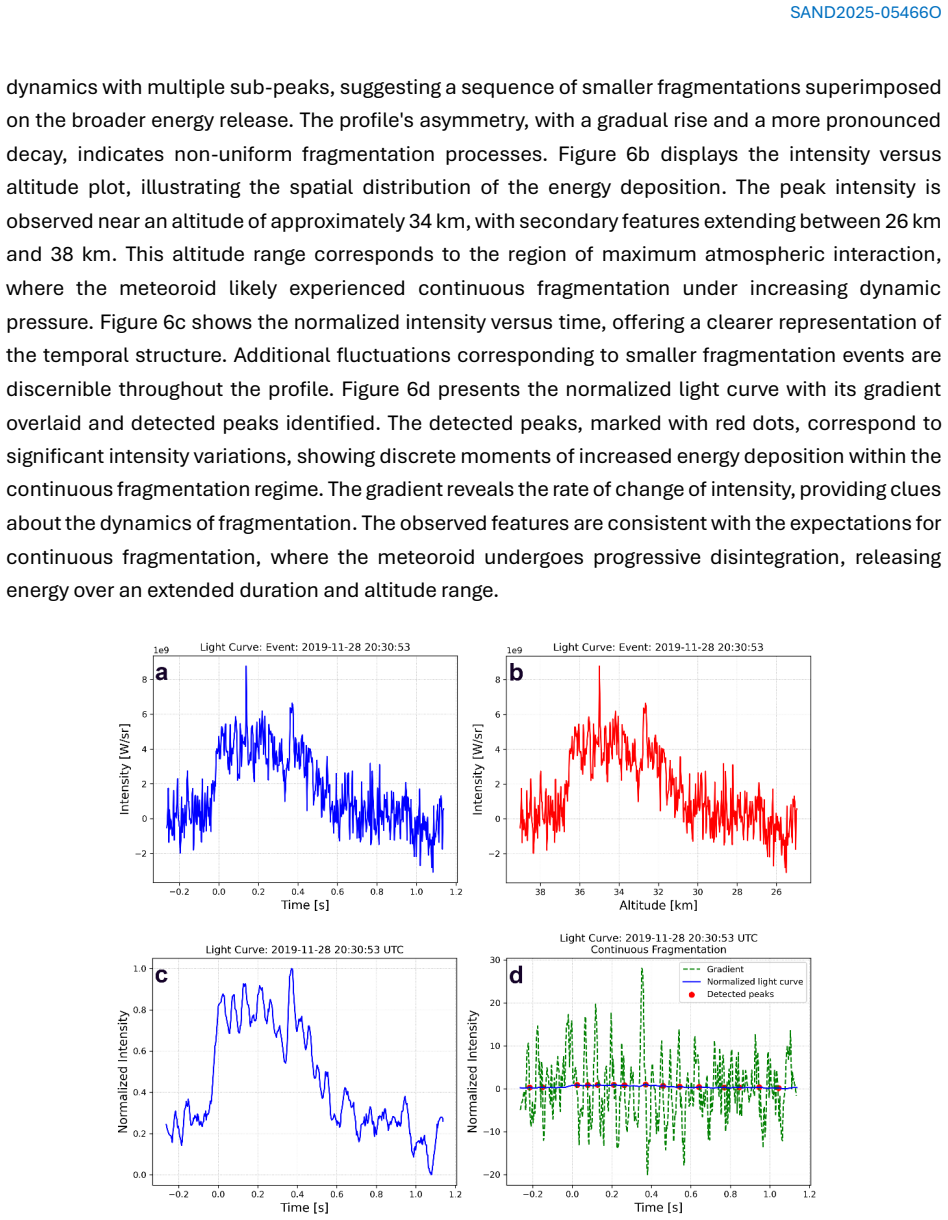
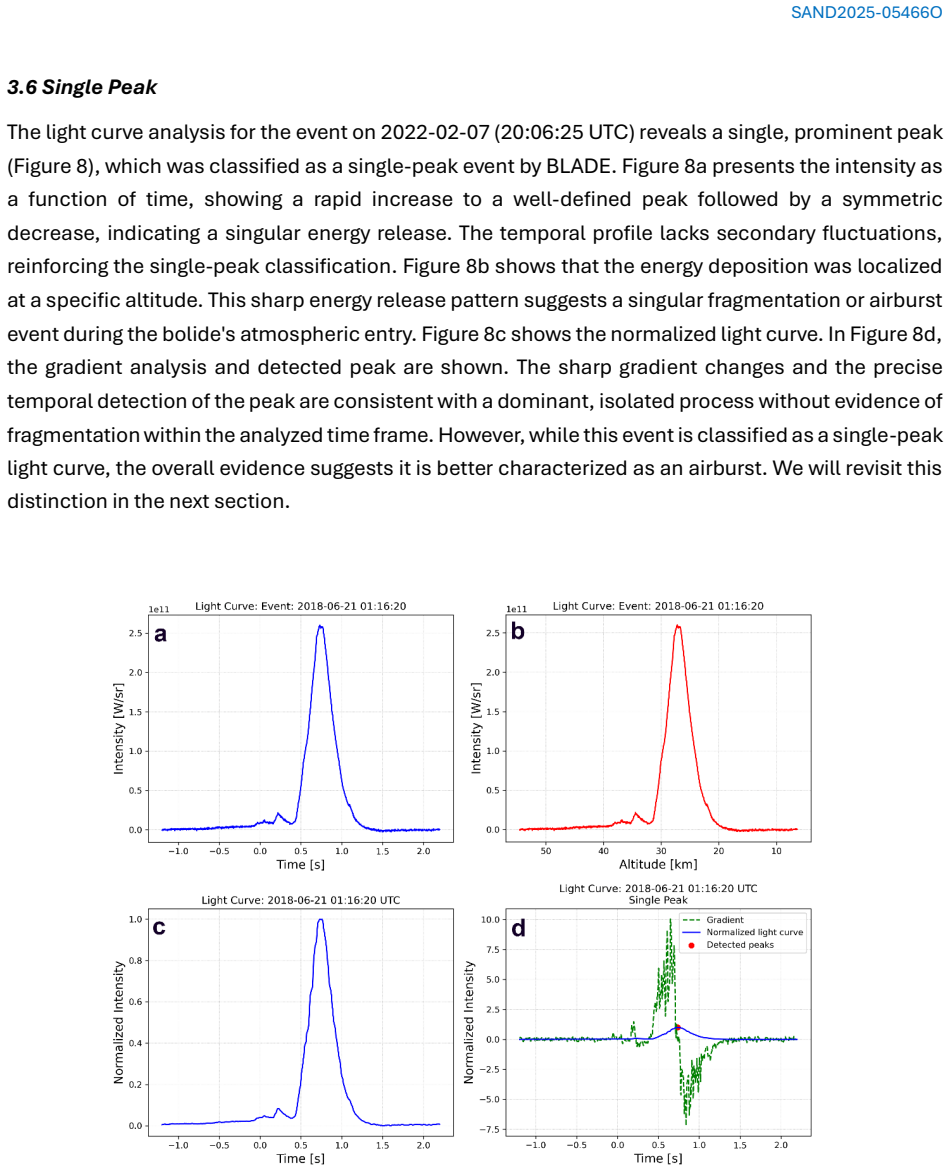
The load-bearing object is the sequence of normalized light-curve peaks extracted by a three-step procedure: adaptive Savitzky-Golay filtering, which sets window length and polynomial order from the standard deviation of the first-difference series (the estimated noise floor); prominence-based peak detection with fixed thresholds of 0.10 normalized intensity and a five-sample minimum separation; and gradient analysis with a 0.5 threshold to identify steep rises. The spacing of the detected peaks (closer or farther than roughly ten to fifteen samples) then separates continuous from discrete fragmentation, while a single steep-rise peak is classified as an airburst or single-peak event.
What would settle it
Run BLADE on fireballs that also have independent high-cadence video trajectory and fragmentation reconstructions, then check whether each detected peak appears as a fragmentation event at the same time and altitude in the video; any systematic mismatch between detected peaks and observed fragmentation times, or a failure to reproduce Chelyabinsk's complex fragmentation, would falsify the peak-to-event mapping.
Extended reading notes
Core claim
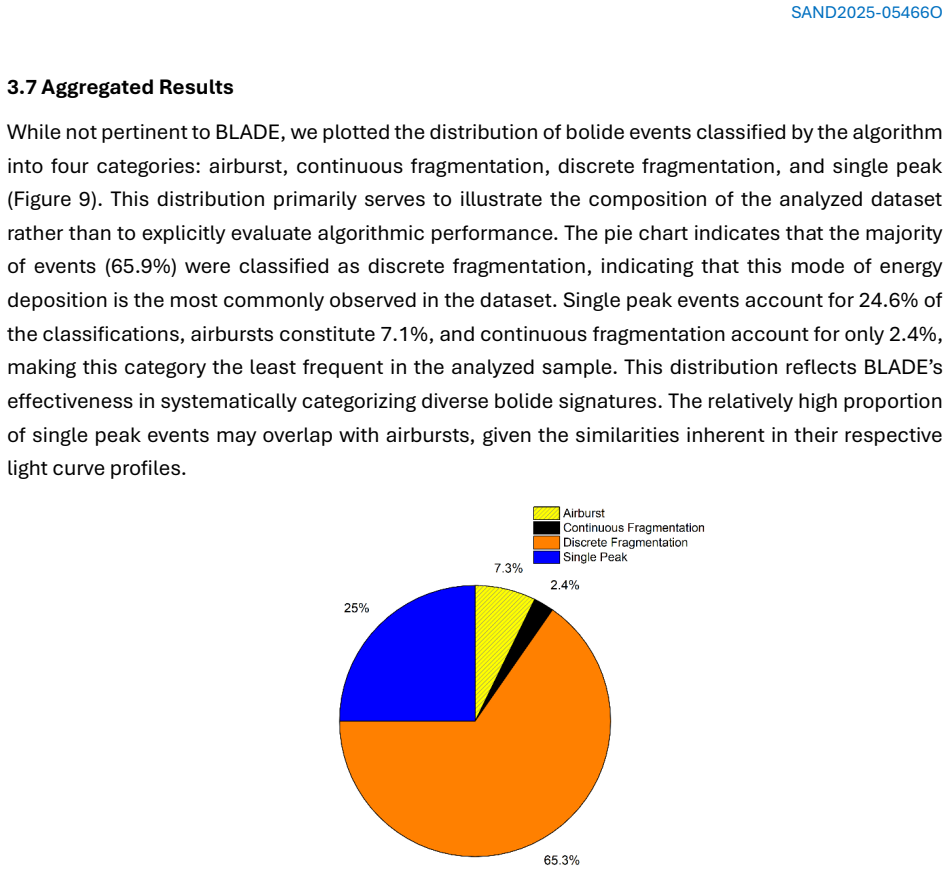
The paper argues that a fully signal-driven pipeline, with no physical assumptions about meteoroid structure or ablation, can assign most CNEOS light curves to physically meaningful classes based solely on the number, spacing, prominence, and steepness of brightness peaks. On a subset of 124 bolides with accompanying infrasound detections, the pipeline labels each event as airburst, discrete fragmentation, continuous fragmentation, or single peak; 65.9% fall in discrete fragmentation, 24.6% single peak, 7.1% airburst, and 2.4% continuous fragmentation. Only nine events were ambiguous, and in every ambiguous case fragmentation was still correctly identified as the primary process. The paper also shows that detected peaks can be anchored to approximate altitudes when velocity-vector metadata exist, and that the analysis takes only minutes for the full 124-event set.
Load-bearing premise
The classification assumes a peak in the digitized, smoothed light curve equals a physical fragmentation or energy-release event, an assumption the paper itself weakens by noting that Chelyabinsk shows a single peak while video shows complex fragmentation.
Editorial extensions
If this is right
- If BLADE works as described, the full archive of roughly 850 light curves can be classified in minutes without manual re-tuning, yielding a uniform fragmentation census.
- The automatic class labels can be correlated with altitude, entry angle, velocity, and impact energy to test physical trends, such as airbursts preferring steeper entry trajectories.
- Because the method is deterministic and signal-only, the same categories transfer to other high-cadence space-optical datasets, including Geostationary Lightning Mapper bolide observations.
- The optional altitude extrapolation converts detected peaks into approximate heights of energy release for the events with velocity metadata, providing input for infrasound-yield and dynamic-pressure modeling.
- Only nine of 124 events were ambiguous, always between continuous and discrete fragmentation, and in all cases fragmentation remained the primary classification.
Reading between the lines
- A natural validation the paper leaves open is to compare BLADE's class labels against independent video-observed fragmentation sequences; Chelyabinsk already shows that the CNEOS light curve can hide real structure, so this comparison would test whether the other 123 labels are physically meaningful.
- Because the thresholds (0.10 prominence, 0.5 gradient, five-sample separation) were chosen empirically on this 124-event sample, porting BLADE to differently sampled sensors will likely require rescaling thresholds relative to noise rather than using the fixed values.
- If the peak-to-fragmentation mapping is correct, BLADE's derived peak altitudes should agree with infrasound-derived source heights for the same events; that cross-modal correlation is the paper's stated future direction and would provide an independent check.
- The 124-event subset was deliberately built from events with published infrasound detections, so the reported proportions (65.9% discrete fragmentation, for instance) describe that multimodal subset, not necessarily the global bolide population.
Editorial analysis
A structured set of objections, weighed in public.
Referee Report
Summary. The paper introduces BLADE, an automated pipeline for classifying light curves in the CNEOS fireball database. The pipeline digitizes PDF light curves, applies a Savitzky-Golay filter with noise-adaptive window parameters, normalizes the signal, detects peaks via SciPy's find_peaks with thresholds on prominence, height, and separation, and computes gradients. Based on the number and temporal spacing of detected peaks and on the maximum gradient, each event is assigned to one of five categories: continuous fragmentation, discrete fragmentation, airburst, single peak, or no significant peaks. The authors apply BLADE to 124 CNEOS fireballs with infrasound detections and report that 65.9% are classified as discrete fragmentation, 24.6% as single peak, 7.1% as airburst, and 2.4% as continuous fragmentation. They also demonstrate altitude extrapolation for events with velocity metadata and discuss the relationship of their categories to energy deposition and infrasound. The central claim, stated in the abstract, is that BLADE 'reliably distinguishes distinct bolide behaviors.'
Significance. If the reliability claim could be supported, BLADE would fill a practical niche: it offers a deterministic, scalable, and openly specified procedure for turning a large, underused public dataset (CNEOS light curves) into categorical labels for fragmentation behavior. The pipeline is clearly described, the choice of Savitzky-Golay filtering and prominence-based peak detection is sensible for noisy, heterogeneous time series, and the authors provide a supplementary CSV of their classifications, which will be useful regardless of the label semantics. The paper explicitly positions the work as a foundation, and the code-level details (parameter choices, library calls) are given in enough detail to allow independent implementation. The main significance is therefore conditional: the paper is a promising methodological blueprint, but its headline claim of reliability is not yet supported by the evidence in the manuscript.
major comments (4)
- [Abstract and §2.2.2–§2.2.3 and §5] The central claim that BLADE 'reliably distinguishes distinct bolide behaviors' is not supported by any validation experiment. All detection thresholds (prominence≥0.10, height≥0.10, distance=5, gradient>0.5) were set after 'systematic examination' of the same CNEOS dataset on which performance is then demonstrated (Section 2.2.2, Section 2.2.3). There is no held-out set, no comparison to independent physical ground truth (video, radar, infrasound, or physics-based fragmentation simulations), and no human-expert agreement measure. Section 5 lists 'Validation and benchmarking' only as future work. Given that the categories are the paper's main output, this is a load-bearing gap. The authors should add a validation section with external references (e.g., well-documented events like Chelyabinsk, or synthetic light curves with known fragmentation sequences) or at minimum a cross-validation scheme and inter-labeler agreement analysis.
- [§2.1 and §3] The paper does not quantify digitization error, although the input data are PDF light curves that must be manually digitized with a web-based tool before peak detection. Because the entire classification hinges on the number, position, and prominence of peaks, uncontrolled digitization error can change labels. No reproducibility check (e.g., re-digitizing a subset of light curves multiple times and comparing the resulting classifications) is reported. Without this, the phrase 'high-fidelity framework' in the abstract and the claim of 'reliable' classification are not justified. The authors should add a digitization-uncertainty analysis and propagate the resulting variability through the peak detection and classification steps.
- [§4, Chelyabinsk discussion] The manuscript itself provides a direct counterexample to the assumption that peaks in CNEOS light curves correspond to physical fragmentation events: the Chelyabinsk light curve shows a single dominant peak, while video recordings show complex fragmentation. This is acknowledged in Section 4 but is not resolved or used to qualify the classification labels. As written, BLADE's categories ('discrete fragmentation', 'continuous fragmentation', 'airburst') imply a physical interpretation that the data product may not support. The authors should either (i) restrict the claims to morphological classification of the digitized light curves, or (ii) provide evidence for a subset events with independent observations that the detected peak structure indeed tracks physical fragmentation. This distinction is essential for the paper's advertised use in energy-deposition and infrasound studies.
- [§2.2.4 and §3.7] The boundary between 'discrete fragmentation' and 'continuous fragmentation' rests on a peak separation threshold of '10–15 samples' that is not derived from any physical timescale and is not accompanied by a sensitivity analysis. The paper reports that nine of 124 events are ambiguous between these two categories (Section 3.7), yet the threshold's choice is presented as a given. Furthermore, the distinction between 'single peak' and 'airburst' is acknowledged to be fuzzy (Section 3.6, Section 4), and the aggregate statistics (Figure 9) treat these as separate categories. If the method is to be a foundation for future physics studies, the classification criteria need a more explicit and less arbitrary basis, or at least a quantitative sensitivity study showing how the category fractions vary with the thresholds.
minor comments (6)
- [Fig. 8 caption and §3.6] The text in §3.6 describes the event of 2022-02-07 20:06:25 UTC, but the Figure 8 caption reads 'Light curve analysis for the 2018-06-21 01:16:20 UTC event.' One of these is a typo; please correct it so that the event identifier is consistent.
- [§3.7 first sentence] The sentence 'While not pertinent to BLADE, we plotted the distribution...' appears to contain a typo; it should likely say 'While not central to BLADE' or 'While not the primary focus of BLADE.'
- [§2.2.1, noise-adaptive SG parameters] The noise-level bins (σΔI ≤ 0.5, 0.5 < σΔI ≤ 1.0, σΔI > 1.0) and the corresponding window lengths and polynomial orders are described in prose but not summarized in a table; a small table would aid reproducibility.
- [§2.2.3, gradient threshold units] The text explains that the 0.5 gradient threshold can be interpreted either per second or per sample depending on whether a time vector is supplied to np.gradient, but it never states which convention was used for the 124-event analysis. Please specify the actual implementation.
- [Data Availability] The statement that 'BLADE source code is not publicly available at this time' is in tension with the paper's reproducibility emphasis; consider releasing at least a minimal reference implementation or a containerized version, or clarify why the code cannot be shared.
- [§2.2.1, typo] 'This dynamic adjustment optimizess the balance' should read 'optimizes.'
Circularity Check
Partial in-sample circularity: thresholds tuned and validated on the same 124 events; no external prediction.
-
fitted input called prediction
[Section 2.2 (manual reference), Section 2.2.2 (peak thresholds), Section 2.2.3 (gradient threshold), Abstract]
"First, an initial visual inspection of bolide light curves was undertaken to preliminarily identify characteristic modes of energy deposition, including continuous fragmentation, discrete fragmentation, and airbursts. This manual analysis served as an initial reference for evaluating and validating the numerical classification algorithm. ... This threshold was empirically determined through a systematic examination of representative fragmentation and airburst profiles."
Runtime thresholds (prominence=0.10, height=0.10, distance=5, gradient>0.5) were tuned on 'representative fragmentation and airburst profiles' from the same 124-event CNEOS subset that BLADE then classifies. Manual visual inspection is both the source of reference categories and the 'validation' of the algorithm; no held-out set or independent ground truth is used (Section 5 defers 'validation and benchmarking' to future work). Thus the abstract's reliability claim is in-sample: success is partly built into fitted thresholds rather than demonstrated against an independent target. Partial, because the deterministic classifier could be tested on external data.
full rationale
BLADE's classification pipeline is not self-definitional: the categories are operational definitions, and the smoothed peak features are derived from the light curves themselves, not from the output labels. I found no load-bearing self-citation: Silber-authored references are used for infrasound context and dataset selection, not to justify the classification rule. The main circularity concern is validation: thresholds and manual visual labels come from the same 124-event set, so the reported 'reliably distinguishes' result is in-sample. This is a real but partial circularity; the algorithm is deterministic, reproducible, and could be benchmarked against video, infrasound, or simulated light curves, which the paper explicitly defers to future work. The Chelyabinsk single-peak caveat is a physical-realism limitation rather than a circularity. Overall score 4.
Assumptions & free parameters
free parameters (6)
- Peak prominence threshold =
0.10 (normalized intensity units)
- Peak height threshold =
0.10 (normalized intensity units)
- Minimum peak separation =
5 samples
- Gradient threshold =
0.5 normalized intensity units per sample
- Continuous vs discrete fragmentation separation =
10-15 samples
- Noise-level bins for Savitzky-Golay parameters =
sigma_dI <=0.5, 0.5-1.0, >1.0 with window lengths 31/21/15 and polyorder 3/3/2
assumptions (4)
- domain assumption CNEOS light curve intensity is a faithful proxy for bolide energy deposition.
- domain assumption Digitization of PDF light curves preserves relative timing and amplitudes.
- domain assumption A detected peak in the smoothed normalized curve corresponds to a physical fragmentation or energy-release event.
- domain assumption Constant velocity during the luminous phase for altitude extrapolation.
Cite this review
Pith. "Pith review of BLADE: An Automated Framework for Classifying Light Curves from the Center for Near-Earth Object Studies (CNEOS) Fireball Database." pith.science (2026). https://pith.science/paper/BIMZSPYF
@misc{pith2026250616099,
  author       = {Pith},
  title        = {Pith review of: BLADE: An Automated Framework for Classifying Light Curves from the Center for Near-Earth Object Studies (CNEOS) Fireball Database},
  year         = {2026},
  howpublished = {\url{https://pith.science/paper/BIMZSPYF}},
  note         = {Machine review of arXiv:2506.16099}
}
read the original abstract
Fireballs (bolides) are high-energy luminous phenomena produced when meteoroids and small asteroids enter Earth's atmosphere at hypersonic speeds, often resulting in fragmentation or complete disintegration accompanied by significant energy release. The resulting bolide light curves capture temporal brightness variations as these objects traverse increasingly dense atmospheric layers, providing essential information on meteoroid entry dynamics, fragmentation behavior, and atmospheric energy deposition processes. The Center for Near-Earth Object Studies' (CNEOS) continuously expanding fireball database offers a globally comprehensive archive of bolide events, including light curves and associated metadata. Events associated with infrasound detections allow direct correlations between acoustic signatures and light-curve features, therefore enabling detailed analyses of fragmentation dynamics and energy deposition. Here, we introduce BLADE (Bolide Light-curve Analysis and Discrimination Explorer), a robust and high-fidelity framework specifically designed to analyze bolide light curves for objects detected from space. BLADE incorporates a processing pipeline integrating Savitzky-Golay filtering, prominence-based peak detection, and gradient analysis, enabling systematic identification and classification of fragmentation events and their associated energy release characteristics. Preliminary results demonstrate that BLADE reliably distinguishes distinct bolide behaviors, providing an objective, scalable methodology for characterization and analysis of large bolide light curve datasets. This foundational work establishes a novel pathway for advanced bolide research, with promising applications in planetary defense and global atmospheric monitoring.
Figures


Figures from the paper (8 more)





Reference graph
Works this paper leans on
-
[8]
Geophysical Journal International 241, 1053-1065,10.1093/gji/ggaf091
Acoustic Waves from the 20 April 2023 SpaceX Starship Rocket Explosion Traveling in the Elevated ‘AtmoSOFAR’ Channel. Geophysical Journal International 241, 1053-1065,10.1093/gji/ggaf091. Bronshten, V .A.,
-
[13]
Nature 503, 238 - 241,10.1038/nature12741
A 500-kiloton airburst over Chelyabinsk and an enhanced hazard from small impactors. Nature 503, 238 - 241,10.1038/nature12741. Brown, P .G., Borovička, J.,
-
[14]
The Astrophysical Journal 953, 167,10.3847/1538-4357/ace421
On the Proposed Interstellar Origin of the USG 20140108 Fireball. The Astrophysical Journal 953, 167,10.3847/1538-4357/ace421. Ceplecha, Z., Borovička, J., Elford, W.G., ReVelle, D.O., Hawkes, R.L., Porubčan, V ., Šimek, M.,
-
[16]
Icarus 429, 116444,10.1016/j.icarus.2024.116444
Decameter -sized Earth impactors – I: Orbital properties. Icarus 429, 116444,10.1016/j.icarus.2024.116444. Christie, D.R., Campus, P .,
-
[17]
Exploring Seismic Signal Detection and Source Identification of Atmospheric Entries: The Hayabusa2 Sample Return Capsule as a Benchmark. Seismological Research Letters,10.48550/arXiv.2505.16072. Devillepoix, H.A.R., Bland, P .A., Sansom, E.K., Towner, M.C., Cupák, M., Howie, R.M., Hartig, B.A.D., Jansen- Sturgeon, T., Cox, M.A.,
-
[18]
Monthly Notices of the Royal Astronomical Society 483, 5166-5178,10.1093/mnras/sty3442
Observation of metre -scale impactors by the Desert Fireball Network. Monthly Notices of the Royal Astronomical Society 483, 5166-5178,10.1093/mnras/sty3442. Ens, T.A., Brown, P .G., Edwards, W.N., Silber, E.A.,
-
[21]
Planetary and Space Science 143, 169-181,10.1016/j.pss.2017.04.021
Refinement of bolide characteristics from infrasound measurements. Planetary and Space Science 143, 169-181,10.1016/j.pss.2017.04.021. Gritsevich, M., Koschny, D.,
-
[22]
Icarus 212, 877 - 884,10.1016/j.icarus.2011.01.033
Constraining the luminous efficiency of meteors. Icarus 212, 877 - 884,10.1016/j.icarus.2011.01.033. Hajduková, M., Stober, G., Barghini, D., Koten, P ., Vaubaillon, J., Sterken, V .J., Ďurišová, S., Jackson, A., Desch, S.,
Show all 53 references
-
[25]
A&A 671, A23,10.1051/0004-6361/202245023 Hoffleit, D.,
Semi-automatic meteoroid fragmentation modeling using genetic algorithms. A&A 671, A23,10.1051/0004-6361/202245023 Hoffleit, D.,
-
[27]
Copernicus Meetings,10.5194/egusphere - egu24-7566
Characterizing the 2022 South Atlantic fireball using infrasound recordings of the International Monitoring System. Copernicus Meetings,10.5194/egusphere - egu24-7566. Ishihara, Y ., Hiramatsu, Y ., Yamamoto, M.-y., Furumoto, M., Fujita, K.,
2022 doi
-
[28]
Earth, Planets and Space 64, 655 - 660,10.5047/eps.2012.01.003
Infrasound/seismic observation of the Hayabusa reentry: Observations and preliminary results. Earth, Planets and Space 64, 655 - 660,10.5047/eps.2012.01.003. Jenniskens, P .,
2012 doi
-
[31]
Acta Astronautica 156, 394- 408,10.1016/j.actaastro.2018.06.020
Advances in planetary defense in the United States. Acta Astronautica 156, 394- 408,10.1016/j.actaastro.2018.06.020. Le Pichon, A., Ceranna, L., Pilger, C., Mialle, P ., Brown, D., Herry, P ., Brachet, N.,
2018 doi
-
[32]
Geophysical Research Letters 40, 3732 - 3737,10.1002/grl.50619
The 2013 Russian fireball largest ever detected by CTBTO infrasound sensors. Geophysical Research Letters 40, 3732 - 3737,10.1002/grl.50619. Li, L.-X., Paczyński, B.,
2013 doi
-
[33]
Journal of Geophysical Research: Planets 122, 789 - 793,10.1002/2017JE005318
The future of planetary defense. Journal of Geophysical Research: Planets 122, 789 - 793,10.1002/2017JE005318. Mas-Sanz, E., Trigo -Rodríguez, J.M., Silber, E.A., Peña -Asensio, E., Gritsevich, M., Lee, M.R.,
-
[36]
Astronomy & Astrophysics 654, A98,10.1051/0004-6361/202141106 Ott, T., Drolshagen, E., Koschny, D., Mialle, P ., Pilger, C., Vaubaillon, J., Drolshagen, G., Poppe, B.,
Infrasound signals of fireballs detected by the Geostationary Lightning Mapper. Astronomy & Astrophysics 654, A98,10.1051/0004-6361/202141106 Ott, T., Drolshagen, E., Koschny, D., Mialle, P ., Pilger, C., Vaubaillon, J., Drolshagen, G., Poppe, B.,
-
[37]
Planetary and Space Science 179, 104715,10.1016/j.pss.2019.104715
Combination of infrasound signals and complementary data for the analysis of bright fireballs. Planetary and Space Science 179, 104715,10.1016/j.pss.2019.104715. Ozerov, A., Smith, J.C., Dotson, J.L., Longenbaugh, R.S., Morris, R.L.,
2019
-
[38]
Icarus 408, 115843,10.1016/j.icarus.2023.115843
GOES GLM, biased bolides, and debiased distributions. Icarus 408, 115843,10.1016/j.icarus.2023.115843. Pecina, P ., Koten, P .,
2023
-
[39]
Monthly Notices of the Royal Astron omical Society: Letters 533, L92 - L99,10.1093/mnrasl/slae065
The 18 May 2024 Iberian superbolide from a sunskirting orbit: USG space sensors and ground -based independent observations. Monthly Notices of the Royal Astron omical Society: Letters 533, L92 - L99,10.1093/mnrasl/slae065. Peña-Asensio, E., Trigo-Rodríguez, J.M., Rimola, A.,
2024 doi
-
[41]
Geophysical Research Letters 42, 2523- 2531,10.1002/2015GL063482
CTBT infrasound network performance to detect the 2013 Russian fireball event. Geophysical Research Letters 42, 2523- 2531,10.1002/2015GL063482. Pilger, C., Gaebler, P ., Hupe, P ., Ott, T., Drolshagen, E.,
2013 doi
-
[44]
Acta Astronautica 215, 739-755,10.1016/j.actaastro.2023.11.020
Evacuation and shelter plans for asteroid impacts informed by hurricanes and nuclear explosions. Acta Astronautica 215, 739-755,10.1016/j.actaastro.2023.11.020. Sanchez, J.A., Reddy, V ., Thirouin, A., Bottke, W.F ., Kareta, T., De Florio, M., Sharkey, B.N.L., Battle, A., Cant...
2023 doi
-
[45]
The Planetary Science Journal 5, 131,10.3847/PSJ/ad445f
The Population of Small Near -Earth Objects: Composition, Source Regions, and Rotational Properties. The Planetary Science Journal 5, 131,10.3847/PSJ/ad445f. Savitzky, A., Golay, M.J.,
-
[47]
Advances in Space Research 62, 489 - 532,10.1016/j.asr.2018.05.010
Physics of meteor generated shock waves in the Earth’s atmosphere – A review. Advances in Space Research 62, 489 - 532,10.1016/j.asr.2018.05.010. Silber, E.A., Bowman, D.C., Carr, C.G., Eisenberg, D.P ., Elbing, B.R., Fernando, B., Garces, M.A., Haaser, R., Krishnamoorthy, S.,...
2018 doi
-
[48]
The Planetary Science Journal 5,10.3847/PSJ/ad5b5e
Geophysical Observations of the 24 September 2023 OSIRIS -REx Sample Return Capsule Re -Entry. The Planetary Science Journal 5,10.3847/PSJ/ad5b5e. Silber, E.A., Brown, P .G., Krzeminski, Z.,
2023 doi
-
[49]
Geophys. Res. Lett. 38, L12201,10.1029/2011gl047633. Silber, E.A., Trigo-Rodriguez, J., Oseghae, I., Peña Asensio, E., Boslough, M.B., Whitaker, R., Pilger, C., Lubin, P ., Sawal, V ., Hetzer, C., Longenbaugh, R., Jenniskens, P ., Bailey, B., Mas Sanz, E., Hupe, P ., Cohen, A....
-
[50]
Astronomy & Astrophysics 686, A67,10.1051/0004-6361/202449735 Spurný, P ., Koten, P .,
Atmospheric entry and fragmentation of the small asteroid 2024 BX1: Bolide trajectory, orbit, dynamics, light curve, and spectrum. Astronomy & Astrophysics 686, A67,10.1051/0004-6361/202449735 Spurný, P ., Koten, P .,
2024 doi
-
[51]
Icarus 284, 416 - 423,10.1016/j.icarus.2016.12.008
The near-Earth asteroid population from two decades of observations. Icarus 284, 416 - 423,10.1016/j.icarus.2016.12.008. Virtanen, P ., Gommers, R., Oliphant, T.E., Haberland, M., Reddy, T., Cournapeau, D., Burovski, E., Peterson, P ., Weckesser, W., Bright, J.,
2016 doi
-
[52]
The Astronomical Journal 169,10.3847/1538-3881/adbb70
Bolide infrasound signal morphology and yield estimates: A case study of two events detected by a dense acoustic sensor network. The Astronomical Journal 169,10.3847/1538-3881/adbb70. Yamamoto, M.-y., Ishihara, Y ., Hiramatsu, Y ., Kitamura, K., Ueda, M., Shiba, Y ., Furumoto,...
-
[53]
Publications of the Astronomical Society of Japan 63, 971 - 978,10.1093/pasj/63.5.971
Detection of acoustic/infrasonic/seismic waves generated by hypersonic re -entry of the HAYABUSA capsule and fragmented parts of the spacecraft. Publications of the Astronomical Society of Japan 63, 971 - 978,10.1093/pasj/63.5.971. Zimmermann, B., Kohler, A.,
-
[1933]
Proceedings of the National Academy of Sciences 19, 212 - 221,10.1073/pnas.19.2.21
A study of meteor light curves. Proceedings of the National Academy of Sciences 19, 212 - 221,10.1073/pnas.19.2.21. Hupe, P ., Vergoz, J., Pilger, C., Le Pichon, A.,
-
[1964]
Analytical chemistry 36, 1627-1639 Silber, E.A., 2024a
Smoothing and differentiation of data by simplified least squares procedures. Analytical chemistry 36, 1627-1639 Silber, E.A., 2024a. Perspectives and Challenges in Bolide Infrasound Processing and Interpretation: A Focused Review with Case Studies. Remote Sensing 16, 3628,10....
-
[1972]
The Journal of the Acoustical Society of America 51, 1565-1575,10.1121/1.1913000
Atmospheric Absorption of Sound: Theoretical Predictions. The Journal of the Acoustical Society of America 51, 1565-1575,10.1121/1.1913000. Gi, N., Brown, P .,
-
[1976]
Journal of Geophysical Research 81, 1217 - 1230,10.1029/JA081i007p01217
On meteor -generated infrasound. Journal of Geophysical Research 81, 1217 - 1230,10.1029/JA081i007p01217. Robertson, D., Wheeler, L., Mathias, D.,
-
[1983]
Fizika meteornykh iavlenii, , Moscow, Izdatel'stvo Nauka, 1981 Dordrecht, D
Physics of meteoric phenomena. Fizika meteornykh iavlenii, , Moscow, Izdatel'stvo Nauka, 1981 Dordrecht, D. Reidel Publishing Co, Dordrecht, Holland,10.1007/978-94-009-7222-3. Brown, P ., McCausland, P .J.A., Fries, M., Silber, E., Edwards, W.N., Wong, D.K., Weryk, R.J., Fries...
1981 doi
-
[1994]
Planetary and Space Science 42, 491 -506,10.1016/0032- 0633(94)90091-4
Radiation emitted during the flight of asteroids and comets through the atmosphere. Planetary and Space Science 42, 491 -506,10.1016/0032- 0633(94)90091-4. Nemtchinov, I.V ., Svetsov, V .V ., Kosarev, I.B., Golub, A.P ., Popova, O.P ., Shuvalov, V .V ., Spalding, R.E., Jacobs,...
-
[1997]
Icarus 130, 259-274,10.1006/icar.1997.5821
Assessment of Kinetic Energy of Meteoroids Detected by Satellite -Based Light Sensors. Icarus 130, 259-274,10.1006/icar.1997.5821. Oppenheim, A.V ., Schafer, R.,
1997
-
[1998]
Space Science Reviews 84, 327-471,10.1023/A:1005069928850
Meteor Phenomena and Bodies. Space Science Reviews 84, 327-471,10.1023/A:1005069928850. Chen, K., Zhang, H., Wei, H., Li, Y .,
-
[2002]
Nature 420, 294-296,10.1038/nature01238
The flux of small near-Earth objects colliding with the Earth. Nature 420, 294-296,10.1038/nature01238. Brown, P ., Wiegert, P ., Clark, D., Tagliaferri, E.,
-
[2008]
International Journal of Impact Engineering 35, 1441-1448,10.1016/j.ijimpeng.2008.07.053
Low -altitude airbursts and the impact threat. International Journal of Impact Engineering 35, 1441-1448,10.1016/j.ijimpeng.2008.07.053. Bowman, D.C., Silber, E.A., Giannone, M.R., Albert, S.A., Edwards, T., Dugick, F .K.D., Longenbaugh, R.S.,
2008 doi
-
[2009]
Nature 458, 485 - 488,10.1038/nature07920
The impact and recovery of asteroid 2008 TC3. Nature 458, 485 - 488,10.1038/nature07920. Koten, P ., Spurný, P ., Borovička, J., Evans, S., Elliott, A., Betlem, H., Štork, R., Jobse, K.,
2008 doi
-
[2011]
Meteoritics & Planetary Science 46, 339-363,10.1111/j.1945-5100.2010.01167.x
The fall of the Grimsby meteorite —I: Fireball dynamics and orbit from radar, video, and infrasound records. Meteoritics & Planetary Science 46, 339-363,10.1111/j.1945-5100.2010.01167.x. SAND2025-05466O 32 Brown, P ., Spalding, R.E., ReVelle, D.O., Tagliaferri, E., Worden, S.P .,
1945
-
[2012]
Journal of Atmospheric and Solar-Terrestrial Physics 80, 208-229,10.1016/j.jastp.2012.01.018
Infrasound production by bolides: A global statistical study. Journal of Atmospheric and Solar-Terrestrial Physics 80, 208-229,10.1016/j.jastp.2012.01.018. Evans, L.B., Bass, H.E., Sutherland, L.C.,
2012 doi
-
[2013]
Meteoritics & Planetary Science 48, 1757-1779,10.1111/maps.12078
The Košice meteorite fall: Atmospheric trajectory, fragmentation, and orbit. Meteoritics & Planetary Science 48, 1757-1779,10.1111/maps.12078. Boslough, M., Brown, P ., Harris, A.,
-
[2015]
IEEE, pp
Updated population and risk assessment for airbursts from near - earth objects (NEOs), 2015 IEEE aerospace conference. IEEE, pp. 1-12,10.1109/AERO.2015.7119288. Boslough, M.B., Crawford, D.,
2015
-
[2016]
Icarus 266, 96-111,10.1016/j.icarus.2015.11.022
Orbital and physical characteristics of meter -scale impactors from airburst observations. Icarus 266, 96-111,10.1016/j.icarus.2015.11.022. Brown, P .G., Assink, J.D., Astiz, L., Blaauw, R., Boslough, M.B., Borovicka, J., Brachet, N., Brown, D., Campbell- Brown, M., Ceranna, L...
2015 doi
-
[2017]
Planetary and Space Science 143, 147 - 158,10.1016/j.pss.2017.02.006
The January 7, 2015, superbolide over Romania and structural diversity of meter -sized asteroids. Planetary and Space Science 143, 147 - 158,10.1016/j.pss.2017.02.006. Borovička, J., Spurný, P ., Shrbený, L., 2020b. Two Strengths of Ordinary Chondritic Meteoroids as Derived fr...
2015 doi
-
[2018]
Meteoritics & Planetary Science 53, 2445-2469,10.1111/maps.13137
Detection of meteoroid impacts by the Geostationary Lightning Mapper on the GOES-16 satellite. Meteoritics & Planetary Science 53, 2445-2469,10.1111/maps.13137. Jenniskens, P ., Shaddad, M.H., Numan, D., Elsir, S., Kudoda, A.M., Zolensky, M.E., Le, L., Robinson, G.A., Friedric...
-
[2019]
Meteoritics & Planetary Science 54, 1024-1041,10.1111/maps.13259
The Maribo CM2 meteorite fall—Survival of weak material at high entry speed. Meteoritics & Planetary Science 54, 1024-1041,10.1111/maps.13259. Borovička, J., Setvák, M., Roesli, H., Kerkmann, J., 2020a. Satellite observation of the dust trail of a major bolide event over the B...
-
[2020]
Atmosphere 11, 83,10.3390/atmos11010083
Global Monitoring and Characterization of Infrasound Signatures by Large Fireballs. Atmosphere 11, 83,10.3390/atmos11010083. SAND2025-05466O 35 Popova, O.P ., Sidneva, S.N., Shuvalov, V .V ., Strelkov, A.S.,
-
[2021]
Icarus 365, 114452,10.1016/j.icarus.2021.114452
The population of near-earth asteroids revisited and updated. Icarus 365, 114452,10.1016/j.icarus.2021.114452. Harris, C.R., Millman, K.J., Van Der Walt, S.J., Gommers, R., Virtanen, P ., Cournapeau, D., Wieser, E., Taylor, J., Berg, S., Smith, N.J.,
2021
-
[2022]
The Astronomical Journal 164, 76,10.3847/1538-3881/ac75d2
Orbital Characterization of Superbolides Observed from Space: Dynamical Association with Near -Earth Objects, Meteoroid Streams, and Identification of Hyperbolic Meteoroids. The Astronomical Journal 164, 76,10.3847/1538-3881/ac75d2. Pilger, C., Ceranna, L., Ross, J.O., Le Pich...
-
[2023]
Earth and Space Science 10, e2023EA003149,10.1029/2023EA003149
The AtmoSOFAR channel: First direct observations of an elevated acoustic duct. Earth and Space Science 10, e2023EA003149,10.1029/2023EA003149. Bailey, B., Cohen, A.N., Egan, S., Lubin, P ., Xu, R., Boslough, M., Robertson, D., Silber, E.A., Sagert, I., Korobkin, O., Sjoden, G.,
-
[2024]
A&A 691, A8,10.1051/0004 - 6361/202449569
No evidence for interstellar fireballs in the CNEOS database. A&A 691, A8,10.1051/0004 - 6361/202449569. SAND2025-05466O 33 Hargittai, S.,
-
[2025]
The Astrophysical Journal 981, 181,10.3847/1538-4357/adb289
Evaluating Short -warning Mitigation via Intentional Robust Disruption of a Hypothetical Impact of Asteroid 2023 NT1. The Astrophysical Journal 981, 181,10.3847/1538-4357/adb289. Beech, M.,
2023 doi
Reviewed August 6, 2026 · model on record in the stance chip above.
Discussion (0). Continue with ORCID to comment.