REVIEW 2 major objections 4 minor 3 cited by
Observer Time from Causality in Perturbative Quantum Gravity
T0 review · 2 major / 4 minor · reviewed 2026-08-06 · deepseek-v4-flash
Pith's one-line read Elapsed proper time, defined by light-cone intersections, becomes a quantum operator in perturbative quantum gravity, with a nonzero commutator at order $G_N$.
desk verdict Genuinely new lightbulb-clock definition of observer time, but the headline commutator rests on an asserted gauge equivalence and an imported two-point function. read the letter →
The pith
A machine-rendered reading of the paper's core claim, the machinery that carries it, and where it could break.
The reading
What carries the argument
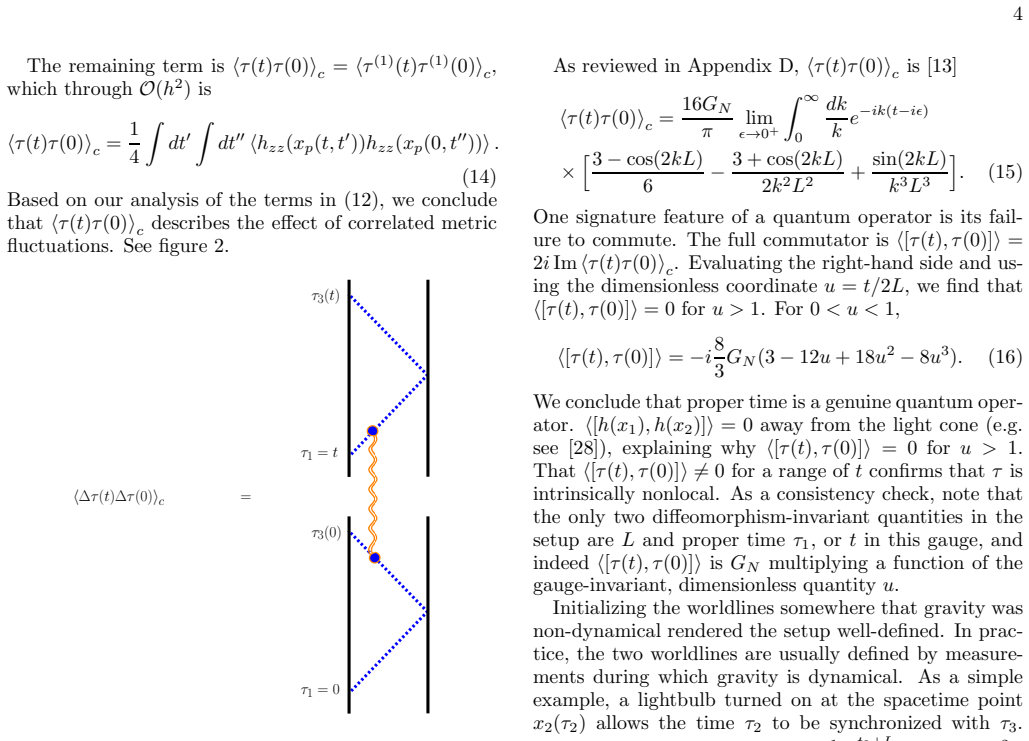
The lightbulb clock: elapsed proper time $\tau_3-\tau_1$ is defined by flashing a light from worldline $x_1$ at $\tau_1$, recording the unique future-light-cone intersection $\tau_2$ on worldline $x_2$, and the return intersection $\tau_3$ on $x_1$. The paper quantizes this by expanding $g_{\mu\nu}=\eta_{\mu\nu}+h_{\mu\nu}$, imposing the worldline equations of motion, and path-integrating over $h$; in synchronous gauge the worldlines stay fixed and the null ray's perturbed trajectory supplies $\tau_2,\tau_3$ order by order. The load-bearing computation is the connected two-point function $\langle\tau(t)\tau(0)\rangle_c$, which becomes an integral of the graviton Wightman function $\langle h_{zz}(x)h_{zz}(x')\rangle$ along the unperturbed null rays; evaluating this integral, with a residual transverse-traceless gauge choice, produces the commutator.
What would settle it
Repeat the path-integral computation in a different gauge, such as harmonic gauge, and check whether the $O(G_N)$ commutator $\langle[\tau(t),\tau(0)]\rangle$ is unchanged; if the gauge-invariant regulator yields a different function of $u=t/2L$, the central claim fails.
Extended reading notes
Core claim
The central claim is that an observer's elapsed proper time, defined by light-cone intersections rather than coordinates, does not commute with itself at different tick times after quantization. In flat space with two inertial worldlines separated by $L$, the leading vacuum expectation value is $\langle[\tau(t),\tau(0)]\rangle = -i \frac{8}{3}G_N(3-12u+18u^2-8u^3)$ for $0<u<1$ and zero for $u>1$, with $u=t/2L$. The same analysis for a clock-synchronization protocol gives $\langle[\tau_3(t),\tau_3(0)]\rangle = i \frac{16G_N}{3}(u-1)^3$ in the same interval. Since free graviton fields commute outside the light cone, the nonzero commutator shows elapsed time is an intrinsically nonlocal functional of the metric, and the paper takes it as evidence that time is a quantum operator in quantum gravity.
Load-bearing premise
The construction rests on assuming the future light cone of one observer's flash intersects the other worldline exactly once at every perturbative order in the metric fluctuation; if quantum fluctuations cause multiple or no intersections, the elapsed time is not uniquely defined and the path-integral correlators collapse.
Editorial extensions
If this is right
- Elapsed proper time is a quantum operator: $\langle[\tau(t),\tau(0)]\rangle\neq 0$ for $0<t<2L$, so time measurements do not commute in the vacuum.
- No universal clock synchronization survives in perturbative quantum gravity: the synchronized-time commutator $\langle[\tau_3(t),\tau_3(0)]\rangle$ is nonzero for $0<u<1$.
- The result reproduces and extends earlier interferometer proper-time analyses: the $O(h)$ round-trip time is recovered, and the $O(h^2)$ connected correlator is the leading quantum-gravity contribution to the toy-interferometer observable.
- The same light-cone intersection procedure defines a diffeomorphism-invariant, all-orders-in-$G_N$ prescription for geometric observables, so the framework applies beyond time measurements alone.
Reading between the lines
- Editorial inference: if time is genuinely noncommuting, any notion of a global time coordinate in quantum gravity must break down at $O(G_N)$; protocols that exchange light signals will inherit an irreducible timing uncertainty from vacuum gravitons.
- Editorial inference: the same construction could define a nonlocal quantum length between worldlines, with a commutator of analogous support, connecting the result to relational observables beyond time.
- Editorial inference: the commutator signature for $0<u<1$ is, in principle, a falsifiable prediction for the spectrum of timing noise in long-baseline interferometers, although the effect is far below current sensitivity.
Editorial analysis
A structured set of objections, weighed in public.
Referee Report
Summary. This paper proposes a relational observable—elapsed proper time defined by a 'lightbulb clock' in which future light cones from one inertial worldline intersect a second worldline, and the return signal defines τ3−τ1. The construction is then quantized by expanding g=η+h and performing a path integral over h, with τ1 serving as a fixed parameter. The paper computes τ3 to O(h^2) in synchronous gauge (Eqs. (8)–(11), Appendix C), identifies the O(G_N) connected two-point function as an integral of the h_zz Wightman function (Eq. (14)), and, using the explicit Wightman function reviewed from [13] in Appendix D, obtains the commutator ⟨[τ(t),τ(0)]⟩ shown in Eq. (16) (and the synchronization version in Eq. (18)), concluding that proper time is a quantum operator. Appendices A and B relate the clock to detector correlators and bulk-point singularities.
Significance. The idea of defining an observer's time through causal light-cone intersections and promoting it to a path-integral operator is attractive and could connect relational observables to interferometer experiments; the paper is clear that the leading-order term in τ3 agrees with [26]. If Eq. (16) is established, it gives a concrete, falsifiable prediction of nonzero commutativity for a time observable, which is a nontrivial conceptual result. The manuscript is honest about its assumptions, and the O(h^2) perturbative setup is standard. However, the paper's central quantitative output is not independently derived: Eq. (15) is quoted from the overlapping [13], and the gauge identification behind it is asserted rather than proven. The significance is therefore conditional on closing that gap.
major comments (2)
- [Section III, Eq. (14) and following paragraph] The central computation replaces the synchronous-gauge h_zz entering Eq. (14) with the transverse-traceless vacuum Wightman function, using 'residual gauge freedom in synchronous gauge.' This is not proven. Synchronous gauge leaves only restricted residual transformations (ξ_0 independent of t and ∂_0 ξ_i = −∂_i ξ_0), and the TT condition imposes additional constraints on the spatial components; the paper does not show that these residual transformations remove the non-TT (scalar and longitudinal) parts of the particular integrated correlator ⟨∫ h_zz ∫ h_zz⟩, nor that those parts cancel at O(G_N). Since Eq. (15) is taken from [13] rather than derived in this paper, and since Eq. (16) is the paper's main quantitative result, this is a load-bearing gap that must be closed by a direct derivation of Eq. (15) in synchronous gauge or by an explicit gauge-invariance argument for the truncated correlator.
- [Section IIB, path-integral definition] The path-integral definition (3)–(5) assumes that the light-cone intersection equations have a unique solution τ3(τ1,h) to all perturbative orders, stated as the assumption that small h 'does not violate the lightbulb clock conditions at any perturbative order.' This is plausible locally by the implicit function theorem near the background solution, but it is not established that caustics, multiple intersections, or loss of intersection do not occur for finite time intervals or for generic small fluctuations h. If multiple branches exist, the integrals (3) and (5) require a branch choice; without one, the observable is not fully defined to all orders. The O(G_N) result may be unaffected, but the paper's claim to an all-orders definition needs this assumption either removed or explicitly defended.
minor comments (4)
- [Title and header] The title in the abstract appears with a line-break artifact ('Gravi ty'); the author name in the full text is also given as 'Allic Sivaramakrishnan', which should be checked against the arXiv metadata for consistency.
- [Section III, Eqs. (14)–(15)] The notation x_p(t,t') in Eq. (14) is inconsistent with the earlier notation x_p(t_1, λ); please unify the notation so that the fixed initial proper time and the integration variable are clearly distinguished.
- [Section III, after Eq. (16)] The explanation that ⟨[τ(t),τ(0)]⟩ vanishes for u>1 because local graviton commutators vanish outside the light cone is heuristic, since τ is a nonlocal functional of h; the sentence should be phrased as an interpretation rather than a derivation.
- [Appendix E] In Eq. (E1), the logarithms contain arguments like 2Lu and 2L(1+u) that mix a length scale L with the dimensionless u; this is harmless dimensionally but should be written with explicit dimensionless ratios (for example, t/(2L), |t−2L|/(2L), and (t+2L)/(2L)) to avoid confusion.
Circularity Check
No significant circularity: the central commutator follows from a parameter-free Wightman function that is re-derived in Appendix D, and the self-citation to [13] is independent support rather than an input-equivalent construction.
full rationale
The paper's central result, Eq. (16), is obtained by taking the imaginary part of Eq. (15), which is a parameter-free two-point function. Eq. (15) is explicitly attributed to [13], but Appendix D re-derives the needed free graviton Wightman function from the standard mode expansion and polarization sum, so the closed form does not reduce to a fitted input or to the paper's own conclusion by construction. The lightbulb-clock definition in Section II is a classical, diffeomorphism-invariant construction, and the perturbative computation in Section III (Eqs. 8-14) follows from solving the null and timelike geodesic equations; no parameter is fitted to a subset of data and then renamed as a prediction. The self-citation to [13] is load-bearing for the final analytic integral, but it is independent support: it is parameter-free, it is based on stated physical assumptions, and it is externally falsifiable as an interferometer response prediction, so it does not constitute circularity under the review rules. The potentially fragile step is the assertion that residual gauge freedom in synchronous gauge makes Eq. (14) exactly the transverse-traceless correlator of [13]; this is an unproven gauge equivalence that could affect correctness, but it is not a circular reduction by construction. The explicit assumption in Section IIB that light-cone intersections remain unique at all perturbative orders is an assumption about the validity of the construction, not a circular step.
Assumptions & free parameters
assumptions (4)
- domain assumption Small metric fluctuations preserve the unique intersection of future light cones with observer worldlines at every perturbative order.
- domain assumption Perturbative quantum gravity as an effective field theory, with path integral over h around a fixed background, is valid for defining these observables.
- domain assumption The Wightman function of h in transverse-traceless gauge and its closed-form integral, Eq (15), are correct as reviewed from [13].
- domain assumption Observers can be modeled as point masses on geodesics with back-reaction included through the worldline action.
Cite this review
Pith. "Pith review of Observer Time from Causality in Perturbative Quantum Gravity." pith.science (2026). https://pith.science/paper/DTDSLRYD
@misc{pith2026250616109,
  author       = {Pith},
  title        = {Pith review of: Observer Time from Causality in Perturbative Quantum Gravity},
  year         = {2026},
  howpublished = {\url{https://pith.science/paper/DTDSLRYD}},
  note         = {Machine review of arXiv:2506.16109}
}
abstract
It is unclear whether an observable notion of time exists in quantum gravity even in principle because spacetime itself fluctuates. We propose a form of observable time in perturbative quantum gravity. First, we define an elapsed proper time in curved space using intersections of worldlines and future light cones. Here, time arises from causality via the dependence on light cones. We then propose that performing the gravitational path integral describes quantum gravity corrections to this notion of proper time at all orders in $G_N$. Using this prescription, we compute the leading quantum gravity corrections to two-point correlation functions of elapsed time. We find that the commutators can be nonzero, showing this notion of time is a quantum operator in quantum gravity.
Figures


Forward citations
Cited by 3 Pith papers
-
Geometric noise spectrum in interferometers
The noise spectrum an interferometer would see from quantum spacetime jitter is computed for vacuum, thermal, squeezed, and scalar-backreaction states; all are Planck-suppressed.
-
Imprint of the black hole interior on thermal four-point correlators
Analytically continuing and smearing thermal four-point correlators turns them into flat-space scattering amplitudes at a bulk point inside the black hole.
-
Composite AdS geodesics for CFT correlators and timelike entanglement entropy
A bulk extremization prescription produces composite timelike-spacelike geodesics whose complex length exactly matches CFT two-point functions at timelike separation, including behind the BTZ horizon.
Reference graph
Works this paper leans on
-
[13]
Observational signatures of quantum gravity in interferometers,
E. P. Verlinde and K. M. Zurek, “Observational signatures of quantum gravity in interferometers,” Phys. Lett. B 822 (2021) 136663, arXiv:1902.08207 [gr-qc]
arXiv 2021
-
[26]
Takesaki, Tomita’sTheory of Modular Hilbert Algebras and Its Applications
M. Takesaki, Tomita’sTheory of Modular Hilbert Algebras and Its Applications. Lecture Notes in Mathematics. Springer-Verlag, 1970
work page 1970
-
[1]
Observables in Quantum Gravity: from Theory to Experiment
− τ ′ 1)⟩. The times τ2, τ3 have become quantum operators. 1 Im- posing the equations of motion for the worldlines and performing the path integral over hµν was a procedure studied in [19]. The main novel feature of our work is to define proper-time correlators in this setup. III. PROPER-TIME CORRELATORS We now compute the two-point correlators of proper t...
work page 2025
-
[2]
Gravitational entropy is observer-dependent,
J. De Vuyst, S. Eccles, P. A. Hoehn, and J. Kirklin, “Gravitational entropy is observer-dependent,” arXiv:2405.00114 [hep-th]
-
[3]
Crossed products and quantum reference frames: on the observer-dependence of gravitational entropy,
J. De Vuyst, S. Eccles, P. A. Hoehn, and J. Kirklin, “Crossed products and quantum reference frames: on the observer-dependence of gravitational entropy,” arXiv:2412.15502 [hep-th]
-
[4]
An algebra of observables for de Sitter space,
V. Chandrasekaran, R. Longo, G. Penington, and E. Witten, “An algebra of observables for de Sitter space,” JHEP 02 (2023) 082, arXiv:2206.10780 [hep-th]
arXiv 2023
-
[5]
Quantum gravity observables: observation, algebras, and mathematical structure,
S. B. Giddings, “Quantum gravity observables: observation, algebras, and mathematical structure,” arXiv:2505.22708 [hep-th]
-
[6]
Introduction to the effective field theory description of gravity,
J. F. Donoghue, “Introduction to the effective field theory description of gravity,” in Advanced School on Effective Theories. 6, 1995. arXiv:gr-qc/9512024
arXiv 1995
Show all 54 references
-
[7]
Quantum gravity in everyday life: General relativity as an effective field theory,
C. P. Burgess, “Quantum gravity in everyday life: General relativity as an effective field theory,” Living Rev. Rel. 7 (2004) 5–56, arXiv:gr-qc/0311082
2004 arXiv
-
[8]
Noise and decoherence induced by gravitons,
S. Kanno, J. Soda, and J. Tokuda, “Noise and decoherence induced by gravitons,” Phys. Rev. D 103 no. 4, (2021) 044017, arXiv:2007.09838 [hep-th]
2021 arXiv
-
[9]
Signatures of the quantization of gravity at gravitational wave detectors,
M. Parikh, F. Wilczek, and G. Zahariade, “Signatures of the quantization of gravity at gravitational wave detectors,” Phys. Rev. D 104 no. 4, (2021) 046021, arXiv:2010.08208 [hep-th]
2021 arXiv
-
[10]
Quantum Mechanics of Gravitational Waves,
M. Parikh, F. Wilczek, and G. Zahariade, “Quantum Mechanics of Gravitational Waves,” Phys. Rev. Lett. 127 no. 8, (2021) 081602, arXiv:2010.08205 [hep-th]
2021 arXiv
-
[11]
The Noise of Gravitons,
M. Parikh, F. Wilczek, and G. Zahariade, “The Noise of Gravitons,” Int. J. Mod. Phys. D 29 no. 14, (2020) 2042001, arXiv:2005.07211 [hep-th]
2020 arXiv
-
[12]
On vacuum fluctuations in quantum gravity and interferometer arm fluctuations,
K. M. Zurek, “On vacuum fluctuations in quantum gravity and interferometer arm fluctuations,” Phys. Lett. B 826 (2022) 136910, arXiv:2012.05870 [hep-th]
2022 arXiv
-
[14]
Response of interferometers to the vacuum of quantum gravity,
D. Carney, M. Karydas, and A. Sivaramakrishnan, “Response of interferometers to the vacuum of quantum gravity,” arXiv:2409.03894 [hep-th]
-
[15]
Advanced ligo,
J. Aasi et al., “Advanced ligo,” Classical and quantum gravity 32 no. 7, (2015) 074001
2015
-
[16]
Photon-Counting Interferometry to Detect Geontropic Space-Time Fluctuations with GQuEST,
S. M. Vermeulen et al., “Photon-Counting Interferometry to Detect Geontropic Space-Time Fluctuations with GQuEST,” Phys. Rev. X 15 no. 1, (2025) 011034, arXiv:2404.07524 [gr-qc]
2025 arXiv
-
[17]
C. W. Misner, K. S. Thorne, and J. A. Wheeler, Gravitation. 1973
1973
-
[18]
Ligo technical document ligo-t0900043,
“Ligo technical document ligo-t0900043,” https://dcc.ligo.org/public/0000/T0900043/011/ LIGO-T0900043-11.pdf. 6
-
[19]
Maggiore, Gravitational Waves
M. Maggiore, Gravitational Waves. Vol. 1: Theory and Experiments. Oxford University Press, 2007
2007
-
[20]
Diffeomorphism-invariant observables and their nonlocal algebra,
W. Donnelly and S. B. Giddings, “Diffeomorphism-invariant observables and their nonlocal algebra,” Phys. Rev. D 93 no. 2, (2016) 024030, arXiv:1507.07921 [hep-th] . [Erratum: Phys.Rev.D 94, 029903 (2016)]
2016 arXiv
-
[21]
Observables, gravitational dressing, and obstructions to locality and subsystems,
W. Donnelly and S. B. Giddings, “Observables, gravitational dressing, and obstructions to locality and subsystems,” Phys. Rev. D 94 no. 10, (2016) 104038, arXiv:1607.01025 [hep-th]
2016 arXiv
-
[22]
Diffeomorphism-invariant observables and dynamical frames in gravity: reconciling bulk locality with general covariance,
C. Goeller, P. A. Hoehn, and J. Kirklin, “Diffeomorphism-invariant observables and dynamical frames in gravity: reconciling bulk locality with general covariance,” arXiv:2206.01193 [hep-th]
-
[23]
Characterization of standard clocks by means of light rays and freely falling particles,
V. Perlick, “Characterization of standard clocks by means of light rays and freely falling particles,” General Relativity and Gravitation 19 no. 11, (Nov., 1987) 1059–1073. https://doi.org/10.1007/BF00759142
1987 doi
-
[24]
On the Radar method in general-relativist ic spacetimes,
V. Perlick, “On the Radar method in general-relativist ic spacetimes,” Astrophys. Space Sci. Libr. 349 (2008) 131–152, arXiv:0708.0170 [gr-qc]
2008 arXiv
-
[25]
Maggiore, Gravitational waves, vol
M. Maggiore, Gravitational waves, vol. 2. Oxford university press, 2008
2008
-
[27]
Proper Time Observables of General Gravitational Perturbations in Laser Interferometry-based Gravitational Wave Detectors,
V. S. H. Lee and K. M. Zurek, “Proper Time Observables of General Gravitational Perturbations in Laser Interferometry-based Gravitational Wave Detectors,” arXiv:2408.03363 [hep-ph]
-
[28]
Correlators of Worldline Prope r Length,
A. Sivaramakrishnan, “Correlators of Worldline Prope r Length,” arXiv:2406.17205 [hep-th]
-
[29]
Spectrum of Hawking Radiation and Huygens’ Principle,
H. Ooguri, “Spectrum of Hawking Radiation and Huygens’ Principle,” Phys. Rev. D 33 (1986) 3573
1986
-
[30]
CFT unitarity and the AdS Cutkosky rules,
D. Meltzer and A. Sivaramakrishnan, “CFT unitarity and the AdS Cutkosky rules,” JHEP 11 (2020) 073, arXiv:2008.11730 [hep-th]
2020 arXiv
-
[31]
On-shell correlators and color-kinematics duality in curved symmetric spacetimes,
C. Cheung, J. Parra-Martinez, and A. Sivaramakrishnan, “On-shell correlators and color-kinematics duality in curved symmetric spacetimes,” JHEP 05 (2022) 027, arXiv:2201.05147 [hep-th]
2022 arXiv
-
[32]
Modular Fluctuations in Cosmology,
L. Aalsma and S.-E. Bak, “Modular Fluctuations in Cosmology,” arXiv:2503.04886 [hep-th]
-
[33]
Generalized entropy for general subregions in quantum gravity,
K. Jensen, J. Sorce, and A. J. Speranza, “Generalized entropy for general subregions in quantum gravity,” JHEP 12 (2023) 020, arXiv:2306.01837 [hep-th]
2023 arXiv
-
[34]
Algebras, regions, and observers,
E. Witten, “Algebras, regions, and observers,” Proc. Symp. Pure Math. 107 (2024) 247–276, arXiv:2303.02837 [hep-th]
2024 arXiv
-
[35]
Quantum mechanics and observers for gravity in a closed universe,
D. Harlow, M. Usatyuk, and Y. Zhao, “Quantum mechanics and observers for gravity in a closed universe,” arXiv:2501.02359 [hep-th]
-
[36]
The gravitational path integral from an observer’s point of view,
A. I. Abdalla, S. Antonini, L. V. Iliesiu, and A. Levine, “The gravitational path integral from an observer’s point of view,” arXiv:2501.02632 [hep-th]
-
[37]
Quantum Reference Frames, Measurement Schemes and the Type of Local Algebras in Quantum Field Theory,
J. C. Fewster, D. W. Janssen, L. D. Loveridge, K. Rejzner, and J. Waldron, “Quantum Reference Frames, Measurement Schemes and the Type of Local Algebras in Quantum Field Theory,” Commun. Math. Phys. 406 no. 1, (2025) 19, arXiv:2403.11973 [math-ph]
2025 arXiv
-
[38]
Quantum reference frames from top-down crossed products,
S. Ali Ahmad, W. Chemissany, M. S. Klinger, and R. G. Leigh, “Quantum reference frames from top-down crossed products,” Phys. Rev. D 110 no. 6, (2024) 065003, arXiv:2405.13884 [hep-th]
2024 arXiv
-
[39]
Crossed products, conditional expectations and constraint quantization,
M. S. Klinger and R. G. Leigh, “Crossed products, conditional expectations and constraint quantization,” Nucl. Phys. B 1006 (2024) 116622, arXiv:2312.16678 [hep-th]
2024 arXiv
-
[40]
Gravity and the crossed product,
E. Witten, “Gravity and the crossed product,” JHEP 10 (2022) 008, arXiv:2112.12828 [hep-th]
2022 arXiv
-
[41]
Toward stringy horizons,
E. Gesteau and H. Liu, “Toward stringy horizons,” arXiv:2408.12642 [hep-th]
-
[42]
A background-independent algebra in quantum gravity,
E. Witten, “A background-independent algebra in quantum gravity,” JHEP 03 (2024) 077, arXiv:2308.03663 [hep-th]
2024 arXiv
-
[43]
Direct detection of a single photon by humans,
J. N. Tinsley, M. I. Molodtsov, R. Prevedel, D. Wartmann, J. Espigul´ e-Pons, M. Lauwers, and A. Vaziri, “Direct detection of a single photon by humans,” Nature Communications 7 no. 1, (2016) 12172
2016
-
[44]
Energy Correlators in Perturbative Quantum Gravity,
E. Herrmann, M. Kologlu, and I. Moult, “Energy Correlators in Perturbative Quantum Gravity,” arXiv:2412.05384 [hep-th]
-
[45]
Energy Correlators: A Journey From Theory to Experiment,
I. Moult and H. X. Zhu, “Energy Correlators: A Journey From Theory to Experiment,” arXiv:2506.09119 [hep-ph]
-
[46]
Local bulk S-matrix elements and CFT singularities,
M. Gary, S. B. Giddings, and J. Penedones, “Local bulk S-matrix elements and CFT singularities,” Phys. Rev. D 80 (2009) 085005, arXiv:0903.4437 [hep-th]
2009 arXiv
-
[47]
Negative energy, superluminosity and holography,
J. Polchinski, L. Susskind, and N. Toumbas, “Negative energy, superluminosity and holography,” Phys. Rev. D 60 (1999) 084006, arXiv:hep-th/9903228
1999 arXiv
-
[48]
Holography from Conformal Field Theory,
I. Heemskerk, J. Penedones, J. Polchinski, and J. Sully , “Holography from Conformal Field Theory,” JHEP 10 (2009) 079, arXiv:0907.0151 [hep-th]
2009 arXiv
-
[49]
Writing CFT correlation functions as AdS scattering amplitudes,
J. Penedones, “Writing CFT correlation functions as AdS scattering amplitudes,” JHEP 03 (2011) 025, arXiv:1011.1485 [hep-th]
2011 arXiv
-
[50]
String scattering in flat space and a scaling limit of Yang-Mills correlators,
T. Okuda and J. Penedones, “String scattering in flat space and a scaling limit of Yang-Mills correlators,” Phys. Rev. D 83 (2011) 086001, arXiv:1002.2641 [hep-th]
2011 arXiv
-
[51]
Looking for a bulk point,
J. Maldacena, D. Simmons-Duffin, and A. Zhiboedov, “Looking for a bulk point,” JHEP 01 (2017) 013, arXiv:1509.03612 [hep-th]
2017 arXiv
-
[52]
Holographic cameras: an eye for the bulk,
S. Caron-Huot, “Holographic cameras: an eye for the bulk,” JHEP 03 (2023) 047, arXiv:2211.11791 [hep-th]
2023 arXiv
-
[53]
Looking at bulk points in general geometries,
S. Caron-Huot, J. Chakravarty, and K. Namjou, “Looking at bulk points in general geometries,” arXiv:2502.14963 [hep-th]
-
[54]
Towards a Reconstruction of General Bulk Metrics,
N. Engelhardt and G. T. Horowitz, “Towards a Reconstruction of General Bulk Metrics,” Class. Quant. Grav. 34 no. 1, (2017) 015004, arXiv:1605.01070 [hep-th]. 7 Appendix A: Proper time from detector correlators Here we sketch how proper time can be defined opera- tionally in a m...
2017 arXiv
Reviewed August 6, 2026 · model on record in the stance chip above.
Discussion (0). Sign in to comment.